


 |
市場調查報告書
商品編碼
2114877
玻璃鋼管:市場佔有率分析、產業趨勢與統計、成長預測(2026-2031)Fiberglass Pipes - Market Share Analysis, Industry Trends & Statistics, Growth Forecasts (2026 - 2031) |
||||||

※ 本網頁內容可能與最新版本有所差異。詳細情況請與我們聯繫。
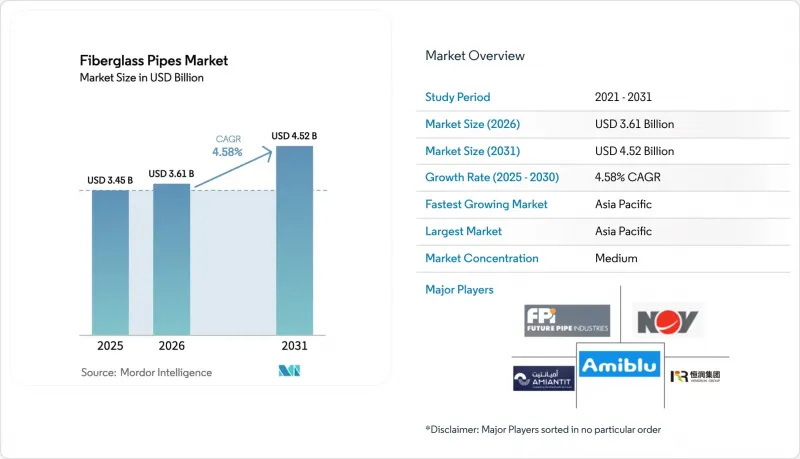
根據 Mordor Intelligence 預測,玻璃纖維管道市場規模將從 2025 年的 34.5 億美元成長到 2026 年的 36.1 億美元,然後在 2031 年達到 45.2 億美元,2026 年至 2031 年的複合年成長率為 4.58%。
本報告按類型(玻璃纖維增強塑膠 (GRP) 管、玻璃纖維增強環氧樹脂 (GRE) 管及其他)、終端用戶產業(石油天然氣、化學、廢水處理等)和地區(亞太地區、北美地區、歐洲地區、南美地區以及中東和非洲地區)進行細分。市場預測以美元 (USD) 為單位。
全球玻璃鋼管市場趨勢與洞察
石油和天然氣管道鋪設量增加
國營石油公司正在擴大非金屬管道的應用範圍,以減少酸性環境下的停機時間和陰極防蝕成本。沙烏地阿美「主天然氣系統」三期工程新增了4000公里複合材料輸氣管道,這是全球單一國家採用玻璃纖維標準的最大規模項目。科羅拉多監管機構強制要求新建天然氣收集管線使用符合API 15S標準的管道,加速了傳統鋼製管道的替換。 Strom公司為沙烏地阿美法迪利天然氣擴建計畫訂單了33公里熱塑性複合材料管道,凸顯了陸上和海上油田材料應用的融合趨勢。 API和CSA標準提供了一個協調一致的框架,降低了營運商認證過程中的風險,並加速了大規模應用。隨著新井中硫化氫和二氧化碳濃度的增加,抗疲勞玻璃鋼管在玻璃鋼管市場中的佔有率正在逐步擴大。
用水和污水基礎設施更新
法院判決和城市擴張正在加速市政管網中複合材料的應用。根據美國環保署 (EPA) 的命令,聖安東尼奧水務局將於 2024 年投資 2,650 萬美元鋪設 6 英里長的玻璃鋼管道,這標誌著市政管網從粘土和混凝土管道轉向耐腐蝕系統。印度的 CPHEEO 手冊規定使用 DN 200-3000 範圍內的玻璃鋼管道,實際上已將玻璃鋼管道納入所有州政府資助的水競標中。中國忠縣、臨海和廣州的非開挖頂管工程表明,玻璃鋼管道能夠最大限度地減少人口密集都市區對地面的影響。這些項目透過將監管合規期限與快速鋪設指標掛鉤,擴大了玻璃鋼管道的市場,而輕質複合材料在這方面表現出色。
原料(樹脂和玻璃)價格波動
環氧樹脂和聚酯樹脂的價格與原油衍生原料價格密切相關,供應衝擊可能在一個季度內逆轉成本通貨緊縮趨勢。由於玻璃纖維製造爐消耗大量天然氣,歐洲生產商極易受到TTF價格波動的影響,而TTF價格在2025年初的波動幅度超過40%。特種環氧樹脂的價格比通用聚酯樹脂高出25%至35%,這限制了其在預算緊張的水利工程中的應用。東南亞的小規模加工商缺乏對沖手段,外匯波動加劇了成本的不確定性,擠壓了利潤空間。持續的波動促使EPC承包商在合約中加入價格調整條款,略微延長了玻璃纖維管道專案的競標週期。
細分市場分析
預計到2025年,玻璃鋼(GRP)管道將佔據玻璃纖維管道市場48.79%的佔有率,這反映了其在用水和污水和污水處理、灌溉以及低壓輸油管領域的成本優勢。儘管玻璃鋼(GRE)管道的絕對出貨量較低,但由於海上平台和化工廠對更高耐熱性和耐壓性的需求,其市場規模預計到2031年將以4.82%的複合年成長率成長。由於環氧樹脂基體在多軸應力和循環負荷下具有優異的抗疲勞性能,操作員願意為玻璃鋼管道支付25%至35%的溢價。 HOBAS公司於2024年將產能擴大了50%,並在美國推出了第二條生產線。該生產線生產的管道直徑範圍為12至118英寸,設計壽命保證為150年。這項優勢有助於緩解用水和污水競標中關於生命週期成本的爭議。西非和墨西哥灣的深海油田指定使用特定等級的環氧樹脂來避免氫致起泡,這推動了玻璃鋼管市場對 GRE 的需求。
這種新型混合結構將碳纖維耐壓鎧裝層與熱塑性樹脂內襯結合,能夠承受超過3000公尺超深海環境中的拉伸負荷。儘管目前仍屬於小眾領域,但這些設計展現了材料創新的進步,複合材料在氫環境中易脆化的金屬管道方面依然保持著優於金屬管道的優勢。 API 15S和ISO 14692標準的修訂提高了複合材料接頭的設計係數,縮小了不確定性範圍,並收緊了壁厚公差。連續纏繞製程降低了每米樹脂用量,縮短了固化週期,使製造商能夠在不影響利潤率的情況下,將效率提升的優勢傳遞給買家。因此,玻璃纖維(GRE)和混合材料的產量成長速度超過了玻璃纖維(GRP),重塑了玻璃纖維管道市場的產品組合模式。
區域分析
預計到2025年,亞太地區將佔據全球44.42%的銷售佔有率,並在2031年之前保持4.65%的複合年成長率,這主要得益於中國、印度和沙烏地阿拉伯流體輸送網路的現代化改造。在中國,非開挖頂管工程採用DN 250-2000規格的玻璃纖維管道,以最大限度地減少對城市的影響;同時,一家浙江製造商正在供應使用壽命長達50年的泵站,以提高可靠性。印度的CPHEEO指南規定了所有中央資助的供水事業必須使用玻璃鋼管道,從而提高了管道競標的統一性。在沙烏地阿拉伯,與Group Five Pipe簽訂的價值8億美元的合約以及Strohm公司交付的複合材料輸油管線,將玻璃鋼應用於海水淡化和碳氫化合物系統中。這些同步進行的資本投資項目正在鞏固亞太地區作為玻璃鋼管道市場成長引擎的地位。
在北美,與API和CSA標準相關的法規日益嚴格。基於聖安東尼奧同意裁決和科羅拉多強制性輸油管線要求的項目表明,遵守法規能夠帶來即時的訂單。美國能源局的「氫氣噴射」試點計畫正在測試用於輸送氫氣和二氧化碳的雙層壁FRP管道,凸顯了其作為分散式能源網路複合材料標準選擇的潛力。 HOBAS在美國的新生產線和Amiblu在西班牙的生產能力正在集中為北美競標提供更多供應,縮短前置作業時間並減少進口。這些努力共同推動該地區以4.2%的複合年成長率穩定成長,使其成為繼亞太地區之後玻璃纖維管道市場成長速度第二快的地區。
歐洲正著力提升水資源韌性並推動脫碳進程。歐洲投資銀行(EIB)已向蘇伊士集團的專案提供5億歐元貸款,該專案旨在探索在歷史悠久的市中心引入免開挖玻璃鋼(GRP)管道。英國已撥款80億英鎊,用於2025年至2030年間的水庫、輸水和海水淡化項目,這將催生對額定壓力為32巴的DN 3000管道的新需求。 Amibl公司位於塔拉戈納的工廠透過現場太陽能發電,已將其二氧化碳排放量減少了72%,並嚴格遵守優先使用低碳材料的採購規則。
雖然南美洲、中東和非洲在絕對支出方面落後於其他地區,但援助機構和國有石油公司資助複合材料基礎設施的地區正在經歷強勁成長,這為玻璃纖維管道市場創造了進一步的成長空間。
其他好處:
- Excel格式的市場預測(ME)表
- 3個月的分析師支持
目錄
第1章:引言
- 研究假設和市場定義
- 調查範圍
第2章:調查方法
第3章執行摘要
第4章 市場狀況
- 市場概覽
- 市場促進因素
- 石油和天然氣管道鋪設量增加
- 用水和污水基礎設施更新項目
- 化學加工產業的需求不斷成長
- 大型海水淡化工程激增。
- 氫氣運輸及碳捕集、利用與封存試點網路,以滿足玻璃鋼管的需求
- 市場限制因素
- 原料(樹脂和玻璃)價格波動
- 可回收性低且面臨監管風險
- 合格複合管道安裝人員短缺
- 價值鏈分析
- 波特五力模型
第5章 市場規模與成長預測
- 按類型
- 玻璃纖維增強塑膠(GRP)管
- 玻璃纖維增強環氧樹脂(GRE)管道
- 其他類型(混合型、碳纖維增強複合材料襯裡等)
- 按最終用戶行業分類
- 石油和天然氣
- 化學品
- 污水
- 農業
- 其他終端用戶產業(採礦、航運、紙漿和造紙等)
- 按地區
- 亞太地區
- 中國
- 印度
- 日本
- 韓國
- 東南亞國協
- 其他亞太國家
- 北美洲
- 美國
- 加拿大
- 墨西哥
- 歐洲
- 德國
- 英國
- 義大利
- 法國
- 西班牙
- 北歐國家
- 其他歐洲國家
- 南美洲
- 巴西
- 阿根廷
- 其他南美國家
- 中東和非洲
- 沙烏地阿拉伯
- 南非
- 其他中東和非洲國家
- 亞太地區
第6章 競爭情勢
- 市場集中度
- 策略趨勢
- 市佔率和排名分析
- 公司簡介
- Abu Dhabi Pipe Factory(ADPF)
- Amiantit Company
- Amiblu Holding GmbH
- Chemical Process Piping Pvt. Ltd.(CPP)
- Farassan
- Fibrex
- Future Pipe Industries
- Graphite India Limited
- Gruppo Sarplast Srl
- Hengrun Group Co., Ltd.
- HOBAS Pipe USA Inc.
- Lianyungang Zhongfu Lianzhong Composites Group Co., Ltd.
- NOV
- Western Fiberglass
第7章 市場機會與未來展望
According to Mordor Intelligence, the fiberglass pipes market size is expected to grow from USD 3.45 billion in 2025 to USD 3.61 billion in 2026 and is forecast to reach USD 4.52 billion by 2031 at a 4.58% CAGR over 2026-2031.
This report is Segmented by Type (Glass Fiber Reinforced Plastic (GRP) Pipes, Glass Reinforced Epoxy (GRE) Pipes, and Other Types), End-User Industry (Oil and Gas, Chemicals, Sewage, and More), and Geography (Asia-Pacific, North America, Europe, South America, and Middle-East and Africa). The Market Forecasts are Provided in Terms of Value (USD).
Global Fiberglass Pipes Market Trends and Insights
Increasing Installation of Oil and Gas Pipelines
National oil companies are scaling non-metallic pipe programs to cut sour-service downtime and cathodic-protection spend. Saudi Aramco's Master Gas System phase three adds 4,000 kilometers of composite flowlines, marking the world's largest single-country adoption of fiberglass standards. Colorado regulators require API 15S-compliant pipes on new gathering lines, triggering replacement of legacy steel assets. Strohm's 33-kilometer thermoplastic composite pipe order for Aramco's Fadhili gas expansion underscores material convergence across onshore and offshore fields. API and CSA codes provide the harmonized framework that de-risks operator qualification cycles and accelerates volume uptake. As new wells trend toward higher H2S and CO2 levels, fatigue-resistant GRE grades capture incremental share within the fiberglass pipes market.
Water- and Wastewater-Infrastructure Replacement Programs
Consent decrees and urban expansion fast-track composite adoption in municipal networks. San Antonio Water System awarded USD 26.5 million in 2024 to install six miles of fiberglass pipe under an Environmental Protection Agency order, signaling a shift from clay and concrete toward corrosion-immune systems. India's CPHEEO Manual codifies GRP across DN 200-3000 ranges, effectively embedding fiberglass in every state-funded water tender. China's trenchless jacking projects in Zhongxian, Linhai, and Guangzhou illustrate how GRP minimizes surface disruption in dense urban corridors. These programs expand the fiberglass pipes market by tying compliance deadlines to rapid installation metrics, a combination where light-weight composites excel.
Raw-material (resin and glass) Price Volatility
Epoxy and polyester resin prices track crude-derived feedstocks, and supply shocks can reverse cost deflation within a single quarter. Glass-fiber furnaces consume large volumes of natural gas, exposing European producers to TTF price swings that topped 40% volatility in early 2025. Specialty epoxy grades command 25-35% premiums over commodity polyester, curbing uptake in budget-constrained water projects. Smaller Southeast Asian fabricators lack hedging tools, so currency fluctuations amplify landed-cost uncertainty and squeeze margins. Persistent volatility leads EPC contractors to include price-adjustment clauses, slightly elongating bid cycles for fiberglass pipes market projects.
Other drivers and restraints analyzed in the detailed report include:
- Rising Demand in Chemical Processing Industry
- Surge in Large-Diameter Desalination Projects
- Limited Recyclability and Looming Regulation Risk
For complete list of drivers and restraints, kindly check the Table Of Contents.
Segment Analysis
GRP commanded 48.79% fiberglass pipes market share in 2025, reflecting its cost leadership in municipal, irrigation, and low-pressure oil gathering lines. GRE pipes, though smaller in absolute shipments, are advancing at a 4.82% CAGR through 2031 as offshore platforms and chemical plants require higher temperature and pressure ratings. Operators accept GRE's 25-35% price premium because epoxy matrices offer fatigue resistance under multi-axial stress and cyclic loading. HOBAS scaled capacity by 50% in 2024, launching a second U.S. line that produces 12- to 118-inch diameters with 150-year design-life warranties, an advantage that mitigates life-cycle cost discussions during municipal tenders. Deepwater fields in West Africa and the Gulf of Mexico specify epoxy grades to avoid hydrogen-induced blistering, thus lifting demand for GRE within the fiberglass pipes market.
New hybrid architectures combine carbon-fiber pressure armor with thermoplastic liners to handle ultra-deepwater tension loads that exceed 3,000 meters. Although still niche, these designs demonstrate the material innovation curve that keeps composites ahead of metallic counterparts suffering embrittlement in hydrogen service. API 15S and ISO 14692 revisions incorporate higher design factors for composite joints, reducing uncertainty allowances and trimming wall-thickness budgets. Continuous winding processes lower per-meter resin utilization and shorten cure cycles, allowing fabricators to pass efficiency gains to buyers without eroding margins. Consequently, volume growth in GRE and hybrids outpaces GRP, reshaping the product-mix outlook inside the fiberglass pipes market.
Complete Report Scope:
- By Type
- Glass Fiber Reinforced Plastic (GRP) Pipes
- Glass Reinforced Epoxy (GRE) Pipes
- Other Types (Hybrid, CFRP-liner, etc.)
- By End-user Industry
- Oil and Gas
- Chemicals
- Sewage
- Agriculture
- Other End-user Industry (Mining, Marine, Pulp and Paper, etc.)
- By Geography
- Asia-Pacific
- China
- India
- Japan
- South Korea
- ASEAN Countries
- Rest of Asia-Pacific
- North America
- United States
- Canada
- Mexico
- Europe
- Germany
- United Kingdom
- Italy
- France
- Spain
- NORDIC Countries
- Rest of Europe
- South America
- Brazil
- Argentina
- Rest of South America
- Middle East and Africa
- Saudi Arabia
- South Africa
- Rest of Middle-East and Africa
- Asia-Pacific
Geography Analysis
Asia-Pacific owns 44.42% revenue share in 2025 and is forecast to maintain a 4.65% CAGR through 2031 as China, India, and Saudi Arabia modernize fluid-transfer grids. China's trenchless jacking projects adopt DN 250-2000 GRP pipes to minimize urban disruption, while Zhejiang-based fabricators supply 50-year-rated pump stations that reinforce reliability narratives. India's CPHEEO guidelines anchor GRP specifications in every centrally funded water program, reinforcing pipeline bid uniformity. Saudi Arabia's USD 800 million Group Five Pipe contract and Strohm's composite flowline delivery integrate fiberglass across desalination and hydrocarbon systems. These concurrent capital programs cement Asia-Pacific as the growth engine for the fiberglass pipes market.
North America rides regulatory upgrades tied to API and CSA standards. San Antonio's consent-decree project and Colorado's flowline mandates demonstrate how legal compliance converts to immediate purchase orders. The U.S. Department of Energy's Hydrogen Shot pilots double-wall FRP pipes that blend hydrogen and CO2 transport, spotlighting composites as the default for distributed energy grids. HOBAS's new U.S. line and Amiblu's capacity in Spain funnel extra supply toward North American tenders, shortening lead times and edging out imports. Collectively these initiatives equip the region with a stable 4.2% CAGR, second only to Asia-Pacific in the fiberglass pipes market.
Europe focuses on water resilience and decarbonization. EIB financed EUR 500 million for SUEZ projects that evaluate trenchless GRP in historic urban centers. The United Kingdom earmarked GBP 8 billion for reservoirs, transfers, and desalination between 2025-2030, opening new demand for DN 3000 pipes rated at 32 bar. Amiblu's Tarragona plant achieves 72% CO2 reduction through onsite solar, aligning with procurement rules that favor low-embodied-carbon materials.
South America and Middle East and Africa trail in absolute spending but display pockets of high growth where donor agencies and national oil companies underwrite composite infrastructure, providing optional upside to the fiberglass pipes market.
- Abu Dhabi Pipe Factory (ADPF)
- Amiantit Company
- Amiblu Holding GmbH
- Chemical Process Piping Pvt. Ltd. (CPP)
- Farassan
- Fibrex
- Future Pipe Industries
- Graphite India Limited
- Gruppo Sarplast S.r.l.
- Hengrun Group Co., Ltd.
- HOBAS Pipe USA Inc.
- Lianyungang Zhongfu Lianzhong Composites Group Co., Ltd.
- NOV
- Western Fiberglass
Additional Benefits:
- The market estimate (ME) sheet in Excel format
- 3 months of analyst support
TABLE OF CONTENTS
1 Introduction
- 1.1 Study Assumptions and Market Definition
- 1.2 Scope of the Study
2 Research Methodology
3 Executive Summary
4 Market Landscape
- 4.1 Market Overview
- 4.2 Market Drivers
- 4.2.1 Increasing installation of oil and gas pipelines
- 4.2.2 Water- and wastewater-infrastructure replacement programs
- 4.2.3 Rising demand in chemical processing industry
- 4.2.4 Surge in large-diameter desalination projects
- 4.2.5 Hydrogen-transport and CCUS pilot networks supporting fiberglass pipes demand
- 4.3 Market Restraints
- 4.3.1 Raw-material (resin and glass) price volatility
- 4.3.2 Limited recyclability and looming regulation risk
- 4.3.3 Shortage of certified composite-pipe installers
- 4.4 Value Chain Analysis
- 4.5 Porter's Five Forces
- 4.5.1 Bargaining Power of Suppliers
- 4.5.2 Bargaining Power of Buyers
- 4.5.3 Threat of New Entrants
- 4.5.4 Threat of Substitutes
- 4.5.5 Degree of Competition
5 Market Size and Growth Forecasts (Value)
- 5.1 By Type
- 5.1.1 Glass Fiber Reinforced Plastic (GRP) Pipes
- 5.1.2 Glass Reinforced Epoxy (GRE) Pipes
- 5.1.3 Other Types (Hybrid, CFRP-liner, etc.)
- 5.2 By End-user Industry
- 5.2.1 Oil and Gas
- 5.2.2 Chemicals
- 5.2.3 Sewage
- 5.2.4 Agriculture
- 5.2.5 Other End-user Industry (Mining, Marine, Pulp and Paper, etc.)
- 5.3 By Geography
- 5.3.1 Asia-Pacific
- 5.3.1.1 China
- 5.3.1.2 India
- 5.3.1.3 Japan
- 5.3.1.4 South Korea
- 5.3.1.5 ASEAN Countries
- 5.3.1.6 Rest of Asia-Pacific
- 5.3.2 North America
- 5.3.2.1 United States
- 5.3.2.2 Canada
- 5.3.2.3 Mexico
- 5.3.3 Europe
- 5.3.3.1 Germany
- 5.3.3.2 United Kingdom
- 5.3.3.3 Italy
- 5.3.3.4 France
- 5.3.3.5 Spain
- 5.3.3.6 NORDIC Countries
- 5.3.3.7 Rest of Europe
- 5.3.4 South America
- 5.3.4.1 Brazil
- 5.3.4.2 Argentina
- 5.3.4.3 Rest of South America
- 5.3.5 Middle East and Africa
- 5.3.5.1 Saudi Arabia
- 5.3.5.2 South Africa
- 5.3.5.3 Rest of Middle-East and Africa
- 5.3.1 Asia-Pacific
6 Competitive Landscape
- 6.1 Market Concentration
- 6.2 Strategic Moves
- 6.3 Market Share (%)/Ranking Analysis
- 6.4 Company Profiles {(includes Global-level Overview, Market-level overview, Core Segments, Financials as available, Strategic Information, Market Rank/Share, Products and Services, Recent Developments)}
- 6.4.1 Abu Dhabi Pipe Factory (ADPF)
- 6.4.2 Amiantit Company
- 6.4.3 Amiblu Holding GmbH
- 6.4.4 Chemical Process Piping Pvt. Ltd. (CPP)
- 6.4.5 Farassan
- 6.4.6 Fibrex
- 6.4.7 Future Pipe Industries
- 6.4.8 Graphite India Limited
- 6.4.9 Gruppo Sarplast S.r.l.
- 6.4.10 Hengrun Group Co., Ltd.
- 6.4.11 HOBAS Pipe USA Inc.
- 6.4.12 Lianyungang Zhongfu Lianzhong Composites Group Co., Ltd.
- 6.4.13 NOV
- 6.4.14 Western Fiberglass
7 Market Opportunities and Future Outlook
- 7.1 White-space and Unmet-Need Assessment
- 7.2 Innovations on Smart-sensor embedded pipes enable predictive maintenance

 全球玻璃鋼管市場
 玻璃纖維管市場規模、佔有率、趨勢和預測:按產品類型、纖維類型、製造流程、材料、最終用戶和地區分類,2026-2034年
 玻璃鋼管市場:依產品類型、壓力等級、應用及終端用戶產業分類-2026-2032年全球市場預測
 全球玻璃纖維管道市場規模、佔有率、趨勢和成長分析報告(2026-2034年)
 2026年全球玻璃纖維管道市場報告
 玻璃鋼管市場-全球產業規模、佔有率、趨勢、機會、預測:按類型、纖維類型、應用、地區和競爭格局分類,2021-2031年
 玻璃鋼管市場規模、佔有率及成長分析(按纖維類型、產品類型、應用和地區分類)-產業預測(2026-2033 年)
 玻璃鋼管道市場規模、佔有率和成長分析:按產品類型、纖維類型、製造流程、材料、最終用戶、地區分類 - 產業預測 2026-2033
 玻璃鋼管道市場機會、成長促進因素、產業趨勢分析及預測(2025-2034年)
 2030 年玻璃纖維管道市場預測:按產品類型、直徑、製造流程、銷售管道、應用、最終用戶和地區進行的全球分析