


 |
市場調查報告書
商品編碼
2114875
證券債券:市場佔有率分析、產業趨勢與統計、成長預測(2026-2031)Security Paper - Market Share Analysis, Industry Trends & Statistics, Growth Forecasts (2026 - 2031) |
||||||

※ 本網頁內容可能與最新版本有所差異。詳細情況請與我們聯繫。
根據 Mordor Intelligence 預測,安全紙市場規模將從 2025 年的 66 億美元成長到 2026 年的 69.2 億美元,然後在 2031 年達到 87.3 億美元,2026 年至 2031 年的複合年成長率為 4.78%。
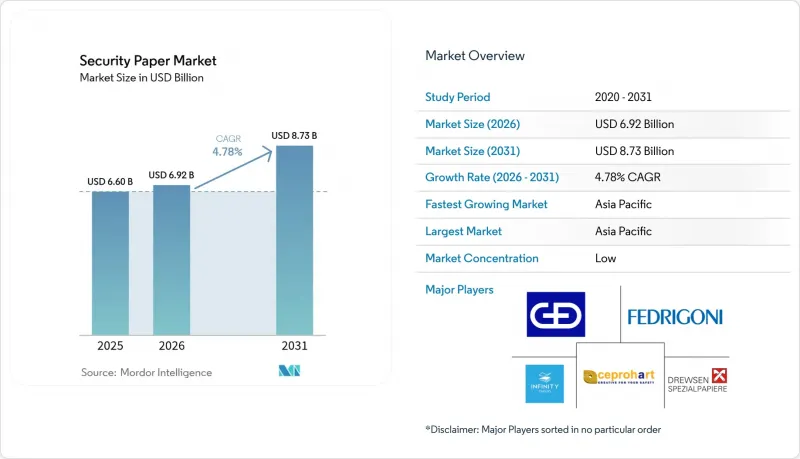
本報告按應用領域(貨幣/鈔票、支付卡/支票、其他)、基材類型(棉纖維紙、聚合物基材、其他)、安全功能整合(水印、安全線、其他)、最終用戶(中央銀行/造幣廠、政府文件機構、安全印刷服務商、其他)和地區進行細分。市場預測以美元計價。
全球安全紙市場趨勢及洞察
詐騙和偽造案件增多
詐騙的加劇是安全紙市場結構性成長的重要支柱。 2025年印度查獲的一張近乎完美的500印度盧比(約合5.58美元)假鈔案例表明,即使是細微的拼寫錯誤如今也成為為數不多的視覺識別線索之一。美國國防安全保障部警告稱,生成式人工智慧將進一步提升偽造文件的技術,迫使發卡機構採用結合觸覺、光學和數位元素的多層基材。為此,世界各國央行正縮短其設計更新周期,導致安全紙市場處於持續升級階段。在亞太地區,聚合物材料測試表明,引入透明窗口和精細穿孔後,假鈔識別率提高了兩位數,這增強了人們對基材升級的信心。對於製造商而言,這種「軍備競賽」導致了研發支出的持續成長,並形成了一個高階價格區間,即使通用纖維的價格因通貨膨脹而飆升,也能保護利潤率。
擴大證件管理項目範圍,加強安全措施(電子護照、身分證)
世界各國政府正在對其身分基礎設施進行現代化改造,將實體身分證件與數位認證系統融合。凸版印刷於2024年收購了HID Citizen Identity Solutions,將傳統安全印刷與生物識別註冊平台結合,為政府機構提供了統一的採購途徑。超過6000項與基於區塊鏈的身份解決方案相關的專利申請表明,業界致力於建立以用戶為中心、保護隱私的身份架構。菲律賓的馬尼拉麻纖維增強聚合物護照等國家級項目,體現了將本地纖維融入世界一流基材的在地化策略。因此,市場需求正轉向能夠存儲加密晶片並顯示可見浮水印的混合紙張,從而鞏固了安全紙張市場多元化的收入來源。
對適用「犯罪稅」的物品強制徵收印花稅
世界各國政府都在加強對菸草、酒精和其他高稅商品的消費稅管控,美國《美國法典》第26篇明確規定了郵票標準,只有使用特殊的安全紙張才能滿足這些標準。同樣,歐盟指令也強制要求使用全像或紫外線標記的郵票,這為安全印刷商創造了一個雖小但永續的訂單。這些指令有雙重目的:既能保障稅收,又能遏止非法貿易,即使在整體印刷市場萎縮的情況下,也能維持郵票需求的強勁成長。能夠將可見全像圖與不可見的RFID晶片結合的供應商將獲得競爭優勢,而安全紙張市場也將在藥品和飲料的追蹤溯源解決方案領域找到新的成長機會。
細分市場分析
預計到2025年,紙幣和鈔票在安全紙市場仍將佔據主導地位,市佔率高達47.78%。這主要得益於日本推出的3D全像鈔票以及亞太地區頻繁的鈔票設計更新。儘管數位錢包的使用日益普及,但現金對於沒有銀行帳戶的人來說仍然至關重要,這為安全紙的需求提供了堅實的基礎。支票和支付卡正逐漸成為安全紙的輔助用途,尤其是在銀行利率不斷上升的地區。身分證明和旅行證件的市佔率正在不斷擴大,這主要得益於歐洲和北美電子護照簽發週期的加速。目前市佔率處於個位數的中等水平,但隨著藥品序列化相關法規的不斷擴展,預計到2031年,安全包裝和標籤的複合年成長率將達到8.22%。這一趨勢表明,安全紙市場正逐步調整其結構,不再僅依賴紙幣。
細分市場的組成也反映了風險管理策略。中央銀行傾向使用聚合物材料製作高面額鈔票,而低面額鈔票則仍指定使用棉布,分散採購風險。相較之下,包裝製造商則更傾向於使用兼顧安全性和永續性的合成纖維和再生纖維。票券和證書等應用在學術和活動領域保持著一定的市場需求,構成了一個長期穩定的收入來源。綜上所述,這些趨勢凸顯了為何對於安全紙張市場的企業而言,應用多元化是因應現金需求結構性下降的最佳策略。
預計到2025年,棉纖維紙將佔據安全紙市場佔有率的56.10%。這一地位建立在數百年累積的製造生態系統和用戶熟悉的舒適感之上。然而,德克薩斯州的一系列乾旱以及印度產量下降10%導致進口量翻倍、原料成本上漲,並暴露了供應方面的脆弱性。如今,聚合物基材料在耐用性和使用成本方面展現出明顯的優勢,促使利比亞、羅馬尼亞和菲律賓的中央銀行將主要面額的鈔票逐步過渡到聚合物基材料。混合型鈔票結合了棉質手感和聚合物薄膜的強度,既能減輕現金使用者的心理抵觸情緒,又能實現設備的逐步更換。
在監管機構和企業永續發展負責人要求評估其環境績效的壓力下,採用再生纖維的產品以9.05%的複合年成長率成為該細分市場中成長最快的產品。蕉麻和亞麻布具有地域性優勢,可望實現供應鏈本地化,並減少發行方的運輸排放。未來,生命週期評估很可能成為影響基材選擇以及防偽性能的因素,進而提升安全紙產業內部纖維研發的策略價值。
區域分析
預計到2025年,亞太地區將佔全球銷售額的32.10%,該地區安全紙市場預計將以6.74%的複合年成長率成長,這主要得益於聚合物的日益普及和國家身份證項目的擴展。日本於2024年7月推出的新版鈔票證明了3D全像肖像的商業性可行性,並有望成為鄰國更新鈔票設計的新標竿。菲律賓將於2025年1月推出首批聚合物鈔票,為其貨幣現代化計畫奠定基礎。在印度,假幣氾濫和棉花供應短缺的雙重威脅促使人們對混合基材產生興趣,以減少對進口棉花的依賴。
北美和歐洲的貨幣市場已趨於成熟,但由於發行機構要求採用符合ISO和國際民航組織護照規定的多層安全措施,平均售價仍居高不下。歐洲央行考慮發行數位歐元帶來了戰略上的不確定性,但羅馬尼亞在2024年發行的聚合物紀念鈔表明,在可預見的未來,歐元區市場仍將繼續專注於使用高度安全的現金。
中東和非洲蘊藏著巨大的成長潛力。利比亞計劃於2025年全面採用聚合物材料,這將成為鄰國的領先指標。海灣國家(例如阿拉伯聯合大公國)的發行機構正在採用耐用的聚合物基材以應對惡劣的氣候條件。在以巴西和阿根廷為首的南美洲,預計稅票的更新將成為優先事項,以遏制非法酒精分銷,這將為安全紙張市場帶來新的收入來源——消費稅申請。
其他福利
- Excel格式的市場預測(ME)表
- 3個月的分析師支持
目錄
第1章:引言
- 研究假設和市場定義
- 調查範圍
第2章:調查方法
第3章執行摘要
第4章 市場狀況
- 市場概覽
- 市場促進因素
- 詐騙和偽造案件增多
- 擴大證件管理項目範圍,加強安全措施(電子護照、身分證)
- 向聚合物雜化基材過渡
- 對適用「犯罪稅」的物品強制徵收印花稅
- 推出整合RFID和NFC技術的「智慧紙」。
- 貴重產品的防篡改包裝
- 市場限制因素
- 數位支付的替代方案
- 高級安全功能高成本
- 棉纖維採購永續性的壓力
- 氣候變遷導致光纖供應中斷
- 供應鏈分析
- 監理情勢
- 技術展望
- 波特五力分析
第5章 市場規模與成長預測
- 透過使用
- 貨幣/紙幣
- 支付卡和支票
- 身分證件和旅行證件
- 證書/票據簽發
- 安全包裝和標籤
- 其他
- 依基材類型
- 棉纖維紙
- 聚合物基材
- 棉/聚合物混紡
- 合成纖維(蕉麻、亞麻)
- 再生纖維紙
- 按類型分類的安全功能整合
- 水印
- 安全線
- 全像眼動追蹤
- 紫外線/紅外線纖維染料
- 嵌入式RFID和NFC
- 微印刷和奈米紡織
- 變色墨水
- 最終用戶
- 中央銀行和造幣廠
- 政府檔案機構
- 安全列印服務提供者
- 商業銀行
- 品牌保護包裝相關企業
- 按地區
- 北美洲
- 美國
- 加拿大
- 墨西哥
- 歐洲
- 德國
- 英國
- 法國
- 義大利
- 俄羅斯
- 其他歐洲國家
- 亞太地區
- 中國
- 印度
- 日本
- 韓國
- 其他亞太國家
- 中東和非洲
- 中東
- 沙烏地阿拉伯
- 阿拉伯聯合大公國
- 土耳其
- 其他中東國家
- 非洲
- 南非
- 奈及利亞
- 其他非洲地區
- 中東
- 南美洲
- 巴西
- 阿根廷
- 南美洲其他地區
- 北美洲
第6章 競爭情勢
- 市場集中度
- 策略趨勢
- 市佔率分析
- 公司簡介
- Giesecke+Devrient Currency Technology GmbH
- De La Rue plc
- Fedrigoni Group
- Crane Currency
- Oberthur Fiduciaire SAS
- Papierfabrik Louisenthal GmbH
- Drewsen Spezialpapiere GmbH & Co. KG
- Domtar Corporation
- Thomas Greg & Sons Ltd
- Infinity Security Papers Ltd
- Simpson Security Papers
- Ceprohart SA
- CIoTola SRL
- A1 Security Print Ltd
- HUECK FOLIEN GmbH
- 巴基斯坦安全紙張有限公司
- Portals Paper Ltd
- Sequana(Arjowiggins Security assets)
- Security Fibres Ltd
- Euro-Banknote Production GmbH
第7章 市場機會與未來展望
According to Mordor Intelligence, the security paper market size is expected to grow from USD 6.60 billion in 2025 to USD 6.92 billion in 2026 and is forecast to reach USD 8.73 billion by 2031 at 4.78% CAGR over 2026-2031.
This report is Segmented by Application (Currency / Banknotes, Payment Cards and Cheques, and More), Substrate Type (Cotton-Fibre Paper, Polymer Substrate, and More), Security Feature Integration (Watermarks, Security Threads, and More), End User (Central Banks and Mints, Government Document Agencies, Secure Printing Houses, and More), by Geography. The Market Forecasts are Provided in Terms of Value (USD).
Global Security Paper Market Trends and Insights
Rising Fraud and Counterfeiting Incidents
Escalating fraud has become a structural growth pillar for the security paper market. India's 2025 seizure of near-perfect counterfeit INR 500(USD 5.58) notes illustrates how spelling micro-errors are now among the few visible detection clues. The U.S. Department of Homeland Security warns that generative AI will heighten document forgery sophistication, forcing issuers to adopt multi-layer substrates that combine tactile, optical and digital elements. Central banks respond by shortening redesign cycles, which keeps the security paper market in a perpetual upgrade mode. Across Asia-Pacific, polymer trials show counterfeit rejection rates improving by double digits once transparent windows and micro-perforations are introduced, reinforcing confidence in substrate migration. For producers, the arms race translates into steady R&D spend and a premium pricing corridor that buffers margins even when commodity fibres face inflationary spikes.
Expansion of Secure-Document Programmes
Governments are modernising identity infrastructures, intertwining physical credentials with digital verification rails. TOPPAN's 2024 acquisition of HID Citizen Identity Solutions fused traditional security printing with biometric enrolment platforms, offering agencies a single procurement lane. Patent filings exceed 6,000 for blockchain-anchored identity solutions, signalling industry commitment to privacy-preserving, user-centric ID architectures. National projects such as the Philippines' abaca-infused polymer passports demonstrate localisation strategies that embed regional fibres into global-grade substrates. Demand therefore tilts toward hybrid papers that can store encrypted chips while still displaying visible watermarks, cementing a multi-dimensional revenue stream for the security paper market.
Excise-Stamp Mandates for Sin-Tax Goods
Governments are tightening excise controls on tobacco, alcohol and other high-levy items, with U.S. Code Title 26 prescribing explicit stamp standards that only specialised security papers can meet. European Union directives similarly require holographic or UV-tagged stamps, generating niche but recurring orders for security printers. Mandates serve dual objectives-securing tax receipts and curbing illicit trade-which together ensure that stamp volumes remain resilient even when broader print markets decline. Suppliers that can blend overt holograms with covert RFID chips gain competitive advantage, positioning the security paper market for adjacent growth in track-and-trace solutions for pharmaceuticals and beverages.
Other drivers and restraints analyzed in the detailed report include:
- Polymer and Hybrid Substrate Migration
- Digital-Payment Substitution
- High Cost of Advanced Security Features
For complete list of drivers and restraints, kindly check the Table Of Contents.
Segment Analysis
Currency and banknotes retained a commanding 47.78% slice of the security paper market in 2025, underpinned by Japan's roll-out of 3D-hologram notes and frequent redesigns across Asia-Pacific. Despite an uptick in digital wallets, cash remains crucial for unbanked populations, giving the security paper market resilient base volumes. Cheques and payment cards hang on as secondary use cases, especially in regions where bank penetration is climbing. Identity and travel documents occupy a growing middle ground because e-passport issuance cycles are accelerating in Europe and North America. Secure packaging and labels, although only a mid-single-digit share today, are projected to rise at an 8.22% CAGR to 2031 as pharmaceutical serialisation laws widen coverage. That trajectory signals a gradual re-balancing of the security paper market away from pure currency dependency.
The segment mix also reflects risk-management strategies. Central banks favour polymer for high-denomination notes yet still specify cotton for lower tiers, spreading sourcing risk. Packaging converters, by contrast, gravitate towards synthetic and recycled fibres that pair security with sustainability. Ticketing and certificate applications retain niche demand in academic and events sectors, providing long-tail revenue. Collectively, these dynamics underline why application diversification is the foremost hedge against structural cash decline for companies active in the security paper market.
Cotton-fibre sheets secured 56.10% of the security paper market share in 2025, a position earned through centuries-old manufacturing ecosystems and user familiarity. Yet consecutive droughts in Texas and a 10% output dip in India forced imports to double, inflating input costs and exposing supply vulnerability. Polymer substrates now enjoy clear durability and cost-in-use advantages, encouraging central banks in Libya, Romania and the Philippines to transition core denominations. Hybrid papers marry cotton's tactile feel with polymer film strength, easing psychological barriers among cash users and enabling gradual equipment retrofits.
Recycled-fibre variants register a 9.05% CAGR, the fastest pace in the segment, driven by environmental scorecard pressures from both regulators and corporate sustainability officers. Abaca and linen offer region-specific opportunities, giving issuers a chance to localise supply and cut transport emissions. Looking ahead, lifecycle assessments will dictate substrate selection as much as counterfeit resistance, elevating the strategic value of in-house fibre R&D within the security paper industry.
Complete Report Scope:
- By Application
- Currency / Banknotes
- Payment Cards and Cheques
- ID and Travel Documents
- Certificates and Ticketing
- Secure Packaging and Labels
- Other Application
- By Substrate Type
- Cotton-fibre Paper
- Polymer Substrate
- Hybrid Cotton-Polymer
- Synthetic Fibres (Abaca, Linen)
- Recycled-fibre Paper
- By Security Feature Integration
- Watermarks
- Security Threads
- Holograms and OVD
- UV/IR Fibres and Dyes
- RFID/NFC Embedded
- Micro-printing and Nanotext
- Colour-shifting Inks
- By End User
- Central Banks and Mints
- Government Document Agencies
- Secure Printing Houses
- Commercial Banks
- Brand-Protection and Packaging Firms
- By Geography
- North America
- United States
- Canada
- Mexico
- Europe
- Germany
- United Kingdom
- France
- Italy
- Russia
- Rest of Europe
- Asia-Pacific
- China
- India
- Japan
- South Korea
- Rest of Asia-Pacific
- Middle East and Africa
- Middle East
- Saudi Arabia
- United Arab Emirates
- Turkey
- Rest of Middle East
- Africa
- South Africa
- Nigeria
- Rest of Africa
- Middle East
- South America
- Brazil
- Argentina
- Rest of South America
- North America
Geography Analysis
Asia-Pacific held 32.10% of 2025 revenue, and the region's security paper market size is forecast to expand at 6.74% CAGR as polymer adoption widens and national ID projects scale. Japan's July 2024 banknote launch proved the commercial viability of 3D hologram portraits, likely setting a new benchmark for neighbours planning redesigns. The Philippines rolled out its first polymer series in January 2025, anchoring its monetary modernisation programme. India's twin dynamics of counterfeit threats and cotton-supply worries are spurring interest in blended substrates that reduce dependence on imported lint.
North America and Europe sit in maturity phase yet still command premium ASPs because issuers demand layered security that meets ISO and ICAO passport stipulations. The European Central Bank's exploration of a digital euro introduces strategic uncertainty, but Romania's 2024 polymer commemorative note confirms that Euro-linked markets remain committed to high-security physical cash for the foreseeable future.
The Middle East and Africa show leap-frog potential; Libya's 2025 polymer switch is a bellwether for neighbouring states. Gulf issuers such as the UAE embrace durable polymer substrates to cope with harsh climates. South America, led by Brazil and Argentina, is expected to prioritise tax-stamp revamps to stem illicit alcohol flows, giving the security paper market a fresh revenue pipeline in excise applications.
- Giesecke+Devrient Currency Technology GmbH
- De La Rue plc
- Fedrigoni Group
- Crane Currency
- Oberthur Fiduciaire SAS
- Papierfabrik Louisenthal GmbH
- Drewsen Spezialpapiere GmbH & Co. KG
- Domtar Corporation
- Thomas Greg & Sons Ltd
- Infinity Security Papers Ltd
- Simpson Security Papers
- Ceprohart SA
- Ciotola SRL
- A1 Security Print Ltd
- HUECK FOLIEN GmbH
- Security Papers Ltd (Pakistan)
- Portals Paper Ltd
- Sequana (Arjowiggins Security assets)
- Security Fibres Ltd
- Euro-Banknote Production GmbH
Additional Benefits:
- The market estimate (ME) sheet in Excel format
- 3 months of analyst support
TABLE OF CONTENTS
1 INTRODUCTION
- 1.1 Study Assumptions and Market Definition
- 1.2 Scope of the Study
2 RESEARCH METHODOLOGY
3 EXECUTIVE SUMMARY
4 MARKET LANDSCAPE
- 4.1 Market Overview
- 4.2 Market Drivers
- 4.2.1 Rising fraud and counterfeiting incidents
- 4.2.2 Expansion of secure-document programmes (e-passports, ID)
- 4.2.3 Polymer and hybrid substrate migration
- 4.2.4 Excise-stamp mandates for sin-tax goods
- 4.2.5 RFID/NFC-integrated "smart paper" adoption
- 4.2.6 Tamper-evident packaging for high-value goods
- 4.3 Market Restraints
- 4.3.1 Digital-payment substitution
- 4.3.2 High cost of advanced security features
- 4.3.3 Sustainability pressure on cotton fibre sourcing
- 4.3.4 Climate-driven fibre supply disruptions
- 4.4 Supply-Chain Analysis
- 4.5 Regulatory Landscape
- 4.6 Technological Outlook
- 4.7 Porter's Five Forces Analysis
- 4.7.1 Threat of New Entrants
- 4.7.2 Bargaining Power of Buyers
- 4.7.3 Bargaining Power of Suppliers
- 4.7.4 Threat of Substitutes
- 4.7.5 Intensity of Competitive Rivalry
5 MARKET SIZE AND GROWTH FORECASTS (VALUE)
- 5.1 By Application
- 5.1.1 Currency / Banknotes
- 5.1.2 Payment Cards and Cheques
- 5.1.3 ID and Travel Documents
- 5.1.4 Certificates and Ticketing
- 5.1.5 Secure Packaging and Labels
- 5.1.6 Other Application
- 5.2 By Substrate Type
- 5.2.1 Cotton-fibre Paper
- 5.2.2 Polymer Substrate
- 5.2.3 Hybrid Cotton-Polymer
- 5.2.4 Synthetic Fibres (Abaca, Linen)
- 5.2.5 Recycled-fibre Paper
- 5.3 By Security Feature Integration
- 5.3.1 Watermarks
- 5.3.2 Security Threads
- 5.3.3 Holograms and OVD
- 5.3.4 UV/IR Fibres and Dyes
- 5.3.5 RFID/NFC Embedded
- 5.3.6 Micro-printing and Nanotext
- 5.3.7 Colour-shifting Inks
- 5.4 By End User
- 5.4.1 Central Banks and Mints
- 5.4.2 Government Document Agencies
- 5.4.3 Secure Printing Houses
- 5.4.4 Commercial Banks
- 5.4.5 Brand-Protection and Packaging Firms
- 5.5 By Geography
- 5.5.1 North America
- 5.5.1.1 United States
- 5.5.1.2 Canada
- 5.5.1.3 Mexico
- 5.5.2 Europe
- 5.5.2.1 Germany
- 5.5.2.2 United Kingdom
- 5.5.2.3 France
- 5.5.2.4 Italy
- 5.5.2.5 Russia
- 5.5.2.6 Rest of Europe
- 5.5.3 Asia-Pacific
- 5.5.3.1 China
- 5.5.3.2 India
- 5.5.3.3 Japan
- 5.5.3.4 South Korea
- 5.5.3.5 Rest of Asia-Pacific
- 5.5.4 Middle East and Africa
- 5.5.4.1 Middle East
- 5.5.4.1.1 Saudi Arabia
- 5.5.4.1.2 United Arab Emirates
- 5.5.4.1.3 Turkey
- 5.5.4.1.4 Rest of Middle East
- 5.5.4.2 Africa
- 5.5.4.2.1 South Africa
- 5.5.4.2.2 Nigeria
- 5.5.4.2.3 Rest of Africa
- 5.5.4.1 Middle East
- 5.5.5 South America
- 5.5.5.1 Brazil
- 5.5.5.2 Argentina
- 5.5.5.3 Rest of South America
- 5.5.1 North America
6 COMPETITIVE LANDSCAPE
- 6.1 Market Concentration
- 6.2 Strategic Moves
- 6.3 Market Share Analysis
- 6.4 Company Profiles (includes Global level Overview, Market level overview, Core Segments, Financials as available, Strategic Information, Market Rank/Share for key companies, Products and Services, and Recent Developments)
- 6.4.1 Giesecke+Devrient Currency Technology GmbH
- 6.4.2 De La Rue plc
- 6.4.3 Fedrigoni Group
- 6.4.4 Crane Currency
- 6.4.5 Oberthur Fiduciaire SAS
- 6.4.6 Papierfabrik Louisenthal GmbH
- 6.4.7 Drewsen Spezialpapiere GmbH & Co. KG
- 6.4.8 Domtar Corporation
- 6.4.9 Thomas Greg & Sons Ltd
- 6.4.10 Infinity Security Papers Ltd
- 6.4.11 Simpson Security Papers
- 6.4.12 Ceprohart SA
- 6.4.13 Ciotola SRL
- 6.4.14 A1 Security Print Ltd
- 6.4.15 HUECK FOLIEN GmbH
- 6.4.16 Security Papers Ltd (Pakistan)
- 6.4.17 Portals Paper Ltd
- 6.4.18 Sequana (Arjowiggins Security assets)
- 6.4.19 Security Fibres Ltd
- 6.4.20 Euro-Banknote Production GmbH
7 MARKET OPPORTUNITIES AND FUTURE OUTLOOK
- 7.1 White-space and Unmet-Need Assessment

 2026-2030年全球安全紙市場
 安全紙市場規模、佔有率、成長及全球產業分析,依類型和應用、區域的考察,未來預測(2026-2034年)
 安全紙市場:按產品類型、安全功能、等級、分銷管道、應用和最終用戶分類-2026-2032年全球預測
 安全紙市場 - 全球產業規模、佔有率、趨勢、機會及預測(按類型、應用、地區和競爭格局分類,2021-2031年)安全信封市場 - 預測 2025-2030
 保全紙的全球市場:市場規模·佔有率·趨勢,產業分析 (類別·各用途·各地區),未來預測 (2025年~2034年)
 安全紙市場規模、佔有率、成長分析(按成分、按應用、按地區)- 產業預測,2024-2031 年