


 |
市場調查報告書
商品編碼
2114869
碳化矽纖維:市場佔有率分析、產業趨勢與統計、成長預測(2026-2031)Silicon Carbide Fiber - Market Share Analysis, Industry Trends & Statistics, Growth Forecasts (2026 - 2031) |
||||||

※ 本網頁內容可能與最新版本有所差異。詳細情況請與我們聯繫。
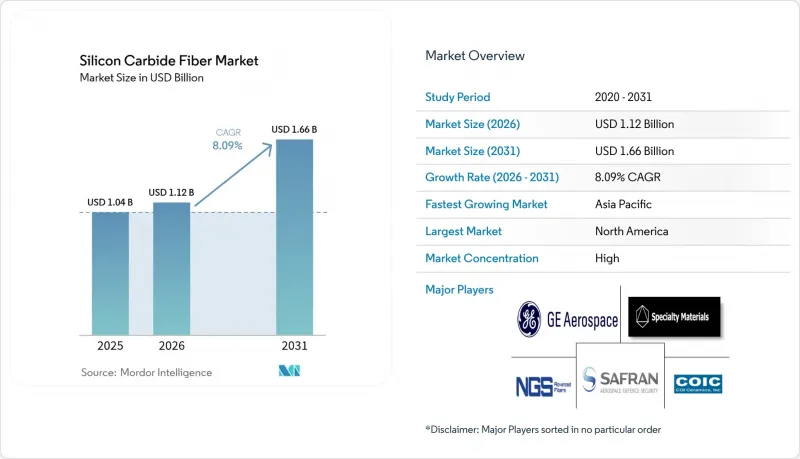
據 Mordor Intelligence 稱,2025 年碳化矽纖維市場價值為 10.4 億美元,預計到 2031 年將從 2026 年的 11.2 億美元成長至 16.6 億美元,預測期(2026-2031 年)複合年成長率為 8.09%。
本報告按纖維類型(連續纖維、短纖維)、形態(連續、機織)、終端用戶產業(航太與國防、能源與發電、工業及其他)和地區(亞太、北美、歐洲、南美、中東和非洲)進行細分。市場預測以美元計價。
全球碳化矽纖維市場趨勢及洞察
民用和軍用航太引擎產量迅速成長
LEAP系列CMC整流罩的飛行時間已超過1000萬小時,充分證明了碳化矽纖維複合材料在商業應用上的卓越性能。其在軍用領域的應用也備受關注。 UH-60M「黑鷹」直升機的T901引擎採用碳化矽CMC材料,零件質量減輕50%,在保持外部尺寸不變的情況下,動力提升了1000軸馬力。普惠公司在卡爾斯巴德開設了一座佔地6萬平方英尺的CMC中心,旨在加速碳化矽增強葉片和燃燒室的認證。引擎OEM廠商預計,到2028年,LEAP引擎的年運轉循環次數將超過1,200次,促使賽峰集團投資超過10億歐元用於其全球服務網路。隨著飛機老化,售後市場需求將確保纖維材料的長期需求,並為持續擴大產能提供基礎。
下一代燃氣渦輪機對碳化矽增強陶瓷基質複合材料(CMC)的需求正在激增。
燃氣渦輪製造商的目標是將燃燒溫度提升至1300 度C以上,以提高複合循環的效率。碳化矽纖維(SiC纖維)即使在鎳合金發生蠕變的溫度範圍內也能保持抗張強度,因此發揮至關重要的作用。過去,陶瓷基複合材料(CMC)的壽命受限於蒸氣氧化,但如今,專為碳化矽纖維設計的環保塗層使其運作時間超過25000小時。氫氣燃氣渦輪機是另一個重要的市場驅動力,因為與鋼相比,碳化矽在高溫氫氣環境中表現出更優異的耐腐蝕性。船舶推進系統也是一個重要的應用領域。配備碳化矽襯裡的緊湊型5MW燃氣渦輪機使渡輪運營商無需高成本催化還原(SCR)系統即可滿足國際海事組織(IMO)Tier III排放標準。整體而言,電力和船舶領域用戶的需求正在超越航太領域,從而穩定了碳化矽纖維市場的成長曲線。
生產成本和資本密集度極高
四組分聚碳矽烷的合成以及在1800 度C下燒結,導致其生產成本遠高於碳纖維的基準成本。通用電氣航空航太公司在亨茨維爾的兩座工廠的總建設成本高達2億美元,凸顯了該行業准入門檻之高。在爐內維持受控的氧氣環境意味著僅能源成本就可能超過成品纖維價格的20%。對光敏聚碳矽烷的研究顯示出在大氣壓力下固化的潛力,但目前仍處於中試階段。在突破性加工技術建立和生產規模擴大以降低固定成本之前,碳化矽纖維市場很可能仍將集中在資金雄厚的成熟企業手中,導致對成本敏感的細分市場價格彈性有限。
細分市場分析
截至2025年,連續纖維將佔碳化矽纖維市場70.02%的佔有率,預計到2031年將以8.63%的複合年成長率成長。第三代碳化矽纖維,例如“Hi-Nicalon S”,在1600 度C下具有2.8 GPa的抗張強度,滿足航太領域載重通道對抗蠕變性能的要求。改良的製造過程抑制了異常晶粒長大,使室溫強度提高到近4 GPa,從而拓展了其應用範圍。連續纖維也可用於纏繞核燃料包殼,其環狀應力的排列可提高冷卻劑損失事件中的抗斷裂性能。雖然短纖維在複雜形貌的製造中仍然發揮著重要作用,尤其是在用於成型工業燃燒器噴嘴的聚合物浸滲和熱解(PIP)製程中,但其機械強度的限制使其在結構應用中的廣泛應用受到限制。
透過將缺陷控制紡絲技術的進步與表面氧管理相結合,可以生產出更光滑、與碳化矽基體均勻結合的纖維絲。這種協調的微觀結構使界面剪切強度提高了25%,並改善了高溫引擎零件的循環疲勞壽命。改良的自動化捲繞機可將粗紗張力控制在±1%以內,從而確保航太引擎法蘭複合材料。隨著技術學習曲線的趨於平緩,生產過程中的廢品率已降至5%以下,降低了每公斤的實際成本。因此,連續纖維支撐了大部分高價值航太訂單,確保了碳化矽纖維市場穩定的收入基礎,同時使生產商能夠為新興領域試生產低等級產品。
區域分析
北美擁有成熟的航太供應鏈和政府對高溫材料的資助,預計到2025年將佔全球銷售額的37.21% 。美國能源局已撥款1.5億美元用於嚴苛環境下的碳化矽纖維項目,加速其在發電和小型模組化反應器(SMR)核子反應爐的認證。亨茨維爾擁有西部首條商業化纖維生產線,使該地區成為一個自給自足的產業中心。同時,加拿大的MDA和墨西哥的克雷塔羅航空航太叢集正在將複合材料整合到引擎短艙結構中。這種地理集中有利於早期採用者獲得優惠價格,並能快速收集顧客回饋,進而推動材料性能的提升。
亞太地區以8.70%的複合年成長率成長,受益於日本在聚碳矽烷化學領域的領先地位以及韓國不斷擴大的航空引擎大修網路。宇部興產計畫在未來十年內將其前體產量提高十倍,以滿足國內外需求。中國正在其航空引擎實驗室擴建用於高超音速滑翔機的碳化矽陶瓷基複合材料(SiC CMC)檢測設施,預計未來一旦技術轉移壁壘降低,將實現大規模消費。韓國的半導體製造業正在推動碳化矽散熱器的發展,從而支撐航空領域以外的需求。印度和東協仍在發展中,但隨著其本土複合材料叢集的成熟,它們正展現出巨大的潛力。
歐洲憑藉在燃氣渦輪機和汽車領域的強大基礎,保持著穩定的需求。意法半導體(STMicroelectronics)的碳化矽功率裝置藍圖需要先進的散熱器,間接促進了光纖的應用。德國一項引擎研發計畫旨在開發一種用於區域供熱、效率達40%的微型燃氣渦輪機,而這需要使用碳化矽襯裡。英國正在航太 Technology Institute)資助一個陶瓷基複合材料(CMC)示範項目,以擴展其認證資料集。一家北歐電力公司正在考慮在聯合循環發電廠中採用氫氣混燒,並指定使用碳化矽襯裡。儘管目前的宏觀經濟逆風正在影響資本投資,但歐洲以減少排放為重點的法規正在維持光纖的長期需求。
其他福利
- Excel格式的市場預測(ME)表
- 3個月的分析師支持
目錄
第1章:引言
- 研究假設和市場定義
- 調查範圍
第2章:調查方法
第3章執行摘要
第4章 市場狀況
- 市場概覽
- 市場促進因素
- 民用和軍用航太引擎產量迅速成長
- 下一代燃氣渦輪機對碳化矽增強陶瓷基質複合材料(CMC)的需求正在激增。
- 小型模組化反應器 (SMR) 供應商在核能防護燃料包殼中採用 SiC 纖維。
- 促進電動車熱防護系統減重
- 利用碳化矽纖維製造高超音速飛行隔熱罩。
- 市場限制因素
- 生產成本和資本密集度極高
- 聚碳矽烷前驅物供應規模化生產中的瓶頸
- 低成本碳纖維和氧化鋁纖維的替代威脅。
- 價值鏈分析
- 波特五力模型
第5章 市場規模與成長預測
- 依纖維類型
- 連續纖維
- 短纖維
- 按形式
- 連續型
- 織物
- 按最終用戶行業分類
- 航太/國防
- 能源和發電
- 產業
- 其他
- 按地區
- 亞太地區
- 中國
- 日本
- 印度
- 韓國
- ASEAN
- 其他亞太國家
- 北美洲
- 美國
- 加拿大
- 墨西哥
- 歐洲
- 德國
- 英國
- 法國
- 義大利
- 西班牙
- 俄羅斯
- 北歐國家
- 其他歐洲國家
- 南美洲
- 巴西
- 阿根廷
- 其他南美國家
- 中東和非洲
- 沙烏地阿拉伯
- 南非
- 其他中東和非洲國家
- 亞太地區
第6章 競爭情勢
- 市場集中度
- 策略趨勢
- 市佔率和排名分析
- 公司簡介
- BJS Ceramics GmbH
- COI Ceramics
- GE Aerospace
- General Atomics Electromagnetic Systems
- Haydale Graphene Industries plc
- MATECH
- NGS Advanced Fibers Co., Ltd.
- Nippon Carbon Co Ltd.
- Safran Ceramics
- SGL Carbon
- Specialty Materials Inc.
- Suzhou Saifei Group Ltd.
- TISICS Ltd.
- TOSHIBA ELECTRONIC DEVICES and STORAGE CORPORATION
- UBE Corporation
第7章 市場機會與未來展望
According to Mordor Intelligence, the silicon carbide fiber market size was valued at USD 1.04 billion in 2025 and estimated to grow from USD 1.12 billion in 2026 to reach USD 1.66 billion by 2031, at a CAGR of 8.09% during the forecast period (2026-2031).
This report is Segmented by Fiber Type (Continuous Fiber, and Short Fiber), Form (Continuous and Woven), End-User Industry (Aerospace and Defense, Energy and Power, Industrial, and Other End-User Industries), and Geography (Asia-Pacific, North America, Europe, South America, and Middle-East and Africa). The Market Forecasts are Provided in Terms of Value (USD).
Global Silicon Carbide Fiber Market Trends and Insights
Rapid Rise in Commercial and Military Aerospace Engine Production
LEAP-series CMC shrouds have surpassed 10 million flight hours, validating silicon carbide fiber composites in commercial service. Parallel military adoption is notable; the T901 engine for the UH-60M Black Hawk delivers 1,000 extra shaft horsepower while retaining form factor because SiC CMCs reduce component mass by 50%. Pratt & Whitney has opened a 60,000 ft2 CMC center in Carlsbad to accelerate qualification of SiC-reinforced vanes and combustors. Engine OEMs expect more than 1,200 annual LEAP shop visits by 2028, prompting Safran to commit over EUR 1 billion to global maintenance networks. As fleets mature, aftermarket demand secures long-term fiber volumes and justifies continued capacity expansion.
Surging Demand for SiC-Reinforced Ceramic Matrix Composites in Next-Gen Gas Turbines
Gas-turbine makers target firing temperatures above 1,300 °C to raise combined-cycle efficiency, and SiC fibers are pivotal because they retain tensile strength where nickel alloys creep. Steam oxidation once limited CMC lifetimes, but environmental-barrier coatings designed for SiC fibers now extend service beyond 25,000 hours. Hydrogen-fired turbines add further impetus because SiC exhibits superior resistance in high-temperature hydrogen compared with steel. Marine propulsion is another vector: 5 MW compact turbines equipped with SiC liners allow ferry operators to meet IMO Tier III emissions without costly SCR systems. Collectively, power and marine users diversify demand beyond aerospace, smoothing the silicon carbide fiber market growth curve.
Ultra-High Production Cost and Capital Intensity
Four-component polycarbosilane synthesis and 1,800 °C sintering create production costs well above carbon fiber benchmarks. GE Aerospace's twin Huntsville plants together cost USD 200 million, underscoring steep entry barriers. Energy spending alone can exceed 20% of finished-fiber price because furnaces must maintain oxygen-controlled atmospheres. Research into photosensitive polycarbosilanes shows promise for ambient-pressure curing but remains at pilot scale. Until breakthrough processing or broader volumes dilute fixed costs, the silicon carbide fiber market will stay concentrated among capital-rich incumbents, limiting price elasticity in cost-sensitive sectors.
Other drivers and restraints analyzed in the detailed report include:
- Nuclear Small Modular Reactor Vendors Adopting SiC Fibers for Accident-Tolerant Fuel Cladding
- Lightweighting Push in E-Mobility Thermal-Protection Systems
- Scale-Up Bottlenecks in Polycarbosilane Precursor Supply
For complete list of drivers and restraints, kindly check the Table Of Contents.
Segment Analysis
Continuous fibers captured 70.02% of the silicon carbide fiber market share in 2025 and are forecast to grow at an 8.63% CAGR through 2031. Third-generation grades such as Hi-Nicalon S deliver 2.8 GPa tensile strength at 1,600 °C, satisfying aerospace load paths where creep resistance is critical. Manufacturing refinements that suppress abnormal grain growth have raised room-temperature strength toward 4 GPa, widening the design envelope. Continuous filaments also enable winding of nuclear fuel cladding tubes, where hoop stress alignment enhances burst tolerance during loss-of-coolant scenarios. Short fibers remain relevant for polymer infiltration and pyrolysis (PIP) routes that mold complex geometries, especially industrial burner nozzles, but their mechanical ceiling restrains broader structural uptake.
Advances in defect-controlled spinning coupled with surface-oxygen management produce smoother filaments that bond uniformly within SiC matrices. This microstructural harmony boosts interfacial shear by 25%, improving cyclic fatigue life in engine hot-sections. Automated winder upgrades now maintain +-1% roving tension, ensuring repeatable composite thickness in aero-engine flanges. As learning curves flatten, production scrap rates have dropped below 5%, reducing effective cost per kilogram. Continuous fibers consequently underpin most high-value aerospace orders, securing the silicon carbide fiber market a stable revenue core while allowing producers to experiment with lower-grade products for emerging sectors.
Complete Report Scope:
- By Fiber Type
- Continous Fiber
- Short Fiber
- By Form
- Continuous
- Woven
- By End-user Industry
- Aerospace and Defence
- Energy and Power
- Industrial
- Other End-user Industries
- By Geography
- Asia-Pacific
- China
- Japan
- India
- South Korea
- ASEAN Countries
- Rest of Asia-Pacific
- North America
- United States
- Canada
- Mexico
- Europe
- Germany
- United Kingdom
- France
- Italy
- Spain
- Russia
- NORDIC Countries
- Rest of Europe
- South America
- Brazil
- Argentina
- Rest of South America
- Middle-East and Africa
- Saudi Arabia
- South Africa
- Rest of Middle-East and Africa
- Asia-Pacific
Geography Analysis
North America retained 37.21% of 2025 revenue due to its entrenched aerospace supply chain and government funding for high-temperature materials. The U.S. Department of Energy earmarked USD 150 million for harsh-environment SiC fiber programs, accelerating qualification for power and SMR reactors. Huntsville hosts the first western commercial fiber line, positioning the region as a self-sufficient hub, while Canada's MDA and Mexico's Queretaro aero-clusters integrate composites into nacelle structures. The geographic concentration supports early adopter pricing and tight customer feedback loops that advance material iterations.
Asia-Pacific, growing at 8.70% CAGR, benefits from Japanese leadership in polycarbosilane chemistry and expanding Korean aero-engine overhaul networks. UBE Corporation plans to multiply precursor output tenfold this decade to meet domestic and export demand. China scales its aero-engine institute's SiC CMC test bed for hypersonic glide vehicles, signaling future high-volume consumption once technology transfer hurdles ease. Semiconductor fabrication in South Korea spurs SiC heat-spreader development, anchoring non-aero demand. India and ASEAN nations are yet nascent but show potential as local composites clusters mature.
Europe leverages a robust gas-turbine and automotive footprint to sustain steady demand. STMicroelectronics' silicon-carbide power-device roadmap necessitates advanced heat spreaders, indirectly boosting fiber uptake. Germany's engine programs seek 40% efficient microturbines for district heat, requiring SiC liners. The UK funds CMC demonstrators under its Aerospace Technology Institute, widening qualification data sets. Nordic utilities exploring hydrogen co-firing in combined-cycle plants also specify SiC liners. Although current macroeconomic headwinds affect capital spending, Europe's regulatory focus on emission reduction preserves long-term fiber demand.
- BJS Ceramics GmbH
- COI Ceramics
- GE Aerospace
- General Atomics Electromagnetic Systems
- Haydale Graphene Industries plc
- MATECH
- NGS Advanced Fibers Co., Ltd.
- Nippon Carbon Co Ltd.
- Safran Ceramics
- SGL Carbon
- Specialty Materials Inc.
- Suzhou Saifei Group Ltd.
- TISICS Ltd.
- TOSHIBA ELECTRONIC DEVICES and STORAGE CORPORATION
- UBE Corporation
Additional Benefits:
- The market estimate (ME) sheet in Excel format
- 3 months of analyst support
TABLE OF CONTENTS
1 Introduction
- 1.1 Study Assumptions and Market Definition
- 1.2 Scope of the Study
2 Research Methodology
3 Executive Summary
4 Market Landscape
- 4.1 Market Overview
- 4.2 Market Drivers
- 4.2.1 Rapid Rise in Commercial and Military Aerospace Engine Production
- 4.2.2 Surging Demand for Sic-Reinforced Ceramic Matrix Composites (Cmcs) in Next-Gen Gas Turbines
- 4.2.3 Nuclear Small Modular Reactor (SMR) Vendors Adopting Sic Fibers for Accident-Tolerant Fuel Cladding
- 4.2.4 Lightweighting Push in E-Mobility Thermal-Protection Systems
- 4.2.5 Hypersonic-Flight Thermal-Shield Programs Adopting Sic Fibers
- 4.3 Market Restraints
- 4.3.1 Ultra-High Production Cost and Capital Intensity
- 4.3.2 Scale-Up Bottlenecks in Polycarbosilane Precursor Supply
- 4.3.3 Substitution Threat from Cost-Competitive Carbon and Alumina Fibers
- 4.4 Value Chain Analysis
- 4.5 Porter's Five Forces
- 4.5.1 Threat of New Entrants
- 4.5.2 Bargaining Power of Buyers
- 4.5.3 Bargaining Power of Suppliers
- 4.5.4 Threat of Substitutes
- 4.5.5 Degree of Competition
5 Market Size and Growth Forecasts (Value)
- 5.1 By Fiber Type
- 5.1.1 Continous Fiber
- 5.1.2 Short Fiber
- 5.2 By Form
- 5.2.1 Continuous
- 5.2.2 Woven
- 5.3 By End-user Industry
- 5.3.1 Aerospace and Defence
- 5.3.2 Energy and Power
- 5.3.3 Industrial
- 5.3.4 Other End-user Industries
- 5.4 By Geography
- 5.4.1 Asia-Pacific
- 5.4.1.1 China
- 5.4.1.2 Japan
- 5.4.1.3 India
- 5.4.1.4 South Korea
- 5.4.1.5 ASEAN Countries
- 5.4.1.6 Rest of Asia-Pacific
- 5.4.2 North America
- 5.4.2.1 United States
- 5.4.2.2 Canada
- 5.4.2.3 Mexico
- 5.4.3 Europe
- 5.4.3.1 Germany
- 5.4.3.2 United Kingdom
- 5.4.3.3 France
- 5.4.3.4 Italy
- 5.4.3.5 Spain
- 5.4.3.6 Russia
- 5.4.3.7 NORDIC Countries
- 5.4.3.8 Rest of Europe
- 5.4.4 South America
- 5.4.4.1 Brazil
- 5.4.4.2 Argentina
- 5.4.4.3 Rest of South America
- 5.4.5 Middle-East and Africa
- 5.4.5.1 Saudi Arabia
- 5.4.5.2 South Africa
- 5.4.5.3 Rest of Middle-East and Africa
- 5.4.1 Asia-Pacific
6 Competitive Landscape
- 6.1 Market Concentration
- 6.2 Strategic Moves
- 6.3 Market Share (%)/Ranking Analysis
- 6.4 Company Profiles (includes Global level Overview, Market level overview, Core Segments, Financials as available, Strategic Information, Market Rank/Share for key companies, Products and Services, and Recent Developments)
- 6.4.1 BJS Ceramics GmbH
- 6.4.2 COI Ceramics
- 6.4.3 GE Aerospace
- 6.4.4 General Atomics Electromagnetic Systems
- 6.4.5 Haydale Graphene Industries plc
- 6.4.6 MATECH
- 6.4.7 NGS Advanced Fibers Co., Ltd.
- 6.4.8 Nippon Carbon Co Ltd.
- 6.4.9 Safran Ceramics
- 6.4.10 SGL Carbon
- 6.4.11 Specialty Materials Inc.
- 6.4.12 Suzhou Saifei Group Ltd.
- 6.4.13 TISICS Ltd.
- 6.4.14 TOSHIBA ELECTRONIC DEVICES and STORAGE CORPORATION
- 6.4.15 UBE Corporation
7 Market Opportunities and Future Outlook
- 7.1 White-space and Unmet-Need Assessment

 全球碳化矽纖維市場規模、佔有率、趨勢和成長分析報告(2026-2034年)
 碳化矽纖維市場-2026-2032年全球市場預測
 碳化矽纖維市場規模、佔有率和成長分析:按產品類型、纖維代數、形態、應用、終端用戶產業和地區分類-2026-2033年產業預測
 碳化矽纖維市場規模、佔有率和趨勢分析:按形態、應用、最終用途、地區和細分市場分類(2026-2033 年)摻雜碳化矽纖維市場:依產品類型、製造流程、摻雜元素和應用分類-2026年至2032年全球預測摻雜連續碳化矽纖維市場:按摻雜元素、產品類型、應用和最終用途產業分類-2026-2032年全球預測碳化矽纖維市場:依纖維類型、製造流程、形態、應用和分銷管道分類-2026-2032年全球預測碳化矽纖維布市場按產品類型、纖維類型、織物類型、塗層類型、應用和最終用戶分類-2026年至2032年全球預測碳化矽纖維氈市場依產品類型、等級、銷售管道、應用及最終用途產業分類-2026年至2032年全球預測
 2025-2035 年全球碳化矽纖維市場