


 |
市場調查報告書
商品編碼
2114867
壓縮機油:市場佔有率分析、產業趨勢與統計、成長預測(2026-2031)Compressor Oil - Market Share Analysis, Industry Trends & Statistics, Growth Forecasts (2026 - 2031) |
||||||

※ 本網頁內容可能與最新版本有所差異。詳細情況請與我們聯繫。
據 Mordor Intelligence 稱,2025 年壓縮機油市值為 4.7413 億公升,預計到 2031 年將達到 6.0933 億公升,而 2026 年為 4.9438 億公升,預測期(2026-2031 年)複合年成長率為 4.27%。
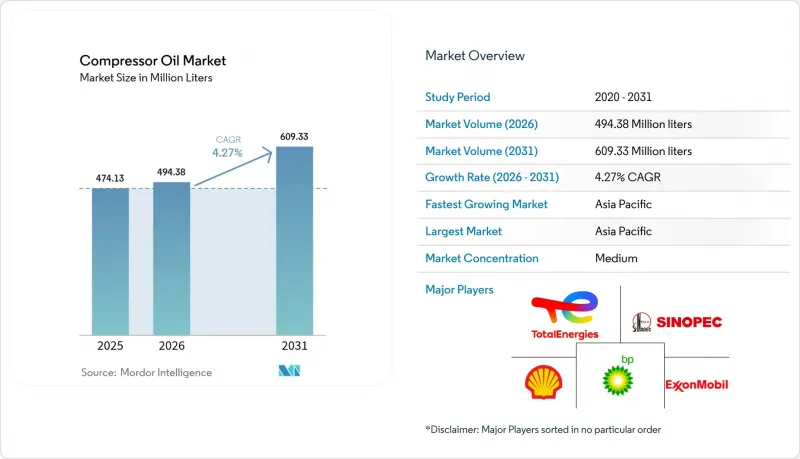
本報告按基礎油類型(合成油、礦物油、其他基礎油)、壓縮機類型(容積式、動壓式)、終端用戶行業(製造業、石油天然氣業、採礦業、其他)、應用領域(空氣壓縮機、氣體壓縮機)以及地區(亞太地區、北美地區、歐洲地區、南美地區、中東和非洲地區)進行細分。市場預測以體積(公升)為單位。
全球壓縮機油市場趨勢及洞察
製造業的蓬勃發展帶動了對壓縮空氣系統的需求。
全球工業自動化的發展推動了對變速壓縮機的需求,這種壓縮機能夠顯著降低維護成本並減少能耗,尤其是在亞洲的生產設施中。美國能源局將於2025年1月生效的新的旋轉式空氣壓縮機能源效率法規要求原始設備製造商(OEM)提高等熵效率,間接提高了對潤滑油的性能要求。採用物聯網(IoT)監控平台的工廠需要潤滑油即使在負載波動的情況下也能保持穩定的黏度和油膜強度,這加速了向高品質合成油的轉變。預計空氣壓縮機銷量的成長與潤滑油消耗量密切相關,這一趨勢在亞太地區尤為明顯,該地區製造業的資本投資依然強勁。壓縮機站中熱回收模組的日益普及提高了潤滑油的平均溫度,因此需要具有卓越抗氧化性能的配方來延長設備的使用壽命。
為節能和高溫運行,過渡到使用合成油
聚α烯烴(PAO) 和酯類潤滑油正日益受到關注,因為儘管其採購價格較高,但它們可以透過延長換油週期來減少停機時間。埃克森美孚新加坡 Regid 升級計畫於 2025 年開始運作EHC 340 MAX 基礎油,從而增強全球優質合成油的供應穩定性。在旋轉螺桿裝置中對二硫化鎢奈米添加劑的測試表明,其比能耗降低了 5% 以上,這一成果可直接轉化為工業用戶範圍 1 排放的減少。歐盟化學品註冊、評估、授權和限制法規 (REACH) 對高硫芳烴組分進行監管,迫使調油商過渡到符合空氣品質法規的更清潔的合成化學品。富勒烯含量低於 50 ppm 的混合添加劑包裝已出現,並在冷媒和製程氣體壓縮機中展現出顯著的減摩效果。這進一步加速了壓縮機油市場對合成油的偏好。
無油壓縮機技術的廣泛應用
為了滿足國際標準化組織 (ISO) 8573-1 0 級空氣品質標準並消除所有污染途徑,製藥和食品加工廠正在加速無油產品。變速驅動裝置和主動磁軸承提高了乾式壓縮機的可靠性,即使在曾經以潤滑設計為主導的領域,也開闢了新的前景。三菱電機已投資 1.435 億美元用於其位於肯塔基州的熱泵壓縮機工廠,目標是到 2027 年實現年產 100 萬台,這凸顯了無油渦卷式和旋轉式壓縮機規模化生產的潛力。雖然鐵路貨運測試已證實了其技術可行性,但由於運輸過程中運作循環帶來的熱衝擊挑戰,潤滑式壓縮機在機車領域仍然發揮著至關重要的作用。營運商正在權衡高額的初始投資與透過減少過濾器更換和潤滑油採購來節省生命週期成本之間的利弊,這在一定程度上抑制了壓縮機油市場的成長。
細分市場分析
預計到2025年,壓縮機油市場,尤其是合成油市場,將佔總銷售量的40.92%。這主要歸功於合成油卓越的抗氧化性能,從而延長了換油週期,減少了意外停機時間。儘管在成本意識較強的市場環境下,礦物油仍佔據主導地位,但隨著合成油在生命週期成本方面的優勢日益凸顯,其市場佔有率正在萎縮。在預算仍然緊張但可靠性要求不斷提高的地區,半合成混合油作為一種中間選擇,需求旺盛。生物基產品在強制要求生物分解性的細分市場中找到了市場,但由於其低溫流動性不足,尚未成為廣泛應用的替代品。
終端用戶對聚α烯烴基礎油的信心源自於其穩定的黏度指數(約140),即使在自動化生產線常見的115 度C排氣溫度下,也能有效保護軸承油膜。採用二硫化鎢和石墨烯片的奈米添加劑可提高導熱性,在壓力測試中降低油底殼溫度3 度C ,直接有助於延長引擎大修間隔時間(MTBF)。埃克森美孚在新加坡的擴建計畫將使其優質基礎油日產能增加2萬桶,體現了其在合成油需求不斷成長的情況下,致力於提供穩定價格的承諾。其他基礎油類別,特別是先進酯類基礎油,預計將以5.18%的複合年成長率成長,因為環保法規要求減少車輛的揮發性有機化合物(VOC)排放。
容積式機械,例如旋轉螺桿式壓縮機和往復式壓縮機,廣泛應用於工廠壓縮空氣迴路中,這些迴路通常在波動工況下運作,預計到2025年,其出貨量將佔總出貨量的64.05%。這些系統需要具有強耐磨性和乳化分離性能的潤滑劑,以保護內部轉子、齒輪和密封件。往復式壓縮機運作飛濺潤滑或壓力潤滑方式,並且必須承受十字頭處的高溫,因此添加劑的穩定性對於減少積碳至關重要。
鑑於石油化學和液化天然氣 (LNG) 應用中製程氣體的處理量龐大,動態壓縮機(主要是離心式壓縮機)預計將以 5.32% 的複合年成長率 (CAGR) 實現最快成長。流體動力軸承要求在連續滿載運轉下具有低發泡和高潤滑油膜強度。混合式「整合齒輪」結構結合了容積式壓縮機和動態分級壓縮機的特性,使操作人員能夠提高調節比。無油離心式壓縮機完全消除了潤滑油的消耗,但許多高壓管線採用浸沒式軸承,並使用特殊配方的合成油來防止在高速運行條件下形成清漆。
區域分析
預計到2025年,亞太地區將佔全球總出貨量的37.86%,並將以5.03%的複合年成長率保持最高水平,這主要得益於中國大力推進自動化以及印度870億美元的石化設備投資計畫。正在進行的大型企劃,例如BASF投資100億歐元的湛江聯合裝置和沙烏地基礎工業公司投資64億美元的福建合資項目,正在持續推動合成潤滑油的需求,以滿足全天候不間斷運作的需求。
在北美,菲利普斯66公司的鐵梅薩工廠和塔加資源公司的二疊紀盆地綜合網路等頁岩氣加工設施的開發,顯著推動了潤滑油的消費。監管壓力,例如美國能源局修訂壓縮機指南和環保署實施排放上限,正在加速合成潤滑油的普及,從而提振了該地區的壓縮機油市場。三菱電機計劃在肯塔基州建設的工廠預計將擴大無油熱泵用渦旋裝置的國內供應,但使用潤滑油的工業產品仍主導著重工業領域。
歐洲在技術上依然領先,這得益於嚴格的REACH法規和綠色氫能藍圖,該路線圖明確規定了抗脆性潤滑油的化學成分。像福斯這樣的製造商正在投資升級其位於巴塞隆納的調配設施,並透過收購來擴展其特種產品系列。南美和中東/非洲的供應量落後於歐洲,但由於採礦業的擴張和新型石化業務的全面發展,這些地區具有巨大的成長潛力。然而,值得注意的是,短期內,這些地區受到嚴格的價格管制,這將維持對礦物油的需求。
其他福利
- Excel格式的市場預測(ME)表
- 3個月的分析師支持
目錄
第1章:引言
- 研究假設和市場定義
- 調查範圍
第2章:調查方法
第3章執行摘要
第4章 市場狀況
- 市場概覽
- 市場促進因素
- 製造業的蓬勃發展帶動了對壓縮空氣系統的需求。
- 為節能和高溫運行,過渡到合成油
- 擴大中游油氣產業的壓縮能力
- 需要抗脆化潤滑劑的氫氣壓縮項目
- 用於電動汽車溫度控管壓縮機的超低黏度聚α烯烴(PAO)混合物
- 市場限制因素
- 無油壓縮機技術的廣泛應用
- 基礎油價格波動與原油價格相關
- 延長換油週期,降低潤滑油消耗
- 價值鏈分析
- 波特五力分析
第5章 市場規模與成長預測
- 基礎油
- 合成油
- 礦物油
- 其他基礎油(半合成、生物基等)
- 按壓縮機類型
- 正位移
- 動態的
- 透過使用
- 空氣壓縮機
- 氣體壓縮機
- 按最終用戶行業分類
- 製造業
- 化工/石油化工
- 石油和天然氣
- 礦業
- 其他終端用戶產業(暖通空調、冷凍、冷凍等)
- 按地區
- 亞太地區
- 中國
- 日本
- 印度
- 韓國
- ASEAN
- 其他亞太國家
- 北美洲
- 美國
- 加拿大
- 墨西哥
- 歐洲
- 德國
- 英國
- 法國
- 義大利
- 西班牙
- 俄羅斯
- 北歐國家
- 其他歐洲國家
- 南美洲
- 巴西
- 阿根廷
- 其他南美國家
- 中東和非洲
- 沙烏地阿拉伯
- 南非
- 其他中東和非洲國家
- 亞太地區
第6章 競爭情勢
- 市場集中度
- 策略趨勢
- 市佔率和排名分析
- 公司簡介
- AMSOIL INC.
- BP plc
- Chevron Corporation
- ENEOS Corporation
- Eurol
- Exxon Mobil Corporation
- FUCHS
- Idemitsu Kosan Co., Ltd.
- LUKOIL
- Petro - Canada, Lubricants LLC
- PETRONAS Lubricants International
- Phillips 66 Company
- Quaker Chemical Corporation
- RCS Bio Solutions
- Sasol
- Shell Plc
- Sinopec Lubricant Company
- TotalEnergies
- Valvoline Global Operations
第7章 市場機會與未來展望
According to Mordor Intelligence, the compressor oil market size was valued at 474.13 Million liters in 2025 and estimated to grow from 494.38 Million liters in 2026 to reach 609.33 Million liters by 2031, at a CAGR of 4.27% during the forecast period (2026-2031).
This report is Segmented by Base Oil (Synthetic, Mineral, and Other Base Oils), Compressor Type (Positive Displacement, and Dynamic), End-User Industry (Manufacturing, Oil and Gas, Mining, and More), Application (Air Compressors and Gas Compressors), and Geography (Asia-Pacific, North America, Europe, South America, and Middle East and Africa). The Market Forecasts are Provided in Terms of Volume (Liters).
Global Compressor Oil Market Trends and Insights
Manufacturing Boom Boosting Compressed-air Systems
Global industrial automation programs lift demand for variable-speed drive compressors that cut energy use while slashing maintenance costs, particularly across Asian production corridors. The United States Department of Energy's new rotary air-compressor efficiency rule, effective January 2025, compels original equipment manufacturers (OEMs) to lift isentropic efficiency, indirectly raising lubricant performance requirements . Factories deploying Internet of Things (IoT) monitoring platforms want oils with viscosity and film strength under fluctuating loads, encouraging migration to premium synthetics. Air compressor sales, forecast to escalate, have a one-to-one correlation with lubricant consumption, especially in the Internet of Things (APAC), where capital investment in manufacturing remains robust. The growing use of heat-recovery modules in compressor stations pushes bulk oil temperatures higher, necessitating oxidation-resistant formulations that preserve equipment life.
Shift to Synthetic Oils for Energy-efficient, High-temperature Operations
Polyalphaolefin (PAO) and ester fluids are gaining traction because longer drain intervals shrink downtime, even though the acquisition price is higher. ExxonMobil's Singapore Resid Upgrade Project will commission EHC 340 MAX basestock in 2025, bolstering global supply security for premium-grade synthetics. Trials of tungsten-disulfide nano-additives in rotary screw units have recorded specific-energy cuts exceeding 5%, a gain that translates directly to lower Scope-1 emissions for industrial users. European Registration, Evaluation, Authorization, and Restriction of Chemicals (REACH) rules restrict high-sulfur aromatic constituents, nudging blenders toward cleaner synthetic chemistries that satisfy air-quality mandates. Hybrid additive packages with fullerene doses below 50 ppm are emerging, demonstrating marked friction reduction in refrigerant and process-gas compressors, which further accelerates the compressor oils market preference for synthetics.
Rising Adoption of Oil-free Compressor Technology
Pharmaceutical and food plants accelerate oil-free purchases to meet International Organization for Standardization (ISO) 8573-1 Class 0 air specs, eliminating any contamination pathway. Variable-speed drives and active-magnetic bearings have lifted the reliability of dry machines, opening prospects in segments once dominated by lubricated designs. Mitsubishi Electric earmarked USD 143.5 million for a Kentucky heat-pump compressor factory targeting 1 million units per year by 2027, underscoring the scale potential for oil-less scroll and rotary models . Rail-freight trials validate technical feasibility, yet mobile duty cycles present thermal-shock hurdles that keep lubricated units relevant in locomotives. Operators weigh higher capex against lifetime savings from filter replacements and oil purchase avoidance, creating a measured but steady drag on volumetric growth in the compressor oils market.
Other drivers and restraints analyzed in the detailed report include:
- Expansion of Oil and Gas Mid-stream Compression Capacity
- Hydrogen Compression Projects Needing Embrittlement-resistant Lubricants
- Crude-linked Volatility in Base-oil Prices
For complete list of drivers and restraints, kindly check the Table Of Contents.
Segment Analysis
The Compressor Oil market size tied to synthetic fluids accounted for 40.92% of the 2025 volume, owing to superior oxidation resistance that extends drain schedules and lowers unscheduled downtime. Mineral oils still hold bulk-volume leadership in cost-sensitive settings, yet their share erodes as lifecycle economics favor synthetics. Semi-synthetic blends offer a midway option and appeal in regions where upfront budget constraints remain acute but reliability demands are rising. Bio-based entrants achieve niche traction where biodegradability mandates exist, although cold-flow limitations restrict widespread substitution.
End-user trust in polyalphaolefin chains stems from consistent viscosity index near 140, safeguarding bearing films at 115°C discharge temperatures common in manufacturing automation lines. Nano-additive work with tungsten-disulfide and graphene platelets enhances thermal conductivity, shaving sump temperatures by 3°C during stress tests, directly supporting higher mean-time-between-overhaul targets. ExxonMobil's Singapore expansion, adding 20,000 bpd (barrels per day) of premium basestock, signals a supply commitment that should stabilize pricing as synthetic demand scales. Other base-oil categories, especially advanced esters, are projected to record a 5.18% CAGR because environmental legislation steers fleets toward lower volatile organic compound (VOC) profiles.
Positive displacement machines, such as rotary screws and reciprocating designs, held 64.05% of 2025 shipments due to ubiquity in factory compressed-air loops that operate under fluctuating duty cycles. These systems require oils with robust anti-wear and demulsibility properties to protect internal rotors, gears, and seals. Reciprocating variants run on splash or pressure feed and endure elevated cross-head temperatures, making additive stability crucial to mitigate carbon deposits.
Given large process-gas volumes in petrochemical and liquefied natural gas (LNG) applications, dynamic compressors, predominantly centrifugal units, will grow the fastest at a 5.32% CAGR. Hydrodynamic bearings demand low foaming potential and high film strength under continuous full-load operation. Hybrid "integrally geared" architectures marry displacement attributes with dynamic staging, enabling operators to broaden turn-down ratios. Although oil-free centrifugal models cut lubricant consumption altogether, many high-pressure lines use flooded bearings where formulated synthetics guard against varnish under high-speed conditions.
Complete Report Scope:
- By Base Oil
- Synthetic
- Mineral
- Other Base Oils (Semi-synthetic, Bio-based, etc.)
- By Compressor Type
- Positive Displacement
- Dynamic
- By Application
- Air Compressors
- Gas Compressors
- By End-user Industry
- Manufacturing
- Chemical and Petrochemical
- Oil and Gas
- Mining
- End-user Industry (HVAC and Refrigeration, etc.)
- By Geography
- Asia-Pacific
- China
- Japan
- India
- South Korea
- ASEAN Countries
- Rest of Asia-Pacific
- North America
- United States
- Canada
- Mexico
- Europe
- Germany
- United Kingdom
- France
- Italy
- Spain
- Russia
- NORDIC Countries
- Rest of Europe
- South America
- Brazil
- Argentina
- Rest of South America
- Middle East and Africa
- Saudi Arabia
- South Africa
- Rest of Middle East and Africa
- Asia-Pacific
Geography Analysis
Asia-Pacific commanded 37.86% of global 2025 volume and is forecast for the highest 5.03% CAGR owing to China's automation push and India's USD 87 billion petrochemical capex pipeline. Ongoing mega-projects such as BASF's EUR 10 billion Zhanjiang complex and SABIC's USD 6.4 billion Fujian venture inject sustained demand for synthetic lubricants to manage 24-hour duty cycles.
North America anchors substantial consumption owing to shale-gas processing developments like Phillips 66's Iron Mesa plant and Targa Resources' integrated Permian Basin network. Regulatory pressure from updated Department of Energy (DOE) compressor guidelines and Environmental Protection Agency (EPA) emissions caps accelerates synthetic adoption and supports the compressor oils market in this region. Mitsubishi Electric's forthcoming Kentucky plant will lift the domestic supply of oil-less heat-pump scroll units, yet lubricated industrial lines still dominate heavy manufacturing.
Europe remains technologically progressive, leveraging stringent REACH limits and a green hydrogen roadmap that specifies embrittlement-resistant lubricant chemistry. Producers like FUCHS invest in Barcelona blending upgrades and acquisitions that broaden specialty portfolios. South America and the Middle East & Africa trail on volume but offer high upside where mining expansion and grassroots petrochemical ventures are ramping, albeit under tighter price discipline that preserves mineral-oil demand in the near term.
- AMSOIL INC.
- BP p.l.c.
- Chevron Corporation
- ENEOS Corporation
- Eurol
- Exxon Mobil Corporation
- FUCHS
- Idemitsu Kosan Co., Ltd.
- LUKOIL
- Petro-Canada Lubricants LLC
- PETRONAS Lubricants International
- Phillips 66 Company
- Quaker Chemical Corporation
- RCS Bio Solutions
- Sasol
- Shell Plc
- Sinopec Lubricant Company
- TotalEnergies
- Valvoline Global Operations
Additional Benefits:
- The market estimate (ME) sheet in Excel format
- 3 months of analyst support
TABLE OF CONTENTS
1 Introduction
- 1.1 Study Assumptions and Market Definition
- 1.2 Scope of the Study
2 Research Methodology
3 Executive Summary
4 Market Landscape
- 4.1 Market Overview
- 4.2 Market Drivers
- 4.2.1 Manufacturing Boom Boosting Compressed-air Systems
- 4.2.2 Shift to Synthetic Oils for Energy-efficient, High-temperature Operations
- 4.2.3 Expansion of Oil and Gas Mid-stream Compression Capacity
- 4.2.4 Hydrogen Compression Projects Needing Embrittlement-Resistant Lubricants
- 4.2.5 Ultra-low-viscosity Polyalphaolefin (PAO) Blends for EV Thermal-management Compressors
- 4.3 Market Restraints
- 4.3.1 Rising Adoption of Oil-free Compressor Technology
- 4.3.2 Crude-linked Volatility in Base-oil Prices
- 4.3.3 Longer Drain-Interval Programs Lowering Lubricant Consumption Intensity
- 4.4 Value Chain Analysis
- 4.5 Porter's Five Forces Analysis
- 4.5.1 Threat of New Entrants
- 4.5.2 Bargaining Power of Buyers
- 4.5.3 Bargaining Power of Suppliers
- 4.5.4 Threat of Substitute Products
- 4.5.5 Degree of Competition
5 Market Size and Growth Forecasts (Volume)
- 5.1 By Base Oil
- 5.1.1 Synthetic
- 5.1.2 Mineral
- 5.1.3 Other Base Oils (Semi-synthetic, Bio-based, etc.)
- 5.2 By Compressor Type
- 5.2.1 Positive Displacement
- 5.2.2 Dynamic
- 5.3 By Application
- 5.3.1 Air Compressors
- 5.3.2 Gas Compressors
- 5.4 By End-user Industry
- 5.4.1 Manufacturing
- 5.4.2 Chemical and Petrochemical
- 5.4.3 Oil and Gas
- 5.4.4 Mining
- 5.4.5 End-user Industry (HVAC and Refrigeration, etc.)
- 5.5 By Geography
- 5.5.1 Asia-Pacific
- 5.5.1.1 China
- 5.5.1.2 Japan
- 5.5.1.3 India
- 5.5.1.4 South Korea
- 5.5.1.5 ASEAN Countries
- 5.5.1.6 Rest of Asia-Pacific
- 5.5.2 North America
- 5.5.2.1 United States
- 5.5.2.2 Canada
- 5.5.2.3 Mexico
- 5.5.3 Europe
- 5.5.3.1 Germany
- 5.5.3.2 United Kingdom
- 5.5.3.3 France
- 5.5.3.4 Italy
- 5.5.3.5 Spain
- 5.5.3.6 Russia
- 5.5.3.7 NORDIC Countries
- 5.5.3.8 Rest of Europe
- 5.5.4 South America
- 5.5.4.1 Brazil
- 5.5.4.2 Argentina
- 5.5.4.3 Rest of South America
- 5.5.5 Middle East and Africa
- 5.5.5.1 Saudi Arabia
- 5.5.5.2 South Africa
- 5.5.5.3 Rest of Middle East and Africa
- 5.5.1 Asia-Pacific
6 Competitive Landscape
- 6.1 Market Concentration
- 6.2 Strategic Moves
- 6.3 Market Share(%)/Ranking Analysis
- 6.4 Company Profiles (includes Global-level Overview, Market-level Overview, Core Segments, Financials as available, Strategic Information, Market Rank/Share, Products and Services, Recent Developments)
- 6.4.1 AMSOIL INC.
- 6.4.2 BP p.l.c.
- 6.4.3 Chevron Corporation
- 6.4.4 ENEOS Corporation
- 6.4.5 Eurol
- 6.4.6 Exxon Mobil Corporation
- 6.4.7 FUCHS
- 6.4.8 Idemitsu Kosan Co., Ltd.
- 6.4.9 LUKOIL
- 6.4.10 Petro-Canada Lubricants LLC
- 6.4.11 PETRONAS Lubricants International
- 6.4.12 Phillips 66 Company
- 6.4.13 Quaker Chemical Corporation
- 6.4.14 RCS Bio Solutions
- 6.4.15 Sasol
- 6.4.16 Shell Plc
- 6.4.17 Sinopec Lubricant Company
- 6.4.18 TotalEnergies
- 6.4.19 Valvoline Global Operations
7 Market Opportunities and Future Outlook
- 7.1 White-space and Unmet-need Assessment
- 7.2 Nano-additives equipped Compressor Oils

 2026-2030年全球壓縮機油市場
 壓縮機油市場:2026-2032年全球市場預測(依產品類型、壓縮機類型、應用類型及最終用途產業分類)
 PAG壓縮機油市場規模、佔有率和成長分析:按產品類型、黏度等級、最終用途產業和地區分類-2026-2033年產業預測
 PAG壓縮機油全球市場規模、佔有率、趨勢和成長分析報告(2026-2034年)壓縮機油市場:市場規模、佔有率、成長率、全球產業分析、按類型、應用和地區分類的考察以及未來預測(2026-2034 年)
 壓縮機油市場規模、佔有率、趨勢和預測:按壓縮機類型、基礎油、應用、最終用戶產業和地區分類,2026-2034年PMA冰點下降劑市場按聚合物類型、分子量範圍、技術、包裝、應用、最終用途和分銷管道分類,全球預測(2026-2032年)
 壓縮機油市場規模、佔有率和成長分析:按油品類型、壓縮機類型、應用、最終用戶產業和地區分類-2026-2033年產業預測
 2026年全球壓縮機油市場報告全球冷凍壓縮機合成油市場(按類型、黏度等級、包裝類型、應用和銷售管道):預測(2025-2030 年)