


 |
市場調查報告書
商品編碼
2114862
汽車區塊鏈:市場佔有率分析、產業趨勢與統計、成長預測(2026-2031)Automotive Blockchain - Market Share Analysis, Industry Trends & Statistics, Growth Forecasts (2026 - 2031) |
||||||

※ 本網頁內容可能與最新版本有所差異。詳細情況請與我們聯繫。
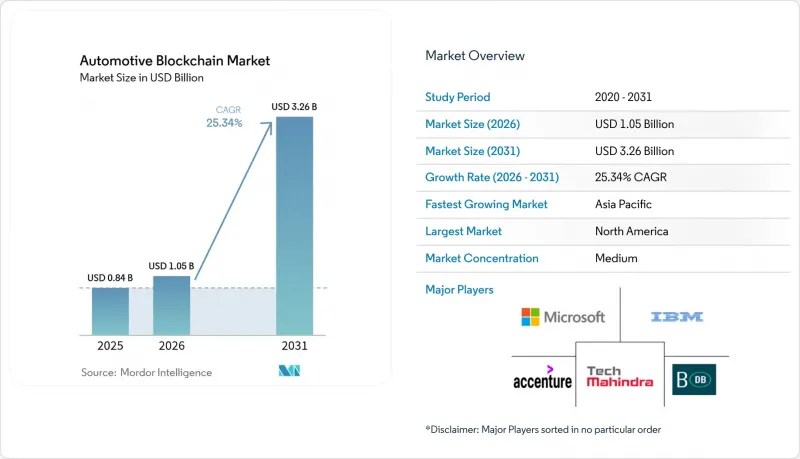
根據 Mordor Intelligence 預測,汽車區塊鏈市場規模將從 2025 年的 8.4 億美元成長到 2026 年的 10.5 億美元,然後在 2031 年達到 32.6 億美元,2026 年至 2031 年的複合年成長率為 25.34%。
本報告按應用領域(製造業、供應鏈和物流、其他)、最終用戶(原始設備製造商、一級供應商、其他)、區塊鏈類型(公有鏈、私人/許可型區塊鏈、其他)、出行模式(個人出行、共享出行、其他)、車輛類型(乘用車、其他)和地區進行細分。市場預測以美元計價。
全球汽車區塊鏈市場趨勢與洞察
電動車電池護照法規,用於追蹤其來源
歐盟2027年電池護照法規要求區塊鏈技術必須能夠確保所有正極、負極和電芯在其15年生命週期內的可追溯性。沃爾沃的EX90護照系統在一個公開的區塊鏈上記錄了鈷的來源、回收成分和二氧化碳排放量,提前三年滿足了歐盟的審計要求。顧問公司估計,每個護照的合規成本在10到15歐元之間,這使得該法規成為平台提供者的業務收益來源。 Circulor的選擇性揭露設計既保護了供應商的敏感數據,也能向監管機構提供來源證明。這種影響也正在擴展到北美,加州的稅額扣抵可能要求提供類似的文檔,預計這將加速美國電動車品牌對汽車區塊鏈市場的滲透。
提高供應鏈透明度和防止假冒偽劣產品的舉措
區塊鏈驅動的可追溯性以涵蓋數千家供應商的不可篡改資料層取代了人工紙本文件,從而降低了假冒零件的風險,而假冒零件每年造成的損失高達450億美元。雷諾的XCEED平台已將合規報告的處理時間縮短了60%。 Catena-X將150多家公司連接到共用的追溯追蹤網路中,將分散的供應商互動轉變為連續且檢驗的資料流。這些措施表明,分散式帳本可以在保持競爭性保密性的同時,向監管機構和客戶披露不可篡改的零件歷史記錄。因此,保固索賠和審計成本得以結構性降低,從而增強了汽車區塊鏈市場的前景。 Catena-X內部就開放標準達成的共識進一步降低了新Tier N供應商的進入門檻。
公鏈的可擴展性和能耗限制
以太坊每秒 15 筆交易的限制以及比特幣每年 120 太瓦時的能源消耗,使得公鏈不適用於數百萬筆汽車交易。雖然二層聚合提高了吞吐量,但也帶來了新的攻擊面,威脅到安全關鍵型工作負載。因此,原始設備製造商 (OEM) 依賴私有網路,接受去中心化程度的降低,以換取低於 500 毫秒的延遲。這種權衡在一定程度上限制了公鏈在汽車區塊鏈市場的佔有率,同時也加速了聯盟對權益證明 (PoS) 解決方案的投資。
細分市場分析
到2025年,供應鏈和物流功能將佔汽車區塊鏈市場39.95%的佔有率,這反映出整個產業迫切需要驗證零件的真偽並確保合規性報告。不可竄改的來源記錄將減少保固詐騙,並縮短召回資訊的搜尋時間。車輛和電池護照雖然目前規模較小,但預計到2027年,隨著歐盟法規對需求的保障,其複合年成長率將達到30.12%,成為成長最快的領域。製造業、金融業、保險業和旅遊服務業都使用相同的帳本平台,但它們的資料類型需求各不相同。這些不同應用的部署表明,一旦開始多用途整合,區塊鏈的柔軟性將超過其額外的實施成本。
價值鏈內的持續資料聚合能夠實現預測性維護警報和環境足跡儀錶板。電池護照的實施透過認證剩餘能量密度來提升車輛轉售價值,這直接影響貸款評估。保險遠端資訊處理技術提供精細化的風險評分,從而減少詐欺損失並提高利潤率。隨著亞洲各國政府考慮推出類似法規,汽車區塊鏈在車輛和電池護照解決方案領域的市場預計將會擴張。因此,儘管供應鏈透明度是當前收入的基礎,但符合監管要求的護照將推動未來的成長週期。
到2025年,整車製造商(OEM)將佔汽車區塊鏈支出的43.72%,並透過多工廠部署來推動汽車區塊鏈市場的發展,這些部署可以追蹤原料入庫和車輛出庫的數據。它們的主導地位源於對召回和監管通知的直接課責。保險公司正以28.33%的複合年成長率快速成長,它們正在利用智慧合約實現理賠自動化並整合即時風險定價。一級供應商正在參與區塊鏈項目,以維持其在整車製造商評估項目中的首選合作夥伴地位,這些項目旨在獎勵檢驗的永續發展指標。
旅遊服務提供者依靠透明的智慧合約實現收益分成,而經銷商則透過驗證零件的真偽來減少仿冒品。監管機構和政府部門利用該網路作為合規管理主機,無需額外的報告入口網站即可存取防篡改日誌。監管機構持有的汽車區塊鏈市場規模正隨著數位所有權計畫的擴展而同步成長。總而言之,在眾多相關人員的參與下,分散式帳本的投資報酬率已遠遠超出工廠的範圍。
區域分析
到2025年,北美將佔汽車區塊鏈市場收入的42.98%,屆時各州政府將利用許可證帳簿對4,200萬張車輛所有權證書進行數位化。聯邦供應鏈安全指令限制了不符合規定的零件,這鞏固了區塊鏈作為強制性檢驗基礎的地位。該地區毗鄰眾多汽車原始設備製造商(OEM)總部和主要雲端區塊鏈提供商,正在加速概念驗證(PoC)的進程。底特律創業投資的持續注資進一步推動了專注於細分帳簿服務的新創公司的發展。
亞太地區預計到2031年將實現30.18%的複合年成長率,這主要得益於中國在全球新電動車銷量中45%的佔有率以及政府對區塊鏈發展的津貼。超過20個城市允許開展L4級自動駕駛試驗的政策,正在推動對安全V2X(車聯網)通訊協定的需求。韓國和日本已公佈國家級自動駕駛出行藍圖,並正在投資數位身分和合規解決方案。區域電池護照試點計畫的實施正在加強洲際市場共生關係,使本地供應商能夠維持對歐盟的出口資格。
歐洲正透過具有約束力的《電池護照條例》保持這一發展勢頭,該條例強制要求在2027年前採用區塊鏈技術。德國將於2025年將L4級自動駕駛合法化,並要求建立安全、防篡改的軟體更新記錄。歐洲汽車製造商正在「Catena-X」框架下合作,透過開發開放且保密的資料交換標準來減少重複投資。在政府津貼和「地平線歐洲」計畫的資助下,抗量子帳本協議的研究正在加速推進,歐洲正逐步確立其在汽車區塊鏈市場的標準制定者地位。
其他好處:
- Excel格式的市場預測(ME)表
- 3個月的分析師支持
目錄
第1章:引言
- 研究假設和市場定義
- 調查範圍
第2章:調查方法
第3章執行摘要
第4章 市場狀況
- 市場概覽
- 市場促進因素
- 關於電動車來源的電池護照法規
- 提高供應鏈透明度,打擊仿冒品
- 聯網汽車和自動駕駛汽車的資料安全需求
- OTA軟體更新的責任審核要求
- Web3時代車用錢包微支付的普及
- 循環經濟中與可追溯性相關的獎勵
- 市場限制因素
- 公鏈的可擴展性和能耗限制
- 跨境智慧合約監管方面的不確定性
- 汽車業區塊鏈人才短缺
- 對聯盟型區塊鏈中OEM知識產權洩漏的擔憂
- 價值供應鏈分析
- 監理情勢
- 技術展望
- 波特五力模型
第5章 市場規模與成長預測
- 透過使用
- 製造業
- 供應鍊和物流
- 資金籌措和安置
- 保險和基於使用量
- 行程服務
- 車輛/電池護照
- 其他
- 最終用戶
- OEMs
- 一級供應商
- 旅遊即服務 (MaaS) 供應商
- 保險公司
- 車主/駕駛
- 經銷商和服務中心
- 監管機構和行政機構
- 按區塊鏈類型
- 公共區塊鏈
- 私有/基於許可的區塊鏈
- 聯盟型區塊鏈
- 混合區塊鏈
- 按移動模型
- 個人出行
- 共享出行
- 商用和物流車輛
- 車輛類型
- 搭乘用車
- 商用車輛
- 按地區
- 北美洲
- 美國
- 加拿大
- 其他北美國家
- 南美洲
- 巴西
- 阿根廷
- 其他南美國家
- 歐洲
- 德國
- 英國
- 法國
- 義大利
- 西班牙
- 其他歐洲國家
- 亞太地區
- 中國
- 日本
- 印度
- 韓國
- 其他亞太國家
- 中東和非洲
- 阿拉伯聯合大公國
- 沙烏地阿拉伯
- 埃及
- 南非
- 其他中東和非洲國家
- 北美洲
第6章 競爭情勢
- 市場集中度
- 策略趨勢
- 市佔率分析
- 公司簡介
- IBM Corporation
- Microsoft Corporation
- Accenture plc
- Tech Mahindra Limited
- BigchainDB GmbH
- carVertical
- XAIN AG
- HCL Technologies Ltd.
- Helbiz
- NXM Labs Inc.
- RSK Labs
- Autoblock
- GEM
- SHIFTMobility Inc.
- Loyyal Corporation
- Bosch Group
- Continental AG
- BMW Group
- Ford Motor Company
- Renault Group
第7章 市場機會與未來展望
According to Mordor Intelligence, the automotive blockchain market size is expected to grow from USD 0.84 billion in 2025 to USD 1.05 billion in 2026 and is forecast to reach USD 3.26 billion by 2031 at 25.34% CAGR over 2026-2031.
This report is Segmented by Application (Manufacturing, Supply Chain and Logistics, and More), End User (OEMs, Tier-1 Suppliers, and More), Blockchain Type (Public Blockchain, Private/Permissioned Blockchain, and More), Mobility Model (Personal Mobility, Shared Mobility, and More), Vehicle Type (Passenger Cars, and More), and Geography. The Market Forecasts are Provided in Terms of Value (USD).
Global Automotive Blockchain Market Trends and Insights
Battery Passport Regulations for EV Provenance
The European Union's 2027 battery passport rule makes blockchain indispensable for tracing every cathode, anode, and cell through a 15-year lifecycle. Volvo's EX90 passport records cobalt origin, recycled content, and CO2 output on a public-permissioned chain that meets anticipated EU audits three years early. Consultancy estimates place compliance spending at EUR 10-15 per passport, turning regulation into a service revenue stream for platform providers. Circulor's selective-disclosure design shields sensitive supplier data while proving provenance to regulators. Spill-over effects reach North America, where California tax credits could hinge on comparable documentation, bolstering the automotive blockchain market penetration among U.S. EV brands.
Supply-chain Transparency and Anti-counterfeit Push
Blockchain-enabled traceability reduces the USD 45 billion annual counterfeit-parts risk by replacing manual paperwork with an immutable data layer that spans thousands of suppliers. Renault's XCEED platform has already cut compliance-report processing time by 60% . Catena-X links more than 150 firms into a shared provenance network that converts fragmented supplier exchanges into continuous, verifiable data flows. These initiatives demonstrate that a distributed ledger can preserve competitive confidentiality while revealing tamper-proof part histories to regulators and customers. The result is a structural drop in warranty claims and audit costs, factors that strengthen the automotive blockchain market outlook. Consensus around open standards within Catena-X further lowers onboarding friction for new tier-n suppliers.
Scalability and Energy-Use Limits of Public Chains
Ethereum's 15 tps ceiling and Bitcoin's 120 TWh annual consumption make public chains ill-suited for millions of vehicle transactions. Layer-2 rollups improve throughput but introduce new attack surfaces that compromise safety-critical workloads. OEMs, therefore, lean on private networks, accepting reduced decentralization in exchange for latency under 500 ms. This trade-off somewhat constrains the public-chain portion of the automotive blockchain market yet accelerates investment in consortium-grade proof-of-stake solutions.
Other drivers and restraints analyzed in the detailed report include:
- Connected and Autonomous-Vehicle Data Security Needs
- OTA Software-update Liability Audit Requirements
- Regulatory Uncertainty for Cross-border Smart Contracts
For complete list of drivers and restraints, kindly check the Table Of Contents.
Segment Analysis
Supply-chain and logistics functions represented 39.95% of the automotive blockchain market in 2025, reflecting industry-wide urgency to authenticate parts and satisfy compliance filings. Immutable provenance records reduce warranty fraud and shorten recall look-up times. Vehicle and battery passports, while smaller today, register the fastest 30.12% CAGR because the 2027 EU mandates guarantee demand. Manufacturing, finance, insurance, and mobility-service niches each leverage the same ledger backbone but diverge in data-type requirements. The application mosaic signals that blockchain flexibility outweighs the additional implementation cost once multipurpose integrations begin.
Continuous data aggregation within supply chains unlocks predictive-maintenance alerts and environmental-footprint dashboards. Battery passport rollouts improve resale values by certifying remaining energy density, which feeds directly into loan underwriting. Insurance telematics delivers granular risk scores, lowering fraud losses and boosting margins. The automotive blockchain market size for vehicle and battery passport solutions is projected to widen as Asian governments consider copy-cat legislation. Supply-chain transparency therefore anchors today's revenue while regulatory passports fuel future cycles.
OEMs held 43.72% of spending in 2025, underpinning the automotive blockchain market through multi-plant deployments that track inbound material and outbound vehicle data. Their leadership stems from direct accountability for recalls and regulatory filings. Insurers, expanding at a 28.33% CAGR, use smart contracts to automate claims and embed real-time risk pricing. Tier-1 suppliers join ledgers to remain preferred partners in OEM scoring programs that reward verified sustainability metrics.
Mobility-service operators rely on transparent smart-contract revenue splits, while dealerships authenticate parts to cut counterfeit incidences. Regulators and authorities view the same network as a compliance console, accessing tamper-proof logs without mandating additional reporting portals. The automotive blockchain market size captured by regulators grows in parallel with digital-title programs. Overall, diverse stakeholder engagement validates distributed-ledger return on investment far beyond the factory gate.
Complete Report Scope:
- By Application
- Manufacturing
- Supply Chain and Logistics
- Financing and Payments
- Insurance and Usage-Based
- Mobility Services
- Vehicle/Battery Passport
- Others
- By End User
- OEMs
- Tier-1 Suppliers
- Mobility-as-a-Service Providers
- Insurance Companies
- Vehicle Owners/Drivers
- Dealerships and Service Centers
- Regulators and Authorities
- By Blockchain Type
- Public Blockchain
- Private/Permissioned Blockchain
- Consortium Blockchain
- Hybrid Blockchain
- By Mobility Model
- Personal Mobility
- Shared Mobility
- Commercial and Logistics Fleet
- By Vehicle Type
- Passenger Cars
- Commercial Vehicles
- By Geography
- North America
- United States
- Canada
- Rest of North America
- South America
- Brazil
- Argentina
- Rest of South America
- Europe
- Germany
- United Kingdom
- France
- Italy
- Spain
- Rest of Europe
- Asia-Pacific
- China
- Japan
- India
- South Korea
- Rest of Asia-Pacific
- Middle East and Africa
- United Arab Emirates
- Saudi Arabia
- Egypt
- South Africa
- Rest of Middle East and Africa
- North America
Geography Analysis
North America accounted for 42.98% of the automotive blockchain market revenue in 2025 as state authorities digitized 42 million vehicle titles using permissioned ledgers. Federal supply-chain security directives that restrict non-allied components reinforce blockchain as a mandated verification backbone. The region enjoys proximity between automotive OEM headquarters and leading cloud-blockchain providers, accelerating proof-of-concept timelines. Continuous funding from Detroit venture capital further supports start-ups specializing in niche ledger services.
Asia-Pacific is on a 30.18% CAGR trajectory through 2031, anchored by China's 45% new-EV sales penetration and municipal blockchain development grants. Policies that permit Level 4 autonomy trials in more than 20 cities amplify demand for secure vehicle-to-everything communication protocols. South Korea and Japan have announced national autonomous-mobility roadmaps, channeling funds toward digital identity and compliance solutions. Regional battery-passport pilots ensure that local suppliers remain eligible for EU exports, reinforcing cross-continental market symbiosis.
Europe sustains momentum through binding battery passport rules that make blockchain compulsory by 2027. Germany legalized Level 4 autonomous driving in 2025, necessitating secure, tamper-proof software update records. The continent's OEMs collaborate within Catena-X to create an open yet confidential data-exchange standard, lowering duplicated investments. Government grants and Horizon-Europe funding anchor research into quantum-safe ledger protocols, positioning Europe as a standards-setter within the automotive blockchain market.
- IBM Corporation
- Microsoft Corporation
- Accenture plc
- Tech Mahindra Limited
- BigchainDB GmbH
- carVertical
- XAIN AG
- HCL Technologies Ltd.
- Helbiz
- NXM Labs Inc.
- RSK Labs
- Autoblock
- GEM
- SHIFTMobility Inc.
- Loyyal Corporation
- Bosch Group
- Continental AG
- BMW Group
- Ford Motor Company
- Renault Group
Additional Benefits:
- The market estimate (ME) sheet in Excel format
- 3 months of analyst support
TABLE OF CONTENTS
1 Introduction
- 1.1 Study Assumptions & Market Definition
- 1.2 Scope of the Study
2 Research Methodology
3 Executive Summary
4 Market Landscape
- 4.1 Market Overview
- 4.2 Market Drivers
- 4.2.1 Battery passport regulations for EV provenance
- 4.2.2 Supply-chain transparency and anti-counterfeit push
- 4.2.3 Connected and autonomous-vehicle data security needs
- 4.2.4 OTA software-update liability audit requirements
- 4.2.5 Web3 vehicle-wallet micropayments adoption
- 4.2.6 Circular-economy traceability incentives
- 4.3 Market Restraints
- 4.3.1 Scalability and energy-use limits of public chains
- 4.3.2 Regulatory uncertainty for cross-border smart contracts
- 4.3.3 Shortage of automotive-grade blockchain talent
- 4.3.4 OEM IP-leakage concerns in consortium blockchains
- 4.4 Value/Supply-Chain Analysis
- 4.5 Regulatory Landscape
- 4.6 Technological Outlook
- 4.7 Porter's Five Forces
- 4.7.1 Threat of New Entrants
- 4.7.2 Bargaining Power of Buyers
- 4.7.3 Bargaining Power of Suppliers
- 4.7.4 Threat of Substitute Products
- 4.7.5 Intensity of Competitive Rivalry
5 Market Size & Growth Forecasts (Value (USD))
- 5.1 By Application
- 5.1.1 Manufacturing
- 5.1.2 Supply Chain and Logistics
- 5.1.3 Financing and Payments
- 5.1.4 Insurance and Usage-Based
- 5.1.5 Mobility Services
- 5.1.6 Vehicle/Battery Passport
- 5.1.7 Others
- 5.2 By End User
- 5.2.1 OEMs
- 5.2.2 Tier-1 Suppliers
- 5.2.3 Mobility-as-a-Service Providers
- 5.2.4 Insurance Companies
- 5.2.5 Vehicle Owners/Drivers
- 5.2.6 Dealerships and Service Centers
- 5.2.7 Regulators and Authorities
- 5.3 By Blockchain Type
- 5.3.1 Public Blockchain
- 5.3.2 Private/Permissioned Blockchain
- 5.3.3 Consortium Blockchain
- 5.3.4 Hybrid Blockchain
- 5.4 By Mobility Model
- 5.4.1 Personal Mobility
- 5.4.2 Shared Mobility
- 5.4.3 Commercial and Logistics Fleet
- 5.5 By Vehicle Type
- 5.5.1 Passenger Cars
- 5.5.2 Commercial Vehicles
- 5.6 By Geography
- 5.6.1 North America
- 5.6.1.1 United States
- 5.6.1.2 Canada
- 5.6.1.3 Rest of North America
- 5.6.2 South America
- 5.6.2.1 Brazil
- 5.6.2.2 Argentina
- 5.6.2.3 Rest of South America
- 5.6.3 Europe
- 5.6.3.1 Germany
- 5.6.3.2 United Kingdom
- 5.6.3.3 France
- 5.6.3.4 Italy
- 5.6.3.5 Spain
- 5.6.3.6 Rest of Europe
- 5.6.4 Asia-Pacific
- 5.6.4.1 China
- 5.6.4.2 Japan
- 5.6.4.3 India
- 5.6.4.4 South Korea
- 5.6.4.5 Rest of Asia-Pacific
- 5.6.5 Middle East and Africa
- 5.6.5.1 United Arab Emirates
- 5.6.5.2 Saudi Arabia
- 5.6.5.3 Egypt
- 5.6.5.4 South Africa
- 5.6.5.5 Rest of Middle East and Africa
- 5.6.1 North America
6 Competitive Landscape
- 6.1 Market Concentration
- 6.2 Strategic Moves
- 6.3 Market Share Analysis
- 6.4 Company Profiles (Includes Global Level Overview, Market Level Overview, Core Segments, Financials as Available, Strategic Information, Market Rank/Share for Key Companies, Products and Services, SWOT Analysis, and Recent Developments)
- 6.4.1 IBM Corporation
- 6.4.2 Microsoft Corporation
- 6.4.3 Accenture plc
- 6.4.4 Tech Mahindra Limited
- 6.4.5 BigchainDB GmbH
- 6.4.6 carVertical
- 6.4.7 XAIN AG
- 6.4.8 HCL Technologies Ltd.
- 6.4.9 Helbiz
- 6.4.10 NXM Labs Inc.
- 6.4.11 RSK Labs
- 6.4.12 Autoblock
- 6.4.13 GEM
- 6.4.14 SHIFTMobility Inc.
- 6.4.15 Loyyal Corporation
- 6.4.16 Bosch Group
- 6.4.17 Continental AG
- 6.4.18 BMW Group
- 6.4.19 Ford Motor Company
- 6.4.20 Renault Group
7 Market Opportunities & Future Outlook
- 7.1 White-space & Unmet-Need Assessment

 汽車產業區塊鏈市場:按組件、部署模式、應用和最終用戶分類-2026-2032年全球市場預測
 汽車區塊鏈市場預測至2034年-全球分析(按組件、區塊鏈類型、供應商、車輛類型、應用、最終用戶和地區分類)
 汽車區塊鏈市場分析與至2035年的預測:類型、產品類型、服務、技術、組件、應用、部署狀態、最終用戶、解決方案
 區塊鏈在汽車市場的策略性洞察與預測(2026-2031)
 2026年全球汽車區塊鏈市場報告
 汽車區塊鏈市場:按供應商、最終用途、類型、旅行類型、應用、國家和地區分類-全球產業分析、市場規模、市場佔有率及2025年至2032年預測汽車區塊鏈市場規模、佔有率、成長及全球產業分析:按類型、應用和地區分類的洞察,2026-2034 年預測全球汽車區塊鏈市場規模、佔有率、趨勢和成長分析報告(2026-2034)
 汽車區塊鏈市場規模、佔有率、趨勢和預測(按類型、提供者、旅行類型、應用、最終用戶和地區分類),2026-2034年
 汽車區塊鏈市場-全球產業規模、佔有率、趨勢、機會及預測(按類型、應用、最終用戶、地區和競爭格局分類,2021-2031年)