


 |
市場調查報告書
商品編碼
2114843
全球實驗室離心分離機:市佔率分析、產業趨勢與統計及成長預測(2026-2031 年)Global Laboratory Centrifuge - Market Share Analysis, Industry Trends & Statistics, Growth Forecasts (2026 - 2031) |
||||||

※ 本網頁內容可能與最新版本有所差異。詳細情況請與我們聯繫。
據 Mordor Intelligence 稱,2025 年實驗離心機市值為 17.1 億美元,預計到 2031 年將達到 23.9 億美元,而 2026 年為 18.1 億美元,預測期(2026-2031 年)的複合年成長率為 5.73%。
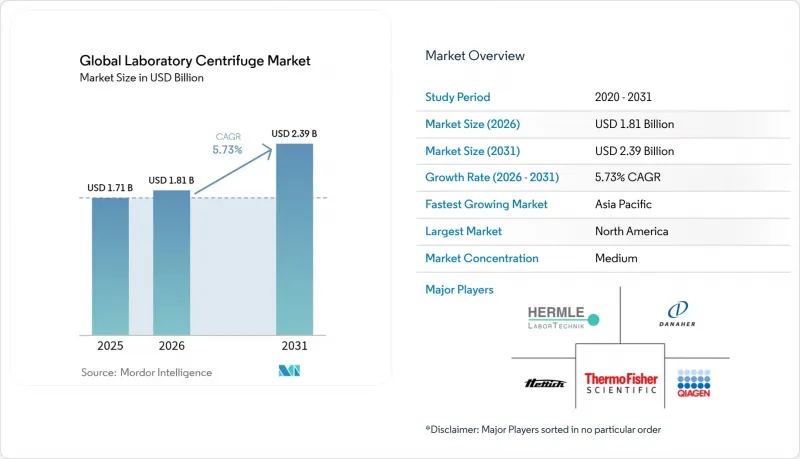
本報告按產品類型(儀器[微型離心機、超速離心機等]、配件[試管、瓶子等])、型號類型(桌上型、落地式)、應用(微生物學、細胞組學等)、最終用戶(醫院、診斷檢查室等)、自動化程度(手動/傳統等)和地區(北美、歐洲、亞太地區等)進行分類。
實驗離心機市場的全球趨勢與洞察
慢性疾病和感染疾病的高發生率
在診斷檢查室中,離心法用於分離血漿和病原體,以識別可用於糖尿病、心血管疾病和癌症管理的生物標記。目前,安全桶的設計符合世界衛生組織結核病防治規程,要求密封操作以降低氣溶膠風險。儘管由於美國和西歐人口老化導致檢體量仍然很高,但新的感染疾病疫情正在加速可攜式離心機在醫療系統一線診所的部署。這些因素共同維持了整個實驗用離心機市場的穩定需求。
生物製藥和生命科學領域研發支出增加
藥物研發計畫採用先進的分離工作流程進行蛋白質純化、細胞外囊泡分離和病毒載體生產。 EVics 系統展示如何透過串聯切向流過濾技術,在保持生物分子完整性的同時,處理高達 1 公升的樣品,從而克服傳統超速離心機的瓶頸。受託研究機構(CRO) 正在採用新的自動化平台來滿足其贊助公司專案的需求,這進一步擴大了實驗離心機市場。
先進系統的初始投資成本很高
設備齊全的超速離心機通常售價超過10萬美元,這限制了小規模實驗室的普及。目前,全球二手設備市場規模達20億美元,提供附廠商保固的翻新設備,使其價格更親民。雖然租賃方案有助於分攤支出,但預算限制依然存在,尤其是拉丁美洲和東南亞部分地區。
細分市場分析
預計到2025年,設備銷售額將佔總銷售額的76.12%,證實了用戶在實驗室離心機市場中優先考慮平台採購。超速離心機的轉速可超過10萬轉/分鐘,支持生技藥品研究中蛋白質和病毒的分離。微型離心機仍然是常規檢測的必備設備,而多功能離心機則滿足了對轉子柔軟性要求較高的機構的需求。儘管實驗室離心機配件的市場規模較小,但隨著實驗室在反覆滅菌循環後更換管路、離心瓶和轉子密封件,該市場正呈現快速成長的趨勢。輕質且耐腐蝕的碳纖維轉子現在已納入維護契約,以確保負載平衡和疲勞測試。
由於耗材的更換頻率高於硬體,配件市場正以7.04%的複合年成長率成長。售後市場需求主要集中在固定角離心機和擺動式離心機上,這得益於供應商提供的捆綁式轉子升級和校準服務。隨著高通量篩檢的普及,實驗室開始批量採購一次性離心管以防止交叉污染。因此,製造商預計耗材銷售將持續成長,從而彌補硬體的初始利潤,增強實驗室離心機市場的韌性。
到2025年,桌上型機型將佔總銷售量的61.30%,主要用於處理500毫升以下樣本的常規診斷和學術實驗。其緊湊的面積使其適用於空間有限的實驗室工作台,而最近的韌體更新還增加了觸控螢幕操作和基於QR碼的維護日誌記錄功能。相較之下,落地架機型透過容納上游生物製程中所需的樣品袋和樣品瓶,實現了6.49%的複合年成長率。可程式設計的加減速控制和減震器符合GMP驗證法規,因此越來越受到契約製造生產商的關注。
實驗離心機市場正受惠於各機構對混合配置方案的採用,例如用於緊急測試的桌上型離心機和用於批量純化的落地式離心機。與機械臂的整合實現了無人值守裝載,將傳統的落地式系統轉變為自動化工作單元。供應商現在提供混合服務方案,可遠端追蹤兩種型號離心機的轉子運作週期,在最大限度地減少停機時間的同時,確保操作人員熟悉操作流程。
區域分析
預計到2025年,北美將佔全球銷售額的36.10%,這主要得益於美國製藥公司總部的高度集中、美國國立衛生研究院 (NIH) 的津貼以及強大的契約製造基礎。加拿大憑藉其公共衛生實驗室和快速發展的生技藥品生態系統對此起到了補充作用,而墨西哥則受益於醫療設備組裝的近岸外包。聯邦政府對先進製造業的激勵措施進一步刺激了符合GMP標準的離心機的訂單,這些離心機供應給當地的細胞治療工廠。隨著實驗室遵守美國職業安全與健康管理局 (OSHA) 和疾病管制與預防中心 (CDC) 的安全指南,以及氣溶膠阻隔蓋和隔音裝置等升級措施的實施,實驗室離心機市場也表現強勁。
亞太地區以7.68%的複合年成長率領先。預計2024年,中國醫療設備產業規模將達到1,790億美元,擁有13.8萬項醫療設備專利,國家政策正積極推動國內採購。印度的「國家醫療設備政策」目標是到2030年實現500億美元的銷售額,並透過簡化監管流程鼓勵跨國公司和本土企業投資建造離心機組裝。在日本、韓國和澳大利亞,不斷擴展的臨床試驗網路對高通量離心技術的需求,正在推動全部區域的實驗性離心機市場發展。
在歐洲,德國以出口為導向的醫療設備製造商、英國的生物技術叢集以及法國的醫院現代化計畫正在推動醫療器材市場的穩定成長。歐盟關於生態設計和醫療設備法規的指令促進了節能轉子的應用和全面驗證記錄的建立。永續性意識的醫院傾向於選擇能耗降低高達70%的型號,並使其採購活動與注重環保的公共採購政策一致。這些努力共同維持了歐洲市場的穩定需求,並為基於循環經濟的再生服務創造了新的市場機遇,從而延長了離心機系統的使用壽命。
其他好處:
- Excel格式的市場預測(ME)表
- 3個月的分析師支持
目錄
第1章:引言
- 研究假設和市場定義
- 調查範圍
第2章:調查方法
第3章執行摘要
第4章 市場狀況
- 市場概覽
- 市場促進因素
- 慢性疾病和感染疾病的高發生率
- 生物製藥和生命科學領域研發支出增加
- 高通量製冷系統的技術進步
- 擴大分散式/患者側診斷實驗室
- 細胞和基因療法生產中對病毒載體的需求
- 轉子回收和循環經濟帶來的收入來源
- 市場限制因素
- 先進系統相關的高昂初始投資成本
- 設備使用壽命長導致更換需求放緩。
- 擴大離心分離服務外包
- 加強生物安全和噪音排放的監管
- 價值供應鏈分析
- 監理情勢
- 技術展望
- 波特五力分析
第5章 市場規模與成長預測
- 依產品類型
- 裝置
- 微型離心機
- 超速離心機
- 多用途/通用
- 透過配件
- 管瓶
- 轉子(固定角度型、擺動鬥型)
- 水桶/盤/耗材
- 裝置
- 按型號
- 工作檯面
- 落地架式
- 透過使用
- 臨床階段
- 臨床前/研究
- 一般
- 透過使用
- 微生物學
- 細胞組學
- 蛋白質體學
- 基因組學
- 診斷
- 最終用戶
- 醫院和診斷檢查室
- 學術研究機構
- 生物技術和製藥公司
- 合約研究組織(CRO)
- 按自動化級別
- 手動/傳統
- 半自動
- 全自動/機器人
- 按地區
- 北美洲
- 美國
- 加拿大
- 墨西哥
- 歐洲
- 德國
- 英國
- 法國
- 義大利
- 西班牙
- 其他歐洲國家
- 亞太地區
- 中國
- 日本
- 印度
- 澳洲
- 韓國
- 其他亞太國家
- 中東和非洲
- GCC
- 南非
- 其他中東和非洲國家
- 南美洲
- 巴西
- 阿根廷
- 其他南美國家
- 北美洲
第6章 競爭情勢
- 市場集中度
- 市佔率分析
- 公司簡介
- Thermo Fisher Scientific Inc.
- Danaher Corp.(Beckman Coulter)
- Eppendorf AG
- Andreas Hettich GmbH & Co. KG
- Sigma Laborzentrifugen GmbH
- HERMLE Labortechnik GmbH
- Kubota Corp.
- NuAire Inc.
- Sartorius AG
- Qiagen NV
- Labnics Equipment
- Esco Life Sciences
- KeraJet/Khera Instruments(Pvt Ltd)
- BT Lab Systems
- LabMedica(Scheuermann)
- Centrisys/CNP LLC
- Alfa Laval AB
- Becton, Dickinson & Co.(BD)
第7章 市場機會與未來展望
According to Mordor Intelligence, the laboratory centrifuge market size was valued at USD 1.71 billion in 2025 and estimated to grow from USD 1.81 billion in 2026 to reach USD 2.39 billion by 2031, at a CAGR of 5.73% during the forecast period (2026-2031).
This report is Segmented by Product Type (Equipment [Microcentrifuges, Ultracentrifuges, and More], Accessories [Tubes & Bottles, and More]), by Model Type (Benchtop, Floor-Standing), by Application (Microbiology, Cellomics, and More), by End-User (Hospitals & Diagnostic Labs, and More), by Automation Level (Manual / Conventional, and More), by Geography (North America, Europe, Asia-Pacific, and More).
Global Laboratory Centrifuge Market Trends and Insights
High Prevalence of Chronic & Infectious Diseases
Diagnostic laboratories rely on centrifugation to separate plasma and isolate pathogens for biomarkers that guide diabetes, cardiovascular, and cancer management. Safety-bucket designs now meet WHO tuberculosis protocols that call for sealed operation to reduce aerosol risk. Aging populations in the United States and Western Europe keep specimen volumes high, while novel infection outbreaks spur health systems to deploy portable centrifuges in frontline clinics. These conditions collectively maintain baseline demand across the laboratory centrifuge market.
Rising R&D Spending in Biopharma & Life Sciences
Drug-discovery programs adopt advanced separation workflows for protein purification, extracellular-vesicle isolation, and viral-vector production. The EVics system shows how tandem tangential-flow filtration overcomes legacy ultracentrifuge bottlenecks by processing up to 1 L while preserving biomolecule integrity. Contract research organizations equip new automated platforms to keep pace with sponsor projects, further expanding the laboratory centrifuge market.
High Upfront Capital Cost of Advanced Systems
Fully-equipped ultracentrifuges often exceed USD 100,000, restricting adoption by small laboratories. A USD 2 billion global secondary-equipment channel now supplies refurbished units with vendor warranties, offering affordable entry points. Leasing and rental plans further spread out expenditure, yet budget constraints persist, especially in Latin America and parts of Southeast Asia.
Other drivers and restraints analyzed in the detailed report include:
- Technological Advances in High-Throughput & Refrigerated Systems
- Viral-Vector Demand for Cell & Gene Therapy Manufacturing
- Tightening Biosafety & Noise-Emission Regulations
For complete list of drivers and restraints, kindly check the Table Of Contents.
Segment Analysis
Equipment represented 76.12% of 2025 revenue, confirming users' primary focus on platform procurement within the laboratory centrifuge market. Ultracentrifuges reach speeds above 100,000 rpm, supporting protein and virus separation for biologics research. Microcentrifuges remain staples of routine assays, while multipurpose units cater to institutions needing rotor flexibility. The laboratory centrifuge market size for accessories is smaller but displays faster momentum as laboratories replace tubes, bottles, and rotor seals after repeated sterilization cycles. Carbon-fiber rotors, lighter yet corrosion-resistant, now enter service contracts that guarantee load balancing and fatigue inspection.
The accessories segment grows at 7.04% CAGR because consumables are replaced more frequently than hardware. Fixed-angle and swinging-bucket formats account for most aftermarket demand, backed by vendor programs that bundle rotor upgrades with calibration services. As high-throughput screens expand, laboratories secure bulk lots of single-use tubes to avoid cross-contamination. Manufacturers thus bank on recurring sales that complement initial hardware margins, reinforcing the resilience of the laboratory centrifuge market.
Benchtop units held 61.30% revenue in 2025, favored for daily diagnostic and academic protocols that handle volumes under 500 mL. Their compact footprint aligns with space-limited benches, and recent firmware updates add touch-screen controls plus QR-code maintenance logs. In contrast, floor-standing models realise a 6.49% CAGR by accommodating bags and bottles needed for upstream bioprocess harvests. Programmable ramps and vibration dampers meet GMP validation rules, which lifts their appeal for contract manufacturers.
The laboratory centrifuge market benefits as institutions deploy mixed fleets: benchtops for stat tests, floor units for batch purification. Integration with robotic arms enables unmanned loading, turning traditional floor systems into automated work cells. Vendors now offer hybrid service plans that remotely track rotor cycles across both model lines, minimising downtime while retaining operator familiarity.
Complete Report Scope:
- By Product Type
- Equipment
- Microcentrifuges
- Ultracentrifuges
- Multipurpose/General-purpose
- Accessories
- Tubes & Bottles
- Rotors (fixed-angle, swinging-bucket)
- Buckets/Plates/Consumables
- Equipment
- By Model Type
- Benchtop
- Floor-standing
- By Intended Use
- Clinical
- Pre-clinical/Research
- General Purpose
- By Application
- Microbiology
- Cellomics
- Proteomics
- Genomics
- Diagnostics
- By End-user
- Hospitals & Diagnostic Labs
- Academic & Research Institutes
- Biotech & Pharma Companies
- Contract Testing / CROs
- By Automation Level
- Manual / Conventional
- Semi-automated
- Fully-automated / Robotic
- By Geography
- North America
- United States
- Canada
- Mexico
- Europe
- Germany
- United Kingdom
- France
- Italy
- Spain
- Rest of Europe
- Asia-Pacific
- China
- Japan
- India
- Australia
- South Korea
- Rest of Asia-Pacific
- Middle East and Africa
- GCC
- South Africa
- Rest of Middle East and Africa
- South America
- Brazil
- Argentina
- Rest of South America
- North America
Geography Analysis
North America retained 36.10% of 2025 revenue, anchored by the United States' dense cluster of pharmaceutical headquarters, National Institutes of Health grants, and a robust contract manufacturing base. Canada complements with public health labs and a growing biologics ecosystem, while Mexico benefits from near-shoring of medical-device assembly. Federal incentives for advanced manufacturing further stimulate orders for GMP-graded centrifuges that feed into local cell-therapy plants. Laboratories also respond to OSHA and CDC safety directives, prompting upgrades to aerosol-tight lids and acoustic dampening, which sustains the laboratory centrifuge market.
Asia-Pacific posts the fastest 7.68% CAGR. China's medical-equipment sector reached USD 179 billion in 2024, featuring 138,000 device patents, and state policy favours domestic sourcing.India's National Medical Devices Policy targets USD 50 billion turnover by 2030 and simplifies regulatory pathways, encouraging multinational and local firms to invest in centrifuge assembly lines. Japan, South Korea, and Australia expand clinical-trial networks that demand high-throughput centrifugation, reinforcing the laboratory centrifuge market across the region.
Europe shows steady growth paced by Germany's export-oriented device makers, the United Kingdom's biotech clusters, and France's hospital modernisation programs. EU directives on eco-design and medical-device regulation encourage adoption of energy-efficient rotors and comprehensive validation records. Sustainability-focused hospitals favor models with 70% lower power draw, aligning procurement with green public-purchasing policies. Collectively, these initiatives keep European demand consistent while opening niches for circular-economy refurbishment services that extend the lifecycle of centrifuge fleets.
- Thermo Fisher Scientific
- Danaher Corp. (Beckman Coulter)
- Eppendorf
- Andreas Hettich
- Sigma Laborzentrifugen
- HERMLE Labortechnik
- Kubota Corp.
- NuAire Inc.
- Sartorius
- QIAGEN
- Labnics Equipment
- Esco Life Sciences
- KeraJet / Khera Instruments (Pvt Ltd)
- BT Lab Systems
- LabMedica (Scheuermann)
- Centrisys/CNP LLC
- Alfa Laval AB
- Becton, Dickinson & Co. (BD)
Additional Benefits:
- The market estimate (ME) sheet in Excel format
- 3 months of analyst support
TABLE OF CONTENTS
1 Introduction
- 1.1 Study Assumptions & Market Definition
- 1.2 Scope of the Study
2 Research Methodology
3 Executive Summary
4 Market Landscape
- 4.1 Market Overview
- 4.2 Market Drivers
- 4.2.1 High prevalence of chronic & infectious diseases
- 4.2.2 Rising R&D spending in biopharma & life sciences
- 4.2.3 Technological advances in high-throughput & refrigerated systems
- 4.2.4 Expansion of decentralised/near-patient diagnostic labs
- 4.2.5 Viral-vector demand for cell & gene therapy manufacturing
- 4.2.6 Rotor-refurbishment & circular-economy revenue streams
- 4.3 Market Restraints
- 4.3.1 High upfront capital cost of advanced systems
- 4.3.2 Long equipment lifespans slowing replacement sales
- 4.3.3 Growth of outsourced centrifugation services
- 4.3.4 Tightening biosafety & noise-emission regulations
- 4.4 Value / Supply-Chain Analysis
- 4.5 Regulatory Landscape
- 4.6 Technological Outlook
- 4.7 Porter's Five Forces Analysis
- 4.7.1 Threat of New Entrants
- 4.7.2 Bargaining Power of Buyers
- 4.7.3 Bargaining Power of Suppliers
- 4.7.4 Threat of Substitutes
- 4.7.5 Competitive Rivalry
5 Market Size & Growth Forecasts (Value)
- 5.1 By Product Type
- 5.1.1 Equipment
- 5.1.1.1 Microcentrifuges
- 5.1.1.2 Ultracentrifuges
- 5.1.1.3 Multipurpose/General-purpose
- 5.1.2 Accessories
- 5.1.2.1 Tubes & Bottles
- 5.1.2.2 Rotors (fixed-angle, swinging-bucket)
- 5.1.2.3 Buckets/Plates/Consumables
- 5.1.1 Equipment
- 5.2 By Model Type
- 5.2.1 Benchtop
- 5.2.2 Floor-standing
- 5.3 By Intended Use
- 5.3.1 Clinical
- 5.3.2 Pre-clinical/Research
- 5.3.3 General Purpose
- 5.4 By Application
- 5.4.1 Microbiology
- 5.4.2 Cellomics
- 5.4.3 Proteomics
- 5.4.4 Genomics
- 5.4.5 Diagnostics
- 5.5 By End-user
- 5.5.1 Hospitals & Diagnostic Labs
- 5.5.2 Academic & Research Institutes
- 5.5.3 Biotech & Pharma Companies
- 5.5.4 Contract Testing / CROs
- 5.6 By Automation Level
- 5.6.1 Manual / Conventional
- 5.6.2 Semi-automated
- 5.6.3 Fully-automated / Robotic
- 5.7 By Geography
- 5.7.1 North America
- 5.7.1.1 United States
- 5.7.1.2 Canada
- 5.7.1.3 Mexico
- 5.7.2 Europe
- 5.7.2.1 Germany
- 5.7.2.2 United Kingdom
- 5.7.2.3 France
- 5.7.2.4 Italy
- 5.7.2.5 Spain
- 5.7.2.6 Rest of Europe
- 5.7.3 Asia-Pacific
- 5.7.3.1 China
- 5.7.3.2 Japan
- 5.7.3.3 India
- 5.7.3.4 Australia
- 5.7.3.5 South Korea
- 5.7.3.6 Rest of Asia-Pacific
- 5.7.4 Middle East and Africa
- 5.7.4.1 GCC
- 5.7.4.2 South Africa
- 5.7.4.3 Rest of Middle East and Africa
- 5.7.5 South America
- 5.7.5.1 Brazil
- 5.7.5.2 Argentina
- 5.7.5.3 Rest of South America
- 5.7.1 North America
6 Competitive Landscape
- 6.1 Market Concentration
- 6.2 Market Share Analysis
- 6.3 Company Profiles (includes Global level Overview, Market level overview, Core Segments, Financials as available, Strategic Information, Market Rank/Share, Products & Services, Recent Developments)
- 6.3.1 Thermo Fisher Scientific Inc.
- 6.3.2 Danaher Corp. (Beckman Coulter)
- 6.3.3 Eppendorf AG
- 6.3.4 Andreas Hettich GmbH & Co. KG
- 6.3.5 Sigma Laborzentrifugen GmbH
- 6.3.6 HERMLE Labortechnik GmbH
- 6.3.7 Kubota Corp.
- 6.3.8 NuAire Inc.
- 6.3.9 Sartorius AG
- 6.3.10 Qiagen NV
- 6.3.11 Labnics Equipment
- 6.3.12 Esco Life Sciences
- 6.3.13 KeraJet / Khera Instruments (Pvt Ltd)
- 6.3.14 BT Lab Systems
- 6.3.15 LabMedica (Scheuermann)
- 6.3.16 Centrisys/CNP LLC
- 6.3.17 Alfa Laval AB
- 6.3.18 Becton, Dickinson & Co. (BD)
7 Market Opportunities & Future Outlook
- 7.1 White-space & Unmet-need Assessment

 2026-2030年全球實驗室離心機市場
 實驗室離心分離機市場:2026-2032年全球市場預測(依產品類型、轉速、自動化程度、最終用戶及銷售管道分類)
 臥螺離心分離器市場規模、佔有率和成長分析:按產品類型、運作模式、應用、最終用途產業、材質、處理能力和地區分類-2026-2033年產業預測
 微型冷藏離心分離器市場預測至2034年—按類型、應用和地區分類的全球分析定量濃縮器市場:按產品類型、技術、樣品類型、部署模式、應用和最終用戶分類,全球預測,2026-2032年
 離心分離瓶市場規模、佔有率和成長分析:按產品類型、設計類型、容量、最終用戶、銷售管道和地區分類 - 2026-2033 年產業預測
 2026年全球實驗室離心機市場報告2026年全球沉澱離心機市場報告2026年全球醫用離心機市場報告
 實驗室離心機市場分析及預測(至2035年):依類型、產品類型、技術、應用、最終用戶、組件、製程及安裝類型分類