


 |
市場調查報告書
商品編碼
2114836
間接量熱儀:市場佔有率分析、產業趨勢與統計、成長預測(2026-2031 年)Indirect Calorimeter - Market Share Analysis, Industry Trends & Statistics, Growth Forecasts (2026 - 2031) |
||||||

※ 本網頁內容可能與最新版本有所差異。詳細情況請與我們聯繫。
據 Mordor Intelligence 稱,2025 年間接量熱儀市值為 8.2 億美元,預計到 2031 年將從 2026 年的 8.6 億美元成長至 10.9 億美元,預測期(2026-2031 年)的複合年成長率預計為 4.82%。
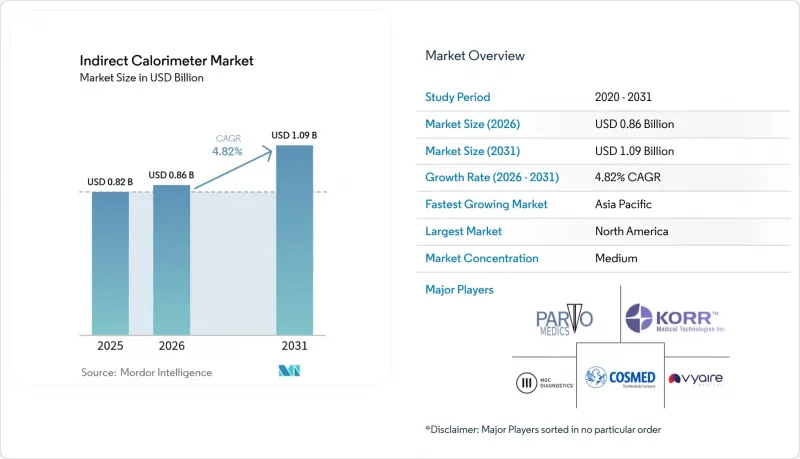
本報告按產品類型(獨立式、可攜式)、應用領域(醫療、運動健身、其他)、最終用戶(醫院、診斷中心、運動表現實驗室、其他)和地區(北美、歐洲、亞太、中東和非洲、南美)進行細分。市場預測以美元計價。
全球間接量熱儀市場趨勢及洞察
技術小型化和感測器成本降低
基於微機電系統(MEMS)的氧氣和二氧化碳感測器如今能夠以遠低於質譜分析的成本,提供與質譜分析相媲美的精度,並將測量不確定度降低至3%,且體積小巧,可輕鬆放入口袋。經過現場檢驗的系統,例如COSMED K4b2,證明攜帶式外形規格即使在戶外運動環境中也能達到實驗室標準的精確度。消費級原型產品與道格拉斯袋測量結果的相關性超過0.99,顯示運作監測正朝著連續性方向發展。更低的單次測量成本和更短的校準週期,使得在醫院床邊常規使用成為可能,並提高了在運動實驗室等真實環境中對運動員進行測量的柔軟性。源自學術研究的可攜式追蹤器,例如“Breezing”,凸顯了代謝分析的普及化。
在全球範圍內,肥胖和代謝紊亂的發生率正在上升。
預測公式無法準確估算超過80%的70歲及以上住院患者的靜止能量消耗,這進一步凸顯了臨床上對直接測量的需求。隨著肥胖相關代謝紊亂的日益增多,精確的熱量測定指導個性化宏量營養素的給藥,從而縮短ICU住院時間並減少併發症。結果數據顯示,由於人工呼吸器使用量的減少,間接熱量測定節省了成本,促使政府和保險公司擴大報銷間接熱量測定的費用。因此,由於慢性病盛行率的上升以及政策向以結果為導向的醫療模式轉變,間接熱量測定設備的市場正在不斷擴大。
前期投資和耗材成本高
獨立的ICU級系統售價超過25,000美元,而校準氣體、流量感測器和一次性閥門等額外費用加起來,給小規模診所帶來了沉重的年度維護負擔。因此,間接測熱儀市場更傾向於三級醫療機構和綜合醫療網路。攜帶式MEMS設備入門價格較低,但擴大醫保覆蓋範圍對於其更廣泛的應用至關重要。
細分市場分析
到2025年,獨立式間接測熱儀佔據了間接測熱儀市場62.70%的佔有率,這得益於重症監護室(ICU)強調絕對精度和全面分析菜單的電子健康記錄的無縫資料收集。可攜式間接測熱儀市場預計到2031年將以5.31%的複合年成長率成長,這反映出其精度不斷提高,可與實驗室基準相媲美,以及運動科學領域對攜帶式間接測熱儀的需求日益成長。
可攜式系統現在整合了微型湍流通道、微型加熱器和先進演算法,精度達到以往只有桌上型設備才能達到的±5%。運動表現中心非常欣賞其測量VO2和VCO2的柔軟性,無需將運動員固定在跑步機上。此外,一項遠距代謝測量試點計畫於2025年在居家醫療計畫中啟動,這表明其有望成為間接測熱儀市場未來新的收入來源。
區域分析
預計到2025年,北美將佔間接測熱儀市場收入的40.70%,主要得益於Medicare代碼94690的採用以及臨床協會的大力支持。供應商正透過聯合採購協議和服務捆綁協議來確保穩定的銷售管道。歐洲緊隨其後,成熟的ICU診療方案和多中心檢驗研究確保了德國、法國和北歐國家間接測熱儀的穩定應用。
亞太地區是成長最快的地區,預計到2031年將以5.26%的複合年成長率成長,這主要得益於各國推行的肥胖防治計劃以及中國和印度私立醫院的快速擴張。當地的契約製造製造商正在獲得西方感測器專利的授權,以生產成本最佳化的設備,從而提升間接測熱儀在該地區市場的滲透率。雖然中東和非洲的部署速度相對滯後,但波灣合作理事會(GCC)成員國的幾家教學醫院正在資助Q-NRG設備的部署,計劃在2025年前完成,這表明隨著培訓門檻的降低,潛在需求可能會轉化為現實。
在南美洲,間接測熱法正逐步普及。巴西的心肺復健診所傾向於使用可與6分鐘步行試驗配合使用的輕型測熱儀,而阿根廷的公立醫院則為每個加護叢集累計一台。這些趨勢共同作用,使各地區的收入結構更加多元化,從而保護間接測熱法市場免受任何特定地區衝擊的影響。
其他好處:
- Excel格式的市場預測(ME)表
- 3個月的分析師支持
目錄
第1章:引言
- 研究假設和市場定義
- 調查範圍
第2章:調查方法
第3章執行摘要
第4章 市場狀況
- 市場概覽
- 市場促進因素
- 技術小型化和感測器成本降低
- 全球肥胖和代謝性疾病日益增多
- 人們越來越意識到它的優勢
- 在加護病房引進精準營養療法
- 過渡到居家代謝檢測服務
- 擴大間接測熱法的保險代碼
- 市場限制因素
- 高昂的資本成本和營運成本
- 嚴格的監管和檢驗要求
- 熟練代謝檢測技術人員短缺
- 低流量兒童測量中的準確性漂移
- 監理情勢
- 技術展望
- 波特五力分析
第5章 市場規模與成長預測
- 依產品類型
- 獨立版
- 可攜式的
- 透過使用
- 醫療保健
- 運動與健身
- 其他
- 最終用戶
- 醫院
- 診斷中心
- 運動表現研究所
- 其他
- 按地區
- 北美洲
- 美國
- 加拿大
- 墨西哥
- 歐洲
- 德國
- 英國
- 法國
- 義大利
- 西班牙
- 其他歐洲國家
- 亞太地區
- 中國
- 日本
- 印度
- 澳洲
- 韓國
- 其他亞太國家
- 中東和非洲
- GCC
- 南非
- 其他中東和非洲國家
- 南美洲
- 巴西
- 阿根廷
- 其他南美國家
- 北美洲
第6章 競爭情勢
- 市場集中度
- 市佔率分析
- 公司簡介
- COSMED Srl
- MGC Diagnostics
- Vyaire Medical
- KORR Medical Technologies
- Maastricht Instruments BV
- Parvo Medics
- Microlife Medical(MedGem/BodyGem)
- Cortex Biophysik
- GE Healthcare
- Schiller AG
- CareFusion/BD
- iWorx Systems
- TSE Systems
- Room Calorimeters(UK)
- Geratherm Respiratory
- Omnical Netherlands
- Summit Healthcare(India)
- Sable Systems International
- CJD Technologies
- AEI Technologies
- Ultima Systems(USA)
第7章 市場機會與未來展望
According to Mordor Intelligence, the indirect calorimeter market size was valued at USD 0.82 billion in 2025 and estimated to grow from USD 0.86 billion in 2026 to reach USD 1.09 billion by 2031, at a CAGR of 4.82% during the forecast period (2026-2031).
This report is Segmented by Product Type (Standalone, Portable), Application (Medical Care, Sports and Fitness, Others), End User (Hospitals, Diagnostic Centers, Sports Performance Labs, Others), and Geography (North America, Europe, Asia-Pacific, Middle East and Africa, South America). The Market Forecasts are Provided in Terms of Value (USD).
Global Indirect Calorimeter Market Trends and Insights
Technological Miniaturization & Sensor Cost Decline
MEMS-based oxygen and carbon-dioxide sensors now rival mass-spectrometry precision at a fraction of the cost, cutting measurement uncertainty to 3% and shrinking form-factors to pocket scale . Field-validated systems such as the COSMED K4b2 prove that mobile calorimetry can match laboratory reference methods in outdoor sports settings. Consumer prototypes achieve >0.99 correlation with Douglas-bag measurements, signaling a shift toward always-on metabolic monitoring. Lower per-test costs and shorter calibration cycles help hospitals justify routine bedside use, while sports labs gain flexibility to test athletes in real-play environments. Academic spin-offs such as the Breezing portable tracker underscore this democratization of metabolic analytics.
Rising Global Obesity & Metabolic Disorders
Prediction equations fail to estimate resting energy expenditure accurately in over 80% of hospitalized adults aged >=70, reinforcing the clinical need for direct measurement. As obesity-related metabolic dysfunction grows, precise calorimetry guides tailored macronutrient dosing, shortens ICU stays, and reduces complications. Governments and insurers increasingly reimburse indirect calorimetry because outcome data reveal cost offsets from fewer ventilator days. The indirect calorimeter market therefore scales with chronic-disease prevalence and policy shifts toward outcome-based care.
High Capital & Disposable Costs
Stand-alone ICU-grade systems exceed USD 25,000 and require calibration gases, flow sensors, and single-use valves, adding annual ownership burdens that smaller clinics struggle to absorb . The indirect calorimeter market therefore favors tertiary hospitals and integrated health networks. Portable MEMS devices cut entry prices, but reimbursement schedules must widen for broader penetration.
Other drivers and restraints analyzed in the detailed report include:
- Growing Awareness About the Advantages
- ICU Adoption for Precision Nutrition Therapy
- Stringent Regulatory & Validation Requirements
For complete list of drivers and restraints, kindly check the Table Of Contents.
Segment Analysis
Standalone calorimeters commanded 62.70% of the indirect calorimeter market share in 2025 on the strength of ICU protocols that prize absolute accuracy and deep analytic menus. Workflow-oriented designs integrate with electronic medical records, ensuring seamless data capture. The indirect calorimeter market size for portable units is projected to climb at 5.31% CAGR to 2031, reflecting their growing equivalence to laboratory benchmarks and their appeal for sports-science field work.
Portable systems now embed mini turbulence channels, micro-heaters, and advanced algorithms, matching +-5% precision thresholds once exclusive to benchtop instruments. Sports performance centers value this flexibility to test VO2 and VCO2 without tethering athletes to treadmills. Healthcare-at-home programs also piloted remote metabolic testing in 2025, signaling another future revenue pool within the indirect calorimeter market.
Complete Report Scope:
- By Product Type
- Standalone
- Portable
- By Application
- Medical Care
- Sports and Fitness
- Others
- By End User
- Hospitals
- Diagnostic Centers
- Sports Performance Labs
- Others
- By Geography
- North America
- United States
- Canada
- Mexico
- Europe
- Germany
- United Kingdom
- France
- Italy
- Spain
- Rest of Europe
- Asia-Pacific
- China
- Japan
- India
- Australia
- South Korea
- Rest of Asia-Pacific
- Middle East and Africa
- GCC
- South Africa
- Rest of Middle East and Africa
- South America
- Brazil
- Argentina
- Rest of South America
- North America
Geography Analysis
North America generated 40.70% of 2025 revenue for the indirect calorimeter market, leveraging Medicare code 94690 and strong clinical-society endorsements. Device vendors secure predictable sales funnels via group-purchasing contracts and bundled service agreements. Europe follows with entrenched ICU protocols and multicenter validation studies that maintain steady installations in Germany, France, and the Nordics.
Asia-Pacific is the fastest expanding geography at 5.26% CAGR to 2031, propelled by national obesity-control programs and rapid private-hospital growth in China and India. Local contract manufacturers are licensing Western sensor patents to produce cost-optimized units, aiding regional penetration of the indirect calorimeter market. Middle East and Africa lag in installed base but several teaching hospitals in the Gulf Cooperation Council funded Q-NRG fleets in 2025, hinting at latent demand once training hurdles ease.
South America observes moderate uptake; Brazil's cardiopulmonary rehab clinics favor lightweight calorimeters that couple with six-minute-walk tests, while Argentina's social-security hospitals budget for one device per ICU cluster. Collectively these dynamics diversify the regional revenue mix and insulate the indirect calorimeter market from single-region shocks.
- COSMED Srl
- MGC Diagnostics
- Vyaire Medical
- KORR Medical Technologies
- Maastricht Instruments
- Parvo Medics
- Microlife Medical (MedGem/BodyGem)
- Cortex Biophysik
- GE Healthcare
- Schiller
- CareFusion / BD
- iWorx Systems
- TSE Systems
- Room Calorimeters (UK)
- Geratherm Respiratory
- Omnical Netherlands
- Summit Healthcare (India)
- Sable Systems International
- CJD Technologies
- AEI Technologies
- Ultima Systems (USA)
Additional Benefits:
- The market estimate (ME) sheet in Excel format
- 3 months of analyst support
TABLE OF CONTENTS
1 Introduction
- 1.1 Study Assumptions & Market Definition
- 1.2 Scope of the Study
2 Research Methodology
3 Executive Summary
4 Market Landscape
- 4.1 Market Overview
- 4.2 Market Drivers
- 4.2.1 Technological miniaturization & sensor cost decline
- 4.2.2 Rising global obesity & metabolic disorders
- 4.2.3 Growing Awareness about the advantages
- 4.2.4 ICU adoption for precision nutrition therapy
- 4.2.5 Shift to at-home metabolic testing services
- 4.2.6 Insurance coding expansion for indirect calorimetry
- 4.3 Market Restraints
- 4.3.1 High capital & disposable costs
- 4.3.2 Stringent regulatory/validation requirements
- 4.3.3 Lack of trained metabolic technologists
- 4.3.4 \Accuracy drift in low-flow pediatric measurements
- 4.4 Regulatory Landscape
- 4.5 Technological Outlook
- 4.6 Porter's Five Forces Analysis
- 4.6.1 Threat of New Entrants
- 4.6.2 Bargaining Power of Buyers
- 4.6.3 Bargaining Power of Suppliers
- 4.6.4 Threat of Substitutes
- 4.6.5 Intensity of Competitive Rivalry
5 Market Size & Growth Forecasts (Value, USD)
- 5.1 By Product Type
- 5.1.1 Standalone
- 5.1.2 Portable
- 5.2 By Application
- 5.2.1 Medical Care
- 5.2.2 Sports and Fitness
- 5.2.3 Others
- 5.3 By End User
- 5.3.1 Hospitals
- 5.3.2 Diagnostic Centers
- 5.3.3 Sports Performance Labs
- 5.3.4 Others
- 5.4 By Geography
- 5.4.1 North America
- 5.4.1.1 United States
- 5.4.1.2 Canada
- 5.4.1.3 Mexico
- 5.4.2 Europe
- 5.4.2.1 Germany
- 5.4.2.2 United Kingdom
- 5.4.2.3 France
- 5.4.2.4 Italy
- 5.4.2.5 Spain
- 5.4.2.6 Rest of Europe
- 5.4.3 Asia-Pacific
- 5.4.3.1 China
- 5.4.3.2 Japan
- 5.4.3.3 India
- 5.4.3.4 Australia
- 5.4.3.5 South Korea
- 5.4.3.6 Rest of Asia-Pacific
- 5.4.4 Middle East and Africa
- 5.4.4.1 GCC
- 5.4.4.2 South Africa
- 5.4.4.3 Rest of Middle East and Africa
- 5.4.5 South America
- 5.4.5.1 Brazil
- 5.4.5.2 Argentina
- 5.4.5.3 Rest of South America
- 5.4.1 North America
6 Competitive Landscape
- 6.1 Market Concentration
- 6.2 Market Share Analysis
- 6.3 Company Profiles (includes Global level Overview, Market level overview, Core Segments, Financials as available, Strategic Information, Market Rank/Share for key companies, Products & Services, and Recent Developments)
- 6.3.1 COSMED Srl
- 6.3.2 MGC Diagnostics
- 6.3.3 Vyaire Medical
- 6.3.4 KORR Medical Technologies
- 6.3.5 Maastricht Instruments BV
- 6.3.6 Parvo Medics
- 6.3.7 Microlife Medical (MedGem/BodyGem)
- 6.3.8 Cortex Biophysik
- 6.3.9 GE Healthcare
- 6.3.10 Schiller AG
- 6.3.11 CareFusion / BD
- 6.3.12 iWorx Systems
- 6.3.13 TSE Systems
- 6.3.14 Room Calorimeters (UK)
- 6.3.15 Geratherm Respiratory
- 6.3.16 Omnical Netherlands
- 6.3.17 Summit Healthcare (India)
- 6.3.18 Sable Systems International
- 6.3.19 CJD Technologies
- 6.3.20 AEI Technologies
- 6.3.21 Ultima Systems (USA)
7 Market Opportunities & Future Outlook
- 7.1 White-space & Unmet-Need Assessment

 2026年全球帶觸控螢幕室內壓力監測器市場報告
 水平測量儀器市場規模、佔有率和成長分析:按產品類型、技術、應用、最終用戶產業和地區分類-2026-2033年產業預測2026年全球工程秤市場報告
 雷射光束分析儀市場規模:按產品類型、應用、終端用戶產業、地區和未來預測分類
 工業觸控螢幕市場:按技術、螢幕大小、應用和地區分類
 雷射光束分析儀市場分析及預測(至2035年):依類型、產品、服務、技術、組件、應用、形式、設備及最終用戶分類
 電氣安全分析儀市場規模、佔有率和成長分析:外形規格、測試參數類型、產品模式、輸出電壓範圍、最終用戶產業和地區分類-2026-2033年產業預測
 地球化學服務市場:全球市場按服務類型、技術、樣品類型、應用和最終用戶分類的預測——2026-2032年
 晶圓厚度測量系統市場:全球產業分析、市場規模、市場佔有率和預測(2026-2033 年),按產品類型、測量範圍、功能、技術、最終用戶、國家和地區分類樣條測量儀器市場:依類型、測量方法、應用、最終用途、國家及地區分類-全球產業分析、市場規模、市場佔有率及2026年至2033年預測