


 |
市場調查報告書
商品編碼
2114814
家用電器包裝:市場佔有率分析、產業趨勢與統計、成長預測(2026-2031)Consumer Electronics Packaging - Market Share Analysis, Industry Trends & Statistics, Growth Forecasts (2026 - 2031) |
||||||

※ 本網頁內容可能與最新版本有所差異。詳細情況請與我們聯繫。
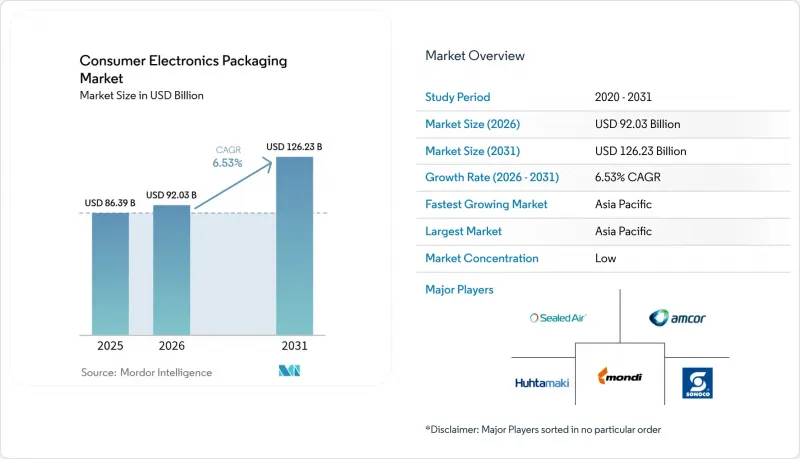
根據 Mordor Intelligence 估計,2026 年消費性電子產品包裝市值將達到 920.3 億美元,高於 2025 年的 863.9 億美元,預計到 2031 年將達到 1,262.3 億美元。
預計從 2026 年到 2031 年,其複合年成長率將達到 6.53%。
本報告按材料(塑膠、紙張)、包裝類型(吸塑包裝、翻蓋包裝、其他)、功能(初級包裝、二級包裝/展示包裝、其他)、消費性電子產品(智慧型手機、計算設備、電視/機上盒、穿戴式設備/助聽設備、其他)和地區進行細分。市場預測以美元計價。
全球消費性電子產品包裝市場趨勢及洞察
電子商務的快速發展推動了對具有保護性和便於運輸的包裝的需求。
2024年假期季節,消費性電子產品的線上銷售額達到553億美元,較去年同期成長8.8%。從商店展示到運輸最佳化包裝的轉變,推動了對工程緩衝材料、防篡改功能以及自動化、尺寸合適的包裝的需求成長。 Ranpak的「Cut'it EVO Multi-Lid」系統減少了包裝內的空氣空隙,降低了運輸成本,同時也有助於永續性指標。品牌擁有者將包裝視為產品體驗的延伸,並利用QR碼來增強售後互動。隨著小包裹遞送網路的日益複雜和分散,消費性電子產品包裝市場也不斷擴張,其規格也隨之調整,以適應多階段處理流程和不斷變化的氣候條件。
符合生產者責任延伸制度和塑膠禁令要求的環保基材。
歐盟的《包裝及包裝廢棄物法規》規定,到2025年,所有消費性包裝的回收率必須達到65%。為了確保市場准入,各大品牌正迅速轉向使用可回收纖維和生質塑膠混合物。羅技公司將滑鼠包裝改為紙質包裝,每年減少了660噸塑膠用量和6000噸碳排放。 Paptic和Woodley公司正在將具有防潮性能的阻隔塗層紙商業化,這種性能先前僅限於聚合物。隨著加工商改造生產線以適應纖維基材,消費性電子產品包裝市場正在逐步擴張,但監管認證的前置作業時間仍然是一個瓶頸。
紙漿、紙張和聚合物原料價格的波動
2024年至2025年間,紙漿價格波動幅度達25%至40%,反映氣候變遷與物流瓶頸的影響。聚合物價格仍然與原油價格波動密切相關,這給消費電子包裝市場加工商的利潤率帶來了壓力。大型企業紛紛對沖原料成本,而許多中小企業往往接受較短的估算週期,這引發了原始設備製造商(OEM)對成本可見性的擔憂。
細分市場分析
塑膠解決方案憑藉其防潮和防穿刺性能,能夠有效保護複雜的電子設備,預計到2025年將佔總銷售額的54.88%。發泡內襯和熱成型托盤仍然是旗艦智慧型手機和電腦硬體的標準包裝材料。然而,隨著品牌遵守生產者延伸責任(EPR)標準和碳排放目標,消費性電子產品包裝中紙基材料的市場規模正以7.36%的複合年成長率成長,預計到2031年將持續成長。可折疊紙盒和模塑纖維緩衝材料現在採用水性塗層,使其具備以往只有聚合物才能實現的抗靜電和耐油性能。
諸如斯道拉恩索的「Papira」纖維素泡沫等技術進步,在提供與發泡聚乙烯(PE)相當的跌落測試性能的同時,也兼具纖維的可回收性。結合紙質外層和薄聚合物內膜的混合包裝正日益受到關注,它在法規遵從性和性能之間取得了平衡。提供生命週期評估(LCA)數據的加工商在競標中佔優勢,進一步鞏固了紙本材料在消費性電子包裝市場的發展動能。
到2025年,瓦楞紙箱和托盤(構成從工廠到零售所有物流的基礎)將佔銷售額的30.31%。成長最快的細分市場是保護性郵寄信封和氣泡膜,預計到2031年將達到9.27%的複合年成長率,這主要得益於直接面對消費者(DTC)的配送模式。隨著輕量穿戴裝置和配件擴大採用獨立配送方式,消費性電子包裝市場中郵寄信封的市場規模也不斷擴大。
創新的包裝設計巧妙地融合了緩衝保護和品牌故事敘述。紡織包裝袋外觀高階,可重複使用,深受環保意識強的消費者青睞。生產線上形成的充氣腔室減少了材料用量,而模塑纖維翻蓋式容器則延長了零售貨架期,並便於路邊回收。這種多功能包裝設計既支援自動化包裝,又能提升貨架可見度,在OEM競標中獲得了最高分。
區域分析
由於強大的製造業基礎以及智慧型手機和穿戴式裝置國內消費的激增,亞太地區預計到2025年將佔消費電子包裝市場39.74%的佔有率。在越南、印度和馬來西亞旨在實現加工商產能在地化和縮短前置作業時間的激勵措施的推動下,該地區的複合年成長率預計到2031年將達到9.75%。中國加工商正在利用機器人技術來管理多樣化的產品組合,而印度瓦楞紙板製造商則正在採用數位印刷機來適應可變幾何印刷。
在北美,高階電子產品和訂閱模式的品牌持續蓬勃發展,並專注於推廣可回收纖維和智慧包裝的應用。品牌正在美國和加拿大試點應用RFID技術的試驗計畫,推動消費性電子產品包裝市場早期採用者的需求。區域物流供應商正攜手開發可按需密封包裝的自動化單元,以滿足小包裹承運商的尺寸要求。
歐洲引領監管潮流,為可回收性和再生材料含量標準樹立了全球先例。總部位於德國、瑞典和法國的原始設備製造商(OEM)正在檢驗纖維素泡沫和單一材料軟性包裝等創新技術,為全球推廣做準備。在中東和非洲,智慧型手機普及率的提高和基礎設施的完善,正推動著高溫氣候下對防潮包裝的需求逐步成長。南美洲受益於北美供應鏈的近岸外包,尤其是墨西哥的電子產品生產在某些品類上的表現優於來自中國的進口產品。
其他福利
- Excel格式的市場預測(ME)表
- 3個月的分析師支持
目錄
第1章:引言
- 研究假設和市場定義
- 調查範圍
第2章:調查方法
第3章執行摘要
第4章 市場狀況
- 市場概覽
- 市場促進因素
- 電子商務的快速發展推動了能夠提供保護且適合運輸的包裝形式的發展。
- 根據EPR塑膠禁令措施,必須使用環保基材。
- 具備防偽和防篡改功能,以保護品牌。
- 亞洲新興市場智慧型手機和穿戴式裝置出貨量成長
- 面向循環經濟的逆向物流RFID包裝材料。
- 透過小型化模組化包裝,減少運輸體積和成本。
- 市場限制因素
- 紙漿、紙張和聚合物等原料價格的波動
- 加強全球對一次性塑膠製品的監管
- 減少以 DaaS(設備即服務)模式銷售的包裝產品數量。
- 受半導體供應衝擊影響,電子產品生產放緩
- 供應鏈分析
- 監理展望
- 技術展望
- 波特五力分析
- 投資分析
第5章 市場規模與成長預測
- 材料
- 塑膠
- 發泡體
- 熱成型托盤
- 其他塑膠
- 紙
- 折疊紙箱
- 瓦楞紙箱
- 其他論文
- 塑膠
- 按包裝類型
- 吸塑包裝
- 蛤殼
- 保護性信封及氣泡膜
- 托盤插入件
- 瓦楞紙箱和托盤
- 按功能
- 初級包裝
- 二級包裝和展示包裝
- 三級包裝/物流包裝
- 防偽安全包裝
- 智慧互聯包裝
- 家用電器
- 智慧型手機
- 計算設備
- 電視機上盒
- 穿戴式和可聽見的
- 智慧家庭物聯網設備
- 其他家用電器
- 按地區
- 北美洲
- 美國
- 加拿大
- 墨西哥
- 歐洲
- 德國
- 英國
- 法國
- 義大利
- 西班牙
- 俄羅斯
- 其他歐洲國家
- 亞太地區
- 中國
- 印度
- 日本
- 韓國
- 澳洲和紐西蘭
- 其他亞太國家
- 中東和非洲
- 中東
- 阿拉伯聯合大公國
- 沙烏地阿拉伯
- 土耳其
- 其他中東國家
- 非洲
- 南非
- 奈及利亞
- 埃及
- 其他非洲國家
- 中東
- 南美洲
- 巴西
- 阿根廷
- 其他南美國家
- 北美洲
第6章 競爭情勢
- 市場集中度
- 策略趨勢
- 市佔率分析
- 公司簡介
- Sealed Air Corporation
- Smurfit WestRock
- International Paper Co.
- Pregis LLC
- Sonoco Products Co.
- Stora Enso Oyj
- Dordan Manufacturing
- Mondi Group
- Amcor plc
- Nefab AB
- UFP Technologies Inc.
- ProAmpac LLC
- Huhtamaki Oyj
- DunaPack Packaging Group
- Clondalkin Group
- Johns Byrne Co.
- Ball Corp.(Aerosol & Transit)
- Molded Fiber Glass Co.
第7章 市場機會與未來展望
According to Mordor Intelligence, the consumer electronic packaging market size in 2026 is estimated at USD 92.03 billion, growing from 2025 value of USD 86.39 billion with 2031 projections showing USD 126.23 billion, growing at 6.53% CAGR over 2026-2031.
This report is Segmented by Material (Plastics, Paper), Packaging Format (Blister Packs, Clamshells, and More), Function (Primary Packaging, Secondary/Display Packaging, and More), Consumer Electronics (Smartphones, Computing Devices, TV and Set-Top Boxes, Wearables and Hearables, and More), and Geography. The Market Forecasts are Provided in Terms of Value (USD).
Global Consumer Electronics Packaging Market Trends and Insights
E-commerce boom driving protective and transit-ready formats
Holiday-season online sales of consumer electronics reached USD 55.3 billion in 2024, an 8.8% year-over-year increase. The shift from shelf-ready displays to transit-optimised packs raises the demand for engineered cushioning, tamper evidence, and right-size automation. Ranpak's Cut'it EVO Multi-Lid system reduces void space and freight costs while boosting sustainability metrics. Brand owners view packaging as an extension of the product experience, integrating quick-response codes for post-purchase engagement. As parcel networks grow denser and more fragmented, the consumer electronic packaging market expands with specifications tailored to multi-touch handling and variable climates.
Eco-friendly substrates mandated by EPR and plastics bans
The EU Packaging and Packaging Waste Regulation enforces a 65% recycling rate for all consumer packaging by 2025. Brands shift rapidly to recyclable fibre and bio-plastic blends to secure market access. Logitech eliminated 660 tons of plastic annually by converting mice packaging to paper-based formats, cutting carbon emissions by 6,000 tons. Paptic and Woodly commercialise barrier-coated papers delivering moisture protection once reserved for polymers. The consumer electronic packaging market gains incremental volume as converters retrofit lines for fibre substrates, though lead times for regulatory certification remain a bottleneck.
Volatile pulp, paper and polymer feedstock prices
Pulp prices fluctuated 25-40% from 2024 to 2025, reflecting climatic disruptions and logistics bottlenecks.Polymer pricing remains tied to crude oil swings, squeezing converter margins in the consumer electronic packaging market. Large players hedge inputs, but small and mid-sized firms often accept shorter quoting cycles, raising cost visibility concerns for OEMs.
Other drivers and restraints analyzed in the detailed report include:
- Anti-counterfeit and tamper-evident features for brand protection
- Rising smartphone and wearable shipments in emerging Asia
- Single-use-plastic restrictions tightening worldwide
For complete list of drivers and restraints, kindly check the Table Of Contents.
Segment Analysis
Plastic solutions retained 54.88% of total revenue in 2025 thanks to their moisture barrier and puncture resistance properties that safeguard complex electronics. Foam inserts and thermoformed trays remain the baseline for flagship smartphones and computing hardware. The consumer electronic packaging market size for paper substrates, however, is expanding at a 7.36% CAGR through 2031 as brands align with EPR thresholds and carbon targets. Folding cartons and molded fibre cushionings now integrate water-based coatings that provide antistatic and grease resistance previously achievable only with polymers.
Technological advances such as Stora Enso's Papira cellulose foam deliver comparable drop-test performance to expanded PE while offering fibre recyclability. Hybrid packs that combine paper exteriors with thin internal polymer films gain traction, balancing compliance with performance. Converters marketing life-cycle assessment data win bidding rounds, reinforcing paper momentum inside the consumer electronic packaging market.
Corrugated master cartons and pallets accounted for 30.31% of revenue in 2025 because they underpin every logistics move from factory to retailer. Growth accelerates most in protective mailers and bubble wraps, which post a 9.27% CAGR to 2031 on the back of direct-to-consumer fulfilment. The consumer electronic packaging market size for mailers rises as lightweight wearables and accessories ship individually.
Format innovation blends cushioning with brand storytelling. Textile-based pouches provide premium aesthetics and reusability, appealing to eco-centric consumers. Air-filled chambers formed in line reduce materials, and molded fibre clamshells extend retail display life while enabling curbside recycling. Multi-function formats that support both auto-packing and shelf visibility receive the highest RFP scores in OEM tenders.
Complete Report Scope:
- By Material
- Plastics
- Foam
- Thermoformed Trays
- Other Plastics
- Paper
- Folding Cartons
- Corrugated Boxes
- Other Papers
- Plastics
- By Packaging Format
- Blister Packs
- Clamshells
- Protective Mailers and Bubble Wrap
- Trays and Inserts
- Corrugated Boxes and Pallets
- By Function
- Primary Packaging
- Secondary/Display Packaging
- Tertiary and Logistics Packaging
- Anti-counterfeit and Security Packaging
- Smart/Connected Packaging
- By Consumer Electronics
- Smartphones
- Computing Devices
- TV and Set-Top Boxes
- Wearables and Hearables
- Smart Home / IoT Devices
- Other Consumer Electronics
- By Geography
- North America
- United States
- Canada
- Mexico
- Europe
- Germany
- United Kingdom
- France
- Italy
- Spain
- Russia
- Rest of Europe
- Asia-Pacific
- China
- India
- Japan
- South Korea
- Australia and New Zealand
- Rest of Asia-Pacific
- Middle East and Africa
- Middle East
- United Arab Emirates
- Saudi Arabia
- Turkey
- Rest of Middle East
- Africa
- South Africa
- Nigeria
- Egypt
- Rest of Africa
- Middle East
- South America
- Brazil
- Argentina
- Rest of South America
- North America
Geography Analysis
Asia-Pacific captured 39.74% of the consumer electronic packaging market in 2025, underpinned by its deep manufacturing bases and surging domestic consumption of smartphones and wearables. Regional CAGR stands at 9.75% through 2031, aided by policy incentives in Vietnam, India, and Malaysia that localise converter capacity and shorten lead times. Chinese converters leverage robotics to manage diverse SKU portfolios, while India's corrugated producers add digital presses for variable print.
North America retains strength in premium electronics and subscription models that favour recyclable fibre and smart pack integration. Brands place pilot programs for RFID-enabled circular frameworks in the US and Canada, driving early-adopter demand inside the consumer electronic packaging market. Regional logistics providers co-develop automation cells that seal on demand, aligning with parcel carrier dimension requirements.
Europe leads regulatory momentum, setting global precedents on recyclability and recycled-content thresholds. OEMs headquartered in Germany, Sweden, and France validate innovations such as cellulose foams and mono-material flexibles before global rollout. Middle East and Africa see rising smartphone penetration paired with infrastructure build-outs, generating incremental demand for moisture-resistant packs in hot climates. South America benefits from near-shoring of North American supply chains, especially as Mexican electronics production eclipses imports from China in certain categories.
- Sealed Air Corporation
- Smurfit WestRock
- International Paper Co.
- Pregis LLC
- Sonoco Products Co.
- Stora Enso Oyj
- Dordan Manufacturing
- Mondi Group
- Amcor plc
- Nefab AB
- UFP Technologies Inc.
- ProAmpac LLC
- Huhtamaki Oyj
- DunaPack Packaging Group
- Clondalkin Group
- Johns Byrne Co.
- Ball Corp. (Aerosol & Transit)
- Molded Fiber Glass Co.
Additional Benefits:
- The market estimate (ME) sheet in Excel format
- 3 months of analyst support
TABLE OF CONTENTS
1 INTRODUCTION
- 1.1 Study Assumptions and Market Definition
- 1.2 Scope of the Study
2 RESEARCH METHODOLOGY
3 EXECUTIVE SUMMARY
4 MARKET LANDSCAPE
- 4.1 Market Overview
- 4.2 Market Drivers
- 4.2.1 E-commerce boom driving protective and transit-ready formats
- 4.2.2 Eco-friendly substrates mandated by EPR and plastics bans
- 4.2.3 Anti-counterfeit and tamper-evident features for brand protection
- 4.2.4 Rising smartphone and wearable shipments in emerging Asia
- 4.2.5 RFID-enabled reverse-logistics packaging for circular economy
- 4.2.6 Miniaturized modular packs lowering freight cube and costs
- 4.3 Market Restraints
- 4.3.1 Volatile pulp, paper and polymer feedstock prices
- 4.3.2 Single-use-plastic restrictions tightening worldwide
- 4.3.3 Device-as-a-Service model curbing packaged unit volumes
- 4.3.4 Semiconductor supply shocks dampening electronics output
- 4.4 Supply-Chain Analysis
- 4.5 Regulatory Outlook
- 4.6 Technological Outlook
- 4.7 Porter's Five Forces Analysis
- 4.7.1 Threat of New Entrants
- 4.7.2 Bargaining Power of Buyers
- 4.7.3 Bargaining Power of Suppliers
- 4.7.4 Threat of Substitutes
- 4.7.5 Intensity of Competitive Rivalry
- 4.8 Investment Analysis
5 MARKET SIZE AND GROWTH FORECASTS (VALUE)
- 5.1 By Material
- 5.1.1 Plastics
- 5.1.1.1 Foam
- 5.1.1.2 Thermoformed Trays
- 5.1.1.3 Other Plastics
- 5.1.2 Paper
- 5.1.2.1 Folding Cartons
- 5.1.2.2 Corrugated Boxes
- 5.1.2.3 Other Papers
- 5.1.1 Plastics
- 5.2 By Packaging Format
- 5.2.1 Blister Packs
- 5.2.2 Clamshells
- 5.2.3 Protective Mailers and Bubble Wrap
- 5.2.4 Trays and Inserts
- 5.2.5 Corrugated Boxes and Pallets
- 5.3 By Function
- 5.3.1 Primary Packaging
- 5.3.2 Secondary/Display Packaging
- 5.3.3 Tertiary and Logistics Packaging
- 5.3.4 Anti-counterfeit and Security Packaging
- 5.3.5 Smart/Connected Packaging
- 5.4 By Consumer Electronics
- 5.4.1 Smartphones
- 5.4.2 Computing Devices
- 5.4.3 TV and Set-Top Boxes
- 5.4.4 Wearables and Hearables
- 5.4.5 Smart Home / IoT Devices
- 5.4.6 Other Consumer Electronics
- 5.5 By Geography
- 5.5.1 North America
- 5.5.1.1 United States
- 5.5.1.2 Canada
- 5.5.1.3 Mexico
- 5.5.2 Europe
- 5.5.2.1 Germany
- 5.5.2.2 United Kingdom
- 5.5.2.3 France
- 5.5.2.4 Italy
- 5.5.2.5 Spain
- 5.5.2.6 Russia
- 5.5.2.7 Rest of Europe
- 5.5.3 Asia-Pacific
- 5.5.3.1 China
- 5.5.3.2 India
- 5.5.3.3 Japan
- 5.5.3.4 South Korea
- 5.5.3.5 Australia and New Zealand
- 5.5.3.6 Rest of Asia-Pacific
- 5.5.4 Middle East and Africa
- 5.5.4.1 Middle East
- 5.5.4.1.1 United Arab Emirates
- 5.5.4.1.2 Saudi Arabia
- 5.5.4.1.3 Turkey
- 5.5.4.1.4 Rest of Middle East
- 5.5.4.2 Africa
- 5.5.4.2.1 South Africa
- 5.5.4.2.2 Nigeria
- 5.5.4.2.3 Egypt
- 5.5.4.2.4 Rest of Africa
- 5.5.4.1 Middle East
- 5.5.5 South America
- 5.5.5.1 Brazil
- 5.5.5.2 Argentina
- 5.5.5.3 Rest of South America
- 5.5.1 North America
6 COMPETITIVE LANDSCAPE
- 6.1 Market Concentration
- 6.2 Strategic Moves
- 6.3 Market Share Analysis
- 6.4 Company Profiles (Includes Global level Overview, Market level overview, Core Segments, Financials as available, Strategic Information, Market Rank/Share for key companies, Products and Services, and Recent Developments)
- 6.4.1 Sealed Air Corporation
- 6.4.2 Smurfit WestRock
- 6.4.3 International Paper Co.
- 6.4.4 Pregis LLC
- 6.4.5 Sonoco Products Co.
- 6.4.6 Stora Enso Oyj
- 6.4.7 Dordan Manufacturing
- 6.4.8 Mondi Group
- 6.4.9 Amcor plc
- 6.4.10 Nefab AB
- 6.4.11 UFP Technologies Inc.
- 6.4.12 ProAmpac LLC
- 6.4.13 Huhtamaki Oyj
- 6.4.14 DunaPack Packaging Group
- 6.4.15 Clondalkin Group
- 6.4.16 Johns Byrne Co.
- 6.4.17 Ball Corp. (Aerosol & Transit)
- 6.4.18 Molded Fiber Glass Co.
7 MARKET OPPORTUNITIES AND FUTURE OUTLOOK
- 7.1 White-space and Unmet-Need Assessment

 家用電子電器包裝市場:依材料、產品類型、應用、包裝形式、通路、國家及地區分類-全球產業分析、市場規模、市場佔有率及2026年至2033年預測
 消費性電子產品包裝市場:依材料類型、產品類型和地區分類
 TWS耳機包裝材料市場:按材料類型、價格範圍、最終用途、分銷管道和應用分類-2026-2032年全球預測
 消費性電子產品包裝市場分析及預測(至2035年):按類型、產品、材料類型、技術、應用、組件、最終用戶、功能、製程及解決方案分類
 2026年全球消費性電子產品包裝市場報告
 消費性電子產品包裝市場-2026-2031年預測工業電子封裝市場-2026-2031年預測