


 |
市場調查報告書
商品編碼
2114804
電子掃描陣列雷達:市場佔有率分析、行業趨勢和統計數據、成長預測(2026-2031)Electronically Scanned Array Radar - Market Share Analysis, Industry Trends & Statistics, Growth Forecasts (2026 - 2031) |
||||||

※ 本網頁內容可能與最新版本有所差異。詳細情況請與我們聯繫。
據 Mordor Intelligence 稱,2025 年電子掃描陣列 (ESA) 雷達市場價值為 102.9 億美元,預計到 2031 年將達到 154.8 億美元,而 2026 年為 110.2 億美元,預測期(2026-2031 年)的複合年成長率為 7.05%。
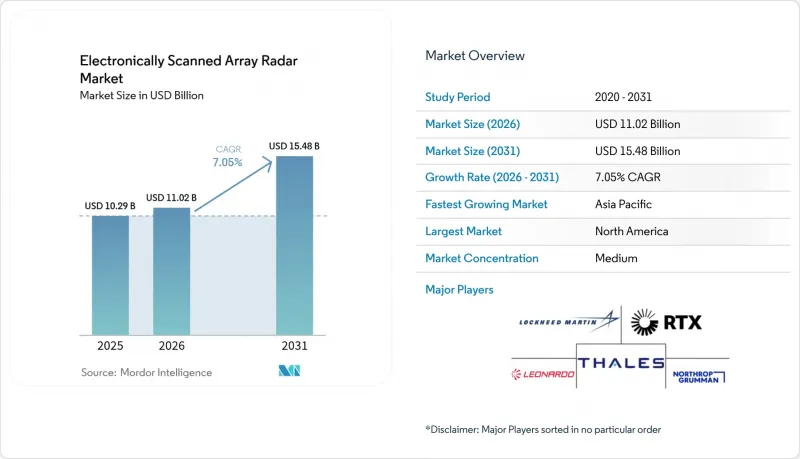
本報告按類型(AESA等)、平台(陸基、機載等)、部署配置(新安裝和維修)、頻段(L波段和S波段等)、應用(監視/預警等)、最終用戶(國防部隊等)、組件(數位訊號處理器等)和地區(北美等)進行細分。市場預測以美元計價。
全球主動相控陣雷達(AESA)市場趨勢與洞察
軍事現代化計畫加速了AESA採購
在下一代裝備中,有源相控陣雷達(AESA)的功能已從「理想之選」轉變為「必不可少」。美國空軍已部署諾斯羅普·格魯曼公司的AN/TPS-80 G/ATOR雷達,該雷達將五種常規功能整合於單一平台。歐洲各國也紛紛效仿,英國整合了其先進的「颱風」雷達,愛沙尼亞則採購了泰雷茲公司的GM400a系統。這種加速採購的趨勢反映出人們意識到,傳統的機械掃描雷達已不足以應對多域作戰。人工智慧驅動的模式進一步提升了任務價值。因此,國防機構現在將AESA定位為網路中心戰的基礎架構。
對多功能4D情境察覺雷達的需求
操作人員需要即時取得方位角、仰角、距離和多普勒資料。泰雷茲公司的NS200雷達可提供高達400公里的全數位波束成形,支援集群防禦和飛彈導引。洛克希德馬丁公司的遠程識別雷達可追蹤2000公里以外的目標,用於彈道飛彈防禦。民用航空領域的下一代航空運輸系統(NextGen)計畫同樣推動了對先進監視系統的需求。軍民兩用需求的整合降低了單位成本。單孔徑即可覆蓋多種任務的能力徹底改變了平台設計的經濟性。
與傳統系統相比,此項目資本支出更高。
升級到AESA雷達需要大量的初期投入。 B-52轟炸機的雷達更換專案已經超出最初的預算,進度落後。諾斯羅普·格魯曼公司訂單的B-1轟炸機天線維修合約價值1.215億美元,這清楚地表明了這項投資的規模。與電源、冷卻和資料匯流排相關的複雜整合工作使預算大幅膨脹。小規模的國防機構正在推遲採用AESA雷達,從而維持了市場兩極化的格局。
細分市場分析
到2025年,AESA技術將佔銷售額的62.96%,分散式收發模組消除了單點故障,預計到2031年,該細分市場將以9.32%的複合年成長率成長。電子掃描陣列雷達市場的優勢在於,即使在戰鬥傷害的情況下,也能分階段保持性能,因為每個模組都是獨立可擴展的。被動電子掃描陣列(PESA)仍然用於對成本要求較高的地面任務,但由於氮化鎵(GaN)裝置價格的下降,兩者之間的成本差距正在縮小。人工智慧驅動的波形自適應技術進一步擴大了AESA的效能優勢。
對抗高級干擾能力日益成長的需求推動了AESA配置的普及,這種配置能夠在微秒內跳頻並定向波束。隨著產量的增加,規模經濟效應使得AESA的單位成本越來越接近PESA,從而重塑了採購決策的標準。軟體定義更新延長了使用壽命並加快了功能升級。因此,預計到2031年,AESA平台的電子掃描陣列雷達市場規模將達到97.5億美元,鞏固其作為航空航太、海事和地面系統標準架構的地位。
到2025年,陸基系統將佔45.12%的佔有率,而海軍設施的複合年成長率預計為10.62%,在所有平台中最高。新建的驅逐艦、護衛艦和兩棲攻擊艦將整合SPY-6、CERETRON和GhostEye系統,取代機械掃描陣列。雷神公司價值11.8億美元的SPY-6系列合約清楚地表明了其大規模生產的潛力。
海事領域的蓬勃發展反映了印太地區艦隊的現代化以及對分散式飛彈防禦網路的需求。在陸地領域,對反無人機系統(UAS)的需求支撐著地面設備的銷售,而對F-15EX和鷹獅E戰鬥機機載系統升級的需求仍然強勁。儘管規模較小,但太空和高空偽衛星領域的需求也逐漸成長。整體而言,隨著海基彈道飛彈防禦成為重中之重,預計到2031年,海軍平台用電子掃描陣列雷達的市場佔有率將增加4個百分點。
隨著F-35、Type 26和衛星群級飛機的採購計劃,預計到2025年,Line-Fit交付將佔總收入的68.23%。然而,隨著軍方延長老舊艦艇的服役年限,改裝業務正以10.21%的複合年成長率快速成長。 APG-79雷達整合到F/A-18戰鬥機以及SPY-6雷達改裝到尼米茲級航母上,都清楚地展現了這一成長規模。
模組化陣列和通用後端處理器簡化了部署並減少了停機時間。數位介面減少了佈線,整合式冷卻板最大限度地減少了結構改造的需求。因此,改裝的設備無需平台升級所需的大量資本支出即可達到接近全新設備的性能,這將推動電子掃描陣列(ESA)雷達市場在2020年代中期持續成長。
區域分析
憑藉全球最大的國防預算和成熟的工業基礎,北美預計到2025年將維持35.12%的市場佔有率。 SPY-6和TPY-4系統的多年生產支撐著區域需求,而對老舊雷達進行人工智慧(AI)升級則確保了售後市場收入。加拿大的北美防空司令部(NORAD)現代化計畫和墨西哥的邊防安全計畫正在推動更多訂單。對氮化鎵(GaN)晶圓廠產能的持續投資,使該地區即使在日益激烈的全球競爭中也能保持出口競爭力。
預計到2031年,亞太地區將以9.61%的複合年成長率實現最高成長。中國的KJ-3000預警機平台以及在南海垃圾掩埋場基地部署相位陣列雷達,正加速周邊國家的採購。日本向菲律賓和蒙古提供FPS-3ME雷達,體現了防務合作的深化。印度自主研發的Uttam雷達體現了其維護國家主權的決心,而韓國韓華系統公司正在為其FFX-III型護衛艦配備國產氮化鎵(GaN)陣列雷達。這些舉措共同推動了全部區域電子掃描陣列(ESA)雷達市場的發展。
在歐洲,隨著北約《綜合防空反導戰略》強制推行標準化AESA雷達,市場持續穩定成長。亨索爾特公司高達69.29億歐元(約80.6億美元)的累積訂單充分展現了市場的規模。 EISNET聯盟強調軟體定義的互通性,並整合多感測器資料以實現即時指揮。受烏克蘭衝突的影響,東歐國家優先發展地面防空雷達,而英國的「颱風」戰鬥機維修則是推動飛機相關支出成長的主要動力。總體而言,預計在整個預測期內,歐洲在AESA雷達採購的市佔率將維持在25%以上。
其他好處:
- Excel格式的市場預測(ME)表
- 3個月的分析師支持
目錄
第1章:引言
- 研究假設和市場定義
- 調查範圍
第2章:調查方法
第3章執行摘要
第4章 市場狀況
- 市場概覽
- 市場促進因素
- 軍事現代化計畫最終將導致AESA導彈的購買。
- 對多功能4D情境察覺雷達的需求
- 地緣政治緊張局勢導致國防預算增加
- 透過遷移至氮化鎵(GaN)T/R模組來降低生命週期成本
- AI驅動的軟體定義波束成形功能
- 適用於無人機和消耗性平台的輕型ESA維修
- 市場限制因素
- 與舊有系統相比,此項目資本支出更高。
- ITAR和出口管制限制
- 高密度氮化鎵陣列的溫度控管局限性
- T/R模組稀土元素供應鏈的脆弱性
- 價值鏈分析
- 監理情勢
- 技術展望
- 波特五力分析
第5章 市場規模與成長預測
- 按類型
- 主動電子掃描陣列(AESA)
- 被動電子掃描陣列(PESA)
- 按平台
- 機載
- 土地
- 海軍
- 太空和高空偽衛星系統(HAPS)
- 適合
- Line-Fit(新建)
- 改裝/升級
- 按頻段
- L波段和S波段
- C波段和X波段
- Ku/ Ka波段
- 透過使用
- 監測/預警
- 火控和武器導引
- 電子戰和訊號情報
- 天氣及空中交通管制
- 最終用戶
- 自衛隊
- 國防安全保障和邊境管制機構
- 民用航空和空中交通管制(ATC)
- 按組件
- 收發模組
- 數位訊號處理器
- 天線孔徑和天線罩
- 其他規則
- 按地區
- 北美洲
- 美國
- 加拿大
- 墨西哥
- 歐洲
- 英國
- 法國
- 德國
- 俄羅斯
- 其他歐洲國家
- 亞太地區
- 中國
- 印度
- 日本
- 韓國
- 其他亞太國家
- 南美洲
- 巴西
- 其他南美國家
- 中東和非洲
- 中東
- 沙烏地阿拉伯
- 阿拉伯聯合大公國
- 土耳其
- 其他中東國家
- 非洲
- 南非
- 其他非洲國家
- 中東
- 北美洲
第6章 競爭情勢
- 市場集中度分析
- 策略趨勢
- 市佔率分析
- 公司簡介
- Thales Group
- HENSOLDT AG
- Lockheed Martin Corporation
- RTX Corporation
- Saab AB
- BAE Systems plc
- ASELSAN AS
- Leonardo SpA
- Israel Aerospace Industries Ltd.
- Airbus SE
- L3Harris Technologies, Inc.
- Northrop Grumman Corporation
- Indra Sistemas, SA
- Bharat Electronics Ltd.
- Terma A/S
- NEC Corporation
- Teledyne Technologies Incorporated
- Mitsubishi Electric Corporation
- LIG Nex1
第7章 市場機會與未來展望
According to Mordor Intelligence, the electronically scanned array (ESA) radar market size was valued at USD 10.29 billion in 2025 and estimated to grow from USD 11.02 billion in 2026 to reach USD 15.48 billion by 2031, at a CAGR of 7.05% during the forecast period (2026-2031).
This report is Segmented by Type (AESA, and More), Platform (Land, Airborne, and More), Fit (Line Fit and Retrofit), Frequency Band (L and S Band, and More), Application (Surveillance/Early-warning, and More), End-User (Defense Forces, and More), Component (Digital Signal Processor, and More), and Geography (North America, and More). The Market Forecasts are Provided in Terms of Value (USD).
Global Electronically Scanned Array Radar Market Trends and Insights
Military Modernization Programs Accelerating AESA Procurement
AESA capability has shifted from desirable to mandatory for next-generation assets. The US Air Force fielded Northrop Grumman's AN/TPS-80 G/ATOR, combining five legacy functions into one platform. European states follow, with the UK integrating an advanced Typhoon radar and Estonia procuring Thales GM400a systems. Procurement velocity reflects recognition that legacy mechanically scanned radars cannot support multi-domain operations. AI-enabled modes further magnify mission value. Consequently, defense agencies now treat AESA as foundational infrastructure for network-centric warfare.
Demand for Multi-Function 4D Situational-Awareness Radars
Operators require instantaneous azimuth, elevation, range, and Doppler data. Thales' NS200 offers full digital beam-forming up to 400 km while supporting swarm defense and missile guidance. Lockheed Martin's Long-Range Discrimination Radar tracks targets beyond 2,000 km for ballistic-missile defense. Civil aviation's NextGen program similarly propels demand for advanced surveillance. Convergence of military and civilian needs lowers per-unit cost. The ability to cover multiple missions with one aperture transforms platform design economics.
High Program CAPEX Versus Legacy Systems
AESA upgrades carry steep upfront costs. The B-52 radar replacement has surpassed initial estimates and slowed schedules. Northrop Grumman's USD 121.5 million contract to refurbish B-1 antennas highlights the investment intensity. Complex integration work on power, cooling, and data buses inflates budgets. Smaller defense agencies defer adoption, sustaining a two-tier market.
Other drivers and restraints analyzed in the detailed report include:
- Geopolitical Tension-Fueled Defense Budget Expansion
- Transition to GaN T/R Modules Lowering Lifecycle Cost
- ITAR and Export-Control Constraints
For complete list of drivers and restraints, kindly check the Table Of Contents.
Segment Analysis
AESA technology accounted for 62.96% revenue in 2025 as distributed T/R modules eliminated single-point failure, while the segment promises a 9.32% CAGR through 2031. The electronically scanned array radar market benefits as each module scales independently, allowing graceful degradation under battle damage. Passive electronically scanned arrays (PESA) persist in cost-sensitive ground roles, yet falling GaN device pricing narrows the cost gap. AI-driven waveform agility further widens AESA's performance edge.
Growing demand for resilience against sophisticated jamming favours AESA configurations that can hop frequency and steer beams within microseconds. As volumes rise, manufacturing economies drive unit pricing closer to PESA equivalents, reshaping procurement calculus. Software-defined updates lengthen service life and accelerate capability upgrades. Consequently, the electronically scanned array radar market size for AESA platforms is forecast to reach USD 9.75 billion by 2031, reinforcing its position as the baseline architecture across airborne, maritime, and ground systems.
Land-based systems held a 45.12% share in 2025, yet naval installations are tracking an 10.62% CAGR, the highest across platforms. New-build destroyers, frigates, and amphibious vessels integrate SPY-6, CERETRON, and GhostEye systems, replacing mechanically scanned arrays. Raytheon's USD 1.18 billion SPY-6 series contract exemplifies volume potential.
The maritime up-cycle reflects Indo-Pacific fleet modernization and the need for distributed missile-defense coverage. Onshore, counter-UAS demand sustains ground segment sales, while airborne upgrades to F-15EX and Gripen E remain robust. Space and high-altitude pseudo-satellites add incremental demand, albeit from a small base. Altogether, the electronically scanned array radar market share for naval platforms is projected to rise four percentage points by 2031 as sea-based ballistic-missile defense becomes a top priority.
Line-fit deliveries represented 68.23% of 2025 revenue owing to F-35, Type 26, and Constellation-class procurement pipelines. Retrofit activity, however, grows faster at 10.21% CAGR as forces extend legacy fleet life. The APG-79 integration on F/A-18 and SPY-6 back-fit for Nimitz-class carriers illustrates scale.
Modular arrays and common back-end processors simplify insertion, curbing downtime. Digital-through-digital interfaces reduce cabling while embedded cooling plates lower structural modification needs. Retrofitting, therefore, offers near-new performance without the capital outlay of platform replacement, bolstering the electronically scanned array radar market through mid-decade.
Complete Report Scope:
- By Type
- Active Electronically Scanned Array (AESA)
- Passive electronically scanned array (PESA)
- By Platform
- Airborne
- Land
- Naval
- Space and High-Altitude Pseudo-Satellites (HAPS)
- By Fit
- Line-fit (new-build)
- Retrofit/Upgrade
- By Frequency Band
- L and S Band
- C and X Band
- Ku/Ka Band
- By Application
- Surveillance/Early-warning
- Fire-control and Weapon-Guidance
- Electronic Warfare and SIGINT
- Weather and Air-Traffic Control
- By End-User
- Defense Forces
- Homeland Security and Border Agencies
- Commercial Aviation and ATC
- By Component
- T/R Module
- Digital Signal Processor
- Antenna Aperture and Radome
- Other Components
- By Geography
- North America
- United States
- Canada
- Mexico
- Europe
- United Kingdom
- France
- Germany
- Russia
- Rest of Europe
- Asia-Pacific
- China
- India
- Japan
- South Korea
- Rest of Asia-Pacific
- South America
- Brazil
- Rest of South America
- Middle East and Africa
- Middle East
- Saudi Arabia
- United Arab Emirates
- Turkey
- Rest of Middle East
- Africa
- South Africa
- Rest of Africa
- Middle East
- North America
Geography Analysis
North America retained a 35.12% share in 2025, buoyed by the world's largest defense budget and a mature industrial base. Multi-year production of SPY-6 and TPY-4 systems underpins regional demand, while artificial-intelligence upgrades to legacy radars lock in aftermarket revenue. Canadian NORAD modernization and Mexican border-security programs provide supplemental orders. Continuous investment in GaN fab capacity positions the region to secure export competitiveness despite rising global rivalry.
Asia-Pacific posts the strongest 9.61% CAGR to 2031. China's KJ-3000 AEW platform and phased-array coverage on reclaimed South-China-Sea outposts spur neighbours to accelerate buys. Japan's transfer of FPS-3ME radars to the Philippines and Mongolia demonstrates deepening defense cooperation. India's indigenously developed Uttam radar showcases ambitions for sovereignty, while South Korea's Hanwha Systems equips FFX-III frigates with domestic GaN arrays. These combined initiatives elevate the electronically scanned array radar market across the region.
Europe continues to grow steadily as NATO's integrated-air-and-missile-defense strategy mandates the adoption of standardised AESA. HENSOLDT's EUR 6.929 billion (USD 8.06 billion) backlog exemplifies continental scale. The EISNET consortium integrates multi-sensor data for real-time command, emphasising software-defined interoperability. Influenced by the Ukraine conflict, Eastern European states prioritise ground-based air-defense radar, while the UK's Eurofighter upgrades anchor airborne spending. Collectively, European procurement sustains the electronically scanned array radar market share above 25% through the forecast window.
- Thales Group
- HENSOLDT AG
- Lockheed Martin Corporation
- RTX Corporation
- Saab AB
- BAE Systems plc
- ASELSAN A.S.
- Leonardo S.p.A
- Israel Aerospace Industries Ltd.
- Airbus SE
- L3Harris Technologies, Inc.
- Northrop Grumman Corporation
- Indra Sistemas, S.A.
- Bharat Electronics Ltd.
- Terma A/S
- NEC Corporation
- Teledyne Technologies Incorporated
- Mitsubishi Electric Corporation
- LIG Nex1
Additional Benefits:
- The market estimate (ME) sheet in Excel format
- 3 months of analyst support
TABLE OF CONTENTS
1 INTRODUCTION
- 1.1 Study Assumptions and Market Definition
- 1.2 Scope of the Study
2 RESEARCH METHODOLOGY
3 EXECUTIVE SUMMARY
4 MARKET LANDSCAPE
- 4.1 Market Overview
- 4.2 Market Drivers
- 4.2.1 Military modernization programs accelerating AESA procurement
- 4.2.2 Demand for multi-function 4D situational-awareness radars
- 4.2.3 Geopolitical tension-fueled defense budget expansion
- 4.2.4 Transition to GaN T/R modules lowering lifecycle cost
- 4.2.5 AI-enabled software-defined beam-forming capabilities
- 4.2.6 Lightweight ESA retrofits for UAVs and attritable platforms
- 4.3 Market Restraints
- 4.3.1 High program CAPEX versus legacy systems
- 4.3.2 ITAR and export-control constraints
- 4.3.3 Thermal-management limits of dense GaN arrays
- 4.3.4 Rare-earth supply-chain fragility for T/R modules
- 4.4 Value Chain Analysis
- 4.5 Regulatory Landscape
- 4.6 Technological Outlook
- 4.7 Porter's Five Forces Analysis
- 4.7.1 Bargaining Power of Buyers/Consumers
- 4.7.2 Bargaining Power of Suppliers
- 4.7.3 Threat of New Entrants
- 4.7.4 Threat of Substitute Products
- 4.7.5 Intensity of Competitive Rivalry
5 MARKET SIZE AND GROWTH FORECASTS (VALUE)
- 5.1 By Type
- 5.1.1 Active Electronically Scanned Array (AESA)
- 5.1.2 Passive electronically scanned array (PESA)
- 5.2 By Platform
- 5.2.1 Airborne
- 5.2.2 Land
- 5.2.3 Naval
- 5.2.4 Space and High-Altitude Pseudo-Satellites (HAPS)
- 5.3 By Fit
- 5.3.1 Line-fit (new-build)
- 5.3.2 Retrofit/Upgrade
- 5.4 By Frequency Band
- 5.4.1 L and S Band
- 5.4.2 C and X Band
- 5.4.3 Ku/Ka Band
- 5.5 By Application
- 5.5.1 Surveillance/Early-warning
- 5.5.2 Fire-control and Weapon-Guidance
- 5.5.3 Electronic Warfare and SIGINT
- 5.5.4 Weather and Air-Traffic Control
- 5.6 By End-User
- 5.6.1 Defense Forces
- 5.6.2 Homeland Security and Border Agencies
- 5.6.3 Commercial Aviation and ATC
- 5.7 By Component
- 5.7.1 T/R Module
- 5.7.2 Digital Signal Processor
- 5.7.3 Antenna Aperture and Radome
- 5.7.4 Other Components
- 5.8 By Geography
- 5.8.1 North America
- 5.8.1.1 United States
- 5.8.1.2 Canada
- 5.8.1.3 Mexico
- 5.8.2 Europe
- 5.8.2.1 United Kingdom
- 5.8.2.2 France
- 5.8.2.3 Germany
- 5.8.2.4 Russia
- 5.8.2.5 Rest of Europe
- 5.8.3 Asia-Pacific
- 5.8.3.1 China
- 5.8.3.2 India
- 5.8.3.3 Japan
- 5.8.3.4 South Korea
- 5.8.3.5 Rest of Asia-Pacific
- 5.8.4 South America
- 5.8.4.1 Brazil
- 5.8.4.2 Rest of South America
- 5.8.5 Middle East and Africa
- 5.8.5.1 Middle East
- 5.8.5.1.1 Saudi Arabia
- 5.8.5.1.2 United Arab Emirates
- 5.8.5.1.3 Turkey
- 5.8.5.1.4 Rest of Middle East
- 5.8.5.2 Africa
- 5.8.5.2.1 South Africa
- 5.8.5.2.2 Rest of Africa
- 5.8.5.1 Middle East
- 5.8.1 North America
6 COMPETITIVE LANDSCAPE
- 6.1 Market Concentration Analysis
- 6.2 Strategic Moves
- 6.3 Market Share Analysis
- 6.4 Company Profiles (includes Global level Overview, Market level overview, Core Segments, Financials as available, Strategic Information, Market Rank/Share for key companies, Products and Services, and Recent Developments)
- 6.4.1 Thales Group
- 6.4.2 HENSOLDT AG
- 6.4.3 Lockheed Martin Corporation
- 6.4.4 RTX Corporation
- 6.4.5 Saab AB
- 6.4.6 BAE Systems plc
- 6.4.7 ASELSAN A.S.
- 6.4.8 Leonardo S.p.A
- 6.4.9 Israel Aerospace Industries Ltd.
- 6.4.10 Airbus SE
- 6.4.11 L3Harris Technologies, Inc.
- 6.4.12 Northrop Grumman Corporation
- 6.4.13 Indra Sistemas, S.A.
- 6.4.14 Bharat Electronics Ltd.
- 6.4.15 Terma A/S
- 6.4.16 NEC Corporation
- 6.4.17 Teledyne Technologies Incorporated
- 6.4.18 Mitsubishi Electric Corporation
- 6.4.19 LIG Nex1
7 MARKET OPPORTUNITIES AND FUTURE OUTLOOK
- 7.1 White-space and Unmet-need Assessment

 雷達測速儀市場規模、佔有率和成長分析:按偵測器類型、雷達頻寬、應用、最終用戶、安裝類型和地區分類-2026-2033年產業預測
 汽車雷達偵測器市場:全球市場預測,2026-2032年固態雷達市場-2026-2032年全球市場預測
 全球武器偵測雷達市場:2026-2036年
 被動雷達市場規模、佔有率和成長分析:按系統類型、頻段、平台、組件、應用、分銷管道和地區分類-2026-2033年產業預測
 2026年全球主動相位陣列雷達市場報告
 固態雷達市場分析及預測(至2035年):依類型、產品類型、服務、技術、組件、應用、材質、部署類型、最終用戶及功能分類雷達偵測器市場分析及預測(至2035年):依類型、產品、技術、組件、應用、設備、最終用戶及功能分類2026年全球犬類GPS電子產品市場報告2026年全球軍用相位陣列天線市場報告