


 |
市場調查報告書
商品編碼
2114779
碳酸飲料加工設備:市場佔有率分析、產業趨勢與統計、成長預測(2026-2031)Carbonated Beverage Processing Equipment - Market Share Analysis, Industry Trends & Statistics, Growth Forecasts (2026 - 2031) |
||||||

※ 本網頁內容可能與最新版本有所差異。詳細情況請與我們聯繫。
據 Mordor Intelligence 稱,2025 年碳酸飲料加工設備市值為 75.5 億美元,預計到 2031 年將達到 96.7 億美元,而 2026 年為 78.7 億美元,預測期(2026-2031 年)的複合年成長率為 4.21%。
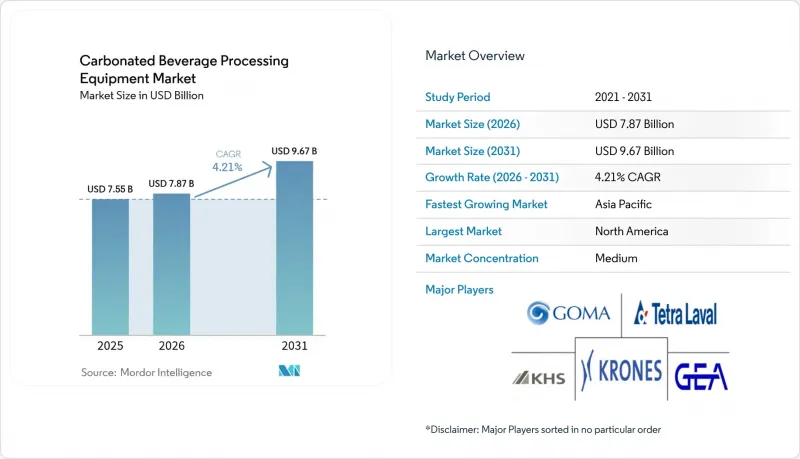
本報告按設備類型(例如,碳酸化系統、熱交換器)、飲料類型(例如,碳酸飲料、蘇打水和俱樂部蘇打水)、自動化程度(例如,全自動加工設備、半自動加工設備)和地區(例如,北美、歐洲)進行細分。市場預測以美元計價。
全球碳酸飲料加工設備市場趨勢及洞察
碳酸飲料消費量增加
在全球減少糖攝取量的趨勢下,全球對碳酸飲料的需求持續成長。在亞太地區,瓶裝飲料公司正在部署新型高速生產線,以滿足都市區消費者日益成長的需求,他們更傾向於選擇便於攜帶的包裝進行日常飲用。這些先進的生產系統需要精密的碳酸化設備,能夠在較寬的溫度範圍內保持穩定的二氧化碳濃度,這促使設備製造商改進線上混合系統並開發更高效的衛生級閥門技術。隨著已開發市場和新興市場消費模式的不斷變化,對能夠處理各種飲料配方的專用加工設備的需求日益成長,這些飲料包括傳統碳酸飲料、低糖飲料、使用天然甜味劑的產品以及添加了營養成分和補充劑的功能性氣泡飲料。根據英國軟性飲料協會的數據,英國碳酸飲料的消費量預計將在2023年達到約59億公升。
對自動化、節能型飲料加工系統的需求日益成長。
飲料製造商正大力推動自動化和能源效率提升,以應對人手不足、降低營運成本並實現永續性目標。設備製造商正在開發整合填充、封蓋、貼標和包裝等多個製作流程的系統,並透過先進的熱回收技術降低能耗,並利用精密的CIP(就地清洗)系統最大限度地減少用水量。熱回收熱交換器可回收並再利用製作流程產生的熱能,乾式潤滑輸送機無需使用水性潤滑劑,而人工智慧驅動的CIP循環則可最佳化清洗方案和化學品用量,從而減少水和清潔劑的消耗。由於投資回收期不到四年,中型裝瓶廠正從半自動化系統過渡到全自動化運營,實現全天候不間斷生產,並將人工干預降至最低。這些自動化系統整合了感測器和監控設備,用於追蹤生產指標、保持品管並預測維護需求,而先前由人工操作員完成的物料搬運和包裝任務則由先進的機器人技術完成。
高昂的初始資本投資和營運成本
設備採購和安裝的高昂成本是飲料生產商面臨的主要障礙,尤其是小規模生產商和希望推出或擴大碳酸飲料生產的新參與企業。設備製造商提供模組化系統,允許分階段部署,使飲料生產商能夠從基本配置開始,並隨著產量的增加而擴展。這些資金籌措挑戰對資源有限的精釀飲料新創公司和區域生產商的影響尤其顯著,因為他們需要與跨國公司競爭。因此,市場對二手二手和「設備即服務」模式的需求日益成長,這些模式允許企業在利用先進加工技術的同時降低初始投資。
細分市場分析
至2025年,碳酸化系統將以34.85%的市佔率引領碳酸飲料加工設備市場,持續維持其在確保整條飲料生產線口味一致性方面的關鍵地位。糖溶解系統將實現4.92%的顯著複合年成長率,這主要得益於低糖可樂和無糖蘇打水需求的成長,這些產品需要微米級的精確計量能力。製造商正策略性地將混合、脫氣和碳酸化功能整合到綜合系統中,以最大限度地減少設備面積,並提高整個生產週期的清潔效率。 Pentea先進的二氧化碳捕捉系統能夠捕捉和淨化發酵氣體,並以99.998%的純度直接將其重新用於軟性飲料生產線,從而實現永續的生產設計,並減少高達60%的外部二氧化碳需求。
熱交換器和薄膜過濾器市場表現強勁,技術發展主要集中在先進的可重複使用板組和精密的反脈衝濾芯上,這些技術顯著延長了生產環境中的清洗週期。隨著製造商擴大含有複雜植物成分、需要特殊高速攪拌製程的發泡機能飲料的生產,混合攪拌設備市場持續成長。設備製造商正策略性地採用先進的低轉速磁力攪拌器和高精度罐內超音波乳化器,以在整個生產過程中保持和保護敏感生物活性成分的功效。
區域分析
預計到2025年,北美將佔全球銷售額的34.75%,這主要得益於維修項目,這些項目用伺服驅動的一體式灌裝機替換了老舊的灌裝機,從而實現了更快的換型。製造商正在採用能源回收系統和低潤滑輸送機,以實現其企業環境、社會和管治(ESG)目標。牛皮紙蘇打水產業持續推動市場成長,該產業需要緊湊且易於配置的生產線,從而帶動了售後零件和業務收益。
預計到2031年,亞太地區將實現5.44%的複合年成長率,成為全球經濟成長的主要驅動力。可支配收入的成長、都市化的加速以及消費者偏好的轉變,正促使當地企業擴大產能。中國和印度的製造商正在採用西方的衛生標準,這為歐洲設備製造商在該地區生產創造了授權許可的機會。政府的獎勵正在推動熱泵消毒系統的應用,從而減少溫室氣體排放。
在歐洲,由於包裝法規的推動,輕質瓶和繫繩式瓶蓋的普及率不斷提高,市場保持穩定成長。快速釋放灌裝閥和水循環系統在設備升級上也備受重視。東歐的趨勢,例如克羅姆巴赫公司於2024年11月斥資1億歐元升級其灌裝廠,清楚地展現了該地區製造商在滿足歐盟碳排放法規的同時,努力擴大產能的決心。在南美、中東和非洲,連接太陽能系統的模組化PET生產線的投資正在穩步推進,這預示著飲料生產方式正向現代化轉型。
其他好處:
- Excel格式的市場預測(ME)表
- 3個月的分析師支持
目錄
第1章:引言
- 研究假設和市場定義
- 調查範圍
第2章:調查方法
第3章執行摘要
第4章 市場狀況
- 市場概覽
- 市場促進因素
- 碳酸軟性飲料消費量增加
- 對自動化和節能型飲料加工系統的需求日益成長
- 碳酸化和包裝技術的進步提高了效率和品質。
- 碳酸飲料包裝中寶特瓶和罐的使用量增加
- 精釀蘇打水新興企業的蓬勃發展,推動了對模組化、擴充性設備的需求。
- 物聯網與智慧感測器的整合,用於即時監控和預測性維護
- 市場限制因素
- 較大的初始資本投資和營運成本
- 由於食品安全和設施衛生法規日益嚴格,情況變得越來越複雜。
- 由於消費者越來越偏好更健康的非碳酸飲料,碳酸飲料的需求正在下降。
- 原料成本波動和供應鏈中斷會影響生產設施。
- 供應鏈分析
- 監理情勢
- 波特五力分析
第5章 市場規模與成長預測
- 依設備類型
- 碳酸化注入系統
- 混合攪拌設備
- 熱交換器
- 糖溶解系統
- 過濾和淨化設備
- 其他設備
- 按飲料類型
- 碳酸軟性飲料(CSD)
- 碳酸機能飲料
- 蘇打水和俱樂部蘇打水
- 碳酸能量飲料及等等滲透壓飲料
- 按自動化級別
- 全自動處理單元
- 半自動加工設備
- 手動或批次處理設備
- 按地區
- 北美洲
- 美國
- 加拿大
- 墨西哥
- 其他北美國家
- 歐洲
- 英國
- 德國
- 西班牙
- 法國
- 義大利
- 俄羅斯
- 其他歐洲國家
- 亞太地區
- 中國
- 印度
- 日本
- 澳洲
- 其他亞太國家
- 南美洲
- 巴西
- 阿根廷
- 其他南美國家
- 中東和非洲
- 沙烏地阿拉伯
- 南非
- 其他中東和非洲國家
- 北美洲
第6章 競爭情勢
- 市場集中度
- 策略趨勢
- 市場排名分析
- 公司簡介
- Krones AG
- GEA Group AG
- KHS GmbH
- Tetra Laval(Tetra Pak)
- Goma Engineering Pvt. Ltd
- Alfa Laval AB
- A DUE SpA
- Bajaj Group(Bajaj Processpack Limited)
- Pentair Plc
- Raj Innotech Pvt. Ltd.
- ProMach Inc.(Statco-DSI)
- Paul Mueller Company
- Wild Goose Filling(Deutsche Beverage+Process)
- Velo Acciai Srl(VLS Technologies)
- IC Filling Systems
- Central States Industrial
- Guangdong Jinzong Machinery Co., Ltd.
- Zhangjiagang King Machine Co., Ltd.
- Zhangjiagang Alps Machine Co.,Ltd.
- Zhangjiagang Comark Machinery Co.,LTD
第7章 市場機會與未來展望
According to Mordor Intelligence, the carbonated beverage processing equipment market size was valued at USD 7.55 billion in 2025 and estimated to grow from USD 7.87 billion in 2026 to reach USD 9.67 billion by 2031, at a CAGR of 4.21% during the forecast period (2026-2031).
This report is Segmented by Equipment Type (Carbonation Systems, Heat Exchangers, and More), Beverage Type (Carbonated Soft Drinks, Sparkling Water and Club Soda, and More), Level of Automation (Fully Automatic Processing Equipment, Semi-Automatic Processing Equipment, and More), and Geography (North America, Europe, and More). The Market Forecasts are Provided in Terms of Value (USD).
Global Carbonated Beverage Processing Equipment Market Trends and Insights
Rising carbonated soft drink consumption
Global demand for carbonated beverages continues to grow despite increasing sugar-reduction initiatives worldwide. In the Asia-Pacific region, bottling companies are installing new high-speed production lines to meet the rising demand from urban consumers who prefer portable packaging formats for their daily consumption. These advanced production systems require sophisticated carbonation units that can maintain consistent CO2 levels across varying temperature ranges, leading equipment manufacturers to enhance their inline-blending systems and develop more efficient sanitary valve technologies. The expanding consumption patterns in both developed and emerging markets are generating increased demand for specialized processing equipment that can handle multiple beverage formulations, including traditional carbonated soft drinks, reduced-sugar options, natural sweetener variants, and functional sparkling beverages with added nutrients and supplements. According to the data from the British Soft Drinks Association, an increase from 2023, approximately 5.9 billion liters of carbonates were consumed in the United Kingdom.
Growing preference for automated and energy-efficient beverage processing systems
Beverage manufacturers are increasing automation and energy efficiency to address labor shortages, reduce operational costs, and meet sustainability goals. Equipment manufacturers are developing integrated systems that combine multiple processing steps, including filling, capping, labeling, and packaging, while reducing energy consumption through advanced heat recovery technologies and minimizing water usage with sophisticated cleaning-in-place systems. Heat-recovery exchangers capture and reuse thermal energy from processing operations, dry-lubrication conveyors eliminate the need for water-based lubricants, and AI-based cleaning-in-place cycles optimize cleaning schedules and chemical usage to reduce water and detergent consumption. With return-on-investment periods now under four years, mid-sized bottlers are transitioning from semi-automatic systems to fully automated operations, enabling 24/7 production with minimal human intervention. These automated systems incorporate sensors and monitoring equipment to track production metrics, maintain quality control, and predict maintenance needs, while advanced robotics handle material movement and packaging tasks traditionally performed by human operators.
High initial capital investment and operating costs
The high costs of equipment procurement and installation present major barriers for beverage producers, especially small manufacturers and new market entrants looking to establish or expand carbonated beverage production. Equipment manufacturers offer modular systems for phased implementation, enabling beverage producers to begin with basic configurations and expand as production volumes increase. These financing challenges particularly affect craft beverage startups and regional producers who compete with multinational corporations but have limited financial resources. As a result, the market sees increased demand for used equipment and equipment-as-a-service options that lower initial capital requirements while providing access to advanced processing technologies.
Other drivers and restraints analyzed in the detailed report include:
- Advances in carbonation and packaging technologies enhancing efficiency and quality
- Increasing use of PET bottles and cans in carbonated beverage packaging
- Strict food safety and equipment sanitation regulations increasing complexity
For complete list of drivers and restraints, kindly check the Table Of Contents.
Segment Analysis
Carbonation systems dominated with a 34.85% share of the carbonated beverage processing equipment market in 2025, maintaining their essential position in ensuring consistent taste profiles across beverage production lines. Sugar dissolution systems recorded a significant 4.92% CAGR, primarily driven by increased production demands for low-Brix colas and zero-sugar sodas that require precise micron-level dosing capabilities. Manufacturers are strategically integrating mixing, deaeration, and carbonation functions into comprehensive unified systems to minimize facility footprint requirements and enhance cleaning efficiency across production cycles. Pentair's advanced CO2-recovery system demonstrates sustainable manufacturing design by capturing and purifying fermentation gas at 99.998% purity for direct reuse in soft-drink production lines, substantially reducing external CO2 requirements by up to 60%.
Heat exchangers and membrane filters maintain robust market performance, with technological developments focusing on advanced regenerative plate packs and sophisticated back-pulseable cartridges that significantly extend cleaning intervals in production environments. The market for mixing and blending equipment continues to expand as manufacturers increase production of sparkling functional beverages containing complex botanical ingredients that require specialized high-speed agitation processes. Equipment manufacturers are strategically incorporating advanced low-RPM magnetic mixers and precision in-tank ultrasound emulsifiers to maintain and protect the effectiveness of sensitive bioactive ingredients throughout the production process.
Complete Report Scope:
- By Equipment Type
- Carbonation Systems
- Mixing and Blending Equipment
- Heat Exchangers
- Sugar Dissolution Systems
- Filtration and Clarification Equipment
- Other Equipment
- By Beverage Type
- Carbonated Soft Drinks (CSDs)
- Carbonated Functional Beverages
- Sparkling Water and Club Soda
- Carbonated Energy and Isotonic Drinks
- By Level of Automation
- Fully Automatic Processing Equipment
- Semi-Automatic Processing Equipment
- Manual or Batch-Scale Processing Equipment
- By Geography
- North America
- United States
- Canada
- Mexico
- Rest of North America
- Europe
- United Kingdom
- Germany
- Spain
- France
- Italy
- Russia
- Rest of Europe
- Asia-Pacific
- China
- India
- Japan
- Australia
- Rest of Asia-Pacific
- South America
- Brazil
- Argentina
- Rest of South America
- Middle East and Africa
- Saudi Arabia
- South Africa
- Rest of Middle East and Africa
- North America
Geography Analysis
North America held 34.75% of global revenue in 2025, driven by retrofit programs replacing older fillers with servo-driven monoblocks that enable faster changeovers. Manufacturers have adopted energy-recovery systems and low-lubrication conveyors to meet corporate environmental, social, and governance (ESG) targets. The market growth continues through the craft-soda segment, which requires compact, easily configurable production lines, supporting aftermarket parts and service revenue.
Asia-Pacific is projected to achieve a 5.44% CAGR through 2031, leading global growth rates. Increasing disposable income, urbanization, and changing consumer preferences drive local companies to expand production capacity. Chinese and Indian manufacturers are adopting Western hygiene standards, creating opportunities for European equipment manufacturers to license designs for regional production. Government incentives support the adoption of heat-pump pasteurization systems that reduce greenhouse gas emissions.
Europe maintains steady growth as packaging regulations drive the adoption of lightweight bottles and tethered caps. Equipment updates emphasize quick-release filler valves and water recycling systems. Eastern European developments, including Krombacher's EUR 100 million bottling facility upgrade in November 2024, demonstrate regional manufacturers' commitment to expanding capacity while meeting EU carbon regulations. South America and the Middle East and Africa regions are investing in modular PET lines connected to solar-powered systems, indicating a direct transition to modern beverage production methods.
- Krones AG
- GEA Group AG
- KHS GmbH
- Tetra Laval (Tetra Pak)
- Goma Engineering Pvt. Ltd
- Alfa Laval AB
- A DUE SpA
- Bajaj Group (Bajaj Processpack Limited)
- Pentair Plc
- Raj Innotech Pvt. Ltd.
- ProMach Inc. (Statco-DSI)
- Paul Mueller Company
- Wild Goose Filling (Deutsche Beverage + Process)
- Velo Acciai S.r.l. (VLS Technologies)
- IC Filling Systems
- Central States Industrial
- Guangdong Jinzong Machinery Co., Ltd.
- Zhangjiagang King Machine Co., Ltd.
- Zhangjiagang Alps Machine Co.,Ltd.
- Zhangjiagang Comark Machinery Co.,LTD
Additional Benefits:
- The market estimate (ME) sheet in Excel format
- 3 months of analyst support
TABLE OF CONTENTS
1 INTRODUCTION
- 1.1 Study Assumptions and Market Definition
- 1.2 Scope of the Study
2 RESEARCH METHODOLOGY
3 EXECUTIVE SUMMARY
4 MARKET LANDSCAPE
- 4.1 Market Overview
- 4.2 Market Drivers
- 4.2.1 Rising carbonated soft drink consumption
- 4.2.2 Growing preference for automated and energy-efficient beverage processing systems
- 4.2.3 Advances in carbonation and packaging technologies enhancing efficiency and quality
- 4.2.4 Increasing use of pet bottles and cans in carbonated beverage packaging
- 4.2.5 Growth of craft soda startups driving demand for modular and scalable equipment
- 4.2.6 Integration of IOT and smart sensors for real-time monitoring and predictive maintenance
- 4.3 Market Restraints
- 4.3.1 High initial capital investment and operating costs
- 4.3.2 Strict food safety and equipment sanitation regulations increasing complexity
- 4.3.3 Rising consumer shift toward healthier, non-carbonated beverages reducing carbonation demand
- 4.3.4 Fluctuating raw material costs and supply chain disruptions affecting equipment production
- 4.4 Supply Chain Analysis
- 4.5 Regulatory Landscape
- 4.6 Porter's Five Forces Analysis
- 4.6.1 Threat of New Entrants
- 4.6.2 Bargaining Power of Buyers
- 4.6.3 Bargaining Power of Suppliers
- 4.6.4 Threat of Substitute Products
- 4.6.5 Intensity of Competitive Rivalry
5 MARKET SIZE AND GROWTH FORECASTS (VALUE)
- 5.1 By Equipment Type
- 5.1.1 Carbonation Systems
- 5.1.2 Mixing and Blending Equipment
- 5.1.3 Heat Exchangers
- 5.1.4 Sugar Dissolution Systems
- 5.1.5 Filtration and Clarification Equipment
- 5.1.6 Other Equipment
- 5.2 By Beverage Type
- 5.2.1 Carbonated Soft Drinks (CSDs)
- 5.2.2 Carbonated Functional Beverages
- 5.2.3 Sparkling Water and Club Soda
- 5.2.4 Carbonated Energy and Isotonic Drinks
- 5.3 By Level of Automation
- 5.3.1 Fully Automatic Processing Equipment
- 5.3.2 Semi-Automatic Processing Equipment
- 5.3.3 Manual or Batch-Scale Processing Equipment
- 5.4 By Geography
- 5.4.1 North America
- 5.4.1.1 United States
- 5.4.1.2 Canada
- 5.4.1.3 Mexico
- 5.4.1.4 Rest of North America
- 5.4.2 Europe
- 5.4.2.1 United Kingdom
- 5.4.2.2 Germany
- 5.4.2.3 Spain
- 5.4.2.4 France
- 5.4.2.5 Italy
- 5.4.2.6 Russia
- 5.4.2.7 Rest of Europe
- 5.4.3 Asia-Pacific
- 5.4.3.1 China
- 5.4.3.2 India
- 5.4.3.3 Japan
- 5.4.3.4 Australia
- 5.4.3.5 Rest of Asia-Pacific
- 5.4.4 South America
- 5.4.4.1 Brazil
- 5.4.4.2 Argentina
- 5.4.4.3 Rest of South America
- 5.4.5 Middle East and Africa
- 5.4.5.1 Saudi Arabia
- 5.4.5.2 South Africa
- 5.4.5.3 Rest of Middle East and Africa
- 5.4.1 North America
6 COMPETITIVE LANDSCAPE
- 6.1 Market Concentration
- 6.2 Strategic Moves
- 6.3 Market Ranking Analysis
- 6.4 Company Profiles (Includes Global-level Overview, Market-level Overview, Core Segments, Financials, Strategic Info, Market Rank/Share, Products and Services, Recent Developments)
- 6.4.1 Krones AG
- 6.4.2 GEA Group AG
- 6.4.3 KHS GmbH
- 6.4.4 Tetra Laval (Tetra Pak)
- 6.4.5 Goma Engineering Pvt. Ltd
- 6.4.6 Alfa Laval AB
- 6.4.7 A DUE SpA
- 6.4.8 Bajaj Group (Bajaj Processpack Limited)
- 6.4.9 Pentair Plc
- 6.4.10 Raj Innotech Pvt. Ltd.
- 6.4.11 ProMach Inc. (Statco-DSI)
- 6.4.12 Paul Mueller Company
- 6.4.13 Wild Goose Filling (Deutsche Beverage + Process)
- 6.4.14 Velo Acciai S.r.l. (VLS Technologies)
- 6.4.15 IC Filling Systems
- 6.4.16 Central States Industrial
- 6.4.17 Guangdong Jinzong Machinery Co., Ltd.
- 6.4.18 Zhangjiagang King Machine Co., Ltd.
- 6.4.19 Zhangjiagang Alps Machine Co.,Ltd.
- 6.4.20 Zhangjiagang Comark Machinery Co.,LTD
7 MARKET OPPORTUNITIES AND FUTURE OUTLOOK

 碳酸飲料線性灌裝機市場-2026年至2032年全球市場預測寶特瓶碳酸飲料灌裝生產線市場:按機器類型、填充技術、自動化程度、生產線速度、瓶子尺寸、組件和應用分類-全球預測,2026-2032年
 碳酸飲料加工設備全球市場規模、佔有率、趨勢和成長分析報告(2026-2034)
 2026年全球碳酸飲料加工設備市場報告
 碳酸飲料加工設備市場-全球產業規模、佔有率、趨勢、機會及預測(依設備類型、飲料類型、地區及競爭格局分類,2021-2031年)
 工業食品飲料過濾系統市場規模、佔有率和成長分析(過濾技術、過濾應用、終端用戶產業和地區分類)-2026-2033年產業預測