


 |
市場調查報告書
商品編碼
2114761
氟矽酸鹽:市場佔有率分析、行業趨勢和統計數據、成長預測(2026-2031 年)Fluorosilicone - Market Share Analysis, Industry Trends & Statistics, Growth Forecasts (2026 - 2031) |
||||||

※ 本網頁內容可能與最新版本有所差異。詳細情況請與我們聯繫。
根據 Mordor Intelligence 預測,氟矽市場將從 2025 年的 31.15 千噸成長到 2026 年的 32.63 千噸,然後在 2031 年達到 41.12 千噸,2026 年至 2031 年的複合年成長率為 4.74%。
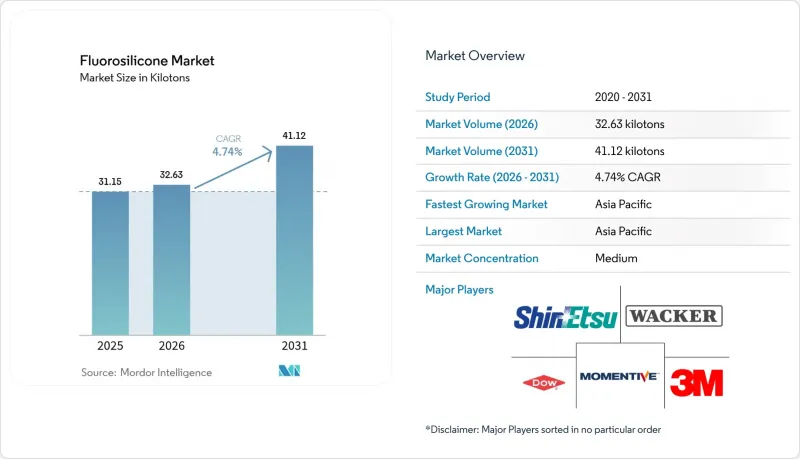
本報告按產品類型(彈性體、黏合劑和密封劑等)、終端用戶產業(石油和天然氣、汽車等)以及地區(亞太地區、北美地區等)對產業進行細分。市場預測以數量(噸)為單位。
全球氟矽市場趨勢與洞察
航太和國防領域對燃料/液壓系統的需求不斷成長。
現代飛機燃油迴路的運作溫度超過 177 度C ,循環著合成生物噴射機燃料混合物、液壓油和除冰添加劑。標準矽橡膠在高溫下會斷裂或膨脹,而氟矽橡膠中的三氟丙基取代鏈使其在低至 -73 度C下仍能保持彈性,從而避免在高空脆性斷裂。目前,領先的密封件供應商正在對符合 MIL-DTL-25988 標準的氟矽橡膠 O 型環進行認證,以確保其能夠承受快速壓力循環而不產生疲勞。隨著輕量化趨勢的加劇,這種轉變正在加速,因為更薄的密封件需要更優異的耐化學腐蝕性能才能在整個使用壽命中保持可靠性。
在海上油氣天然氣田的應用範圍擴大
在超深井中,壓力超過 22,000 psi,溫度接近 450°F。整套管柱和 FPSO 流體旋轉接頭暴露於酸性氣體、高濃度鹽水和快速氣體減壓環境。即使在 HNBR 和全氟橡膠開裂或強度下降的情況下,氟矽橡膠仍能保持其模量和體積變化符合 API 標準。由於更長的維護週期可以降低提升成本,作業者在惡劣氣藏的封儲存、防噴器 (BOP) 密封件和井下感測器中均指定使用氟矽橡膠。
具有成本競爭力的替代方案的出現
先進的EPDM、HNBR和VMQ化合物如今具備了以往只有氟矽橡膠才能達到的耐燃料性能,這使得在中溫應用中材料成本最多可降低70%。這種轉變在大眾市場汽車和消費性電子產品密封件領域進展最為迅速,這些領域總暴露溫度很少超過180 度C。然而,在同時暴露於高腐蝕性芳香族化合物和劇烈溫度波動的環境中,其他彈性體仍落後於競爭對手。
細分市場分析
到2025年,彈性體將佔據氟矽橡膠市場最大佔有率,銷售量佔46.55%。彈性體之所以佔據市場主導地位,是因為高黏度橡膠和液態矽橡膠等產品適用於軟管、墊圈和O型圈製造商使用的壓模成型、擠出成型和射出成型線。潤滑劑、潤滑脂和介電液的市佔率雖小,但成長迅速,預計到2031年將以7.55%的複合年成長率成長,這主要得益於電池式電動車冷卻迴路的擴展。在大規模生產中,液態產品可在保持嚴格公差的同時縮短生產週期,而雙組分室溫硫化(RTV)化學成分則簡化了生產線上的墊圈安裝。特種塗料和消泡劑仍處於小眾市場,但盈利豐厚,主要銷往需要化學惰性和無味劑的製藥和食品加工企業。
更廣泛的配方選擇使供應商能夠調整硬度、彈性和膨脹極限,以滿足每位客戶的特定要求。這種柔軟性即使在各產業需求改變的情況下,也能維持彈性體的優勢。同時,潤滑劑細分市場正受益於「直接浸入式電池冷卻」的激增,該領域對低電導率要求極高。此外,在半導體真空幫浦領域,由於碳氫化合物回流是不可接受的,氟矽油的應用也不斷擴展。在所有這些應用領域,到2030年,氟矽油潤滑劑市場規模有望從實驗室層級成長到商業噸級。
區域分析
預計到2025年,亞太地區將佔全球出貨量的38.55%,並將在2031年之前維持6.55%的複合年成長率。中國憑藉其大規模生產汽車渦輪增壓器、300毫米半導體晶圓廠的快速擴張以及旨在構建特種化學品國內供應鏈的國家計劃,仍然是該地區的核心樞紐。中國本土化學家正在測試用於油水分離的氟矽泡沫,這項舉措凸顯了該地區深厚的創新實力。日本正利用其精密製程技術為航空航太和國防設備生產超潔淨級產品;而在韓國,KCC株式會社收購合併邁圖電子(Momentive)後,不僅最佳化了集團結構,也鞏固了其內部供應鏈的穩定性。
北美仍然是第二大消費市場,這主要得益於航空航太、國防以及頁岩油氣和海上油氣業者對高品質材料的青睞。該地區氟矽橡膠市場規模的擴大得益於美國聯邦航空管理局 (FAA) 和美國國防部 (DoD) 的認證,這些認證確保了較長的更換週期。由於成本削減目標,汽車行業的需求保持穩定而非激增,但向純電動卡車的轉型正在為導熱界面材料和介電液創造新的機會。在加拿大油砂,足夠高的工作溫度使得氟矽橡膠優於氟橡膠 (FKM),從而擴大了該地區對能源領域的需求。
歐洲面臨最複雜的法規環境。 REACH法規下擬議的PFAS法規收緊了報告和替代方案的要求,但對航太、醫療和關鍵能源基礎設施領域給予了豁免。德國原始設備製造商(OEM)繼續在生質燃料相容引擎中使用氟矽橡膠軟管,而耐輻射等級的氟矽橡膠軟管則繼續在法國核能設施中使用。在北歐國家,人們正在研究可回收的矽膠環,這種矽膠環可以將聚合物鏈分解成可重複使用的單體,從而為循環經濟鋪平道路,並有望穩定長期供應。總體而言,儘管歐洲的消費量成長緩慢,但市場正在向永續的低氟設計轉變,這一細分市場使本地生產商擁有了脫穎而出的強大優勢。
其他好處:
- Excel格式的市場預測(ME)表
- 3個月的分析師支持
目錄
第1章:引言
- 研究的先決條件
- 調查範圍
第2章:調查方法
第3章執行摘要
第4章 市場狀況
- 市場概覽
- 市場促進因素
- 航太和國防領域對燃料/液壓系統的需求不斷成長。
- 石油和天然氣產業的使用量增加
- 在高溫環境下應用於汽車渦輪增壓器和生質燃料管路
- 軟性電子產品和電動汽車電池應用的興起
- 生物基氟化矽氧烷單體的商業化
- 市場限制因素
- 具有成本競爭力的替代方案的可用性
- 氟單體價格波動與供應瓶頸
- 氟化合物的環境問題
- 價值鏈分析
- 波特五力模型
第5章 市場規模與成長預測
- 依產品類型
- 彈性體
- 黏合劑和密封劑
- 消泡劑
- 塗層
- 其他產品類型(例如潤滑劑)
- 按最終用戶行業分類
- 石油和天然氣
- 車
- 航太/國防
- 其他終端用戶產業(工業OEM廠商等)
- 按地區
- 亞太地區
- 中國
- 印度
- 日本
- 韓國
- 其他亞太國家
- 北美洲
- 美國
- 加拿大
- 墨西哥
- 歐洲
- 德國
- 英國
- 法國
- 義大利
- 其他歐洲國家
- 南美洲
- 巴西
- 阿根廷
- 其他南美國家
- 中東和非洲
- 沙烏地阿拉伯
- 南非
- 其他中東和非洲國家
- 亞太地區
第6章 競爭情勢
- 市場集中度
- 策略趨勢
- 市佔率和排名分析
- 公司簡介
- 3M
- Dow
- Eagle Elastomer Inc.
- DLR Elastomer Engineering Ltd
- Marco Rubber & Plastics
- Momentive Performance Materials(KCC Corporation)
- Parker Hannifin Corp
- Shandong Huaxia Shenzhou New Material Co., Ltd.
- Shin-Etsu Silicones of America, Inc.
- Trelleborg Group
- Wacker Chemie AG
- Zhejiang Huanxin Fluoro Material Co. Ltd.
第7章 市場機會與未來展望
According to Mordor Intelligence, the fluorosilicone market size is expected to grow from 31.15 kilotons in 2025 to 32.63 kilotons in 2026 and is forecast to reach 41.12 kilotons by 2031 at 4.74% CAGR over 2026-2031.
This report Segments the Industry by Product Type (Elastomer, Adhesives and Sealants, and More), End-User Industry (Oil and Gas, Automotive, and More), and Geography (Asia-Pacific, North America, and More). The Market Forecasts are Provided in Terms of Volume (Tons).
Global Fluorosilicone Market Trends and Insights
Growing Demand from Aerospace & Defence Fuel/Hydraulic Systems
Modern aircraft fuel circuits run hotter than 177 °C and cycle between synthetic bio-jet blends, hydraulic fluids, and anti-icing additives. Standard silicones fracture or swell, but trifluoropropyl-substituted chains in fluorosilicone stay elastic down to -73 °C, avoiding brittle failure at altitude. Leading seal suppliers now qualify fluorosilicone O-rings under MIL-DTL-25988 to satisfy rapid pressure cycling without fatigue. Weight-saving trends intensify the switch because thinner seals rely on superior chemical tenacity to preserve lifetime reliability.
Rising Utilisation from Offshore Oil and Gas Fields
Ultra-deep wells exceed 22,000 psi and approach 450 °F. Completion strings and FPSO fluid swivels face sour gas, high brine salinity, and rapid gas decompression. Fluorosilicone keeps modulus and volume change within API-spec limits where HNBR and perfluoroelastomer grades either crack or lose strength. Longer mean time between intervention lowers lifting costs, so operators specify fluorosilicone on packers, blow-out preventer seals, and downhole sensors for harsh-gas reservoirs.
Availability of Cost-Competitive Alternatives
Advanced EPDM, HNBR, and VMQ compounds now reach fuel-resistance levels once exclusive to fluorosilicone, offering up to 70% material savings for moderate-temperature duties. The switch is fastest in mass-market automotive and appliance seals where total exposure temperatures seldom surpass 180 °C. However, in environments with simultaneous exposure to aggressive aromatics and large thermal swings, competing elastomers still fall short.
Other drivers and restraints analyzed in the detailed report include:
- Adoption in High-Temperature Automotive Turbo & Bio-Fuel Lines
- Emergence of Flexible Electronics and EV Battery Applications
- Fluoromonomer Price Volatility & Supply Bottlenecks
For complete list of drivers and restraints, kindly check the Table Of Contents.
Segment Analysis
Elastomers generated the largest slice of the fluorosilicone market in 2025, capturing 46.55% of volume. They dominate because high-consistency rubber and liquid silicone rubber formats suit press-molding, extrusion, and injection lines used by hose, gasket, and O-ring producers. Lubricants, greases, and dielectric fluids sit in a smaller but faster pool, expected to post a 7.55% CAGR through 2031 as battery-electric cooling circuits scale up. In mass production, liquid grades cut cycle times while holding tight tolerances, and two-part room-temperature-vulcanizing chemistries simplify on-line gasketing. Specialty coatings and antifoams stay niche yet profitable, sold to pharmaceutical and food processors that need chemically inert, non-tainting agents.
A wider formulation window allows suppliers to tailor hardness, resilience, and swelling limits to each customer specification. That flexibility preserves elastomer prominence even as volumes shift among industries. Meanwhile, the lubricant sub-segment rides the jump in direct-immersion battery cooling, where low electrical conductivity matters. Adoption also spreads in semiconductor vacuum pumps unable to tolerate hydrocarbon backstreaming. Across these uses the fluorosilicone market size for lubricants could move from lab scale to commercial tonnage by 2030.
Complete Report Scope:
- By Product Type
- Elastomer
- Adhesives and Sealants
- Antifoams
- Coating
- Other Product Types (Lubricants, etc.)
- By End-user Industry
- Oil and Gas
- Automotive
- Aerospace and Defence
- Other End-user Industries (Industrial OEM, etc.)
- By Geography
- Asia-Pacific
- China
- India
- Japan
- South Korea
- Rest of Asia-Pacific
- North America
- United States
- Canada
- Mexico
- Europe
- Germany
- United Kingdom
- France
- Italy
- Rest of Europe
- South America
- Brazil
- Argentina
- Rest of South America
- Middle East and Africa
- Saudi Arabia
- South Africa
- Rest of Middle East and Africa
- Asia-Pacific
Geography Analysis
Asia-Pacific controlled 38.55% of global shipments in 2025 and is poised to record a 6.55% CAGR to 2031. China remains the central node, thanks to high-volume automotive turbocharger production, rapid expansion in 300 mm semiconductor fabs, and state programs that target domestic supply chains for specialty chemicals. Indigenous chemists are trialling fluorosilicone foams for oil-water separation, a step that underlines the region's innovation depth. Japan leverages precision process know-how to turn out ultra-clean grades for space and defence instruments, while South Korea's chaebol structure benefited after KCC Corporation absorbed Momentive, cementing in-house supply security.
North America maintains the second-largest consumption bloc, supported by its aviation, space, and defence sectors, plus shale and offshore operators that prefer premium materials. The fluorosilicone market size in the region is anchored by FAA and DoD certifications, which lock in long replacement cycles. Automotive demand is stable rather than stellar, hampered by cost-down targets, yet the shift to battery-electric trucks creates new thermal-interface and dielectric-fluid opportunities. Canadian oil sands push service temperatures high enough to justify fluorosilicone over FKM, extending regional demand into energy.
Europe faces the most intricate regulatory climate. Draft PFAS restrictions under REACH tighten reporting and substitution requirements, but carve-out exemptions exist for aerospace, medical, and critical energy infrastructure. German OEMs continue to fit fluorosilicone hoses on bio-fuel-capable engines, and French nuclear facilities keep using radiation-hard grades. Nordic countries explore recycled silicone loops that break down polymer chains into reusable monomers, a pathway for circularity that could stabilise long-term supply. Overall, European consumption grows slowly yet shifts toward sustainable, low-fluoro content designs, a niche that local producers are well placed to serve.
- 3M
- Dow
- Eagle Elastomer Inc.
- DLR Elastomer Engineering Ltd
- Marco Rubber & Plastics
- Momentive Performance Materials (KCC Corporation)
- Parker Hannifin Corp
- Shandong Huaxia Shenzhou New Material Co., Ltd.
- Shin-Etsu Silicones of America, Inc.
- Trelleborg Group
- Wacker Chemie AG
- Zhejiang Huanxin Fluoro Material Co. Ltd.
Additional Benefits:
- The market estimate (ME) sheet in Excel format
- 3 months of analyst support
TABLE OF CONTENTS
1 Introduction
- 1.1 Study Assumptions
- 1.2 Scope of the Study
2 Research Methodology
3 Executive Summary
4 Market Landscape
- 4.1 Market Overview
- 4.2 Market Drivers
- 4.2.1 Growing demand from aerospace & defence fuel/ hydraulic systems
- 4.2.2 Rising utilisation from the oil and gas industry
- 4.2.3 Adoption in high-temperature automotive turbo & bio-fuel lines
- 4.2.4 Emergence of flexible electronics and electric vehicle battery applications
- 4.2.5 Commercialisation of bio-sourced fluorinated siloxane monomer
- 4.3 Market Restraints
- 4.3.1 Availability of cost-competitive alternatives
- 4.3.2 Fluoromonomer price volatility & supply bottlenecks
- 4.3.3 Environemntal concerns related to fluorine compounds
- 4.4 Value Chain Analysis
- 4.5 Porter's Five Forces
- 4.5.1 Bargaining Power of Suppliers
- 4.5.2 Bargaining Power of Buyers
- 4.5.3 Threat of New Entrants
- 4.5.4 Threat of Substitutes
- 4.5.5 Degree of Competition
5 Market Size & Growth Forecasts (Volume)
- 5.1 By Product Type
- 5.1.1 Elastomer
- 5.1.2 Adhesives and Sealants
- 5.1.3 Antifoams
- 5.1.4 Coating
- 5.1.5 Other Product Types (Lubricants, etc.)
- 5.2 By End-user Industry
- 5.2.1 Oil and Gas
- 5.2.2 Automotive
- 5.2.3 Aerospace and Defence
- 5.2.4 Other End-user Industries (Industrial OEM, etc.)
- 5.3 By Geography
- 5.3.1 Asia-Pacific
- 5.3.1.1 China
- 5.3.1.2 India
- 5.3.1.3 Japan
- 5.3.1.4 South Korea
- 5.3.1.5 Rest of Asia-Pacific
- 5.3.2 North America
- 5.3.2.1 United States
- 5.3.2.2 Canada
- 5.3.2.3 Mexico
- 5.3.3 Europe
- 5.3.3.1 Germany
- 5.3.3.2 United Kingdom
- 5.3.3.3 France
- 5.3.3.4 Italy
- 5.3.3.5 Rest of Europe
- 5.3.4 South America
- 5.3.4.1 Brazil
- 5.3.4.2 Argentina
- 5.3.4.3 Rest of South America
- 5.3.5 Middle East and Africa
- 5.3.5.1 Saudi Arabia
- 5.3.5.2 South Africa
- 5.3.5.3 Rest of Middle East and Africa
- 5.3.1 Asia-Pacific
6 Competitive Landscape
- 6.1 Market Concentration
- 6.2 Strategic Moves
- 6.3 Market Share(%)/Ranking Analysis
- 6.4 Company Profiles {(includes Global level Overview, Market level overview, Core Segments, Financials as available, Strategic Information, Market Rank/Share for key companies, Products & Services, and Recent Developments)}
- 6.4.1 3M
- 6.4.2 Dow
- 6.4.3 Eagle Elastomer Inc.
- 6.4.4 DLR Elastomer Engineering Ltd
- 6.4.5 Marco Rubber & Plastics
- 6.4.6 Momentive Performance Materials (KCC Corporation)
- 6.4.7 Parker Hannifin Corp
- 6.4.8 Shandong Huaxia Shenzhou New Material Co., Ltd.
- 6.4.9 Shin-Etsu Silicones of America, Inc.
- 6.4.10 Trelleborg Group
- 6.4.11 Wacker Chemie AG
- 6.4.12 Zhejiang Huanxin Fluoro Material Co. Ltd.
7 Market Opportunities & Future Outlook
- 7.1 White-space & Unmet-need Assessment

 氟矽市場:全球市場預測,2026-2032年
 氟矽市場-2025-2030年預測
 全球氟矽酮市場規模研究與預測,依加工技術、最終用途產業和區域預測 2025-2035全球氟矽橡膠市場規模研究、加工技術、最終用途及區域預測 2022-2032