


 |
市場調查報告書
商品編碼
2114753
螺旋膜:市場佔有率分析、產業趨勢與統計、成長預測(2026-2031)Spiral Membrane - Market Share Analysis, Industry Trends & Statistics, Growth Forecasts (2026 - 2031) |
||||||

※ 本網頁內容可能與最新版本有所差異。詳細情況請與我們聯繫。
據 Mordor Intelligence 稱,2025 年螺旋膜市值為 74.5 億美元,預計到 2031 年將達到 142.8 億美元,而 2026 年為 83 億美元,預測期(2026-2031 年)的複合年成長率為 11.48%。
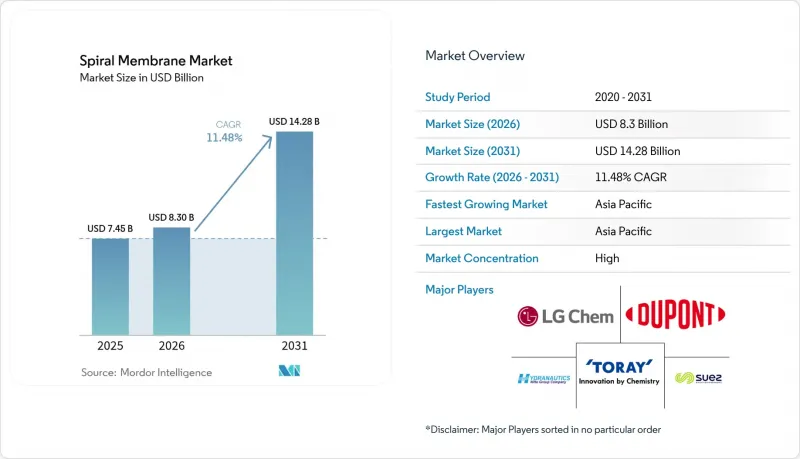
本報告按聚合物材料(例如,聚醯胺(TFC)、聚醚碸(PES))、分離技術(例如,過濾、超過濾)、終端用戶產業(例如,市政水處理、食品飲料)和地區(例如,亞太地區、北美地區、歐洲地區)進行細分。市場預測以美元(USD)為單位。
全球螺旋膜市場趨勢及洞察
食品飲料產業對蛋白質分離的需求日益成長。
乳製品加工商和果汁裝瓶商正從熱濃縮轉向膜分離,以生產高價值的蛋白質分離物,從而獲得溢價40-60%的產品。最新的螺旋捲式過濾線能夠以99%的效率分離乳清蛋白,同時保持其功能性,使製造商能夠向運動營養、醫療營養和嬰幼兒配方奶粉市場供應產品。近期對隔板的重新設計提高了交叉流速度,減少了結垢,並延長了清洗週期。工廠管理人員也十分欣賞其面積小的優勢。螺旋組件的表面積是同類中空纖維裝置的2-3倍,降低了土木工程成本。
從中中空纖維到高磁通量螺旋纏繞模組的過渡
工業水處理負責人對螺旋纏繞結構印象深刻,與中空纖維膜相比,其堆積密度高達三倍,從而可以縮小撬裝尺寸並降低更換成本。清洗流程也得到了改善。新型進料隔板形狀促進了湍流,減少了化學物質的使用量。這些優勢對於高黏度流體(例如乳製品、糖和明膠)至關重要,因為中空纖維膜在這些流體中容易快速結垢。
膜污染及清洗化學物質成本
在荷蘭海水淡化廠,清洗成本佔逆滲透(RO)運作成本的24%。生物污染會縮短薄膜的使用壽命,這種趨勢在不耐遊離氯的聚醯胺膜元件上尤其明顯。開發人員正致力於透過使用兩性離子聚合物表面塗層和脈衝流清洗技術,將化學品的使用量減少一半。在這些技術成熟之前,高昂的清洗成本和停機時間可能會阻礙逆滲透技術在高生物活性流體中的應用。
細分市場分析
聚醯胺薄膜複合複合材料在海水淡化領域經過數十年的性能最佳化(該領域99.5%的脫鹽率已成為標準),預計到2025年將佔據螺旋膜市場42.58%的佔有率。聚醚碸(PES)由於其能夠承受反覆的蒸氣循環,正被應用於生物製程領域的特定應用。聚偏氟乙烯(PVDF)和聚四氟乙烯(PTFE)等氟聚合物目前僅佔市場佔有率的一小部分,但預計將以12.34%的年成長率成長,這得益於其在鋰鹽水、半導體和高腐蝕性溶劑加工等領域的市場機會。這些材料能夠承受0-14的pH值和高達120 度C的溫度,這些特性使其價格較高。表面活化技術(例如電漿蝕刻和紫外線接枝)正在克服其固有的疏水性,使其水通量接近聚醯胺的水平。
聚醯胺膜擁有成熟的供應鏈和具有競爭力的價格,但其對氯的高度敏感性限制了其在結垢後的重複使用,促使營運商維修使用含氟聚合物。陶瓷和複合材料膜廣泛應用於運作超過資本投資成本的嚴苛環境中,例如生產水淨化。這些薄膜在特種化學品和礦業服務的螺旋膜市場中佔據了雖小但具有重要戰略意義的佔有率。
區域分析
預計到2025年,亞太地區將佔據螺旋膜市場33.74%的最大佔有率,到2031年複合年成長率將達到12.63%,超過其他所有地區。日益嚴格的環境法規正促使中國工廠採用先進的薄膜技術;而在印度,公共資金正透過「Jal Jeevan Mission」等項目投資於都市區基礎建設。台灣、日本和韓國的半導體製造廠需要總有機碳(TOC)含量低於5 ppt的超純水,這推動了對高選擇性逆滲透(RO)和超濾(UF)膜堆的需求。澳洲正依賴螺旋卷式逆滲透膜來保障面臨長期乾旱的城市的飲用水供應。
北美是全球第二大消費市場,根據《基礎建設投資與就業法案》,北美已撥款550億美元用於水系統現代化。 2000年代初期安裝的老舊逆滲透(RO)設備正被高滲透性設備所取代,後者可降低20-25%的能耗。市場趨勢的重點在於提高全氟烷基和多氟烷基物質(PFAS)的去除能力以及工業用水的再利用。在墨西哥的汽車工業走廊,對零液體排放(ZLD)技術的投資不斷增加,導致當地螺旋膜的進口量也隨之擴大。
在歐洲,水框架指令維持嚴格的廢水處理標準,食品、飲料和製藥廠的設備維修正在進行中。斯堪地那維亞的公共產業正在試驗應用奈米過濾技術去除全氟烷基和多氟烷基物質(PFAS),而南部國家則正在實施海水淡化以應對長期乾旱。隨著營運商遵守能源效率和循環經濟目標,供應商預計售後市場銷售額將強勁成長。
拉丁美洲的需求主要集中在礦區。在智利和阿根廷,螺旋型奈米過濾系統正被安裝在鋰鹽湖中,用於提取電池級原料,同時回收鹽水。在巴西的紙漿和造紙廠,逆滲透(RO)技術應用於封閉回路型漂白迴路,可將化學需氧量(COD)排放量降低85%。中東和北非地區正著力建造大規模逆滲透裝置,國有電力公司也考慮引進能源回收系統以應對電力短缺。雖然撒哈拉以南非洲地區的採用率仍然較低,但隨著多邊金融機構為缺水城市的廢水再利用計畫提供資金,採用率正在提高。
其他好處:
- Excel格式的市場預測(ME)表
- 3個月的分析師支持
目錄
第1章:引言
- 研究假設和市場定義
- 調查範圍
第2章:調查方法
第3章執行摘要
第4章 市場狀況
- 市場概覽
- 市場促進因素
- 食品和飲料行業對蛋白質組分的需求不斷成長
- 更嚴格的工業污水和生活污水排放標準。
- 從中中空纖維型模組過渡到高磁通螺旋繞線模組
- 在生物製程採用耐高溫滅菌螺旋膜
- 電池供應鏈中採用螺旋型奈米過濾濃縮鋰鹽水
- 市場限制因素
- 膜污染和清洗化學物質的成本
- 逆滲透(RO)處理對高能量和高壓的需求
- 超高純度聚醯胺流延薄膜的價格波動較大。
- 價值鏈分析
- 波特五力模型
第5章 市場規模與成長預測
- 透過聚合物材料
- 聚醯胺(TFC)
- 聚醚碸(PES)
- 含氟聚合物(PTFE、PVDF)
- 其他材質(醋酸纖維素、陶瓷、複合材料)
- 透過分離技術
- 微過濾(MF)
- 超過濾(UF)
- 奈米過濾(NF)
- 逆滲透(RO)
- 按最終用戶行業分類
- 地方政府的水處理
- 食品/飲料
- 衛生保健
- 石油和天然氣
- 其他(化工、紙漿和造紙、採礦、電力、紡織)
- 按地區
- 亞太地區
- 中國
- 印度
- 日本
- 韓國
- ASEAN
- 澳洲和紐西蘭
- 其他亞太國家
- 北美洲
- 美國
- 加拿大
- 墨西哥
- 歐洲
- 德國
- 英國
- 法國
- 義大利
- 西班牙
- 俄羅斯
- 其他歐洲國家
- 南美洲
- 巴西
- 阿根廷
- 其他南美國家
- 中東和非洲
- 沙烏地阿拉伯
- 阿拉伯聯合大公國
- 南非
- 其他中東和非洲國家
- 亞太地區
第6章 競爭情勢
- 市場集中度
- 策略趨勢
- 市佔率分析
- 公司簡介
- Alfa Laval
- Asahi Kasei Corporation
- AXEON Water
- DuPont
- Hydranautics(Nitto)
- IDE Technologies
- Koch Separation Solutions
- Lanxess
- LG Chem
- MANN+HUMMEL
- Membranium(JSC RM Nanotech)
- Merck KgaA
- Pall Corporation
- Pentair PLC
- Synder Filtration, Inc
- SUEZ
- Toray Industries Inc
- Toyobo Co., Ltd
- Veolia
- Xylem
- ZwitterCo.
第7章 市場機會與未來展望
According to Mordor Intelligence, the spiral membrane market size was valued at USD 7.45 billion in 2025 and estimated to grow from USD 8.3 billion in 2026 to reach USD 14.28 billion by 2031, at a CAGR of 11.48% during the forecast period (2026-2031).
This report is Segmented by Polymer Material (Polyamide (TFC), Polyethersulfone (PES), and More), Separation Technique (Microfiltration, Ultrafiltration, and More), End-User Industry (Municipal Water Treatment, Food and Beverage, and More), and Geography (Asia-Pacific, North America, Europe, and More). The Market Forecasts are Provided in Terms of Value (USD).
Global Spiral Membrane Market Trends and Insights
Expanding Food and Beverage Protein-Fractionation Needs
Dairy processors and juice bottlers are migrating from thermal concentration to membrane fractionation so they can produce value-added protein isolates that sell at 40-60% price premiums. Modern spiral-wound microfiltration lines separate whey proteins with 99% efficiency while preserving functional properties, allowing manufacturers to serve sports-nutrition, medical-nutrition, and infant-formula channels. Recent spacer redesigns lift cross-flow velocity, which suppresses fouling and stretches run times between cleanings. Plant managers also appreciate the smaller footprint; spiral modules pack two to three times more surface area than equivalent hollow-fiber units, lowering civil-work costs.
Shift from Hollow-Fiber to High-Flux Spiral-Wound Modules
Industrial water operators notice that spiral-wound designs deliver up to three-fold higher packing density than hollow-fiber counterparts, enabling smaller skids and lower replacement costs. Cleaning protocols also improve: new feed-spacer geometries enhance turbulence, reducing chemical use. These benefits are decisive in viscous streams such as dairy, sugar, and gelatin, where hollow-fiber membranes foul rapidly.
Membrane Fouling and Cleaning-Chemical Costs
Across Dutch desalination plants, cleaning accounts for 24% of RO operating expenses. Biofouling shortens membrane life, especially in polyamide elements that cannot tolerate free chlorine. Developers are coating surfaces with zwitterionic polymers and leveraging pulsed-flow cleaning to cut chemical use in half. Until these tools mature, elevated cleaning and downtime costs will temper adoption in heavily bio-active streams.
Other drivers and restraints analyzed in the detailed report include:
- Adoption of Hot-Sanitizable Spiral Membranes in Bioprocessing
- Stricter Industrial and Municipal Wastewater Discharge Norms
- High Energy/Pressure Demand for RO Operations
For complete list of drivers and restraints, kindly check the Table Of Contents.
Segment Analysis
Polyamide thin-film composites retained a 42.58% spiral membrane market share in 2025, propelled by decades of performance optimization in desalination where 99.5% salt rejection is routine. PES holds niche utility in bioprocessing because it withstands repeated steam cycles. Fluoropolymers such as PVDF and PTFE, though only a small slice today, are on track to grow 12.34% annually, capturing opportunities in lithium brine, semiconductor, and aggressive-solvent streams. These chemistries tolerate pH 0-14 and temperatures to 120 °C, features that justify premium pricing. Surface-activation techniques-plasma etching, UV grafting-now overcome their intrinsic hydrophobicity, pushing water flux toward polyamide territory.
The polyamide segment draws strength from mature supply chains and competitive pricing, but its chlorine sensitivity restricts reuse after fouling events, nudging operators toward fluoropolymer retrofits. Ceramic and composite designs populate extreme environments such as produced-water clean-up, where uptime outweighs capital intensity. They represent a small yet strategic fragment of the spiral membrane market size for specialty chemicals and mining services.
Complete Report Scope:
- By Polymer Material
- Polyamide (TFC)
- Polyethersulfone (PES)
- Fluoropolymers (PTFE, PVDF)
- Others (Cellulose Acetate, Ceramic, Composite)
- By Separation Technique
- Microfiltration (MF)
- Ultrafiltration (UF)
- Nanofiltration (NF)
- Reverse Osmosis (RO)
- By End-user Industry
- Municipal Water Treatment
- Food and Beverage
- Healthcare
- Oil and Gas
- Others (Chemicals, Pulp and Paper, Mining, Power, Textiles)
- By Geography
- Asia-Pacific
- China
- India
- Japan
- South Korea
- ASEAN
- Australia and New Zealand
- Rest of Asia-Pacific
- North America
- United States
- Canada
- Mexico
- Europe
- Germany
- United Kingdom
- France
- Italy
- Spain
- Russia
- Rest of Europe
- South America
- Brazil
- Argentina
- Rest of South America
- Middle East and Africa
- Saudi Arabia
- United Arab Emirates
- South Africa
- Rest of Middle East and Africa
- Asia-Pacific
Geography Analysis
Asia Pacific commands the largest slice of spiral membrane market share at 33.74% in 2025, and its 12.63% CAGR through 2031 outpaces all other regions. Environmental enforcement now compels Chinese factories to install advanced membranes, while India funnels public funds into municipal upgrades under schemes such as the Jal Jeevan Mission. Semiconductor fabs in Taiwan, Japan, and South Korea require ultra-pure water below 5 ppt total organic carbon, pushing demand for high-selectivity RO and UF stacks. Australia leans on spiral-wound RO to secure potable water for cities facing protracted drought.
North America is the second-largest consumer as the Infrastructure Investment and Jobs Act channels USD 55 billion into water-system modernization. Aging RO trains from the early-2000s are being swapped for high-permeability designs that cut energy 20-25%. Market activity centers on upgrading PFAS removal and industrial reuse. Mexico's automotive corridor invests in zero-liquid-discharge, boosting local spiral membrane imports.
Europe maintains strict effluent norms under the Water Framework Directive, spurring retrofits across food, beverage, and pharmaceutical plants. Scandinavian utilities pilot PFAS-targeted nanofiltration, while southern states deploy seawater desalination to offset prolonged drought. Suppliers see healthy aftermarket sales as operators adhere to energy-efficiency and circular-economy targets.
Latin American demand concentrates in mining hubs. Chile and Argentina fit spiral nanofiltration for lithium salars, extracting battery-grade feedstock while recycling brine. Brazil's pulp-and-paper mills adopt RO for closed-loop bleaching circuits, trimming chemical oxygen demand discharges by 85%. The Middle East and North Africa emphasize megascale RO plants where state utilities explore energy-recovery devices to offset power constraints. Sub-Saharan Africa's uptake remains low but climbs as multilateral lenders finance sewage-reuse projects in water-scarce cities.
- Alfa Laval
- Asahi Kasei Corporation
- AXEON Water
- DuPont
- Hydranautics (Nitto)
- IDE Technologies
- Koch Separation Solutions
- Lanxess
- LG Chem
- MANN+HUMMEL
- Membranium (JSC RM Nanotech)
- Merck KgaA
- Pall Corporation
- Pentair PLC
- Synder Filtration, Inc
- SUEZ
- Toray Industries Inc
- Toyobo Co., Ltd
- Veolia
- Xylem
- ZwitterCo.
Additional Benefits:
- The market estimate (ME) sheet in Excel format
- 3 months of analyst support
TABLE OF CONTENTS
1 Introduction
- 1.1 Study Assumptions and Market Definition
- 1.2 Scope of the Study
2 Research Methodology
3 Executive Summary
4 Market Landscape
- 4.1 Market Overview
- 4.2 Market Drivers
- 4.2.1 Expanding food and beverage protein-fractionation needs
- 4.2.2 Stricter industrial and municipal wastewater discharge norms
- 4.2.3 Shift from hollow-fiber to high-flux spiral-wound modules
- 4.2.4 Adoption of hot-sanitizable spiral membranes in bioprocessing
- 4.2.5 Lithium-brine concentration via spiral Nano Filtration in battery supply chain
- 4.3 Market Restraints
- 4.3.1 Membrane fouling and cleaning-chemical costs
- 4.3.2 High energy/pressure demand for RO operations
- 4.3.3 Volatile pricing of ultra-pure polyamide casting films
- 4.4 Value Chain Analysis
- 4.5 Porter's Five Forces
- 4.5.1 Threat of New Entrants
- 4.5.2 Bargaining Power of Buyers
- 4.5.3 Bargaining Power of Suppliers
- 4.5.4 Threat of Substitute Products
- 4.5.5 Degree of Competition
5 Market Size and Growth Forecasts (Value)
- 5.1 By Polymer Material
- 5.1.1 Polyamide (TFC)
- 5.1.2 Polyethersulfone (PES)
- 5.1.3 Fluoropolymers (PTFE, PVDF)
- 5.1.4 Others (Cellulose Acetate, Ceramic, Composite)
- 5.2 By Separation Technique
- 5.2.1 Microfiltration (MF)
- 5.2.2 Ultrafiltration (UF)
- 5.2.3 Nanofiltration (NF)
- 5.2.4 Reverse Osmosis (RO)
- 5.3 By End-user Industry
- 5.3.1 Municipal Water Treatment
- 5.3.2 Food and Beverage
- 5.3.3 Healthcare
- 5.3.4 Oil and Gas
- 5.3.5 Others (Chemicals, Pulp and Paper, Mining, Power, Textiles)
- 5.4 By Geography
- 5.4.1 Asia-Pacific
- 5.4.1.1 China
- 5.4.1.2 India
- 5.4.1.3 Japan
- 5.4.1.4 South Korea
- 5.4.1.5 ASEAN
- 5.4.1.6 Australia and New Zealand
- 5.4.1.7 Rest of Asia-Pacific
- 5.4.2 North America
- 5.4.2.1 United States
- 5.4.2.2 Canada
- 5.4.2.3 Mexico
- 5.4.3 Europe
- 5.4.3.1 Germany
- 5.4.3.2 United Kingdom
- 5.4.3.3 France
- 5.4.3.4 Italy
- 5.4.3.5 Spain
- 5.4.3.6 Russia
- 5.4.3.7 Rest of Europe
- 5.4.4 South America
- 5.4.4.1 Brazil
- 5.4.4.2 Argentina
- 5.4.4.3 Rest of South America
- 5.4.5 Middle East and Africa
- 5.4.5.1 Saudi Arabia
- 5.4.5.2 United Arab Emirates
- 5.4.5.3 South Africa
- 5.4.5.4 Rest of Middle East and Africa
- 5.4.1 Asia-Pacific
6 Competitive Landscape
- 6.1 Market Concentration
- 6.2 Strategic Moves
- 6.3 Market Share Analysis
- 6.4 Company Profiles (includes Global level Overview, Market level overview, Core Segments, Financials as available, Strategic Information, Market Rank/Share for key companies, Products and Services, and Recent Developments)
- 6.4.1 Alfa Laval
- 6.4.2 Asahi Kasei Corporation
- 6.4.3 AXEON Water
- 6.4.4 DuPont
- 6.4.5 Hydranautics (Nitto)
- 6.4.6 IDE Technologies
- 6.4.7 Koch Separation Solutions
- 6.4.8 Lanxess
- 6.4.9 LG Chem
- 6.4.10 MANN+HUMMEL
- 6.4.11 Membranium (JSC RM Nanotech)
- 6.4.12 Merck KgaA
- 6.4.13 Pall Corporation
- 6.4.14 Pentair PLC
- 6.4.15 Synder Filtration, Inc
- 6.4.16 SUEZ
- 6.4.17 Toray Industries Inc
- 6.4.18 Toyobo Co., Ltd
- 6.4.19 Veolia
- 6.4.20 Xylem
- 6.4.21 ZwitterCo.
7 Market Opportunities and Future Outlook
- 7.1 White-space and Unmet-need Assessment


