

 |
市場調查報告書
商品編碼
2114749
鑽石塗層:市場佔有率分析、行業趨勢和統計數據、成長預測(2026-2031)Diamond Coating - Market Share Analysis, Industry Trends & Statistics, Growth Forecasts (2026 - 2031) |
||||||

※ 本網頁內容可能與最新版本有所差異。詳細情況請與我們聯繫。
據 Mordor Intelligence 稱,2025 年鑽石塗層市場價值為 34.1 億美元,預計到 2031 年將達到 48.6 億美元,而 2026 年為 36.2 億美元,預測期(2026-2031 年)的複合年成長率為 6.08%。
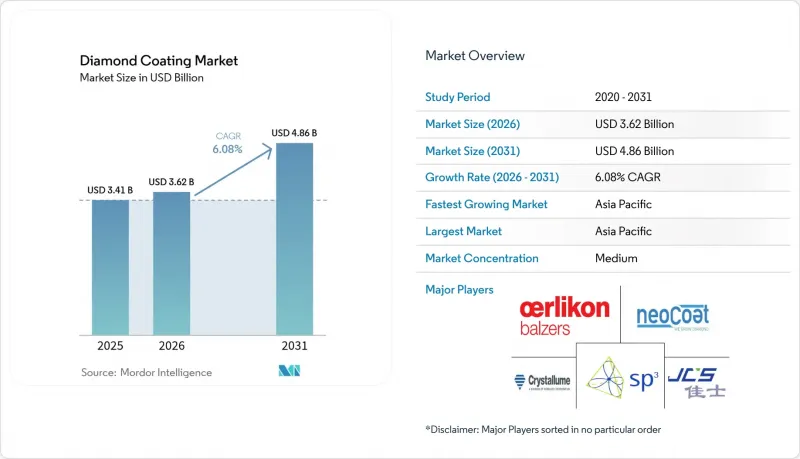
本報告按技術(化學氣相沉積 (CVD)、物理氣相沉積 (PVD))、塗層類型(多晶鑽石 (PCD)、奈米晶/微晶鑽石 (NCD/MCD) 等)、終端用戶產業(電氣電子、醫療及其他)和地區(亞太、北美及其他)進行細分。市場預測以美元 (USD) 為單位。
全球鑽石塗層市場趨勢及洞察
輕質複合材料切削刀具的應用迅速成長
加工碳纖維增強塑膠會產生磨蝕性粉塵,導致傳統硬質合金刀片在幾次切割後便會變鈍。而採用 CVD 鑽石塗層的刀具壽命可延長 15 至 30 倍,顯著減少航太複合材料結構因更換刀具而造成的停機時間和廢料。微晶/奈米晶雙層層級構造進一步抑制裂紋擴展,降低了機翼面板和汽車車體面板分層的風險。隨著波音和空中巴士等公司不斷增加複合材料的使用,供應商開始指定使用鑽石塗層刀具,即使在高轉速下也能獲得乾淨的切割刃。因此,北美和歐洲對鑽石塗層鑽頭、銑刀和端銑刀的需求正在成長。由於目前運作的複合材料飛機數量仍然相對較新,備件加工量也才剛開始擴大,預計中期市場成長將十分強勁。
消費性電子產品對溫度控管解決方案的需求日益成長。
目前,資料中心GPU每個模組的散熱量超過700瓦,迫使營運商重新考慮其底板所用材質。在Akash Systems公司價值2700萬美元的供應合約下,其部署的AI伺服器試點模型中,導熱係數高達800瓦/米·開爾文的銅-鑽石複合材料將核心溫度降低了20度C。實驗室製造的單晶鑽石散熱片導熱係數達到1500-2200瓦/米·開爾文,遠超銅的400瓦/米·開爾文。這種顯著的性能差異正在推動其應用。美國弗勞恩霍夫研究所研發的軟性鑽石奈米薄膜可望透過更有效率地從電力電子設備散熱,將電動車電池的充電速度提高五倍。因此,結合小型化和高功率密度的發展趨勢,用於溫度控管的鑽石塗層在智慧型手機、筆記型電腦和資料中心OEM廠商的採購藍圖中佔據著重要地位。短期需求在亞太地區最為強勁,因為那裡正在進行大規模的設備組裝。
大筆資本投入和較長的投資回收期
一台CemeCon三腔CC800鑽石加工設備造價數百萬美元,且需要對排氣系統、氣體處理系統和無塵室進行單獨改造。因此,中小企業難以證明這些支出的合理性,因為切削刀具客戶對高昂的價格有所抵觸。即使是大規模鑄造廠,其設備折舊免稅額期也長達五年或更久,從而延長了投資回報期。資金籌措審查也日趨嚴格,貸款機構在核准租賃前會仔細審查運轉率。在新興市場,進入門檻更高,因為當地的電力成本和熟練勞動成本會擠壓營運利潤空間。這些現實情況阻礙了短期內設備的普及,尤其對於非一級供應商而言更是如此。
細分市場分析
2025年,CVD製程佔鑽石塗層市場銷售額的66.70%,預計到2031年,這一佔有率將以6.74%的複合年成長率成長。 CVD製程能夠控制晶粒尺寸、形成高密度薄膜,並保持小於±3µm的厚度均勻性,使其成為高性能切削刀具和散熱器製造的核心技術。 Element Six公司的800 W/mK銅-鑽石複合材料展示了CVD技術如何將鑽石晶粒無空隙地嵌入金屬基質中,從而實現人工智慧處理器的高速導熱。此外,採用氧化石墨烯的生長方法使沉積速率提高了35%,縮短了週期時間並降低了每片晶圓的成本。 PVD製程的溫度上限為150–200 度C,在需要保護敏感基板和聚合物基板的特定領域中佔據關鍵地位。然而,隨著等離子增強技術的逐步改進,預計性能差距將逐漸縮小,使該技術能夠應用於無法承受傳統化學氣相沉積(CVD)高溫的醫療設備原始設備製造商(OEM)。這兩種方法共同鞏固了鑽石塗佈市場的技術基礎。
區域分析
預計到2025年,亞太地區將佔全球銷售額的56.10%,並將在2031年之前以6.79%的複合年成長率推動市場成長。中國正利用其「863」計畫的長期資金支持,將實驗室培育鑽石的供應與化學氣相沉積(CVD)反應器的製造相結合,從而使國內企業在整個鑽石塗層價值鏈中都擁有成本優勢。日本Orbray公司已成功量產2吋單晶鑽石晶片,並計畫在2027年實現4吋基板的生產,為寬能隙半導體和量子光電奠定基礎。在韓國,電動車電池的蓬勃發展恰逢對用於極耳鍵合的鑽石塗層焊條的需求激增。
北美已成為鑽石材料技術成熟應用的地區,桑迪亞國家實驗室宣布研發厚度足以覆蓋大面積而不開裂的無應力非晶態鑽石薄膜。根據“CHIPS方法”, 連貫和Akash Systems已獲得超過8000萬美元的津貼,用於加速美國鑽石材料技術的發展。此外,加拿大航太加工叢集和墨西哥汽車組裝上也開始指定使用鑽石刀具來維持複合材料零件的公差。
在歐洲市場,嚴格的環境法規與精密工程的傳統交織在一起。德國的汽車製造商正在使用鑽石銑床加工碳纖維車身面板,而法國的賽峰集團和歐瑞康集團則投資超過800萬美元,建立了一個聯合表面處理實驗室,致力於提高渦輪機的效率。英國透過其研究與創新署(UKRI)出資520萬美元,支持Element Six公司與華威大學合作開發用於航空航太電子設備的合成鑽石散熱器。遵守REACH法規促使歐洲企業不斷探索耐用且可回收的模具方案。
儘管南美洲、中東和非洲地區目前市場規模較小,但來自採礦、油田和精密農業設備製造商的諮詢量正在增加,他們希望在惡劣環境下延長零件的使用壽命。隨著這些地區工業化的加速,預計鑽石塗層市場將把銷售網路和塗層承包能力擴展到巴西、沙烏地阿拉伯和阿拉伯聯合大公國(阿拉伯聯合大公國)。
其他好處:
- Excel格式的市場預測(ME)表
- 3個月的分析師支持
目錄
第1章:引言
- 研究假設和市場定義
- 調查範圍
第2章:調查方法
第3章執行摘要
第4章 市場狀況
- 市場概覽
- 市場促進因素
- 輕質複合材料切削刀具的應用迅速成長
- 消費性電子產品對溫度控管解決方案的需求日益成長。
- 鑽石塗層外科和牙科器械的使用正在加速成長。
- 監管機構大力推動無鉛精密焊接設備。
- 電動車電池電銲條對耐磨性的需求日益成長。
- 市場限制因素
- 大筆資本投入和較長的投資回收期
- 溫度敏感基材的黏著挑戰
- 具有競爭力的低成本替代塗料
- 價值鏈分析
- 波特五力模型
第5章 市場規模與成長預測
- 透過技術
- 化學氣相沉積(CVD)
- 物理氣相沉積(PVD)
- 按塗層類型
- 多晶鑽石(PCD)
- 奈米/微晶鑽石(NCD/MCD)
- 類金剛石碳(DLC)
- 複合材料/摻雜鑽石塗層
- 按最終用戶行業分類
- 電氣和電子設備
- 醫學領域
- 產業
- 其他終端用戶產業(航太、國防等)
- 地區
- 亞太地區
- 中國
- 日本
- 印度
- 韓國
- 東南亞國協
- 其他亞太國家
- 北美洲
- 美國
- 加拿大
- 墨西哥
- 歐洲
- 德國
- 英國
- 法國
- 義大利
- 西班牙
- 俄羅斯
- 北歐國家
- 其他歐洲國家
- 南美洲
- 巴西
- 阿根廷
- 其他南美國家
- 中東和非洲
- 沙烏地阿拉伯
- 南非
- 其他中東和非洲國家
- 亞太地區
第6章 競爭情勢
- 市場集中度
- 策略趨勢
- 市佔率和排名分析
- 公司簡介
- CemeCon AG
- Crystallume
- Diamond Product Solutions
- Diamond Technologies Inc.(DTI)
- Element Six UK Ltd.
- JCS Technologies Pte Ltd
- NeoCoat SA
- OC Oerlikon Balzers
- Pureon AG
- SP3 Diamond Technologies
- Surface Technology, Inc.
- United Protective Technologies, LLC.
- Vergason Technology, Inc
第7章 市場機會與未來展望
According to Mordor Intelligence, the diamond coating market size was valued at USD 3.41 billion in 2025 and estimated to grow from USD 3.62 billion in 2026 to reach USD 4.86 billion by 2031, at a CAGR of 6.08% during the forecast period (2026-2031).
This report is Segmented by Technology (Chemical Vapour Deposition (CVD), Physical Vapour Deposition (PVD)), Coating Type (Polycrystalline Diamond (PCD), Nano-/Micro-crystalline Diamond (NCD/MCD), and More), End-User Industry (Electrical and Electronics, Medical, and More), and Geography (Asia-Pacific, North America, and More). The Market Forecasts are Provided in Terms of Value (USD).
Global Diamond Coating Market Trends and Insights
Surging Adoption in Cutting Tools for Light-Weight Composites
Machining carbon-fiber reinforced plastics generates abrasive dust that blunts conventional carbide inserts after limited passes. CVD diamond-coated cutters last 15-30 times longer, shaving tool-change downtime and scrap on aerospace composite structures. Dual-layer micro-crystalline/nano-crystalline stacks further suppress crack propagation, lowering delamination risk on wing panels and automotive body panels As Boeing and Airbus lift composite content, suppliers specify diamond coatings to achieve clean edges at high spindle speeds. The result is rising unit demand for diamond-ready drills, routers, and end mills across North America and Europe. Medium-term growth remains secure because the installed fleet of composite airframes is still young and spare-parts machining volumes are only beginning to scale.
Growing Demand for Thermal-Management Solutions in Consumer Electronics
Data-center GPUs now dissipate beyond 700 W per module, forcing operators to rethink baseplate materials. Copper-diamond composites delivering 800 W/mK thermal conductivity cut core temperatures by up to 20 °C in pilot AI servers deployed by Akash Systems under a USD 27 million supply contract. Laboratory single-crystal diamond spreaders reach 1,500-2,200 W/mK, far eclipsing copper at 400 W/mK, creating a clear performance gap that favors adoption. Fraunhofer USA's flexible diamond nanomembranes promise five-fold faster EV battery charging by extracting heat from power electronics more efficiently. The collision of miniaturisation and higher power density therefore keeps thermal-grade diamond coatings firmly on the procurement road-maps of smartphone, laptop, and datacenter OEMs. Short-term pull is strongest in Asia-Pacific where volume device assembly occurs.
High Capital Investment and Long Payback Periods
A single three-chamber CC800 Diamond unit from CemeCon costs multiple millions of USD and demands customised exhaust, gas handling, and clean-room retrofits. SMEs therefore struggle to justify outlays when cutting-tool clients resist premium pricing. Even for large foundries, depreciation stretches beyond five years, lengthening return horizons. Financing has become more selective, with lenders scrutinising utilisation rates before approving leases. In emerging markets the hurdle is steeper because local electricity and skilled-labour costs narrow operating margin cushions. These realities shave near-term adoption, particularly outside tier-one suppliers.
Other drivers and restraints analyzed in the detailed report include:
- Accelerating Use of Diamond-Coated Surgical and Dental Tools
- Regulatory Push for Lead-Free Precision Soldering Equipment
- Adhesion Challenges on Temperature-Sensitive Substrates
For complete list of drivers and restraints, kindly check the Table Of Contents.
Segment Analysis
CVD processes commanded 66.70% of 2025 revenue, and this slice of the diamond coating market is forecast to climb at a 6.74% CAGR to 2031. The technique's ability to tailor grain size, build dense films, and hit thickness uniformity below +-3 µm keeps it at the core of high-performance cutting-tool and heat-spreader production. Element Six's 800 W/mK copper-diamond composite illustrates how CVD can embed diamond grains in metal matrices without voids, unlocking rapid heat flow for AI processors. Graphene-oxide assisted growth now accelerates deposition by 35%, trimming cycle time and lowering per-wafer costs. PVD holds niche positions where 150-200 °C limits protect sensitive electronics boards or polymer substrates. Even so, incremental improvements in plasma-enhanced variants are expected to narrow the performance gap, allowing PVD to court medical OEMs that cannot tolerate the higher temperatures of conventional CVD. Together, both methods secure the technological backbone of the diamond coating market.
Complete Report Scope:
- By Technology
- Chemical Vapour Deposition (CVD)
- Physical Vapour Deposition (PVD)
- By Coating Type
- Polycrystalline Diamond (PCD)
- Nano-/Micro-crystalline Diamond (NCD/MCD)
- Diamond-Like Carbon (DLC)
- Composite / Doped Diamond Coatings
- By End-user Industry
- Electrical and Electronics
- Medical
- Industrial
- Other End-user Industries (Aerospace and Defense, etc.)
- Geography
- Asia-Pacific
- China
- Japan
- India
- South Korea
- ASEAN Countries
- Rest of Asia-Pacific
- North America
- United States
- Canada
- Mexico
- Europe
- Germany
- United Kingdom
- France
- Italy
- Spain
- Russia
- NORDIC Countries
- Rest of Europe
- South America
- Brazil
- Argentina
- Rest of South America
- Middle-East and Africa
- Saudi Arabia
- South Africa
- Rest of Middle-East and Africa
- Asia-Pacific
Geography Analysis
Asia-Pacific controlled 56.10% of global revenue in 2025 and is pacing the field with a 6.79% CAGR through 2031. China leverages long-running "863" funding lines to integrate lab-grown diamond supply with CVD reactor manufacturing, giving local players cost advantages along the diamond coating value chain. Japan's Orbray has scaled 2-inch single-crystal diamond wafers and targets 4-inch substrates by 2027, laying groundwork for wide-bandgap semiconductors and quantum photonics. South Korea's EV battery boom creates a parallel surge in diamond-clad welding electrodes for tab joining.
North America follows as a mature adopter, with Sandia National Laboratories unveiling stress-free amorphous diamond films thick enough for large-area coverage without cracking. CHIPS Act grants worth more than USD 80 million have already flowed to Coherent and Akash Systems to accelerate on-shore diamond material technologies. Canada's aerospace machining cluster and Mexico's automotive assembly lines also specify diamond tooling to maintain tolerances on composite parts.
Europe's market reflects an interplay of strict environmental regulations and precision engineering heritage. Germany's OEMs rely on diamond routers to machine carbon-fiber body panels, while France's Safran and Oerlikon together invested over USD 8 million in a joint surface-treatment lab focused on turbine efficiency. The United Kingdom has dedicated USD 5.2 million via UKRI to an Element Six-University of Warwick program developing synthetic diamond heat spreaders for space electronics. Compliance with REACH continues to steer European firms toward durable, recyclable tooling options.
South America and the Middle-East and Africa are smaller today but show rising inquiry volumes from mining, oil-field, and precision agricultural equipment producers seeking longer component life in abrasive conditions. As regional industrialisation gains pace, the diamond coating market will likely see distributor networks and toll-coating capacity expand into Brazil, Saudi Arabia, and the United Arab Emirates.
- CemeCon AG
- Crystallume
- Diamond Product Solutions
- Diamond Technologies Inc. (DTI)
- Element Six UK Ltd.
- JCS Technologies Pte Ltd
- NeoCoat SA
- OC Oerlikon Balzers
- Pureon AG
- SP3 Diamond Technologies
- Surface Technology, Inc.
- United Protective Technologies, LLC.
- Vergason Technology, Inc
Additional Benefits:
- The market estimate (ME) sheet in Excel format
- 3 months of analyst support
TABLE OF CONTENTS
1 Introduction
- 1.1 Study Assumptions and Market Definition
- 1.2 Scope of the Study
2 Research Methodology
3 Executive Summary
4 Market Landscape
- 4.1 Market Overview
- 4.2 Market Drivers
- 4.2.1 Surging Adoption in Cutting Tools for Light-Weight Composites
- 4.2.2 Growing Demand for Thermal-Management Solutions In Consumer Electronics
- 4.2.3 Accelerating Use of Diamond-Coated Surgical and Dental Tools
- 4.2.4 Regulatory Push for Lead-Free Precision Soldering Equipment
- 4.2.5 Increased Wear-Life Needs of EV Battery Welding Electrodes
- 4.3 Market Restraints
- 4.3.1 High Capital Investment and Long Payback Periods
- 4.3.2 Adhesion Challenges on Temperature-Sensitive Substrates
- 4.3.3 Competing Lower-Cost Coating Alternatives
- 4.4 Value Chain Analysis
- 4.5 Porter's Five Forces
- 4.5.1 Threat of New Entrants
- 4.5.2 Bargaining Power of Buyers
- 4.5.3 Bargaining Power of Suppliers
- 4.5.4 Threat of Substitute Products
- 4.5.5 Degree of Competition
5 Market Size and Growth Forecasts (Value)
- 5.1 By Technology
- 5.1.1 Chemical Vapour Deposition (CVD)
- 5.1.2 Physical Vapour Deposition (PVD)
- 5.2 By Coating Type
- 5.2.1 Polycrystalline Diamond (PCD)
- 5.2.2 Nano-/Micro-crystalline Diamond (NCD/MCD)
- 5.2.3 Diamond-Like Carbon (DLC)
- 5.2.4 Composite / Doped Diamond Coatings
- 5.3 By End-user Industry
- 5.3.1 Electrical and Electronics
- 5.3.2 Medical
- 5.3.3 Industrial
- 5.3.4 Other End-user Industries (Aerospace and Defense, etc.)
- 5.4 Geography
- 5.4.1 Asia-Pacific
- 5.4.1.1 China
- 5.4.1.2 Japan
- 5.4.1.3 India
- 5.4.1.4 South Korea
- 5.4.1.5 ASEAN Countries
- 5.4.1.6 Rest of Asia-Pacific
- 5.4.2 North America
- 5.4.2.1 United States
- 5.4.2.2 Canada
- 5.4.2.3 Mexico
- 5.4.3 Europe
- 5.4.3.1 Germany
- 5.4.3.2 United Kingdom
- 5.4.3.3 France
- 5.4.3.4 Italy
- 5.4.3.5 Spain
- 5.4.3.6 Russia
- 5.4.3.7 NORDIC Countries
- 5.4.3.8 Rest of Europe
- 5.4.4 South America
- 5.4.4.1 Brazil
- 5.4.4.2 Argentina
- 5.4.4.3 Rest of South America
- 5.4.5 Middle-East and Africa
- 5.4.5.1 Saudi Arabia
- 5.4.5.2 South Africa
- 5.4.5.3 Rest of Middle-East and Africa
- 5.4.1 Asia-Pacific
6 Competitive Landscape
- 6.1 Market Concentration
- 6.2 Strategic Moves
- 6.3 Market Share(%)/Ranking Analysis
- 6.4 Company Profiles {(includes Global level Overview, Market level overview, Core Segments, Financials as available, Strategic Information, Market Rank/Share for key companies, Products and Services, and Recent Developments)}
- 6.4.1 CemeCon AG
- 6.4.2 Crystallume
- 6.4.3 Diamond Product Solutions
- 6.4.4 Diamond Technologies Inc. (DTI)
- 6.4.5 Element Six UK Ltd.
- 6.4.6 JCS Technologies Pte Ltd
- 6.4.7 NeoCoat SA
- 6.4.8 OC Oerlikon Balzers
- 6.4.9 Pureon AG
- 6.4.10 SP3 Diamond Technologies
- 6.4.11 Surface Technology, Inc.
- 6.4.12 United Protective Technologies, LLC.
- 6.4.13 Vergason Technology, Inc
7 Market Opportunities and Future Outlook
- 7.1 White-space and Unmet-Need Assessment

 鑽石塗層市場:按類型、基材類型、塗層技術、晶體結構、應用、終端用戶產業和分銷管道分類-2026-2032年全球預測
 鑽石塗層市場:按技術、基材、終端應用產業和地區分類
 2026年全球鑽石塗層市場報告
 鑽石塗層市場規模、佔有率和趨勢分析報告:按技術、基材、最終用途、地區和細分市場預測,2025-2033 年
 鑽石塗料市場,規模,佔有率,趨勢,產業分析報告:各技術,各種基板,各終端用戶,各地區-2025年~2034年市場預測美國鑽石塗層市場規模、佔有率、趨勢分析報告:按基材、技術、最終用途和細分市場預測,2025 年至 2033 年
 鑽石塗佈市場-全球產業規模、佔有率、趨勢、機會及預測,按基材、最終用戶、地區及競爭情況細分,2020-2030 年
 鑽石塗層市場報告:趨勢、預測和競爭分析(至 2031 年)