

 |
市場調查報告書
商品編碼
2114746
矽酮塗料:市場佔有率分析、產業趨勢與統計、成長預測(2026-2031)Silicone Coating - Market Share Analysis, Industry Trends & Statistics, Growth Forecasts (2026 - 2031) |
||||||

※ 本網頁內容可能與最新版本有所差異。詳細情況請與我們聯繫。
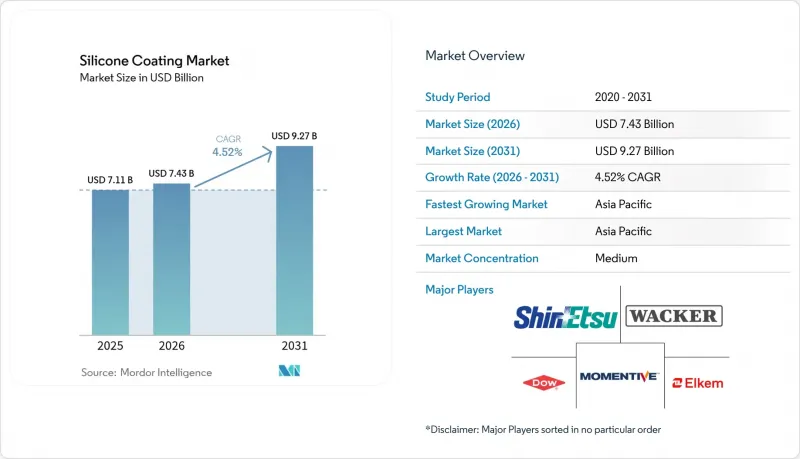
據 Mordor Intelligence 稱,2025 年矽塗料市值為 71.1 億美元,預計到 2031 年將達到 92.7 億美元,而 2026 年為 74.3 億美元,預測期(2026-2031 年)的複合年成長率為 4.52%。
本報告按成分類型(聚合物、100% 矽酮、防水劑、添加劑)、技術(無溶劑、溶劑型、其他)、基材(金屬、混凝土和磚石、其他)、終端用戶行業(建築、電子、其他)以及地區(亞太、北美、歐洲、其他)進行細分。市場預測以美元計價。
全球矽塗料市場趨勢與洞察
節能建築的冷冷屋頂維修激增。
加州第24號建築規範規定,緩坡商業屋頂的最低太陽反射率必須達到0.63,熱輻射率必須達到0.75。這項規定即時引發了對高反射率矽酮塗層的需求。越來越多的業主選擇矽酮維修而非徹底更換屋頂,不僅可以節省高達40%的資本支出,還能延長屋頂的使用壽命。加州能源委員會的實地研究表明,在炎熱氣候下,冷冷屋頂可以降低高達15%的年度能源消耗。類似的基於性能的建築規範目前也正在歐洲和亞洲快速發展的大都會圈推廣,並將矽酮解決方案納入長期維修預算。隨著電費持續上漲,矽酮冷冷屋頂系統的投資回收期正在縮短,從而推動了矽酮塗層市場的持續需求。
來自建築和建設產業的需求不斷成長
建設產業正從被動維修轉向預防性圍護結構保護,而矽酮化學正處於這項轉型策略轉捩點。儘管水分侵入仍是混凝土劣化的主要原因,但透氣性矽酮屏障可在確保基材透氣性的同時,將結構的使用壽命延長20至30年。在大跨距橋樑上測試的奈米鈦改質矽烷塗層展現出超過70年的潛在使用壽命。公共基礎設施採購中的保障架構日益明確規定了最低維護週期,而只有矽酮技術才能滿足這些要求,這鞏固了這個需求促進因素的長期影響。政府針對「全生命週期碳排放量」計算的新獎勵進一步提高了高耐久性矽酮薄膜的採用率,從而增強了矽酮塗料市場的成長動能。
矽氧烷和氣相二氧化矽原料價格的波動
金屬矽價格的波動正蔓延至矽氧烷和氣相二氧化矽等中間體,削弱塗料製造商的成本可預測性。由於冶煉產能集中在能源密集型省份,中國地區電力供應限制和環境法規導致的停產可能在數週內引發全球原物料物價指數的急劇上漲。塗料製造商正透過簽訂供應合約進行避險,並提高再生材料的比例來應對。此外,新的解聚合技術正被用於將廢舊矽重新轉化為單體原料。雖然資本密集的後向整合可以提高獲利能力,但其益處僅限於少數跨國公司。因此,短期價格波動導致下游用戶採取謹慎的庫存策略,略微減緩了矽塗料市場的擴張。
細分市場分析
到2025年,100%純矽酮產品將佔總銷售額的41.02%,即使在嚴苛的紫外線和熱循環條件下,也能展現出無與倫比的耐久性。這些產品構成了石油化工、船舶和屋頂材料等行業工業維護預算的基礎,因為在這些行業中,停機成本遠高於較高的材料成本。儘管產量較低,但預計到2031年,疏水性化學品將以5.28%的複合年成長率高速成長,成為成長最快的行業之一,因為建築師擴大要求在淨零能耗建築中使用「透氣且防潮」的外牆材料。超疏水矽膠樹脂的進步使其靜態接觸角超過160°,為外牆板、紀念碑甚至太陽能組件的保護開闢了新的途徑。
目前,我們的研發管線正在開發生物基烷基聚矽氧烷,該材料在保持高接觸角的同時,可降低碳排放強度,並滿足公共基礎設施項目以永續性為導向的競標要求。同時,含有倍半矽氧烷和奈米氧化鋯的添加劑組合可在不增加VOC含量的情況下提高耐磨性,這在排放管制嚴格的噴塗室中尤其有利。因此,競爭差異化正從基礎聚合物轉化轉向獨特的表面能控制,從而確保客戶忠誠度,並增強我們在矽酮塗料市場的定價能力。
2025年,受建築業和OEM工廠中VOC含量限制等環保法規的推動,無溶劑系統將佔銷售額的37.85%。由於不含易燃載體溶劑,工廠安全審核得以簡化,承包商的保險費用也得以降低。然而,紫外光固化平台預計將以5.33%的複合年成長率成長,隨著生產線追求1分鐘以內的無黏性固化時間和更低的能耗,其市場佔有率將迅速縮小與無溶劑系統的差距。近紅外光光引發劑的技術突破使得固化深度超過25毫米,從而實現了先前依賴熱固化的結構性黏著劑和厚壁灌封。
水性混合產品在學校和醫院等室內空氣品質法規限制溶劑暴露的場所越來越受歡迎,而輻射固化環氧樹脂則能保護微型LED背板免受助焊劑焊接工藝的損害。這些技術的結合正在拓展矽酮塗料市場的應用範圍,為設計人員提供日益精細化的工具包,以滿足生產效率和永續性。
區域分析
預計到2025年,亞太地區將佔全球銷售額的45.70%,到2031年將維持4.92%的複合年成長率。這反映了中國、印度和越南在基礎建設方面的協調投資,以及韓國和台灣電子製造業的飽和。當地企業正加大對電動車溫度控管和半導體封裝技術等領域的研發投入,進而在單純提高產量之外,創造更多區域附加價值。跨國製造商正加強合資企業建設,以確保接近性終端用戶並降低物流風險,從而保持其在矽塗料市場的領先地位。
北美市場技術依然成熟,加州第24號法規等能源法規正推動冷屋頂的需求制度化。屋頂工人正在利用矽膠修補系統來避免掩埋成本,這促進了陽光地帶各省對冷屋頂的採用。在加拿大,聯邦綠建築標準提高了透氣性外牆塗料的重要性,而墨西哥的汽車產業叢集則為導熱界面矽膠帶帶來了穩定的需求。儘管總銷量趨於平穩,但這些趨勢仍在支撐著價值的穩定成長。
在歐洲市場,對循環經濟的追求推動了對持久耐用、低維護成本的化學產品的需求。這使得矽酮成為橋樑維修和離岸風力發電單樁工程的標準選擇。德國和北歐國家在矽酮襯裡廢棄物的製程回收進程內處於領先地位,增強了區域供應的韌性。在其他地區,南歐的維修熱潮推動了經濟刺激資金用於反射塗層,以緩解城市熱島效應。在南美、中東和非洲等新興經濟體,隨著港口擴建和能源項目的推進,需求正在逐步成長,但外匯波動和承包商專業知識的缺乏限制了這些地區的應用。
其他好處:
- Excel格式的市場預測(ME)表
- 3個月的分析師支持
目錄
第1章:引言
- 研究假設和市場定義
- 調查範圍
第2章:調查方法
第3章執行摘要
第4章 市場狀況
- 市場概覽
- 市場促進因素
- 節能建築中,冷屋頂維修激增。
- 來自建築和建設產業的需求不斷成長
- 三防膠在消費性和工業電子設備中的快速普及
- 汽車業對矽塗料的需求不斷成長
- 緩解城市熱島效應的措施正在推動反射矽膠屋頂的廣泛應用。
- 市場限制因素
- 原料價格波動(矽氧烷、氣相二氧化矽)
- 矽烷單體原料供應鏈的集中化
- 更嚴格的室內空氣防火安全標準限制了室內矽膠的使用。
- 價值鏈分析
- 波特五力分析
第5章 市場規模與成長預測
- 按配置類型
- 聚合物
- 100% 矽膠
- 防水
- 添加劑
- 透過技術
- 無溶劑
- 溶劑型
- 水溶液
- 輻射/紫外線固化
- 按基礎材料
- 金屬
- 混凝土和磚石結構
- 塑膠和複合材料
- 玻璃和陶瓷
- 按最終用戶行業分類
- 建築/施工
- 電子設備
- 汽車和運輸業
- 其他終端用戶產業(能源、電力等)
- 按地區
- 亞太地區
- 中國
- 日本
- 印度
- 韓國
- 東南亞國協
- 其他亞太國家
- 北美洲
- 美國
- 加拿大
- 墨西哥
- 歐洲
- 德國
- 英國
- 法國
- 義大利
- 西班牙
- 俄羅斯
- 北歐國家
- 其他歐洲國家
- 南美洲
- 巴西
- 阿根廷
- 其他南美國家
- 中東和非洲
- 沙烏地阿拉伯
- 南非
- 其他中東和非洲國家
- 亞太地區
第6章 競爭情勢
- 市場集中度
- 策略趨勢
- 市佔率和排名分析
- 公司簡介
- Akzo Nobel NV
- BASF
- Carlisle Companies Inc.
- Chase Corp.
- CHT Germany GmbH
- Dow
- Elkem ASA
- Evonik Industries AG
- GAF Materials LLC
- Hempel A/S
- Huntsman International LLC
- KCC CORPORATION
- Milliken and Company
- Momentive
- PPG Industries, Inc.
- Shin-Etsu Chemical Co., Ltd.
- Sika AG
- The Sherwin-Williams Company
- Wacker Chemie AG
第7章 市場機會與未來展望
According to Mordor Intelligence, the silicone coating market size was valued at USD 7.11 billion in 2025 and estimated to grow from USD 7.43 billion in 2026 to reach USD 9.27 billion by 2031, at a CAGR of 4.52% during the forecast period (2026-2031).
This report is Segmented by Composition Type (Polymers, 100% Silicone, Water Repellents, Additives), Technology (Solvent-Less, Solvent-Based, and More), Substrate (Metal, Concrete and Masonry, and More), End-User Industry (Building and Construction, Electronics, and More), and Geography (Asia-Pacific, North America, Europe, and More). The Market Forecasts are Provided in Terms of Value (USD).
Global Silicone Coating Market Trends and Insights
Surge in Cool-Roof Refurbishments for Energy-Efficient Buildings
California's Title 24 code enforces a minimum aged solar reflectance of 0.63 and thermal emittance of 0.75 on low-slope commercial roofs, converting regulatory language into immediate demand for high-reflectance silicone membranes. Building owners frequently choose silicone restoration rather than full reroofing, trimming capital expenditure by as much as 40% while extending service life. Field studies from the California Energy Commission indicate that cool roofs cut annual energy use by up to 15% in hot climates. Similar performance-based codes now appear across Europe and fast-growing Asian megacities, embedding silicone solutions in long-range retrofit budgets. As electricity tariffs continue to rise, the payback period for silicone cool-roof systems shortens, reinforcing a durable demand driver in the Silicone coatings market.
Growing Demand from the Building and Construction Industry
The construction sector is shifting from reactive repairs toward proactive envelope protection, and silicone chemistry sits at that strategic pivot point. Moisture ingress remains the dominant degradation mechanism in concrete, yet vapor-permeable silicone barriers extend structural life by two to three decades while allowing substrates to breathe. Nanotitanium-modified silane coatings tested on long-span bridges have demonstrated potential lifetimes exceeding 70 years. Warranty frameworks in public-infrastructure procurement increasingly specify minimum service intervals that silicone technology uniquely satisfies, anchoring the long-term influence of this driver. Emerging government incentives for "whole-life-carbon" accounting further lift specification rates for high-durability silicone membranes, amplifying growth momentum in the Silicone coatings market.
Volatile Raw-Material Prices for Siloxanes and Fumed Silica
Silicon-metal price swings cascade through to siloxane and fumed-silica intermediates, undermining cost predictability for coating formulators. Concentrated smelting capacity in energy-intensive provinces means that local power curtailments or environmental shutdowns in China can spike global raw-material indices within weeks. Coating producers respond through supply-contract hedging and greater recycle content, with emerging depolymerization technologies converting post-consumer silicone back into monomeric feedstock. Capital-intensive backward integration shelters margins yet favors only a handful of multinational players. Short-term volatility therefore translates into cautious inventory strategies among downstream users, mildly dampening expansion in the Silicone coatings market.
Other drivers and restraints analyzed in the detailed report include:
- Rapid Adoption in Consumer and Industrial Electronics Conformal Coatings
- Increasing Demand from the Automotive Industry
- Supply-Chain Concentration of Silane Monomer Feedstocks
For complete list of drivers and restraints, kindly check the Table Of Contents.
Segment Analysis
In 2025, 100% silicone grades generated 41.02% of total revenue, reflecting their unrivaled durability under severe UV and thermal cycling. These products anchor industrial-maintenance budgets in petrochemical, marine, and roofing markets where downtime costs exceed material premiums. Water-repellent chemistries, although smaller in volume, post the highest 5.28% CAGR to 2031 as architects increasingly specify breathable yet moisture-blocking facades for net-zero buildings. Advancements in super-hydrophobic silicone resins have achieved static contact angles above 160°, opening facade panels, monuments, and even solar modules to new protective paradigms.
Research pipelines now blend bio-based alkyl-polysiloxanes that retain high contact angles while cutting carbon intensity, answering sustainability tenders in public infrastructure. Concurrently, additive packages containing silsesquioxanes and nano-zirconia enable abrasion resistance without raising VOC levels, a benefit in emission-regulated spray booths. Competitive differentiation therefore migrates from basic polymer conversion to proprietary surface-energy control, locking in customer loyalty and supporting pricing power across the Silicone coatings market.
Solvent-less systems captured 37.85% revenue in 2025, propelled by environmental regulations that cap VOC content in architectural and OEM facilities. Absence of flammable carrier solvents also simplifies plant-safety audits, lowering insurance premiums for applicators. Yet UV-cured platforms, forecast to grow at 5.33% CAGR, are rapidly closing the gap as production lines chase sub-minute tack-free times and lower energy footprints. Breakthroughs in near-infrared photoinitiators achieve cure depths exceeding 25 mm, unlocking structural adhesives and thick-section potting that previously defaulted to thermal bakeouts.
Water-borne hybrids edge into schools and hospitals where indoor-air regulations restrict solvent exposure, while radiation-cured epoxies protect mini-LED backplanes against flux-solder processing. Collectively, these technology options expand the addressable footprint of the Silicone coatings market, supplying specifiers with an increasingly granular toolkit aligned to both throughput and sustainability metrics.
Complete Report Scope:
- By Composition Type
- Polymers
- 100 % Silicone
- Water Repellents
- Additives
- By Technology
- Solvent-less
- Solvent-based
- Water-borne
- Radiation/UV-cured
- By Substrate
- Metal
- Concrete and Masonry
- Plastics and Composites
- Glass and Ceramics
- By End-user Industry
- Building and Construction
- Electronics
- Automotive and Transportation
- Other End-user Industries (Energy and Power,etc.)
- By Geography
- Asia-Pacific
- China
- Japan
- India
- South Korea
- ASEAN Countries
- Rest of Asia-Pacific
- North America
- United States
- Canada
- Mexico
- Europe
- Germany
- United Kingdom
- France
- Italy
- Spain
- Russia
- NORDIC Countries
- Rest of Europe
- South America
- Brazil
- Argentina
- Rest of South America
- Middle East and Africa
- Saudi Arabia
- South Africa
- Rest of Middle East and Africa
- Asia-Pacific
Geography Analysis
Asia-Pacific accounted for 45.70% of global revenue in 2025 and is projected to register a 4.92% CAGR to 2031, reflecting concerted infrastructure investment in China, India, and Vietnam alongside electronics manufacturing saturation in South Korea and Taiwan. Local firms increasingly channel R&D into EV thermal-management and semiconductor encapsulation, broadening regional value capture beyond basic volume. Multinational producers deepen joint ventures to secure proximity to end-users and buffer logistics exposure, thereby sustaining leadership within the Silicone coatings market.
North America remains a technologically mature arena where energy codes, such as California's Title 24, institutionalize cool-roof demand. Roofing contractors leverage silicone restoration systems to sidestep landfill disposal fees, boosting adoption in sun-belt states. In Canada, federal green-building standards elevate vapor-permeable facade coatings, while Mexico's automotive clusters generate steady pull for thermal-interface silicones. These dynamics anchor steady value growth, even as overall unit volumes plateau.
Europe's market pursues circular-economy goals that reward long-life, low-maintenance chemistries, positioning silicone as the default for bridge refurbishment and offshore wind monopiles. Germany and the Nordics pioneer in-process recycling of silicone liner waste, reinforcing local supply resilience. Elsewhere, Southern Europe's renovation wave channels stimulus funds toward roof-reflective coatings to mitigate urban heat islands. Emerging economies in South America and the Middle East & Africa add incremental demand through port expansions and energy projects, though currency volatility and limited applicator expertise moderate uptake in these regions.
- Akzo Nobel N.V.
- BASF
- Carlisle Companies Inc.
- Chase Corp.
- CHT Germany GmbH
- Dow
- Elkem ASA
- Evonik Industries AG
- GAF Materials LLC
- Hempel A/S
- Huntsman International LLC
- KCC CORPORATION
- Milliken and Company
- Momentive
- PPG Industries, Inc.
- Shin-Etsu Chemical Co., Ltd.
- Sika AG
- The Sherwin-Williams Company
- Wacker Chemie AG
Additional Benefits:
- The market estimate (ME) sheet in Excel format
- 3 months of analyst support
TABLE OF CONTENTS
1 Introduction
- 1.1 Study Assumptions and Market Definition
- 1.2 Scope of the Study
2 Research Methodology
3 Executive Summary
4 Market Landscape
- 4.1 Market Overview
- 4.2 Market Drivers
- 4.2.1 Surge in cool-roof refurbishments for energy-efficient buildings
- 4.2.2 Growing demand from building and construction industry
- 4.2.3 Rapid adoption in consumer and industrial electronics conformal coatings
- 4.2.4 Increasing demand for silicone coatings from the automotive industry
- 4.2.5 Urban-heat-island mitigation programs driving reflective silicone roofs
- 4.3 Market Restraints
- 4.3.1 Volatile raw-material prices (siloxanes, fumed silica)
- 4.3.2 Supply-chain concentration of silane monomer feedstocks
- 4.3.3 Stricter indoor-air fire-safety codes limiting interior silicone use
- 4.4 Value Chain Analysis
- 4.5 Porter's Five Forces Analysis
- 4.5.1 Bargaining Power of Suppliers
- 4.5.2 Bargaining Power of Buyers
- 4.5.3 Threat of New Entrants
- 4.5.4 Threat of Substitutes
- 4.5.5 Degree of Competition
5 Market Size and Growth Forecasts (Value)
- 5.1 By Composition Type
- 5.1.1 Polymers
- 5.1.2 100 % Silicone
- 5.1.3 Water Repellents
- 5.1.4 Additives
- 5.2 By Technology
- 5.2.1 Solvent-less
- 5.2.2 Solvent-based
- 5.2.3 Water-borne
- 5.2.4 Radiation/UV-cured
- 5.3 By Substrate
- 5.3.1 Metal
- 5.3.2 Concrete and Masonry
- 5.3.3 Plastics and Composites
- 5.3.4 Glass and Ceramics
- 5.4 By End-user Industry
- 5.4.1 Building and Construction
- 5.4.2 Electronics
- 5.4.3 Automotive and Transportation
- 5.4.4 Other End-user Industries (Energy and Power,etc.)
- 5.5 By Geography
- 5.5.1 Asia-Pacific
- 5.5.1.1 China
- 5.5.1.2 Japan
- 5.5.1.3 India
- 5.5.1.4 South Korea
- 5.5.1.5 ASEAN Countries
- 5.5.1.6 Rest of Asia-Pacific
- 5.5.2 North America
- 5.5.2.1 United States
- 5.5.2.2 Canada
- 5.5.2.3 Mexico
- 5.5.3 Europe
- 5.5.3.1 Germany
- 5.5.3.2 United Kingdom
- 5.5.3.3 France
- 5.5.3.4 Italy
- 5.5.3.5 Spain
- 5.5.3.6 Russia
- 5.5.3.7 NORDIC Countries
- 5.5.3.8 Rest of Europe
- 5.5.4 South America
- 5.5.4.1 Brazil
- 5.5.4.2 Argentina
- 5.5.4.3 Rest of South America
- 5.5.5 Middle East and Africa
- 5.5.5.1 Saudi Arabia
- 5.5.5.2 South Africa
- 5.5.5.3 Rest of Middle East and Africa
- 5.5.1 Asia-Pacific
6 Competitive Landscape
- 6.1 Market Concentration
- 6.2 Strategic Moves
- 6.3 Market Share(%)/Ranking Analysis
- 6.4 Company Profiles (includes Global level Overview, Market level overview, Core Segments, Financials as available, Strategic Information, Market Rank/Share, Products and Services, Recent Developments)
- 6.4.1 Akzo Nobel N.V.
- 6.4.2 BASF
- 6.4.3 Carlisle Companies Inc.
- 6.4.4 Chase Corp.
- 6.4.5 CHT Germany GmbH
- 6.4.6 Dow
- 6.4.7 Elkem ASA
- 6.4.8 Evonik Industries AG
- 6.4.9 GAF Materials LLC
- 6.4.10 Hempel A/S
- 6.4.11 Huntsman International LLC
- 6.4.12 KCC CORPORATION
- 6.4.13 Milliken and Company
- 6.4.14 Momentive
- 6.4.15 PPG Industries, Inc.
- 6.4.16 Shin-Etsu Chemical Co., Ltd.
- 6.4.17 Sika AG
- 6.4.18 The Sherwin-Williams Company
- 6.4.19 Wacker Chemie AG
7 Market Opportunities and Future Outlook
- 7.1 White-space and Unmet-need Assessment

 矽酮塗料市場規模、佔有率和成長分析:按類型、應用、基材、最終用途和地區分類-2026-2033年產業預測
 矽酮和矽氧烷市場:全球趨勢、佔有率、規模、成長、機會和預測(2026-2034年)矽酮塗料市場報告:按產品、技術、應用和地區分類(2026-2034 年)
 矽酮塗料市場-全球產業規模、佔有率、趨勢、機會、預測:按成分類型、技術、應用、地區和競爭格局分類,2021-2031年
 全球矽酮塗料市場規模、佔有率、趨勢及成長分析報告(2026-2034)
 有機矽塗料市場規模、佔有率、趨勢分析報告:依產品、應用、地區、細分市場預測,2025-2033