


 |
市場調查報告書
商品編碼
2114745
苯酚:市場佔有率分析、產業趨勢與統計、成長預測(2026-2031)Phenol - Market Share Analysis, Industry Trends & Statistics, Growth Forecasts (2026 - 2031) |
||||||

※ 本網頁內容可能與最新版本有所差異。詳細情況請與我們聯繫。
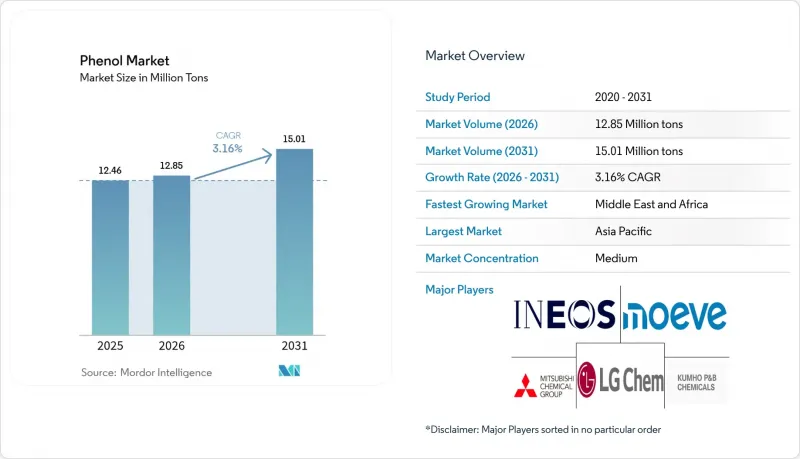
根據 Mordor Intelligence 預測,苯酚市場將從 2025 年的 1,246 萬噸成長到 2026 年的 1,285 萬噸,然後在 2031 年達到 1,501 萬噸,2026 年至 2031 年的複合年成長率為 3.16%。
本報告按產品類型(雙酚A、酚醛樹脂、己內醯胺及其他)、終端用戶產業(汽車、建築、製藥、家具及其他)和地區(亞太、北美、歐洲、南美、中東和非洲)進行細分。市場預測以噸為單位。
全球苯酚市場趨勢與洞察
聚碳酸酯和環氧樹脂對雙酚A的需求不斷增加。
雙酚A (BPA) 仍然是電子設備機殼、汽車玻璃和醫療設備等對透明度和抗衝擊強度要求極高的領域中,聚碳酸酯和環氧樹脂的關鍵單體。目前,電動車電池機殼強制使用阻燃聚碳酸酯混合物,即使在歐洲最近禁止將其用於食品包裝後,BPA 的出貨量仍然有所增加。在中國和印度,蓬勃發展的電子產品製造和基礎設施項目需要大量聚碳酸酯板材,這抵消了歐洲需求的下降。生產商透過將出貨地給東南亞的加工商和北美的代工模塑商來維持運轉率。中期來看,BPA 需求的成長預計將使運轉率保持在 85% 左右,從而在區域限制下支撐整個苯酚市場。
用於汽車領域的輕質酚醛複合材料的發展
汽車製造商正在檢驗酚醛複合材料在煞車輔助器和離合器片以外的應用,BMW的量產工廠已在結構性進氣歧管和空氣管理零件中驗證了其實用性。這種材料可在保持尺寸穩定性的同時,將重量減輕近20%,即使在140 度C的高溫下也能保持穩定,有助於滿足嚴格的排放氣體法規和續航里程目標。電動車(EV)平台進一步推動了電池模組外殼對酚醛衍生物的需求,因為在電池模組外殼中,阻燃性能和熱失控期間的機械完整性至關重要。原始設備供應商(OES)報告稱,酚醛複合材料的使用壽命長達15年,且具有穩定的抗碰撞性能,促使他們與歐美一級複合材料製造商簽訂了長期供貨協議。這些趨勢正在重振酚醛市場,並將需求轉向價格彈性較低的高附加價值工程應用領域。
食品接觸應用中的雙酚A法規
歐盟委員會2024年推出的法規禁止在罐頭塗層和可重複使用的食品容器中使用雙酚A(BPA),導致該地區需求下降約五分之一。允許的過渡期迫使包裝製造商在18個月內重新認證材料,擾亂了採購管道,並導致環氧樹脂製造商庫存減少。加拿大和美國幾個州也提出了類似的監管提案,將增加2027年之前的下行風險。雖然工業應用仍然強勁,但公眾對內分泌干擾物的日益關注可能會削弱投資者信心,並可能迫使苯酚市場的參與企業轉向爭議較小的衍生產品系列。
細分市場分析
儘管歐洲已禁止將雙酚A (BPA) 用於食品接觸,但由於成熟的聚碳酸酯生產,BPA在2025年仍維持了44.35%的苯酚市場佔有率。預計到2031年,與BPA相關的苯酚市場規模年均成長率僅2.22%,而己內醯胺的年均成長率預計將達到4.86%。在中國和中東擁有資產的生產商正在擴大運轉率,以彌補歐洲和美國需求的下降,並正在建立新的供應鏈以規避監管障礙。酚醛樹脂是第二大應用領域,受惠於建設活動的復甦,尤其是在商業設施維修,低煙保溫板的需求更為強勁。己內醯胺市場4.86%的複合年成長率主要得益於尼龍6纖維在工業纖維和輕量化汽車零件領域的應用成長。烷基酚等特種中間體用於界面活性劑,二甲苯酚則供應消毒劑市場,該市場因近期公共衛生危機而擴張。鹼性水解技術的進步使得尼龍的工業規模回收成為可能,並有望將廢棄物回收用於己內醯胺的合成,從而促進苯酚市場的循環經濟發展。
在苯酚商品市場,由於供應過剩和苯價格波動,利潤率受到擠壓,導致產品組合轉向高利潤率的衍生性商品。因此,歐洲的投資重點更放在解決己內醯胺和高純度酚醛樹脂生產線的瓶頸問題上,而不是新建雙酚A(BPA)工廠。在整個預測期內,技術許可方預計每次維修週期的能源效率將提高1.5%,預計將進一步降低成本。環境、社會和管治(ESG)指標正在影響客戶的採購決策,迫使生產商轉向生物基苯酚產品和再生酚醛樹脂,這些產品在提供經過檢驗的碳強度數據時可獲得溢價。
區域分析
預計到2025年,亞太地區仍將佔據全球苯酚市場53.94%的佔有率。這主要得益於中國大規模石化聯合裝置的化學品收率高達40%,而傳統煉油生產線的收率僅15-20%。印度投資11億美元的古吉拉突邦計畫預計在2027年前擴大苯酚、丙酮和雙酚A(BPA)的產能,符合印度旨在實現化學品自給自足的「印度製造」策略。日本和韓國供應高階下游衍生物,特別是用於電子產品的光學級聚碳酸酯和耐高溫酚類化合物,而東南亞國協則為快速成長的建築和家具產業提供產品。這些市場動態確保亞太地區將持續維持重要的供需中心地位。
北美面臨原料價格波動,但其豐富的頁岩氣儲量使其丙酮產品價格保持競爭力。然而,煉油廠停產導致丙烯供應緊張,利潤空間受壓,引發了關於分料異丙苯工廠代工生產的討論。美國關稅政策和反傾銷稅或許能暫時緩解來自亞洲的進口激增,但持續的競爭力將取決於對能源效率的投資以及與生物丙烯相關的潛在合作。
歐洲苯酚生產商正面臨高昂的能源成本和環境法規的雙重挑戰,這加速了產業重組,包括里昂巴塞爾對六家苯酚資產的重新評估。由於雙酚A(BPA)法規和優先發展生物基替代品的激進氣候目標,歐洲大陸的需求前景更加不明朗。中東和非洲是成長最快的地區,複合年成長率(CAGR)達5.42%,主要得益於沙烏地阿拉伯和阿拉伯聯合大公國的綜合煉油廠和石化聯合企業。這些企業利用了有利的原料成本和靠近亞洲進口樞紐的地理優勢。南美洲市場規模相對小規模但較穩定,巴西是全球苯酚消費大國,其苯酚主要用於汽車煞車零件和建築保溫板。阿根廷的經濟改革可能帶來一些利多因素,但外匯波動仍是短期風險。總體而言,區域市場格局的再平衡正在推動多元化的成長要素,從而增強全球苯酚市場。
其他好處:
- Excel格式的市場預測(ME)表
- 3個月的分析師支持
目錄
第1章:引言
- 研究假設和市場定義
- 調查範圍
第2章:調查方法
第3章執行摘要
第4章 市場狀況
- 市場概覽
- 市場促進因素
- 聚碳酸酯和環氧樹脂對雙酚A的需求量很高
- 用於汽車領域的輕質酚醛複合材料的發展
- 酚醛保溫板在建設產業的應用現狀
- 利用生物/綠色丙烯的永續異丙苯生產路線
- 苯酚生產設施與專用PO/SM綜合設施的整合
- 市場限制因素
- 食品接觸應用中雙酚A的相關規定
- 原料(苯和丙烯)價格波動
- 生物基酚類替代品的興起
- 價值鏈分析
- 監理情勢
- 波特五力模型
第5章 市場規模與成長預測
- 依產品類型
- 雙酚A
- 酚醛樹脂
- 己內醯胺
- 其他
- 按最終用戶行業分類
- 車
- 建造
- 製藥
- 家具
- 其他
- 按地區
- 亞太地區
- 中國
- 印度
- 日本
- 韓國
- 東南亞國協
- 其他亞太國家
- 北美洲
- 美國
- 加拿大
- 墨西哥
- 歐洲
- 德國
- 英國
- 法國
- 義大利
- 俄羅斯
- 北歐國家
- 其他歐洲國家
- 南美洲
- 巴西
- 阿根廷
- 其他南美國家
- 中東和非洲
- 沙烏地阿拉伯
- 南非
- 其他中東和非洲國家
- 亞太地區
第6章 競爭情勢
- 市場集中度
- 策略趨勢
- 市佔率/排名分析
- 公司簡介
- AdvanSix Inc.
- Altivia
- Chang Chun Group
- Deepak Nitrite Ltd
- Domo Chemicals GmbH
- Formosa Chemicals and Fibre Corp.
- INEOS Group
- Kumho P&B Chemicals Inc.
- LG Chem
- LyondellBasell Industries NV
- Mitsubishi Chemical Group Corporation
- Mitsui Chemicals Inc.
- Moeve
- PTT Phenol Company Limited
- SABIC
- Solvay
第7章 市場機會與未來展望
According to Mordor Intelligence, the phenol market size is expected to grow from 12.46 Million tons in 2025 to 12.85 Million tons in 2026 and is forecast to reach 15.01 Million tons by 2031 at 3.16% CAGR over 2026-2031.
This report is Segmented by Product Type (Bisphenol-A, Phenolic Resins, Caprolactam, and Others), End-User Industry (Automotive, Construction, Pharmaceuticals, Furniture, and Others), and Geography (Asia-Pacific, North America, Europe, South America, and Middle East and Africa). The Market Forecasts are Provided in Terms of Volume (Tons).
Global Phenol Market Trends and Insights
High Demand for Bisphenol-A in Polycarbonates and Epoxy Resins
Bisphenol-A continues to be the backbone monomer for polycarbonate and epoxy resins used in electronics housings, automotive glazing, and medical devices where clarity and impact strength are non-negotiable. Battery enclosures in electric vehicles now specify flame-retardant polycarbonate blends, further lifting BPA volumes even after Europe's recent bans in food packaging. China and India are offsetting those European losses through aggressive electronics manufacturing and infrastructure projects that deploy large polycarbonate sheet volumes. Producers are maintaining capacity utilization by diverting cargoes to Southeast Asian converters and North American contract molders. Over the medium term, incremental BPA growth should keep operating rates near 85%, supporting the broader phenol market despite localized restrictions.
Growth in Lightweight Automotive Phenolic Composites
Automakers are validating phenolic composites beyond brake boosters and clutch plates, with structural intake manifolds and air-management components already proven at BMW's series plants. The material's ability to maintain dimensional stability at 140 °C while reducing mass by nearly 20% aligns with stringent emissions and range targets. Electric-vehicle platforms add another pull on phenol derivatives for battery module housings where flame-spread performance and mechanical integrity under thermal runaway are critical. Original equipment suppliers (OES) report 15-year durability cycles and consistent crash-resistance metrics, prompting tier-one composite processors in Europe and the United States to enter long-term offtake contracts. These developments elevate the phenol market by shifting demand toward high-value engineering applications with price-inelastic characteristics.
BPA Restrictions in Food-Contact Applications
The European Commission's 2024 regulation eliminated BPA from can coatings and reusable food containers, removing nearly one-fifth of regional demand. Allowed transition windows force packagers to requalify materials inside 18 months, disrupting procurement pipelines and triggering inventory run-downs at epoxy resin producers. Similar draft proposals in Canada and several U.S. states add downside risk through 2027. Although industrial uses remain intact, the public-health spotlight on endocrine disruptors may dampen investor confidence, compelling phenol market participants to diversify toward less contentious derivative portfolios.
Other drivers and restraints analyzed in the detailed report include:
- Construction-Sector Uptake of Phenolic Insulation Boards
- Sustainable Cumene Routes Using Bio/Green Propylene
- Feedstock (Benzene and Propylene) Price Volatility
For complete list of drivers and restraints, kindly check the Table Of Contents.
Segment Analysis
Bisphenol-A retained a 44.35% phenol market share in 2025, underpinned by entrenched polycarbonate volumes despite Europe's food-contact ban . The phenol market size attached to BPA is now projected to grow at just 2.22% annually through 2031, compared with 4.86% for caprolactam. Producers with Chinese or Middle-Eastern assets are lifting utilization to offset Western demand erosion, driving new supply chains that circumvent regulatory bottlenecks. Phenolic resins, the second-largest application, benefit from rebounding construction activity, especially in commercial retrofits that favor low-smoke insulation boards. The caprolactam segment's 4.86% CAGR rests on nylon 6 fiber expansion for technical textiles and lightweight automotive parts. Specialty intermediates such as alkylphenols serve surfactants, while xylenols feed disinfectant markets that expanded after recent public health crises. Advances in alkaline hydrolysis enable nylon recycling at industrial scale, looping waste back into caprolactam synthesis and potentially supporting a circular phenol market.
Shifting product mix now prioritizes higher-margin derivatives as commodity phenol contracts face margin compression from oversupply and volatile benzene pricing. As such, investment flows favor debottlenecking caprolactam and high-purity phenolic resin lines rather than greenfield BPA in Europe. Over the forecast horizon, technology licensors expect 1.5% energy-efficiency gains per retrofit cycle, unlocking incremental cost reductions. Environmental, social and governance (ESG) metrics are influencing customer procurement decisions, nudging producers toward bio-based phenol streams and recycled phenolic resins that command price premiums when accompanied by verified carbon intensity data.
Complete Report Scope:
- By Product Type
- Bisphenol-A
- Phenolic Resins
- Caprolactam
- Others
- By End-user Industry
- Automotive
- Construction
- Pharmaceuticals
- Furniture
- Others
- By Geography
- Asia-Pacific
- China
- India
- Japan
- South Korea
- ASEAN Countries
- Rest of Asia-Pacific
- North America
- United States
- Canada
- Mexico
- Europe
- Germany
- United Kingdom
- France
- Italy
- Russia
- NORDIC Countries
- Rest of Europe
- South America
- Brazil
- Argentina
- Rest of South America
- Middle East and Africa
- Saudi Arabia
- South Africa
- Rest of Middle East and Africa
- Asia-Pacific
Geography Analysis
Asia-Pacific retained 53.94% of phenol market size in 2025, buoyed by China's massive oil-to-chemicals complexes that achieve 40% chemical yield versus traditional 15-20% refinery lines. India's USD 1.1 billion Gujarat project will add phenol, acetone, and BPA capacity by 2027, aligning with the country's "Make in India" strategy for chemical self-sufficiency. Japan and South Korea supply high-end downstream derivatives, especially optical-grade polycarbonate and high-heat phenolic compounds for electronics, while ASEAN nations feed rising construction and furniture sectors. These market dynamics ensure Asia-Pacific remains the principal demand and supply node.
North America faces feedstock-induced volatility yet benefits from abundant shale gas that supports competitive acetone co-product pricing. However, refinery shutdowns have tightened propylene supply, compressing margins and prompting talks of tolling arrangements for split-feed cumene units. U.S. tariff policies and anti-dumping duties could offer temporary relief against surging Asian imports, although sustained competitiveness will depend on energy-efficiency investments and potential bio-propylene partnerships.
Europe's phenol producers grapple with high energy costs and environmental regulations, prompting consolidation efforts such as LyondellBasell's review of six assets. The continent's demand outlook is further clouded by BPA restrictions and aggressive climate targets that favor bio-based alternatives. Middle East and Africa represent the fastest-growing region at a 5.42% CAGR, anchored by integrated refinery-petrochemical complexes in Saudi Arabia and the UAE that exploit favorable feedstock economics and proximity to Asian import hubs. South America is comparatively small but stable, with Brazil absorbing most phenol for automotive brake components and construction insulation boards. Economic reforms in Argentina could unlock modest upside, yet currency volatility remains a near-term risk. Collectively, geographic rebalancing underpins diverse growth vectors that reinforce a global phenol market.
- AdvanSix Inc.
- Altivia
- Chang Chun Group
- Deepak Nitrite Ltd
- Domo Chemicals GmbH
- Formosa Chemicals and Fibre Corp.
- INEOS Group
- Kumho P&B Chemicals Inc.
- LG Chem
- LyondellBasell Industries N.V.
- Mitsubishi Chemical Group Corporation
- Mitsui Chemicals Inc.
- Moeve
- PTT Phenol Company Limited
- SABIC
- Solvay
Additional Benefits:
- The market estimate (ME) sheet in Excel format
- 3 months of analyst support
TABLE OF CONTENTS
1 Introduction
- 1.1 Study Assumptions and Market Definition
- 1.2 Scope of the Study
2 Research Methodology
3 Executive Summary
4 Market Landscape
- 4.1 Market Overview
- 4.2 Market Drivers
- 4.2.1 High Demand for Bisphenol-A in Polycarbonates and Epoxy Resins
- 4.2.2 Growth in Lightweight Automotive Phenolic Composites
- 4.2.3 Construction-Sector Uptake of Phenolic Insulation Boards
- 4.2.4 Sustainable Cumene Routes Using Bio/Green Propylene
- 4.2.5 Integration of Phenol Units with On-Purpose PO/SM Complexes
- 4.3 Market Restraints
- 4.3.1 BPA Restrictions in Food-Contact Applications
- 4.3.2 Feedstock (Benzene and Propylene) Price Volatility
- 4.3.3 Rise of Bio-Based Phenolic Alternatives
- 4.4 Value Chain Analysis
- 4.5 Regulatory Landscape
- 4.6 Porter's Five Forces
- 4.6.1 Bargaining Power of Suppliers
- 4.6.2 Bargaining Power of Buyers
- 4.6.3 Threat of New Entrants
- 4.6.4 Threat of Substitutes
- 4.6.5 Degree of Competition
5 Market Size and Growth Forecasts (Value and Volume)
- 5.1 By Product Type
- 5.1.1 Bisphenol-A
- 5.1.2 Phenolic Resins
- 5.1.3 Caprolactam
- 5.1.4 Others
- 5.2 By End-user Industry
- 5.2.1 Automotive
- 5.2.2 Construction
- 5.2.3 Pharmaceuticals
- 5.2.4 Furniture
- 5.2.5 Others
- 5.3 By Geography
- 5.3.1 Asia-Pacific
- 5.3.1.1 China
- 5.3.1.2 India
- 5.3.1.3 Japan
- 5.3.1.4 South Korea
- 5.3.1.5 ASEAN Countries
- 5.3.1.6 Rest of Asia-Pacific
- 5.3.2 North America
- 5.3.2.1 United States
- 5.3.2.2 Canada
- 5.3.2.3 Mexico
- 5.3.3 Europe
- 5.3.3.1 Germany
- 5.3.3.2 United Kingdom
- 5.3.3.3 France
- 5.3.3.4 Italy
- 5.3.3.5 Russia
- 5.3.3.6 NORDIC Countries
- 5.3.3.7 Rest of Europe
- 5.3.4 South America
- 5.3.4.1 Brazil
- 5.3.4.2 Argentina
- 5.3.4.3 Rest of South America
- 5.3.5 Middle East and Africa
- 5.3.5.1 Saudi Arabia
- 5.3.5.2 South Africa
- 5.3.5.3 Rest of Middle East and Africa
- 5.3.1 Asia-Pacific
6 Competitive Landscape
- 6.1 Market Concentration
- 6.2 Strategic Moves
- 6.3 Market Share/ Ranking Analysis
- 6.4 Company Profiles (includes Global level Overview, Market level overview, Core Segments, Financials as available, Strategic Information, Market Rank/Share, Products and Services, Recent Developments)
- 6.4.1 AdvanSix Inc.
- 6.4.2 Altivia
- 6.4.3 Chang Chun Group
- 6.4.4 Deepak Nitrite Ltd
- 6.4.5 Domo Chemicals GmbH
- 6.4.6 Formosa Chemicals and Fibre Corp.
- 6.4.7 INEOS Group
- 6.4.8 Kumho P&B Chemicals Inc.
- 6.4.9 LG Chem
- 6.4.10 LyondellBasell Industries N.V.
- 6.4.11 Mitsubishi Chemical Group Corporation
- 6.4.12 Mitsui Chemicals Inc.
- 6.4.13 Moeve
- 6.4.14 PTT Phenol Company Limited
- 6.4.15 SABIC
- 6.4.16 Solvay
7 Market Opportunities and Future Outlook
- 7.1 White-space and Unmet-need Assessment

 全球苯酚市場
 苯酚市場-2026-2032年全球市場預測Nonen市場 - 全球市場預測 2026-2032
 壬烯市場規模、佔有率和成長分析:按類型、應用、最終用途、通路和地區分類-2026-2033年產業預測
 4-叔戊基苯酚市場:依最終用途、應用和地區分類
 對乙基苯酚市場規模、佔有率和成長分析:按產品類型、形態、應用、最終用途產業、純度、分銷管道和地區分類 - 產業預測,2026-2033年
 苯酚衍生物市場規模、佔有率和成長分析:按衍生物類型、應用、終端用戶產業和地區分類-2026-2033年產業預測
 全球苯酚市場,2026-2030年
 苯酚市場報告:按應用和地區分類(2026-2034 年)
 對氨基苯酚市場規模、佔有率和成長率,全球行業分析,按類型、應用和地區的考察,未來預測(2026-2034年)