


 |
市場調查報告書
商品編碼
2114724
過濾器完整性測試:市場佔有率分析、產業趨勢與統計、成長預測(2026-2031)Filter Integrity Test - Market Share Analysis, Industry Trends & Statistics, Growth Forecasts (2026 - 2031) |
||||||

※ 本網頁內容可能與最新版本有所差異。詳細情況請與我們聯繫。
據 Mordor Intelligence 稱,過濾器完整性測試市場預計到 2026 年價值 8,879 萬美元,高於 2025 年的 8,443 萬美元,預計到 2031 年將達到 1.1429 億美元。
預計從 2026 年到 2031 年,其複合年成長率將達到 5.16%。
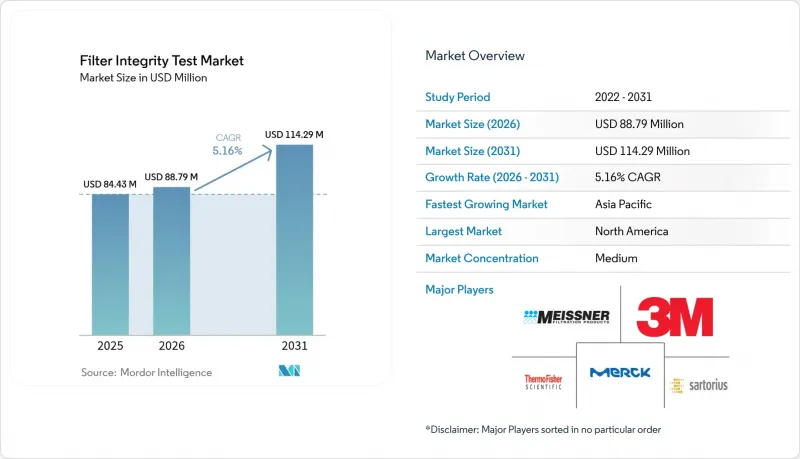
本報告按產品類型(手動和自動)、測試類型(例如,泡點測試)、方法(例如,壓力測試)、過濾器類型(例如,液體過濾器)、最終用戶(例如,製藥和生物技術公司)、應用(例如,液體過濾完整性測試)和地區(例如,北美)進行細分。市場預測以貨幣價值(美元)表示。
全球過濾器完整性測試市場趨勢及洞察
擴大全球生物製藥生產能力
大規模生物反應器的建設正在蓬勃發展,隨著企業驗證的過濾面積比以往任何時候都過濾,對過濾器完整性測試解決方案的需求也日益成長。目前,全球超過1500家工廠的運作產能超過1650萬公升,其中不銹鋼和一次性設備的擴張主要集中在亞太地區。 90%的中國製造商表示計劃在未來10年內實現全球出口,這一比例與受訪的印度同行持相同觀點。三星生物製劑在仁川投資14.6億美元建設的第四家工廠,以及FUJIFILM迪奧辛斯在丹麥和北卡羅來納州投資32億美元的擴建項目等知名項目,都清楚地表明了多地建設的趨勢,每個項目都需要數百個自動化測試單元。處理能力是這些工廠的首要任務,這推動了自診斷系統的應用,該系統能夠實現平行測試和即時電子放行(批准)。
無菌生產合規性的監管要求
監管機構已將完整性測試從“最佳實踐”提升為“明確要求”,從而縮短了產品上市核准的時間。歐洲藥品管理局 (EMA) 附件 1 強制要求對無菌藥品過濾器進行“使用前和滅菌後完整性測試”,導致歐洲工廠的測試頻率顯著增加。美國食品藥物管理局 (FDA) 關於生物等效性測試資料完整性的指南要求完整、準確且同步產生的電子記錄,這促進了符合 21 CFR Part 11 標準的設備的升級。統一的微生物標準,例如 FDA 規定的過濾微生物附著量閾值“≤10 CFU/100 mL”,正在生技藥品和疫苗生產線中建立常規的檢驗流程。
自動化測試設備的初始成本較高
符合EMA附件1標準的先進完整性測試設備單價可能超過10萬美元,這高昂成本阻礙了小規模機構立即採用。雖然像防爆型「Sartocheck 5 Plus」這樣的設備配備了風險管理軟體、自動故障安全邏輯和加密審計追蹤,但初始投資仍然很高。租賃模式和按次收費的服務合約的出現降低了准入門檻,但在價格敏感的地區,這些模式的普及速度仍然緩慢。
細分市場分析
到2025年,在資料完整性通用法規的推動下,自動化測試設備將佔據過濾器完整性測試(FIT)市場56.88%的佔有率。隨著企業逐步淘汰缺乏電子記錄功能的手動設備,自動化測試設備也將成為成長最快的領域,到2031年,其年複合成長率(CAGR)將達到7.52%。領先的平台整合了預先編程的PUPSIT循環、遠距離診斷和預測性維護警報,從而提高了設備的運作和批量放行速度。在預算限制大於合規壓力的情況下,手動設備仍在先導工廠和小規模營養補充劑生產基地使用。然而,感測器成本的下降和雲原生分析技術的出現正在縮小總體擁有成本(TCO)的差距,加速了工廠維修中向自動化的過渡。如今,自動化設備已成為全球新建生物製藥生產基地的標準配備。
第二代設備整合了人工智慧 (AI) 演算法,能夠識別異常擴散曲線,並在膜嚴重破損污染產品之前自動標記潛在的膜損傷。供應商根據 GAMP 5 標準驗證韌體,從而簡化了運往受監管的美國生產線的設備的 510(k) 認證流程。這些進步使此自動化系統成為企業級電子品管系統 (eQMS) 的基石,鞏固了其在過濾器完整性測試市場的領先地位。
儘管氣泡點法仍是親水性膜檢測的黃金標準,佔40.75%的市場佔有率,但水滲入測試(WIT)正以7.12%的複合年成長率推動市場成長。 WIT對於多產品細胞和基因治療設施至關重要,因為它無需進行可能影響無菌性的潤濕和乾燥過程即可檢驗疏水性過濾器。先進的演算法基準設定可補償濕度波動,從而擴大了WIT不受氣候影響的適用範圍。擴散/正向流動方案對於驗證高活性藥物生產中小表面積過濾器仍然至關重要,而保持壓力測試則可確認其在突波條件下的機械穩定性。在預測期內,WIT在新型疏水性過濾器的引入方面預計將超越擴散法,鞏固其作為過濾器完整性測試(FIT)市場成長引擎的地位。
區域分析
到2025年,北美將引領過濾器完整性測試市場,佔39.10%的市場。這得益於美國食品藥物管理局(FDA)的嚴格監管以及對生物製藥研發管線的持續投入。強制性資料完整性審計正在推動設備升級,以符合美國聯邦法規21 CFR Part 11的要求。馬薩諸塞州和北卡羅來納州的生物技術叢集正在將自動化測試設備整合到數位化原生「未來工廠」佈局中,從而提高了區域應用率。疫苗接種量的激增也推動了常規服務合約的維護,進而提升了售後市場的收入。
歐洲也紛紛效仿,EMA附件1中強制性的PUPSIT條款導致每個過濾器的測試週期達到歷史新高。例如,默克集團在達姆施塔特投資6,200萬歐元建造的品管中心,擴大了當地的校準能力,減少了德國和瑞士製造商的停機時間。對永續性關注推動了可回收聚合物外殼和生物基膜的研發,為歐洲供應商提供了長期的差異化優勢。
亞太地區是成長最快的地區,預計到2031年將以6.41%的複合年成長率成長,這主要得益於中國、印度和韓國競相遵守全球GMP標準。位於海得拉巴和大田的大規模CDMO園區正在對自動化測試設備進行標準化改造,以滿足未來美國和歐盟的監管要求。政府提供的高達40%的資本投資補貼正在加速相關技術的普及,並有望縮小與成熟市場在普及率上的差距。同時,新加坡和台灣半導體製造業的擴張正在開闢新的收入來源——超純水過濾器測試——並擴大整個過濾器完整性測試市場需求的地理分佈。
其他好處:
- Excel格式的市場預測(ME)表
- 3個月的分析師支持
目錄
第1章:引言
- 研究假設和市場定義
- 調查範圍
第2章:調查方法
第3章執行摘要
第4章 市場狀況
- 市場概覽
- 市場促進因素
- 擴大全球生物製藥生產能力
- 無菌生產合規性的監管要求
- 一次性過濾系統的擴展
- 品管和過程分析的數位化
- 擴大高效能藥物和先進療法的生產
- 品管和過程分析的數位化
- 市場限制因素
- 自動化測試設備的高昂購置成本
- GMP合規性檢測方面熟練人員短缺
- 傳統測試軟體中的資料完整性風險
- 一次性塑膠廢棄物引發的環境問題
- 監理情勢
- 波特五力分析
第5章 市場規模與成長預測
- 依產品類型
- 手動的
- 自動化
- 按測試類型
- 氣泡點測試
- 擴散/正向流動測試
- 壓力/保持力測試
- 浸水試驗
- 其他類型的測試
- 透過機制
- 壓力型
- 標記底座
- 視覺化
- 聲音/音效
- 按篩選類型
- 液體過濾器
- 空氣/氣體過濾器
- 最終用戶
- 製藥和生物技術公司
- 契約製造組織
- 其他最終用戶
- 透過使用
- 液體過濾的完整性
- 空氣過濾的完整性
- 地區
- 北美洲
- 美國
- 加拿大
- 墨西哥
- 歐洲
- 德國
- 英國
- 法國
- 義大利
- 西班牙
- 其他歐洲國家
- 亞太地區
- 中國
- 日本
- 印度
- 澳洲
- 韓國
- 其他亞太國家
- 中東和非洲
- GCC
- 南非
- 其他中東和非洲國家
- 南美洲
- 巴西
- 阿根廷
- 其他南美國家
- 北美洲
第6章 競爭情勢
- 市場集中度
- 市佔率分析
- 公司簡介
- 3M
- Donaldson Company
- Eaton Corporation PLC
- Filter Integrity Ltd
- Meissner Filtration Products Inc.
- Merck KGaA
- Pall Corporation
- Parker Hannifin Corp.
- Sartorius AG
- Thermo Fisher Scientific, Inc.
- Danaher Corporation
- Porvair Filtration Group
- Critical Process Filtration Inc.
- Cobetter Filtration Group
- Single Use Support GmbH
- Sterlitech Corporation
- Ace Filtration Systems
第7章 市場機會與未來展望
According to Mordor Intelligence, the filter integrity test market size in 2026 is estimated at USD 88.79 million, growing from 2025 value of USD 84.43 million with 2031 projections showing USD 114.29 million, growing at 5.16% CAGR over 2026-2031.
This report is Segmented by Product Type (Manual and Automated), Test Type (Bubble Point Test, and More), Mechanism (Pressure-Based, and More), Filter Type (Liquid Filters, and More), End Users (Pharmaceutical and Biotechnology Companies, and More), Application (Liquid Filtration Integrity, and More), and Geography (North America, and More). The Market Forecasts are Provided in Terms of Value (USD).
Global Filter Integrity Test Market Trends and Insights
Growth in Global Biopharmaceutical Production Capacity
Surging construction of large-scale bioreactors amplifies demand for Filter Integrity Test market solutions as firms validate ever-greater filtration surface areas. More than 16.5 million L of active capacity now spans 1,500+ facilities worldwide, with APAC adding the largest blocks of stainless-steel and single-use suites. Chinese producers report that 90% plan to export globally within a decade, mirroring 100% of surveyed Indian peers. High-profile projects such as Samsung Biologics' USD 1.46 billion fourth plant in Incheon and Fujifilm Diosynth's USD 3.2 billion expansions in Denmark and North Carolina illustrate the multi-site build-outs that each require hundreds of automated testers. These installations emphasize throughput, driving preference for self-diagnosing systems capable of parallel test execution and instant electronic release.
Regulatory Mandates for Sterile Manufacturing Compliance
Regulators elevate integrity testing from best practice to explicit requirement, tightening timelines for market authorization. EMA Annex 1 now obliges Pre-Use Post-Sterilization Integrity Testing for sterile drug filters, materially increasing test frequency in European plants. U.S. FDA guidance on data integrity for bioequivalence studies stipulates complete, accurate, contemporaneous electronic records, spurring upgrades to 21 CFR Part 11-compliant instruments. Harmonized microbial limits, such as the FDA's <= 10 CFU/100 mL bioburden threshold before final filtration, institutionalize routine verification cycles across biologics and vaccine lines.
High Capital Cost of Automated Test Instruments
Cutting-edge integrity testers that conform to EMA Annex 1 can exceed USD 100,000 per unit, discouraging smaller facilities from immediate adoption. Instruments such as the explosion-proof Sartocheck 5 Plus bundle risk-management software, auto-fail-safe logic, and encrypted audit-trails, but the upfront cash outlay remains substantial. Leasing models and pay-per-test service contracts have emerged to lower entry barriers, although uptake in price-sensitive regions still lags.
Other drivers and restraints analyzed in the detailed report include:
- Rising Adoption of Single-Use Filtration Systems
- Digitalization of Quality Control and Process Analytics
- Limited Skilled Workforce for GMP Integrity Testing
For complete list of drivers and restraints, kindly check the Table Of Contents.
Segment Analysis
Automated testers captured 56.88% of Filter Integrity Test market share in 2025 on the back of universal data-integrity mandates. They are simultaneously the fastest-growing at a 7.52% CAGR through 2031 as firms phase out manual rigs that lack electronic record keeping. Leading platforms integrate pre-programmed PUPSIT cycles, remote diagnostics, and predictive maintenance alerts, boosting equipment uptime and batch-release velocity. Manual devices persist in pilot plants and low-volume nutraceutical operations where budget constraints outweigh compliance pressure. Nevertheless, falling sensor costs and cloud-native analytics narrow the total-cost-of-ownership gap, accelerating the switch to automation during facility refurbishments. Across global installations, automated instruments now represent the default specification for any greenfield biologics expansion.
Second-generation units embed artificial-intelligence algorithms that recognize atypical diffusion curves, auto-flagging potential membrane damage before a catastrophic breach can contaminate product. Suppliers validate firmware under GAMP 5 to streamline 510(k) approvals for devices shipped into regulated U.S. lines. This evolution positions automated systems as the linchpin of enterprise-wide electronic Quality Management Systems, cementing their dominance in the filter integrity test market.
Bubble point remains the gold-standard hydrophilic membrane assay with 40.75% share; however water intrusion testing (WIT) leads growth at a 7.12% CAGR. WIT verifies hydrophobic filters without the wetting and drying steps that jeopardize sterility, making it indispensable for cell- and gene-therapy suites running multi-product campaigns. Enhanced algorithmic baselining compensates for humidity fluctuations, broadening WIT's deployability across climate zones. Diffusion/forward-flow protocols retain relevance for validating low-surface-area filters in high-potency drug manufacture, while pressure-hold tests confirm mechanical stability under surge conditions. Over the forecast horizon, WIT adoption is poised to eclipse diffusion in new hydrophobic filter installations, reinforcing its status as the segment's growth engine within the Filter Integrity Test market size.
Complete Report Scope:
- By Product Type
- Manual
- Automated
- By Test Type
- Bubble Point Test
- Diffusion / Forward-Flow Test
- Pressure / Hold Test
- Water Intrusion Test
- Other Tests Types
- By Mechanism
- Pressure-based
- Marker-based
- Visualization
- Acoustic / Sonic
- By Filter Type
- Liquid Filters
- Air / Gas Filters
- By End Users
- Pharmaceutical and Biotechnology Companies
- Contract Manufacturing Organizations
- Other End Users
- By Application
- Liquid Filtration Integrity
- Air Filtration Integrity
- Geography
- North America
- United States
- Canada
- Mexico
- Europe
- Germany
- United Kingdom
- France
- Italy
- Spain
- Rest of Europe
- Asia-Pacific
- China
- Japan
- India
- Australia
- South Korea
- Rest of Asia-Pacific
- Middle East & Africa
- GCC
- South Africa
- Rest of Middle East & Africa
- South America
- Brazil
- Argentina
- Rest of South America
- North America
Geography Analysis
North America led the Filter Integrity Test market with 39.10% share in 2025, anchored by stringent FDA oversight and continuous biologics pipeline funding. Mandated data-integrity audits catalyze replacement cycles toward 21 CFR Part 11-ready instruments. Biotech clusters across Massachusetts and North Carolina embed automated testers into digitally native "factory-of-the-future" footprints, raising regional penetration rates. High vaccine-fill volumes sustain recurrent service contracts that boost aftermarket revenue streams.
Europe follows closely, propelled by EMA Annex 1's compulsory PUPSIT clause that elevates test counts per filter to an all-time high. Investments such as Merck KGaA's €62 million Darmstadt QC facility expand local capacity for on-site calibration, shortening downtime for German and Swiss manufacturers. Sustainability discourse intensifies R&D into recyclable polymer housings and bio-based membranes, offering longer-term differentiation to European suppliers.
Asia-Pacific is the fastest-growing region with a 6.41% CAGR projected through 2031 as China, India, and South Korea race toward global GMP parity. Large-scale CDMO campuses in Shanghai, Hyderabad, and Daejeon standardize on automated testers to satisfy prospective U.S. and EU regulators. Government incentives covering up to 40% of equipment expenditures accelerate adoption, positioning APAC to narrow the installed-base gap with mature markets. Simultaneously, rising semiconductor fabrication in Singapore and Taiwan opens adjacent revenue channels for ultrapure-water filter testing, broadening geographic demand diversity across the Filter Integrity Test market.
- 3M
- Donaldson Company
- Eaton
- Filter Integrity
- Meissner Filtration Products
- Merck
- Pall
- Parker Hannifin
- Sartorius
- Thermo Fisher Scientific
- Danaher
- Porvair Filtration Group
- Critical Process Filtration Inc.
- Cobetter Filtration Group
- Single Use Support GmbH
- Sterlitech
- Ace Filtration Systems
Additional Benefits:
- The market estimate (ME) sheet in Excel format
- 3 months of analyst support
TABLE OF CONTENTS
1 Introduction
- 1.1 Study Assumptions & Market Definition
- 1.2 Scope of the Study
2 Research Methodology
3 Executive Summary
4 Market Landscape
- 4.1 Market Overview
- 4.2 Market Drivers
- 4.2.1 Growth In Global Biopharmaceutical Production Capacity
- 4.2.2 Regulatory Mandates for Sterile Manufacturing Compliance
- 4.2.3 Rising Adoption of Single-Use Filtration Systems
- 4.2.4 Digitalization of Quality Control and Process Analytics
- 4.2.5 Expansion of High-Potency and Advanced Therapies Manufacturing
- 4.2.6 Digitalization of Quality Control and Process Analytics
- 4.3 Market Restraints
- 4.3.1 High Capital Cost of Automated Test Instruments
- 4.3.2 Limited Skilled Workforce for GMP Integrity Testing
- 4.3.3 Data Integrity Risks in Legacy Tester Software
- 4.3.4 Environmental Concerns Over Single-Use Plastic Waste
- 4.4 Regulatory Landscape
- 4.5 Porter's Five Forces Analysis
- 4.5.1 Threat of New Entrants
- 4.5.2 Bargaining Power of Buyers
- 4.5.3 Bargaining Power of Suppliers
- 4.5.4 Threat of Substitutes
- 4.5.5 Competitive Rivalry
5 Market Size & Growth Forecasts (Value, USD)
- 5.1 By Product Type
- 5.1.1 Manual
- 5.1.2 Automated
- 5.2 By Test Type
- 5.2.1 Bubble Point Test
- 5.2.2 Diffusion / Forward-Flow Test
- 5.2.3 Pressure / Hold Test
- 5.2.4 Water Intrusion Test
- 5.2.5 Other Tests Types
- 5.3 By Mechanism
- 5.3.1 Pressure-based
- 5.3.2 Marker-based
- 5.3.3 Visualization
- 5.3.4 Acoustic / Sonic
- 5.4 By Filter Type
- 5.4.1 Liquid Filters
- 5.4.2 Air / Gas Filters
- 5.5 By End Users
- 5.5.1 Pharmaceutical and Biotechnology Companies
- 5.5.2 Contract Manufacturing Organizations
- 5.5.3 Other End Users
- 5.6 By Application
- 5.6.1 Liquid Filtration Integrity
- 5.6.2 Air Filtration Integrity
- 5.7 Geography
- 5.7.1 North America
- 5.7.1.1 United States
- 5.7.1.2 Canada
- 5.7.1.3 Mexico
- 5.7.2 Europe
- 5.7.2.1 Germany
- 5.7.2.2 United Kingdom
- 5.7.2.3 France
- 5.7.2.4 Italy
- 5.7.2.5 Spain
- 5.7.2.6 Rest of Europe
- 5.7.3 Asia-Pacific
- 5.7.3.1 China
- 5.7.3.2 Japan
- 5.7.3.3 India
- 5.7.3.4 Australia
- 5.7.3.5 South Korea
- 5.7.3.6 Rest of Asia-Pacific
- 5.7.4 Middle East & Africa
- 5.7.4.1 GCC
- 5.7.4.2 South Africa
- 5.7.4.3 Rest of Middle East & Africa
- 5.7.5 South America
- 5.7.5.1 Brazil
- 5.7.5.2 Argentina
- 5.7.5.3 Rest of South America
- 5.7.1 North America
6 Competitive Landscape
- 6.1 Market Concentration
- 6.2 Market Share Analysis
- 6.3 Company Profiles (includes Global level Overview, Market level overview, Core Business Segments, Financials, Headcount, Key Information, Market Rank, Market Share, Products and Services, and analysis of Recent Developments)
- 6.3.1 3M
- 6.3.2 Donaldson Company
- 6.3.3 Eaton Corporation PLC
- 6.3.4 Filter Integrity Ltd
- 6.3.5 Meissner Filtration Products Inc.
- 6.3.6 Merck KGaA
- 6.3.7 Pall Corporation
- 6.3.8 Parker Hannifin Corp.
- 6.3.9 Sartorius AG
- 6.3.10 Thermo Fisher Scientific, Inc.
- 6.3.11 Danaher Corporation
- 6.3.12 Porvair Filtration Group
- 6.3.13 Critical Process Filtration Inc.
- 6.3.14 Cobetter Filtration Group
- 6.3.15 Single Use Support GmbH
- 6.3.16 Sterlitech Corporation
- 6.3.17 Ace Filtration Systems
7 Market Opportunities & Future Outlook
- 7.1 White-space & Unmet-Need Assessment

 過濾器完整性測試市場:2026-2032年全球市場預測(依測試類型、過濾器類型、技術、最終用途產業和部署模式分類)
 全球過濾器完整性測試市場規模、佔有率、趨勢和成長分析報告(2026-2034年)
 過濾器完整性測試市場 - 全球產業規模、佔有率、趨勢、機會和預測:按測試類型、過濾器類型、機制、最終用戶、地區和競爭格局分類,2021-2031 年按膜材料、孔徑、過濾方式、最終用戶和應用分類的滅菌級膠囊過濾器市場-全球預測,2026-2032年
 過濾器完整性測試市場規模、佔有率和趨勢分析報告:按測試方法、模式、類型、最終用途、地區和細分市場預測(2026-2033 年)美國過濾器完整性測試市場:市場規模、佔有率、趨勢分析(按測試方法、模式、類型和最終用途分類)、細分市場預測(2025-2033 年)
 全球過濾器完整性測試市場規模研究與預測,依測試方法(前進流(擴散)測試、泡點測試、壓力保持測試)、模式(自動、手動)、類型、最終用途和區域預測 2025-2035