

 |
市場調查報告書
商品編碼
2114722
聚聚二氟亞乙烯(PVDF)膜:市場佔有率分析、行業趨勢和統計數據以及成長預測(2026-2031 年)Polyvinylidene Difluoride (PVDF) Membrane - Market Share Analysis, Industry Trends & Statistics, Growth Forecasts (2026 - 2031) |
||||||

※ 本網頁內容可能與最新版本有所差異。詳細情況請與我們聯繫。
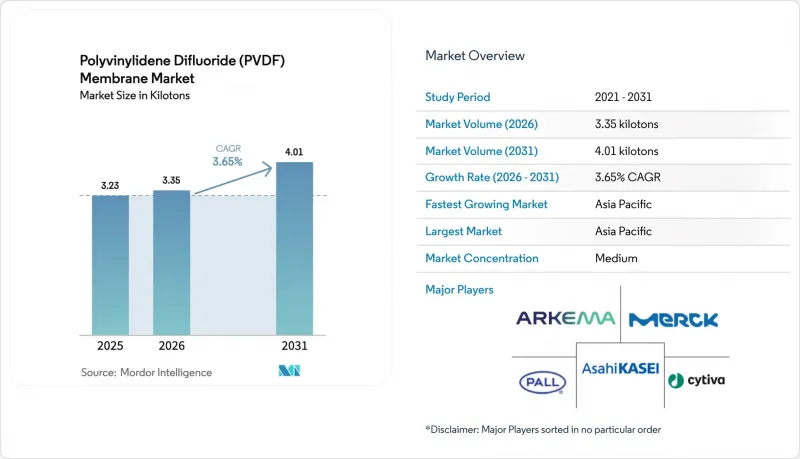
據 Mordor Intelligence 稱,聚二氟亞乙烯(PVDF) 薄膜的市場規模預計將從 2025 年的 3.23 千噸成長到 2026 年的 3.35 千噸,到 2031 年達到 4.01 千噸,2026 年至 2031 年的複合年成長率為 3.65%。
本報告按膜類型(疏水性和親水性)、技術(微濾、超過濾等)、應用(過濾、吸附、分離等)、終端用戶產業(生物製藥、製藥等)和地區(亞太地區、北美地區、歐洲地區等)進行細分。市場預測以噸為單位。
全球聚偏二Polyvinylidene(PVDF)膜市場趨勢及洞察
生物製程需求快速成長
一次性切向流濾盒現已預先輻照並序列化後出貨,無需現場完整性測試,並將宣傳活動週期從數天縮短至數小時。 2022年至2025年間,百康生物製藥公司(Biocon Biologics)在班加羅爾新建了一座生物相似藥生產廠,投資約12億美元,該廠採用了先進的連續收穫和純化製程。與傳統生產線相比,每公斤原料藥的膜消耗量增加了兩倍。細胞和基因療法開發者要求每劑藥物中宿主細胞DNA殘留量低於10納克,這促使人們轉向使用0.2微米親水性PVDF膜,這種膜在無菌保持性和滲透性之間實現了更優的平衡。提高產能仍需相當長的時間。 2026年7月,旭化成(Asahi Kasei)為其第四座「Planova」病毒去除過濾器工廠舉行了奠基儀式,該工廠計劃於2030年運作。這凸顯了結構性供應限制。品牌所有者和合約研發生產機構(CDMO)均已簽署多年供貨協議,提高了生產量的透明度,並提振了PVDF薄膜市場的前景。由此產生的需求推動工廠平均運轉率超過85%,支撐了溢價。
醫療和診斷設備的運轉率提高
聚偏氟乙烯(PVDF)膜仍然是印跡介質的標桿。 Bio-Rad公司的Sequi-Blot系列膜可結合170–200 µg/cm²的蛋白質,其性能優於硝酸纖維素膜,並且能夠承受多次剝離循環以進行抗體重探。分散式檢查的普及進一步凸顯了這一優勢,因為即時檢測(PoC)試劑盒必須能夠耐受室溫儲存並在15分鐘內提供結果。默克公司於2025年在科赫工廠安裝了第二條膜生產線,用於生產橫向流動化驗,以檢測登革熱、瘧疾和COVID-19。孔徑分佈持續極化,0.2 µm的膜片可用於低分子量蛋白質的定序,而0.45 µm的膜片則適用於一般的免疫印跡。因此,PVDF膜市場保持可預測的再訂購週期,擴大了每年需要更換膜捲的診斷平台的應用範圍。
PVDF薄膜高成本
聚偏氟乙烯(PVDF)樹脂的價格為每公斤8-12美元,是聚碸的兩倍,是醋酸纖維素的三倍。如此高的價格使得許多市政機構和乳製品相關項目被拒之門外。阿科瑪公司計劃於2024年將其位於卡爾弗特市的PVDF產能擴大15%,但其目標市場是電池和半導體,而非過濾,顯示樹脂生產商優先考慮的是高利潤通路。生物製藥業的買家可以承受如此高的價格,因為薄膜的成本不到原料藥價值的1%。然而,對於利潤率僅5-8%的乳製品加工商而言,聚碸能夠以一半的成本達到80%的透水性,因此沒有充分的理由採用PVDF。這種價格差異限制了PVDF在通用應用領域的滲透,並抑制了PVDF膜市場在價格敏感型細分領域的成長潛力。
細分市場分析
預計到2025年,親水性PVDF膜將佔據59.32%的市場佔有率,並以3.61%的複合年成長率成長。這一成長率高於用於過濾空氣和溶劑的疏水性PVDF膜。默克公司的Durapore系列膜的結合容量可達170–200 µg/cm²,無需甲醇預潤濕即可實現抗體的多次重複使用。由於其防水性能可防止孔隙堵塞,疏水性PVDF膜仍然是通風和溶劑應用領域不可或缺的。表面改質研究正在探索兩性離子胜肽接枝和二氧化鈦奈米複合材料,這些方法無需使用PFAS處理助劑即可維持通量,從而解決環境、物質和治理(ESG)問題。 2024年發表於《膜》(Membranes)期刊的一項研究報告稱,氧化石墨烯增強的聚偏氟乙烯(PVDF)膜的純水滲透性提高了40%至60%,但其對強鹼的長期穩定性仍有檢驗。雖然雙親性共聚物(其潤濕性會隨pH值變化)可能會模糊親水和疏水之間的界限,但由於需要進行檢驗週期,預計在預測期內,當前的市場模式將保持不變。生物製藥領域的持續發展將確保親水性PVDF膜在PVDF膜市場中繼續佔據核心地位。
到2025年,過濾將佔PVDF膜市場41.75%的佔有率,其中0.2µm無菌過濾是核心。同時,奈米過濾正以4.27%的複合年成長率快速成長。這是因為20nm的截留分子量允許150kDa或更高的單株抗體通過,同時去除病毒。旭化成(Asahi Kasei)的「Planova」系列產品雖然是纖維素基的,但也體現了市場對病毒去除膜的高需求,並滿足了對能夠耐受強鹼洗滌的PVDF類產品的需求。超過濾在蛋白質濃縮領域佔據中間位置,而膜蒸餾等小眾技術僅佔不到5%的市場。 PVDF的耐化學性使得在連續生物反應器中引入耐強鹼洗滌的奈米過濾裝置成為可能。在這一領域,溶劑相容性比聚醯胺的低成本優勢更為重要。整合式膜級聯技術透過減少層析法步驟和加快病毒去除檢驗,進一步加強了 PVDF 膜市場中奈米過濾的成長軌跡。
區域分析
預計到2025年,亞太地區將佔據PVDF膜市場56.39%的佔有率,並在2031年之前以4.85%的複合年成長率持續成長,這主要得益於中國廢水處理法規的實施、印度CDMO行業的蓬勃發展以及日本精密膜出口的成長。中國每天2000立方公尺的PVDF膜生物反應器(MBR)供應量,用於處理製藥污水,凸顯了其嚴格的監管要求。杭州求實公司以較短的交貨週期供應本地生產的組件。印度的契約製造市場正在快速擴張,預計到2024年將達到82億美元,並計劃到2030年達到208億美元,膜技術正被引入新型一次性生物反應器中。東麗公司計劃於2025年11月在沙烏地阿拉伯運作的逆滲透(RO)裝置,將為沿岸地區的海水淡化專案做出貢獻,其中PVDF預處理可有效減少膜污染。韓國生物技術走廊受惠於現代微電子和LG化學等公司在國內生產的PVDF,從而加強了三星生物製劑的供應鏈。
北美PVDF膜市場的成長得益於丹納赫公司斥資16億美元擴建位於彭薩科拉、法哈多和韓國的生產線,以滿足美國市場需求。政府主導的舉措,例如美國生物醫學高級研究與發展局(BARDA)的計劃,正在加強國內疫苗供應並維持訂單前景。在歐洲,區域性生產體系已經建立。默克投資4.4億歐元的科赫工廠為歐洲、中東和非洲(EMEA)市場生產過濾系統,而薩托裡亞斯公司對亞烏科工廠的投資則服務於美洲市場。長達6.5年的PFAS監管寬限期正在影響市政部門的採用趨勢,並引導公共產業轉向PVDF替代品,但對工業用戶的影響甚微。
在南美洲、中東和非洲,對聚偏氟乙烯(PVDF)薄膜的需求正在成長。沙烏地阿拉伯海水淡化計畫和巴西污水處理計畫的私有化推動了基於PVDF膜的膜生物反應器(MBR)訂單的成長,這些系統用於處理高鹽度和富含營養物質的原水。南非的礦業和石化公司正在採用閉合迴路超過濾和逆滲透(RO)系統來最大限度地提高供水效率,而PVDF預處理可以將RO系統的使用壽命從3年延長至5年。儘管這些地區的處理量不大,但單位利潤率很高,吸引了PVDF膜市場的專業供應商。
其他好處:
- Excel格式的市場預測(ME)表
- 3個月的分析師支持
目錄
第1章:引言
- 研究假設和市場定義
- 調查範圍
第2章:調查方法
第3章執行摘要
第4章 市場狀況
- 市場概覽
- 市場促進因素
- 生物製程需求快速成長
- 在醫療和診斷設備中的應用範圍擴大
- 污水處理應用的需求日益成長
- 生物技術和製藥行業的持續擴張
- 採用 PVDF 的一次性切向流過濾(TFF) 模組的出現。
- 市場限制因素
- PVDF薄膜高成本
- 高脂肪食品和飲料流中的膜污染
- 對氟化聚合物處置的環境、社會和治理(ESG)審查
- 價值鏈分析
- 波特五力模型
第5章 市場規模與成長預測
- 依膜類型
- 疏水性
- 親水性
- 透過技術
- 微濾
- 超過濾
- 奈米過濾
- 其他技術
- 透過使用
- 過濾
- 印跡法
- 分離
- 純化
- 其他用途
- 按最終用戶行業分類
- 生物製藥
- 製藥
- 食品/飲料
- 其他終端用戶產業
- 按地區
- 亞太地區
- 中國
- 日本
- 印度
- 韓國
- 其他亞太國家
- 北美洲
- 美國
- 加拿大
- 墨西哥
- 歐洲
- 德國
- 英國
- 法國
- 義大利
- 其他歐洲國家
- 南美洲
- 巴西
- 阿根廷
- 其他南美國家
- 中東和非洲
- 沙烏地阿拉伯
- 南非
- 其他中東和非洲國家
- 亞太地區
第6章 競爭情勢
- 市場集中度
- 策略趨勢
- 市佔率和排名分析
- 公司簡介
- Arkema
- Asahi Kasei Corporation
- CITIC Group Corporation.
- Cobetter Filtration Equipment Co. Ltd
- Cytiva
- GVS SpA
- Hyundae Micro Co., Ltd
- Kovalus Separation Solutions
- Kuraray Co., Ltd
- LG Chem
- Membrane Solutions(Nantong)
- Merck
- Mitsubishi Chemical Corporation
- Pall Corporation(Danaher Corporation)
- Pentair
- Synder Filtration Inc.
- Toray Industries, Inc.
- Veolia
第7章 市場機會與未來展望
According to Mordor Intelligence, the polyvinylidene difluoride membrane market size is expected to increase from 3.23 kilotons in 2025 to 3.35 kilotons in 2026 and reach 4.01 kilotons by 2031, growing at a CAGR of 3.65% over 2026-2031.
This report is Segmented by Membrane Type (Hydrophobic and Hydrophilic), Technology (Microfiltration, Ultrafiltration, and More), Application (Filtration, Blotting, Separation, and More), End-User Industry (Biopharmaceutical, Pharmaceutical, and More), and Geography (Asia-Pacific, North America, Europe, and More). Market Forecasts are Provided in Terms of Volume (Tons).
Global Polyvinylidene Difluoride (PVDF) Membrane Market Trends and Insights
Rapid Growth of Bioprocessing Demand
Single-use tangential-flow cassettes now arrive pre-irradiated and serialized, eliminating on-site integrity testing and reducing campaign turnaround from days to hours. Biocon Biologics invested approximately USD 1.2 billion in a new Bengaluru biosimilar manufacturing plant between 2022 and 2025 that embeds advanced continuous harvest and purification processes, tripling membrane consumption per kilogram of drug substance compared with legacy lines. Cell- and gene-therapy developers require residual host-cell DNA below 10 nanograms per dose, steering them toward 0.2-micrometer hydrophilic PVDF that balances sterile retention and flux. Capacity additions remain lengthy; Asahi Kasei broke ground in July 2026 on its fourth Planova virus-removal filter plant that will open in 2030, underscoring structural supply tightness. Both brand owners and CDMOs lock in multi-year supply contracts, reinforcing volume visibility and underpinning the PVDF membrane market outlook. The resulting demand pull lifts average plant utilization rates above 85%, supporting premium pricing.
Rising Utilization in Medical and Diagnostic Devices
PVDF remains the benchmark blotting media. Bio-Rad's Sequi-Blot range binds 170-200 µg/cm2 of protein, outperforming nitrocellulose while tolerating multiple stripping cycles for antibody reprobing. Decentralized testing heightens this advantage because point-of-care kits must withstand ambient storage and deliver results within 15 minutes. Merck installed a second membrane line in Cork in 2025 aimed at lateral-flow assays for dengue, malaria, and COVID-19 detection. Pore-size bifurcation persists: 0.2 µm sheets enable low-molecular-weight protein sequencing, while 0.45 µm variants support general immunoblotting. The net effect is a broader installed base of diagnostic platforms that consume replacement rolls annually, keeping the PVDF membrane market on a predictable reorder cycle.
High Cost of PVDF Membranes
PVDF resin sells for USD 8-12/kg, double polysulfone, and triple cellulose acetate, pricing many municipal and dairy projects out of the market. Arkema expanded Calvert City PVDF capacity by 15% in 2024 but targeted batteries and semiconductors rather than filtration, showing that resin producers prioritize higher-margin outlets. Biopharma buyers absorb the premium because membrane costs stay below 1% of drug-substance value, yet dairy processors running on 5-8% margins cannot justify PVDF when polysulfone delivers 80% of the flux at half the cost. This price gap limits penetration into commodity applications and clips upside potential for the PVDF membrane market in price-sensitive segments.
Other drivers and restraints analyzed in the detailed report include:
- Growing Demand for Wastewater Treatment Applications
- Continuous Expansion of Biotechnology and Pharma Sector
- Membrane Fouling in High-Fat Food and Beverage Streams
For complete list of drivers and restraints, kindly check the Table Of Contents.
Segment Analysis
Hydrophilic variants held 59.32% PVDF membrane market share in 2025 and are forecast to grow at a 3.61% CAGR, outperforming hydrophobic formats that serve air and solvent filtration. Merck's Durapore line delivers 170-200 µg/cm2 binding capacity, enabling multiplex antibody reuse without methanol pre-wetting. Hydrophobic PVDF remains critical for venting and solvent applications where moisture repellence prevents pore blockage. Surface-modification research explores zwitterionic peptide grafting and titanium-dioxide nanocomposites that preserve flux without PFAS processing aids, addressing ESG concerns. A 2024 Membranes study reported 40-60% higher pure-water flux on graphene-oxide-enhanced PVDF, although long-term caustic stability is unproven. Amphiphilic copolymers that toggle wettability by pH may blur the hydrophilic-hydrophobic divide, yet validation cycles mean current segmentation will persist through the forecast period. The continued shift toward biologics keeps hydrophilic grades central to the PVDF membrane market.
Microfiltration accounted for 41.75% of the PVDF membrane market size in 2025, anchored by sterile filtration at 0.2 µm. Nanofiltration, however, is expanding at a 4.27% CAGR because 20-nm cutoffs remove viruses while passing monoclonal antibodies above 150 kDa. Asahi Kasei's Planova range, though cellulose-based, demonstrates the pull of virus-removal membranes and validates demand for PVDF analogs that tolerate caustic cleaning. Ultrafiltration occupies the middle ground for protein concentration, while niche technologies such as membrane distillation remain below 5% of volume. PVDF's chemical resistance opens doors for caustic-cleaned nanofiltration skids in continuous bioreactors, where solvent compatibility eclipses the lower cost of polyamide. Integrated membrane cascades reduce chromatography steps and speed virus clearance validation, reinforcing the growth trajectory of nanofiltration inside the PVDF membrane market.
Complete Report Scope:
- By Membrane Type
- Hydrophobic
- Hydrophilic
- By Technology
- Microfiltration
- Ultrafiltration
- Nanofiltration
- Other Technologies
- By Application
- Filtration
- Blotting
- Separation
- Purification
- Other Applications
- By End-user Industry
- Biopharmaceutical
- Pharmaceutical
- Food and Beverage
- Other End-user industries
- By Geography
- Asia-Pacific
- China
- Japan
- India
- South Korea
- Rest of Asia-Pacific
- North America
- United States
- Canada
- Mexico
- Europe
- Germany
- United Kingdom
- France
- Italy
- Rest of Europe
- South America
- Brazil
- Argentina
- Rest of South America
- Middle-East and Africa
- Saudi Arabia
- South Africa
- Rest of Middle-East and Africa
- Asia-Pacific
Geography Analysis
Asia-Pacific held 56.39% of the PVDF membrane market share in 2025 and is expanding at a 4.85% CAGR through 2031, propelled by China's wastewater mandates, India's CDMO boom, and Japan's precision membrane exports. China's 2,000 m3/day PVDF MBRs for pharmaceutical effluent underscore regulatory enforcement, while Hangzhou Qiushi supplies local modules with short lead times. India's contract manufacturing jumped to USD 8.2 billion in 2024, targeting USD 20.8 billion by 2030, pulling membranes into new single-use bioreactors. Toray's November 2025 Saudi RO plant serves Gulf desalination projects, with PVDF pretreatment cutting fouling. South Korea's biotech corridor benefits from domestic PVDF production at Hyundae Micro and LG Chem, tightening supply loops for Samsung Biologics.
North America's PVDF membrane market growth is supported by Danaher's USD 1.6 billion capacity expansion across Pensacola, Fajardo, and a South Korean line serving U.S. demand. Government initiatives such as BARDA reinforce on-shore vaccine supply, sustaining order visibility. Europe follows with region-for-region manufacturing; Merck's EUR 440 million Cork hub produces filtration devices for the EMEA market, and Sartorius' Yauco investment serves the Americas. The 6.5-year PFAS derogation shapes municipal uptake, nudging utilities toward PVDF alternatives yet leaving industrial users largely unaffected.
South America and Middle East and Africa are witnessing rising demand for PVDF membranes. Saudi desalination and Brazilian sanitation privatization drive orders for PVDF-based MBRs that treat high-salinity or nutrient-rich feedwater. South African mining and petrochemical firms adopt closed-loop ultrafiltration-RO systems to stretch water supply, with PVDF pretreatment extending RO life from three to five years. While smaller in tonnage, these regions offer high unit margins that attract specialist suppliers in the PVDF membrane market.
- Arkema
- Asahi Kasei Corporation
- CITIC Group Corporation.
- Cobetter Filtration Equipment Co. Ltd
- Cytiva
- GVS S.p.A.
- Hyundae Micro Co., Ltd
- Kovalus Separation Solutions
- Kuraray Co., Ltd
- LG Chem
- Membrane Solutions (Nantong)
- Merck
- Mitsubishi Chemical Corporation
- Pall Corporation (Danaher Corporation)
- Pentair
- Synder Filtration Inc.
- Toray Industries, Inc.
- Veolia
Additional Benefits:
- The market estimate (ME) sheet in Excel format
- 3 months of analyst support
TABLE OF CONTENTS
1 Introduction
- 1.1 Study Assumptions and Market Definition
- 1.2 Scope of the Study
2 Research Methodology
3 Executive Summary
4 Market Landscape
- 4.1 Market Overview
- 4.2 Market Drivers
- 4.2.1 Rapid growth of bioprocessing demand
- 4.2.2 Rising utilization in medical and diagnostic devices
- 4.2.3 Growing demand for wastewater treatment applications
- 4.2.4 Continuous expansion of biotechnology and pharma sector
- 4.2.5 Emergence of single-use Tangential Flow Filtration (TFF) modules integrating PVDF
- 4.3 Market Restraints
- 4.3.1 High cost of PVDF membranes
- 4.3.2 Membrane fouling in high-fat Food and Beverage streams
- 4.3.3 ESG scrutiny on fluorinated-polymer disposal
- 4.4 Value Chain Analysis
- 4.5 Porter's Five Forces
- 4.5.1 Threat of New Entrants
- 4.5.2 Bargaining Power of Buyers
- 4.5.3 Bargaining Power of Suppliers
- 4.5.4 Threat of Substitute Products
- 4.5.5 Degree of Competition
5 Market Size and Growth Forecasts (Volume)
- 5.1 By Membrane Type
- 5.1.1 Hydrophobic
- 5.1.2 Hydrophilic
- 5.2 By Technology
- 5.2.1 Microfiltration
- 5.2.2 Ultrafiltration
- 5.2.3 Nanofiltration
- 5.2.4 Other Technologies
- 5.3 By Application
- 5.3.1 Filtration
- 5.3.2 Blotting
- 5.3.3 Separation
- 5.3.4 Purification
- 5.3.5 Other Applications
- 5.4 By End-user Industry
- 5.4.1 Biopharmaceutical
- 5.4.2 Pharmaceutical
- 5.4.3 Food and Beverage
- 5.4.4 Other End-user industries
- 5.5 By Geography
- 5.5.1 Asia-Pacific
- 5.5.1.1 China
- 5.5.1.2 Japan
- 5.5.1.3 India
- 5.5.1.4 South Korea
- 5.5.1.5 Rest of Asia-Pacific
- 5.5.2 North America
- 5.5.2.1 United States
- 5.5.2.2 Canada
- 5.5.2.3 Mexico
- 5.5.3 Europe
- 5.5.3.1 Germany
- 5.5.3.2 United Kingdom
- 5.5.3.3 France
- 5.5.3.4 Italy
- 5.5.3.5 Rest of Europe
- 5.5.4 South America
- 5.5.4.1 Brazil
- 5.5.4.2 Argentina
- 5.5.4.3 Rest of South America
- 5.5.5 Middle-East and Africa
- 5.5.5.1 Saudi Arabia
- 5.5.5.2 South Africa
- 5.5.5.3 Rest of Middle-East and Africa
- 5.5.1 Asia-Pacific
6 Competitive Landscape
- 6.1 Market Concentration
- 6.2 Strategic Moves
- 6.3 Market Share(%)/Ranking Analysis
- 6.4 Company Profiles (includes Global level Overview, Market level overview, Core Segments, Financials, Strategic Info, Products and Services, Recent Developments)
- 6.4.1 Arkema
- 6.4.2 Asahi Kasei Corporation
- 6.4.3 CITIC Group Corporation.
- 6.4.4 Cobetter Filtration Equipment Co. Ltd
- 6.4.5 Cytiva
- 6.4.6 GVS S.p.A.
- 6.4.7 Hyundae Micro Co., Ltd
- 6.4.8 Kovalus Separation Solutions
- 6.4.9 Kuraray Co., Ltd
- 6.4.10 LG Chem
- 6.4.11 Membrane Solutions (Nantong)
- 6.4.12 Merck
- 6.4.13 Mitsubishi Chemical Corporation
- 6.4.14 Pall Corporation (Danaher Corporation)
- 6.4.15 Pentair
- 6.4.16 Synder Filtration Inc.
- 6.4.17 Toray Industries, Inc.
- 6.4.18 Veolia
7 Market Opportunities and Future Outlook
- 7.1 White-space and Unmet-Need Assessment

 Polyvinylidene乙烯市場報告:趨勢、預測及競爭分析(至2035年)
 聚偏聚二氟亞乙烯(PVDF)-全球市佔率及排名、總收入及需求預測(2025-2031年)聚二氟亞乙烯(PVDF)市場報告:趨勢、預測和競爭分析(至2031年)