

 |
市場調查報告書
商品編碼
2114719
逆滲透膜:市場佔有率分析、產業趨勢與統計、成長預測(2026-2031)Reverse Osmosis Membrane - Market Share Analysis, Industry Trends & Statistics, Growth Forecasts (2026 - 2031) |
||||||

※ 本網頁內容可能與最新版本有所差異。詳細情況請與我們聯繫。
根據 Mordor Intelligence 預測,逆滲透膜市場規模將從 2025 年的 52.3 億美元成長到 2026 年的 56.6 億美元,到 2031 年將達到 83.8 億美元,2026 年至 2031 年的複合年成長率為 8.18%。
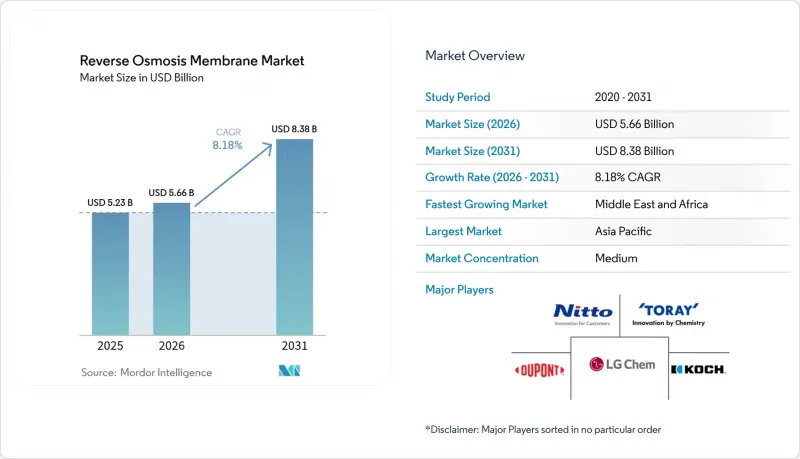
本報告按膜類型(薄膜複合膜、纖維素基膜)、組成(螺旋捲繞式、中空纖維式等)、終端用戶產業(住宅、商業和公共設施、市政和海水淡化廠、工業製程用水、發電等)以及地區(亞太地區、北美地區、歐洲地區等)進行細分。市場預測以美元計價。
全球逆滲透膜市場趨勢及洞察
對純淨水和飲用水的需求日益成長
氣候變遷正使全球40%的人口面臨水資源短缺的風險,因此,能夠大規模處理微鹹水和受污染水源的薄膜淨化技術越來越受歡迎。印度、越南和奈及利亞的市政供水事業已在其五年資本計畫中納入逆滲透膜升級改造的預算,因為自2020年以來,由於高通量TFC薄膜的應用,營運成本已下降了25%。城市發展進一步加劇了這種壓力,特大城市需要在不擴大水處理設施面積下,確保新的飲用水源。等離子增強表面改質進一步減少了生物污染的發生,並延長了CIP(就地清洗)週期之間的間隔。因此,組件價格的下降與公共部門到2030年實現永續目標(SDG)6的目標一致。
擴大海水淡化能力
光是沙烏地阿拉伯的NEOM計畫就需要相當於目前全球年產量15%的薄膜,加速了高流量、低壓膜片的預訂。摩洛哥的阿加迪爾擴建計畫和約旦的紅海計畫也同樣加劇了供應緊張,促使韓國和中國的亞洲製造商計劃在2026年前擴大生產線。大型工廠的規模經濟效應已將均質水成本降至每立方公尺0.5美元以下,進一步鞏固了逆滲透技術作為新建設備標準技術的地位。這些趨勢增強了逆滲透膜市場新參與企業對長期需求前景的確定性。
膜的購置和更換成本高
膜組件通常佔總營運成本的35%至45%,而聚醯胺原料價格的波動可能導致8吋螺旋膜組件的單價高達300美元,這阻礙了成本敏感型市場的普及。東南亞小規模市政業者正在延長組件的使用壽命,使其超出製造商的建議,雖然這會增加能源消耗,但可以減少短期資本投入。目前,金融機構要求專案模型中包含相當於五年更換儲備金的資金,這增加了初始資金需求並延長了投資回收期。儘管組件的再利用和回收仍然有限,但西班牙和新加坡的試驗計畫在聚丙烯外殼的回收利用方面已顯示出令人鼓舞的成果。在二手市場和回收流程成熟之前,更換成本很可能仍將是預算有限的買家推廣應用的限制因素。
細分市場分析
到2025年,薄膜複合膜將憑藉其99.5%的脫鹽率和廣泛的化學穩定性,佔據逆滲透膜市場81.90%的佔有率。對自動化塗佈生產線的大力投資,使得卷對卷加工產能穩定超過每天10,000平方米,從而實現了成本降低和品質提升。纖維素基膜在飲料和乳製品澄清領域仍佔有一席之地,因為在這些領域,生物分解性和耐氯性比脫鹽效率更為重要。然而,隨著採用無溶劑界面聚合技術形成厚度小於50奈米的超薄隔離層,其性能差距正在逐年擴大,使泵能耗降低10-15%。
從2026年到2031年,對TFC的需求預計將以8.49%的複合年成長率成長。這主要是由於大型海水淡化廠指定使用高通量、低壓產品,以滿足低於3 kWh/m³的能耗目標。隨著法規傾向優先考慮長壽命、低廢棄物解決方案,預計到2031年,醋酸纖維素逆滲透膜的市場規模將萎縮至1.45億美元不足。雖然日益成長的永續性問題可能會重新激發人們對生物基膜的興趣,但TFC元件回收技術的發展速度更快,削弱了其優勢。供應商目前正在測試不含全氟烷基和多氟烷基的合成路線,以滿足未來的環境法規要求,同時又不犧牲性能。
區域分析
到2025年,亞太地區將佔逆滲透膜市場45.60%的佔有率,這主要得益於中國「零液體排放」計劃和印度「智慧城市」建設的推動。截至2024年,中國的紡織、電子和石化企業消耗了全球30%以上的膜產量。江蘇和浙江等省份的國內製造商正在迅速擴大生產規模,與進口膜片相比,縮短了前置作業時間並降低了接收成本。印度的「國家水務使命」要求到2030年實現20%的循環利用率,為此,各邦公共產業正在普納、蘇拉特和清奈的新建水資源再利用項目中引入逆滲透(RO)技術作為核心組成部分。
預計中東和非洲將成為該地區成長最快的地區,到2031年年均複合成長率將達到8.78%。這主要得益於沙烏地阿拉伯「2030願景」下對海水淡化的200億美元投資,以及阿拉伯聯合大公國、卡達和阿曼等國的多項官民合作關係。肯亞和加納等非洲國家正在試行為缺乏電網的農村地區提供太陽能逆滲透(RO)系統,這顯示與海灣國家的大型企劃相比,非洲的發展模式更為分散。
北美和歐洲市場雖已成熟,但盈利仍然豐厚,強勁的銷售動能得益於設備升級需求和監管合規要求。歐盟委員會的《工業排放指令》強制要求化學品製造商實施多層阻隔系統,而中空纖維預過濾器與TFC螺旋過濾器的組合通常是滿足排放標準的常用方法。
其他好處:
- Excel格式的市場預測(ME)表
- 3個月的分析師支持
目錄
第1章:引言
- 研究假設和市場定義
- 調查範圍
第2章:調查方法
第3章執行摘要
第4章 市場狀況
- 市場概覽
- 市場促進因素
- 對純淨水和飲用水的需求日益成長
- 擴大海水淡化能力
- 更嚴格的工業污水排放標準
- 住宅終端/POE過濾系統的成長
- 低壓逆滲透膜可用於離網應用
- 市場限制因素
- 購買和更換薄膜的成本很高。
- 持續的結垢和水垢積聚問題
- 特種聚醯胺原料的供應鏈風險
- 價值鏈分析
- 波特五力分析
第5章 市場規模與成長預測
- 依膜類型
- 薄膜複合膜(TFC)
- 纖維素(CA 和 CTA)
- 透過配置
- 螺旋纏繞
- 中空纖維
- 板框
- 管狀
- 按最終用途行業分類
- 住宅
- 商業/公共部門
- 地方政府和海水淡化項目
- 工業製程用水
- 發電
- 食品/飲料
- 醫療和藥品
- 按地區
- 亞太地區
- 中國
- 印度
- 日本
- 韓國
- 其他亞太國家
- 北美洲
- 美國
- 加拿大
- 墨西哥
- 歐洲
- 德國
- 英國
- 法國
- 義大利
- 其他歐洲國家
- 南美洲
- 巴西
- 阿根廷
- 其他南美國家
- 中東和非洲
- 沙烏地阿拉伯
- 南非
- 其他中東和非洲國家
- 亞太地區
第6章 競爭情勢
- 市場集中度
- 策略趨勢
- 市佔率和排名分析
- 公司簡介
- applied membranes, inc.
- Aquatech
- Axeon Water Technologies
- BNKO Environmental Techology(Shanghai)Co., Ltd
- DuPont
- GEA Group Aktiengesellschaft
- Koch Membrane Systems, Inc
- Lenntech BV
- LG Chem
- Membranium
- NITTO DENKO CORPORATION
- Pentair
- Permionics Membranes Private Limited
- Pure Aqua, Inc.
- Samco Technologies, Inc
- Scinor Water America, LLC
- Synder Filtration, Inc
- TORAY INDUSTRIES, INC.
- Toyobo.Co.Ltd
- Veolia Water Technologies
第7章 市場機會與未來展望
According to Mordor Intelligence, the reverse osmosis membrane market size is expected to grow from USD 5.23 billion in 2025 to USD 5.66 billion in 2026 and is forecast to reach USD 8.38 billion by 2031 at 8.18% CAGR over 2026-2031.
This report is Segmented by Membrane Type (Thin-Film Composite, Cellulose-Based), Configuration (Spiral-Wound, Hollow-Fiber, and More), End-Use Industry (Residential, Commercial and Institutional, Municipal and Desalination Utilities, Industrial Process Water, Power Generation, and More), and Geography (Asia-Pacific, North America, Europe, and More). The Market Forecasts are Provided in Terms of Value (USD).
Global Reverse Osmosis Membrane Market Trends and Insights
Increasing Demand for Pure and Potable Water
Climate change intensifies water stress for 40% of the global population, amplifying the appeal of membrane purification that can process brackish or contaminated supplies at scale. Municipal utilities in India, Vietnam, and Nigeria now budget reverse osmosis upgrades into five-year capital plans because operating costs have fallen 25% since 2020 thanks to higher-flux TFC sheets. Urban growth compounds this pressure as megacities must secure new potable sources without increasing treatment footprints. Plasma-enhanced surface modification further cuts biofouling episodes, allowing longer run times between clean-in-place cycles. Declining module prices therefore align with public-sector objectives to achieve Sustainable Development Goal 6 targets by 2030.
Expansion of Seawater Desalination Capacity
Saudi Arabia's NEOM utility alone will demand membranes equal to 15% of current annual global production, accelerating pre-order activity for high-flux, low-pressure sheets. Morocco's Agadir expansion and Jordan's Red Sea Project similarly tighten supply, prompting Asian producers in South Korea and China to plan line expansions by 2026. Scaling efficiencies at mega-plants now cut levelized water costs below USD 0.50 per cubic meter, reinforcing RO as the default technology for new capacity. These trends reinforce long-term demand visibility for reverse osmosis membrane market participants.
High Acquisition and Replacement Cost of Membranes
Membrane elements often represent 35-45% of total operating expenditure, and price volatility in polyamide feedstocks can push unit costs to USD 300 per 8-inch spiral, deterring adoption in cost-sensitive markets. Smaller municipal operators in Southeast Asia sometimes extend element lifetimes beyond manufacturer guidelines, trading higher energy usage for lower near-term capital outlay. Financing institutions now request five-year replacement reserve accounts in project models, raising up-front cash requirements and elongating payback. Component reuse and recycling remain limited, though pilot programs in Spain and Singapore show promise for reclaiming polypropylene housings. Until secondary markets or recycling streams mature, replacement expense will curb installation growth among budget-constrained buyers.
Other drivers and restraints analyzed in the detailed report include:
- Stricter Industrial-Effluent Discharge Norms
- Growth in Residential POU/POE Filtration Units
- Persistent Fouling and Scaling Issues
For complete list of drivers and restraints, kindly check the Table Of Contents.
Segment Analysis
Thin-film composite sheets captured an 81.90% reverse osmosis membrane market share in 2025, benefitting from 99.5% salt rejection and broad chemical stability. Robust investment in automated coating lines now yields consistent roll-to-roll throughput above 10,000 m2 per day, lowering costs while improving quality. Cellulose-based alternatives retain footholds in beverage and dairy clarification where biodegradability and chlorine tolerance matter more than rejection efficiency. Nonetheless, the performance gap widens each year as solvent-free interfacial polymerization creates ultra-thin barrier layers under 50 nm, reducing pump energy by 10-15%.
Across 2026-2031, TFC demand will rise at an 8.49% CAGR as desalination mega-plants specify higher-flux, low-pressure variants to hit sub-3 kWh/m3 energy targets. The reverse osmosis membrane market size for cellulose acetate products is set to shrink to less than USD 145 million by 2031 as regulation favors longer-life, lower-waste solutions. Sustainability narratives could revive interest in bio-derived membranes, yet recycling schemes for TFC elements are advancing faster, dulling that advantage. Suppliers now trial per- and polyfluoroalkyl-free synthesis routes to anticipate future environmental scrutiny without sacrificing performance.
Complete Report Scope:
- By Membrane Type
- Thin-Film Composite (TFC)
- Cellulose-Based (CA and CTA)
- By Configuration
- Spiral-Wound
- Hollow-Fiber
- Plate and Frame
- Tubular
- By End-use Industry
- Residential
- Commercial and Institutional
- Municipal and Desalination Utilities
- Industrial Process Water
- Power Generation
- Food and Beverage
- Healthcare and Pharmaceuticals
- By Geography
- Asia-Pacific
- China
- India
- Japan
- South Korea
- Rest of Asia-Pacific
- North America
- United States
- Canada
- Mexico
- Europe
- Germany
- United Kingdom
- France
- Italy
- Rest of Europe
- South America
- Brazil
- Argentina
- Rest of South America
- Middle-East and Africa
- Saudi Arabia
- South Africa
- Rest of Middle-East and Africa
- Asia-Pacific
Geography Analysis
Asia-Pacific accounted for 45.60% of reverse osmosis membrane market revenue in 2025 on the back of China's zero-liquid-discharge drive and India's Smart Cities rollouts. Chinese textile, electronics, and petrochemical facilities together consumed over 30% of global membrane output as of 2024. Domestic producers scale quickly in Jiangsu and Zhejiang provinces, shortening lead times and lowering landed cost versus imported sheets. India's National Water Mission mandates 20% recycling by 2030, prompting state utilities to integrate RO as the backbone of new water reuse projects across Pune, Surat, and Chennai.
Middle East and Africa will register the fastest regional growth at 8.78% CAGR through 2031, driven by USD 20 billion in desalination spending under Saudi Arabia's Vision 2030 and multiple public-private partnerships in the UAE, Qatar, and Oman. African states such as Kenya and Ghana pilot solar-powered RO units for rural communities where grid ties are unavailable, signaling a decentralized trajectory distinct from Gulf mega-projects.
North America and Europe remain mature yet lucrative as replacement business and regulatory compliance underpin steady sales. The European Commission's Industrial Emissions Directive now forces chemical producers to retrofit multi-barrier systems, often selecting hollow-fiber pre-filters followed by TFC spirals to hit discharge thresholds.
- applied membranes, inc.
- Aquatech
- Axeon Water Technologies
- BNKO Environmental Techology (Shanghai) Co., Ltd
- DuPont
- GEA Group Aktiengesellschaft
- Koch Membrane Systems, Inc
- Lenntech B.V.
- LG Chem
- Membranium
- NITTO DENKO CORPORATION
- Pentair
- Permionics Membranes Private Limited
- Pure Aqua, Inc.
- Samco Technologies, Inc
- Scinor Water America, LLC
- Synder Filtration, Inc
- TORAY INDUSTRIES, INC.
- Toyobo.Co.Ltd
- Veolia Water Technologies
Additional Benefits:
- The market estimate (ME) sheet in Excel format
- 3 months of analyst support
TABLE OF CONTENTS
1 Introduction
- 1.1 Study Assumptions and Market Definition
- 1.2 Scope of the Study
2 Research Methodology
3 Executive Summary
4 Market Landscape
- 4.1 Market Overview
- 4.2 Market Drivers
- 4.2.1 Increasing demand for pure and potable water
- 4.2.2 Expansion of seawater-desalination capacity
- 4.2.3 Stricter industrial-effluent discharge norms
- 4.2.4 Growth in residential POU/POE filtration units
- 4.2.5 Low-pressure RO membranes enabling off-grid usage
- 4.3 Market Restraints
- 4.3.1 High acquisition and replacement cost of membranes
- 4.3.2 Persistent fouling and scaling issues
- 4.3.3 Supply-chain risk for specialty polyamide feedstocks
- 4.4 Value Chain Analysis
- 4.5 Porter's Five Forces Analysis
- 4.5.1 Bargaining Power of Suppliers
- 4.5.2 Bargaining Power of Buyers
- 4.5.3 Threat of New Entrants
- 4.5.4 Threat of Substitutes
- 4.5.5 Degree of Competition
5 Market Size and Growth Forecasts (Value)
- 5.1 By Membrane Type
- 5.1.1 Thin-Film Composite (TFC)
- 5.1.2 Cellulose-Based (CA and CTA)
- 5.2 By Configuration
- 5.2.1 Spiral-Wound
- 5.2.2 Hollow-Fiber
- 5.2.3 Plate and Frame
- 5.2.4 Tubular
- 5.3 By End-use Industry
- 5.3.1 Residential
- 5.3.2 Commercial and Institutional
- 5.3.3 Municipal and Desalination Utilities
- 5.3.4 Industrial Process Water
- 5.3.5 Power Generation
- 5.3.6 Food and Beverage
- 5.3.7 Healthcare and Pharmaceuticals
- 5.4 By Geography
- 5.4.1 Asia-Pacific
- 5.4.1.1 China
- 5.4.1.2 India
- 5.4.1.3 Japan
- 5.4.1.4 South Korea
- 5.4.1.5 Rest of Asia-Pacific
- 5.4.2 North America
- 5.4.2.1 United States
- 5.4.2.2 Canada
- 5.4.2.3 Mexico
- 5.4.3 Europe
- 5.4.3.1 Germany
- 5.4.3.2 United Kingdom
- 5.4.3.3 France
- 5.4.3.4 Italy
- 5.4.3.5 Rest of Europe
- 5.4.4 South America
- 5.4.4.1 Brazil
- 5.4.4.2 Argentina
- 5.4.4.3 Rest of South America
- 5.4.5 Middle-East and Africa
- 5.4.5.1 Saudi Arabia
- 5.4.5.2 South Africa
- 5.4.5.3 Rest of Middle-East and Africa
- 5.4.1 Asia-Pacific
6 Competitive Landscape
- 6.1 Market Concentration
- 6.2 Strategic Moves
- 6.3 Market Share (%)/Ranking Analysis
- 6.4 Company Profiles (includes Global level Overview, Market level overview, Core Segments, Financials as available, Strategic Information, Market Rank/Share for key companies, Products and Services, and Recent Developments)
- 6.4.1 applied membranes, inc.
- 6.4.2 Aquatech
- 6.4.3 Axeon Water Technologies
- 6.4.4 BNKO Environmental Techology (Shanghai) Co., Ltd
- 6.4.5 DuPont
- 6.4.6 GEA Group Aktiengesellschaft
- 6.4.7 Koch Membrane Systems, Inc
- 6.4.8 Lenntech B.V.
- 6.4.9 LG Chem
- 6.4.10 Membranium
- 6.4.11 NITTO DENKO CORPORATION
- 6.4.12 Pentair
- 6.4.13 Permionics Membranes Private Limited
- 6.4.14 Pure Aqua, Inc.
- 6.4.15 Samco Technologies, Inc
- 6.4.16 Scinor Water America, LLC
- 6.4.17 Synder Filtration, Inc
- 6.4.18 TORAY INDUSTRIES, INC.
- 6.4.19 Toyobo.Co.Ltd
- 6.4.20 Veolia Water Technologies
7 Market Opportunities and Future Outlook
- 7.1 White-space and Unmet-Need Assessment

 逆滲透膜市場-2026-2032年全球市場預測
 2026-2030年全球逆滲透膜系統市場
 全球逆滲透膜市場:按類型、過濾組件、應用、最終用途和地區分類污水逆滲透膜市場:按薄膜類型、組件類型、應用和終端用戶產業分類-2026-2032年全球市場預測
 逆滲透(RO)薄膜市場規模、佔有率、趨勢和預測:按材料類型、過濾組件、最終用途和地區分類,2026-2034年逆滲透水淨化市場(依薄膜類型、配置、容量、產品類型、最終用戶和銷售管道),全球預測(2026-2032年)
 全球污水逆滲透膜市場規模、佔有率、趨勢和成長分析報告(2026-2034)全球逆滲透膜市場規模、佔有率、趨勢和成長分析報告(2026-2034)
 2026年全球逆滲透(RO)膜市場報告按應用、水源、材料、最終用戶和系統類型分類的碟管式逆滲透膜市場,全球預測,2026-2032年