

 |
市場調查報告書
商品編碼
2114717
合成乳膠聚合物:市場佔有率分析、產業趨勢與統計、成長預測(2026-2031)Synthetic Latex Polymers - Market Share Analysis, Industry Trends & Statistics, Growth Forecasts (2026 - 2031) |
||||||

※ 本網頁內容可能與最新版本有所差異。詳細情況請與我們聯繫。
據 Mordor Intelligence 稱,合成乳膠聚合物市場預計到 2026 年價值 398.9 億美元,高於 2025 年的 387.1 億美元,預計到 2031 年將達到 463.4 億美元。
預計 2026 年至 2031 年的複合年成長率為 3.04%。
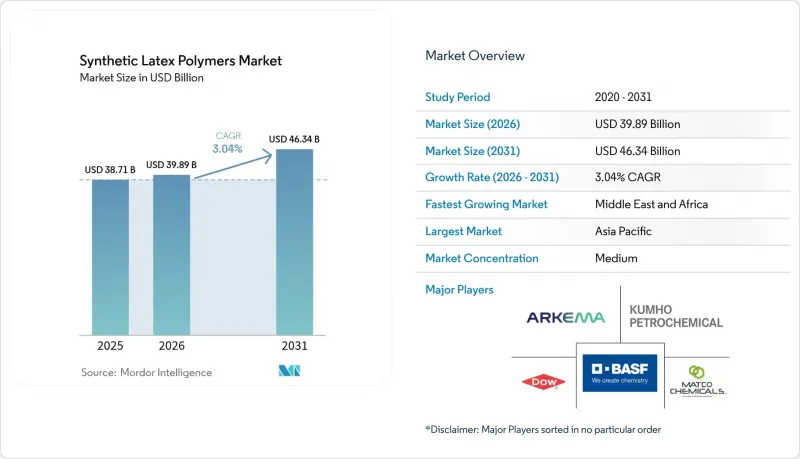
本報告按聚合物類型(苯乙烯-丁二烯聚合物、丙烯酸酯等)、應用領域(油漆和塗料、黏合劑和密封劑、紙張和紙板等)以及地區(亞太地區、北美地區、歐洲地區、南美地區、中東和非洲地區)對產業進行分類。市場預測以美元計價。
全球合成乳膠聚合物市場趨勢及洞察
油漆和塗料行業的需求不斷成長
隨著塗料製造商響應各轄區設定的揮發性有機化合物 (VOC) 排放限值(從 50 克/公升到 250 克/公升不等,例如加州南海岸空氣品質管理區 (AQMD) 的第 1168 號法規),建築產品的配方改良正在推進,對合成乳膠聚合物市場的需求持續成長。全球供應商正積極回應,推出新一代丙烯酸分散體,例如BASF的 2025 工業產品組合。這些產品消除了需報告的 VOC,採用了生物基原料,並保持了漆膜強度和耐候性。溶劑型塗料和水性塗料之間日益擴大的差距正在推動合成乳膠塗料的長期發展,尤其是在對氣味、乾燥時間和室內空氣品質標準要求極高的室內建築裝飾領域。
建築業的蓬勃發展推動了黏合劑和密封劑的使用。
新興市場的基礎設施發展週期為合成乳膠聚合物市場提供了另一個成長支柱。例如,沙烏地阿拉伯的「2030願景」計畫旨在到2030年將其國內石化產能加倍,達到1.4億噸以上,並將高性能聚合物作為建築化學領域的優先發展方向。公共採購法規也反映了這個發展方向。華盛頓州交通部(DOT)2024年規範強制要求在關鍵橋樑橋面上使用乳膠改質混凝土罩面層,從而確保了對苯乙烯-丁二烯分散體的基本需求。
原料(丁二烯)成本波動
丁二烯價格波動持續對乳膠利潤率構成壓力。 2025年第一季,現貨價格受汽車輪胎需求疲軟以及部分裂解裝置因例行維護而停產的影響而大幅波動。根據美國化學協會(ACC)估計,苯乙烯-丁二烯乳膠佔丁二烯總消費量的8%,這意味著上游市場價格的每一次上漲都會影響生產商。此外,利安德巴塞爾對其歐洲烯烴資產的審查也進一步加劇了未來供應前景的壓力和不確定性。
細分市場分析
預計到2025年,丙烯酸乳膠聚合物將佔據合成乳膠聚合物市場35.62%的佔有率,年複合成長率達3.42%,主要得益於其優異的成膜性能、耐候性和符合低VOC法規的要求。在更廣泛的合成乳膠聚合物市場中,丙烯酸分散體被廣泛用作高檔無味牆面塗料的標準黏合劑,這些塗料符合LEED和BREEAM等室內空氣品質標準。供應商也在開發自交聯技術,以在不使用外部凝聚劑的情況下提高耐磨性。苯乙烯-丁二烯級產品因其卓越的成本績效,在造紙、地毯和水泥添加劑領域仍保持競爭力,儘管該領域必須應對原料價格波動帶來的挑戰。醋酸乙烯酯和聚醋酸乙烯酯在木材加工和紡織品整理領域仍存在利基市場,在這些領域,柔軟性比「水氾白」問題更為重要。由於丁腈橡膠乳膠具有優異的耐化學腐蝕性和抗穿刺性,因此在護手套領域需求強勁。政府研究津貼,例如位於阿克倫市、耗資5,100萬美元的永續聚合物技術中心,旨在推動生物基丁二烯的商業化,最終將重塑不同聚合物的成本結構和碳排放指標。
儘管丙烯酸酯預計仍將保持其主導地位,但在生物基丙烯酸酯單體、可回收性和循環原料採購等領域,仍將湧現漸進式創新。隨著微塑膠排放和碳排放揭露法規的日益嚴格,丙烯酸酯憑藉其良好的合規記錄,預計將繼續保持領先地位。同時,苯乙烯類化學品生產商可能會投資於混合配方和物料平衡認證,以維持其市場佔有率。
區域分析
到2025年,亞太地區將佔合成乳膠聚合物市場規模的48.10%,這反映了該地區強大的製造業基礎、豐富的勞動力資源和快速的都市化。中國是該地區油漆和黏合劑消費的主要驅動力,同時,由於工廠合理化和向乙烷基原料的轉型,石化產業的競爭格局正在改變。印度憑藉公共住宅項目和電子商務帶來的包裝需求成長,正獲得發展動力。然而,隨著現有產能逐漸跟上以往的成長高峰,以及ESG審計在跨國買家中日益普及,該地區的成長勢頭正在趨於平緩。這使得能夠展現低碳實力和循環經濟實踐的供應商獲得了優先待遇。
中東和非洲地區目前消費量較低,但卻是成長最快的地區,預計到2031年複合年成長率將達到4.05%。根據“2030願景”,波灣合作理事會(GCC)成員國正在投資建設大規模基礎設施,這些基礎設施以具有競爭力的原料和涵蓋從煉油到聚合物生產的一體化綜合體為基礎。沙烏地阿拉伯計劃將其石化產品年產量提高一倍以上,達到1.4億噸,這凸顯了其致力於在下游領域(包括合成乳膠原料)增加價值的決心。跨境夥伴關係,例如沙烏地阿美和陶氏化學的合資企業Sadara,正在增強規模和市場准入。
北美和歐洲是成熟的需求中心,合成乳膠聚合物市場的發展更受到監管而非需求激增的影響。美國能源局估計,到2030年,化學和煉油業需要900億至1200億美元的脫碳投資,這將迫使乳膠生產商轉型使用綠色能源、熱整合技術和物料平衡認證的原料。歐洲也正在採取類似的措施,將聚合物課稅、生產者延伸責任制和零污染藍圖納入其產業政策。依賴傳統溶劑生產的供應商面臨最大的轉型成本,而一體化企業則正將研發重點轉向生物丙烯酸酯、機械回收和零排放乾燥爐。
其他好處:
- Excel格式的市場預測(ME)表
- 3個月的分析師支持
目錄
第1章:引言
- 研究假設和市場定義
- 調查範圍
第2章:調查方法
第3章執行摘要
第4章 市場狀況
- 市場概覽
- 市場促進因素
- 油漆和塗料行業需求增加
- 建築業的蓬勃發展推動了黏合劑和密封劑的使用。
- VOC法規優先考慮合成乳膠而非溶劑型產品。
- 在醫療保健領域不斷擴大應用
- 利用乳膠改善流變性能的3D列印混凝土外加劑
- 市場限制因素
- 原料(丁二烯)成本波動
- 已開發國家地毯需求下降
- C4 精煉廠的關閉限制了丁二烯的供應。
- 價值鏈分析
- 波特五力模型
第5章 市場規模與成長預測
- 按聚合物類型
- 苯乙烯丁二烯
- 丙烯酸纖維
- 醋酸乙烯酯
- 聚乙酸乙烯酯
- 其他(例如丁腈橡膠)
- 透過使用
- 油漆和塗料
- 黏合劑和密封劑
- 紙張和紙板
- 紡織品和不織布
- 其他用途(建築添加劑、合成皮革等)
- 按地區
- 亞太地區
- 中國
- 印度
- 日本
- 韓國
- 其他亞太國家
- 北美洲
- 美國
- 加拿大
- 墨西哥
- 歐洲
- 德國
- 英國
- 法國
- 義大利
- 其他歐洲國家
- 南美洲
- 巴西
- 阿根廷
- 其他南美國家
- 中東和非洲
- 沙烏地阿拉伯
- 南非
- 其他中東和非洲國家
- 亞太地區
第6章 競爭情勢
- 市場集中度
- 策略趨勢
- 市佔率和排名分析
- 公司簡介
- Apcotex
- Arkema
- ARLANXEO
- Ashland
- BASF
- DIC Corporation
- Dow
- Jubilant Agri and Consumer Products Limited(JACPL)
- Kumho Petrochemical
- LANXESS
- LG Chem
- Lion Elastomers
- Matco Chemicals Group
- SIBUR
- Sumitomo Chemical Advanced Technologies
- ZEON CORPORATION
第7章 市場機會與未來展望
According to Mordor Intelligence, the synthetic latex polymers market size in 2026 is estimated at USD 39.89 billion, growing from 2025 value of USD 38.71 billion with 2031 projections showing USD 46.34 billion, growing at 3.04% CAGR over 2026-2031.
This report Segments the Industry by Polymer Type (Styrene-Butadiene, Acrylic, and More), Application (Paints and Coatings, Adhesives and Sealants, Paper and Paperboard, and More), and Geography (Asia-Pacific, North America, Europe, South America, and Middle East and Africa). The Market Forecasts are Provided in Terms of Value (USD).
Global Synthetic Latex Polymers Market Trends and Insights
Rising Demand from Paints & Coatings Industry
Architectural reformulations continue to accelerate uptake in the synthetic latex polymers market as coating makers align with VOC caps that now range from 50 g/L to 250 g/L in jurisdictions such as California's South Coast AQMD Rule 1168. Global suppliers respond with next-generation acrylic dispersions, typified by BASF's 2025 industrial portfolio, which eliminates reportable VOCs and integrates bio-based feedstock while retaining film strength and weatherability. A widening gap between solvent and water-based systems reinforces the long-term shift toward synthetic latex, particularly in interior architectural finishes where odor, drying time, and indoor-air benchmarks converge.
Construction Boom Driving Adhesives & Sealants Usage
Emerging-market infrastructure cycles sustain another pillar of growth for the synthetic latex polymers market. Saudi Arabia's Vision 2030 blueprint, for example, doubles national petrochemical capacity to more than 140 million tons by 2030 and prioritizes specialty polymers geared to construction chemistry. Public procurement rules echo this direction: Washington State DOT 2024 specifications require latex-modified concrete overlays on critical bridge decks, guaranteeing baseline demand for styrene-butadiene dispersions.
Raw-Material (Butadiene) Cost Volatility
Butadiene swings continue to squeeze latex margins. Q1 2025 spot prices reacted sharply to soft automotive tire demand and selective cracker turnarounds. The American Chemistry Council estimates styrene-butadiene latex consumes 8% of total butadiene, exposing producers to every upstream rally. Further pressure stems from LyondellBasell's review of European olefin assets, which clouds forward supply visibility.
Other drivers and restraints analyzed in the detailed report include:
- VOC Regulations Favouring Synthetic Latex Over Solvent Systems
- Increasing Utilization in Medical and Healthcare Applications
- Carpet Demand Decline in Developed Markets
For complete list of drivers and restraints, kindly check the Table Of Contents.
Segment Analysis
Acrylics hold 35.62% of the synthetic latex polymers market share in 2025 and are expanding at a 3.42% CAGR, reinforced by excellent film-forming, weather resistance, and low-VOC compliance. Within the broader synthetic latex polymers market size, acrylic dispersions routinely serve as the default binder in premium zero-odor wall paints that meet indoor-air programs such as LEED and BREEAM. Suppliers also advance self-crosslinking technology that boosts scrub resistance without external coalescents. Styrene-butadiene grades remain competitive in paper, carpet, and cementitious admixtures because of favorable cost-performance ratios, yet the segment must navigate feedstock volatility. Vinyl acetate and polyvinyl acetate niches persist in woodworking and textile finishing where flexibility outweighs water-whitening concerns. Nitrile butadiene latex commands loyal demand in protective gloves due to chemical resistance and puncture strength. Government research grants, typified by the USD 51 million Sustainable Polymers Tech Hub in Akron, aim to commercialize bio-based butadiene, ultimately reshuffling cost structures and carbon metrics across polymer types.
Acrylic dominance looks durable, although incremental innovation will likely unfold along bio-acrylic monomers, recyclability, and circular feedstock sourcing. As regulations tighten microplastic release and carbon disclosure, the superior compliance record of acrylics positions them to preserve leadership, while producers of styrene-heavy chemistries may invest in hybrid formulations or mass-balance certification to stay relevant.
Complete Report Scope:
- By Polymer Type
- Styrene-Butadiene
- Acrylic
- Vinyl Acetate
- Polyvinyl Acetate
- Others (Nitrile Butadiene, etc.)
- By Application
- Paints and Coatings
- Adhesives and Sealants
- Paper and Paperboard
- Textiles and Non-woven Fabrics
- Other Applications (Construction Additives, Synthetic Leather and Misc., etc.)
- By Geography
- Asia-Pacific
- China
- India
- Japan
- South Korea
- Rest of Asia-Pacific
- North America
- United States
- Canada
- Mexico
- Europe
- Germany
- United Kingdom
- France
- Italy
- Rest of Europe
- South America
- Brazil
- Argentina
- Rest of South America
- Middle East and Africa
- Saudi Arabia
- South Africa
- Rest of Middle East and Africa
- Asia-Pacific
Geography Analysis
Asia-Pacific holds 48.10% of the synthetic latex polymers market size in 2025, reflecting its deep manufacturing base, abundant labor, and rapid urbanization. China drives a large portion of regional coating and adhesive consumption, even as plant rationalizations and ethane-based feedstock shifts redefine competitiveness in petrochemicals. India adds momentum through public housing schemes and expanding packaging demand for e-commerce. Still, the region's growth curve is flattening as installed capacity catches up with prior surges and as ESG auditing gains traction among multinational buyers, favoring suppliers that can document low carbon intensity and circular practices.
The Middle East & Africa currently contributes a smaller volume but is the fastest mover, with a 4.05% CAGR anticipated to 2031. Gulf Cooperation Council economies bankroll mega-infrastructure under Vision 2030, underpinned by competitive feedstock and integrated refinery-to-polymer complexes. Saudi Arabia's plan to more than double petrochemical output to 140 million t annually underscores commitment to downstream value capture, including synthetic latex raw materials Cross-border partnerships-such as the Sadara venture between Saudi Aramco and Dow-reinforce scale and market access.
North America and Europe represent mature demand centers where the synthetic latex polymers market is shaped more by regulation than volume spikes. The US Department of Energy calculates that the chemicals and refining segment requires USD 90-120 billion in decarbonization investment by 2030, prodding latex producers to green electricity, heat integration, and mass-balance certified feedstocks. Europe follows a similar path, embedding polymer taxation, extended producer responsibility, and zero-pollution roadmaps into industrial policy. Suppliers with legacy solvent footprints face the most significant transformation costs, while integrated players redirect R&D to bio-acrylics, mechanical recycling, and emission-free drying ovens.
- Apcotex
- Arkema
- ARLANXEO
- Ashland
- BASF
- DIC Corporation
- Dow
- Jubilant Agri and Consumer Products Limited (JACPL)
- Kumho Petrochemical
- LANXESS
- LG Chem
- Lion Elastomers
- Matco Chemicals Group
- SIBUR
- Sumitomo Chemical Advanced Technologies
- ZEON CORPORATION
Additional Benefits:
- The market estimate (ME) sheet in Excel format
- 3 months of analyst support
TABLE OF CONTENTS
1 Introduction
- 1.1 Study Assumptions & Market Definition
- 1.2 Scope of the Study
2 Research Methodology
3 Executive Summary
4 Market Landscape
- 4.1 Market Overview
- 4.2 Market Drivers
- 4.2.1 Rising demand from paints & coatings industry
- 4.2.2 Construction boom driving adhesives & sealants usage
- 4.2.3 VOC regulations favouring synthetic latex over solvent systems
- 4.2.4 Increasing utilization in medical and healthcare application
- 4.2.5 3-D printable concrete admixtures using latex for rheology
- 4.3 Market Restraints
- 4.3.1 Raw-material (butadiene) cost volatility
- 4.3.2 Carpet demand decline in developed markets
- 4.3.3 C4 refinery shutdowns limiting butadiene supply
- 4.4 Value Chain Analysis
- 4.5 Porter's Five Forces
- 4.5.1 Threat of New Entrants
- 4.5.2 Bargaining Power of Buyers
- 4.5.3 Bargaining Power of Suppliers
- 4.5.4 Threat of Substitutes
- 4.5.5 Degree of Competion
5 Market Size & Growth Forecasts (Value)
- 5.1 By Polymer Type
- 5.1.1 Styrene-Butadiene
- 5.1.2 Acrylic
- 5.1.3 Vinyl Acetate
- 5.1.4 Polyvinyl Acetate
- 5.1.5 Others (Nitrile Butadiene, etc.)
- 5.2 By Application
- 5.2.1 Paints and Coatings
- 5.2.2 Adhesives and Sealants
- 5.2.3 Paper and Paperboard
- 5.2.4 Textiles and Non-woven Fabrics
- 5.2.5 Other Applications (Construction Additives, Synthetic Leather and Misc., etc.)
- 5.3 By Geography
- 5.3.1 Asia-Pacific
- 5.3.1.1 China
- 5.3.1.2 India
- 5.3.1.3 Japan
- 5.3.1.4 South Korea
- 5.3.1.5 Rest of Asia-Pacific
- 5.3.2 North America
- 5.3.2.1 United States
- 5.3.2.2 Canada
- 5.3.2.3 Mexico
- 5.3.3 Europe
- 5.3.3.1 Germany
- 5.3.3.2 United Kingdom
- 5.3.3.3 France
- 5.3.3.4 Italy
- 5.3.3.5 Rest of Europe
- 5.3.4 South America
- 5.3.4.1 Brazil
- 5.3.4.2 Argentina
- 5.3.4.3 Rest of South America
- 5.3.5 Middle East and Africa
- 5.3.5.1 Saudi Arabia
- 5.3.5.2 South Africa
- 5.3.5.3 Rest of Middle East and Africa
- 5.3.1 Asia-Pacific
6 Competitive Landscape
- 6.1 Market Concentration
- 6.2 Strategic Moves
- 6.3 Market Share (%)/Ranking Analysis
- 6.4 Company Profiles (includes Global level Overview, Market level overview, Core Segments, Financials as available, Strategic Information, Market Rank/Share for key companies, Products & Services, and Recent Developments)
- 6.4.1 Apcotex
- 6.4.2 Arkema
- 6.4.3 ARLANXEO
- 6.4.4 Ashland
- 6.4.5 BASF
- 6.4.6 DIC Corporation
- 6.4.7 Dow
- 6.4.8 Jubilant Agri and Consumer Products Limited (JACPL)
- 6.4.9 Kumho Petrochemical
- 6.4.10 LANXESS
- 6.4.11 LG Chem
- 6.4.12 Lion Elastomers
- 6.4.13 Matco Chemicals Group
- 6.4.14 SIBUR
- 6.4.15 Sumitomo Chemical Advanced Technologies
- 6.4.16 ZEON CORPORATION
7 Market Opportunities & Future Outlook
- 7.1 White-space & Unmet-Need Assessment

 合成乳膠聚合物市場:2026-2032年全球市場預測(依聚合物類型、固態含量、粒徑、應用及終端用戶產業分類)
 合成乳膠聚合物市場報告:按類型、應用、終端用戶產業和地區分類(2026-2034 年)
 乳膠塗料市場:依乳膠類型、應用、終端用戶產業、功能、基材及地區分類
 合成乳膠聚合物(2026-2029):商業分析與機會
 2026年全球合成乳膠聚合物市場報告中性黑乳膠市場:依最終用途、產品類型、通路、材料、技術和公司規模分類-2026-2032年全球預測
 全球乳膠黏合劑市場
 合成乳膠聚合物市場-全球產業規模、佔有率、趨勢、機會和預測(按類型、應用、地區和競爭細分,2020-2030 年)
 全球合成乳膠聚合物市場需求分析,按地區、應用和預測(~2034年)
 乳膠塗料市場報告:趨勢、預測和競爭分析(至2031年)