

 |
市場調查報告書
商品編碼
2114715
膜分離技術:市場佔有率分析、產業趨勢與統計、成長預測(2026-2031)Membrane Separation Technology - Market Share Analysis, Industry Trends & Statistics, Growth Forecasts (2026 - 2031) |
||||||

※ 本網頁內容可能與最新版本有所差異。詳細情況請與我們聯繫。
根據 Mordor Intelligence 預測,膜分離技術市場規模將從 2025 年的 264.2 億美元成長到 2026 年的 275.3 億美元,然後在 2031 年達到 338.2 億美元,2026 年至 2031 年的複合年成長率為 4.21%。
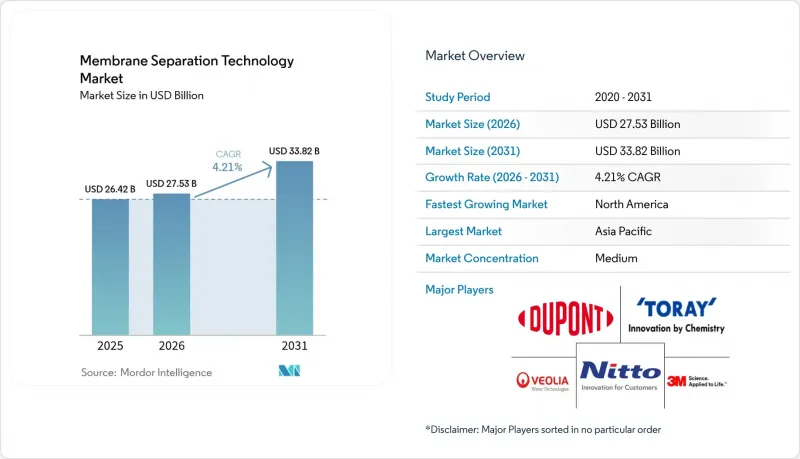
本報告按膜技術(逆滲透、超過濾等)、膜材料(聚合物、陶瓷、複合材料/混合材料)、組件配置(螺旋纏繞、中空纖維等)、應用(水和廢水處理、食品加工等)和地區(亞太地區、北美、歐洲、南美、中東和非洲)進行分類。
全球膜分離技術市場趨勢與洞察
對水和污水處理的需求不斷成長。
全球有20億人面臨水資源短缺,因此,能夠處理以往無法使用的受污染水源的薄膜修復技術需求空前高漲。市政水處理廠正在大力推廣薄膜生物反應器(MBR)系統,光是中國就有超過300座MBR裝置運作,幾乎佔全球年均成長率10.9%的100%。這項技術能夠生產高品質的處理水,可直接回用,因此在水資源匱乏、傳統處理方法難以達到嚴格排放標準的地區,MBR技術得到了廣泛應用。先進的薄膜結構使供水事業能夠從高鹽度和高有機污染的水源中提取飲用水。向分散式水處理系統的轉變正在創造新的市場領域,尤其是在工業區,因為現場處理可以降低運輸成本和監管合規風險。
食品、飲料和製藥加工產業的成長
乳製品生產商目前正採用交叉流過濾濃縮乳清蛋白,避免熱損傷,進而拓展產品線,推出獲利豐厚的營養分離蛋白產品(DAIRYNETWORK.COM)。製藥廠在生產注射用水時,也正從蒸餾法轉向超過濾。旭化成最新推出的撬裝式設備可去除99.999%的內毒素,同時降低30%的能耗。低酒精飲料的激增進一步推高了對超濾的需求,因為中空纖維奈米過濾在去除乙醇的同時,比真空蒸發法更好地保留了微妙的芳香成分。此外,膜分離技術可在室溫下分離機能性食品中的生物活性成分,從而保護對熱敏感的營養補充劑,並降低營運成本。
高資本投資及營運成本
雖然陶瓷薄膜的使用壽命比同類聚合物產品更長,但它們需要更昂貴的氧化鋁或氧化鋯基板,導致低收入地區的部署成本增加高達50%。在電價超過0.12美元/度的地區,與傳統修復方法相比,能源相關成本可能使生命週期成本增加20-30%。投資者要求提供清晰的投資回收期預測,而本已面臨預算限制的公共產業正在延長採購週期。資金籌措障礙正在推動創新租賃模式和基於績效的合約的出現,這些模式將資本風險轉移給供應商,但在信貸管道有限的市場,這些模式的普及速度仍然緩慢。
細分市場分析
到2025年,在海水淡化和工業回用等大型企劃的推動下,逆滲透(RO)將佔據膜分離技術市場47.73%的佔有率。公共產業選擇RO的原因在於其近乎通用的化學屏障和成熟的供應鏈,降低了資本成本。目前,結合正滲透和膜生物反應器(MBR)的技術組合成長最快,複合年成長率(CAGR)達4.92%,這表明操作員希望在處理高TDS(總溶解固態)原水時降低能耗。超過濾和奈米過濾透過處理特定範圍的溶質並作為可靠的預處理製程保護下游RO裝置,持續擴大市場佔有率。
將過濾、奈米過濾和高級氧化處理整合於單一緊湊型撬裝單元中的混合處理系統正在歐洲各地進入試點階段。這種模組化架構可將試運行時間縮短25%,且無需客製化土木工程即可達到目標廢水水質。因此,膜分離技術產業的整合商不僅在聚合物配方方面競爭,還在智慧製程控制和可互通元件設計方面競爭。
預計到2025年,聚合物薄膜將佔據膜分離技術市場64.52%的佔有率。這主要得益於高度擴充性的擠出生產線和經過充分研究的化學成分。聚醚碸和聚二氟亞乙烯(PVDF)在飲用水應用中佔據主導地位,因為這些應用對機械耐久性和耐氯性要求極高。然而,隨著全氟烷基和多氟烷基物質(PFAS)的逐步淘汰迫在眉睫,供應商正在調整配方並測試無氟替代品。
將氧化石墨烯、沸石或金屬有機結構嵌入聚合物主鏈中的複合雜化膜,可在不影響滲透性的前提下提高選擇性,預計2031年將維持5.11%的複合年成長率。陶瓷支撐複合膜目前已進入示範階段,其在高溫酸性流體中的性能優於傳統聚合物薄膜,並在石油化工和採礦領域佔據了一席之地。材料的多樣化降低了對特定化學原料的依賴,並減輕了可能阻礙膜分離技術市場成長的監管風險。
區域分析
亞太地區在中國、印度和越南兩位數工業成長的推動下,預計到2025年將佔全球銷售額的40.83%。去年,中國部署了300多個膜生物反應器(MBR)項目,顯示中國已做好直接邁向先進處理技術的準備,無需經過傳統的曝氣池(CHINA-WATER.ORG)。該地區的電子產業叢集正逐季擴大晶圓級超純水產能,為聚合物超過濾和逆滲透設備供應商提供了穩定的銷售管道。政府對農村飲用水採購的補貼進一步擴大了目標市場。
預計北美將迎來最快成長,到2031年複合年成長率將達到4.86%,主要歸因於飲用水中PFAS含量監管更加嚴格後,緊急維修訂單激增。美國多個市政當局已訂購並建造奈米過濾管線,保證去除99%的長鏈PFAS,從而推動了對低壓、高選擇性膜的需求(EPA.GOV)。其次是加拿大採礦相關人員,該行業修訂後的硒和硝酸鹽廢水標準正促使膜濃縮器作為多級化學處理的替代方案被廣泛採用。
歐洲是一個成熟而又充滿創新活力的市場,嚴格的工業排放上限推動著設備的持續升級。在德國和荷蘭,陶瓷奈米過濾技術正被不斷改進,用於處理難以處理的滲濾液和煉油廠廢棄物,這些應用案例正逐步推廣到鄰近市場。同時,中東地區的大規模海水淡化計畫正在加速發展,通常將能源回收系統與先進的薄膜複合膜結合。儘管非洲的公共產業發展滯後,但它們正獲得用於貨櫃式處理系統的優惠融資,這些系統可以繞過管道基礎設施的不足,為長期發展奠定基礎。
其他好處:
- Excel格式的市場預測(ME)表
- 3個月的分析師支持
目錄
第1章:引言
- 研究假設和市場定義
- 調查範圍
第2章:調查方法
第3章執行摘要
第4章 市場狀況
- 市場概覽
- 市場促進因素
- 對水處理和污水處理的需求不斷成長。
- 食品、飲料和製藥加工產業的成長
- 加強工業污水管理法規
- 前向穿透和電響應膜的採用
- 加工對低酒精飲料的需求
- 市場限制因素
- 高昂的資本和營運成本
- 膜污染與維護的複雜性
- 針對膜組件的 PFAS 法規即將訂定。
- 價值鏈分析
- 波特五力模型
第5章 市場規模與成長預測
- 透過膜技術
- 逆滲透
- 超過濾
- 奈米過濾
- 微濾
- 其他技術(正向滲透、膜生物反應器(MBR)等)
- 透過電影材料
- 聚合物體系
- 陶瓷製品
- 複合材料/雜化材料(石墨烯、金屬有機框架、沸石)
- 透過模組配置
- 螺旋纏繞
- 中空纖維
- 板框
- 管狀
- 透過使用
- 供水和廢水處理
- 食品加工
- 化學品和製藥
- 其他應用(氣體分離、電子等)
- 按地區
- 亞太地區
- 中國
- 日本
- 印度
- 韓國
- 東南亞國協
- 其他亞太國家
- 北美洲
- 美國
- 加拿大
- 墨西哥
- 歐洲
- 德國
- 英國
- 法國
- 義大利
- 西班牙
- 俄羅斯
- 北歐國家
- 其他歐洲國家
- 南美洲
- 巴西
- 阿根廷
- 其他南美國家
- 中東和非洲
- 沙烏地阿拉伯
- 南非
- 其他中東和非洲國家
- 亞太地區
第6章 競爭情勢
- 市場集中度
- 策略趨勢
- 市佔率和排名分析
- 公司簡介
- 3M
- ALFA LAVAL
- Aquaporin A/S
- Asahi Kasei Corporation
- AXEON Water
- DuPont
- Kovalus Separation Solutions
- KUBOTA Corporation
- LG Chem
- Nitto Denko Corporation
- Pall Corporation
- Pentair
- Samco Technologies, Inc.
- Sartorius AG
- Thermo Fisher Scientific
- TORAY ENGINEERING Co.,Ltd.
- Veolia Water Technologies & Solutions
- Xylem
第7章 市場機會與未來展望
According to Mordor Intelligence, the membrane separation technology market size market is expected to grow from USD 26.42 billion in 2025 to USD 27.53 billion in 2026 and is forecast to reach USD 33.82 billion by 2031 at 4.21% CAGR over 2026-2031.
This report is Segmented by Membrane Technology (Reverse Osmosis, Ultrafiltration, and More), Membrane Material (Polymeric, Ceramic, and Composite/Hybrid), Module Configuration (Spiral Wound, Hollow Fiber, and More), Application (Water and Waste-Water Treatment, Food Processing, and More), and Geography (Asia-Pacific, North America, Europe, South America, and Middle-East and Africa).
Global Membrane Separation Technology Market Trends and Insights
Rising Demand for Water and Waste-Water Treatment
Water scarcity affects 2 billion people globally, creating unprecedented demand for membrane-based purification technologies that can process contaminated water sources previously deemed unusable. Municipal water treatment facilities are increasingly adopting membrane bioreactor systems, with China alone implementing over 300 MBR plants achieving nearly 100% annual growth compared to the global rate of 10.9%. The technology's ability to produce high-quality effluent suitable for direct reuse is driving adoption in water-stressed regions, where traditional treatment methods prove inadequate for meeting stringent discharge standards. Advanced membrane configurations are enabling utilities to extract potable water from sources with high salinity and organic contamination levels. The shift toward decentralized water treatment systems is creating new market segments, particularly in industrial zones where on-site treatment reduces transportation costs and regulatory compliance risks.
Growth In Food, Beverage and Pharma Processing
Dairy groups now rely on cross-flow microfiltration to concentrate whey proteins without heat damage, extending product lines into high-margin nutritional isolates DAIRYNETWORK.COM. Pharmaceutical plants are shifting from distillation to ultrafiltration for water-for-injection; Asahi Kasei's latest skid removes 99.999% endotoxins while trimming energy draw by 30%. The surge in low-alcohol beverages further strengthens demand because hollow fiber nanofiltration strips ethanol while preserving delicate aroma compounds better than vacuum evaporation. Membrane steps also isolate bioactive ingredients for functional foods at ambient temperatures, protecting heat-sensitive nutraceuticals and lowering operating costs.
High Capital and Operating Costs
Ceramic membranes outlast polymeric rivals but require pricier alumina or zirconia substrates, elevating installed costs by up to 50% in low-income regions. Where power rates exceed USD 0.12 /kWh, energy line items can raise life-cycle ownership by 20-30% over conventional clarification. Investors demand clear visibility on payback, lengthening procurement cycles for public utilities that already face budget constraints. Financing hurdles spur innovative leasing models and outcome-based contracts that shift capital risk to suppliers, yet adoption remains slow in markets with limited credit access.
Other drivers and restraints analyzed in the detailed report include:
- Stricter Industrial Effluent Regulations
- Adoption of Forward-Osmosis and Electrically Responsive Membranes
- Membrane Fouling and Maintenance Complexity
For complete list of drivers and restraints, kindly check the Table Of Contents.
Segment Analysis
Reverse osmosis contributed 47.73% to the membrane separation technology market in 2025 on the back of seawater desalination megaprojects and industrial reuse schemes. Utilities pick RO for its near-universal chemistry barrier and mature supply base that cushions capital costs. Forward-osmosis together with membrane bioreactors is now the fastest-expanding cluster at a 4.92% CAGR, showing that operators want lower energy profiles for high-TDS feeds. Ultrafiltration and nanofiltration continue to carve space by handling specific solute ranges and acting as robust pretreatment steps that safeguard downstream RO arrays.
Hybrid trains that weld microfiltration, nanofiltration, and advanced oxidation in one compact skid are entering pilot stages across Europe. This modular architecture shortens commissioning by 25% and achieves target effluent quality without bespoke civil works. The membrane separation technology industry therefore sees integrators compete on smart process controls and interoperable element designs rather than on polymer recipes alone.
Polymeric membranes accounted for 64.52% of the membrane separation technology market size in 2025 owing to scalable extrusion lines and well-studied chemistries. Polyethersulfone and polyvinylidene fluoride dominate potable-water deployments where mechanical resilience and chlorine tolerance are prized. However, looming PFAS phase-outs are nudging suppliers to tweak formulations and test fluorine-free alternatives.
Composite-hybrid membranes will clock a 5.11% CAGR through 2031 by embedding graphene oxide, zeolites, or metal-organic frameworks inside polymer backbones that raise selectivity without hurting permeability. Pilot ceramic-supported composites already outperform legacy polymers in hot acid streams, granting them footholds in petrochemical and mining sectors. The resultant material diversification lowers reliance on any single chemical feedstock and mitigates regulatory risks that could otherwise slow the membrane separation technology market.
Complete Report Scope:
- By Membrane Technology
- Reverse Osmosis
- Ultrafiltration
- Nanofiltration
- Microfiltration
- Other Technologies (Forward Osmosis, Membrane Bioreactor (MBR), etc.)
- By Membrane Material
- Polymeric
- Ceramic
- Composite / Hybrid (Graphene, MOF, Zeolite)
- By Module Configuration
- Spiral Wound
- Hollow Fiber
- Plate and Frame
- Tubular
- By Application
- Water and Waste-water Treatment
- Food Processing
- Chemical and Pharmaceutical
- Other Applications (Gas Separation, Electronics etc.)
- By Geography
- Asia-Pacific
- China
- Japan
- India
- South Korea
- ASEAN Countries
- Rest of Asia-Pacific
- North America
- United States
- Canada
- Mexico
- Europe
- Germany
- United Kingdom
- France
- Italy
- Spain
- Russia
- NORDIC Countries
- Rest of Europe
- South America
- Brazil
- Argentina
- Rest of South America
- Middle-East and Africa
- Saudi Arabia
- South Africa
- Rest of Middle-East and Africa
- Asia-Pacific
Geography Analysis
Asia-Pacific generated 40.83% of global sales in 2025, underpinned by double-digit industrial growth across China, India, and Vietnam. China rolled out more than 300 membrane bioreactor projects last year, showcasing readiness to leapfrog directly to advanced treatment technologies without legacy aeration lagoons CHINA-WATER.ORG. Regional electronics clusters add wafer-grade ultrapure water capacity every quarter, giving polymeric ultrafiltration and reverse-osmosis skid suppliers a dependable sales funnel. Government subsidies for rural potabilization further widen the addressable base.
North America is on track for the swiftest 4.86% CAGR to 2031 because tightened PFAS caps in drinking water spur urgent retrofit orders. Several US municipalities have issued design-build contracts for nanofiltration lines guaranteed to strip 99% of long-chain PFAS, lifting demand for low-pressure high-selectivity membranes EPA.GOV. Canada's mining friends are next: revised effluent limits for selenium and nitrate mean membrane concentrators are replacing multi-step chemical treatments.
Europe constitutes a mature yet innovative arena where strict industrial emission ceilings nourish continuous upgrades. Germany and the Netherlands refine ceramic nanofiltration for hard-to-treat leachate and refinery waste, adding use cases that slowly migrate to neighboring markets. Meanwhile, the Middle East accelerates large-scale seawater desalination, typically pairing energy-recovery devices with advanced thin-film composite membranes. African utilities trail but receive concessional finance for containerized treatment units that bypass piped infrastructure deficits, planting seeds for long-run growth.
- 3M
- ALFA LAVAL
- Aquaporin A/S
- Asahi Kasei Corporation
- AXEON Water
- DuPont
- Kovalus Separation Solutions
- KUBOTA Corporation
- LG Chem
- Nitto Denko Corporation
- Pall Corporation
- Pentair
- Samco Technologies, Inc.
- Sartorius AG
- Thermo Fisher Scientific
- TORAY ENGINEERING Co.,Ltd.
- Veolia Water Technologies & Solutions
- Xylem
Additional Benefits:
- The market estimate (ME) sheet in Excel format
- 3 months of analyst support
TABLE OF CONTENTS
1 Introduction
- 1.1 Study Assumptions and Market Definition
- 1.2 Scope of the Study
2 Research Methodology
3 Executive Summary
4 Market Landscape
- 4.1 Market Overview
- 4.2 Market Drivers
- 4.2.1 Rising Demand for Water and Waste-Water Treatment
- 4.2.2 Growth In Food, Beverage and Pharma Processing
- 4.2.3 Stricter Industrial Effluent Regulations
- 4.2.4 Adoption of Forward-Osmosis and Electrically Responsive Membranes
- 4.2.5 Low-Alcohol Beverage Processing Demand
- 4.3 Market Restraints
- 4.3.1 High Capital and Operating Costs
- 4.3.2 Membrane Fouling and Maintenance Complexity
- 4.3.3 Impending PFAS Restrictions on Membrane Components
- 4.4 Value Chain Analysis
- 4.5 Porter's Five Forces
- 4.5.1 Threat of New Entrants
- 4.5.2 Bargaining Power of Buyers
- 4.5.3 Bargaining Power of Suppliers
- 4.5.4 Threat of Substitutes
- 4.5.5 Degree of Competition
5 Market Size and Growth Forecasts (Value)
- 5.1 By Membrane Technology
- 5.1.1 Reverse Osmosis
- 5.1.2 Ultrafiltration
- 5.1.3 Nanofiltration
- 5.1.4 Microfiltration
- 5.1.5 Other Technologies (Forward Osmosis, Membrane Bioreactor (MBR), etc.)
- 5.2 By Membrane Material
- 5.2.1 Polymeric
- 5.2.2 Ceramic
- 5.2.3 Composite / Hybrid (Graphene, MOF, Zeolite)
- 5.3 By Module Configuration
- 5.3.1 Spiral Wound
- 5.3.2 Hollow Fiber
- 5.3.3 Plate and Frame
- 5.3.4 Tubular
- 5.4 By Application
- 5.4.1 Water and Waste-water Treatment
- 5.4.2 Food Processing
- 5.4.3 Chemical and Pharmaceutical
- 5.4.4 Other Applications (Gas Separation, Electronics etc.)
- 5.5 By Geography
- 5.5.1 Asia-Pacific
- 5.5.1.1 China
- 5.5.1.2 Japan
- 5.5.1.3 India
- 5.5.1.4 South Korea
- 5.5.1.5 ASEAN Countries
- 5.5.1.6 Rest of Asia-Pacific
- 5.5.2 North America
- 5.5.2.1 United States
- 5.5.2.2 Canada
- 5.5.2.3 Mexico
- 5.5.3 Europe
- 5.5.3.1 Germany
- 5.5.3.2 United Kingdom
- 5.5.3.3 France
- 5.5.3.4 Italy
- 5.5.3.5 Spain
- 5.5.3.6 Russia
- 5.5.3.7 NORDIC Countries
- 5.5.3.8 Rest of Europe
- 5.5.4 South America
- 5.5.4.1 Brazil
- 5.5.4.2 Argentina
- 5.5.4.3 Rest of South America
- 5.5.5 Middle-East and Africa
- 5.5.5.1 Saudi Arabia
- 5.5.5.2 South Africa
- 5.5.5.3 Rest of Middle-East and Africa
- 5.5.1 Asia-Pacific
6 Competitive Landscape
- 6.1 Market Concentration
- 6.2 Strategic Moves
- 6.3 Market Share(%)/Ranking Analysis
- 6.4 Company Profiles (includes Global level Overview, Market level overview, Core Segments, Financials, Strategic Information, Market Rank/Share, Products and Services, Recent Developments)
- 6.4.1 3M
- 6.4.2 ALFA LAVAL
- 6.4.3 Aquaporin A/S
- 6.4.4 Asahi Kasei Corporation
- 6.4.5 AXEON Water
- 6.4.6 DuPont
- 6.4.7 Kovalus Separation Solutions
- 6.4.8 KUBOTA Corporation
- 6.4.9 LG Chem
- 6.4.10 Nitto Denko Corporation
- 6.4.11 Pall Corporation
- 6.4.12 Pentair
- 6.4.13 Samco Technologies, Inc.
- 6.4.14 Sartorius AG
- 6.4.15 Thermo Fisher Scientific
- 6.4.16 TORAY ENGINEERING Co.,Ltd.
- 6.4.17 Veolia Water Technologies & Solutions
- 6.4.18 Xylem
7 Market Opportunities and Future Outlook
- 7.1 White-space and Unmet-Need Assessment

 膜分離技術市場-2026-2032年全球市場預測正向滲透技術市場-2026-2032年全球市場預測
 先進膜材料市場預測至2034年-按材料類型、膜結構、分離製程、應用、最終用戶和地區分類的全球分析
 膜分離技術市場-全球產業規模、佔有率、趨勢、機會、預測:按應用、技術、地區和競爭格局分類,2021-2031年
 膜分離市場:按技術、應用和地區分類
 膜分離技術市場規模、佔有率和趨勢分析報告:按技術、應用、地區和細分市場分類(2026-2033 年)
 2026年全球膜分離系統市場報告雙極膜電滲析設備市場:依技術、薄膜材料、容量、應用、終端用戶和銷售管道,全球預測,2026-2032年雙極膜電滲析設備市場(按產品類型、技術、薄膜材料、系統規模、最終用戶和應用分類),全球預測(2026-2032年)
 全球膜分離技術市場規模、佔有率、趨勢和成長分析報告(2026-2034)