


 |
市場調查報告書
商品編碼
2114666
抗菌纖維:市場佔有率分析、產業趨勢與統計、成長預測(2026-2031)Antimicrobial Textile - Market Share Analysis, Industry Trends & Statistics, Growth Forecasts (2026 - 2031) |
||||||

※ 本網頁內容可能與最新版本有所差異。詳細情況請與我們聯繫。
據 Mordor Intelligence 稱,抗菌紡織品市場預計在 2026 年價值 142.9 億美元,預計在預測期(2026-2031 年)內將以 3.84% 的複合年成長率成長,到 2031 年達到 172.5 億美元。
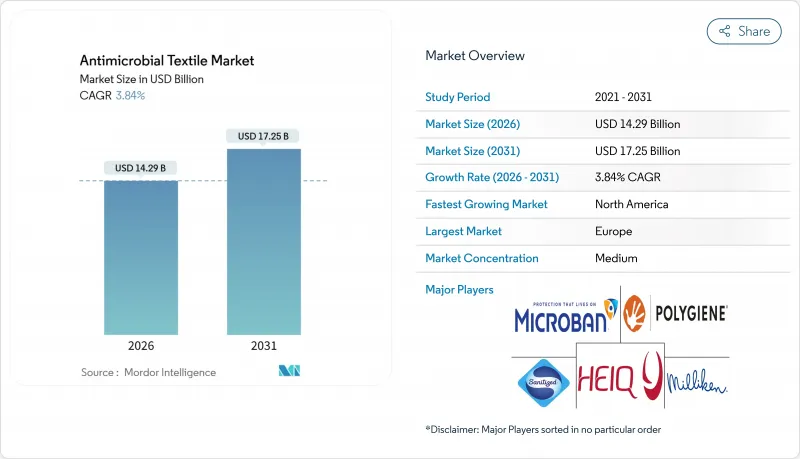
本報告按類型(季銨鹽、三氯生等)、纖維類型(棉、聚酯等)、應用(醫用紡織品、服裝等)、終端用戶行業(醫療保健、體育休閒等)和地區(亞太地區、北美、歐洲、南美、中東和非洲)進行細分。市場預測以美元計價。
全球抗菌紡織品市場趨勢及洞察
強制預防醫療相關感染
ISO 20743 現已成為醫院競標標準的基礎,要求供應商驗證其產品對金黃色葡萄球菌和肺炎克雷伯菌(2024 年美國疾病管制與預防中心 (CDC) 網路中 42% 的血流感染病原體)的抑菌性能達到 log-3。採購團隊優先考慮那些擁有內部 AATCC 100 和 ASTM E2149檢驗能力的紡織品製造商,這縮小了依賴外部認證的代工染色商的商機。英國國家醫療服務體系 (NHS) 規定,自 2025 年起,所有產品均需在 71 度C下進行 3 分鐘的熱滅菌。此製程可分解表面塗覆的季銨化合物,同時保持銀鍵結聚醯胺的完整性,從而推動外科用覆蓋巾和罩衣採用具有固有抗菌性的合成纖維。類似的耐久性要求也被納入日本的 JIS L 1902 標準,促使以母粒解決方案為中心的整合程度不斷提高。現在,無塵室服裝(符合 ISO 13629-2 標準)和傷口敷料(符合 FDA 510(k) 標準)也適用類似的嚴格要求,這導致人們對經過驗證的耐洗布料的需求增加。
高階運動服在運動過程中對氣味控制的需求
耐吉於2025年2月推出的「Aero-FIT」貼身層,將銀離子聚合物母粒融入再生聚酯纖維中,旨在解決價值120億美元的運動服飾市場中23%的退貨問題(即異味)。根據《紡織研究雜誌》的一項研究,未經處理的聚酯纖維釋放的甲硫醇是羊毛的4.7倍,但添加0.8 wt%的銀離子後,其性能可與羊毛媲美。為此,阿迪達斯、安德瑪和露露檸檬等品牌已強制要求在壓縮區域使用抗菌聚醯胺,以延長服裝壽命並減少洗滌次數。 Fulgar的「Q-SKIN」聚醯胺即使經過100次家用洗滌,仍能維持94%的抗菌效果,並符合OEKO-TEX® I級安全標準。此外,各品牌均參考了REACH法規附件XVII第72節,該節規定每次洗滌釋放的銀離子量不得超過0.1 mg/kg,並以此作為選擇化學品的指南。
加強對奈米顆粒排放的監管(歐盟 REACH 法規、美國環保署)
2024年3月,歐洲化學品管理局(ECHA)將奈米銀列入潛在的高度關注物質(SVHC)清單。這意味著,進口含有0.1wt%或以上奈米銀產品的進口商必須依照第7條規定提交通知,並繳納5萬至15萬歐元的申報費。受此措施影響,2022年至2025年間,歐洲抗菌化合物生產商的數量已從47家減少至29家。同時,2025年1月生效的美國《有毒物質管制法》(TSCA)第8(a)條奈米材料法規要求報告粒徑小於100奈米的銀顆粒的產量和暴露情況,違規者將面臨每日最高5萬美元的罰款。由於聚合物結合的銀不受監管,生產商正競相引進雙螺桿生產線進行母粒整合,導致研發週期延長一年以上。
細分市場分析
預計到2025年,季銨鹽在抗菌纖維市場將佔32.56%的佔有率。這反映了其廣譜抗菌活性以及在工作服和飯店布草方面的經濟優勢。然而,苯扎氯銨被列入加州「更安全消費品清單」增加了合規成本,削弱了其優勢。三氯生在FDA禁止非處方消毒劑後,目前僅應用於外科洗手服此細分領域。幾丁聚醣預計將以5.81%的複合年成長率成長,這得益於其在FDA 21 CFR 184法規下的GRAS(公認安全)認證以及良好的生物相容性,後者降低了ISO 10993標準的細胞毒性門檻。 《碳水化合物聚合物》雜誌上的一項研究證實,1 wt%的配方可實現3個對數單位的殺菌效果,顯示其競爭力可與銀媲美,而材料成本僅為銀的幾分之一。
對耐用性的期望進一步加速了這些變革。雖然美國環保署 (EPA) 的《聯邦殺蟲劑、殺菌劑和滅鼠劑法案》(FIFRA) 註冊要求季銨鹽化合物必須具有公共衛生功效,但用於除臭的幾丁聚醣可以避免被視為殺蟲劑,從而加快商業化進程。幾丁聚醣和Zinc pyrithione則滿足了糖尿病襪和具有抗菌性能的戶外裝備等特殊領域的需求。
受家用紡織品和醫院用布舒適度需求的推動,棉織物預計到2025年將佔市場佔有率的44.71%。然而,棉織物的表面處理在經過30-40次工業洗滌後會失去效力,從而推高了生命週期成本。聚醯胺織物預計將成長5.94%,其在熔融紡絲過程中將銀離子融入聚合物基質中。這使得聚醯胺織物即使經過100次家用洗滌後仍能維持94%的活性,從而在壓力襪和手術服等領域獲得更高的溢價。
65%聚酯纖維和35%棉等混紡布料符合NFPA 1999緊急醫療服務(EMS)服裝標準,在兼顧舒適性和耐用性時是理想的選擇。芳香聚醯胺和改性腈綸基產品用於需要阻燃性能的軍事應用,米利肯公司將於2025年1月收購Two Rivers公司,以擴大其產能,為「阿爾忒彌斯行動」提供服裝。所有布料的化學品選擇均需符合ISO 6330洗滌測試標準以及REACH法規附件XVII規定的銀釋放限值。
區域分析
歐洲正引領抗菌紡織品市場,預計2025年將佔全球銷售額的35.01%。這主要歸功於REACH法規附件XVII的嚴格規定,該規定迫使紡紗廠轉向使用母粒解決方案,並淘汰會滲出奈米顆粒的整理劑。德國機械供應商,尤其是歐瑞康(Oerlikon),正在推動線上添加銀製程的發展。同時,隨著英國國家醫療服務體系(NHS)的洗滌規範推薦使用聚醯胺手術包,英國和愛爾蘭的需求也不斷成長。法國國家藥品與健康產品安全局(ANSM)強制要求抗菌敷料必須帶有CE標誌MDR 2017/745,這導致供應商集中在垂直整合型企業。在義大利普拉托地區,為了減少傳統羊毛生產線上整理劑的劣化,人們正轉向使用聚醯胺-棉混紡布料。
預計到2031年,北美市場將以4.77%的複合年成長率成長,這主要得益於TSCA(有毒物質控制法案)法規的實施,推動了聚合物結合銀的使用量增加;國內紡絲投資的成長;以及對受奈米顆粒報告要求約束的亞洲進口產品的依賴性降低。加拿大衛生部已於2024年底前將PMRA(植物藥衛生署)的指導方針與EPA(環保署)的FIFRA(聯邦殺蟲劑、殺菌劑和滅鼠劑法案)指導方針相協調,從而消除了位置供應商的註冊延誤。墨西哥的Maquiladora公司根據美墨加協定(USMCA)的原產地規則供應抗菌工作服,並受益於其與美國客戶的地理鄰近性。
在亞太地區,中國修訂的GB/T 20944標準與ISO 20743標準接軌,促進了出口。同時,日本的50次洗滌耐久性測試(JIS L 1902)也對東麗和優尼卡的母粒有利。韓國食品藥物安全部(MFDS)加快了幾丁聚醣基傷口敷料的核准流程,計劃於2025年完成核准,但由於東南亞國協缺乏統一的法規,除泰國和馬來西亞以外,殼聚醣基傷口敷料的廣泛應用進展緩慢。儘管南美洲、中東和非洲地區仍在發展中,但巴西國家衛生監督局(ANVISA)已於2024年推出了醫院抗菌紡織品註冊制度。
其他好處:
- Excel格式的市場預測(ME)表
- 3個月的分析師支持
目錄
第1章:引言
- 研究假設和市場定義
- 調查範圍
第2章:調查方法
第3章執行摘要
第4章 市場狀況
- 市場概覽
- 市場促進因素
- 強制預防醫療相關感染疾病(HAI)
- 高階運動服在運動過程中對氣味控制的需求
- 採用抗菌感測器布料的智慧穿戴設備
- 改善公共交通和共享出行服務場所內部的衛生管理。
- 採用可回收的銀離子母粒
- 市場限制因素
- 加強對奈米顆粒排放的監管(歐盟 REACH 法規、美國環保署)
- 與未經處理的紡織品相比,溢價差異
- 白銀價格波動與供應鏈集中化
- 價值鏈分析
- 波特五力模型
第5章 市場規模與成長預測
- 按類型
- 季銨鹽
- 三氯生
- 幾丁聚醣
- 環糊精
- 其他類型
- 按布料類型
- 棉布
- 聚酯纖維
- 聚醯胺
- 混合和複合材料
- 其他布料類型
- 透過使用
- 醫用紡織品
- 服飾
- 家用紡織品
- 工業紡織品
- 其他用途(防護衣等)
- 按最終用戶行業分類
- 衛生保健
- 運動休閒
- 住宅
- 工業和製造業
- 軍事/國防
- 食品加工
- 運輸
- 其他終端用戶產業
- 按地區
- 亞太地區
- 中國
- 印度
- 日本
- 韓國
- 東南亞國協
- 其他亞太國家
- 北美洲
- 美國
- 加拿大
- 墨西哥
- 歐洲
- 德國
- 英國
- 法國
- 義大利
- 其他歐洲國家
- 南美洲
- 巴西
- 阿根廷
- 其他南美國家
- 中東和非洲
- 沙烏地阿拉伯
- 南非
- 其他中東和非洲國家
- 亞太地區
第6章 競爭情勢
- 市場集中度
- 策略趨勢
- 市佔率和排名分析
- 公司簡介
- 1888 Mills, LLC
- Ahlstrom
- BioCote Limited
- Birlacril
- HeiQ Materials AG
- Herculite
- Indorama Ventures Public Company Limited
- Microban International
- Milliken
- Noble Biomaterials
- Polygiene Group AB
- PurThread
- SANITIZED AG
- Sciessent LLC
- Toray Industries, Inc.
- UNITIKA LTD.
第7章 市場機會與未來展望
According to Mordor Intelligence, the antimicrobial textile market size is estimated at USD 14.29 billion in 2026, and is expected to reach USD 17.25 billion by 2031, at a CAGR of 3.84% during the forecast period (2026-2031).
This report is Segmented by Type (Quaternary Ammonium, Triclosan, and More), Fabric Type (Cotton, Polyester, and More), Application (Medical Textiles, Apparels, and More), End-User Industry (Healthcare, Sports and Leisure and More), and Geography (Asia-Pacific, North America, Europe, South America, and Middle-East and Africa). The Market Forecasts are Provided in Terms of Value (USD).
Global Antimicrobial Textile Market Trends and Insights
Healthcare-Associated Infection Prevention Mandates
ISO 20743 now underpins hospital tenders, obliging suppliers to verify log-3 bacterial-reduction performance against Staphylococcus aureus and Klebsiella pneumoniae, the pathogens driving 42% of 2024 bloodstream infections in the CDC network. Procurement teams favor mills that maintain in-house AATCC 100 and ASTM E2149 capability, shrinking opportunities for job-dyers dependent on external certification. The U.K. NHS mandated 71 °C, 3-minute thermal disinfection in 2025, a practice that degrades topical quats yet leaves silver-bonded polyamide intact, prompting a pivot to inherently antimicrobial synthetics in drapes and gowns. Comparable durability requirements entered Japan's JIS L 1902, driving consolidation around masterbatch solutions. Similar stringency now applies to ISO 13629-2 cleanroom garments and FDA 510(k) wound dressings, reinforcing demand for proven, wash-resilient fabrics.
Athletic-Odor Management Demand in Premium Sportswear
Nike's February 2025 Aero-FIT base layers introduced silver-polymer masterbatch in recycled polyester, addressing the USD 12 billion performance-apparel segment where malodor accounts for 23% of returns. A Textile Research Journal study found untreated polyester emitted 4.7 times more methanethiol than wool, yet matched wool once dosed with 0.8 wt% silver ion. Adidas, Under Armour, and Lululemon have since specified antimicrobial polyamide in compression zones, extending garment life and reducing wash frequency. Fulgar's Q-SKIN polyamide retains 94% efficacy after 100 household washes, meeting OEKO-TEX Class I safety limits. Brands also lean on REACH Annex XVII entry 72, which caps silver release at 0.1 mg/kg per wash, guiding chemistry selection.
Tightening Nanoparticle Discharge Restrictions (EU REACH, US EPA)
ECHA placed nano-silver on its SVHC Candidate List in March 2024, forcing importers of articles with more than 0.1 wt% nano-silver to submit Article 7 notices and pay dossier fees ranging from EUR 50,000 to EUR 150,000. The move has already reduced European antimicrobial-finish formulators from 47 to 29 between 2022 and 2025. In parallel, the U.S. TSCA Section 8(a) nanomaterial rule, active January 2025, mandates production-volume and exposure reports for sub-100 nm silver particles with penalties up to USD 50,000 per day. Because polymer-bound silver is exempt, mills are racing to install twin-screw lines for masterbatch integration, extending development cycles by a year or more.
Other drivers and restraints analyzed in the detailed report include:
- Smart-Wearables Using Antimicrobial Sensor Fabrics
- Public Transport and Shared-Mobility Upholstery Hygiene Upgrades
- Premium Cost Delta Vs. Untreated Textiles
For complete list of drivers and restraints, kindly check the Table Of Contents.
Segment Analysis
Quaternary ammonium held 32.56% of 2025 antimicrobial textile market share, reflecting its broad-spectrum activity and favorable economics in workwear and hospitality linen. Yet California's Safer Consumer Products list now flags benzalkonium chlorides, adding compliance costs that erode its advantage. Triclosan persists only in niche surgical scrubs after FDA bans on OTC antiseptics. Chitosan is forecast to grow at a 5.81% CAGR, benefiting from GRAS status under FDA 21 CFR 184 and biocompatibility that eases ISO 10993 cytotoxicity hurdles. Studies in Carbohydrate Polymers confirm log-3 reductions at 1 wt% loading, competitive with silver at a fraction of the material cost.
Durability expectations amplify these shifts. EPA FIFRA registration requires public-health claims for quats, yet chitosan marketed for odor control can bypass pesticide status, allowing quicker commercialization. Hybrid formulations blending chitosan with low-dose silver aim to balance cost, safety, and wash resistance. Meanwhile, copper and zinc pyrithione fill specialist gaps in diabetic socks and mildew-resistant outdoor gear.
Cotton kept 44.71% of 2025 volume, driven by home-textile and hospital-linen comfort requirements, but its topical finishes lose efficacy after 30-40 industrial washes, raising lifecycle costs. Polyamide, forecast to grow at 5.94%, integrates silver ions during melt-spinning, locking them within the polymer matrix and retaining 94% activity after 100 domestic washes, thus commanding a premium in compression hosiery and surgical garments.
Blends such as 65/35 polyester-cotton meet NFPA 1999 EMS garment codes and provide a midway option where comfort and durability must coexist. Aramid and modacrylic variants serve flame-retardant military uses, with Milliken enlarging capacity via its January 2025 Two Rivers acquisition to supply Artemis mission garments. Across all fabrics, ISO 6330 wash-test compliance and REACH Annex XVII silver-release caps govern chemistry choices.
Complete Report Scope:
- By Type
- Quaternary Ammonium
- Triclosan
- Chitosan
- Cyclodextrin
- Other Types
- By Fabric Type
- Cotton
- Polyester
- Polyamide
- Blended and Composite
- Other Fabric Types
- By Application
- Medical Textiles
- Apparels
- Home Textiles
- Industrial Textiles
- Other Applications (Protective Clothing, etc.)
- By End-user Industry
- Healthcare
- Sports and Leisure
- Residential
- Industrial and Manufacturing
- Military and Defense
- Food Processing
- Transportation
- Other End-user Industries
- By Geography
- Asia-Pacific
- China
- India
- Japan
- South Korea
- ASEAN Countries
- Rest of Asia-Pacific
- North America
- United States
- Canada
- Mexico
- Europe
- Germany
- United Kingdom
- France
- Italy
- Rest of Europe
- South America
- Brazil
- Argentina
- Rest of South America
- Middle-East and Africa
- Saudi Arabia
- South Africa
- Rest of Middle-East and Africa
- Asia-Pacific
Geography Analysis
Europe led the antimicrobial textile market with 35.01% of 2025 revenue, driven by stringent REACH Annex XVII controls that push mills toward masterbatch solutions, eliminating leachable nanoparticle finishes. Germany's machinery suppliers, notably Oerlikon, enable in-line silver dosing, while the U.K. NHS laundry protocol favors polyamide surgical packs, lifting demand in Britain and Ireland. France's ANSM requires MDR 2017/745 CE marking for antimicrobial dressings, consolidating the supplier base among vertically integrated firms. Italy's Prato district is shifting into polyamide-cotton blends to mitigate finish degradation on traditional wool lines.
North America is set to grow at a 4.77% CAGR through 2031 as TSCA rules encourage polymer-bound silver, prompting domestic spinning investments and reducing reliance on Asian imports subject to nanoparticle reporting. Health Canada harmonized its PMRA guidance with EPA FIFRA in late 2024, cutting registration delays for cross-border suppliers. Mexico's maquiladoras supply antimicrobial workwear under USMCA origin rules, benefiting from proximity to U.S. clients.
In Asia-Pacific, China's GB/T 20944 revision aligns to ISO 20743, making exports smoother, while Japan's 50-wash JIS L 1902 durability test favors Toray and Unitika masterbatches. South Korea's MFDS fast-tracked chitosan wound dressings in 2025, and ASEAN's regulatory patchwork slows uptake outside Thailand and Malaysia. South America and the Middle East and Africa remain nascent, though Brazil's ANVISA instituted hospital antimicrobial-textile registration in 2024.
- 1888 Mills, LLC
- Ahlstrom
- BioCote Limited
- Birlacril
- HeiQ Materials AG
- Herculite
- Indorama Ventures Public Company Limited
- Microban International
- Milliken
- Noble Biomaterials
- Polygiene Group AB
- PurThread
- SANITIZED AG
- Sciessent LLC
- Toray Industries, Inc.
- UNITIKA LTD.
Additional Benefits:
- The market estimate (ME) sheet in Excel format
- 3 months of analyst support
TABLE OF CONTENTS
1 Introduction
- 1.1 Study Assumptions and Market Definition
- 1.2 Scope of the Study
2 Research Methodology
3 Executive Summary
4 Market Landscape
- 4.1 Market Overview
- 4.2 Market Drivers
- 4.2.1 Healthcare-Associated Infection (HAI) Prevention Mandates
- 4.2.2 Athletic-Odor Management Demand in Premium Sportswear
- 4.2.3 Smart-Wearables Using Antimicrobial Sensor Fabrics
- 4.2.4 Public Transport and Shared-Mobility Upholstery Hygiene Upgrades
- 4.2.5 Recycling-Ready Silver-Ion Masterbatch Adoption
- 4.3 Market Restraints
- 4.3.1 Tightening Nanoparticle Discharge Restrictions (EU REACH, US EPA)
- 4.3.2 Premium Cost Delta Vs. Untreated Textiles
- 4.3.3 Silver Price Volatility and Supply-Chain Concentration
- 4.4 Value Chain Analysis
- 4.5 Porter's Five Forces
- 4.5.1 Threat of New Entrants
- 4.5.2 Bargaining Power of Buyers
- 4.5.3 Bargaining Power of Suppliers
- 4.5.4 Threat of Substitutes
- 4.5.5 Degree of Competition
5 Market Size and Growth Forecasts (Value)
- 5.1 By Type
- 5.1.1 Quaternary Ammonium
- 5.1.2 Triclosan
- 5.1.3 Chitosan
- 5.1.4 Cyclodextrin
- 5.1.5 Other Types
- 5.2 By Fabric Type
- 5.2.1 Cotton
- 5.2.2 Polyester
- 5.2.3 Polyamide
- 5.2.4 Blended and Composite
- 5.2.5 Other Fabric Types
- 5.3 By Application
- 5.3.1 Medical Textiles
- 5.3.2 Apparels
- 5.3.3 Home Textiles
- 5.3.4 Industrial Textiles
- 5.3.5 Other Applications (Protective Clothing, etc.)
- 5.4 By End-user Industry
- 5.4.1 Healthcare
- 5.4.2 Sports and Leisure
- 5.4.3 Residential
- 5.4.4 Industrial and Manufacturing
- 5.4.5 Military and Defense
- 5.4.6 Food Processing
- 5.4.7 Transportation
- 5.4.8 Other End-user Industries
- 5.5 By Geography
- 5.5.1 Asia-Pacific
- 5.5.1.1 China
- 5.5.1.2 India
- 5.5.1.3 Japan
- 5.5.1.4 South Korea
- 5.5.1.5 ASEAN Countries
- 5.5.1.6 Rest of Asia-Pacific
- 5.5.2 North America
- 5.5.2.1 United States
- 5.5.2.2 Canada
- 5.5.2.3 Mexico
- 5.5.3 Europe
- 5.5.3.1 Germany
- 5.5.3.2 United Kingdom
- 5.5.3.3 France
- 5.5.3.4 Italy
- 5.5.3.5 Rest of Europe
- 5.5.4 South America
- 5.5.4.1 Brazil
- 5.5.4.2 Argentina
- 5.5.4.3 Rest of South America
- 5.5.5 Middle-East and Africa
- 5.5.5.1 Saudi Arabia
- 5.5.5.2 South Africa
- 5.5.5.3 Rest of Middle-East and Africa
- 5.5.1 Asia-Pacific
6 Competitive Landscape
- 6.1 Market Concentration
- 6.2 Strategic Moves
- 6.3 Market Share(%)/Ranking Analysis
- 6.4 Company Profiles {(includes Global level Overview, Market level overview, Core Segments, Financials as available, Strategic Information, Products and Services, and Recent Developments)}
- 6.4.1 1888 Mills, LLC
- 6.4.2 Ahlstrom
- 6.4.3 BioCote Limited
- 6.4.4 Birlacril
- 6.4.5 HeiQ Materials AG
- 6.4.6 Herculite
- 6.4.7 Indorama Ventures Public Company Limited
- 6.4.8 Microban International
- 6.4.9 Milliken
- 6.4.10 Noble Biomaterials
- 6.4.11 Polygiene Group AB
- 6.4.12 PurThread
- 6.4.13 SANITIZED AG
- 6.4.14 Sciessent LLC
- 6.4.15 Toray Industries, Inc.
- 6.4.16 UNITIKA LTD.
7 Market Opportunities and Future Outlook
- 7.1 White-space and Unmet-Need Assessment
- 7.2 Development of Non-Toxic and Bio-Compatible Products

 抗病毒和抗菌紡織品市場:全球市場預測,2026-2032年抗菌紡織品市場:按類型、織物類型、功能、最終用戶和分銷管道分類-2026-2032年全球市場預測
 抗菌纖維市場規模、佔有率和成長分析:按產品類型、應用、最終用戶、技術類型和地區分類-2026-2033年產業預測
 抗菌紡織品市場規模、佔有率、趨勢和預測:按材料、活性成分、應用和地區分類,2026-2034年
 抗菌紡織品市場規模、佔有率、成長及全球產業分析:按類型、應用和地區分類,並預測至2026-2034年全球抗菌纖維市場規模、佔有率、趨勢和成長分析報告(2026-2034年)日本抗菌纖維市場規模、佔有率、趨勢和預測:按活性成分、應用和地區分類,2026-2034年
 2026年全球抗菌服飾市場報告2026年全球抗菌紡織品市場報告除臭功能纖維市場:2026-2032年全球預測(按材料類型、技術、價格範圍、應用和通路)