

 |
市場調查報告書
商品編碼
2114660
地工格網:市場佔有率分析、產業趨勢與統計、成長預測(2026-2031)Geogrids - Market Share Analysis, Industry Trends & Statistics, Growth Forecasts (2026 - 2031) |
||||||

※ 本網頁內容可能與最新版本有所差異。詳細情況請與我們聯繫。
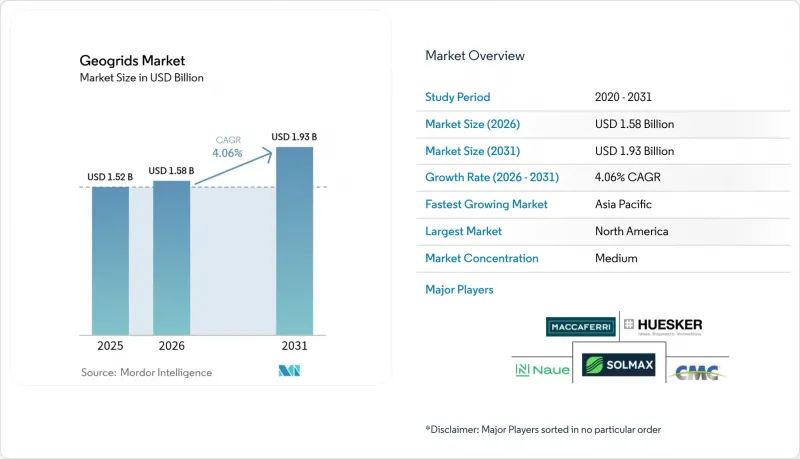
據 Mordor Intelligence 稱,2025 年地工格網市場價值為 15.2 億美元,預計到 2031 年將從 2026 年的 15.8 億美元成長至 19.3 億美元,預測期(2026-2031 年)的複合年預計成長率為 4.06%。
本報告按材料(聚丙烯、聚乙烯、聚酯等)、結構類型(單軸、雙軸、三軸)、製造方法(擠出、編織/針織、粘合/焊接)、應用(道路建設、地面加固、鐵路穩定等)和地區(亞太地區、北美、歐洲、南美、中東和非洲)進行分類。
全球地工格網市場趨勢與洞察
延長路面使用壽命的目標激增
交通基礎設施的設計正從基於厚度的經驗規則轉向基於動態的經驗方法,這種方法量化了在40至100年的使用壽命內採用地工格網所帶來的增量效益。層係數比的計算表明,更薄的加筋路面可以達到相當的疲勞性能,這為預算緊張的地區提供了直接支持。美國各州政府已開始將地工格網納入軟弱地基路段的標準規範,歐盟多個成員國也出現了類似的趨勢。這種行為轉變導致人們更加重視生命週期成本而非初始成本,並更加關注具有可靠現場性能數據的產品。由此產生的需求成長在需要快速安裝和最大限度減少車道封閉的維修合約中最為明顯。因此,地工格網市場正受到路面維護預算增加和先前延期維護獎勵策略重新分配的推動。
碳減排義務促進輕型地質解決方案
目前,在一些地區,「總隱含碳排放量」已被納入競標評估範圍,要求承包商量化與骨材運輸和瀝青生產相關的排放量。獨立研究表明,地工格網加勁路基可減少28%至45%的材料運輸量,使雙車道公路每公里減少58至85噸二氧化碳當量排放。考慮到超過95%的道路建設排放都源自於材料生產,這一優勢至關重要。在法國和北歐國家,一些先驅性措施已催生出將碳減排作為非價格評估標準的採購模板,目前該模式正推廣至美國各州運輸部。能夠利用第三方檢驗數據證明其碳減量效果的供應商,可在低碳試驗計畫中獲得優先待遇。從長遠來看,隨著公共資助的交通項目預計將強制披露生命週期清單,地工格網將更深入地融入主流設計之中。
聚丙烯和高密度聚乙烯的價格波動
聚丙烯現貨價格飆升,擠壓了與固定價格公共合約掛鉤的製造商的利潤空間。為了降低風險,生產商正對沖原料價格波動風險,並轉向聚酯產品,但由於聚丙烯在道路建設中佔據主導地位,且用量巨大,這種替代仍然有限。價格的不確定性也使專案預算編制變得更加複雜,一些機構推遲了地工格網的競標,或要求加入價格調整條款。短期來看,這種價格波動可能會阻礙成本敏感型地方道路工程採用地工格網,並抑制新興國家的需求成長,儘管地工格網市場具有強勁的結構性促進因素。
細分市場分析
在2025年的地工格網市場中,聚丙烯佔比43.78%,在全球銷售額中佔最大佔有率。即使從絕對值來看,聚丙烯地工格網的市佔率也高於其他任何材料。這是因為聚丙烯優異的抗張強度、化學惰性和價格競爭力使其無需添加樹脂改質劑即可滿足大多數公路規範的要求。
然而,根據同樣的數據,聚酯材料市場正以5.32%的複合年成長率快速成長,是所有材料中成長最快的。這是因為工程師在長期承載載荷的結構中優先考慮抗蠕變性能。聚酯材料即使在持續應力下也能抵抗氧化劣化,因此是高堤防和加固陡坡的理想選擇,這些結構必須承受數十年的持續重力作用。設計顧問公司越來越建議在高度超過10公尺的結構中使用聚酯材料,隨著無序的城市擴張將交通走廊推向偏遠地區,這一細分市場的規模也不斷擴大。
到2025年,雙向地工格網將佔全球銷售額的45.21%,在地工格網市場的結構層級中佔有重要地位。其主導地位源自於數十年的設計指南、豐富的現場數據以及規模化生產帶來的成本優勢,這些因素共同降低了單位成本。由於指南文件中包含了針對雙向地工格網剛度特性而製定的交通當量厚度係數,因此,在對標準軟性路面進行維修時,工程師通常會預設選擇雙向地工格網。
儘管如此,三軸格柵的市佔率正以5.05%的複合年成長率不斷擴大,尤其是在高負載工況下,來自各個方向的交通模式會在骨材界面產生高剪切力,因此三軸格柵的應用日益廣泛。獨立測試實驗室的測試表明,三軸格柵採用徑向肋條排列,能夠在各個方向上相互鎖定,在重複車輪荷載作用下,其減少永久變形的效果比雙軸格柵高出30%至40%。
區域分析
北美地區在《基礎設施投資與就業法案》批准的3,500億美元聯邦公路資金支持下,預計2025年將佔全球收入的39.01%。市場需求已基本形成製度化,各州交通部(DOT)在地工地工格網認證規範中經常引用AASHTO R50程序。在加州、德克薩斯州和紐約州,路面養護方法正從增加厚度轉向機械穩定,儘管車道公里數成長放緩,但單位面積的機械穩定化應用率仍在上升。
亞太地區受中國、印度、印尼和越南等國大型公路和鐵路大型企劃的推動,成為成長最快的地區,預計2031年將維持4.74%的複合年成長率。在中國,哈爾濱-宜春走廊等高速公路沿線,多個省份正在易凍土路堤上鋪設地工格網;而印度國家公路管理局則強制要求在“印度公路網計劃”(Bharatmala-Pariyojana)的膨脹性粘土路基中使用抗張強度等級的PET地工格網。豐富的基礎建設建設計畫和複雜的地質條件共同推動亞太地區地工格網市場維持高於全球平均的成長動能。
在歐洲,嚴格的碳減排法規鼓勵對現有路網維修,並採用高效材料進行加固,這些法規正在推動市場發展。法國基礎設施總局強制要求在全層路面翻新中使用地工格網,而英國的基礎設施戰略則將產品選擇與淨零排放目標相銜接。
除了上述三個地區外,南美洲也正在採用官民合作關係(PPP)模式,波灣合作理事會(GCC)成員國也在投資興建穿越沙漠地區的新建設走廊。在所有這些情況下,地工格網透過緩解路基剛度不足和防止沙土造成的車轍,為全球地工格網市場的擴張做出了貢獻。
其他好處:
- Excel格式的市場預測(ME)表
- 3個月的分析師支持
目錄
第1章:引言
- 研究假設和市場定義
- 調查範圍
第2章:調查方法
第3章執行摘要
第4章 市場狀況
- 市場概覽
- 市場促進因素
- 路面使用壽命延長目標激增。
- 碳減排義務促進輕型地面解決方案
- 開發中國家公路網的快速擴張
- 礦山運輸道路加固需求
- 數位孿生技術的引入使得實現具有最佳化設計的地工格網成為可能。
- 市場限制因素
- 聚丙烯和高密度聚乙烯的價格波動
- 認證標準因地區而異。
- 新興市場安裝人員技能不足
- 價值鏈分析
- 波特五力模型
第5章 市場規模與成長預測
- 材料
- 聚丙烯(PP)
- 聚乙烯(HDPE/LDPE)
- 聚酯(PET)
- 其他材料(玻璃纖維、複合材料等)
- 依結構類型
- 單軸
- 雙軸
- 三軸
- 透過製造方法
- 擠壓
- 針織/梭織布料
- 粘合/焊接
- 透過使用
- 道路建設
- 地基加固
- 鐵路穩定
- 其他用途(採礦和隧道支撐結構、港口等)
- 按地區
- 亞太地區
- 中國
- 日本
- 印度
- 韓國
- 東南亞國協
- 其他亞太國家
- 北美洲
- 美國
- 加拿大
- 墨西哥
- 歐洲
- 德國
- 英國
- 法國
- 義大利
- 西班牙
- 俄羅斯
- 北歐國家
- 其他歐洲國家
- 南美洲
- 巴西
- 阿根廷
- 其他南美國家
- 中東和非洲
- 沙烏地阿拉伯
- 南非
- 其他中東和非洲國家
- 亞太地區
第6章 競爭情勢
- 市場集中度
- 策略趨勢
- 市佔率和排名分析
- 公司簡介
- ABG Limited
- ACE Geosynthetics
- Commercial Metals Company
- CTM Technical Textiles Ltd.
- Geofabrics Australasia Pty Ltd.
- HUESKER International
- Maccaferri Spa
- Naue GmbH & Co. KG
- Pietrucha International Sp. z oo
- Singhal Industries Pvt. Ltd.
- Solmax
- Strata Systems, Inc.
- Taian Road Engineering Materials
- TECHFABINDIA
- TENAX SpA
- Thrace Group
- Titan Environmental
第7章 市場機會與未來展望
According to Mordor Intelligence, the geogrids market size was valued at USD 1.52 billion in 2025 and estimated to grow from USD 1.58 billion in 2026 to reach USD 1.93 billion by 2031, at a CAGR of 4.06% during the forecast period (2026-2031).
This report is Segmented by Material (Polypropylene, Polyethylene, Polyester, and Others), Structural Type (Uniaxial, Biaxial, and Triaxial), Manufacturing Method (Extrusion, Knitted/Woven, and Bonded/Welded), Application (Road Construction, Soil Reinforcement, Railroad Stabilisation, and Others), and Geography (Asia-Pacific, North America, Europe, South America, and Middle-East and Africa).
Global Geogrids Market Trends and Insights
Surge in Pavement Life-Cycle Extension Targets
Transport agencies are shifting from thickness-based empirical design toward mechanistic-empirical approaches that quantify the incremental benefit of geogrid inclusion over a 40- to 100-year life. Layer Coefficient Ratio calculations prove that thinner reinforced pavements can deliver identical fatigue performance, directly supporting budget-constrained jurisdictions. United States state departments have begun embedding geogrids in standard specifications for weak-subgrade corridors, a practice mirrored in several EU member states. This behavioural change elevates lifecycle cost over first cost, heightening interest in products with robust field performance data. The resulting demand uptick is most visible in rehabilitation contracts, where agencies seek rapid construction and minimal lane closure times. Consequently, the geogrids market registers increased pull-through from pavement preservation budgets and stimulus allocations earmarked for deferred maintenance.
Carbon-Reduction Mandates Favouring Lightweight Geo-Solutions
Several jurisdictions now score bids partly on total embodied carbon, prompting contractors to quantify emissions from aggregate haulage and asphalt production. Independent studies show geogrid-reinforced base layers can shrink material haulage volumes by 28 to 45%, translating into 58 to 85 tCO2e/km savings on two-lane highways. With material production accounting for more than 95% of road-building emissions, this benefit carries decisive weight. Early movers in France and the Nordics have created procurement templates that treat carbon reduction as a non-price criterion, a model now spreading to US state DOTs. Suppliers able to substantiate carbon savings with third-party verified data gain preferred status on low-carbon pilot programs. Over the long term, lifecycle inventory disclosure is expected to become mandatory on publicly funded transportation projects, embedding geogrids deeper into mainstream design.
Price Volatility of Polypropylene and HDPE
Spikes in polypropylene spot values compress margins for manufacturers locked into fixed-price public contracts. To buffer risk, producers hedge feedstock exposure and diversify toward polyester, yet substitution remains partial because polypropylene dominates high-volume roads. Price uncertainty also complicates project budgeting, leading some agencies to postpone geogrid tenders or seek escalation clauses. Over the near term, volatility is likely to deter adoption in cost-sensitive rural road programs, trimming incremental demand in emerging economies despite strong structural drivers for the geogrids market.
Other drivers and restraints analyzed in the detailed report include:
- Rapid Expansion of Expressway Networks in Developing Economies
- Mining Haul-Road Reinforcement Demand
- Fragmented Certification Standards Across Regions
For complete list of drivers and restraints, kindly check the Table Of Contents.
Segment Analysis
The geogrids market registered a polypropylene contribution of 43.78% in 2025, translating into the single-largest slice of global revenues. In absolute terms, the polypropylene segment commanded a larger share of the geogrids market size than any other material because its tensile efficiency, chemical inertness, and price competitiveness meet most highway specifications without additional resin modifiers.
Yet the same data show polyester advancing at a 5.32% CAGR, the sharpest trajectory among materials, as engineers prioritise creep resistance for long-term load-bearing structures. Polyester's lower susceptibility to oxidative degradation under sustained stress makes it the preferred choice for high embankments and reinforced steep slopes that must resist constant gravitational pull over decades. Design consultancies increasingly prescribe polyester for structures exceeding 10 m in height, a specification niche widening as urban sprawl pushes transport corridors onto marginal terrain.
Biaxial designs delivered 45.21% of global revenue in 2025, thereby anchoring the structural hierarchy of the geogrids market. Their dominance stems from multi-decade design guidance, abundant field data, and manufacturing economies of scale that drive down unit costs. Engineers deploying standard flexible pavement rehabilitation often default to biaxial because guidance documents contain traffic-equivalent thickness factors calibrated for its stiffness profile.
Nevertheless, triaxial units are expanding at a 5.05% CAGR and are increasingly specified for heavy-loading conditions where omnidirectional traffic patterns create high shear at aggregate interfaces. Independent laboratory tests reveal that triaxial grids can reduce permanent deformation 30-40% more effectively than biaxial under cyclic wheel loads, owing to their radial rib distribution that mobilises interlock in every direction.
Complete Report Scope:
- By Material
- Polypropylene (PP)
- Polyethylene (HDPE/LDPE)
- Polyester (PET)
- Others Materials (Fiberglass, Composite, etc.)
- By Structural Type
- Uniaxial
- Biaxial
- Triaxial
- By Manufacturing Method
- Extrusion
- Knitted/Woven
- Bonded/Welded
- By Application
- Road Construction
- Soil Reinforcement
- Railroad Stabilisation
- Other Applications (Mining and Tunnel Support, Ports, etc.)
- By Geography
- Asia-Pacific
- China
- Japan
- India
- South Korea
- ASEAN Countries
- Rest of Asia-Pacific
- North America
- United States
- Canada
- Mexico
- Europe
- Germany
- United Kingdom
- France
- Italy
- Spain
- Russia
- NORDIC Countries
- Rest of Europe
- South America
- Brazil
- Argentina
- Rest of South America
- Middle-East and Africa
- Saudi Arabia
- South Africa
- Rest of Middle-East and Africa
- Asia-Pacific
Geography Analysis
North America delivered 39.01% of 2025 revenues, underpinned by USD 350 billion of federal highway funding authorised by the Infrastructure Investment and Jobs Act. State DOT specifications routinely cite AASHTO R50 procedures for geogrid qualification, effectively institutionalising demand. Pavement preservation philosophies in California, Texas, and New York have moved from thickness-addition toward mechanical stabilisation, translating into higher unit uptake even as lane-kilometre growth slows.
Asia-Pacific ranks as the fastest-growing territory with a 4.74% CAGR through 2031, buoyed by expressway and rail megaprojects across China, India, Indonesia, and Vietnam. Chinese provinces allocate grids for frost-susceptible embankments on high-speed routes such as the Harbin-Yichun corridor, while India's National Highways Authority mandates tensile-grade PET geogrids on expansive-clay subgrades within the Bharatmala Pariyojana. Abundant infrastructure pipelines and soil-condition challenges synergize to keep the Asia-Pacific geogrids market on a higher-than-global trajectory.
Europe is driven by the rehabilitation of legacy networks and stringent carbon-reduction rules that favour material-efficient reinforcement. France's Directorate-General for Infrastructure specifies geogrids in full-depth pavement recycling, while the UK Infrastructure Strategy aligns product selection with net-zero goals.
Beyond the triad, South America leans on public-private concession models, and Gulf Cooperation Council states fund new-build corridors across desert terrain, both contexts where geogrids counteract weak subgrade stiffness and sand-induced rutting, broadening the global footprint of the geogrids market.
- ABG Limited
- ACE Geosynthetics
- Commercial Metals Company
- CTM Technical Textiles Ltd.
- Geofabrics Australasia Pty Ltd.
- HUESKER International
- Maccaferri Spa
- Naue GmbH & Co. KG
- Pietrucha International Sp. z o. o.
- Singhal Industries Pvt. Ltd.
- Solmax
- Strata Systems, Inc.
- Taian Road Engineering Materials
- TECHFABINDIA
- TENAX SpA
- Thrace Group
- Titan Environmental
Additional Benefits:
- The market estimate (ME) sheet in Excel format
- 3 months of analyst support
TABLE OF CONTENTS
1 Introduction
- 1.1 Study Assumptions and Market Definition
- 1.2 Scope of the Study
2 Research Methodology
3 Executive Summary
4 Market Landscape
- 4.1 Market Overview
- 4.2 Market Drivers
- 4.2.1 Surge in Pavement Life-Cycle Extension Targets
- 4.2.2 Carbon-Reduction Mandates Favouring Lightweight Geo-Solutions
- 4.2.3 Rapid Expansion of Expressway Network in Developing Economies
- 4.2.4 Mining Haul-Road Reinforcement Demand
- 4.2.5 Digital Twin Adoption Enabling Design-Optimised Geogrids
- 4.3 Market Restraints
- 4.3.1 Price Volatility of Polypropylene and HDPE
- 4.3.2 Fragmented Certification Standards Across Regions
- 4.3.3 Limited Installer Skillsets in Emerging Markets
- 4.4 Value Chain Analysis
- 4.5 Porter's Five Forces
- 4.5.1 Bargaining Power of Suppliers
- 4.5.2 Bargaining Power of Buyers
- 4.5.3 Threat of New Entrants
- 4.5.4 Threat of Substitute Products
- 4.5.5 Degree of Competition
5 Market Size and Growth Forecasts (Value)
- 5.1 By Material
- 5.1.1 Polypropylene (PP)
- 5.1.2 Polyethylene (HDPE/LDPE)
- 5.1.3 Polyester (PET)
- 5.1.4 Others Materials (Fiberglass, Composite, etc.)
- 5.2 By Structural Type
- 5.2.1 Uniaxial
- 5.2.2 Biaxial
- 5.2.3 Triaxial
- 5.3 By Manufacturing Method
- 5.3.1 Extrusion
- 5.3.2 Knitted/Woven
- 5.3.3 Bonded/Welded
- 5.4 By Application
- 5.4.1 Road Construction
- 5.4.2 Soil Reinforcement
- 5.4.3 Railroad Stabilisation
- 5.4.4 Other Applications (Mining and Tunnel Support, Ports, etc.)
- 5.5 By Geography
- 5.5.1 Asia-Pacific
- 5.5.1.1 China
- 5.5.1.2 Japan
- 5.5.1.3 India
- 5.5.1.4 South Korea
- 5.5.1.5 ASEAN Countries
- 5.5.1.6 Rest of Asia-Pacific
- 5.5.2 North America
- 5.5.2.1 United States
- 5.5.2.2 Canada
- 5.5.2.3 Mexico
- 5.5.3 Europe
- 5.5.3.1 Germany
- 5.5.3.2 United Kingdom
- 5.5.3.3 France
- 5.5.3.4 Italy
- 5.5.3.5 Spain
- 5.5.3.6 Russia
- 5.5.3.7 NORDIC Countries
- 5.5.3.8 Rest of Europe
- 5.5.4 South America
- 5.5.4.1 Brazil
- 5.5.4.2 Argentina
- 5.5.4.3 Rest of South America
- 5.5.5 Middle-East and Africa
- 5.5.5.1 Saudi Arabia
- 5.5.5.2 South Africa
- 5.5.5.3 Rest of Middle-East and Africa
- 5.5.1 Asia-Pacific
6 Competitive Landscape
- 6.1 Market Concentration
- 6.2 Strategic Moves
- 6.3 Market Share(%)/Ranking Analysis
- 6.4 Company Profiles (includes Global level Overview, Market level overview, Core Segments, Financials as available, Strategic Information, Market Rank/Share for key companies, Products and Services, and Recent Developments)
- 6.4.1 ABG Limited
- 6.4.2 ACE Geosynthetics
- 6.4.3 Commercial Metals Company
- 6.4.4 CTM Technical Textiles Ltd.
- 6.4.5 Geofabrics Australasia Pty Ltd.
- 6.4.6 HUESKER International
- 6.4.7 Maccaferri Spa
- 6.4.8 Naue GmbH & Co. KG
- 6.4.9 Pietrucha International Sp. z o. o.
- 6.4.10 Singhal Industries Pvt. Ltd.
- 6.4.11 Solmax
- 6.4.12 Strata Systems, Inc.
- 6.4.13 Taian Road Engineering Materials
- 6.4.14 TECHFABINDIA
- 6.4.15 TENAX SpA
- 6.4.16 Thrace Group
- 6.4.17 Titan Environmental
7 Market Opportunities and Future Outlook
- 7.1 White-space and Unmet-Need Assessment
- 7.2 Application of Geogrids in Mining Industry

 地工格網市場規模、佔有率、趨勢和預測:按類型、應用和地區分類,2026-2034年
 地工格網市場規模、佔有率、成長及全球產業分析:按類型和應用分類,區域洞察及2026-2034年預測
 地工格網市場:類型、原料、製造方法、應用與最終用途-2026-2032年全球市場預測地工格網材料市場:按材料、結構、安裝、應用和最終用途分類,全球預測(2026-2032)瀝青增強網市場按產品類型、材料、技術、應用、最終用戶和分銷管道分類,全球預測(2026-2032年)聚酯複合地工格網市場按產品類型、安裝類型、應用、最終用戶產業和銷售管道分類-2026-2032年全球預測
 地工格網市場規模、佔有率及成長分析(按材料、產品、應用及地區分類)-2026-2033年產業預測
 地工格網市場-全球產業規模、佔有率、趨勢、機會和預測(按材料、應用、地區和競爭細分,2020-2030 年)
 地工格網的中國市場的評估:結構類別,各材料類型,不同製造流程,各用途,各地區,機會,預測(2018年~2032年)美國的地工格網市場:結構類別,各材料類型,不同製造流程,各用途,各地區,機會,預測,2018年~2032年