


 |
市場調查報告書
商品編碼
2114658
礦業潤滑劑:市場佔有率分析、產業趨勢與統計、成長預測(2026-2031)Mining Lubricants - Market Share Analysis, Industry Trends & Statistics, Growth Forecasts (2026 - 2031) |
||||||

※ 本網頁內容可能與最新版本有所差異。詳細情況請與我們聯繫。
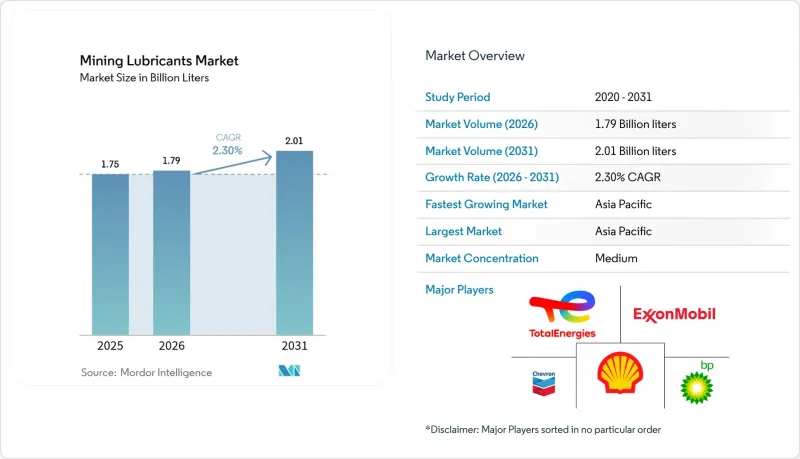
預計到 2025 年,礦業潤滑油市場規模將達到 17.5 億公升,從 2026 年的 17.9 億公升成長到 2031 年的 20.1 億公升,預測期(2026-2031 年)的複合年成長率為 2.30%。
本報告按基礎油(礦物油、其他基礎油)、產品類型(引擎油、齒輪油、液壓油、變速箱油、其他產品類型)和地區(亞太地區、北美地區、歐洲地區、南美地區、中東和非洲地區)進行細分。市場預測以公升為單位。
全球礦業潤滑油市場趨勢及洞察
在煤炭資源豐富的地區擴大採礦活動
儘管面臨脫碳壓力,澳洲、中國、印度和美國的生產商仍保持著穩定的動力煤產量,這導致礦場擴張,進而增加了車輛的運作和潤滑油的使用量。在澳大利亞,採礦業的投資加倍,以擴大鐵礦石和煤炭的產能,從而推高了對用於挖掘機和運輸卡車的重型引擎油和潤滑脂的需求。在加拿大,預計到2024年底,油砂產量將增加至190萬桶/日,而瓶頸消除項目已使平土機的處理能力提高了60萬桶/日,這刺激了對極端溫度和高污染條件下潤滑油的需求。對於煤礦現場使用的重型機械而言,高性能、長效潤滑油對於減少非計劃性停機時間至關重要。然而,由於電力產業的脫碳,全球煤炭需求的不確定性可能會限制此需求促進因素的持續時間。
硬岩礦山產能的快速擴張
新建的露天銅礦、金礦和稀土元素礦正在引入自動化高壓設備,運作在更深的地下作業,使得潤滑要求日益複雜。營運商正在部署配備眾多感測器的液壓挖土機和高減速比變速箱,這些變速箱都需要具有卓越熱穩定性的合成油。利勃海爾的零排放鑽井藍圖旨在2030年實現石化燃料燃料系統,這表明未來將轉向電動和混合動力驅動系統,但變速箱和軸承組件仍需要特定應用的潤滑油。預測性維護平台收集摩擦和溫度的即時數據,以最佳化更換週期,在確保運作的同時減少廢棄物。隨著智利銅礦帶和西澳大利亞金礦的硬岩礦山不斷擴張,專為應對高負荷和快速升溫而設計的特種潤滑油價格也水漲船高。
原油價格波動推高了基礎油成本。
由於II類基礎油與石油基準價格掛鉤,原油價格飆升會對潤滑油生產商的利潤率帶來壓力。殼牌公司將其位於德國的加氫裂解裝置改造為III類基礎油(年產量30萬噸)生產線,提高了區域供應的韌性,並每年減少了62萬噸二氧化碳排放,但礦業公司的成本上漲仍然不可避免。礦業公司正透過實施基於狀態的維護來減少潤滑油用量,從而抵消價格波動的影響,這迫使供應商在價格和高價值技術支援之間尋求平衡。由於每公升價格較高,高品質合成潤滑油可以部分對沖利潤率波動帶來的風險。
細分市場分析
2025年,礦物油憑藉其成本優勢和成熟的供應鏈,在礦業潤滑油市場保持了66.58%的佔有率。然而,隨著高功率機械、更深礦井和極端環境條件不斷突破礦物油的性能極限,預計到2031年,合成潤滑油的市場佔有率將以3.03%的複合年成長率成長。合成潤滑油在礦業潤滑油市場佔有率的成長得益於其黏度穩定、抗氧化以及因換油週期延長而減少運作等優勢。雪佛龍的重型合成和半合成潤滑油為OEM廠商提供了支持,滿足了他們對能夠提高燃油效率的長效潤滑油的需求。雖然生物基潤滑油目前仍處於小眾市場,但預計其市場將持續成長,尤其是在北極、亞馬遜和島嶼礦區等環境許可證強制要求嚴格生物分解性的地區。
合成潤滑油的高品質縮小了與礦物油的成本差距,延長了換油週期,從而降低了全生命週期成本。當與自動駕駛運輸車輛結合使用時,合成合成潤滑油卓越的潤滑油膜保持能力可減少軸承故障,使其較高的初始成本物有所值,並促使以績效為導向、優先考慮運作運行時間的採購合約日益普及。
區域分析
亞太地區預計到2025年將佔據全球礦業潤滑油市場39.28%的佔有率,這反映了澳洲、印尼和印度龐大的礦產資源產量。持續的投資支撐著皮爾巴拉和加里曼丹的鐵礦石和煤炭出口,儘管中國房地產市場成長放緩,但仍能有效支撐市場需求。澳洲儲備銀行指出,支撐潤滑油銷售量的礦業資本投資已加倍。殼牌位於泰國的潤滑脂工廠年產量已成長至1.5萬噸,是東南亞最大的潤滑脂工廠,也是該地區供應的關鍵樞紐。埃克森美孚在新加坡的基礎油產能已擴大至每日2萬桶,因此能夠供應高品質的工程化、高碳化物(EHC)產品,並有助於原料的穩定供應。儘管來自中國的進口需求正在放緩,但印度不斷成長的都市化抵消了這一影響,預計到2031年,年複合成長率(CAGR)將保持在3.68%。
北美在技術上仍保持領先地位,加拿大油砂和美國銅礦部署自動駕駛車輛,推動了物聯網連接潤滑系統的應用。殼牌惠特莫爾合資企業提供涵蓋潤滑脂、潤滑油和自動化供應硬體的承包可靠性解決方案,從而提高礦商的運作。隨著油砂產量在2024年達到創紀錄的190萬桶/日,以及平土機產能的擴張,即使在極寒環境下,對潤滑油的需求依然強勁。更嚴格的環境法規正在推動在水道附近地區使用可生物分解潤滑油,並促進了小眾合成油和生質油的普及。
儘管歐洲採礦業規模相對較小,產量有限,但領先,並積極推動歐盟生態標籤認證潤滑油的早期應用。殼牌在德國的基礎油項目將滿足德國國內40%的需求和歐盟9%的需求,從而緩解III類基礎油的供應短缺並減少排放。在斯堪的斯堪地那維亞半島和伊比利半島的礦山,先進的狀態監控系統正在被應用,以延長換油週期,這體現了企業從銷售量轉向確保運作的概念。儘管由於該地區致力於循環經濟和減少碳排放,整體採礦業生產成長緩慢,但高性能合成油和生質油市場預計將會成長。
其他好處:
- Excel格式的市場預測(ME)表
- 3個月的分析師支持
目錄
第1章:引言
- 研究假設和市場定義
- 調查範圍
第2章:調查方法
第3章執行摘要
第4章 市場狀況
- 市場概覽
- 市場促進因素
- 在煤炭資源豐富的地區擴大採礦活動
- 硬岩礦山產能的快速擴張
- 最新的高功率設備增加了潤滑油的使用量。
- 需要智慧集中潤滑的自動駕駛運輸。
- 在脆弱的生物系統中推廣可生物分解潤滑劑的環境影響
- 市場限制因素
- 原油價格波動推高了基礎油成本。
- 煉油廠的合理化導致II類基礎油供應短缺。
- 透過即時狀態監測延長換油週期。
- 價值鏈分析
- 監理情勢
- 技術展望
- 波特五力模型
第5章 市場規模與成長預測
- 依基料
- 礦物油
- 其他基料(合成油、生物基油等)
- 依產品類型
- 機油
- 齒輪油
- 油壓
- 變速箱油
- 其他產品類型(潤滑脂、壓縮機油等)
- 按地區
- 亞太地區
- 中國
- 日本
- 印度
- 韓國
- 東南亞國協
- 其他亞太國家
- 北美洲
- 美國
- 加拿大
- 墨西哥
- 歐洲
- 德國
- 英國
- 法國
- 義大利
- 西班牙
- 俄羅斯
- 北歐國家
- 其他歐洲國家
- 南美洲
- 巴西
- 阿根廷
- 其他南美國家
- 中東和非洲
- 沙烏地阿拉伯
- 南非
- 其他中東和非洲國家
- 亞太地區
第6章 競爭情勢
- 市場集中度
- 策略趨勢
- 市佔率和排名分析
- 公司簡介
- BP plc
- Chevron Corporation
- China Petrochemical Corporation(Sinopec)
- Engen Petroleum(PTY)LTD
- Exxon Mobil Corporation
- Freudenberg
- FUCHS
- Gulf Oil International
- Idemitsu Kosan Co.,Ltd.
- LUKOIL
- Petro-Canada Lubricants Inc.
- PetroChina Company Limited
- Quaker Houghton
- Shell plc
- Suncor Energy Inc.
- TotalEnergies
- Valvoline
第7章 市場機會與未來展望
According to Mordor Intelligence, the mining lubricants market size was valued at 1.75 billion liters in 2025 and estimated to grow from 1.79 billion liters in 2026 to reach 2.01 billion liters by 2031, at a CAGR of 2.30% during the forecast period (2026-2031).
This report is Segmented by Base Stock (Mineral Oil, Other Base Stocks), Product Type (Engine Oil, Gear Oil, Hydraulic Fluids, Transmission Fluids, Other Product Types), and Geography (Asia-Pacific, North America, Europe, South America, Middle East and Africa). The Market Forecasts are Provided in Terms of Volume (Liters).
Global Mining Lubricants Market Trends and Insights
Expansion of Coal-Rich Mining Activities
Coal mine expansions extend fleet operating hours and raise lubricant loads as producers in Australia, China, India, and the United States keep thermal-coal output stable despite decarbonization pressure. Australia doubled mining-sector investment to lift iron ore and coal capacity, reinforcing volume demand for heavy-duty engine oils and greases used in draglines and haul trucks. Canadian oil-sands production climbed to 1.9 million b/d in late-2024, and debottlenecking projects raised upgrader capacity to 600,000 b/d, spurring lubricant needs for extreme-temperature and high-contamination conditions. Bigger equipment in coal pits relies on high-performance lubricants with longer service intervals to cut unscheduled stoppages. Yet global coal demand uncertainties tied to power-sector decarbonization may cap the longevity of this driver.
Rapid Capacity Additions in Hard-Rock Mines
New copper, gold, and rare-earth pits deploy automated, high-pressure equipment operating deeper underground, intensifying lubricant complexity. Operators install sensor-laden hydraulic shovels and high-ratio gearboxes that necessitate synthetic oils with superior thermal stability. Liebherr's zero-emission excavation roadmap, targeting fossil-free systems by 2030, illustrates the shift to electric and hybrid drive trains that still depend on tailored lubricants for transmissions and bearing sets. Predictive-maintenance platforms feed real-time friction and temperature data to optimize change intervals, reducing waste while safeguarding uptime. As hard-rock expansions proliferate in Chilean copper belts and Western Australian goldfields, specialized lubricants that manage high loads and temperature spikes command premium pricing.
Crude-Price Volatility Inflating Base-Oil Costs
Lubricant producers face margin pressure when crude prices spike since Group-II base stocks track petroleum benchmarks. Shell's conversion of a German hydrocracker to 300,000 t/y of Group-III base oils improves regional supply resilience and trims carbon emissions by 620,000 t/y, but cost pass-throughs to mine operators remain inevitable. Miners offset volatility by adopting condition-based maintenance that cuts oil use, pressuring suppliers to balance pricing with value-added technical support. Premium synthetics partially hedge margin swings through higher per-liter value.
Other drivers and restraints analyzed in the detailed report include:
- Modern, High-Horsepower Equipment Boosting Lube Intensity
- Autonomous Haulage Requiring Smart Centralized Lubrication
- Longer Drain Intervals from Real-Time Condition Monitoring
For complete list of drivers and restraints, kindly check the Table Of Contents.
Segment Analysis
Mineral oils retained 66.58% mining lubricants market share in 2025 owing to cost advantages and established supply. Synthetic variants, however, accelerate at a 3.03% CAGR to 2031 as high-horsepower machinery, deeper pits, and ambient extremes outstrip mineral capabilities. The synthetic slice of the mining lubricants market size benefits from stable viscosity, oxidation resistance, and extended drains that reduce service downtime. Chevron's heavy-duty synthetic and semi-synthetic rollout underscores OEM endorsement for longer-life fluids that deliver fuel efficiency gains. Bio-based lubricants remain a niche but grow where environmental permits require stringent biodegradability, particularly in Arctic, Amazon, and island mines.
The premium nature of synthetics narrows the cost differential versus mineral alternatives as drain intervals stretch, improving lifecycle economics. Coupled with autonomous haulage, synthetics' superior film retention lowers bearing failures, justifying higher upfront price and tilting procurement toward performance-based contracts that reward uptime.
Complete Report Scope:
- By Base Stock
- Mineral Oil
- Other Base Stocks (Synthetic Oils, Bio-based, etc.)
- By Product Type
- Engine Oil
- Gear Oil
- Hydraulic Fluids
- Transmission Fluids
- Other Product Types (Greases, Compressor Oils, etc.)
- By Geography
- Asia-Pacific
- China
- Japan
- India
- South Korea
- ASEAN Countries
- Rest of Asia-Pacific
- North America
- United States
- Canada
- Mexico
- Europe
- Germany
- United Kingdom
- France
- Italy
- Spain
- Russia
- NORDIC Countries
- Rest of Europe
- South America
- Brazil
- Argentina
- Rest of South America
- Middle East and Africa
- Saudi Arabia
- South Africa
- Rest of Middle East and Africa
- Asia-Pacific
Geography Analysis
Asia-Pacific's 39.28% mining lubricants market share in 2025 reflects massive mineral output in Australia, Indonesia, and India. Ongoing investment keeps iron-ore and coal exports flowing from the Pilbara and Kalimantan, sustaining demand despite China's property slowdown. The Reserve Bank of Australia noted a doubling of mining capital expenditures that underpin lubricant volumes. Shell's grease plant in Thailand tripled to 15,000 t/y, becoming Southeast Asia's largest and anchoring regional supply. ExxonMobil's 20,000 b/d base-oil expansion in Singapore supplies advanced EHC grades and bolsters feedstock security. While China's import pull eases, India's urban growth helps compensate, anchoring a 3.68% CAGR through 2031.
North America remains technologically advanced, with autonomous fleets in Canadian oil sands and US copper pits pushing uptake of IoT-linked lubrication. Shell-Whitmore's joint venture offers turnkey reliability solutions spanning greases, oils, and automated delivery hardware, enhancing operational uptime for mine operators. Record 1.9 million b/d oil-sands production in 2024 and upgrader capacity hikes translate into steady lubricant demand across extreme cold operations. Environmental scrutiny encourages biodegradable fluids in regions adjacent to waterways, fostering niche synthetic and bio-oil uptake.
Europe's smaller mining footprint limits volume but leads in environmental compliance, driving early adoption of EU Ecolabel-certified lubricants. Shell's German base-oil project will meet 40% of domestic demand and 9% of EU requirements, easing Group-III supply tightness and cutting emissions. Scandinavian and Iberian mines fit advanced condition monitoring that extends drain intervals, underscoring the shift from litres sold to uptime delivered. The region's focus on circularity and carbon cuts positions high-performance synthetics and bio-oils for growth despite sluggish overall mining output.
- BP p.l.c.
- Chevron Corporation
- China Petrochemical Corporation (Sinopec)
- Engen Petroleum (PTY) LTD
- Exxon Mobil Corporation
- Freudenberg
- FUCHS
- Gulf Oil International
- Idemitsu Kosan Co.,Ltd.
- LUKOIL
- Petro-Canada Lubricants Inc.
- PetroChina Company Limited
- Quaker Houghton
- Shell plc
- Suncor Energy Inc.
- TotalEnergies
- Valvoline
Additional Benefits:
- The market estimate (ME) sheet in Excel format
- 3 months of analyst support
TABLE OF CONTENTS
1 Introduction
- 1.1 Study Assumptions and Market Definition
- 1.2 Scope of the Study
2 Research Methodology
3 Executive Summary
4 Market Landscape
- 4.1 Market Overview
- 4.2 Market Drivers
- 4.2.1 Expansion of coal-rich mining activities
- 4.2.2 Rapid capacity additions in hard-rock mines
- 4.2.3 Modern, high-horsepower equipment boosting lube intensity
- 4.2.4 Autonomous haulage requiring smart centralized lubrication
- 4.2.5 Environmental push for biodegradable lubricants in fragile biomes
- 4.3 Market Restraints
- 4.3.1 Crude-price volatility inflating base-oil costs
- 4.3.2 Group-II base-oil supply tightness from refinery rationalization
- 4.3.3 Longer drain-intervals from real-time condition monitoring
- 4.4 Value Chain Analysis
- 4.5 Regulatory Landscape
- 4.6 Technological Outlook
- 4.7 Porter's Five Forces
- 4.7.1 Bargaining Power of Suppliers
- 4.7.2 Bargaining Power of Buyers
- 4.7.3 Threat of New Entrants
- 4.7.4 Threat of Substitutes
- 4.7.5 Degree of Competition
5 Market Size and Growth Forecasts (Volume)
- 5.1 By Base Stock
- 5.1.1 Mineral Oil
- 5.1.2 Other Base Stocks (Synthetic Oils, Bio-based, etc.)
- 5.2 By Product Type
- 5.2.1 Engine Oil
- 5.2.2 Gear Oil
- 5.2.3 Hydraulic Fluids
- 5.2.4 Transmission Fluids
- 5.2.5 Other Product Types (Greases, Compressor Oils, etc.)
- 5.3 By Geography
- 5.3.1 Asia-Pacific
- 5.3.1.1 China
- 5.3.1.2 Japan
- 5.3.1.3 India
- 5.3.1.4 South Korea
- 5.3.1.5 ASEAN Countries
- 5.3.1.6 Rest of Asia-Pacific
- 5.3.2 North America
- 5.3.2.1 United States
- 5.3.2.2 Canada
- 5.3.2.3 Mexico
- 5.3.3 Europe
- 5.3.3.1 Germany
- 5.3.3.2 United Kingdom
- 5.3.3.3 France
- 5.3.3.4 Italy
- 5.3.3.5 Spain
- 5.3.3.6 Russia
- 5.3.3.7 NORDIC Countries
- 5.3.3.8 Rest of Europe
- 5.3.4 South America
- 5.3.4.1 Brazil
- 5.3.4.2 Argentina
- 5.3.4.3 Rest of South America
- 5.3.5 Middle East and Africa
- 5.3.5.1 Saudi Arabia
- 5.3.5.2 South Africa
- 5.3.5.3 Rest of Middle East and Africa
- 5.3.1 Asia-Pacific
6 Competitive Landscape
- 6.1 Market Concentration
- 6.2 Strategic Moves
- 6.3 Market Share(%)/Ranking Analysis
- 6.4 Company Profiles (includes Global level Overview, Market-level Overview, Core Segments, Financials as available, Strategic Information, Market Rank/Share for key companies, Products and Services, and Recent Developments)
- 6.4.1 BP p.l.c.
- 6.4.2 Chevron Corporation
- 6.4.3 China Petrochemical Corporation (Sinopec)
- 6.4.4 Engen Petroleum (PTY) LTD
- 6.4.5 Exxon Mobil Corporation
- 6.4.6 Freudenberg
- 6.4.7 FUCHS
- 6.4.8 Gulf Oil International
- 6.4.9 Idemitsu Kosan Co.,Ltd.
- 6.4.10 LUKOIL
- 6.4.11 Petro-Canada Lubricants Inc.
- 6.4.12 PetroChina Company Limited
- 6.4.13 Quaker Houghton
- 6.4.14 Shell plc
- 6.4.15 Suncor Energy Inc.
- 6.4.16 TotalEnergies
- 6.4.17 Valvoline
7 Market Opportunities and Future Outlook
- 7.1 White-space and Unmet-need Assessment
- 7.2 Growing Demand for High Performance Lubricants

 礦業潤滑劑市場規模、佔有率、成長及全球產業分析:按類型、應用和地區的洞察,2026-2034年的預測
 礦業潤滑劑市場報告:按產品、設備功能、採礦技術、應用和地區分類(2026-2034 年)全球礦業潤滑劑市場規模、佔有率、趨勢和成長分析報告(2026-2034年)
 礦業潤滑劑市場規模、佔有率及成長分析(按產品、應用及地區分類)-2026-2033年產業預測全球礦業潤滑劑市場-2025-2030年預測
 採礦潤滑油市場按產品類型、設備、包裝類型、最終用戶和分銷管道分類-2025-2030 年全球預測
 全球採礦潤滑油市場按產品類型、萃取技術、最終用途產業、潤滑油類型和地區分類 - 預測至 2030 年