


 |
市場調查報告書
商品編碼
2114650
塗層織物:市場佔有率分析、產業趨勢與統計、成長預測(2026-2031)Coated Fabric - Market Share Analysis, Industry Trends & Statistics, Growth Forecasts (2026 - 2031) |
||||||

※ 本網頁內容可能與最新版本有所差異。詳細情況請與我們聯繫。
塗層織物市場預計將從 2025 年的 246.7 億美元成長到 2026 年的 259.2 億美元,然後在 2031 年達到 332.1 億美元,2026 年至 2031 年的複合年成長率為 5.08%。
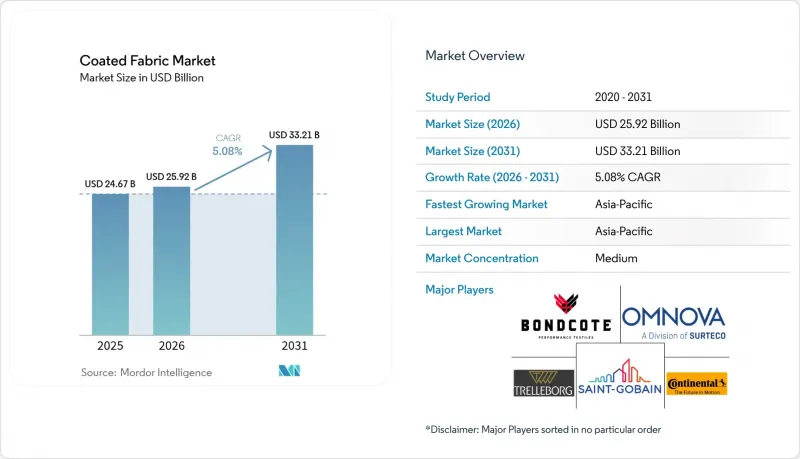
本報告按塗層材料(聚合物塗層、橡膠塗層、織物背壁材)、織物基材(聚酯纖維、尼龍、棉及其混紡織物等)、應用領域(汽車和交通運輸、防護衣、家具等)以及地區(亞太地區、北美地區、歐洲地區、南美地區、中東和非洲)進行細分。市場預測以美元計價。
全球塗層織物市場趨勢及洞察
汽車安全氣囊和座椅套的需求激增。
汽車安全法規和電動車設計目標正在推動對耐熱、輕質塗層織物的需求。 2024年,奧托立夫推出了由100%再生聚酯製成的安全氣囊織物,顯示嚴格的碰撞安全要求和循環經濟目標是可以兼顧的。李爾公司計劃於2025年推出的「ComfortMax」座椅系統,將PU塗層與整合式加熱器結合,以縮短電動車的預熱時間並節省電池電量。科思創的熱塑性PU薄膜可用於製造具有整合式電子元件的軟性天窗簾子,這體現了材料正朝著智慧內飾方向發展。這些突破性技術正推動塗層織物市場向高價值、多功能結構轉型,這些結構具有耐磨、耐極端溫度和可承受複雜成型等特性。
擴大工業防護衣相關法規的適用範圍
歐盟更新的標準,例如EN ISO 11612,要求織物具備經認證的阻燃性和耐熱性,這使得與未經處理的織物相比,對先進塗層的需求日益成長。為了遵守更嚴格的雇主責任法規,Sioen Industries於2025年將其多用途防護工作服「SYNQ」推廣至英國和愛爾蘭。經銀離子處理的產品即使經過50次洗滌,也能維持99%以上的細菌去除率,將衛生和安全完美結合於一件服裝之中。擁有多項認證的製造商正將法規轉化為穩定的收入來源。這一趨勢在化學、石油天然氣和公共產業等行業尤為明顯,這些行業在採購過程中優先考慮預先獲得認證的供應商。
PVC原料價格波動及對廢棄物處理的重視。
歐盟提案對超過1萬種PFAS化學物質進行監管,這將對乙烯基塗料產生直接影響,因為許多配方都依賴含氟加工助劑。韓華的生物基PVC產品,添加了植物油和廢棄食用油,可將從原料開採到產品生產的全生命週期二氧化碳排放量減少58%,但高昂的原料成本正擠壓著利潤空間。歐盟生產者延伸責任制(EPR)框架下的處置成本和回收計劃增加了傳統PVC產品的生命週期成本,導致原始設備製造商(OEM)儘管初始成本更高,仍轉向使用聚氨酯(PU)和矽酮基塗料系統。
細分市場分析
聚合物塗層用途廣泛,涵蓋汽車、工業和消費品等諸多領域,預計2025年將佔據塗層織物市場80.12%的佔有率。其中,聚氨酯塗層預計到2031年將以6.75%的複合年成長率成長,這一成長表明原始設備製造商(OEM)更傾向於選擇軟性、無溶劑的乙烯基替代品。雖然聚氯乙烯(PVC)在篷布和廣告橫幅領域仍保持著規模經濟優勢,但由於生產者延伸責任(EPR)費用和掩埋禁令,其在歐洲的目標市場規模正在萎縮。矽基體系在高溫墊片領域佔據主導地位,而丙烯酸分散體塗層則成為透氣戶外裝備的基礎。BASF)的Haptex 4.0——一種可與PET可再生——將於2024年上市,預示著未來配方將簡化機械回收流程。
生物基聚合物的持續研發對現有化學技術提出了新的挑戰。雖然橡膠塗層織物滿足了對極高耐磨性的特定需求,但聚氨酯薄膜正日益取代橡膠塗層織物,後者在提供同等耐久性的同時,重量更輕。賦予織物導電性和自修復性能的專用奈米塗層正在創造高利潤,並將塗層織物市場拓展至電子和航太等細分領域。隨著終端用戶對承包解決方案的需求不斷成長,掌握多層共射出成型和線上固化技術的供應商可望獲得最高利潤。
區域分析
預計到2025年,亞太地區將佔全球銷售額的46.70%,並在2031年之前以6.20%的複合年成長率持續成長。中國憑藉其完整的紡織產業基礎和快速成長的電動車產量,正引領該地區的發展。同時,印度技術紡織園區的擴建吸引了聖戈班等跨國公司的新資本,聖戈班的目標是到2035年將其在印度的銷售額提高兩倍。日本和韓國正在加強研發與大規模生產的合作,提供先進的塗層生產線,使織物具備豐富的觸感和感測功能。
北美是一個成熟的市場,專注於高價值的細分領域。美國在航太、國防和醫用床墊領域佔據主導地位,這些領域對可追溯性要求嚴格。加拿大是美國PVC塗層織物的主要進口國,受益於關稅豁免和地理位置接近性。同時,墨西哥正在擴大汽車座椅的產能,這得歸功於近岸外包。區域政策正在推廣不含PFAS的化學品,從而促進了對水性PU分散體的投資。
歐洲面臨世界上最嚴格的紡織品法規,但它正利用這些法規引領永續塗層技術的發展。將於2025年1月實施的生產者延伸責任制(EPR)框架,強制要求對紡織品進行單獨回收,並提高了不可回收層壓產品的合規標準。德國和義大利正致力於出口能夠實現無溶劑、多道工序生產線的機械設備,而法國和荷蘭則在試驗塗層織物邊角料的化學回收循環系統。隨著歐盟即將實施PFAS法規,對不含矽和氟的防水材料的需求不斷成長,這使得歐盟生產商在下一代整理過程中擁有競爭優勢。
其他好處:
- Excel格式的市場預測(ME)表
- 3個月的分析師支持
目錄
第1章:引言
- 研究假設和市場定義
- 調查範圍
第2章:調查方法
第3章執行摘要
第4章 市場狀況
- 市場概覽
- 市場促進因素
- 汽車安全氣囊和座椅套出貨量激增
- 擴大強制使用工業防護衣的範圍
- 為提高公共衛生韌性,對抗菌和抗病毒塗層的需求日益成長
- 用於智慧室內設計和穿戴式裝置的嵌入式感測器電子紡織品
- 醫療產業對塗層織物的需求日益成長
- 市場限制因素
- PVC原料價格波動和更嚴格的廢棄物處理法規。
- 特種聚合物供應鏈中斷
- 對生物基、無塗層工業紡織品的需求不斷成長。
- 價值鏈分析
- 波特五力模型
第5章 市場規模與成長預測
- 透過塗層材料
- 聚合物塗層
- PVC塗層
- PU塗層
- PE塗層
- 其他聚合物塗層材料(丙烯酸塗層、矽酮塗層等)
- 橡膠塗層
- 壁紙底襯
- 聚合物塗層
- 織品基材
- 聚酯纖維
- 尼龍
- 棉及混紡
- 其他材質(羊毛、人造絲等)
- 透過使用
- 汽車和運輸業
- 防護衣
- 家具
- 產業
- 其他用途(橫幅、包裝等)
- 按地區
- 亞太地區
- 中國
- 印度
- 日本
- 韓國
- 其他亞太國家
- 北美洲
- 美國
- 加拿大
- 墨西哥
- 歐洲
- 德國
- 英國
- 義大利
- 法國
- 其他歐洲國家
- 南美洲
- 巴西
- 阿根廷
- 其他南美國家
- 中東和非洲
- 沙烏地阿拉伯
- 南非
- 其他中東和非洲國家
- 亞太地區
第6章 競爭情勢
- 市場集中度
- 策略趨勢
- 市佔率和排名分析
- 公司簡介
- Continental AG
- Freudenberg Performance Materials Service GmbH
- Graniteville
- Haartz Corporation
- Herculite
- Heytex Gruppe
- OMNOVA North America Inc.
- Saint-Gobain
- Seaman Corporation
- Sioen Industries NV
- SRF Limited
- Trelleborg AB
第7章 市場機會與未來展望
According to Mordor Intelligence, the coated fabric market size is expected to grow from USD 24.67 billion in 2025 to USD 25.92 billion in 2026 and is forecast to reach USD 33.21 billion by 2031 at 5.08% CAGR over 2026-2031.
This report is Segmented by Coating Material (Polymer Coated, Rubber Coated, Fabric-Backed Wall Coverings), Fabric Substrate (Polyester, Nylon, Cotton & Blends, Other), Application (Automotive & Transportation, Protective Clothing, Furniture, and More), and Geography (Asia-Pacific, North America, Europe, South America, Middle East and Africa). The Market Forecasts are Provided in Terms of Value (USD).
Global Coated Fabric Market Trends and Insights
Surge in Automotive Air-Bag and Seat-Cover Volumes
Automotive safety laws and electric-vehicle design targets are boosting demand for heat-stable, lightweight coated fabrics. Autoliv introduced an airbag fabric made from 100% recycled polyester in 2024, showing that stringent crash-safety requirements can coexist with circular-economy goals. Lear Corporation's ComfortMax seat system, scheduled for 2025 launches, blends PU coatings with integrated heating to cut cabin-warm-up times and battery drain in electric cars. Covestro's thermoplastic PU films enable flexible sunroof shades that house embedded electronics, illustrating the materials shift toward smart interiors. These breakthroughs push the coated fabrics market toward high-value, multifunctional constructions that tolerate abrasion, extreme temperatures, and complex forming.
Expansion of Industrial Protective-Clothing Mandates
Updated EU standards such as EN ISO 11612 require certified flame and heat protection, strengthening demand for advanced coatings over untreated fabrics. Sioen Industries extended its SYNQ multi-hazard workwear into the UK and Ireland in 2025 to address stricter employer liability rules. Silver-ion finishes can now achieve greater than 99% bacterial reduction after 50 laundering cycles, combining hygiene and safety in a single garment. Manufacturers that secure multi-standard certifications convert regulation into durable revenue streams, particularly in chemicals, oil & gas, and utilities, where procurement cycles favor pre-approved vendors.
PVC Raw-Material Volatility & Disposal Scrutiny
The EU's proposal to restrict over 10,000 PFAS chemicals would directly affect vinyl-based coatings, as many formulations rely on fluorinated processing aids. Hanwha's bio-attributed PVC, incorporating plant oils and waste cooking oil, cuts cradle-to-gate CO2 by 58% yet carries higher feedstock costs that squeeze margins. Disposal fees and take-back schemes under the EU's Extended Producer Responsibility (EPR) framework raise life-cycle costs for legacy PVC items, prompting OEMs to switch to PU and silicone systems despite upfront price premiums.
Other drivers and restraints analyzed in the detailed report include:
- Increasing Demand for Antiviral and Antimicrobial Coatings for Public-Health Resilience
- Sensor-Integrated E-Textiles for Smart Interiors and Wearables
- Specialty-Polymer Supply-Chain Disruptions
For complete list of drivers and restraints, kindly check the Table Of Contents.
Segment Analysis
Polymer coatings commanded 80.12% of the coated fabrics market share in 2025 as their versatility spans automotive, industrial, and consumer applications. Within this group, polyurethane grades are on track for a 6.75% CAGR to 2031, a pace that underscores OEM preference for flexible, solvent-free alternatives to vinyl. PVC retains scale benefits in tarpaulins and advertising banners, yet EPR fees and landfill bans shrink its addressable volume in Europe. Silicone systems win in high-temperature gaskets, while acrylic dispersion coatings anchor breathable outdoor gear. BASF's 2024 launch of Haptex 4.0-a recyclable synthetic leather that co-recycles with PET-points to future formulations that streamline mechanical-recycling flows.
Continued R&D in bio-attributed polymers hints at fresh competition for incumbent chemistries. Rubber-coated fabrics meet niche demands for extreme abrasion yet face substitution by PU films that offer similar durability at lighter weights. Specialty nano-coatings that add conductivity or self-healing properties command premium margins, expanding the coated fabrics market into electronics and aerospace niches. Suppliers that master multi-layer co-casting and in-line curing stand to secure the highest returns as end-users seek turnkey solutions.
Complete Report Scope:
- By Coating Material
- Polymer Coated
- PVC Coated
- PU Coated
- PE Coated
- Other Polymer Coated Mterials (Acrylic Coated, Silicone Coated, etc.)
- Rubber Coated
- Fabric-Backed Wall Coverings
- Polymer Coated
- By Fabric Substrate
- Polyester
- Nylon
- Cotton and Blends
- Other (Wool, Rayon, etc.)
- By Application
- Automotive and Transportation
- Protective Clothing
- Furniture
- Industrial
- Other Applications (Banners, Packaging, etc.)
- By Geography
- Asia-Pacific
- China
- India
- Japan
- South Korea
- Rest of Asia-Pacific
- North America
- United States
- Canada
- Mexico
- Europe
- Germany
- United Kingdom
- Italy
- France
- Rest of Europe
- South America
- Brazil
- Argentina
- Rest of South America
- Middle East and Africa
- Saudi Arabia
- South Africa
- Rest of Middle East and Africa
- Asia-Pacific
Geography Analysis
Asia-Pacific retained 46.70% of global revenue in 2025 and is projected to expand at a 6.20% CAGR to 2031. China anchors regional heft with its end-to-end textile base and surging EV output, while India's expansion in technical-textile parks attracts fresh capital from multinationals like Saint-Gobain, which targets a three-fold local revenue lift by 2035. Japan and South Korea supply cutting-edge coating lines that enable haptic, sensor-rich fabrics, closing the loop between R&D and scaled manufacturing.
North America is a mature buyer emphasizing high-value niches. The United States dominates aerospace, defense, and medical bedding lines that demand strict traceability. Canada leads U.S. PVC-coated-fabric imports, benefiting from duty-free access and proximity, while Mexico widens capacity in automotive seating against a backdrop of near-shoring. Regional policy favors PFAS-free chemistries, spurring investment in water-borne PU dispersions.
Europe faces the world's tightest textile regulations but leverages them to spearhead sustainable-coating technologies. The Extended Producer Responsibility framework launching in January 2025 obliges separate textile-collection systems, raising compliance hurdles for non-recyclable laminates. Germany and Italy concentrate on machinery exports that enable solvent-free, multi-pass lines; France and the Netherlands pilot chemical-recycling loops for coated off-cuts. The bloc's looming PFAS curbs amplify demand for silicone and fluorine-free water barriers, giving EU producers a home-court edge in next-generation finishes.
- Continental AG
- Freudenberg Performance Materials Service GmbH
- Graniteville
- Haartz Corporation
- Herculite
- Heytex Gruppe
- OMNOVA North America Inc.
- Saint-Gobain
- Seaman Corporation
- Sioen Industries NV
- SRF Limited
- Trelleborg AB
Additional Benefits:
- The market estimate (ME) sheet in Excel format
- 3 months of analyst support
TABLE OF CONTENTS
1 Introduction
- 1.1 Study Assumptions and Market Definition
- 1.2 Scope of the Study
2 Research Methodology
3 Executive Summary
4 Market Landscape
- 4.1 Market Overview
- 4.2 Market Drivers
- 4.2.1 Surge in automotive airbag and seat-cover volumes
- 4.2.2 Expansion of industrial protective-clothing mandates
- 4.2.3 Increasing demand for Antiviral and antimicrobial coatings for public-health resilience
- 4.2.4 Sensor-integrated e-textiles for smart interiors and wearables
- 4.2.5 Growing demand for coated fabrics from healthcare industry
- 4.3 Market Restraints
- 4.3.1 PVC raw-material volatility and disposal scrutiny
- 4.3.2 Specialty-polymer supply-chain disruptions
- 4.3.3 Increasing demand for Bio-based, un-coated technical textiles
- 4.4 Value Chain Analysis
- 4.5 Porter's Five Forces
- 4.5.1 Bargaining Power of Suppliers
- 4.5.2 Bargaining Power of Buyers
- 4.5.3 Threat of New Entrants
- 4.5.4 Threat of Substitute Products
- 4.5.5 Degree of Competition
5 Market Size and Growth Forecasts (Value)
- 5.1 By Coating Material
- 5.1.1 Polymer Coated
- 5.1.1.1 PVC Coated
- 5.1.1.2 PU Coated
- 5.1.1.3 PE Coated
- 5.1.1.4 Other Polymer Coated Mterials (Acrylic Coated, Silicone Coated, etc.)
- 5.1.2 Rubber Coated
- 5.1.3 Fabric-Backed Wall Coverings
- 5.1.1 Polymer Coated
- 5.2 By Fabric Substrate
- 5.2.1 Polyester
- 5.2.2 Nylon
- 5.2.3 Cotton and Blends
- 5.2.4 Other (Wool, Rayon, etc.)
- 5.3 By Application
- 5.3.1 Automotive and Transportation
- 5.3.2 Protective Clothing
- 5.3.3 Furniture
- 5.3.4 Industrial
- 5.3.5 Other Applications (Banners, Packaging, etc.)
- 5.4 By Geography
- 5.4.1 Asia-Pacific
- 5.4.1.1 China
- 5.4.1.2 India
- 5.4.1.3 Japan
- 5.4.1.4 South Korea
- 5.4.1.5 Rest of Asia-Pacific
- 5.4.2 North America
- 5.4.2.1 United States
- 5.4.2.2 Canada
- 5.4.2.3 Mexico
- 5.4.3 Europe
- 5.4.3.1 Germany
- 5.4.3.2 United Kingdom
- 5.4.3.3 Italy
- 5.4.3.4 France
- 5.4.3.5 Rest of Europe
- 5.4.4 South America
- 5.4.4.1 Brazil
- 5.4.4.2 Argentina
- 5.4.4.3 Rest of South America
- 5.4.5 Middle East and Africa
- 5.4.5.1 Saudi Arabia
- 5.4.5.2 South Africa
- 5.4.5.3 Rest of Middle East and Africa
- 5.4.1 Asia-Pacific
6 Competitive Landscape
- 6.1 Market Concentration
- 6.2 Strategic Moves
- 6.3 Market Share(%)/Ranking Analysis
- 6.4 Company Profiles (includes Global level Overview, Market level overview, Core Segments, Financials as available, Strategic Information, Market Rank/Share for key companies, Products and Services, and Recent Developments)
- 6.4.1 Continental AG
- 6.4.2 Freudenberg Performance Materials Service GmbH
- 6.4.3 Graniteville
- 6.4.4 Haartz Corporation
- 6.4.5 Herculite
- 6.4.6 Heytex Gruppe
- 6.4.7 OMNOVA North America Inc.
- 6.4.8 Saint-Gobain
- 6.4.9 Seaman Corporation
- 6.4.10 Sioen Industries NV
- 6.4.11 SRF Limited
- 6.4.12 Trelleborg AB
7 Market Opportunities and Future Outlook
- 7.1 White-space and Unmet-Need Assessment
- 7.2 Rising Adoption of Advanced Technology

 噴塗織物市場:全球市場預測,2026-2032年
 塗層紡織品市場規模、佔有率、成長、全球產業分析、區域趨勢及2026年至2034年預測防水布料市場:依材料、技術、布料類型、最終用途及通路分類-2026-2032年全球市場預測
 2026年全球國防塗料市場報告
 塗層織物市場:按材料、應用和地區分類
 抗菌塗層風管市場規模、佔有率和成長分析:按材料類型、應用領域、塗層技術、終端用戶產業和地區分類 - 2026-2033 年產業預測全球塗層織物市場規模、佔有率、趨勢和成長分析報告(2026-2034年)合成皮革市場:2026-2032年全球預測(按類型、技術、應用和銷售管道分類)
 塗層織物市場-全球產業規模、佔有率、趨勢、機會和預測,按產品、應用、地區和競爭格局分類,2020-2030年預測
 全球內襯布料市場:2025年