


 |
市場調查報告書
商品編碼
2114612
金屬化薄膜:市場佔有率分析、產業趨勢與統計、成長預測(2026-2031)Metalized Film - Market Share Analysis, Industry Trends & Statistics, Growth Forecasts (2026 - 2031) |
||||||

※ 本網頁內容可能與最新版本有所差異。詳細情況請與我們聯繫。
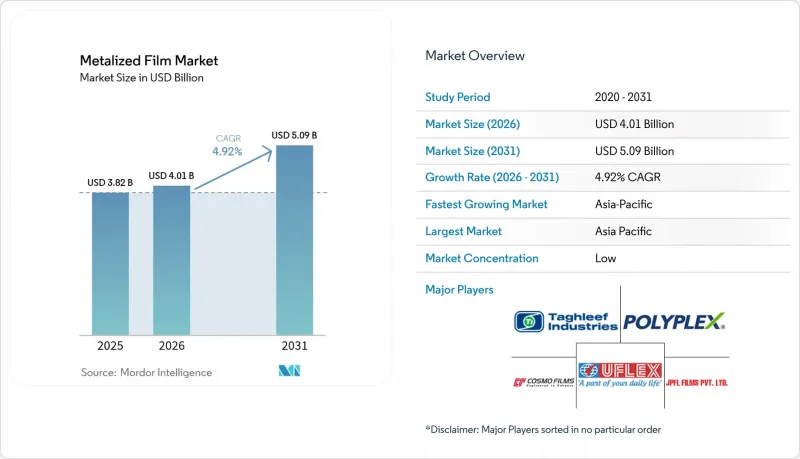
根據 Mordor Intelligence 估計,金屬化薄膜市場在 2026 年的價值將達到 40.1 億美元,高於 2025 年的 38.2 億美元,預計到 2031 年將達到 50.9 億美元。
預計從 2026 年到 2031 年,其複合年成長率將達到 4.92%。
本報告按金屬類型(鋁、銅及其他金屬)、薄膜類型(聚丙烯、聚乙烯及其他薄膜)、終端用戶行業(包裝、電氣電子、裝飾及其他終端用戶行業)和地區(亞太地區、北美、歐洲、南美以及中東和非洲)進行細分。市場預測以美元計價。
全球金屬化薄膜市場趨勢及洞察
阻隔性軟性食品包裝需求激增
食品品牌正從硬質容器轉向軟包裝,後者能夠延長保存期限、減少運輸過程中的排放氣體,並在商店更具吸引力。鋁塗層聚乙烯和聚丙烯薄膜具有氧氣和水蒸氣阻隔功能,能夠確保即食食品在全球漫長供應鏈中的安全性。歐洲和北美的零售商制定了雄心勃勃的減少食物廢棄物的目標,這推動了對金屬化薄膜市場生產的阻隔層壓材料的需求。亞洲的加工商受益於高速沉澱線,這些生產線能夠在不影響性能的前提下降低塗層成本。政府的食品安全法規也鼓勵加工商採用輕質且抗污染的金屬化結構。
快速用輕質金屬化薄膜取代鋁箔
為了符合碳排放法規,汽車製造商和飛機供應商都在努力減輕產品重量。沉澱鋁膜具有與鋁箔相當的阻隔性,但質量卻輕得多,而且可以輕鬆包裹在曲面部件上。其捲對輥塗製程提高了生產效率,並降低了金屬化薄膜加工商的單位成本。電池組製造商更傾向於使用這種薄膜作為導熱墊,因為該材料能夠牢固地粘附在棱柱形電池的邊緣而不會開裂。能夠自主完成聚合物擠出和金屬化過程的製造商更能抵禦原生鋁價格波動的影響。
多層金屬化層壓板回收的複雜性
歐洲監管機構呼籲包裝材料的回收率達到70%,但分離出與聚合物熔合在一起的薄鋁層仍是個難題。廢棄物分類員經常將光面薄膜錯誤地歸類為紙塑複合材料,導致寶貴的材料被送往掩埋。為此,一些品牌正在測試透明塗層阻隔膜,但其性能仍落後於傳統的沉澱結構。德國和荷蘭已運作採用化學剝離法的先導工廠,但尚未實現規模經濟。在建立可靠的回收管道之前,由於嚴格的環境審查以及某些地區擴大生產者責任制下的高額收費,該技術的成長可能會受到限制。
細分市場分析
截至2025年,鋁將佔據金屬化薄膜市場78.10%的佔有率,這反映了其在阻隔性、成本和可回收性方面具有良好的平衡性。真空鍍膜設備在該領域得到廣泛應用,確保了食品和個人保健產品包裝商的穩定供應。同時,受高功率電池組和5G設備對卓越導電需求的推動,預計到2031年,銅的複合年成長率將達到5.55%。在中國和美國超級工廠投資的推動下,用於電池軟包的銅塗層金屬化薄膜市場預計將進一步擴大。雖然銅膜在潮濕環境中容易腐蝕,但多層黏合促進劑的應用正在提高其耐久性。
等離子輔助沉澱等技術進步進一步提高了厚度公差,從而改善了微電路的電氣性能。由於鋁氧化膜的穩定性以及完善的廢料回收體系,鋁仍然是裝飾性包裝和電容器箔的首選材料。銀和氧化鋁等小眾金屬則用於光學濾波器和抗菌包裝,其每平方公尺的附加價值超過了原料成本。製造商若建構包含兩種金屬的組合產品組合,則可以對沖需求波動,並在金屬化薄膜市場的各種終端應用領域中保持運轉率。
區域分析
到2025年,亞太地區將佔金屬化薄膜市場收入的53.20%,這主要得益於中國在聚合物擠出和薄膜真空沉澱的領先地位。江蘇和浙江兩省產能的提升將透過規模經濟和自有鋁捲供應,有效降低單位成本。印度消費品產業的快速擴張提振了國內需求,並吸引了上游投資以建造新的雙向拉伸聚丙烯(BOPP)和雙向拉伸聚酯薄膜(BOPET)生產線。韓國和日本專注於半導體載體的高精度銅和銀塗層,並保持高階出口利基市場的地位。該地區對電動車的政策重視進一步推動了電池級金屬化薄膜的消費。
北美仍然是一個至關重要的區域市場,這主要得益於美國食品飲料品牌對阻隔性包裝袋在冷凍主菜和寵物食品包裝方面的要求。通貨膨脹控制法案下的激勵措施正在刺激電池工廠的建設,從而提高了對金屬化隔膜和絕緣薄膜的在地採購需求。加拿大豐富的清潔能源和不斷成長的鋁坯產量為在安大略省和魁北克省運營的加工商提供了穩定的供應基礎。墨西哥正受益於「近岸外包」趨勢,電子和汽車零件供應商將組裝基地遷至更靠近美國消費者的地方,從而創造了對金屬化包裝薄膜和電容器薄膜的新需求。
嚴格的歐洲循環經濟指令正在加速分層技術和單材料阻隔結構的研究與發展。德國在用於工業驅動器和風力發電機的高速電容器薄膜分切技術領域發揮主導作用。法國和英國優先發展可回收食品包裝,並已啟動零售商主導的回收試點項目,目標是光面零食包裝。北歐國家正在推廣採用生物基材,並塗覆薄層氧化鋁以降低總碳強度。然而,歐洲大陸飆升的電價正在擠壓高能耗金屬化工廠的利潤空間,促使生產能力轉移到電費成本較低的東歐地區。
其他好處:
- Excel格式的市場預測(ME)表
- 3個月的分析師支持
目錄
第1章:引言
- 研究假設和市場定義
- 調查範圍
第2章:調查方法
第3章執行摘要
第4章 市場狀況
- 市場概覽
- 市場促進因素
- 阻隔性軟性食品包裝需求激增
- 快速用輕質金屬沉澱薄膜取代鋁箔
- 擴大絕緣材料和軟包電池在電動車電池中的應用。
- 利用軟式電路板的智慧標籤和印刷電子產品的發展
- 在太陽能發電的背板和反射隔熱材料中的應用
- 市場限制因素
- 多層金屬化層壓板回收的複雜性
- 鋁價波動給提煉的利潤率帶來了壓力。
- 高頻電子設備中銅線可靠度面臨的挑戰。
- 價值鏈分析
- 波特五力分析
第5章 市場規模與成長預測
- 按金屬類型
- 鋁
- 銅
- 其他類型的金屬(氧化鋁(AlOx)、銀等)
- 按膠片類型
- 聚丙烯
- 聚乙烯
- 其他薄膜類型(例如聚醯亞胺)
- 按最終用戶行業分類
- 包裝
- 電氣和電子設備
- 裝飾性的
- 其他終端用戶產業(例如電容器和儲能設備)
- 按地區
- 亞太地區
- 中國
- 印度
- 日本
- 韓國
- 東南亞國協
- 其他亞太國家
- 北美洲
- 美國
- 加拿大
- 墨西哥
- 歐洲
- 德國
- 英國
- 法國
- 義大利
- 北歐國家
- 其他歐洲國家
- 南美洲
- 巴西
- 阿根廷
- 其他南美國家
- 中東和非洲
- 沙烏地阿拉伯
- 南非
- 其他中東和非洲國家
- 亞太地區
第6章 競爭情勢
- 市場集中度
- 策略趨勢
- 市佔率和排名分析
- 公司簡介
- Bollore Inc.
- Cosmo Films
- DUNMORE
- ESTER INDUSTRIES LIMITED
- Futamura Group
- JPFL Films Private Limited
- Kendall Packaging Corporation
- Mitsubishi Chemical Group Corporation.
- Oben Group
- Polinas
- Polyplex
- Taghleef Industries
- Toray Industries, Inc.
- UFlex Limited
- Vpipl
第7章 市場機會與未來展望
According to Mordor Intelligence, metalized film market size in 2026 is estimated at USD 4.01 billion, growing from 2025 value of USD 3.82 billion with 2031 projections showing USD 5.09 billion, growing at 4.92% CAGR over 2026-2031.
This report is Segmented by Metal Type (Aluminium, Copper, Other Metal Types), Film Type (Polypropylene, Polyethylene, Other Film Types), End-User Industry (Packaging, Electrical and Electronics, Decorative, Other End-User Industry), and Geography (Asia-Pacific, North America, Europe, South America, Middle East and Africa). The Market Forecasts are Provided in Terms of Value (USD).
Global Metalized Film Market Trends and Insights
Surging Demand for High-Barrier Flexible Food Packaging
Food brands are switching from rigid containers to flexible packs that deliver long shelf life, lower transport emissions, and premium shelf appeal. Aluminum-coated polyethylene and polypropylene films supply the oxygen and moisture barriers needed to keep ready-to-eat meals safe during lengthy global supply chains. Retailers in Europe and North America set aggressive food waste reduction targets that favor barrier laminates produced in the metalized film market. Asian processors benefit from high-speed vapor deposition lines that cut coating costs without sacrificing performance. Government food-safety rules also push converters to adopt metalized structures that resist contamination while remaining lightweight.
Rapid Substitution of Aluminum Foil with Lightweight Metallized Films
Vehicle makers and aircraft suppliers pursue weight reduction to comply with carbon regulations. Vapor-deposited aluminum films provide barrier levels close to foil at a fraction of the mass and can wrap contoured parts easily. Their roll-to-roll coating process boosts throughput, lowering unit costs for converters active in the metalized film market. Battery pack builders prefer these films for thermal pads because the material conforms around prismatic cell edges without cracking. Producers that control both polymer extrusion and metallization gain resilience against primary aluminum price swings.
Recycling Complexity of Multi-Layer Metallized Laminates
European regulators require packaging to reach 70% recyclability targets, yet thin aluminum layers fused to polymers remain difficult to separate. Waste sorters often misclassify shiny films as paper-plastic composites, sending valuable material to landfill. Brands respond by testing clear-coat barrier films, but performance still trails conventional vapor-deposited structures. Chemical delamination pilot plants operate in Germany and the Netherlands, yet scale economics are unproven. Until reliable recovery routes emerge, environmental scrutiny will curb growth in regions with strict extended producer responsibility fees.
Other drivers and restraints analyzed in the detailed report include:
- Expansion of EV Battery Insulation and Pouch Cell Applications
- Growth of Smart Labels and Printed Electronics on Flexible Substrates
- Aluminum Price Volatility Squeezing Converter Margins
For complete list of drivers and restraints, kindly check the Table Of Contents.
Segment Analysis
Aluminum accounted for 78.10% of the metalized film market in 2025, reflecting its balanced barrier, cost, and recycling profile. The segment's large installed vacuum-coating base secures a predictable supply to food and personal-care packers. Copper, however, is on a 5.55% CAGR trajectory through 2031 as high-power battery packs and 5G devices need superior conductivity. The metalized film market size for copper coatings in battery pouches is projected to increase, supported by gigafactory investments in China and the US. Although copper films risk corrosion in humid environments, multilayer adhesion promoters are improving durability.
Technological refinements such as plasma-assisted vapor deposition deliver tighter thickness tolerances that enhance electrical performance in fine-line circuits. Aluminum remains favored for decorative wraps and capacitor foils because of its oxide layer stability and ample scrap recycling infrastructure. Niche metals such as silver and aluminum oxide serve optical filters and antimicrobial wraps, where value per square meter outruns raw metal cost. Producers balancing a dual-metal portfolio can hedge demand shifts and maintain utilization rates across diverse end-uses in the metalized film market.
Complete Report Scope:
- By Metal Type
- Aluminium
- Copper
- Other Metal Types (Aluminium-Oxide-coated (AlOx), Silver, etc.)
- By Film Type
- Polypropylene
- Polyethylene
- Other Film Types (Polyimide, etc)
- By End-user Industry
- Packaging
- Electrical and Electronics
- Decorative
- Other End-user Industry (Capacitors and Energy Storage, etc.)
- By Geography
- Asia-Pacific
- China
- India
- Japan
- South Korea
- ASEAN Countries
- Rest of Asia-Pacific
- North America
- United States
- Canada
- Mexico
- Europe
- Germany
- United Kingdom
- France
- Italy
- NORDIC Countries
- Rest of Europe
- South America
- Brazil
- Argentina
- Rest of South America
- Middle East and Africa
- Saudi Arabia
- South Africa
- Rest of Middle East and Africa
- Asia-Pacific
Geography Analysis
Asia-Pacific generated 53.20% of the metalized film market revenue in 2025, backed by China's dominance in both polymer extrusion and thin-film vacuum deposition. Annual capacity additions across Jiangsu and Zhejiang provinces keep unit costs low through economies of scale and captive aluminum coil. India's consumer packaged goods sector expands fast, lifting domestic demand and inviting upstream investment in new BOPP and BOPET lines. South Korea and Japan focus on high-precision copper and silver coatings for semiconductor carriers, sustaining premium export niches. The region's policy emphasis on electric mobility further propels the consumption of battery-grade metallized films.
North America remains a key regional block, led by US food and beverage brands that specify high-barrier pouches for frozen entrees and pet foods. Incentives under the Inflation Reduction Act spur battery plant construction, which raises local sourcing requirements for metallized separators and insulation wraps. Canada's abundant clean energy and rising aluminum billet production provide a stable supply base for converters operating in Ontario and Quebec. Mexico benefits from near-shoring trends as electronics and auto suppliers move assembly closer to US consumers, creating fresh pull for metallized packaging and capacitor films.
Europe's stringent circular-economy directives accelerate R&D into de-lamination technologies and mono-material barrier structures. Germany is leading in high-speed capacitor film slitting for industrial drives and wind turbines. France and the United Kingdom prioritize recyclable food wraps and have launched retailer-led collection pilots for shiny snack packs. Nordic countries champion bio-based substrates paired with thin aluminum oxide coatings to lower total carbon intensity. However, elevated power prices in continental Europe challenge profit margins for energy-intensive metallization plants, prompting some capacity relocation to Eastern Europe, where electricity tariffs are lower.
- Bollore Inc.
- Cosmo Films
- DUNMORE
- ESTER INDUSTRIES LIMITED
- Futamura Group
- JPFL Films Private Limited
- Kendall Packaging Corporation
- Mitsubishi Chemical Group Corporation.
- Oben Group
- Polinas
- Polyplex
- Taghleef Industries
- Toray Industries, Inc.
- UFlex Limited
- Vpipl
Additional Benefits:
- The market estimate (ME) sheet in Excel format
- 3 months of analyst support
TABLE OF CONTENTS
1 Introduction
- 1.1 Study Assumptions and Market Definition
- 1.2 Scope of the Study
2 Research Methodology
3 Executive Summary
4 Market Landscape
- 4.1 Market Overview
- 4.2 Market Drivers
- 4.2.1 Surging demand for high-barrier flexible food packaging
- 4.2.2 Rapid substitution of aluminium foil with lightweight metallized films
- 4.2.3 Expansion of EV battery insulation and pouch cell applications
- 4.2.4 Growth of smart labels and printed electronics on flexible substrates
- 4.2.5 Adoption in solar-backsheet and reflective insulation products
- 4.3 Market Restraints
- 4.3.1 Recycling complexity of multi-layer metallized laminates
- 4.3.2 Aluminium price volatility squeezing converter margins
- 4.3.3 Copper-layer reliability issues in high-frequency electronics
- 4.4 Value Chain Analysis
- 4.5 Porter's Five Forces Analysis
- 4.5.1 Bargaining Power of Suppliers
- 4.5.2 Bargaining Power of Buyers
- 4.5.3 Threat of New Entrants
- 4.5.4 Threat of Substitute Products
- 4.5.5 Degree of Competition
5 Market Size and Growth Forecasts (Value)
- 5.1 By Metal Type
- 5.1.1 Aluminium
- 5.1.2 Copper
- 5.1.3 Other Metal Types (Aluminium-Oxide-coated (AlOx), Silver, etc.)
- 5.2 By Film Type
- 5.2.1 Polypropylene
- 5.2.2 Polyethylene
- 5.2.3 Other Film Types (Polyimide, etc)
- 5.3 By End-user Industry
- 5.3.1 Packaging
- 5.3.2 Electrical and Electronics
- 5.3.3 Decorative
- 5.3.4 Other End-user Industry (Capacitors and Energy Storage, etc.)
- 5.4 By Geography
- 5.4.1 Asia-Pacific
- 5.4.1.1 China
- 5.4.1.2 India
- 5.4.1.3 Japan
- 5.4.1.4 South Korea
- 5.4.1.5 ASEAN Countries
- 5.4.1.6 Rest of Asia-Pacific
- 5.4.2 North America
- 5.4.2.1 United States
- 5.4.2.2 Canada
- 5.4.2.3 Mexico
- 5.4.3 Europe
- 5.4.3.1 Germany
- 5.4.3.2 United Kingdom
- 5.4.3.3 France
- 5.4.3.4 Italy
- 5.4.3.5 NORDIC Countries
- 5.4.3.6 Rest of Europe
- 5.4.4 South America
- 5.4.4.1 Brazil
- 5.4.4.2 Argentina
- 5.4.4.3 Rest of South America
- 5.4.5 Middle East and Africa
- 5.4.5.1 Saudi Arabia
- 5.4.5.2 South Africa
- 5.4.5.3 Rest of Middle East and Africa
- 5.4.1 Asia-Pacific
6 Competitive Landscape
- 6.1 Market Concentration
- 6.2 Strategic Moves
- 6.3 Market Share(%)/Ranking Analysis
- 6.4 Company Profiles (includes Global level Overview, Market level overview, Core Segments, Financials as available, Strategic Information, Market Rank/Share for key companies, Products and Services, and Recent Developments)
- 6.4.1 Bollore Inc.
- 6.4.2 Cosmo Films
- 6.4.3 DUNMORE
- 6.4.4 ESTER INDUSTRIES LIMITED
- 6.4.5 Futamura Group
- 6.4.6 JPFL Films Private Limited
- 6.4.7 Kendall Packaging Corporation
- 6.4.8 Mitsubishi Chemical Group Corporation.
- 6.4.9 Oben Group
- 6.4.10 Polinas
- 6.4.11 Polyplex
- 6.4.12 Taghleef Industries
- 6.4.13 Toray Industries, Inc.
- 6.4.14 UFlex Limited
- 6.4.15 Vpipl
7 Market Opportunities and Future Outlook
- 7.1 White-space and Unmet-need Assessment

 農業金屬化薄膜市場:全球市場預測,2026-2032年
 金屬化薄膜市場:依材料、金屬類型、應用、最終用戶、國家及地區分類-全球產業分析、市場規模、市場佔有率及2026年至2033年預測金屬化薄膜市場:全球預測,2026-2032年
 全球金屬沉澱包裝薄膜市場規模、佔有率、趨勢和成長分析報告(2026-2034)
 2026年全球金屬化薄膜市場報告
 金屬化薄膜市場規模、佔有率、趨勢分析報告:按金屬、材料、最終用途、地區、細分市場預測,2025-2030 年2024 年至 2031 年金屬化薄膜市場(按材料、金屬、最終用戶產業和地區劃分)