


 |
市場調查報告書
商品編碼
2114611
防火玻璃:市場佔有率分析、產業趨勢與統計、成長預測(2026-2031年)Fire-Resistant Glass - Market Share Analysis, Industry Trends & Statistics, Growth Forecasts (2026 - 2031) |
||||||

※ 本網頁內容可能與最新版本有所差異。詳細情況請與我們聯繫。
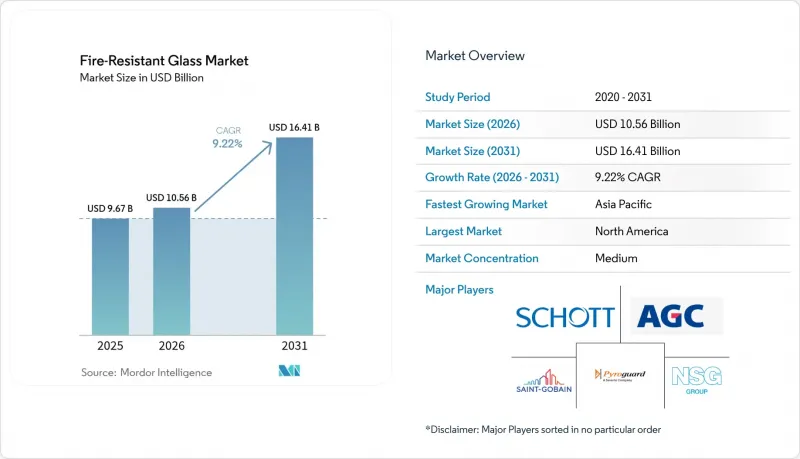
根據 Mordor Intelligence 預測,防火玻璃市場規模將從 2025 年的 96.7 億美元成長到 2026 年的 105.6 億美元,然後在 2031 年達到 164.1 億美元,2026 年至 2031 年的複合年成長率為 9.22%。
本報告按耐火等級(E級(耐火)、EW級(耐火耐輻射)等)、產品類型(鋼絲網玻璃、夾層玻璃等)、終端用戶產業(建築、造船等)及地區(亞太、北美、歐洲、南美、中東和非洲)進行細分。市場預測以美元計價。
全球防火玻璃市場趨勢及洞察
亞太和中東地區高層商業建築激增
快速的垂直都市化使得消防安全成為經營團隊層面的重中之重。中國的GB 55037-2022標準強制規定,所有新建的100公尺以上高層建築必須使用經認證的防火玻璃,這迫使開發商提高規範標準。杜拜修訂後的建築規範限制了幕牆玻璃面積,同時要求更高的隔熱和防火性能,這推動了沿岸地區對高級產品的需求。開發商目前尋求能夠在一塊玻璃中滿足多種性能目標的整合解決方案,這使得供應商能夠以高於標準產品的價格銷售產品,同時也加速了防火玻璃市場對認證產品的普及。
全球更嚴格的消防安全法規
2024版國際建築規範(IBC)強化了牆體連續性要求,並在全球範圍內強制要求使用經實驗室測試的玻璃組件,以符合額定開口密封性能標準。阿拉伯聯合大公國的「十點方案」規定,外牆材料必須獲得民防部門的批准,從而杜絕了低品質進口產品的流通。歐洲類似法規的協調統一正在提高認證玻璃的跨境認可度。這些政策共同擴大了防火玻璃的市場規模,尤其是EI級防火玻璃。
合格承包商和製造商短缺
即使是性能最高的玻璃,如果安裝不當也會失去防火性能。印度、印尼和非洲部分地區的建築需求快速成長,但合格安裝人員的數量卻遠遠超過供應,導致專案延期和成本飆升。儘管國際供應商正透過現場培訓和承包服務來應對,但短期供給能力的限制仍然限制防火玻璃市場的成長。
細分市場分析
E級防火玻璃是市場的主要驅動力,預計到2025年將佔防火玻璃市場規模的47.20%,並已成為辦公大樓和學校隔間的經濟之選。此級產品在銷量上的主導地位源於其簡單的性能要求,主要側重於阻隔火焰和煙霧,而對隔熱性能沒有要求。維修工程通常會直接將強化玻璃更換為E級防火玻璃,從而確保現有製造商的重複業務。然而,向EI級防火玻璃的轉變正在加速。中國和新加坡的事故後檢驗表明,更高的隔熱性能能夠更好地保護樓梯間和疏散樓層,這促使建築師儘管成本更高,但仍選擇採用EI級防火玻璃。
到2031年,EI級防火玻璃的複合年成長率將達到10.11%,這反映了市場「安全至上」的理念轉變。隨著監管機構採用綜合生命安全指標,EI認證的玻璃面板在中庭、交通樞紐和關鍵基礎設施中變得至關重要。持續的產品創新,例如兼具隔音功能的矽酸鹽水凝膠夾層,正在增強其多功能性並推動市場應用。雖然EW級防火玻璃目前仍主要應用於需要減少輻射熱而非完全隔熱的特定場景,但它作為一種中等價位的選擇,可以緩解政府專案的預算限制。因此,防火玻璃的性能分級正在不斷完善,市場需求正逐步從基礎級轉向高級級,從而增強了防火玻璃市場的長期前景。
區域分析
預計到2025年,北美將引領防火玻璃市場,佔據31.60%的市場佔有率,主要得益於2024年國際建築規範(IBC)、國際消防安全標準(IFC)以及豐厚的保險誘因。芝加哥、紐約和多倫多的大規模維修計畫旨在使現有建築符合監管標準,而第179條稅額扣抵則支持私人企業進行生命安全升級改造。隨著業主對防火和節能的雙重需求日益成長,混合型智慧著色EI玻璃正受到越來越多的關注,推高了平均售價,並進一步鞏固了該地區在防火玻璃市場的主導地位。
歐洲市場既成熟又充滿創新活力。除了嚴格的EN 13501測試標準外,歐洲的碳定價體係也在推動低碳製造的需求。聖戈班正在測試其混合爐,該爐可將二氧化碳排放量減少75%,這正體現了這一趨勢,並有望成為歐盟公共項目的實際採購標準(saint-gobain.com)。斯堪地那維亞的木-玻璃複合帷幕牆市場呈現成長態勢,這種帷幕牆兼具防火性能和可再生材料的優勢。歐洲買家也率先採用了EI級即插即用型帷幕牆組件,他們更傾向於成品組件而非單層玻璃。
亞太地區是成長的強勁動力,預計到2031年將以9.55%的複合年成長率成長。中國於2023年中期生效的國家標準強制要求高層建築建築的疏散走廊和電梯廳使用防火玻璃。印度的國家建築標準也正在效仿,印尼計劃在2026年前修訂其2012年的建築標準。同時,在杜拜和整個沿岸地區,2015年「Address」火災後,相關標準有所提高,儘管高溫氣候下的設計面臨挑戰,但對EI-120系統的需求仍在成長。 AGC預測,即使整體建築市場成長放緩,亞洲高隔熱玻璃的出貨量仍將保持強勁。這些趨勢共同推動全球供應商轉向區域合資和本地化生產,從而擴大防火玻璃市場的地域覆蓋範圍。
其他好處:
- Excel格式的市場預測(ME)表
- 3個月的分析師支持
目錄
第1章:引言
- 研究假設和市場定義
- 調查範圍
第2章:調查方法
第3章執行摘要
第4章 市場狀況
- 市場概覽
- 市場促進因素
- 亞太地區和中東地區的高層商業建築建設正在蓬勃發展。
- 全球範圍內加強消防安全法規
- 使用防火玻璃可享有的保險福利
- 用於混合智慧著色玻璃和防火玻璃的創新技術。
- 模組化預製幕牆需要輕質耐火玻璃。
- 在利用氫氣的工業區,需要使用防爆防火玻璃。
- 市場限制因素
- 認證安裝人員和加工人員短缺
- 鈉/硼矽酸原料的供應鏈風險
- 多材料帷幕牆耐火性能等效性的差距
- 價值鏈分析
- 波特五力模型
第5章 市場規模與成長預測
- 按耐火等級
- E(耐火性)
- EW(耐火性和輻射熱)
- EI(防火完整性和隔熱性)
- 依產品類型
- 有線
- 層壓型
- 陶瓷製品
- 強化玻璃
- 凝膠填充型
- 聚碳酸酯及其他材料
- 按最終用戶行業分類
- 建築/施工
- 海上
- 交通運輸(鐵路、航空)
- 能源公用事業
- 其他終端用戶產業
- 按地區
- 亞太地區
- 中國
- 印度
- 日本
- 韓國
- 東南亞
- 其他亞太國家
- 北美洲
- 美國
- 加拿大
- 墨西哥
- 歐洲
- 德國
- 英國
- 法國
- 義大利
- 其他歐洲國家
- 南美洲
- 巴西
- 阿根廷
- 其他南美國家
- 中東和非洲
- 沙烏地阿拉伯
- 南非
- 其他中東和非洲國家
- 亞太地區
第6章 競爭情勢
- 市場集中度
- 策略趨勢
- 市佔率(%)/排名分析
- 公司簡介
- AGC Inc.
- Asahi India Glass Limited
- FireLite(Allegion)
- FUSO
- Nippon Sheet Glass Co. Ltd
- Press Glass SA
- Promat
- Pyroguard
- SAFTI FIRST
- Saint-Gobain
- SCHOTT AG
- Technical Glass Products
第7章 市場機會與未來展望
According to Mordor Intelligence, the fire-Resistant glass market size is expected to grow from USD 9.67 billion in 2025 to USD 10.56 billion in 2026 and is forecast to reach USD 16.41 billion by 2031 at 9.22% CAGR over 2026-2031.
This report is Segmented by Fire-Resistance Class (E (Integrity), EW (Integrity and Radiation), and More), Product Type (Wired, Laminated, and More), End-User Industry (Building and Construction, Marine, and More), and Geography (Asia-Pacific, North America, Europe, South America, Middle East and Africa). The Market Forecasts are Provided in Terms of Value (USD).
Global Fire-Resistant Glass Market Trends and Insights
Surge in High-Rise Commercial Construction in Asia-Pacific and Middle East
Rapid vertical urbanisation has elevated fire safety to board-level priority. China's GB 55037-2022 requires qualified fire-resistant glazing in all new towers above 100 m height, prompting developers to upgrade specification baselines. Dubai's revised building code, which caps facade glazing area yet demands higher thermal and fire performance, is catalysing premium demand in the Gulf. Developers now seek integrated solutions that meet multiple performance targets in a single pane, enabling suppliers to price above commodity levels while accelerating overall adoption of certified products across the fire-resistant glass market.
Stricter Global Fire-Safety Regulations
The 2024 International Building Code strengthens wall continuity and requires lab-tested glazing assemblies for any rated opening-tightening compliance globally. The UAE "Ten-Point Approach" mandates Civil Defence approvals for facade materials and eliminates lower-grade imports. Similar rule harmonisation in Europe increases cross-border acceptance of certified panes. Together these policies expand the qualified addressable base for the fire-resistant glass market, especially for EI-class products.
Shortage of Certified Installers and Fabricators
Even the most advanced pane loses its rating if incorrectly installed. Rapid construction growth in India, Indonesia, and parts of Africa is outpacing the pool of certified installers, delaying project completions and elevating cost premiums. International suppliers are responding with on-site training programs and turnkey service bundles, yet near-term capacity constraints continue to temper growth in the fire-resistant glass market.
Other drivers and restraints analyzed in the detailed report include:
- Insurance Incentives for Using Fire-Rated Glazing
- Hybrid Smart-Tint and Fire-Resistant Glass Innovations
- Supply-Chain Risk for Sodium- / Boro-Silicate Feedstock
For complete list of drivers and restraints, kindly check the Table Of Contents.
Segment Analysis
The E class segment headlines the landscape with 47.20% of the fire-resistant glass market size in 2025, firmly positioned as the affordable baseline for compartmentation in office towers and schools. Volume dominance is rooted in simple performance requirements that target flame and smoke containment without thermal-insulation mandates. Upgrading projects often move directly from wired glass to E class panes, ensuring repeat business for incumbents. Yet specification drift toward EI class is accelerating. Post-incident reviews in China and Singapore show that insulation ratings better protect stairwells and refuge floors, nudging architects to embrace EI class despite higher cost.
EI class's 10.11% CAGR through 2031 reflects this safety-first pivot. As regulatory bodies adopt holistic life-safety metrics, EI-certified panes become indispensable in atria, transportation hubs, and critical infrastructure. Ongoing product innovation such as hydrogel-silicate interlayers that double as acoustic dampers adds multipurpose value, increasing adoption. EW class remains a niche choice where radiant-heat reduction rather than full insulation is required, yet it serves as a mid-price bridge that eases budget constraints on government projects. The upshot is a performance hierarchy that gradually migrates demand from basic to advanced ratings, fortifying the long-term outlook for the fire-resistant glass market.
Complete Report Scope:
- By Fire-Resistance Class
- E (Integrity)
- EW (Integrity and Radiation)
- EI (Integrity and Insulation)
- By Product Type
- Wired
- Laminated
- Ceramic
- Tempered
- Gel-filled
- Polycarbonate and Others
- By End-User Industry
- Building and Construction
- Marine
- Transportation (Rail, Aviation)
- Energy and Utilities
- Other End-User Industries
- By Geography
- Asia-Pacific
- China
- India
- Japan
- South Korea
- South-East Asia
- Rest of Asia-Pacific
- North America
- United States
- Canada
- Mexico
- Europe
- Germany
- United Kingdom
- France
- Italy
- Rest of Europe
- South America
- Brazil
- Argentina
- Rest of South America
- Middle East and Africa
- Saudi Arabia
- South Africa
- Rest of Middle East and Africa
- Asia-Pacific
Geography Analysis
North America leads the fire-resistant glass market with a 31.60% revenue share in 2025, supported by the 2024 International Building Code, the International Fire Code, and robust insurance incentives. Large retrofit programs in Chicago, New York, and Toronto focus on bringing existing stock to code, while the Section 179 tax deduction sustains private spending on life-safety upgrades. Hybrid smart-tint EI panes are gaining traction as owners pursue both fire and energy targets, raising average selling prices and reinforcing the regional leadership of the fire-resistant glass market.
Europe maintains a mature but innovative profile. Stringent EN 13501 testing, plus the continent's carbon-pricing regime, steer demand toward low-carbon manufacturing. Saint-Gobain's hybrid furnace trial that cuts 75% of CO2 emissions exemplifies this alignment and could become a de-facto procurement criterion for EU public projects saint-gobain.com. Niche growth appears in timber-glass composite facades in Scandinavia, which blend fire resistance with renewable materials. European buyers are also early adopters of EI-class plug-and-play curtain wall cassettes, illustrating a preference for complete assemblies versus single panes.
Asia-Pacific is the clear growth engine, expanding at 9.55% CAGR through 2031. China's national standard, in force since mid-2023, mandates fire-rated glazing for high-rise egress corridors and lift lobbies. India's National Building Code amendments are following suit, while Indonesia plans to update its 2012 code by 2026. Meanwhile, Dubai and the wider Gulf have raised standard levels after the 2015 Address incident, fuelling demand for EI-120 systems despite hot-climate design challenges. AGC forecasts shipments of high heat-insulating glass to remain resilient in Asia even as overall construction moderates. These developments collectively pull global suppliers toward regional joint ventures and local fabrication, widening the geographic footprint of the fire-resistant glass market.
- AGC Inc.
- Asahi India Glass Limited
- FireLite (Allegion)
- FUSO
- Nippon Sheet Glass Co. Ltd
- Press Glass S.A.
- Promat
- Pyroguard
- SAFTI FIRST
- Saint-Gobain
- SCHOTT AG
- Technical Glass Products
Additional Benefits:
- The market estimate (ME) sheet in Excel format
- 3 months of analyst support
TABLE OF CONTENTS
1 Introduction
- 1.1 Study Assumptions and Market Definition
- 1.2 Scope of the Study
2 Research Methodology
3 Executive Summary
4 Market Landscape
- 4.1 Market Overview
- 4.2 Market Drivers
- 4.2.1 Surge in high-rise commercial construction in Asia Pacicand Middle East.
- 4.2.2 Stricter global fire-safety regulations
- 4.2.3 Insurance incentives for using fire-rated glazing
- 4.2.4 Hybrid smart-tint and fire-resistant glass innovations
- 4.2.5 Modular prefab facades need lightweight fire glass
- 4.2.6 Hydrogen-ready industrial sites demand blast-plus-fire glass
- 4.3 Market Restraints
- 4.3.1 Shortage of certified installers and fabricators
- 4.3.2 Supply-chain risk for sodium-/boro-silicate feedstock
- 4.3.3 Rating-equivalence gaps for multi-material facades
- 4.4 Value Chain Analysis
- 4.5 Porter's Five Forces
- 4.5.1 Bargaining Power of Suppliers
- 4.5.2 Bargaining Power of Buyers
- 4.5.3 Threat of New Entrants
- 4.5.4 Threat of Substitutes
- 4.5.5 Degree of Competition
5 Market Size and Growth Forecasts (Value)
- 5.1 By Fire-Resistance Class
- 5.1.1 E (Integrity)
- 5.1.2 EW (Integrity and Radiation)
- 5.1.3 EI (Integrity and Insulation)
- 5.2 By Product Type
- 5.2.1 Wired
- 5.2.2 Laminated
- 5.2.3 Ceramic
- 5.2.4 Tempered
- 5.2.5 Gel-filled
- 5.2.6 Polycarbonate and Others
- 5.3 By End-User Industry
- 5.3.1 Building and Construction
- 5.3.2 Marine
- 5.3.3 Transportation (Rail, Aviation)
- 5.3.4 Energy and Utilities
- 5.3.5 Other End-User Industries
- 5.4 By Geography
- 5.4.1 Asia-Pacific
- 5.4.1.1 China
- 5.4.1.2 India
- 5.4.1.3 Japan
- 5.4.1.4 South Korea
- 5.4.1.5 South-East Asia
- 5.4.1.6 Rest of Asia-Pacific
- 5.4.2 North America
- 5.4.2.1 United States
- 5.4.2.2 Canada
- 5.4.2.3 Mexico
- 5.4.3 Europe
- 5.4.3.1 Germany
- 5.4.3.2 United Kingdom
- 5.4.3.3 France
- 5.4.3.4 Italy
- 5.4.3.5 Rest of Europe
- 5.4.4 South America
- 5.4.4.1 Brazil
- 5.4.4.2 Argentina
- 5.4.4.3 Rest of South America
- 5.4.5 Middle East and Africa
- 5.4.5.1 Saudi Arabia
- 5.4.5.2 South Africa
- 5.4.5.3 Rest of Middle East and Africa
- 5.4.1 Asia-Pacific
6 Competitive Landscape
- 6.1 Market Concentration
- 6.2 Strategic Moves
- 6.3 Market Share (%)/ Ranking Analysis
- 6.4 Company Profiles (includes Global level Overview, Market level overview, Core Segments, Financials as available, Strategic Information, Market Rank/Share for key companies, Products and Services, and Recent Developments)
- 6.4.1 AGC Inc.
- 6.4.2 Asahi India Glass Limited
- 6.4.3 FireLite (Allegion)
- 6.4.4 FUSO
- 6.4.5 Nippon Sheet Glass Co. Ltd
- 6.4.6 Press Glass S.A.
- 6.4.7 Promat
- 6.4.8 Pyroguard
- 6.4.9 SAFTI FIRST
- 6.4.10 Saint-Gobain
- 6.4.11 SCHOTT AG
- 6.4.12 Technical Glass Products
7 Market Opportunities and Future Outlook
- 7.1 White-space and Unmet-Need Assessment
- 7.2 Growing Demand from Marine Industry
- 7.3 Lightweight fire-glass for EV battery factories

 全球防火玻璃市場:按類型、應用和地區分類-預測至2031年
 防火玻璃市場報告:趨勢、預測及競爭分析(至2035年)
 防火玻璃市場-2026-2032年全球市場預測
 防火玻璃市場報告:按類型、應用和地區分類(2026-2034 年)
 防火玻璃市場規模、佔有率和趨勢分析報告:按產品、應用、地區和細分市場預測(2026-2033 年)高硼矽酸耐火玻璃市場:按類型、通路、最終用戶和應用分類 - 全球預測(2026-2032年)
 全球防火玻璃市場規模、佔有率、趨勢和成長分析報告(2026-2034年)
 防火玻璃市場-全球產業規模、佔有率、趨勢、機會、預測:按類型、應用、地區和競爭格局分類,2021-2031年
 防火玻璃市場規模、佔有率及成長分析(按類型、應用和地區)-2025-2032 年產業預測
 防火玻璃市場至2030年的預測:按類型、價格分佈範圍、分銷管道、應用、最終用戶和地區的全球分析