


 |
市場調查報告書
商品編碼
2114593
特種酵素:市場佔有率分析、產業趨勢與統計、成長預測(2026-2031)Specialty Enzymes - Market Share Analysis, Industry Trends & Statistics, Growth Forecasts (2026 - 2031) |
||||||

※ 本網頁內容可能與最新版本有所差異。詳細情況請與我們聯繫。
據 Mordor Intelligence 稱,特種酶市場預計到 2026 年價值 71.3 億美元,高於 2025 年的 65.9 億美元,預計到 2031 年將達到 105.2 億美元。
預計從 2026 年到 2031 年,其複合年成長率將達到 8.12%。
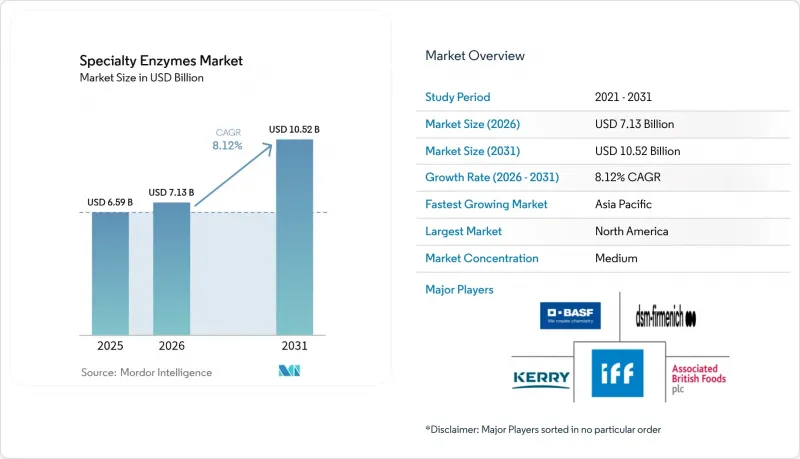
本報告按來源(植物來源、微生物來源、動物來源)、形態(液體、固體)、類型(碳水化合物消化酶、蛋白酶、脂肪酶、其他)、應用(食品飲料、藥品、動物飼料、其他)和地區(北美、歐洲、亞太、南美、中東和非洲)進行細分。市場預測以美元計價。
全球特種酵素市場趨勢與洞察
擴大環境友善生物催化劑在製藥生產的應用
為了減少環境影響並提高製程效率,製藥公司正擴大用生物催化劑取代化學催化劑。這種轉變在生物製藥領域尤其重要,因為酵素的精確性最大限度地減少了對複雜純化製程的需求。美國食品藥物管理局(FDA) 縮短了包括 POMBILITI 和 EPKINLY 在內的生物製藥產品的監管審查週期,該審查將於 2025 年完成,這表明酶療法的核准流程正在簡化。與傳統方法相比,重組酶能夠以更高的選擇性和更少的廢棄物產生生產掌性藥物中間體。電腦輔助設計工具縮短了酵素的開發週期,使製藥公司能夠更有效率地為特定的藥物合成途徑開發生物催化劑。酵素的應用範圍正在擴展到先進的藥物遞送系統和遺傳疾病的治療,這為特種酶領域的製造商創造了商機。
政府透過政策和資金支持推動市場成長。
政府措施正透過政策架構和直接資助,加速特種酵素市場的發展,這些措施支持研究、商業化和產業化部署。世界各國政府正積極透過津貼、稅收優惠和公私合營(PPP)等方式,連結學術界和產業界,為酵素創新提供資金支持。印度的BioE3政策是政府在生物技術領域的一項重大干預措施,撥款9,197印度盧比(約11億美元)用於建立生物基化學品和酵素的生物製造中心。該政策旨在2030年實現3,000億美元的生物經濟規模,並將酵素定位為精準生物製藥和氣候適應型農業等六大領域的關鍵組成部分。中國修訂後的食品安全法規通過強制性報名手續,為酵素生產商創造了商機,該程序有利於那些擁有良好安全記錄的成熟企業。歐盟對食品酵素的上市前核准要求,規範了安全評估流程,並降低了符合要求的生產商的市場准入門檻。
客製化酶的生產成本高昂
客製化酵素的設計、開發和規模化生產涉及複雜的流程,需要對先進技術、熟練勞動力和品管措施進行大量投資。對特殊原料的需求和嚴格的監管合規性也推高了生產成本。為特定工業流程客製化酵素需要大量的研發投入,通常需要2-3年才能實現產品商業化。中小型生物技術公司在將生產規模從實驗室擴展到商業化時面臨著巨大的挑戰。必要的發酵基礎設施需要大量的資本投入和專業知識。工業酵素和藥用酵素的價格差異反映了它們不同的價值提案,藥用蛋白的價格高於工業應用。生產成本受到特殊純化製程和品管系統要求的影響,這些製程和系統必須符合各種最終用途的監管標準。
細分市場分析
由於重組DNA技術在酵素生產方面具有擴充性和成本優勢,預計到2025年,微生物酶將佔68.05%的市場佔有率。受消費者對天然成分和食品及化妝品行業永續性需求的推動,植物來源酶在2026年至2031年間將以9.35%的複合年成長率成長。由於倫理問題和監管限制,對動物源酵素的需求正在下降,這一趨勢在歐洲市場尤為明顯,因為歐洲市場對替代成分的需求正在成長。
微生物酶之所以佔據市場主導地位,是因為它們可以在可控的發酵條件下生產,從而確保品質穩定並最大限度地降低污染風險。微生物生產系統正利用合成生物學的進步來提高酵素的分泌能力,並開發能夠最大限度減少產品特定廢棄物的生產菌株。植物來源酵素的發展得益於從農業廢棄物中提取酵素的新技術,這為循環經濟創造了機遇,並有助於降低原料成本。
預計到2025年,液體製劑將憑藉其卓越的性能和多功能性主導市場,佔據56.60%的市場佔有率,並有望在2031年之前以9.98%的複合年成長率成長。乾粉酶製劑仍保持其市場地位,尤其是在對保存期限長和運輸成本要求較高的特殊應用領域,例如動物飼料和工業清潔。液體製劑之所以受到市場青睞,是因為它們可即時發揮生物利用度,無需溶解步驟即可無縫整合到生產流程中。新型穩定技術延長了液體酵素的保存期限,克服了以往的一大挑戰。
在需要提高基材溶解度並降低迴饋抑制的應用中,非水液體製劑的使用日益增加。高濃度液體製劑可在保持酵素活性的同時降低儲存和運輸成本。對於乾燥製劑,先進的噴霧乾燥和冷凍乾燥技術正在不斷提升產品質量,即使在脫水過程中也能維持酵素的結構和活性。
區域分析
到2025年,北美將佔據特種酵素市場32.78%的主導地位,這得益於其強大的研發能力和簡化的酵素製劑監管流程。該地區的頂尖大學正引領國內創新,率先主導人工智慧驅動的酵素設計。此外,支持永續生產的稅收優惠政策正在擴大酵素在各種工業流程中的應用,進一步鞏固北美的市場主導地位。該地區對技術創新和產學合作的高度重視,也進一步增強了其在全球市場的競爭優勢。
亞太地區正崛起為成長最快的地區,預計年複合成長率將達到9.62%,主要得益於政府支持、成本優勢和高素質的勞動力。扶持性政策和固有的成本優勢是這一成長的基礎。印度的BioE3策略和中國食品酶法規的改革促進了市場進入。此外,該地區低成本的生產環境、豐富的高素質勞動力和先進的基礎設施正吸引著來自世界各地的酵素生產商。人們對生物技術的日益關注以及政府主導的加強酶生產能力的舉措,進一步推動了該地區的快速成長。
歐洲、南美洲以及中東和非洲地區也取得了穩定進展。在歐洲,嚴格的安全標準和強調永續性的法規環境持續促進創新並增強消費者信心。此外,該地區對綠色化學和環境友善酵素應用的重視與永續性目標相契合,並推動了市場的進一步擴張。同時,在南美,受益於有利的貿易協定和生物經濟計劃,巴西和阿根廷的生物技術企業正在推動食品和農業領域的成長。在中東和非洲,醫療保健的改善和糧食安全的努力也帶來了進展。
其他好處:
- Excel格式的市場預測(ME)表
- 3個月的分析師支持
目錄
第1章:引言
- 研究假設和市場定義
- 調查範圍
第2章:調查方法
第3章執行摘要
第4章 市場狀況
- 市場概覽
- 市場促進因素
- 擴大環境友善生物催化劑在製藥生產的應用
- 政府透過政策和資金支持促進市場成長。
- 酶工程和定向進化的進展
- 化妝品和皮膚科對酵素換膚的需求
- 對酵素基傷口清創產品的需求正在飆升。
- 人們對綠色化學和永續工業流程的興趣日益濃厚。
- 市場限制因素
- 客製化酶的生產成本高昂
- 它的保存期限短,穩定性也存在問題。
- 酵素療法中過敏反應和免疫抗原性的風險
- 使用動物性酵素的倫理問題
- 供應鏈分析
- 監理展望
- 波特五力模型
第5章 市場規模與成長預測
- 按原料
- 植物來源
- 微生物來源
- 動物源性
- 按形式
- 液體
- 乾燥
- 按類型
- 碳水化合物消化酶
- 蛋白酶
- 脂肪酶
- 其他
- 透過使用
- 食品/飲料
- 製藥
- 動物飼料
- 其他
- 按地區
- 北美洲
- 美國
- 加拿大
- 墨西哥
- 其他北美國家
- 歐洲
- 德國
- 法國
- 英國
- 西班牙
- 荷蘭
- 義大利
- 瑞典
- 波蘭
- 比利時
- 其他歐洲國家
- 亞太地區
- 中國
- 印度
- 日本
- 澳洲
- 韓國
- 印尼
- 泰國
- 新加坡
- 其他亞太國家
- 南美洲
- 巴西
- 阿根廷
- 智利
- 哥倫比亞
- 秘魯
- 其他南美國家
- 中東和非洲
- 阿拉伯聯合大公國
- 南非
- 奈及利亞
- 沙烏地阿拉伯
- 埃及
- 摩洛哥
- 土耳其
- 其他中東和非洲國家
- 北美洲
第6章 競爭情勢
- 市場集中度
- 策略趨勢
- 市場排名分析
- 公司簡介
- International Flavors & Fragrances
- dsm-firmenich
- Kerry Group plc
- BASF SE
- Associated British Foods plc
- Amano Enzyme
- Novozymes A/S
- Specialty Enzymes & Probiotics
- Suntaq International Limited
- Biocatalysts Ltd.
- Advanced Enzyme Technologies
- ENZIQUIM
- Nagase America LLC
- AST Enzymes
- Sunson Industry Group
- Enzyme Development Corporation
- Antozyme Biotech Pvt Ltd,
- NOOR ENZYMES(DWC)LLC
- Bioseutica BV
- Apex International
第7章 市場機會與未來展望
According to Mordor Intelligence, specialty enzymes market size in 2026 is estimated at USD 7.13 billion, growing from 2025 value of USD 6.59 billion with 2031 projections showing USD 10.52 billion, growing at 8.12% CAGR over 2026-2031.
This report is Segmented by Source (Plant, Microbial, and Animal), by Form (Liquid, and Dry), by Enzyme Type (Carbohydrases, Proteases, Lipases, and Others), by Application (Food and Beverages, Pharmaceutical, Animal Feed, and Others), and Geography (North America, Europe, Asia-Pacific, South America, and Middle East and Africa). The Market Forecasts are Provided in Terms of Value (USD).
Global Specialty Enzymes Market Trends and Insights
Increasing adoption of eco-friendly biocatalysts in pharmaceutical manufacturing
Pharmaceutical producers are increasingly replacing chemical catalysts with biocatalysts to reduce environmental impact and improve process efficiency. This shift is particularly valuable in biologics, where enzyme precision minimizes the need for complex purification steps. The Food and Drug Administration (FDA)'s regulatory review periods for biologics, including POMBILITI and EPKINLY in 2025, indicate streamlined approval processes for enzyme-based therapeutics . Engineered enzymes enable the production of chiral pharmaceutical intermediates with improved selectivity and reduced waste compared to traditional methods. Computational design tools have shortened enzyme development cycles, enabling pharmaceutical companies to develop biocatalysts for specific drug synthesis routes more efficiently. Enzyme applications now extend to advanced drug delivery systems and therapies for genetic disorders, broadening opportunities for manufacturers in the specialty enzyme space.
Government support drives market growth through policy and funding
Government initiatives are accelerating the growth of the specialty enzymes market through policy frameworks and direct funding that support research, commercialization, and industrial adoption. Governments are actively funding enzyme innovation through grants, tax benefits, and PPP collaborations that bridge academia and industry. India's BioE3 policy represents a major government intervention in biotechnology, with an allocation of INR 9,197 crore (USD 1.1 billion) to establish biomanufacturing hubs for bio-based chemicals and enzymes. The policy aims to achieve a USD 300 billion bioeconomy by 2030, identifying enzymes as essential components across six areas, including precision biotherapeutics and climate-resilient agriculture . China's updated food safety regulatory system has created opportunities for enzyme manufacturers through mandatory registration procedures that benefit established companies with proven safety records . The European Union's pre-market approval requirements for food enzymes have standardized safety assessments, reducing market entry barriers for compliant manufacturers.
High production cost for customized enzymes
The complex processes involved in designing, engineering, and scaling up tailored enzymes require substantial investment in advanced technologies, skilled labor, and quality control measures. The need for specialized raw materials and stringent regulatory compliance increases production costs. Tailoring enzymes for specialized industrial processes requires heavy research and developments investment, often taking two to three years before the product reaches commercial readiness. Small and medium-sized biotechnology companies encounter significant challenges in scaling production from laboratory to commercial quantities. The required fermentation infrastructure demands substantial capital investment and specialized expertise. The pricing difference between industrial and pharmaceutical enzymes reflects their distinct value propositions, with pharmaceutical proteins priced at higher end compared to industrial applications. Manufacturing economics are impacted by the requirement for specialized purification processes and quality control systems that comply with regulatory standards for different end-use applications.
Other drivers and restraints analyzed in the detailed report include:
- Advancement in enzyme engineering and directed evolution
- Demand from cosmetic and dermatology sectors for enzymatic peels
- Short shelf life and stability challenges
For complete list of drivers and restraints, kindly check the Table Of Contents.
Segment Analysis
Microbial sources hold a 68.05% market share in 2025, due to the scalability and cost advantages of recombinant DNA technology for enzyme production. Plant-derived enzymes are growing at 9.35% CAGR (2026-2031), driven by consumer demand for natural ingredients and sustainability requirements in food and cosmetic applications. Animal-derived enzymes experience declining demand due to ethical concerns and regulatory restrictions, especially in European markets where alternative sources are increasingly required.
Microbial enzymes dominate because they can be produced under controlled fermentation conditions, ensuring consistent quality and minimizing contamination risks. Microbial production systems leverage advances in synthetic biology to develop production strains with improved enzyme secretion and minimized by-product formation. The growth in plant sources is supported by new enzyme extraction methods from agricultural waste, which create circular economy opportunities and lower raw material costs.
Liquid formulations dominate the market with a 56.60% share in 2025 and are projected to grow at a CAGR of 9.98% through 2031, driven by their superior performance characteristics and application versatility. Dry enzyme formulations maintain their position in specialized applications where extended shelf life and reduced shipping costs are essential, particularly in animal feed and industrial cleaning sectors. The market preference for liquid formulations stems from their immediate bioavailability and seamless integration into manufacturing processes without dissolution requirements. New stabilization technologies have helped extend the shelf life of liquid enzymes, overcoming one of their main historical drawbacks.
Non-aqueous liquid systems are increasing in adoption for applications that require better substrate solubility and reduced feedback inhibition. Concentrated liquid formulations offer reduced storage and transportation costs while maintaining enzyme activity. Dry formulations continue to improve through advanced spray-drying and freeze-drying techniques that maintain enzyme structure and activity during dehydration.
Complete Report Scope:
- By Source
- Plant
- Microbial
- Animal
- By Form
- Liquid
- Dry
- By Type
- Carbohydrases
- Proteases
- Lipases
- Others
- By Application
- Food and Beverages
- Pharmaceutical
- Animal Feed
- Others
- By Geography
- North America
- United States
- Canada
- Mexico
- Rest of North America
- Europe
- Germany
- France
- United Kingdom
- Spain
- Netherlands
- Italy
- Sweden
- Poland
- Belgium
- Rest of Europe
- Asia-Pacific
- China
- India
- Japan
- Australia
- South Korea
- Indonesia
- Thailand
- Singapore
- Rest of Asia-Pacific
- South America
- Brazil
- Argentina
- Chile
- Colombia
- Peru
- Rest of South America
- Middle East and Africa
- United Arab Emirates
- South Africa
- Nigeria
- Saudi Arabia
- Egypt
- Morocco
- Turkey
- Rest of Middle East and Africa
- North America
Geography Analysis
In 2025, North America clinched a commanding 32.78% share of the specialty enzymes market, supported by strong research and development capabilities and streamlined regulatory pathways for enzyme therapeutics. Leading universities in the region spearhead AI-driven enzyme design, propelling domestic innovation. Furthermore, tax incentives championing sustainable manufacturing have amplified enzyme utilization across various industrial processes, solidifying North America's preeminence. The region's strong focus on technological advancements and partnerships between academia and industry further strengthens its competitive edge in the global market.
Asia-Pacific is emerging as the fastest-growing region, driven by supportive government initiatives, cost advantages, and a skilled workforce, with a projected 9.62% CAGR. Supportive policies and inherent cost advantages underpin this growth. India's BioE3 strategy, coupled with China's revised food enzyme regulations, has smoothed the path for market entry. Moreover, the region's affordable production costs, a reservoir of skilled talent, and state-of-the-art infrastructure are luring global enzyme manufacturers. The region's growing focus on biotechnology and government-backed initiatives to enhance enzyme production capacity further contribute to its rapid growth.
Europe, South America, the Middle East, and the Africa region are also making strides. In Europe, strict safety standards and a sustainability-focused regulatory environment continue to foster innovation and consumer confidence. Additionally, the region's emphasis on green chemistry and eco-friendly enzyme applications aligns with its sustainability goals, driving further market expansion. Meanwhile, in South America, biotech ventures in Brazil and Argentina, buoyed by favorable trade agreements and bioeconomy initiatives, are driving growth in the food and agriculture sectors. The Middle East and Africa region is witnessing advancements, owing to healthcare enhancements and initiatives aimed at food security.
- International Flavors & Fragrances
- dsm-firmenich
- Kerry Group plc
- BASF SE
- Associated British Foods plc
- Amano Enzyme
- Novozymes A/S
- Specialty Enzymes & Probiotics
- Suntaq International Limited
- Biocatalysts Ltd.
- Advanced Enzyme Technologies
- ENZIQUIM
- Nagase America LLC
- AST Enzymes
- Sunson Industry Group
- Enzyme Development Corporation
- Antozyme Biotech Pvt Ltd,
- NOOR ENZYMES (DWC) LLC
- Bioseutica BV
- Apex International
Additional Benefits:
- The market estimate (ME) sheet in Excel format
- 3 months of analyst support
TABLE OF CONTENTS
1 INTRODUCTION
- 1.1 Study Assumptions and Market Definition
- 1.2 Scope of the Study
2 RESEARCH METHODOLOGY
3 EXECUTIVE SUMMARY
4 MARKET LANDSCAPE
- 4.1 Market Overview
- 4.2 Market Drivers
- 4.2.1 Increasing adoption of eco-friendly biocatalysts in pharmaceutical manufacturing
- 4.2.2 Government support drives market growth through policy and funding
- 4.2.3 Advancement in enzyme engineering and directed evolution
- 4.2.4 Demand from cosemetic and dermatology sectors for enzymatic peels
- 4.2.5 Surge in demand for enzymatic wound debridement products
- 4.2.6 Growing focus on green chemistry and sustainable industrial process
- 4.3 Market Restraints
- 4.3.1 High production cost for customised enzymes
- 4.3.2 Short shelf life and stability challenges
- 4.3.3 Risk of allergic reaction and immunogenicity in enzyme therapy
- 4.3.4 Ethical concern in use of animal-derived enzymes
- 4.4 Supply Chain Analysis
- 4.5 Regulatory Outlook
- 4.6 Porter's Five Forces
- 4.6.1 Threat of New Entrants
- 4.6.2 Bargaining Power of Buyers/Consumers
- 4.6.3 Bargaining Power of Suppliers
- 4.6.4 Threat of Substitute Products
- 4.6.5 Intensity of Competitive Rivalry
5 MARKET SIZE AND GROWTH FORECASTS (VALUE)
- 5.1 By Source
- 5.1.1 Plant
- 5.1.2 Microbial
- 5.1.3 Animal
- 5.2 By Form
- 5.2.1 Liquid
- 5.2.2 Dry
- 5.3 By Type
- 5.3.1 Carbohydrases
- 5.3.2 Proteases
- 5.3.3 Lipases
- 5.3.4 Others
- 5.4 By Application
- 5.4.1 Food and Beverages
- 5.4.2 Pharmaceutical
- 5.4.3 Animal Feed
- 5.4.4 Others
- 5.5 By Geography
- 5.5.1 North America
- 5.5.1.1 United States
- 5.5.1.2 Canada
- 5.5.1.3 Mexico
- 5.5.1.4 Rest of North America
- 5.5.2 Europe
- 5.5.2.1 Germany
- 5.5.2.2 France
- 5.5.2.3 United Kingdom
- 5.5.2.4 Spain
- 5.5.2.5 Netherlands
- 5.5.2.6 Italy
- 5.5.2.7 Sweden
- 5.5.2.8 Poland
- 5.5.2.9 Belgium
- 5.5.2.10 Rest of Europe
- 5.5.3 Asia-Pacific
- 5.5.3.1 China
- 5.5.3.2 India
- 5.5.3.3 Japan
- 5.5.3.4 Australia
- 5.5.3.5 South Korea
- 5.5.3.6 Indonesia
- 5.5.3.7 Thailand
- 5.5.3.8 Singapore
- 5.5.3.9 Rest of Asia-Pacific
- 5.5.4 South America
- 5.5.4.1 Brazil
- 5.5.4.2 Argentina
- 5.5.4.3 Chile
- 5.5.4.4 Colombia
- 5.5.4.5 Peru
- 5.5.4.6 Rest of South America
- 5.5.5 Middle East and Africa
- 5.5.5.1 United Arab Emirates
- 5.5.5.2 South Africa
- 5.5.5.3 Nigeria
- 5.5.5.4 Saudi Arabia
- 5.5.5.5 Egypt
- 5.5.5.6 Morocco
- 5.5.5.7 Turkey
- 5.5.5.8 Rest of Middle East and Africa
- 5.5.1 North America
6 COMPETITIVE LANDSCAPE
- 6.1 Market Concentration
- 6.2 Strategic Moves
- 6.3 Market Ranking Analysis
- 6.4 Company Profiles (includes Global-level Overview, Market-level Overview, Core Segments, Financials (if available), Strategic Information, Market Rank/Share, Products and Services, Recent Developments)
- 6.4.1 International Flavors & Fragrances
- 6.4.2 dsm-firmenich
- 6.4.3 Kerry Group plc
- 6.4.4 BASF SE
- 6.4.5 Associated British Foods plc
- 6.4.6 Amano Enzyme
- 6.4.7 Novozymes A/S
- 6.4.8 Specialty Enzymes & Probiotics
- 6.4.9 Suntaq International Limited
- 6.4.10 Biocatalysts Ltd.
- 6.4.11 Advanced Enzyme Technologies
- 6.4.12 ENZIQUIM
- 6.4.13 Nagase America LLC
- 6.4.14 AST Enzymes
- 6.4.15 Sunson Industry Group
- 6.4.16 Enzyme Development Corporation
- 6.4.17 Antozyme Biotech Pvt Ltd,
- 6.4.18 NOOR ENZYMES (DWC) LLC
- 6.4.19 Bioseutica BV
- 6.4.20 Apex International
7 MARKET OPPORTUNITIES AND FUTURE OUTLOOK

 特異性酶市場報告:趨勢、預測與競爭分析(至2035年)
 醫用級酵素市場-2026-2032年全球市場預測
 醫用級酵素市場規模、佔有率和成長分析:按產品類型、來源、應用、最終用戶、劑型、生產技術和地區分類-產業預測,2026-2033年
 2026-2030年全球特種酵素市場特種酵素市場:依酵素類型、原料、形態和應用分類-2026-2032年全球市場預測
 2026年全球特種酵素市場報告
 2026-2034年全球特種酵素市場規模、佔有率、趨勢和成長分析報告全球菊糖酶市場規模、佔有率、趨勢和成長分析報告(2026-2034年)全球診斷酵素市場規模、佔有率、趨勢和成長分析報告(2026-2034)
 特種酵素市場規模、佔有率和成長分析(按來源、產品類型、應用和地區分類)-2026-2033年產業預測