


 |
市場調查報告書
商品編碼
2114555
圖片膠片:市場佔有率分析、產業趨勢與統計、成長預測(2026-2031)Graphic Film - Market Share Analysis, Industry Trends & Statistics, Growth Forecasts (2026 - 2031) |
||||||

※ 本網頁內容可能與最新版本有所差異。詳細情況請與我們聯繫。
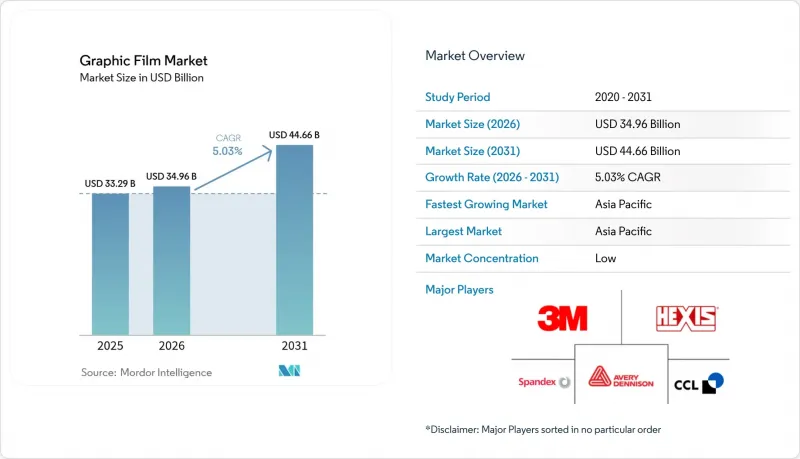
根據 Mordor Intelligence 估計,到 2026 年,圖形底片市值將達到 349.6 億美元,高於 2025 年的 332.9 億美元,預計到 2031 年將達到 446.6 億美元。
預計從 2026 年到 2031 年,年複合成長率將達到 5.03%。
本報告按薄膜類型(不透明、透明、半透明、反光)、聚合物(聚氯乙烯(PVC)、聚丙烯 (PP)、聚乙烯 (PE) 等)、印刷技術(數位印刷、柔版印刷、凹版印刷、網版印刷)、終端用戶(汽車、廣告和促銷機構、建築和施工等)以及地區進行細分。市場預測以美元 (USD) 為單位。
全球圖形底片市場趨勢及洞察
建設產業的發展與生活水準的提高
亞太和中東地區的都市化推動了大規模基礎設施建設,這需要防塗鴉、使用壽命長的圖形薄膜用於標誌和外觀品牌推廣。專案業主正在將建築資訊模型(BIM)與圖形薄膜規格相結合,以實現精確的材料規劃並減少施工過程中的廢棄物。建築師傾向於選擇兼具美觀性和節能玻璃性能的可客製化飾面,從而拓展了應用範圍。政府針對交通樞紐、公共住宅和智慧城市的獎勵策略也支撐了市場需求。隨著生活水準的提高,住宅開發商正在採用符合綠色認證標準的室內裝飾薄膜,這將推動圖形薄膜市場的中期成長。
車輛貼膜和車隊圖形設計的需求日益成長
車輛業者正從噴漆轉向車身貼膜,以實現快速品牌形象更新和車漆保護的雙重目標。隨著電動車的普及,市場對輕盈、易於更新且能最大限度降低空氣阻力和電力消耗的車身貼膜的需求日益成長。叫車和末端配送公司由於需要頻繁更新宣傳活動內容,因此更傾向於選擇易於移除、低黏性的貼膜。高階車身貼膜能夠實現整車一夕之間煥新品牌形象,進而提升車輛轉售價值並減少停工時間。亞太地區的成長動能與美國和歐洲的普及趨勢相符,中小企業採用車身貼膜進行在地化行銷,也推動了運作貼膜市場的短期擴張。
PVC、PET和特殊添加劑的價格波動
原油價格和能源成本的波動正在影響PVC和PET樹脂市場,給加工商的長期合約利潤率帶來壓力。亞洲供應集中加劇了地緣政治因素和天氣相關供應中斷的影響,可能導致下游塗佈生產線運作。紫外線穩定劑和塑化劑等特殊添加劑的供應商和產能往往有限,導致現貨市場供應供不應求。儘管製造商正在努力實現採購多元化,擴大樹脂產能以更靠近需求中心,並引入價格調整條款,但成本的不確定性仍然是限制圖形薄膜市場的一大因素。
細分市場分析
2025年,不透明薄膜佔據了圖形薄膜市場41.88%的佔有率,這主要得益於其廣泛的應用範圍,包括車身貼膜、店鋪門面和建築外觀圖案等。由於這些薄膜能夠遮蓋基材缺陷並實現醒目的品牌形象,因此市場需求持續旺盛。目前的技術進步,例如UV噴墨相容性和低溫柔柔軟性,正在拓展其在各種氣候條件下的終端應用範圍。相較之下,受安全法規和節能要求的驅動,反光薄膜的成長速度超過了整體圖形薄膜市場,年複合成長率高達7.05%。透明和半透明產品則在零售展示櫃和背光建築元素等領域佔據了細分市場。供應商正在拓展產品線,推出具有抗菌和防塗鴉性能的面塗層,從而推高了平均售價。
隨著交通管理部門強制要求道路標誌和鐵路車輛採用更高反射率的反光膜,反光膜的應用正在加速成長。建築師指定使用隔熱窗膜來降低暖通空調系統的負荷,將光學性能與永續性目標連結起來。同時,安裝人員更傾向於使用具有可重新定位黏合劑的新一代不透明薄膜,這種薄膜可以將安裝時間縮短10%至15%。 ORAFOL公司1.65億至1.75億美元的擴張計畫有助於確保多種薄膜類別的供應穩定,從而增強了市場對長期需求的信心。這些趨勢共同促成了薄膜類型的多樣化,並為圖形薄膜市場創造了健康的收入來源。
到2025年,由於PVC成本低、易於壓延以及對不規則表面具有很強的黏合性,將佔據全球圖形薄膜市場62.98%的佔有率。然而,永續發展措施和對塑化劑日益嚴格的監管正在推動PET的需求成長,其複合年成長率(CAGR)為6.12%。 PET的可回收性受到規範制定者的青睞,尤其是在歐洲,他們希望透過循環經濟來獲得積分。聚丙烯和聚乙烯仍然在一些對耐化學性和抗撕裂性要求較高的專業細分市場中使用。
隨著 PFAS 的逐步淘汰迫在眉睫,高耐久性面漆產業正被迫進行價值鏈調整,這為新型樹脂創造了尚未開發的市場。 Polyplex 在阿拉巴馬州投資 PET,使北美供應來源多元化,並縮短了加工商因運費波動而面臨的前置作業時間。製造商正透過開發符合柔軟性和印刷適性標準的無 PVC 產品線來規避風險。如果成功,這將重塑聚合物市場佔有率,但短期經濟因素意味著 PVC 仍然在圖形薄膜市場佔據主導地位。
區域分析
預計到2025年,亞太地區將佔全球銷售額的45.30%,並在2031年之前以7.28%的複合年成長率成長,這主要得益於該地區無與倫比的聚合物生產能力和政府基礎設施發展計劃。隨著中國「一帶一路」計劃、印度智慧城市計畫以及製造地向東南亞轉移,其應用範圍不斷擴大。國內加工商受益於更短的前置作業時間和不斷成長的中產階級消費,這推動了汽車包裝膜和零售標牌產量的成長。
儘管北美市場需求已趨於成熟,但它仍然是一個高價值市場,尤其是在高階包裝、隔熱窗膜和抗菌塗層領域。 Polyplex位於阿拉巴馬州的全新PET生產線實現了本地原料採購,從而減少了對進口的依賴,並提高了成本的可預測性。憑藉在低VOC油墨和可回收基材方面的主導監管地位,加工商正在引領永續產品的開發,而這一趨勢如今正在全球蔓延。
在技術應用和永續性法規方面,歐洲與北美並駕齊驅。 REACH法規的修訂以及關於塑膠稅的討論正在加速PVC替代品的採用和無溶劑油墨的推廣,從而影響著全球的產品配方。此外,中東地區旅遊業和大型活動的蓬勃發展推動了指示牌需求的成長;而在南美,巴西和墨西哥基礎設施建設的重啟也支撐了市場的溫和成長。這些多區域趨勢共同推動了圖形薄膜市場的發展前景。
其他好處:
- Excel格式的市場預測(ME)表
- 3個月的分析師支持
目錄
第1章:引言
- 研究假設和市場定義
- 調查範圍
第2章:調查方法
第3章執行摘要
第4章 市場狀況
- 市場概覽
- 市場促進因素
- 建設產業的發展與生活水準的提高
- 車輛貼膜和車隊圖形設計的需求日益成長
- 數位和UV噴墨列印技術的普及
- 零售店POS機和標示牌的擴展
- 用於醫療環境的新型抗菌圖形薄膜
- 電致變色/智慧嵌裝玻璃圖形薄膜的普及
- 市場限制因素
- PVC、PET和特殊添加劑的價格波動
- 對聚氯乙烯和溶劑型油墨有嚴格的規定。
- 由於可回收利用率低,該建築無法獲得綠建築認證。
- 光引發劑供不應求
- 產業供應鏈分析
- 監理情勢
- 技術展望
- 波特五力分析
第5章 市場規模與成長預測
- 按膠片類型
- 不透明薄膜
- 透明薄膜
- 半透明薄膜
- 反光膜
- 透過聚合物
- 聚氯乙烯(PVC)
- 聚丙烯(PP)
- 聚乙烯(PE)
- 聚對苯二甲酸乙二醇酯(PET)
- 其他聚合物
- 透過印刷技術
- 數位的
- 柔版印刷
- 膠印光刻
- 凹版印刷
- 網版印刷
- 按最終用戶行業分類
- 車
- 廣告促銷機構
- 建築/施工
- 公共和基礎設施部門
- 其他終端用戶產業
- 按地區
- 北美洲
- 美國
- 加拿大
- 墨西哥
- 南美洲
- 巴西
- 阿根廷
- 智利
- 其他南美國家
- 歐洲
- 英國
- 德國
- 法國
- 義大利
- 西班牙
- 俄羅斯
- 其他歐洲國家
- 亞太地區
- 中國
- 印度
- 日本
- 韓國
- 澳洲
- 其他亞太國家
- 中東和非洲
- 中東
- 沙烏地阿拉伯
- 阿拉伯聯合大公國
- 土耳其
- 其他中東國家
- 非洲
- 南非
- 奈及利亞
- 其他非洲國家
- 中東
- 北美洲
第6章 競爭情勢
- 市場集中度
- 策略趨勢
- 市佔率分析
- 公司簡介
- 3M Company
- Avery Dennison Corporation
- ORAFOL Europe GmbH
- Hexis SAS
- Arlon Graphics LLC
- FDC Graphic Films, Inc.
- Spandex AG
- Drytac Corporation
- Lintec Corporation
- LX Hausys Ltd.
- Taghleef Industries LLC
- CCL Industries Inc.
- Cosmos Films Ltd
- Ultraflex Systems Inc.
- Contra Vision Ltd
第7章 市場機會與未來展望
According to Mordor Intelligence, the graphic films market size in 2026 is estimated at USD 34.96 billion, growing from 2025 value of USD 33.29 billion with 2031 projections showing USD 44.66 billion, growing at 5.03% CAGR over 2026-2031.
This report is Segmented by Film Type (Opaque, Transparent, Translucent, and Reflective), Polymer (Polyvinyl Chloride (PVC), Polypropylene (PP), Polyethylene (PE), and More), Printing Technology (Digital, Flexography, Rotogravure, Screen Printing), End-User (Automotive, Advertising and Promotion Agencies, Building and Construction, and More), and Geography. The Market Forecasts are Provided in Value (USD).
Global Graphic Film Market Trends and Insights
Growth in the construction industry and higher living standards
Urbanization across Asia-Pacific and the Middle East spurs large-scale infrastructure builds that specify graffiti-resistant, long-life graphic films for wayfinding and facade branding. Project owners integrate Building Information Modeling with graphic film specifications, enabling precise material planning and lower installation waste. Architects favor customizable finishes that merge aesthetics with energy-efficient glazing, widening application breadth. Government stimulus for transport hubs, public housing, and smart cities anchors volume commitments. As living standards rise, residential developers are adopting interior decorative films that meet green certification goals, thereby reinforcing the medium-term growth of the graphic films market.
Rising demand for vehicle-wrap and fleet graphics
Fleet operators shift from paint to film wraps to achieve rapid brand makeovers and paint protection in one step. Surging electric vehicle fleets intensify demand for lightweight, easily updatable graphics that minimize drag and power consumption. Ride-sharing and last-mile delivery companies frequently refresh their campaign artwork, favoring removable, low-adhesion films. Premium wraps enhance resale values and reduce downtime, as entire fleets can be rebranded overnight. Growth momentum in APAC follows the U.S. and European adoption curves as small businesses adopt wraps for hyper-local marketing, supporting a near-term uplift in the graphic films market.
Volatility in prices of PVC, PET and specialty additives
Swinging crude oil and energy costs ripple through PVC and PET resin markets, compressing converter margins on long-term contracts. Concentrated supply in Asia magnifies geopolitical and weather-related disruptions that can idle downstream coating lines. Specialty additives, such as UV stabilizers and plasticizers, often come from narrow supplier pools with limited ramp-up capability, resulting in spot shortages. Producers respond by dual-sourcing, expanding resin capacity closer to demand centers, and introducing price-adjustment clauses, yet cost unpredictability remains a drag on the graphic films market.
Other drivers and restraints analyzed in the detailed report include:
- Penetration of digital and UV-inkjet printing technologies
- Expansion of retail PoS and way-finding signage
- Stringent regulations on PVC and solvent-based inks
For complete list of drivers and restraints, kindly check the Table Of Contents.
Segment Analysis
Opaque films accounted for 41.88% of the graphic films market share in 2025, driven by their universal suitability for vehicle wraps, storefronts, and facade graphics. These films mask substrate flaws and deliver vivid branding, sustaining high-volume demand. Innovations now target UV-inkjet compatibility and low-temperature pliability, broadening end-use scenarios across climates. In contrast, reflective films, driven by safety regulations and energy-saving mandates, outpace the total graphic films market at a 7.05% CAGR. Transparent and translucent variants gain niche share in retail showcases and backlit architectural elements. Suppliers expand their portfolios with antimicrobial and graffiti-resistant topcoats, which help lift average selling prices.
Reflective film adoption accelerates as transportation departments mandate higher retroreflectivity for road signs and railcars. Architects specify heat-reflective window films that cut HVAC loads, linking optics to sustainability targets. Meanwhile, installers favor next-generation opaque films featuring repositionable adhesives that cut labor time by 10-15%. ORAFOL's USD 165-175 million expansion underpins supply security for multiple film classes, underscoring confidence in long-range demand. Collectively, these dynamics entrench film-type diversity and fuel healthy revenue streams in the graphic films market.
PVC controlled 62.98% of the global graphic films market size in 2025, owing to its low cost, ease of calendering, and robust adhesion on irregular surfaces. Yet, sustainability drivers and scrutiny of plasticizers propel PET volumes, driving the material at a 6.12% CAGR. PET's recyclability appeals to specifiers chasing circular-economy credits, especially in Europe. Polypropylene and polyethylene remain in specialized niches where chemical resistance or tearability is essential.
The pending PFAS phase-out forces value-chain adjustments in high-durability topcoats, creating white space for novel resins. PET investments in Alabama by Polyplex diversify the North American supply and shorten lead times for converters hit by freight volatility. Producers hedge by developing PVC-free portfolios that match flexibility and printability benchmarks. Success here would realign polymer shares, yet near-term economics keep PVC at the helm of the graphic films market.
Complete Report Scope:
- By Film Type
- Opaque Film
- Transparent Film
- Translucent Film
- Reflective Film
- By Polymer
- Polyvinyl Chloride (PVC)
- Polypropylene (PP)
- Polyethylene (PE)
- Polyethylene Terephthalate (PET)
- Other Polymers
- By Printing Technology
- Digital
- Flexography
- Offset Lithography
- Rotogravure
- Screen Printing
- By End-User Industry
- Automotive
- Advertising and Promotion Agencies
- Building and Construction
- Institutional and Public Infrastructure
- Other End-User Industries
- By Geography
- North America
- United States
- Canada
- Mexico
- South America
- Brazil
- Argentina
- Chile
- Rest of South America
- Europe
- United Kingdom
- Germany
- France
- Italy
- Spain
- Russia
- Rest of Europe
- Asia-Pacific
- China
- India
- Japan
- South Korea
- Australia
- Rest of Asia-Pacific
- Middle East and Africa
- Middle East
- Saudi Arabia
- United Arab Emirates
- Turkey
- Rest of Middle East
- Africa
- South Africa
- Nigeria
- Rest of Africa
- Middle East
- North America
Geography Analysis
The Asia-Pacific region secured 45.30% of global revenue in 2025 and is expected to grow at a 7.28% CAGR to 2031, driven by unmatched polymer capacity and government infrastructure agendas. China's Belt and Road projects, India's smart-city initiatives, and the relocation of Southeast Asian manufacturing continually widen their application breadth. Domestic converters benefit from short lead times and rising middle-class consumption that lifts automotive wraps and retail signage volumes.
North America's demand is mature yet value-rich, centered on premium wraps, solar-control window films, and antimicrobial coatings. Polyplex's new PET line in Alabama secures local feedstock, trimming dependency on imports and sharpening cost predictability. Regulatory leadership in low-VOC inks and recyclable substrates prompts converters to pioneer sustainable offerings, which later cascade worldwide.
Europe matches North America in terms of technology adoption and sustainability regulations. REACH updates and discussions on the plastic tax accelerate the adoption of PVC alternatives and the migration to solvent-free inks, influencing product formulation globally. Elsewhere, the Middle East leverages tourism and mega-event developments for signage demand, while South America's infrastructure revival in Brazil and Mexico nurtures moderate growth. These multi-regional trends collectively reinforce the expansion outlook for the graphic films market.
- 3M Company
- Avery Dennison Corporation
- ORAFOL Europe GmbH
- Hexis S.A.S.
- Arlon Graphics LLC
- FDC Graphic Films, Inc.
- Spandex AG
- Drytac Corporation
- Lintec Corporation
- LX Hausys Ltd.
- Taghleef Industries LLC
- CCL Industries Inc.
- Cosmos Films Ltd
- Ultraflex Systems Inc.
- Contra Vision Ltd
Additional Benefits:
- The market estimate (ME) sheet in Excel format
- 3 months of analyst support
TABLE OF CONTENTS
1 INTRODUCTION
- 1.1 Study Assumptions and Market Definition
- 1.2 Scope of the Study
2 RESEARCH METHODOLOGY
3 EXECUTIVE SUMMARY
4 MARKET LANDSCAPE
- 4.1 Market Overview
- 4.2 Market Drivers
- 4.2.1 Growth in the construction industry and higher living standards
- 4.2.2 Rising demand for vehicle-wrap and fleet graphics
- 4.2.3 Penetration of digital and UV-inkjet printing technologies
- 4.2.4 Expansion of retail PoS and way-finding signage
- 4.2.5 Emerging antimicrobial graphic films in healthcare settings
- 4.2.6 Adoption of electrochromic/smart glazing graphic films
- 4.3 Market Restraints
- 4.3.1 Volatility in prices of PVC, PET and specialty additives
- 4.3.2 Stringent regulations on PVC and solvent-based inks
- 4.3.3 Limited recyclability hindering green-building certification
- 4.3.4 Supply shortages of photoinitiators for UV-cure inks
- 4.4 Industry Supply-Chain Analysis
- 4.5 Regulatory Landscape
- 4.6 Technological Outlook
- 4.7 Porter's Five Forces Analysis
- 4.7.1 Threat of New Entrants
- 4.7.2 Bargaining Power of Suppliers
- 4.7.3 Bargaining Power of Buyers
- 4.7.4 Threat of Substitutes
- 4.7.5 Industry Rivalry
5 MARKET SIZE AND GROWTH FORECASTS (VALUE)
- 5.1 By Film Type
- 5.1.1 Opaque Film
- 5.1.2 Transparent Film
- 5.1.3 Translucent Film
- 5.1.4 Reflective Film
- 5.2 By Polymer
- 5.2.1 Polyvinyl Chloride (PVC)
- 5.2.2 Polypropylene (PP)
- 5.2.3 Polyethylene (PE)
- 5.2.4 Polyethylene Terephthalate (PET)
- 5.2.5 Other Polymers
- 5.3 By Printing Technology
- 5.3.1 Digital
- 5.3.2 Flexography
- 5.3.3 Offset Lithography
- 5.3.4 Rotogravure
- 5.3.5 Screen Printing
- 5.4 By End-User Industry
- 5.4.1 Automotive
- 5.4.2 Advertising and Promotion Agencies
- 5.4.3 Building and Construction
- 5.4.4 Institutional and Public Infrastructure
- 5.4.5 Other End-User Industries
- 5.5 By Geography
- 5.5.1 North America
- 5.5.1.1 United States
- 5.5.1.2 Canada
- 5.5.1.3 Mexico
- 5.5.2 South America
- 5.5.2.1 Brazil
- 5.5.2.2 Argentina
- 5.5.2.3 Chile
- 5.5.2.4 Rest of South America
- 5.5.3 Europe
- 5.5.3.1 United Kingdom
- 5.5.3.2 Germany
- 5.5.3.3 France
- 5.5.3.4 Italy
- 5.5.3.5 Spain
- 5.5.3.6 Russia
- 5.5.3.7 Rest of Europe
- 5.5.4 Asia-Pacific
- 5.5.4.1 China
- 5.5.4.2 India
- 5.5.4.3 Japan
- 5.5.4.4 South Korea
- 5.5.4.5 Australia
- 5.5.4.6 Rest of Asia-Pacific
- 5.5.5 Middle East and Africa
- 5.5.5.1 Middle East
- 5.5.5.1.1 Saudi Arabia
- 5.5.5.1.2 United Arab Emirates
- 5.5.5.1.3 Turkey
- 5.5.5.1.4 Rest of Middle East
- 5.5.5.2 Africa
- 5.5.5.2.1 South Africa
- 5.5.5.2.2 Nigeria
- 5.5.5.2.3 Rest of Africa
- 5.5.5.1 Middle East
- 5.5.1 North America
6 COMPETITIVE LANDSCAPE
- 6.1 Market Concentration
- 6.2 Strategic Moves
- 6.3 Market Share Analysis
- 6.4 Company Profiles (includes Global level Overview, Market level overview, Core Segments, Financials as available, Strategic Information, Market Rank/Share for key companies, Products and Services, and Recent Developments)
- 6.4.1 3M Company
- 6.4.2 Avery Dennison Corporation
- 6.4.3 ORAFOL Europe GmbH
- 6.4.4 Hexis S.A.S.
- 6.4.5 Arlon Graphics LLC
- 6.4.6 FDC Graphic Films, Inc.
- 6.4.7 Spandex AG
- 6.4.8 Drytac Corporation
- 6.4.9 Lintec Corporation
- 6.4.10 LX Hausys Ltd.
- 6.4.11 Taghleef Industries LLC
- 6.4.12 CCL Industries Inc.
- 6.4.13 Cosmos Films Ltd
- 6.4.14 Ultraflex Systems Inc.
- 6.4.15 Contra Vision Ltd
7 MARKET OPPORTUNITIES AND FUTURE OUTLOOK
- 7.1 White-space and Unmet-need Assessment

 環保溶劑型背光膜市場:全球市場預測(2026-2032年)
 PCR薄膜和箔市場規模、佔有率和成長分析:按產品類型、材料、應用、最終用戶、板規格和地區分類-2026-2033年產業預測
 圖形薄膜市場規模、佔有率、趨勢和預測:按聚合物、薄膜類型、印刷技術、應用和地區分類,2026-2034 年
 圖文膠片市場規模、佔有率和趨勢分析報告:按產品類型、膠片類型、製造流程、印刷技術、終端用戶產業、地區和細分市場預測(2026-2033 年)
 裝飾薄膜和箔材市場規模、佔有率和成長分析:按材料類型、設計和表面處理、應用、最終用途行業、地區和行業預測,2026-2033年裝飾性PVC薄膜市場按產品類型、分銷管道、厚度、表面處理、應用和最終用途分類,全球預測(2026-2032年)
 背光膜市場-全球產業規模、佔有率、趨勢、機會及預測(按類型、應用、地區及競爭狀況,2020-2030 年)
 2032 年圖形薄膜市場預測:按薄膜類型、聚合物類型、印刷技術、基材類型、應用、最終用戶和地區進行的全球分析
 全球圖形薄膜市場(2024-2028)