


 |
市場調查報告書
商品編碼
2114541
定位感測器:市場佔有率分析、產業趨勢與統計、成長預測(2026-2031)Position Sensor - Market Share Analysis, Industry Trends & Statistics, Growth Forecasts (2026 - 2031) |
||||||

※ 本網頁內容可能與最新版本有所差異。詳細情況請與我們聯繫。
根據 Mordor Intelligence 估計,到 2026 年,位置感測器市值將達到 93.1 億美元,高於 2025 年的 84.9 億美元,預計到 2031 年將達到 147.9 億美元。
預計從 2026 年到 2031 年,其複合年成長率將達到 9.68%。
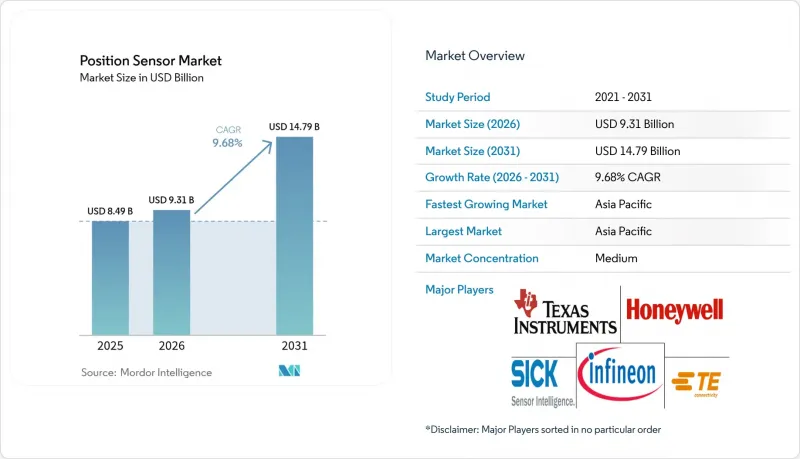
本報告按類型(線性感測器、旋轉感測器等)、技術(接觸式和非接觸式)、輸出介面(類比和數位)、應用(農業車輛/自走式機械、牲畜定位和健康監測等)以及地區(北美、歐洲、亞太等)進行細分。市場預測以美元計價。
全球位置感測器市場趨勢及洞察
工業4.0環境下的自動化進展
智慧工廠的理念正在重新定義機器設計,它需要連續的亞毫米級位置數據,並與數位孿生技術無縫整合。曳引機和聯合收割機製造商目前正在預先安裝遠端資訊處理閘道器,將感測器輸出資料傳輸到雲端控制面板,從而實現車隊的即時調整和遠距離診斷。精準播種系統採用磁致伸縮桿,以小於10微米的精度檢測滾筒位置,並在作業過程中動態調整播種深度,從而在有限的播種期內節省燃料和材料。同時,製造商正在整合LiDAR、雷達和角度感測器,以實現無人駕駛車輛的360度情境察覺。隨著原始設備製造商(OEM)在新車型平台上標準化智慧介面,這一發展勢頭進一步推動了位置感測器市場的發展。
電氣化和功能安全需求
隨著高壓驅動系統的普及,感測器的選擇變得至關重要,因為即使在電磁干擾和劇烈溫度波動的情況下,感測器仍需保持精確度。為了達到最高效率,電動牽引馬達的轉子位置測量精度必須小於1°,而冗餘通道對於滿足ISO 26262汽車安全完整性等級D(SIL D)的要求也不可或缺。英飛凌以25億美元收購Marvell的汽車乙太網路業務,凸顯了緊密整合感測和網路協定堆疊的戰略價值。向認證雙晶片架構的轉變,增加了每輛車的組件數量,深化了與供應商的合作,並透過現有車隊的電氣化改裝套件,進一步推動了位置感測器市場的發展。
非接觸式線性感測器的平均售價較高
磁致伸縮編碼器和光學編碼器的價格通常是電位計式感測器的三到五倍,這對小規模農場的資本投資預算來說是一筆不小的負擔。 Neo Performance Materials 指出,釹磁鐵的季度價格波動會導致毛利率波動,進而影響感測器價格。雖然更長的使用壽命和無需重新校準降低了整體擁有成本,但高昂的初始成本會延緩老舊油壓缸的更換,從而限制了位置感測器市場的短期轉型。
細分市場分析
預計到2025年,線性感測器將佔據位置感測器市場40.45%的佔有率,這反映了它們在犁地、播種和噴藥臂水平調整的精確控制中發揮著至關重要的作用。磁致伸縮桿可承受超過350巴的液壓,耐磨損土壤,並將維護間隔延長至20,000小時以上。旋轉編碼器在轉向節和動力輸出軸中發揮關鍵作用,在這些部件中,精確的角度數據對於封閉回路型導航至關重要。接近感測器和位移感測器也佔據了相當大的市場佔有率,它們被應用於割台高度偵測和避障系統。
受價格下降和光學污染防治改進的推動,預計到2031年,雷射位移感測器的複合年成長率將達到13.25%。這一成長速度超過了整體位置感測器市場的成長率,並得益於輸送機收割機產量監測和水果分類系統的日益普及,這些系統需要亞毫米級的距離測量來進行作物分類。
到2025年,非接觸式感測器將佔市場佔有率的61.25%,並且已證明其能夠抵抗泥漿、衝擊和振動,而這些因素會降低刮臂電位計的性能。目前,具有整合式T代碼介面的霍爾角度感測器正被應用於功率超過600馬力的曳引機中,因為在這些曳引機上,接觸磨損會帶來故障風險。接觸式解決方案仍然佔據位置感測器市場38.75%的佔有率,在諸如糧食運輸車螺旋輸送機和飼料攪拌機滑軌等應用中,它們能夠以較低的成本提供足夠的精度。
受汽車跨界平台和共用相同矽晶片和光學設計的自動化光學檢測線的推動,非接觸式感測器市場預計將以每年12.20%的速度成長。 SICK與Endress+Hauser的合作將為智慧農業機械引入工業級堅固性,從而擴大目標市場規模。預計到本十年末,非接觸式感測器市場規模將達到數百億美元。
區域分析
預計到2025年,亞太地區將佔全球銷售額的45.60%,這主要得益於中國到2025年實現75%農業機械化的目標,以及印度「數位農業計畫」下60億美元用於數位平台建設的撥款。該地區預計將以11.15%的複合年成長率成長,並將持續成為定位感測器市場規模成長的主要引擎,直至2031年。中國農業機械進口年增14.6%,而印度預算撥款60億美元用於連接農地登記系統與金融和保險系統的遙感探測技術正從基本的GPS導航不斷升級到完全自動駕駛的車隊,這鞏固了亞太地區作為定位感測器市場基石的地位。
在歐洲,精準噴霧器和自動除草機器人的推廣應用正在穩步推進,以實現「綠色新政」中設定的農藥減量目標。歐盟委員會已在「地平線歐洲」計畫下累計1,500萬歐元(約1,650萬美元),用於在2025年進行農業機器人試點計畫。北美市場正在擴張,這得益於其廣袤無垠的農田,使得全自動設備能夠實現規模經濟效益。 2024年《農業、食品和國家安全法案》的通過進一步推動了這一成長,該法案設立了聯邦精密農業工作組。推動該地區成長的是那些率先採用先進技術的企業,他們經常使用30米噴桿噴霧器、自動播種機和全自動穀物運輸車等先進技術。
在缺水地區,這些技術進步已展現出顯著效益。例如,佛羅裡達州的智慧灌溉計畫透過整合土壤濕度探頭和閥門位置感測器,預計到2024年可節水1.64億加侖。儘管該地區的成長速度不如亞太地區,但仍保持強勁勢頭,這得益於分階段的技術升級、稅收優惠以及強大的改裝套件供應商生態系統,這些因素持續推動著位置感測器市場的成長。
其他好處:
- Excel格式的市場預測(ME)表
- 3個月的分析師支持
目錄
第1章:引言
- 研究假設和市場定義
- 調查範圍
第2章:調查方法
第3章執行摘要
第4章 市場狀況
- 市場概覽
- 市場促進因素
- 工業4.0自動化技術的進步
- 電氣化和功能安全需求
- MEMS位置感測器的微型化
- 符合 ISO 26262 標準的片上診斷
- 基於人工智慧的邊緣感知技術用於預測性運作和維護(O&M);
- 超低功耗能源採集感測器
- 市場限制因素
- 非接觸式線性感測器的平均售價較高
- 組合式積體電路慣性感測器可替代線路
- 特種磁性材料的複雜供應鏈
- ASIL-D 設計中的認證瓶頸
- 技術展望
- 霍爾效應、AMR 和 TMR 架構的比較
- 磁致伸縮編碼器和光學編碼器的發展藍圖
- 監理情勢
- 波特五力分析
第5章 市場規模與成長預測
- 按類型
- 線性感測器
- 旋轉感應器
- 接近/位移感測器
- 其他類型
- 透過技術
- 聯繫類型
- 非接觸式
- 透過輸出介面
- 模擬
- 數位的
- 農業用途
- 農業車輛/自行機械
- 監測牲畜位置和健康狀況
- 室內/垂直農業自動化
- 其他農業用途
- 按地區
- 北美洲
- 美國
- 加拿大
- 墨西哥
- 其他北美國家
- 南美洲
- 巴西
- 阿根廷
- 其他南美國家
- 歐洲
- 德國
- 英國
- 法國
- 俄羅斯
- 西班牙
- 其他歐洲國家
- 亞太地區
- 中國
- 日本
- 印度
- 澳洲
- 其他亞太國家
- 中東
- 沙烏地阿拉伯
- 阿拉伯聯合大公國
- 其他中東國家
- 非洲
- 南非
- 奈及利亞
- 其他非洲國家
- 北美洲
第6章 競爭情勢
- 市場集中度
- 策略趨勢
- 市佔率分析
- 公司簡介
- Honeywell International Inc.
- TE Connectivity Ltd.
- Texas Instruments Incorporated
- SICK AG(Sick Holding GmbH)
- Infineon Technologies AG
- STMicroelectronics NV
- Balluff GmbH
- Renishaw plc
- Omron Corporation
- Allegro MicroSystems, Inc.
- Baumer Holding AG
- Pepperl+Fuchs SE
- ifm electronic gmbh(Ifm Stiftung & Co. Kg)
- ams-OSRAM AG(ams AG)
- Panasonic Industry Co., Ltd.
第7章 市場機會與未來展望
According to Mordor Intelligence, position sensor market size in 2026 is estimated at USD 9.31 billion, growing from 2025 value of USD 8.49 billion with 2031 projections showing USD 14.79 billion, growing at 9.68% CAGR over 2026-2031.
This report is Segmented by Type (Linear Sensors, Rotary Sensors, and More), by Technology (Contact and Non-Contact), Output Interface (Analog and Digital), by Application (Agricultural Vehicles/Self-Propelled Machinery, Livestock Position and Health Monitoring, and More), and by Geography (North America, Europe, Asia-Pacific, and More). The Market Forecasts are Provided in Terms of Value (USD).
Global Position Sensor Market Trends and Insights
Rising Automation in Industry 4.0 Settings
Smart-factory principles are reshaping machinery design, demanding continuous, sub-millimeter positional data that links seamlessly with digital twins. Tractor and combine builders now preload telematics gateways that stream sensor outputs into cloud dashboards, enabling real-time fleet coordination and remote diagnostics. Precision seeding systems adjust planter depth on the fly using magnetostrictive rods that report cylinder position to within 10 µm, saving fuel and inputs during tight planting windows. In parallel, manufacturers are fusing lidar, radar, and angle sensing to create 360-degree situational awareness for driverless vehicles. This momentum strengthens the position sensor market as OEMs standardize smart interfaces across new model platforms.
Electrification and Functional-Safety Needs
Transitioning to high-voltage drivetrains forces designers to specify sensors that remain accurate despite electromagnetic interference and large temperature swings. Rotor position in electric traction motors must be measured to within 1° for peak efficiency, and redundant channels are mandatory to meet ISO 26262 Automotive Safety Integrity Level D. Infineon's USD 2.5 billion purchase of Marvell's automotive Ethernet business underscores the strategic value of tightly coupled sensing and networking stacks. The push toward certified, dual-die architectures boosts content per vehicle and deepens supplier engagement, adding momentum to the position sensor market through retrofit kits that electrify legacy fleets.
High ASPs of Non-Contact Linear Sensors
Magnetostrictive and optical encoders often list three to five times above potentiometric rods, stretching capital budgets for small farms. Neo Performance Materials links quarter-on-quarter price swings in neodymium magnets to volatility in gross margins that cascade into sensor pricing. While longer life and zero recalibration lower the total cost of ownership, the upfront premium slows replacements in older hydraulic cylinders and restrains near-term conversion within the position sensor market.
Other drivers and restraints analyzed in the detailed report include:
- Miniaturization of MEMS Position Sensors
- On-Chip Diagnostics for ISO 26262 Compliance
- Combo-IC Inertial Sensors Substituting Dedicated Line
For complete list of drivers and restraints, kindly check the Table Of Contents.
Segment Analysis
Linear sensors captured 40.45% of the 2025 position sensor market size, reflecting their indispensability in-depth control for tillage, seeding, and sprayer boom leveling. Magnetostrictive rods endure hydraulic pressures above 350 bar and resist abrasive soil, extending service intervals beyond 20,000 hours. Rotary encoders play a vital role in steering knuckles and power take-off shafts, where accurate angular data is essential for closed-loop guidance. Proximity and displacement models also held a significant market share, driven by their application in header height detection and obstacle avoidance systems.
Laser displacement sensors are projected to climb at a 13.25% CAGR to 2031 as prices fall, and optical contamination mitigation improves. This pace outstrips overall position sensor market growth, helped by conveyor-type harvester yield monitors and fruit grading systems that require sub-millimeter distance measurement to classify crops.
Non-contact architectures secured a 61.25% share of 2025 revenue, confirming their suitability for mud, shock, and vibration that degrade wiper-arm potentiometers. Hall-based angle devices with integrated T-code interfaces now ship in tractors exceeding 600 hp, where contact wear poses failure risks. Contact solutions still occupy 38.75% of the position sensor market because they offer adequate accuracy in grain cart augers and feed mixer slides at a fraction of the cost.
The non-contact segment is forecast to expand at 12.20% annually, supported by automotive cross-over platforms and automated optical inspection lines that share silicon and optical designs. SICK and Endress+Hauser's cooperation transfers industrial ruggedness into smart implements, multiplying addressable volume and pushing the position sensor market size for non-contact solutions toward double-digit billions by decade's end.
Complete Report Scope:
- By Type
- Linear Sensors
- Rotary Sensors
- Proximity/Displacement Sensors
- Other Types
- By Technology
- Contact
- Non-contact
- By Output Interface
- Analog
- Digital
- By Agricultural Application
- Agricultural Vehicles/Self-propelled Machinery
- Livestock Position and Health Monitoring
- Indoor/Vertical Farming Automation
- Other Agricultural Applications
- By Geography
- North America
- United States
- Canada
- Mexico
- Rest of North America
- South America
- Brazil
- Argentina
- Rest of South America
- Europe
- Germany
- United Kingdom
- France
- Russia
- Spain
- Rest of Europe
- Asia-Pacific
- China
- Japan
- India
- Australia
- Rest of Asia-Pacific
- Middle East
- Saudi Arabia
- United Arab Emirates
- Rest of Middle East
- Africa
- South Africa
- Nigeria
- Rest of Africa
- North America
Geography Analysis
Asia-Pacific accounted for 45.60% of 2025 sales, boosted by China's quest for 75% farm mechanization by 2025 and India's USD 6 billion allocation for digital platforms under its Digital Agriculture Mission. The region's projected 11.15% CAGR will keep it the growth engine for the position sensor market size through 2031. Imports of agricultural machinery into China rose 14.6% year on year, while India's budget carved out USD 6 billion for remote-sensing infrastructure linking farm registries to credit and insurance engines. The region's sustained double-digit expansion signals continual upgrades from basic GPS guidance to fully autonomous fleets, cementing Asia-Pacific's role as the fulcrum of the position sensor market.
Europe is advancing the use of precision sprayers and autonomous weeding robots to achieve the pesticide-reduction targets outlined in the Green Deal. The European Commission earmarked EUR 15 million (USD 16.5 million) under Horizon Europe to pilot agrobotics in 2025. The North American market is expanding, supported by large contiguous fields that enable economies of scale for fully automated equipment. This growth is further reinforced by the 2024 Farm, Food, and National Security Act, which launched a Federal Precision Agriculture Task Force. The region's growth is driven by early adopter farms that frequently utilize advanced technologies such as 30-meter boom sprayers, auto-guided planters, and fully autonomous grain carts.
Water-scarce areas have demonstrated significant benefits from these advancements. For instance, Florida's smart irrigation program saved 164 million gallons of water in 2024 by integrating soil-moisture probes with valve position sensors. While the region's growth is steadier compared to Asia-Pacific, it remains positive due to incremental technological upgrades, tax incentives, and a robust ecosystem of retrofit kit suppliers, which continue to drive the position sensor market upward.
- Honeywell International Inc.
- TE Connectivity Ltd.
- Texas Instruments Incorporated
- SICK AG (Sick Holding GmbH)
- Infineon Technologies AG
- STMicroelectronics N.V.
- Balluff GmbH
- Renishaw plc
- Omron Corporation
- Allegro MicroSystems, Inc.
- Baumer Holding AG
- Pepperl+Fuchs SE
- ifm electronic gmbh (Ifm Stiftung & Co. Kg)
- ams-OSRAM AG (ams AG)
- Panasonic Industry Co., Ltd.
Additional Benefits:
- The market estimate (ME) sheet in Excel format
- 3 months of analyst support
TABLE OF CONTENTS
1 Introduction
- 1.1 Study Assumptions and Market Definition
- 1.2 Scope of the Study
2 Research Methodology
3 Executive Summary
4 Market Landscape
- 4.1 Market Overview
- 4.2 Market Drivers
- 4.2.1 Rising automation in Industry 4.0 settings
- 4.2.2 Electrification and functional-safety needs
- 4.2.3 Miniaturization of MEMS position sensors
- 4.2.4 On-chip diagnostics for ISO 26262 compliance
- 4.2.5 AI-enabled edge sensing for predictive O&M
- 4.2.6 Ultra-low-power energy-harvesting sensors
- 4.3 Market Restraints
- 4.3.1 High ASPs of non-contact linear sensors
- 4.3.2 Combo-IC inertial sensors substituting lines
- 4.3.3 Complex supply chain for specialty magnetics
- 4.3.4 Certification bottlenecks for ASIL-D designs
- 4.4 Technological Outlook
- 4.4.1 Hall-effect vs. AMR vs. TMR architectures
- 4.4.2 Magnetostrictive and optical encoder roadmaps
- 4.5 Regulatory Landscape
- 4.6 Porter's Five Forces Analysis
- 4.6.1 Bargaining Power of Suppliers
- 4.6.2 Bargaining Power of Buyers
- 4.6.3 Threat of New Entrants
- 4.6.4 Threat of Substitute Products
- 4.6.5 Intensity of Competitive Rivalry
5 Market Size and Growth Forecasts (Value)
- 5.1 By Type
- 5.1.1 Linear Sensors
- 5.1.2 Rotary Sensors
- 5.1.3 Proximity/Displacement Sensors
- 5.1.4 Other Types
- 5.2 By Technology
- 5.2.1 Contact
- 5.2.2 Non-contact
- 5.3 By Output Interface
- 5.3.1 Analog
- 5.3.2 Digital
- 5.4 By Agricultural Application
- 5.4.1 Agricultural Vehicles/Self-propelled Machinery
- 5.4.2 Livestock Position and Health Monitoring
- 5.4.3 Indoor/Vertical Farming Automation
- 5.4.4 Other Agricultural Applications
- 5.5 By Geography
- 5.5.1 North America
- 5.5.1.1 United States
- 5.5.1.2 Canada
- 5.5.1.3 Mexico
- 5.5.1.4 Rest of North America
- 5.5.2 South America
- 5.5.2.1 Brazil
- 5.5.2.2 Argentina
- 5.5.2.3 Rest of South America
- 5.5.3 Europe
- 5.5.3.1 Germany
- 5.5.3.2 United Kingdom
- 5.5.3.3 France
- 5.5.3.4 Russia
- 5.5.3.5 Spain
- 5.5.3.6 Rest of Europe
- 5.5.4 Asia-Pacific
- 5.5.4.1 China
- 5.5.4.2 Japan
- 5.5.4.3 India
- 5.5.4.4 Australia
- 5.5.4.5 Rest of Asia-Pacific
- 5.5.5 Middle East
- 5.5.5.1 Saudi Arabia
- 5.5.5.2 United Arab Emirates
- 5.5.5.3 Rest of Middle East
- 5.5.6 Africa
- 5.5.6.1 South Africa
- 5.5.6.2 Nigeria
- 5.5.6.3 Rest of Africa
- 5.5.1 North America
6 Competitive Landscape
- 6.1 Market Concentration
- 6.2 Strategic Moves
- 6.3 Market Share Analysis
- 6.4 Company Profiles (includes Global Overview, Market Overview, Core Segments, Financials as available, Strategic Information, Market Rank/Share for key companies, Products and Services, Recent Developments)
- 6.4.1 Honeywell International Inc.
- 6.4.2 TE Connectivity Ltd.
- 6.4.3 Texas Instruments Incorporated
- 6.4.4 SICK AG (Sick Holding GmbH)
- 6.4.5 Infineon Technologies AG
- 6.4.6 STMicroelectronics N.V.
- 6.4.7 Balluff GmbH
- 6.4.8 Renishaw plc
- 6.4.9 Omron Corporation
- 6.4.10 Allegro MicroSystems, Inc.
- 6.4.11 Baumer Holding AG
- 6.4.12 Pepperl+Fuchs SE
- 6.4.13 ifm electronic gmbh (Ifm Stiftung & Co. Kg)
- 6.4.14 ams-OSRAM AG (ams AG)
- 6.4.15 Panasonic Industry Co., Ltd.
7 Market Opportunities and Future Outlook

 全球定位感測器市場
 一維線性位置感測器市場報告:趨勢、預測和競爭分析(至2035年)
 位置感測器市場規模、佔有率、成長率、全球產業分析、區域趨勢及2026-2034年預測。1D線性位置傳感器IC市場報告:趨勢、預測和競爭分析(至2035年)磁性旋轉感測器市場報告:趨勢、預測和競爭分析(至2035年)
 位置感測器市場規模、佔有率和成長分析:按感測器類型、接觸類型、輸出、應用、最終用戶產業和地區分類-2026-2033年產業預測
 2026年全球汽車位置感知器市場報告2026-2034年全球定位偵測感測器市場規模、佔有率、趨勢和成長分析報告全球光學位置感測器市場規模、佔有率、趨勢和成長分析報告(2026-2034年)
 旋轉定位器市場:按負載能力、類型、應用和最終用戶產業分類,全球預測,2026-2032年