


 |
市場調查報告書
商品編碼
2114528
林業機械:市場佔有率分析、產業趨勢與統計、成長預測(2026-2031)Forestry Machinery - Market Share Analysis, Industry Trends & Statistics, Growth Forecasts (2026 - 2031) |
||||||

※ 本網頁內容可能與最新版本有所差異。詳細情況請與我們聯繫。
根據 Mordor Intelligence 估計,2026 年林業機械市值將達到 125.4 億美元,高於 2025 年的 120 億美元,預計到 2031 年將達到 156.6 億美元。
預計 2026 年至 2031 年的複合年成長率為 4.54%。
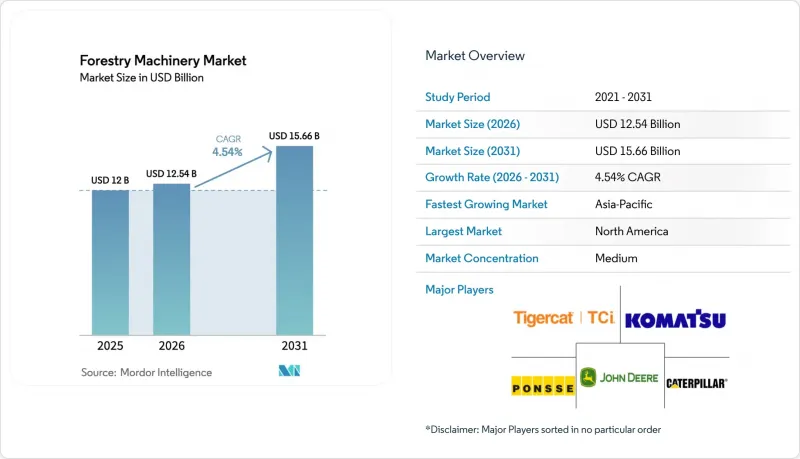
本報告按機器類型(集材機、運材機、伐木集材機等)、動力來源(柴油、混合動力等)、自動化程度(手排等)、最終用戶(伐木承包商、林地所有者協會等)和地區(北美、歐洲、亞太等)進行細分。市場預測以美元計價。
全球林業機械市場趨勢與洞察
新興經濟體機械化伐木的激增
在中國,隨著政府加強對永續森林管理的要求,機械化率不斷提高。巴西桉樹人工林生產力的提升也反映了這一點。當單株木材積超過0.58立方公尺時,集材機每有效工時可達到60.97立方公尺的產量,而木材積較小的單株木材每有效工時產量則為42.06立方公尺。發展中地區的營運成本下降,甚至低於一些已開發市場。在巴拉圭,由於投資者尋求從機械化桉樹林中獲得回報,人工林面積增加了四倍。設備製造商開發了輕型集材機和振動式轉向架,以減少土壤壓實,從而適應當地的地形條件,使新興國家的作業者能夠同時滿足生產力和環境標準。
全球對認證木製品的需求不斷成長
2023年,在土耳其,FSC認證使橡木原木價格上漲了19.28%,山毛櫸原木價格上漲了12.30%。這表明認證溢價可以抵消對精密設備的投資。將於2024年12月生效的歐洲森林砍伐法規將要求出口商提供地理位置和可追溯性數據,這需要安裝數位記錄器和衛星系統。日本和西歐的認證要求正在推動選擇性伐木設備和環保車輛的使用,以維護森林品質。主要買家目前正在實施審核系統來處理數據,而機器產生的伐木記錄對於市場准入至關重要。
高昂的初始成本和生命週期擁有成本
在美國東南部,履帶式收割機的價格在31.6萬美元到76.3萬美元之間。在巴西,對於運作時間超過3萬小時的約翰迪爾機型,維護成本佔每小時運轉成本的33.5%。捷克共和國的一項研究發現,人事費用佔集材機營運成本的35%至66%,凸顯了操作員效率對於確保投資報酬率(ROI)的重要性。機器尺寸和品牌會影響保值率,大型車輛的初始投資更大,轉售價值也更高。結合遠端資訊處理服務合約和殘值擔保的融資方案可以幫助控制成本,但小規模承包商仍面臨融資管道有限的問題。
細分市場分析
到2025年,隨著製造商將精密切割頭和長徑最佳化演算法即時整合到產品中,林業收割機將佔據林業機械市場33.80%的佔有率。預計到2031年,集材機市場將以7.65%的複合年成長率成長,因為種植園經營者採用整合式定長切割系統,最大限度地減少對土壤的影響並減少集材機的使用。約翰迪爾公司的C7.1雙渦輪增壓收割機引擎是該行業技術進步的一個典型例子,它將迴轉扭力提高了30%,同時將維護時間減少了15%。
由於南方松樹的特殊特性和林分密度要求,伐木集材機在南方松伐木場仍保持市場地位。然而,隨著伐木機頭多株樹木同時處理能力的提升,其市佔率可能會下降。迴轉式伐木機和裝載機繼續滿足路邊作業的特殊加工需求,而碎木機則在市政防火項目中保持穩定的需求。設備製造商的累積訂單表明,市場對配備可互換附件的多功能運輸車的需求日益成長,這些附件可用於採伐、運輸和鏟運,使操作人員能夠有效應對市場波動。
預計2025年,柴油引擎在林業機械市場仍將佔據77.30%的佔有率。這主要是因為柴油引擎的運作循環性能優於目前的電池性能。電池電動解決方案正以10.25%的複合年成長率成長。沃爾沃推出的「EW240電動物料搬運機」證明了大型電池驅動設備的可行性,行動充電拖車也逐漸成為經銷商產品目錄中的標準配備。混合動力系統目前正作為一種過渡技術發揮作用,例如Senebogen的「綠色混合動力」能源回收系統可將起重機作業的燃油消耗降低高達30%。
金融機構目前正將排碳權收入納入其低排放機械設備的融資計畫中。這項轉變意味著動力傳動系統的選擇不再僅基於初始購買價格,而是基於環境影響的總擁有成本。在斯堪地那維亞,零排放收割機在公共土地合約競標中可獲得加分,這表明監管方面可能訂定相關政策,從而加速柴油動力設備的淘汰,其速度可能超過僅由經濟因素預測的速度。
區域分析
預計到2025年,北美將佔據林業機械市場36.50%的佔有率,這主要得益於成熟的機械化實踐以及為解決人手不足而開展的自主收割機試點部署。該地區將受益於8,000萬美元的聯邦津貼和稅收優惠,從而縮短電動收割機的投資回收期(預計2025年)。加拿大臨時外籍勞工數量增加五倍,顯示勞動力短缺問題依然存在,這將進一步推動自動化設備的普及。經銷商正在調整庫存,以應對約翰迪爾公司預測的2025年銷量下滑,同時,由於營運商致力於提高設備運轉率,對遠端資訊處理模組的改造需求依然強勁。
亞太地區以7.05%的複合年成長率呈現最高增速,其中中國商業伐木機械化率已超過60%。日本小松公司預測,在木材需求、勞動力短缺和日益嚴格的安全要求的推動下,市場將持續擴張。目前,與日本認證相關的額外成本限制了伐木機的升級換代,而日本國內製造商則看到了亞太地區不斷成長的造林業帶來的出口機會。
在歐洲,受認證要求的推動,車輛更新換代週期保持強勁。歐盟的伐木法規將於2024年12月生效,該法規強制要求使用GPS精確的伐木數據,從而推動了對配備StanForD兼容伐木系統的最新型駕駛室的需求。瑞典和芬蘭在電動卡車的推廣應用方面發揮了先鋒作用,SCA的木材運輸車每年可減少55公噸的排放量。 Ponsse公司報告稱,2024年上半年已從北歐國家獲得價值3.36億歐元(3.934億美元)的訂單,這表明儘管建築業低迷,但車輛更新換代需求依然穩定。
在南美洲,統一的桉樹種植園正推動營運最佳化,為大型自動駕駛車隊提供支援。巴西已在成本效益方面建立了生產力標準,而隨著巴拉圭種植面積的擴大,該國也看到了OEM(目的地設備製造商)融資服務的機會。中東和非洲市場仍處於起步階段,但捐助者資助的植樹造林計畫正在為輕型集材機和多用途裝載機創造實際的商業機會。
其他好處:
- Excel格式的市場預測(ME)表
- 3個月的分析師支持
目錄
第1章:引言
- 研究假設和市場定義
- 調查範圍
第2章:調查方法
第3章執行摘要
第4章 市場狀況
- 市場概覽
- 市場促進因素
- 新興經濟體機械化伐木的激增
- 全球對認證木製品的需求不斷成長
- 政府對植樹造林的獎勵措施和補貼
- 非公路機械的電氣化
- 為因應人手不足,引入了自主機械。
- 引入數位孿生技術進行預測性維護
- 市場限制因素
- 高昂的初始成本和整個生命週期的擁有成本
- 針葉樹商品價格波動
- 熟練操作人員短缺,無法操作先進機械
- 具備遙測功能的設備存在網路安全漏洞
- 監理情勢
- 技術展望
- 波特五力分析
第5章 市場規模與成長預測
- 按機器類型
- 集材機
- 貨運代理
- 費勒‧邦徹
- 收割機
- 旋轉機
- 裝載機
- 其他機器類型
- 透過電源
- 柴油引擎
- 混合
- 電池式電動車
- 按自動化級別
- 手動的
- 半自動
- 完全自主
- 最終用戶
- 合約伐木公司
- 森林所有者團體
- 紙漿和造紙公司
- 鋸木廠
- 按地區
- 北美洲
- 美國
- 加拿大
- 墨西哥
- 其他北美國家
- 歐洲
- 德國
- 瑞典
- 芬蘭
- 英國
- 法國
- 西班牙
- 俄羅斯
- 其他歐洲國家
- 亞太地區
- 中國
- 日本
- 印度
- 韓國
- 其他亞太國家
- 南美洲
- 巴西
- 阿根廷
- 其他南美國家
- 中東
- 沙烏地阿拉伯
- 阿拉伯聯合大公國
- 土耳其
- 其他中東國家
- 非洲
- 南非
- 埃及
- 其他非洲國家
- 北美洲
第6章 競爭情勢
- 市場集中度
- 策略趨勢
- 市佔率分析
- 公司簡介
- Deere & Company
- Komatsu Ltd.
- Caterpillar Inc.
- Tigercat International Inc.
- Ponsse Plc
- Volvo Construction Equipment AB(AB Volvo)
- Hitachi Construction Machinery Co., Ltd.(Hitachi Ltd.)
- Kubota Corporation
- Barko Hydraulics LLC(Heico Companies)
- Rottne Industri AB
- Kawasaki Heavy Industries, Ltd.
- Doosan Bobcat Inc.(Doosan Group)
- LKT Holding sro
- Kesla Oyj
- Sennebogen Maschinenfabrik GmbH
第7章 市場機會與未來展望
According to Mordor Intelligence, the forestry machinery market size in 2026 is estimated at USD 12.54 billion, growing from 2025 value of USD 12.0 billion with 2031 projections showing USD 15.66 billion, growing at 4.54% CAGR over 2026-2031.
This report is Segmented by Machine Type (Skidders, Forwarders, Feller Bunchers, and More), by Power Source (Diesel, Hybrid, and More), by Automation Level (Manual, and More), by End User (Contract Logging Firms, Forest Ownership Groups, and More), and by Geography (North America, Europe, Asia-Pacific, and More). The Market Forecasts are Provided in Terms of Value (USD).
Global Forestry Machinery Market Trends and Insights
Surge in Mechanized Logging in Emerging Economies
Mechanization rates in China increased as government mandates strengthened sustainable forest management requirements. Productivity gains in Brazilian eucalyptus plantations demonstrate measurable benefits - forwarder output reaches 60.97 m3 per effective work hour when individual tree volume exceeds 0.58 m3, compared to 42.06 m3 at lower volumes. Operational costs in developing regions have decreased, becoming lower than in several developed markets. Paraguay's plantation area quadrupled as investors targeted returns from mechanized eucalyptus stands. Equipment manufacturers developed lighter forwarders and oscillating bogies that reduce soil compaction for local terrain conditions, enabling emerging operators to achieve both productivity and environmental standards.
Rising Global Demand for Certified Timber Products
Forest Stewardship Council certification increased oak log prices by 19.28% and beech log prices by 12.30% in Turkey in 2023, demonstrating that certification premiums can offset investments in precision equipment. The European Deforestation Regulation, which takes effect in December 2024, requires exporters to provide geolocation and traceability data, necessitating the implementation of digital recorders and satellite systems. Certification requirements in Japan and Western Europe promote the use of selective cutting equipment and low-impact vehicles to maintain forest quality. Major buyers now incorporate audit systems that process data, making machine-generated logging records essential for market access.
High Upfront and Lifecycle Ownership Costs
Tracked harvesters in the southeastern United States range from USD 316,000 to USD 763,000. In Brazil, maintenance accounts for 33.5% of hourly operating costs for John Deere models with over 30,000 operating hours. Research from the Czech Republic indicates that personnel costs comprise 35-66% of forwarder operating expenses, making operator efficiency essential for return on investment. Machine size and brand influence value retention, with larger carriers maintaining higher resale values despite requiring greater initial capital. Financing packages combining telematics subscriptions and residual-value guarantees help manage costs, but small contractors continue to face limited credit availability.
Other drivers and restraints analyzed in the detailed report include:
- Government Re-Afforestation Incentives and Subsidies
- Electrification of Off-Highway Machinery Fleets
- Volatility in Soft-Wood Commodity Prices
For complete list of drivers and restraints, kindly check the Table Of Contents.
Segment Analysis
Harvesters generated 33.80% of the forestry machinery market share in 2025 as manufacturers embedded precision felling heads and real-time length-diameter optimization algorithms. The forwarder segment is projected to grow at a 7.65% CAGR through 2031, as plantation operators adopt integrated cut-to-length systems that minimize soil impact and reduce skidder usage. The technological advancement in the industry is exemplified by Deere's C7.1 twin turbo harvester engine, which delivers 30% higher swing torque while reducing maintenance time by 15%.
Feller bunchers maintain their market position in Southern pine operations due to specific tree characteristics and stand density requirements. Their market share may decline as harvesting heads develop enhanced multi-tree handling capabilities. Swing machines and loaders continue to serve specialized processing requirements at roadside locations, while mulchers maintain consistent demand from municipal wildfire prevention programs. Equipment manufacturers' order backlogs indicate increasing preference for versatile carriers that accommodate interchangeable harvesting, forwarding, and hoe-chucking attachments, helping operators manage market fluctuations effectively.
Diesel engines maintain a 77.30% share in the forestry machinery market in 2025, primarily due to operational duty cycles exceeding current battery capabilities. Battery-electric solutions are growing at a 10.25% CAGR. The introduction of Volvo's EW240 Electric Material Handler demonstrates the viability of heavy battery-powered equipment, while mobile charging trailers become standard offerings in dealer catalogs. Hybrid systems function as transitional technology, with Sennebogen's Green Hybrid energy recovery system reducing fuel consumption by up to 30% in crane operations.
Financial institutions now incorporate carbon credit revenue streams in their equipment financing programs for low-emission machines. This shift has led to powertrain selection decisions based on total environmental ownership costs rather than initial purchase price. In Scandinavia, public land contract bids award additional points for zero-emission harvesters, indicating regulatory influences that may accelerate the transition away from diesel faster than economic factors alone would predict.
Complete Report Scope:
- By Machine Type
- Skidders
- Forwarders
- Feller Bunchers
- Harvesters
- Swing Machines
- Loaders
- Other Machine Type
- By Power Source
- Diesel
- Hybrid
- Battery-Electric
- By Automation Level
- Manual
- Semi-Autonomous
- Fully Autonomous
- By End User
- Contract Logging Firms
- Forest Ownership Groups
- Pulp and Paper Companies
- Sawmills
- By Geography
- North America
- United States
- Canada
- Mexico
- Rest of North America
- Europe
- Germany
- Sweden
- Finland
- United Kingdom
- France
- Spain
- Russia
- Rest of Europe
- Asia-Pacific
- China
- Japan
- India
- South Korea
- Rest of Asia-Pacific
- South America
- Brazil
- Argentina
- Rest of South America
- Middle East
- Saudi Arabia
- United Arab Emirates
- Turkey
- Rest of Middle East
- Africa
- South Africa
- Egypt
- Rest of Africa
- North America
Geography Analysis
North America holds a 36.50% share in the forestry machinery market in 2025 due to established mechanized practices and autonomous harvester trials addressing labor shortages. The region benefits from USD 80 million in federal grants for 2025 and tax incentives that reduce payback periods for electrified carriers. Canada's fivefold increase in temporary foreign workers indicates persistent labor constraints, supporting automated equipment adoption. Dealers manage inventory against Deere's projected decline for 2025, and demand for telematics module retrofits remains strong as operators focus on equipment uptime.
Asia-Pacific shows the highest growth rate at 7.05% CAGR, with China's commercial harvest mechanization exceeding 60%. Komatsu anticipates continued market expansion based on wood demand, labor constraints, and enhanced safety requirements. Japanese certification premiums currently limit harvester upgrades, and domestic manufacturers identify export opportunities in the Asia Pacific's expanding plantation sector.
Europe maintains robust replacement cycles driven by certification requirements. The European Union Deforestation Regulation, effective December 2024, mandates GPS-accurate harvest data, increasing demand for modern cabs with StanForD-compatible logging systems. Sweden and Finland are pioneers in electric truck implementations, with SCA's timber haulers reducing their annual emissions by 55 metric tons. Ponsse reported EUR 336.0 million (USD 393.4 million) in order intake from Nordic countries during the first half of 2024, demonstrating stable replacement demand despite weakness in the construction sector.
South America optimizes operations through uniform eucalyptus plantations supporting high-capacity, automated fleets. Brazil sets productivity standards for cost efficiency, while Paraguay's expanding cultivation area creates opportunities for Original Equipment Manufacturers (OEM) financing services. The Middle East and Africa markets remain early-stage, with reforestation programs supported by donor funding creating specific opportunities for light skidders and multipurpose loaders.
- Deere & Company
- Komatsu Ltd.
- Caterpillar Inc.
- Tigercat International Inc.
- Ponsse Plc
- Volvo Construction Equipment AB (AB Volvo)
- Hitachi Construction Machinery Co., Ltd. (Hitachi Ltd.)
- Kubota Corporation
- Barko Hydraulics LLC (Heico Companies)
- Rottne Industri AB
- Kawasaki Heavy Industries, Ltd.
- Doosan Bobcat Inc. (Doosan Group)
- LKT Holding s. r. o.
- Kesla Oyj
- Sennebogen Maschinenfabrik GmbH
Additional Benefits:
- The market estimate (ME) sheet in Excel format
- 3 months of analyst support
TABLE OF CONTENTS
1 Introduction
- 1.1 Study Assumptions and Market Definition
- 1.2 Scope of the Study
2 Research Methodology
3 Executive Summary
4 Market Landscape
- 4.1 Market Overview
- 4.2 Market Drivers
- 4.2.1 Surge in Mechanized Logging in Emerging Economies
- 4.2.2 Rising Global Demand for Certified Timber Products
- 4.2.3 Government Re-Afforestation Incentives and Subsidies
- 4.2.4 Electrification of Off-Highway Machinery Fleets
- 4.2.5 Labor-Shortage-Led Adoption of Autonomous Machineries
- 4.2.6 Digital Twin Deployment for Predictive Maintenance
- 4.3 Market Restraints
- 4.3.1 High Upfront and Lifecycle Ownership Costs
- 4.3.2 Volatility in Soft-Wood Commodity Prices
- 4.3.3 Shortage of Skilled Operators for Advanced Machines
- 4.3.4 Cyber-Security Gaps in Telemetry-Enabled Equipment
- 4.4 Regulatory Landscape
- 4.5 Technological Outlook
- 4.6 Porter's Five Forces Analysis
- 4.6.1 Bargaining Power of Suppliers
- 4.6.2 Bargaining Power of Buyers
- 4.6.3 Threat of Substitute Products
- 4.6.4 Threat of New Entrants
- 4.6.5 Intensity of Competitive Rivalry
5 Market Size and Growth Forecasts (Value)
- 5.1 By Machine Type
- 5.1.1 Skidders
- 5.1.2 Forwarders
- 5.1.3 Feller Bunchers
- 5.1.4 Harvesters
- 5.1.5 Swing Machines
- 5.1.6 Loaders
- 5.1.7 Other Machine Type
- 5.2 By Power Source
- 5.2.1 Diesel
- 5.2.2 Hybrid
- 5.2.3 Battery-Electric
- 5.3 By Automation Level
- 5.3.1 Manual
- 5.3.2 Semi-Autonomous
- 5.3.3 Fully Autonomous
- 5.4 By End User
- 5.4.1 Contract Logging Firms
- 5.4.2 Forest Ownership Groups
- 5.4.3 Pulp and Paper Companies
- 5.4.4 Sawmills
- 5.5 By Geography
- 5.5.1 North America
- 5.5.1.1 United States
- 5.5.1.2 Canada
- 5.5.1.3 Mexico
- 5.5.1.4 Rest of North America
- 5.5.2 Europe
- 5.5.2.1 Germany
- 5.5.2.2 Sweden
- 5.5.2.3 Finland
- 5.5.2.4 United Kingdom
- 5.5.2.5 France
- 5.5.2.6 Spain
- 5.5.2.7 Russia
- 5.5.2.8 Rest of Europe
- 5.5.3 Asia-Pacific
- 5.5.3.1 China
- 5.5.3.2 Japan
- 5.5.3.3 India
- 5.5.3.4 South Korea
- 5.5.3.5 Rest of Asia-Pacific
- 5.5.4 South America
- 5.5.4.1 Brazil
- 5.5.4.2 Argentina
- 5.5.4.3 Rest of South America
- 5.5.5 Middle East
- 5.5.5.1 Saudi Arabia
- 5.5.5.2 United Arab Emirates
- 5.5.5.3 Turkey
- 5.5.5.4 Rest of Middle East
- 5.5.6 Africa
- 5.5.6.1 South Africa
- 5.5.6.2 Egypt
- 5.5.6.3 Rest of Africa
- 5.5.1 North America
6 Competitive Landscape
- 6.1 Market Concentration
- 6.2 Strategic Moves
- 6.3 Market Share Analysis
- 6.4 Company Profiles (Includes Global-level Overview, Market-level Overview, Core Segments, Financials as available, Strategic Information, Market Rank/Share, Products and Services, and Recent Developments)
- 6.4.1 Deere & Company
- 6.4.2 Komatsu Ltd.
- 6.4.3 Caterpillar Inc.
- 6.4.4 Tigercat International Inc.
- 6.4.5 Ponsse Plc
- 6.4.6 Volvo Construction Equipment AB (AB Volvo)
- 6.4.7 Hitachi Construction Machinery Co., Ltd. (Hitachi Ltd.)
- 6.4.8 Kubota Corporation
- 6.4.9 Barko Hydraulics LLC (Heico Companies)
- 6.4.10 Rottne Industri AB
- 6.4.11 Kawasaki Heavy Industries, Ltd.
- 6.4.12 Doosan Bobcat Inc. (Doosan Group)
- 6.4.13 LKT Holding s. r. o.
- 6.4.14 Kesla Oyj
- 6.4.15 Sennebogen Maschinenfabrik GmbH
7 Market Opportunities and Future Outlook

 農業和林業機械市場分析及預測(至2035年):按類型、產品類型、服務、技術、零件、應用、過程、最終用戶、設備分類
 全球林業機械市場:機會與策略展望(至2035年)
 全球木材削片機市場規模、佔有率、趨勢和成長分析報告(2026-2034年)全球林業設備市場規模、佔有率、趨勢和成長分析報告(2026-2034年)
 木材削片機市場規模、佔有率和趨勢分析報告:按產品、最終用途、地區和細分市場分類(2026-2033 年)
 2026-2030年全球林業設備市場
 林業設備市場商機、成長要素、產業趨勢分析及2026-2035年預測。
 林業設備市場:依產品類型、動力來源、材料及地區分類。
 林業機械市場:2026年至2032年全球預測(依設備類型、推進方式、功率輸出、應用通路通路分類)
 林業設備:市場佔有率分析、產業趨勢與統計、成長預測(2026-2031)