


 |
市場調查報告書
商品編碼
2114513
水產養殖飼料添加劑:市場佔有率分析、產業趨勢和統計數據、成長預測(2026-2031)Aquafeed Additives - Market Share Analysis, Industry Trends & Statistics, Growth Forecasts (2026 - 2031) |
||||||

※ 本網頁內容可能與最新版本有所差異。詳細情況請與我們聯繫。
據 Mordor Intelligence 稱,魚飼料添加劑市場預計到 2026 年價值 30.3 億美元,高於 2025 年的 29 億美元,預計到 2031 年將達到 37.9 億美元。
預計從 2026 年到 2031 年,其複合年成長率將達到 4.55%。
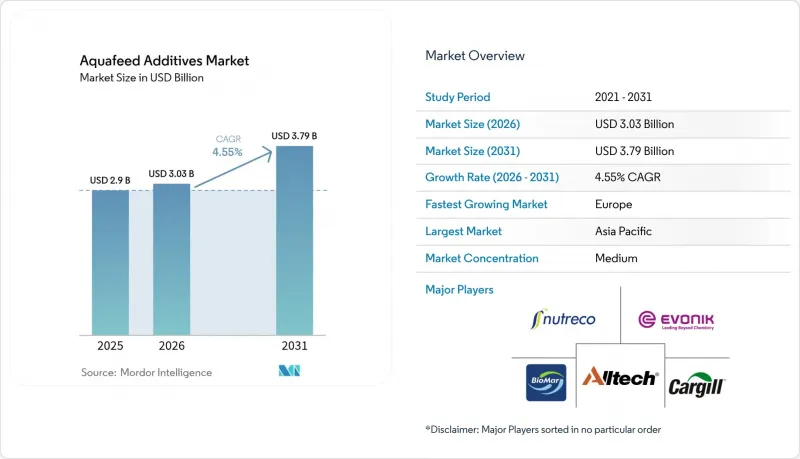
本報告按目標物種(魚類、軟體動物、甲殼類動物及其他)、添加劑類型(維生素、礦物質、抗氧化劑、胺基酸、酵素、酸味劑等)、劑型(乾擠壓顆粒、濕顆粒等)和地區(北美、歐洲、亞太、南美等)進行分類。市場預測以美元計價。
全球水產養殖飼料添加劑市場趨勢及洞察
全球水產品消費量不斷成長,蛋白質來源也不斷變化
全球蛋白質需求正轉向海鮮來源。光是在非洲,預計到2050年水產品消費量就將從1,000萬噸增加到2,900萬噸,這趨勢與亞洲類似。在亞洲,吳郭魚養殖一體化企業正在將飼料廠本地化,以減少進口。聯合國糧農組織預測,2030年養殖魚價格將上漲24%,將促使生產商採用促進生長和縮短生產週期的添加劑。像Albert Heijn這樣的零售商現在銷售以昆蟲粉和藻油為飼料養殖的蝦,這表明消費者正在接受替代飼料技術。這種需求的轉變正在推動植物來源飼料中氨基酸和酵素的使用,以取代魚粉,同時保持最佳的氨基酸組成以提高生產力。因此,海鮮飼料添加劑市場對魚粉價格波動的抵抗力正在增強。
擴大密集水產養殖能力
沙烏地阿拉伯公司NAQUA營運500個水產養殖池塘,目標是到2030年實現年產量25萬噸,凸顯了全球水產養殖業正向高密度養殖系統轉型,而這些系統依賴強大的益生菌和水質管理方案。在中國,集約化蝦類養殖場在2022年產量達209萬噸,但面臨遺傳資源枯竭和疾病風險,促使養殖戶開始採用增強免疫力的添加劑。循環水養殖系統和生物絮團養殖需要精確的營養配比來維持微生物平衡,從而催生了對高品質產品的需求。因此,水產養殖飼料添加劑市場正受惠於技術主導的快速擴張,業務遍及亞洲、中東和南美洲。
魚粉和魚油價格的波動正在影響添加劑的成本。
魚粉和魚油價格的波動給水產飼料添加劑生產商帶來了衝擊,使成本轉嫁和盈利受到威脅。儘管秘魯魚粉產量增加了300%,帶動全球魚粉產量在2025年1月增加了75%,但價格波動限制了生產商將溢價轉嫁給添加劑的能力。魚油產量增加了34%,但由於飼料生產商面臨雙重成本壓力,供應商在利潤空間被壓縮的情況下定價。在中國,由於洪水和養殖戶的成本削減措施,2024年水產飼料產量下降了3.5%。這清楚地表明,價格波動正在抑制添加劑的使用。聯合國糧農組織預測,到2030年,魚粉價格將上漲30%,預計這將加速對昆蟲粉和單細胞蛋白的尋找,而這將需要對新添加劑的配方進行調整。供應鏈的不確定性,特別是到 2025 年 9 月仍需繼續依賴冷凍魚作為原料,使得水產養殖飼料添加劑市場的庫存計畫變得複雜。
細分市場分析
到2025年,魚類將佔據水產養殖飼料添加劑市場52.85%的佔有率,憑藉全球蓬勃發展的鮭魚、吳郭魚和鯉魚養殖業,魚類仍將是最大的消費族群。預計到2025年,魚類飼料添加劑市場規模將達到15.3億美元,凸顯了那些透過標準化添加劑方案來確保飼料轉換率的企業的強大購買力。挪威和智利的鮭魚養殖戶持續添加功能性胺基酸和抗氧化劑,以減輕高密度養殖和運輸過程中的壓力反應。同時,亞洲的鯉魚養殖場則專注於開發經濟高效的維生素和酵素製劑,以應對緊張的飼料預算。由於現有飼料廠已實施數位化可追溯系統,那些能夠顯著提高飼料效率和魚片產量的添加劑,正透過長期供應合約迅速擴大規模。因此,水產養殖業已建立一套標準規範,大多數供應商在檢驗新成分時都會遵循這些規範。
以蝦類為首的甲殼類動物養殖業正呈現最快成長態勢,預計2031年年均複合成長率將達到8.92%。為了降低疾病風險並實現高品質的著色效果,養殖戶仍在增加添加劑投入。一項研究表明,使用5%富含蝦青素的磷蝦油,即使在鹽脅迫下也能實現100%的存活率,並且由於色素加深,市場價值得到提升,從而提高了養殖戶對專用投入品的支付意願。中國水產養殖戶正持續轉向使用含有活化免疫力益生菌的多階段功能性飼料,而南美水產養殖戶則專注於開發能夠抵抗鹹淡水滲漏的植物來源包埋成分。軟體動物和海參等小眾物種也值得關注,儘管其養殖規模較小,但微粉化礦物質混合物能夠改善貝殼強度和質地,使其在高階市場獲得高價銷售。隨著需求多樣化,供應商提供針對每種水產養殖品種最佳化的添加劑組合,預計這將導致水產養殖飼料添加劑市場所有生產環節的銷售量和銷售額穩定成長。
區域分析
預計到2025年,亞太地區將佔全球銷售額的61.05%,並將持續支撐銷售量成長,主要得益於中國蝦類產量超過200萬噸。由於疾病爆發和蛋白質來源的變化,水產養殖場除了使用基礎氨基酸製劑外,還需添加增強免疫力的添加劑。越南和印度的出口型水產養殖業正在擴張,但價格敏感性導致市場兩極化,高階添加劑和成本最佳化型混合製劑並存。
隨著歐盟指令提高永續性要求,歐洲水產養殖飼料添加劑市場預計將從2026年的5.6億美元成長到2031年的8.3億美元,複合年成長率達8.05%。挪威鮭魚產業在精準投餵技術的應用方面處於領先地位,並正在加速人工智慧輔助投餵系統的測試,以提高功能性添加劑的利用效率。 「地平線歐洲」計畫預計每年將投資超過600萬歐元(約695萬美元)用於綠色飼料研究,加速藻類來源的抗氧化劑和植物營養素的商業化。
北美雖然養殖業已較成熟,但仍保持良好的創新環境。美國水產養殖策略計畫支持公私合營,使添加劑開發商能夠在受控條件下試用新型蛋白質和噬菌體解決方案。在加拿大,為保護原住民權利,環境、社會和治理(ESG)因素也正被納入環境友善配方的評估範圍。同時,墨西哥的蝦農正在加強與跨境供應商的合作,並增加添加劑的加工量。
其他好處:
- Excel格式的市場預測(ME)表
- 3個月的分析師支持
目錄
第1章:引言
- 研究假設和市場定義
- 調查範圍
第2章:調查方法
第3章執行摘要
第4章 市場狀況
- 市場概覽
- 市場促進因素
- 全球水產品消費量增加與蛋白質來源轉變
- 擴大密集水產養殖能力
- 政府對水產養殖的補貼和永續性法規。
- 可替代抗生素用於飼料的功能性添加劑
- 碳足跡標籤正在推動微藻類和單細胞衍生添加劑的應用。
- 透過利用人工智慧進行精準投料,我們提高了特殊添加劑的混合比例。
- 市場限制因素
- 魚粉和魚油價格的波動正在影響添加劑成本的轉嫁。
- 多個地區對新型飼料添加劑實行嚴格的核准程序
- 對顆粒粘合劑和塗層中的微塑膠進行審查
- 氣候變遷導致作物減產,加劇了植物來源生物製劑的供應緊張。
- 監理情勢
- 技術展望
- 波特五力分析
第5章 市場規模與成長預測
- 按類型
- 魚
- 鮭科
- 吳郭魚
- 鯉魚
- 鯰魚
- 軟體動物
- 甲殼類動物
- 其他
- 魚
- 按添加劑類型
- 維他命
- 礦物
- 抗氧化劑
- 胺基酸
- 酵素
- 酸味劑
- 益生菌和益生元
- 植物來源和精油
- 其他(類胡蘿蔔素/蝦青素、顆粒粘合劑/膨潤土等)
- 按形式
- 乾擠壓顆粒
- 濕顆粒
- 微膠囊粉末
- 按地區
- 北美洲
- 美國
- 加拿大
- 墨西哥
- 其他北美國家
- 歐洲
- 德國
- 英國
- 法國
- 西班牙
- 俄羅斯
- 其他歐洲國家
- 亞太地區
- 中國
- 印度
- 日本
- 越南
- 其他亞太國家
- 南美洲
- 巴西
- 阿根廷
- 其他南美國家
- 中東
- 土耳其
- 沙烏地阿拉伯
- 其他中東國家
- 非洲
- 南非
- 其他非洲國家
- 北美洲
第6章 競爭情勢
- 市場集中度
- 策略趨勢
- 市佔率分析
- 公司簡介
- Benchmark Holdings plc(INVE Aquaculture)
- BASF SE
- Evonik Industries AG
- Adisseo
- Cargill, Incorporated
- Archer Daniels Midland(ADM)
- BioMar Group
- Alltech
- Nutreco NV(Skretting)
- Zeigler Feeds
- Kemin Industries, Inc.
- Phibro Animal Health Corporation
- Calysta Inc.
- Bentoli
- Phytobiotics Futterzusatzstoffe GmbH
第7章 市場機會與未來展望
According to Mordor Intelligence, aquafeed additives market size market size in 2026 is estimated at USD 3.03 billion, growing from 2025 value of USD 2.9 billion with 2031 projections showing USD 3.79 billion, growing at 4.55% CAGR over 2026-2031.
This report is Segmented by Species Type (Fish, Mollusks, Crustaceans, and Others), by Additives Type (Vitamins, Minerals, Antioxidants, Amino Acids, Enzymes, Acidifiers, and More), by Form (Dry Extruded Pellets, Moist Pellets, and More) and by Geography (North America, Europe, Asia-Pacific, South America, and More). The Market Forecasts are Provided in Terms of Value (USD).
Global Aquafeed Additives Market Trends and Insights
Rising Global Seafood Consumption and Protein Shift
Global protein demand is moving toward aquatic sources. Africa alone is forecast to raise seafood intake from 10 million metric tons to 29 million metric tons by 2050, a trajectory mirrored in Asia, where tilapia integrators are localizing feed mills to cut imports. FAO expects farm-raised fish prices to climb 24% by 2030, encouraging producers to adopt additives that deliver faster growth and shorten production cycles. Retailers such as Albert Heijn now stock shrimp fed on insect meal and algal oil, signaling buyer acceptance of alternative feed technologies. This demand pivot supports amino acid and enzyme use in plant-based diets that replace fishmeal while sustaining optimal amino-acid profiles for performance. Consequently, the aquafeed additives market gains resilience against fishmeal volatility.
Expansion of Intensive Aquaculture Capacity
Saudi firm NAQUA operates 500 ponds and targets 250,000 metric tons of annual output by 2030, highlighting the global shift toward high-density systems that rely on robust probiotic and water-quality programs. In China, intensive shrimp farms produced 2.09 million metric tons in 2022, yet faced germplasm depletion and disease risks that drive uptake of immune-boosting additives. Recirculating aquaculture systems and biofloc require precision nutrient packages to sustain microbial balance, creating premium demand pockets. The aquafeed additives market, therefore, benefits from clustered, technology-driven expansions across Asia, the Middle East, and South America.
Volatile Fishmeal and Fish-Oil Pricing Impacting Additive Cost Pass-Through
Volatile fishmeal and fish-oil prices disrupt aquafeed additive manufacturers, complicating cost pass-through and profitability. Peru's 300% surge in fishmeal output lifted global production by 75% in January 2025, yet price swings restrict manufacturers' ability to price through additive premiums. Fish oil output climbed 34%, but suppliers leveraged compressed margins as feed makers struggled to absorb dual cost pressures. China's aquafeed output fell 3.5% in 2024 amid flooding and farmer cost-cutting, illustrating how volatility curbs additive uptake. FAO foresees fishmeal prices rising 30% by 2030, quickening the search for insect meal or single-cell proteins that demand new additive calibrations. Supply-chain uncertainty, particularly the reliance on frozen fish inputs until September 2025, complicates inventory planning for the aquafeed additives market.
Other drivers and restraints analyzed in the detailed report include:
- Government Subsidies and Sustainability Mandates in Aquaculture
- Functional Additives Replacing In-Feed Antibiotics
- Stringent Multi-Region Approval Timelines for Novel Feed Additives
For complete list of drivers and restraints, kindly check the Table Of Contents.
Segment Analysis
Fish represented 52.85% of the aquafeed additives market share in 2025, remaining the largest consumer group due to the extensive farming of salmon, tilapia, and carp globally. This dominance converted into an estimated USD 1.53 billion slice of the aquafeed additives market size in 2025, illustrating the purchasing power of operators that have standardized additive protocols to safeguard feed-conversion ratios. Salmon producers in Norway and Chile continue to layer functional amino acids and antioxidants that counteract stress during high-density grow-out and transport phases, the Asian carp farms emphasize cost-effective vitamin and enzyme packages to hit tight feed budgets. Established feed mills already integrate digital traceability, so any additive that demonstrates a measurable uplift in feed efficiency or fillet yield quickly scales through long-term supply contracts. Consequently, fish farming sets the baseline specification that most suppliers use when validating new ingredients.
Crustaceans, led by shrimp, display the fastest adoption curve with a 8.92% CAGR through 2031 as producers justify the higher additive spend to offset still-elevated disease risks and achieve premium coloration. Trials using 5% astaxanthin-rich krill oil have delivered 100% survival under salinity stress while raising market value through deeper pigmentation, reinforcing willingness to pay for specialty inputs. Chinese farmers continue turning to multi-phase functional diets that include immunostimulant probiotics, the South American growers focus on encapsulated phytogenics that resist leaching in brackish ponds. Mollusks and niche species such as sea cucumbers remain small but notable, with micronized mineral blends enhancing shell strength and texture attributes that fetch superior prices in gourmet channels. As demand diversifies, suppliers tailor species-specific additive bundles, positioning the aquafeed additives market for steady volume and value gains across distinct production segments.
Complete Report Scope:
- By Species Type
- Fish
- Salmonids
- Tilapia
- Carp
- Catfish
- Mollusks
- Crustaceans
- Others
- Fish
- By Additive Type
- Vitamins
- Minerals
- Antioxidants
- Amino Acids
- Enzymes
- Acidifiers
- Probiotics and Prebiotics
- Phytogenics and Essential Oils
- Others (Carotenoids/Astaxanthin, Pellet Binders/Bentonite, etc.)
- By Form
- Dry Extruded Pellets
- Moist Pellets
- Micro-encapsulated Powders
- By Geography
- North America
- United States
- Canada
- Mexico
- Rest of North America
- Europe
- Germany
- United Kingdom
- France
- Spain
- Russia
- Rest of Europe
- Asia-Pacific
- China
- India
- Japan
- Vietnam
- Rest of Asia-Pacific
- South America
- Brazil
- Argentina
- Rest of South America
- Middle East
- Turkey
- Saudi Arabia
- Rest of Middle East
- Africa
- South Africa
- Rest of Africa
- North America
Geography Analysis
Asia-Pacific contributed 61.05% of global revenue in 2025 and continues to anchor volume growth, led by China's shrimp production surpassing 2 million metric tons. Disease outbreaks and protein-source shifts compel farms to layer immune-enhancing additives on top of core amino-acid packages. Vietnam and India are expanding export-oriented aquaculture, but price sensitivity shapes a two-tier market where premium additives coexist with cost-optimized blends.
Europe's aquafeed additives market size is projected to expand from USD 0.56 billion in 2026 to USD 0.83 billion by 2031 on an 8.05% CAGR as EU directives elevate sustainability requirements. Norway's salmon sector leads precision feeding adoption, catalyzing trials of AI-supported dosing systems that elevate functional additive use efficiency. Horizon Europe projects funnel more than EUR 6 million (USD 6.95 million) into green-feed research annually, accelerating the commercialization of algae-derived antioxidants and phytonutrients.
North America presents a mature but innovation-friendly landscape. The US Strategic Plan for Aquaculture backs public-private infrastructures where additive developers pilot novel proteins or bacteriophage solutions under controlled conditions. Canada's engagement with indigenous rights adds ESG layers that reward eco-friendly formulations. Meanwhile, Mexico's shrimp operators deepen cross-border supplier ties, boosting additive throughput.
- Benchmark Holdings plc (INVE Aquaculture)
- BASF SE
- Evonik Industries AG
- Adisseo
- Cargill, Incorporated
- Archer Daniels Midland (ADM)
- BioMar Group
- Alltech
- Nutreco N.V. (Skretting)
- Zeigler Feeds
- Kemin Industries, Inc.
- Phibro Animal Health Corporation
- Calysta Inc.
- Bentoli
- Phytobiotics Futterzusatzstoffe GmbH
Additional Benefits:
- The market estimate (ME) sheet in Excel format
- 3 months of analyst support
TABLE OF CONTENTS
1 Introduction
- 1.1 Study Assumptions and Market Definition
- 1.2 Scope of the Study
2 Research Methodology
3 Executive Summary
4 Market Landscape
- 4.1 Market Overview
- 4.2 Market Drivers
- 4.2.1 Rising global seafood consumption and protein shift
- 4.2.2 Expansion of intensive aquaculture capacity
- 4.2.3 Government subsidies and sustainability mandates in aquaculture
- 4.2.4 Functional additives replacing in-feed antibiotics
- 4.2.5 Carbon-footprint labeling spurring micro-algae and single-cell additives
- 4.2.6 AI-driven precision feeding enabling higher specialty-additive inclusion
- 4.3 Market Restraints
- 4.3.1 Volatile fishmeal and fish-oil pricing impacting additive cost pass-through
- 4.3.2 Stringent multi-region approval timelines for novel feed additives
- 4.3.3 Micro-plastics scrutiny on pellet binders and coating agents
- 4.3.4 Climate-induced crop failures tightening phytobiotic supply
- 4.4 Regulatory Landscape
- 4.5 Technological Outlook
- 4.6 Porters Five Forces Analysis
- 4.6.1 Threat of New Entrants
- 4.6.2 Bargaining Power of Buyers/Consumers
- 4.6.3 Bargaining Power of Suppliers
- 4.6.4 Threat of Substitute Products
- 4.6.5 Intensity of Competitive Rivalry
5 Market Size and Growth Forecasts (Value)
- 5.1 By Species Type
- 5.1.1 Fish
- 5.1.1.1 Salmonids
- 5.1.1.2 Tilapia
- 5.1.1.3 Carp
- 5.1.1.4 Catfish
- 5.1.2 Mollusks
- 5.1.3 Crustaceans
- 5.1.4 Others
- 5.1.1 Fish
- 5.2 By Additive Type
- 5.2.1 Vitamins
- 5.2.2 Minerals
- 5.2.3 Antioxidants
- 5.2.4 Amino Acids
- 5.2.5 Enzymes
- 5.2.6 Acidifiers
- 5.2.7 Probiotics and Prebiotics
- 5.2.8 Phytogenics and Essential Oils
- 5.2.9 Others (Carotenoids/Astaxanthin, Pellet Binders/Bentonite, etc.)
- 5.3 By Form
- 5.3.1 Dry Extruded Pellets
- 5.3.2 Moist Pellets
- 5.3.3 Micro-encapsulated Powders
- 5.4 By Geography
- 5.4.1 North America
- 5.4.1.1 United States
- 5.4.1.2 Canada
- 5.4.1.3 Mexico
- 5.4.1.4 Rest of North America
- 5.4.2 Europe
- 5.4.2.1 Germany
- 5.4.2.2 United Kingdom
- 5.4.2.3 France
- 5.4.2.4 Spain
- 5.4.2.5 Russia
- 5.4.2.6 Rest of Europe
- 5.4.3 Asia-Pacific
- 5.4.3.1 China
- 5.4.3.2 India
- 5.4.3.3 Japan
- 5.4.3.4 Vietnam
- 5.4.3.5 Rest of Asia-Pacific
- 5.4.4 South America
- 5.4.4.1 Brazil
- 5.4.4.2 Argentina
- 5.4.4.3 Rest of South America
- 5.4.5 Middle East
- 5.4.5.1 Turkey
- 5.4.5.2 Saudi Arabia
- 5.4.5.3 Rest of Middle East
- 5.4.6 Africa
- 5.4.6.1 South Africa
- 5.4.6.2 Rest of Africa
- 5.4.1 North America
6 Competitive Landscape
- 6.1 Market Concentration
- 6.2 Strategic Moves
- 6.3 Market Share Analysis
- 6.4 Company Profiles (Includes Global-level Overview, Market-level Overview, Core Segments, Financials as available, Strategic Information, Market Rank/Share, Products and Services, and Recent Developments)
- 6.4.1 Benchmark Holdings plc (INVE Aquaculture)
- 6.4.2 BASF SE
- 6.4.3 Evonik Industries AG
- 6.4.4 Adisseo
- 6.4.5 Cargill, Incorporated
- 6.4.6 Archer Daniels Midland (ADM)
- 6.4.7 BioMar Group
- 6.4.8 Alltech
- 6.4.9 Nutreco N.V. (Skretting)
- 6.4.10 Zeigler Feeds
- 6.4.11 Kemin Industries, Inc.
- 6.4.12 Phibro Animal Health Corporation
- 6.4.13 Calysta Inc.
- 6.4.14 Bentoli
- 6.4.15 Phytobiotics Futterzusatzstoffe GmbH


