


 |
市場調查報告書
商品編碼
2114511
熱敏列印:市場佔有率分析、產業趨勢與統計、成長預測(2026-2031)Thermal Printing - Market Share Analysis, Industry Trends & Statistics, Growth Forecasts (2026 - 2031) |
||||||

※ 本網頁內容可能與最新版本有所差異。詳細情況請與我們聯繫。
據 Mordor Intelligence 稱,2026 年熱轉印市值為 454.9 億美元,預計到 2031 年將達到 562 億美元。
複合年成長率達到 4.32%,顯示市場穩步擴張,對移動式和無襯墊解決方案的需求不斷成長。
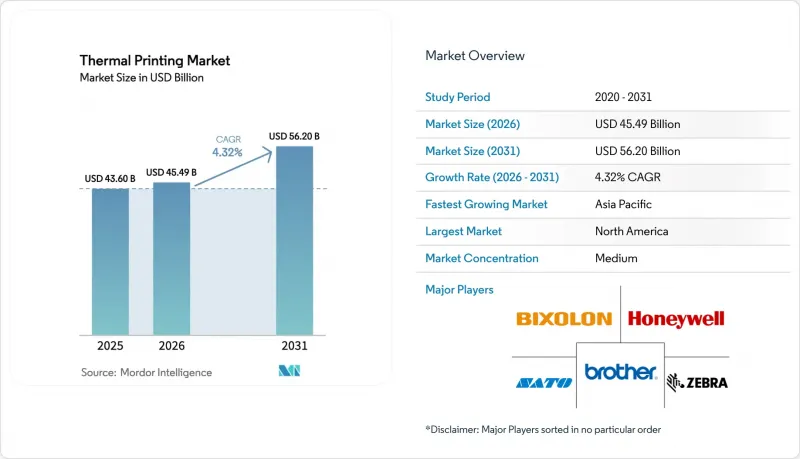
本報告按應用領域(條碼、POS/收據、標籤等)、列印技術(直接熱轉印、熱轉印等)、格式類型(工業、桌面、行動)、最終用途(零售/電子商務、運輸/物流、製造/倉儲等)和地區進行細分。市場預測以美元(USD)為單位。
全球熱轉印市場趨勢及洞察
電子商務物流的快速成長帶動了對條碼和運輸標籤的需求。
跨境電商帶來的小包裹量成長直接推動了熱敏標籤的消費。宅配業者強制要求使用符合GS1標準的標籤格式,並要求按需列印,這促使小規模企業採用桌上型直熱敏印表機,從而將單張標籤的成本降低到0.01美元以下。全通路履約策略將列印作業分散到各個微型倉庫,每個倉庫定期補充耗材和列印頭,使OEM廠商的耗材銷售額加倍。為了因應這一趨勢,製造商提供支援乙太網路和Wi-Fi的印表機,並支援集中式列印佇列管理,確保每個處理點都能即時列印標籤。小包裹量的成長和列印節點的分散化共同作用,為熱敏印表機市場創造了對運輸標籤的強勁需求。
無線/行動印表機在現場和最後一公里作業中迅速普及。
低功耗藍牙和Wi-Fi Direct協定無需固定網路基地台,使行動印表機成為送貨負責人、護理人員和服務技術人員的必備工具。 Brother的RJ2150 RuggedJet 2單次充電可列印1100張2吋標籤,並符合IP54和MIL-STD-810G耐用性標準。 BIXOLON透過消毒濕紙巾消毒認證,進一步提升了其在醫療保健環境中的便攜性。這使得床邊腕帶列印成為可能,從而減少了轉錄錯誤。基於雲端的標籤設計應用程式允許用戶在智慧型手機上編輯模板,消除了IT瓶頸並縮短了引進週期。隨著車輛數量的增加,OEM廠商正在透過行動最佳化電池、充電器和耐用介質來開拓新的收入來源,進一步深化其在整體熱敏列印市場的滲透。
高昂的維修成本和印字頭更換成本
工業級列印頭的價格在 400 美元到 1200 美元之間,可承受 30 到 60 公里的媒體列印。在每天處理 5 萬張標籤的履約中心,印表機頭需要每 6 到 12 個月更換一次,更換成本有時甚至超過印表機的購買價格。專有介面阻礙了相容性,推高了價格,並且買家只能依賴單一供應商的生態系統。Canon的預測壽命模型顯示,在高運轉率條件下,劣化會加速下降,因此難以準確預測故障發生的時間。雖然預防性更換可以減少停機時間,但會增加營運預算,導致中小企業抵制,並減緩了熱轉印印表機市場的擴張。
細分市場分析
條碼列印預計到2025年將佔銷售額的39.73%,這顯示標準化識別碼正成為商業和製造業履約和庫存管理營運的基礎。行動手持終端機的年複合成長率(CAGR)為5.06%,這得益於其更高的柔軟性,因為司機和技術人員可以現場列印標籤,從而減少錯誤並加快工作流程。 POS(銷售點)和收據應用仍然佔據很大佔有率,但由於法國和德國強制使用電子收據,其成長速度正在放緩。以染料擴散熱轉印技術為主的卡片列印支援政府和企業發行安全識別卡,而自助服務終端和票據列印則滿足了交通運輸和娛樂產業的需求。 RFID標籤列印結合了熱成像和嵌體編碼技術,以滿足全通路追蹤的需求,其多樣化的應用場景有助於穩定整個熱敏列印市場的需求。
直接熱感列印的簡單性使其特別適用於運輸標籤,因為這類標籤只需在包裝的整個生命週期內保持影像清晰即可。熱轉印列印在資產標籤和戶外標籤等領域佔據主導地位,這些標籤必須能夠耐受化學品和紫外線照射。在RFID等混合應用中,由於需要同時傳輸列印數據和編碼數據,這項技術在供應鏈視覺性方面發揮核心作用。隨著低溫運輸路線管理、智慧標籤應用和永續性認證的融合,針對特定應用的介質配方正在迅速增加,這防止了熱轉印列印市場的商品化,並保持了利潤率的靈活性。
預計到2025年,直接熱敏列印將佔據51.74%的市場佔有率,由於其無需色帶,成本效益高,因此在收據和短期標籤領域備受青睞。同時,熱轉印列印正以5.65%的複合年成長率快速成長,推動工業熱敏列印市場的穩定發展,因為製造商需要能夠在惡劣環境下保存數年而不受損壞的標籤。染料擴散熱轉印雖然仍是一個小眾領域,但它已在高解析度照片ID卡和支付卡領域得到應用,Evolis的600 dpi再轉印技術可顯著提升影像邊緣到邊緣的品質。
技術選擇通常取決於生命週期成本。直接熱轉印技術可降低色帶成本和維護費用,但由於影像會在幾個月後因高溫和光照而褪色,因此其在戶外或長期儲存中的應用受到限制。熱轉印技術使用耗材色帶,但其列印件可保存長達 10 年,有助於滿足化學、電子和汽車行業的合規要求。東芝 TEC 的雙模設備可讓使用者切換列印方式,從而在各種應用環境中最佳化成本和耐用性。推薦使用無底紙和無酚介質的環保法規也在影響技術選擇,並推動熱敏列印市場的持續創新。
區域分析
預計到2025年,北美將佔全球熱敏列印銷售額的38.73%。這得益於成熟的物流基礎設施、強制性的GS1標準以及政府契約,例如美國郵政服務為本地投遞人員部署行動印表機。加拿大零售商正在採用無底紙列印解決方案以符合塑膠法規,而墨西哥近岸外包的進展正在推動工業印表機在新倉庫中的部署。 RFID技術的普及和電子收據的採用正在抑制銷售點(POS)系統捲紙的消耗,北美保持著穩定但緩慢的成長,這支撐了該地區熱敏列印市場的銷售。
亞太地區是成長最快的區域,預計到2031年將以5.62%的複合年成長率成長,這主要得益於中國小包裹量的激增、印度稅票數位化以及東南亞跨境電商的興起。在中國,2024年小包裹處理量達1,320億件,熱感標籤已成為物流的必備品。印度的製藥和汽車產業是佐藤公司多語言工業印表機WT4-AXB的目標市場,凸顯了市場對區域專用韌體的強勁需求。該地區持續投資倉庫自動化以及新興大都會圈行動POS的普及,也推動了熱敏列印市場的整體規模成長。
歐洲處於平衡的中間狀態,永續發展法規推動了無酚和無襯紙產品的普及,而電子收據的要求在一定程度上限制了零售量。法國的電子收據法和德國針對標籤襯紙的生產者延伸責任制(EPR)代表了不同的監管壓力。英國脫歐相關的海關程序維持了英國標籤使用率的高位,而南歐不斷擴展的生物製藥低溫運輸則支撐了對耐凍介質的需求。同時,在中東和非洲,智慧城市物流投資正湧入熱力基礎建設,而南美的需求則集中在巴西的零售業。這表明,未來的需求將在很大程度上取決於宏觀經濟的穩定性和基礎設施的擴張。
其他好處:
- Excel格式的市場預測(ME)表
- 3個月的分析師支持
目錄
第1章:引言
- 研究假設和市場定義
- 調查範圍
第2章:調查方法
第3章執行摘要
第4章 市場狀況
- 市場概覽
- 市場促進因素
- 電子商務物流的快速成長推動了條碼和運輸標籤處理量的增加。
- 無線/行動印表機在現場和最後一公里作業中迅速普及。
- 與噴墨/雷射列印方式相比,降低大批量標籤和收據列印的總擁有成本。
- 隨著低溫運輸聯網感測器的激增,對按需生產的耐凍標籤的需求也日益成長。
- 無酚、無襯紙介質的興起,以滿足ESG評分卡的要求
- 在履約運作,我們透過嵌入式人工智慧診斷來減少印字頭停機時間。
- 市場限制因素
- 高昂的維修成本和印字頭更換成本
- RFID標籤和電子收據正在取代一些熱敏列印應用。
- 有關苯酚和雙酚A的法規提高了特種紙的原料成本。
- 紙漿價格波動正在擾亂全球標籤紙的供應。
- 產業價值鏈分析
- 監理情勢
- 技術展望
- 波特五力分析
- 投資分析
第5章 市場規模與成長預測
- 透過使用
- 條碼
- POS/收據
- 標籤
- 卡片
- RFID
- 自助售票機和門票
- 行動裝置(手持裝置)
- 透過印刷技術
- 直接熱傳遞(DT)
- 熱傳遞(TT)
- 染料擴散熱轉移(D2T2)
- 按格式類型
- 產業
- 桌面
- 移動的
- 按最終用途行業分類
- 零售與電子商務
- 運輸/物流
- 製造/倉儲
- 醫療保健和製藥
- 政府/公共安全
- 飯店和娛樂
- 銀行和金融服務
- 按地區
- 北美洲
- 美國
- 加拿大
- 墨西哥
- 南美洲
- 巴西
- 阿根廷
- 其他南美國家
- 歐洲
- 德國
- 英國
- 法國
- 義大利
- 西班牙
- 其他歐洲國家
- 亞太地區
- 中國
- 日本
- 印度
- 韓國
- ASEAN
- 其他亞太國家
- 中東和非洲
- 中東
- 沙烏地阿拉伯
- 阿拉伯聯合大公國
- 其他中東國家
- 非洲
- 南非
- 奈及利亞
- 其他非洲國家
- 中東
- 北美洲
第6章 競爭情勢
- 市場集中度
- 策略趨勢
- 市佔率分析
- 公司簡介
- Zebra Technologies Corporation
- SATO Holdings Corporation
- Toshiba TEC Corporation
- Honeywell International Inc.
- Brother Industries Ltd.
- Star Micronics Co., Ltd.
- Seiko Instruments Inc.
- Citizen Systems Japan Co., Ltd.
- Fujitsu Frontech Ltd.
- Seiko Epson Corporation
- BIXOLON Co., Ltd.
- TSC Auto ID Technology Co., Ltd.
- Printronix Auto ID Inc.
- Avery Dennison Corporation
- Evolis SA
- Axiohm SAS
- CognitiveTPG LLC
- Dymo-Newell Brands Inc.
- Posiflex Technology Inc.
- Xiamen Rongta Technology Co., Ltd.
- Brady Corporation
- cab Produkttechnik GmbH and Co KG
- GoDEX International Co., Ltd.
- Dascom Holdings Ltd.
第7章 市場機會與未來展望
According to Mordor Intelligence, the thermal printing market is valued at USD 45.49 billion in 2026 and is projected to reach USD 56.20 billion by 2031, advancing at a 4.32% CAGR, underscoring steady growth in market size and demand for mobile and linerless solutions.
This report is Segmented by Application (Barcode, POS/Receipt, Label, and More), Printing Technology (Direct Thermal, Thermal Transfer, and More), Format Type (Industrial, Desktop, and Mobile), End-Use Industry (Retail and E-Commerce, Transportation and Logistics, Manufacturing and Warehouse, and More), and Geography. The Market Forecasts are Provided in Terms of Value (USD).
Global Thermal Printing Market Trends and Insights
E-Commerce Logistics Boom Fuels Barcode and Shipping-Label Volumes
Parcel growth tied to cross-border digital commerce is directly lifting thermal label consumption. Express carriers enforce GS1-compliant formats that must be printed on demand, prompting small merchants to adopt desktop direct thermal units that bring per-label costs below USD 0.01. Omnichannel fulfillment strategies decentralize printing across micro-warehouses, multiplying consumables revenue for original-equipment manufacturers by having every node regularly replenish media and printheads. Manufacturers respond with Ethernet- and Wi-Fi-enabled printers that can be centrally queued, ensuring real-time label flow at each dock door. The compounding effect of rising parcel counts and distributed printing nodes positions shipping labels as a durable volume anchor for the thermal printing market.
Rapid Adoption of Wireless/Mobile Printers in Field and Last-Mile Operations
Bluetooth Low Energy and Wi-Fi Direct protocols have removed the need for fixed access points, making mobile printers indispensable for delivery agents, nurses, and service technicians. Brother's RJ2150 RuggedJet 2 prints 1,100 two-inch labels per charge and meets IP54 and MIL-STD-810G durability standards. BIXOLON extends portability to healthcare with wipe-disinfectant certification, allowing bedside wristband printing that cuts transcription errors. Cloud label design apps let users modify templates on smartphones, reducing IT bottlenecks and shortening deployment cycles. As fleets grow, OEMs secure new annuity streams in batteries, chargers, and durable media optimized for mobile environments, deepening overall thermal printing market penetration.
High Maintenance and Print-Head Replacement Costs
Industrial printheads cost USD 400-1,200 and last 30-60 kilometers of media. Fulfillment centers running 50,000 labels daily face replacements every six to twelve months, sometimes exceeding the printer's purchase price. Proprietary interfaces prevent interchangeability, keeping prices high and locking buyers into single-vendor ecosystems. Canon's predictive lifespan model shows accelerated degradation under high-duty-cycle conditions, making accurate failure timing difficult to predict. While preventive swaps curb downtime, they inflate operating budgets, creating resistance among smaller enterprises and tempering the expansion of the thermal printing market.
Other drivers and restraints analyzed in the detailed report include:
- Lower Total Cost of Ownership Versus Inkjet/Laser for High-Volume Jobs
- Surge in Cold-Chain IoT Sensors Requiring On-Demand Frost-Resistant Labels
- RFID Tags and E-Receipts Displacing Some Thermal Applications
For complete list of drivers and restraints, kindly check the Table Of Contents.
Segment Analysis
Barcode printing commanded 39.73% of 2025 revenue, demonstrating how standardized identifiers underpin fulfillment and inventory operations across commerce and manufacturing. Mobile handheld units add flexibility, expanding at a 5.06% CAGR as drivers and technicians print labels at the point of task, reducing errors and speeding workflows. Point-of-sale and receipt applications remain sizable, but digital receipt mandates in France and Germany are moderating growth. Card printing, dominated by dye-diffusion thermal transfer, supports secure identity issuance for governments and enterprises, while kiosk and ticket printing address transportation and entertainment needs. RFID label printing merges thermal imaging with inlay encoding to satisfy omnichannel tracking requirements, and the diversity of use cases helps stabilize overall demand in the thermal printing market.
Direct thermal simplicity is particularly suited to shipping labels, where images need only remain legible throughout the parcel lifecycle. Thermal transfer dominates asset tagging and outdoor labels that must withstand chemical or ultraviolet exposure. Hybrid applications such as RFID require both printed and encoded data, reinforcing the technology's centrality in supply-chain visibility. As cold-chain routing, smart-label adoption, and sustainability certifications converge, application-specific media formulations are proliferating, limiting commoditization and sustaining margin dispersion in the thermal printing market.
Direct thermal held 51.74% share in 2025, favored for receipt and short-lifecycle labels that benefit from ribbon-free economics. Thermal transfer is growing faster, at a 5.65% CAGR, as manufacturers require labels that remain intact for years in harsh environments, driving incremental growth in the thermal printing market in industrial sectors. Dye-diffusion thermal transfer, though niche, secures high-resolution photo ID and payment card applications, with Evolis' 600 dpi retransfer technology enhancing edge-to-edge image quality.
Technology choice often hinges on lifecycle costs. Direct thermal strips out ribbon spend and lowers maintenance, but suffers image fade under heat or light after several months, limiting use outdoors or in long-term archives. Thermal transfer uses consumable ribbons yet yields prints that remain readable for up to a decade, providing compliance assurance in chemical, electronics, and automotive settings. Toshiba TEC's dual-mode devices allow users to switch between methods, optimizing expense and durability in mixed-duty environments. Environmental mandates encouraging linerless and phenol-free media further influence technology selection, encouraging continual innovation across the thermal printing market.
Complete Report Scope:
- By Application
- Barcode
- POS / Receipt
- Label
- Card
- RFID
- Kiosk and Ticket
- Mobile (Hand-held)
- By Printing Technology
- Direct Thermal (DT)
- Thermal Transfer (TT)
- Dye Diffusion Thermal Transfer (D2T2)
- By Format Type
- Industrial
- Desktop
- Mobile
- By End-Use Industry
- Retail and E-commerce
- Transportation and Logistics
- Manufacturing and Warehouse
- Healthcare and Pharma
- Government and Public Safety
- Hospitality and Entertainment
- Banking and Financial Services
- By Geography
- North America
- United States
- Canada
- Mexico
- South America
- Brazil
- Argentina
- Rest of South America
- Europe
- Germany
- United Kingdom
- France
- Italy
- Spain
- Rest of Europe
- Asia-Pacific
- China
- Japan
- India
- South Korea
- ASEAN
- Rest of Asia-Pacific
- Middle East and Africa
- Middle East
- Saudi Arabia
- United Arab Emirates
- Rest of Middle East
- Africa
- South Africa
- Nigeria
- Rest of Africa
- Middle East
- North America
Geography Analysis
North America accounted for 38.73% of 2025 revenue, supported by mature logistics infrastructure, mandatory GS1 standards, and government contracts such as the United States Postal Service's rollout of mobile printers for rural carriers. Canadian retailers are adopting linerless solutions to comply with plastics regulations, and Mexican near-shoring is spurring the installation of industrial printers in new warehouses. RFID uptake and digital receipts temper point-of-sale roll consumption, keeping North American growth muted but steady, thereby safeguarding regional revenue for the thermal printing market.
Asia-Pacific is the fastest-growing territory, projected to grow at a 5.62% CAGR through 2031, driven by surging parcel volumes in China, India's tax-driven digitization of receipts, and the rise of cross-border e-commerce in Southeast Asia. China processed 132 billion parcels in 2024, cementing thermal labels as a logistics staple. India's pharmaceutical and automotive sectors are targets for SATO's multilingual WT4-AXB industrial printer, underlining demand for regionally tailored firmware. Regional growth rests on ongoing investments in warehousing automation and mobile point-of-sale adoption across emerging metropolitan areas, boosting overall thermal printing market size.
Europe occupies a balanced middle position, with sustainability mandates driving phenol-free and linerless adoption while digital-receipt requirements stifle some retail volumes. France's electronic receipt law and Germany's extended producer responsibility for label liners illustrate divergent regulatory pressures. Brexit-related customs paperwork keeps United Kingdom label usage elevated, and Southern Europe's expanding biologics cold chain sustains demand for frost-resistant media. Meanwhile, the Middle East and Africa are channeling smart-city logistics investments into thermal infrastructure, and South America's demand is concentrated in Brazil's retail sectors, highlighting that future volumes depend heavily on macroeconomic stability and infrastructure expansion.
- Zebra Technologies Corporation
- SATO Holdings Corporation
- Toshiba TEC Corporation
- Honeywell International Inc.
- Brother Industries Ltd.
- Star Micronics Co., Ltd.
- Seiko Instruments Inc.
- Citizen Systems Japan Co., Ltd.
- Fujitsu Frontech Ltd.
- Seiko Epson Corporation
- BIXOLON Co., Ltd.
- TSC Auto ID Technology Co., Ltd.
- Printronix Auto ID Inc.
- Avery Dennison Corporation
- Evolis SA
- Axiohm SAS
- CognitiveTPG LLC
- Dymo - Newell Brands Inc.
- Posiflex Technology Inc.
- Xiamen Rongta Technology Co., Ltd.
- Brady Corporation
- cab Produkttechnik GmbH and Co KG
- GoDEX International Co., Ltd.
- Dascom Holdings Ltd.
Additional Benefits:
- The market estimate (ME) sheet in Excel format
- 3 months of analyst support
TABLE OF CONTENTS
1 INTRODUCTION
- 1.1 Study Assumptions and Market Definition
- 1.2 Scope of the Study
2 RESEARCH METHODOLOGY
3 EXECUTIVE SUMMARY
4 MARKET LANDSCAPE
- 4.1 Market Overview
- 4.2 Market Drivers
- 4.2.1 E-commerce logistics boom fuels barcode and shipping-label volumes
- 4.2.2 Rapid adoption of wireless/mobile printers in field and last-mile ops
- 4.2.3 Lower TCO versus inkjet/laser for high-volume label and receipt jobs
- 4.2.4 Surge in cold-chain IoT sensors requiring on-demand frost-resistant labels
- 4.2.5 Rise of phenol-free, liner-less media to meet ESG scorecards
- 4.2.6 Embedded AI diagnostics reducing print-head downtime in 24/7 fulfilment hubs
- 4.3 Market Restraints
- 4.3.1 High maintenance and print-head replacement costs
- 4.3.2 RFID tags and e-receipts displacing some thermal applications
- 4.3.3 Phenol/BPA regulations inflating specialty-paper input costs
- 4.3.4 Pulp-price volatility disrupting global label-stock supply
- 4.4 Industry Value Chain Analysis
- 4.5 Regulatory Landscape
- 4.6 Technological Outlook
- 4.7 Porter's Five Forces Analysis
- 4.7.1 Threat of New Entrants
- 4.7.2 Bargaining Power of Buyers
- 4.7.3 Bargaining Power of Suppliers
- 4.7.4 Threat of Substitutes
- 4.7.5 Competitive Rivalry
- 4.8 Investment Analysis
5 MARKET SIZE AND GROWTH FORECASTS (VALUE)
- 5.1 By Application
- 5.1.1 Barcode
- 5.1.2 POS / Receipt
- 5.1.3 Label
- 5.1.4 Card
- 5.1.5 RFID
- 5.1.6 Kiosk and Ticket
- 5.1.7 Mobile (Hand-held)
- 5.2 By Printing Technology
- 5.2.1 Direct Thermal (DT)
- 5.2.2 Thermal Transfer (TT)
- 5.2.3 Dye Diffusion Thermal Transfer (D2T2)
- 5.3 By Format Type
- 5.3.1 Industrial
- 5.3.2 Desktop
- 5.3.3 Mobile
- 5.4 By End-Use Industry
- 5.4.1 Retail and E-commerce
- 5.4.2 Transportation and Logistics
- 5.4.3 Manufacturing and Warehouse
- 5.4.4 Healthcare and Pharma
- 5.4.5 Government and Public Safety
- 5.4.6 Hospitality and Entertainment
- 5.4.7 Banking and Financial Services
- 5.5 By Geography
- 5.5.1 North America
- 5.5.1.1 United States
- 5.5.1.2 Canada
- 5.5.1.3 Mexico
- 5.5.2 South America
- 5.5.2.1 Brazil
- 5.5.2.2 Argentina
- 5.5.2.3 Rest of South America
- 5.5.3 Europe
- 5.5.3.1 Germany
- 5.5.3.2 United Kingdom
- 5.5.3.3 France
- 5.5.3.4 Italy
- 5.5.3.5 Spain
- 5.5.3.6 Rest of Europe
- 5.5.4 Asia-Pacific
- 5.5.4.1 China
- 5.5.4.2 Japan
- 5.5.4.3 India
- 5.5.4.4 South Korea
- 5.5.4.5 ASEAN
- 5.5.4.6 Rest of Asia-Pacific
- 5.5.5 Middle East and Africa
- 5.5.5.1 Middle East
- 5.5.5.1.1 Saudi Arabia
- 5.5.5.1.2 United Arab Emirates
- 5.5.5.1.3 Rest of Middle East
- 5.5.5.2 Africa
- 5.5.5.2.1 South Africa
- 5.5.5.2.2 Nigeria
- 5.5.5.2.3 Rest of Africa
- 5.5.5.1 Middle East
- 5.5.1 North America
6 COMPETITIVE LANDSCAPE
- 6.1 Market Concentration
- 6.2 Strategic Moves
- 6.3 Market Share Analysis
- 6.4 Company Profiles (includes Global level Overview, Market level overview, Core Segments, Financials as available, Strategic Information, Market Rank/Share for key companies, Products and Services, and Recent Developments)
- 6.4.1 Zebra Technologies Corporation
- 6.4.2 SATO Holdings Corporation
- 6.4.3 Toshiba TEC Corporation
- 6.4.4 Honeywell International Inc.
- 6.4.5 Brother Industries Ltd.
- 6.4.6 Star Micronics Co., Ltd.
- 6.4.7 Seiko Instruments Inc.
- 6.4.8 Citizen Systems Japan Co., Ltd.
- 6.4.9 Fujitsu Frontech Ltd.
- 6.4.10 Seiko Epson Corporation
- 6.4.11 BIXOLON Co., Ltd.
- 6.4.12 TSC Auto ID Technology Co., Ltd.
- 6.4.13 Printronix Auto ID Inc.
- 6.4.14 Avery Dennison Corporation
- 6.4.15 Evolis SA
- 6.4.16 Axiohm SAS
- 6.4.17 CognitiveTPG LLC
- 6.4.18 Dymo - Newell Brands Inc.
- 6.4.19 Posiflex Technology Inc.
- 6.4.20 Xiamen Rongta Technology Co., Ltd.
- 6.4.21 Brady Corporation
- 6.4.22 cab Produkttechnik GmbH and Co KG
- 6.4.23 GoDEX International Co., Ltd.
- 6.4.24 Dascom Holdings Ltd.
7 MARKET OPPORTUNITIES AND FUTURE OUTLOOK
- 7.1 White-space and Unmet-need Assessment

 全球固定式熱感式標籤印表機市場:現代企業用互聯標籤基礎設施
 熱感列印市場:按印表機類型、技術、連接方式、列印解析度和最終用戶分類-2026-2032年全球市場預測全球熱敏印表機市場規模、佔有率、趨勢和成長分析報告(2026-2034年)
 熱敏列印市場規模、佔有率和趨勢分析報告:按產品、技術、產品類型、應用、最終用戶、地區和細分市場預測(2026-2033 年)
 熱敏列印市場分析及預測(至2035年):類型、產品類型、技術、組件、應用、材料類型、設備、最終用戶、功能熱敏印表機市場規模、佔有率和趨勢分析報告:按技術、產品、列印寬度、應用、最終用途、地區和細分市場預測(2026-2033 年)
 熱感列印市場:按技術、印表機類型、最終用戶產業和地區分類直接熱感列印膜市場分析及預測(至2035年):類型、產品、應用、材料類型、技術、組件、最終用戶、功能、工藝
 熱感列印市場規模、佔有率和成長分析(按交付方式、印表機類型、格式類型、列印技術、應用和地區分類)-2026-2033年產業預測
 全球熱敏印表機市場