


 |
市場調查報告書
商品編碼
2114477
群體智慧:市場佔有率分析、產業趨勢與統計、成長預測(2026-2031)Swarm Intelligence - Market Share Analysis, Industry Trends & Statistics, Growth Forecasts (2026 - 2031) |
||||||

※ 本網頁內容可能與最新版本有所差異。詳細情況請與我們聯繫。
據 Mordor Intelligence 稱,2025 年群體智慧市場價值 8,000 萬美元,預計到 2031 年將達到 4.6683 億美元,而 2026 年為 1.0734 億美元,預測期(2026-2031 年)的複合年成長率為 34.18%。
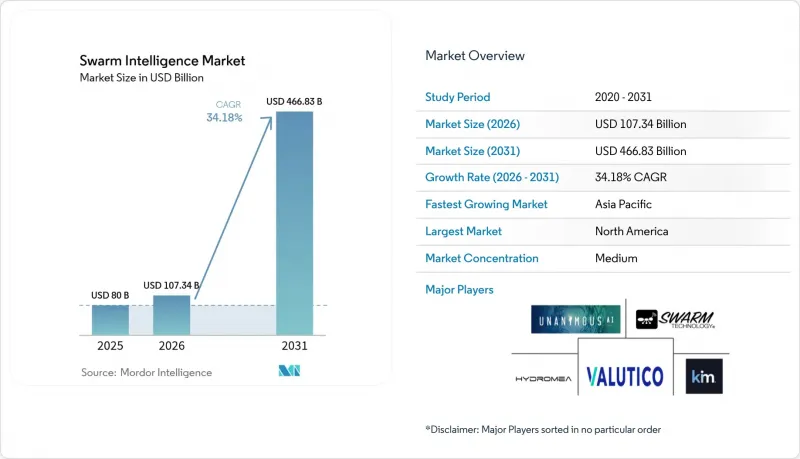
本報告按演算法類型(例如,蟻群最佳化演算法 (ACO)、粒子群最佳化演算法 (PSO))、終端用戶產業(例如,交通運輸與物流、國防與安全)、平台類型(例如,無人機群、無人地面車輛群、無人水面艇群)、部署模式(邊緣/設備端、雲端、混合)和地區進行細分。市場預測以美元 (USD) 為單位。
全球群體智慧市場趨勢與洞察
擴大群體機器人技術在物流和倉儲自動化領域的應用。
當多機器人叢集執行動態路徑規劃時,與單智慧體系統相比,倉庫業者可節省高達 40% 的成本。麻省理工學院的實驗表明,任務完成速度提高了四倍,操作員工作量減少了 50.9%,吞吐量的提升緩解了嚴重的人手不足。德國 Cellumation GmbH 公司開發的 Celluveyor 系統利用自組織六邊形單元,每小時可運輸 5200 個小包裹,充分展現了模組化和擴充性的集群機器人輸送機設計的有效性。隨著履約量的持續成長,這些經濟效益正在加速全球物流中心對該系統的應用。基於邊緣的協同控制進一步消除了雲端中心控制中常見的延遲瓶頸,從而增強了群體智慧市場的商業價值。
擴大無人機群在國防監視和災害應變中的部署。
捷克開發的自主動能無人機「攔截者」等軍事項目展示瞭如何在頻寬競爭的情況下,透過協同集群來摧毀敵方空中目標。聖保羅大學的一項災害救援研究表明,無人機集群能夠比衛星更快地探測到野火和溫室氣體洩漏,即使在通訊中斷的情況下也能保持運作。政府採購活動正在推動邊緣群體智慧的發展,隨著該技術逐步應用於民用巡檢和緊急應變等領域,其應用範圍正在擴大。
跨學科群體智慧演算法工程師短缺
全球生物學、機器人學和分散式系統領域的專家供應量遠遠無法滿足市場需求。根據《SAGE Open》期刊的一篇學術分析文章指出,融合這些領域的課程十分罕見,導致雇主面臨技能缺口。即使提供的薪資比傳統機器人相關職位高出40%以上,仍難以填補空缺,這使得新創公司在與資金雄厚的成熟公司競爭時處於劣勢。這種人才短缺正在減緩從原型到生產的周期,並限制群體智慧產業的規模化發展速度。
細分市場分析
2025年,蟻群最佳化演算法在群體智慧市場中維持了36.65%的最大市場佔有率。這是因為其機率路徑規劃非常適合車輛路線規劃和倉庫揀貨需求。同時,蜂群最佳化演算法預計到2031年將實現34.75%的複合年成長率,因為其分散式資源分配非常適合動態智慧城市服務。粒子群最佳化演算法在金融服務領域也備受關注,透過模型學習,其在加密貨幣價格預測方面達到了98%的準確率。混合框架現在可以根據實際情況即時切換演算法,德克薩斯農工大學的研究人員利用自適應農業機器人證明了這一點。這種向可配置堆疊的轉變正在為供應商拓展業務機會,同時也進一步提升了軟體的差異化優勢。
利用螢火蟲、生物發光蚯蚓、細菌攝食行為和人工魚啟發式演算法的實驗正在不斷擴展,目標是最佳化生態位網格、感測器覆蓋範圍或能源採集。早期量子加速群體智慧原型有望實現搜尋空間的指數級縮減,隨著硬體的成熟,未來有望取得突破性成果。由於採用該技術的公司追求的是針對特定結果的指標,而非通用基準,因此能夠整合多演算法庫的供應商正在群體智慧市場中佔據越來越大的佔有率。
到2025年,交通運輸和物流業將佔群體智慧市場佔有率的27.68%,這主要得益於群體智慧在小包裹處理能力和最後一公里路線規劃方面帶來的直接效益。城市交通出行計劃,包括電動垂直起降計程車和自適應交通網路的協同運營,正推動智慧城市部署實現39.28%的複合年成長率。國防計畫在資助前沿群體智慧研究方面繼續發揮關鍵作用,其研究成果未來將應用於民用基礎設施的檢測。在醫療領域,先導計畫正在利用分散式學習進行診斷,同時保護敏感資料。在農業和採礦業,強大的地面和空中群體智慧系統正在危險區域部署,以提高工人安全和資產利用率。在零售履約中心,應用場景已從運輸擴展到庫存審計;在公共產業,協同代理正被用於平衡電網負載。所有這些都凸顯了群體智慧市場跨產業的擴張。
區域分析
到2025年,北美將佔據群體智慧市場33.72%的佔有率。五角大廈的採購、歐盟倉庫自動化以及《晶片技術創新與創新法案》(CHIPS Act)提供的79億美元補貼,都在推動神經形態處理器的初期需求。矽谷創業投資的集中加速了新創企業的湧現,但勞動市場的緊張使得中小企業難以獲得跨領域人才。自動駕駛汽車監管沙箱的設立,進一步加速了實地測試。
預計到2031年,亞太地區群體智慧市場將以35.90%的複合年成長率(CAGR)實現最高成長。中國於2024年頒布的全面無人機(UAV)安全法規建立了可預測的認證流程,政府主導的城市叢集計畫正在建造大規模示範區。日本和韓國在分子機器人和服務機器人的融合方面發揮先鋒作用,而該地區的半導體製造工廠則是客製化邊緣人工智慧晶片的供應基地。Softbank Corporation對Skild AI的40億美元投資等巨額企業資金投入,凸顯了投資者日益成長的興趣。
在歐洲,無人機產業的成長得益於2019/947號實施細則下的統一監管,該細則強制規定了基於風險的營運類別。 「ROBOMINERS」舉措展示了群體智慧概念在重工業自動化領域的應用,而符合倫理的人工智慧框架則緩解了相關人員對問責制和透明度的擔憂。謹慎而有系統的核准流程維護了公眾的信任,但與亞太地區相比,歐洲無人機技術的普及速度較慢。
其他好處:
- Excel格式的市場預測(ME)表
- 3個月的分析師支持
目錄
第1章:引言
- 研究假設和市場定義
- 調查範圍
第2章:調查方法
第3章執行摘要
第4章 市場狀況
- 市場概覽
- 市場促進因素
- 擴大群體機器人技術在物流和倉儲自動化領域的應用。
- 擴大無人機群在國防監視和災害應變方面的部署。
- 巨量資料物聯網網路中對分散式最佳化的需求
- 一個用於大規模腦力激盪和決策的協作式人工智慧平台。
- 為提高能源效率的仿生邊緣人工智慧晶片提供創業融資。
- 亞太地區對超視距無人機群飛行法規的批准,正在加速城市空中運輸示範測試。
- 市場限制因素
- 跨學科群體智慧演算法工程師短缺
- 即時協作中的通訊延遲和可靠性限制
- 關於自主金融交易集群中演算法責任的擔憂
- 神經形態邊緣節點中的矽供應限制
- 價值鏈分析
- 監理情勢
- 技術展望
- 波特五力分析
第5章 市場規模與成長預測
- 按演算法類型
- 蟻群最佳化演算法(ACO)
- 粒子群最佳化演算法(PSO)
- 蜂群演算法
- 螢火蟲和發光蟲演算法
- 細菌覓食、人工魚和其他
- 按最終用戶行業分類
- 運輸/物流
- 國防與安全
- 機器人與工業自動化
- 醫療保健和生命科學
- 農業和採礦業
- 銀行、金融服務和保險 (BFSI) 及金融服務
- 智慧城市與旅行
- 零售與電子商務
- 能源公用事業
- 依平台類型
- 無人機集團
- 無人地面車輛集團
- USV組
- UUV組
- 純軟體多智慧體系統
- 部署模式
- 邊緣/設備端
- 雲
- 混合
- 按地區
- 北美洲
- 美國
- 加拿大
- 墨西哥
- 南美洲
- 巴西
- 阿根廷
- 智利
- 其他南美國家
- 歐洲
- 德國
- 英國
- 法國
- 義大利
- 西班牙
- 荷蘭
- 俄羅斯
- 其他歐洲國家
- 亞太地區
- 中國
- 印度
- 日本
- 韓國
- ASEAN
- 其他亞太國家
- 中東和非洲
- 中東
- 海灣合作理事會(沙烏地阿拉伯、阿拉伯聯合大公國、卡達等)
- 土耳其
- 其他中東國家
- 非洲
- 南非
- 其他非洲國家
- 中東
- 北美洲
第6章 競爭情勢
- 市場集中度
- 策略趨勢
- 市佔率分析
- 公司簡介
- Swarm Technology
- Unanimous AI
- Hydromea SA
- Sentien Robotics
- Dobots
- Brainalyzed Insight
- ConvergentAI Inc.
- Kim Technologies
- Swarm Systems Ltd.
- Power-Blox AG
- DJI
- Hewlett Packard Enterprise(HPE)
- IBM
- Intel
- Valutico UK Ltd
- HexaDrone
- AeroVironment
- Kratos Defense and Security
- Bluefin Robotics
- Marine AI
- Thales Group
第7章 市場機會與未來展望
According to Mordor Intelligence, the swarm intelligence market size was valued at USD 80 million in 2025 and estimated to grow from USD 107.34 million in 2026 to reach USD 466.83 million by 2031, at a CAGR of 34.18% during the forecast period (2026-2031).
This report is Segmented by Algorithm Type (Ant Colony Optimisation (ACO), Particle Swarm Optimisation (PSO), and More), End-User Industry (Transportation and Logistics, Defense and Security, and More), Platform Type (UAV Swarms, UGV Swarms, USV Swarms, and More), Deployment Mode (Edge / On-Device, Cloud, and Hybrid), and Geography. The Market Forecasts are Provided in Terms of Value (USD).
Global Swarm Intelligence Market Trends and Insights
Rising adoption of swarm robotics in logistics and warehouse automation
Warehouse operators gain up to 40% cost savings versus single-agent systems when multi-robot swarms handle dynamic routing. Experiments at MIT achieved 4 X faster task completion and cut operator workload by 50.9%, confirming throughput gains that mitigate acute labour shortages.Germany-based Cellumation's Celluveyor moves 5,200 parcels per hour with self-organising hexagonal cells, validating modular, easily scalable swarm conveyor designs. As fulfillment volumes keep rising, these economic incentives accelerate deployments across global logistics hubs. Edge-based coordination further eliminates the latency bottlenecks typical of cloud-centric control, strengthening the business case for the swarm intelligence market.
Growing deployment of UAV swarms for defense surveillance and disaster response
Military programmes such as the Czech-origin Interceptor autonomous kinetic drone illustrate how coordinated swarms neutralise hostile aerial targets under contested bandwidth. Disaster-relief research at the University of Sao Paulo shows drone collectives spotting wildfires and greenhouse-gas leaks faster than satellites while maintaining operations during communication blackouts. Government procurement drives edge-AI advances that later migrate into civil inspection and emergency-response use cases, broadening the addressable swarm intelligence market.
Shortage of cross-disciplinary swarm-algorithm engineers
Global supply of professionals fluent in biology, robotics, and distributed systems lags demand. Academic analysis in SAGE Open notes curricula seldom combine these domains, creating capability gaps for employers. Salary premiums that exceed 40% over conventional robotics roles still fail to close vacancies, leaving start-ups at a disadvantage against cash-rich incumbents. The talent constraint slows prototype-to-production cycles and limits scale-out speed in the swarm intelligence industry.
Other drivers and restraints analyzed in the detailed report include:
- Demand for decentralised optimisation in big-data IoT networks
- Collaborative AI platforms for large-scale brainstorming and decision-making
- Communication latency and reliability limits on real-time coordination
For complete list of drivers and restraints, kindly check the Table Of Contents.
Segment Analysis
Ant colony optimisation retained the largest 36.65% share of the swarm intelligence market in 2025 as its probabilistic path-finding fits vehicle routing and warehouse picking needs. Bee colony methods are set for a 34.75% CAGR to 2031 because their decentralised resource allocation suits dynamic smart-city services. Particle swarm optimisation gains traction in financial services where model training achieved 98% accuracy for cryptocurrency price prediction. Hybrid frameworks now switch algorithms in real time to match context, as Texas A&M researchers showed in adaptive agricultural robots. This pivot toward configurable stacks broadens supplier opportunities while deepening software differentiation.
Growing experimentation with firefly, glow-worm, bacterial foraging, and artificial fish heuristics targets niche grids, sensor coverage, or energy-harvest optimisation. Early quantum-accelerated swarm prototypes promise exponential search-space pruning, hinting at disruptive future gains once hardware matures. As adopters pursue outcome-specific metrics rather than general benchmarks, vendors capable of integrating multi-algorithm libraries capture a larger slice of the swarm intelligence market.
Transportation and logistics held 27.68% share of the swarm intelligence market in 2025 due to immediate paybacks in parcel throughput and last-mile routing. Urban-mobility schemes, including coordinated eVTOL taxis and adaptive traffic grids, propel a 39.28% CAGR in smart-city adoption. Defense programmes remain pivotal for funding leading-edge swarm research that later transitions to civil infrastructure inspection. Health-care pilots apply distributed learning for diagnostics while safeguarding sensitive data. Agriculture and mining deploy ruggedised ground and aerial swarms in hazardous zones, raising worker safety and asset utilisation. Retail fulfilment centres extend use cases beyond conveyance to inventory auditing, and utilities employ cooperative agents for grid load-balancing, attesting to the cross-sector depth of the swarm intelligence market.
Complete Report Scope:
- By Algorithm Type
- Ant Colony Optimisation (ACO)
- Particle Swarm Optimisation (PSO)
- Bee Colony / Honey-Bee Algorithms
- Firefly and Glow-worm Algorithms
- Bacterial Foraging, Artificial Fish and Others
- By End-user Industry
- Transportation and Logistics
- Defense and Security
- Robotics and Industrial Automation
- Healthcare and Life Sciences
- Agriculture and Mining
- BFSI and Financial Services
- Smart Cities and Mobility
- Retail and E-commerce
- Energy and Utilities
- By Platform Type
- UAV Swarms
- UGV Swarms
- USV Swarms
- UUV Swarms
- Software-Only Multi-Agent Systems
- By Deployment Mode
- Edge / On-Device
- Cloud
- Hybrid
- By Geography
- North America
- United States
- Canada
- Mexico
- South America
- Brazil
- Argentina
- Chile
- Rest of South America
- Europe
- Germany
- United Kingdom
- France
- Italy
- Spain
- Netherlands
- Russia
- Rest of Europe
- Asia Pacific
- China
- India
- Japan
- South Korea
- ASEAN
- Rest of Asia Pacific
- Middle East and Africa
- Middle East
- GCC (Saudi Arabia, UAE, Qatar, etc.)
- Turkey
- Rest of Middle East
- Africa
- South Africa
- Rest of Africa
- Middle East
- North America
Geography Analysis
North America contributed 33.72% of the swarm intelligence market in 2025. Pentagon procurement, e-commerce warehouse automation, and USD 7.9 billion in CHIPS Act incentives spur early demand for neuromorphic processors. Venture capital concentration in Silicon Valley accelerates start-up formation, yet tight labour markets make it harder for smaller firms to secure cross-disciplinary talent. Regulatory sandboxes for autonomous vehicles further encourage field trials.
Asia Pacific delivers the steepest 35.90% CAGR to 2031 for the swarm intelligence market. China's comprehensive 2024 UAV safety rules create predictable certification pathways, and governmental city-cluster programmes unlock large-scale demonstration zones. Japan and South Korea pioneer molecular and service-robotics integration, while regional semiconductor fabs anchor supply for bespoke edge AI chips. Substantial corporate funding, such as SoftBank's USD 4 billion injection into Skild AI, underscores rising investor appetite.
Europe sustains growth through harmonised drone regulations under Implementing Regulation 2019/947 that enforce risk-based operational categories. The ROBOMINERS initiative illustrates how swarm ideas feed heavy-industry automation, and ethical-AI frameworks reassure stakeholders about liability and transparency. A deliberate but methodical approval process protects public trust, albeit at a slower deployment cadence than Asia Pacific.
- Swarm Technology
- Unanimous AI
- Hydromea SA
- Sentien Robotics
- Dobots
- Brainalyzed Insight
- ConvergentAI Inc.
- Kim Technologies
- Swarm Systems Ltd.
- Power-Blox AG
- DJI
- Hewlett Packard Enterprise (HPE)
- IBM
- Intel
- Valutico UK Ltd
- HexaDrone
- AeroVironment
- Kratos Defense and Security
- Bluefin Robotics
- Marine AI
- Thales Group
Additional Benefits:
- The market estimate (ME) sheet in Excel format
- 3 months of analyst support
TABLE OF CONTENTS
1 INTRODUCTION
- 1.1 Study Assumptions and Market Definition
- 1.2 Scope of the Study
2 RESEARCH METHODOLOGY
3 EXECUTIVE SUMMARY
4 MARKET LANDSCAPE
- 4.1 Market Overview
- 4.2 Market Drivers
- 4.2.1 Rising adoption of swarm robotics in logistics and warehouse automation
- 4.2.2 Growing deployment of UAV swarms for defense surveillance and disaster response
- 4.2.3 Demand for decentralized optimisation in big-data IoT networks
- 4.2.4 Collaborative AI platforms for large-scale brainstorming and decision-making
- 4.2.5 Venture funding for bio-inspired edge-AI chips improving energy efficiency
- 4.2.6 APAC BVLOS drone-swarm regulatory green-lights accelerating urban air mobility pilots
- 4.3 Market Restraints
- 4.3.1 Shortage of cross-disciplinary swarm-algorithm engineers
- 4.3.2 Communication-latency and reliability limits on real-time coordination
- 4.3.3 Algorithmic-liability concerns in autonomous financial-trading swarms
- 4.3.4 Silicon supply constraints for neuromorphic edge nodes
- 4.4 Value Chain Analysis
- 4.5 Regulatory Landscape
- 4.6 Technological Outlook
- 4.7 Porter's Five Forces Analysis
- 4.7.1 Threat of New Entrants
- 4.7.2 Bargaining Power of Buyers
- 4.7.3 Bargaining Power of Suppliers
- 4.7.4 Threat of Substitutes
- 4.7.5 Intensity of Competitive Rivalry
5 MARKET SIZE AND GROWTH FORECASTS (VALUE)
- 5.1 By Algorithm Type
- 5.1.1 Ant Colony Optimisation (ACO)
- 5.1.2 Particle Swarm Optimisation (PSO)
- 5.1.3 Bee Colony / Honey-Bee Algorithms
- 5.1.4 Firefly and Glow-worm Algorithms
- 5.1.5 Bacterial Foraging, Artificial Fish and Others
- 5.2 By End-user Industry
- 5.2.1 Transportation and Logistics
- 5.2.2 Defense and Security
- 5.2.3 Robotics and Industrial Automation
- 5.2.4 Healthcare and Life Sciences
- 5.2.5 Agriculture and Mining
- 5.2.6 BFSI and Financial Services
- 5.2.7 Smart Cities and Mobility
- 5.2.8 Retail and E-commerce
- 5.2.9 Energy and Utilities
- 5.3 By Platform Type
- 5.3.1 UAV Swarms
- 5.3.2 UGV Swarms
- 5.3.3 USV Swarms
- 5.3.4 UUV Swarms
- 5.3.5 Software-Only Multi-Agent Systems
- 5.4 By Deployment Mode
- 5.4.1 Edge / On-Device
- 5.4.2 Cloud
- 5.4.3 Hybrid
- 5.5 By Geography
- 5.5.1 North America
- 5.5.1.1 United States
- 5.5.1.2 Canada
- 5.5.1.3 Mexico
- 5.5.2 South America
- 5.5.2.1 Brazil
- 5.5.2.2 Argentina
- 5.5.2.3 Chile
- 5.5.2.4 Rest of South America
- 5.5.3 Europe
- 5.5.3.1 Germany
- 5.5.3.2 United Kingdom
- 5.5.3.3 France
- 5.5.3.4 Italy
- 5.5.3.5 Spain
- 5.5.3.6 Netherlands
- 5.5.3.7 Russia
- 5.5.3.8 Rest of Europe
- 5.5.4 Asia Pacific
- 5.5.4.1 China
- 5.5.4.2 India
- 5.5.4.3 Japan
- 5.5.4.4 South Korea
- 5.5.4.5 ASEAN
- 5.5.4.6 Rest of Asia Pacific
- 5.5.5 Middle East and Africa
- 5.5.5.1 Middle East
- 5.5.5.1.1 GCC (Saudi Arabia, UAE, Qatar, etc.)
- 5.5.5.1.2 Turkey
- 5.5.5.1.3 Rest of Middle East
- 5.5.5.2 Africa
- 5.5.5.2.1 South Africa
- 5.5.5.2.2 Rest of Africa
- 5.5.5.1 Middle East
- 5.5.1 North America
6 COMPETITIVE LANDSCAPE
- 6.1 Market Concentration
- 6.2 Strategic Moves
- 6.3 Market Share Analysis
- 6.4 Company Profiles (includes Global level Overview, Market level overview, Core Segments, Financials as available, Strategic Information, Market Rank/Share for key companies, Products and Services, and Recent Developments)
- 6.4.1 Swarm Technology
- 6.4.2 Unanimous AI
- 6.4.3 Hydromea SA
- 6.4.4 Sentien Robotics
- 6.4.5 Dobots
- 6.4.6 Brainalyzed Insight
- 6.4.7 ConvergentAI Inc.
- 6.4.8 Kim Technologies
- 6.4.9 Swarm Systems Ltd.
- 6.4.10 Power-Blox AG
- 6.4.11 DJI
- 6.4.12 Hewlett Packard Enterprise (HPE)
- 6.4.13 IBM
- 6.4.14 Intel
- 6.4.15 Valutico UK Ltd
- 6.4.16 HexaDrone
- 6.4.17 AeroVironment
- 6.4.18 Kratos Defense and Security
- 6.4.19 Bluefin Robotics
- 6.4.20 Marine AI
- 6.4.21 Thales Group
7 MARKET OPPORTUNITIES AND FUTURE OUTLOOK
- 7.1 White-space and Unmet-need Assessment

 集群無人機市場規模、佔有率和趨勢分析報告:按組件、平台、技術、應用、最終用途、地區和細分市場預測(2026-2033 年)
 集群無人機市場規模、佔有率、成長率、全球產業分析、區域趨勢及2026-2034年預測
 2026年全球集群無人機市場報告
 群體智慧市場:按應用、技術、部署模式和區域分類
 衛星群技術市場分析與預測(至2035年):按類型、產品、服務、技術、組件、應用、部署方式、最終用戶和功能分類2026年全球無人機群控制市場報告2026年全球無人機群控制系統市場報告2026年全球無人機群通訊模組市場報告2026年全球自主無人機群安全市場報告2026年全球集群式水面無人機巡邏市場報告