


 |
市場調查報告書
商品編碼
2114469
雷射清洗:市場佔有率分析、產業趨勢與統計、成長預測(2026-2031)Laser Cleaning - Market Share Analysis, Industry Trends & Statistics, Growth Forecasts (2026 - 2031) |
||||||

※ 本網頁內容可能與最新版本有所差異。詳細情況請與我們聯繫。
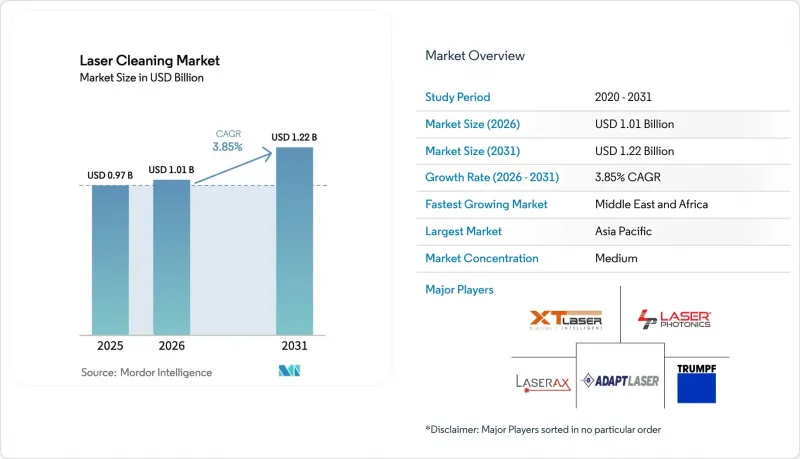
據 Mordor Intelligence 稱,雷射清洗市場預計將從 2025 年的 9.7 億美元成長到 2026 年的 10.1 億美元,到 2031 年達到 12.2 億美元,預計 2026 年至 2031 年的複合年成長率為 3.85%。
本報告按雷射類型(光纖雷射、固體、二氧化碳雷射、超短脈衝雷射)、功率範圍(高功率、中功率、低功率)、便攜性(手持式雷射、桌上型雷射、機器人雷射)、脈衝寬度(連續波雷射、奈秒航太、航太市場預測以美元(USD)計價。
全球雷射清洗市場趨勢及洞察
嚴格的環境法規取代化學溶劑
歐盟的揮發性有機化合物(VOC)指令以及加州類似的法規,使得許多金屬加工企業難以負擔溶劑罐的使用成本。在德國,每桶廢棄物的處理成本超過200美元,促使一級汽車零件供應商維修到500瓦的無殘留光纖雷射。空中巴士報告稱,其漢堡工廠在複合材料模具維護方面改用雷射清洗後,VOC排放量減少了85%。隨著美國職業安全與健康管理局(OSHA)收緊了2025年生效的二氯甲烷暴露限值,美國各地的工廠也開始採取類似措施。同時,跨國原始設備製造商(OEM)正在亞太地區對其分包商實施統一的環境標準。波蘭和捷克共和國的契約製造製造商正在安裝雷射脫漆生產線以維持汽車契約,這表明法規正在加速該技術在早期採用者之外的推廣應用。
非接觸式表面處理自動化需求日益成長
在組裝廠,一台1.5千瓦的光纖雷射與一台六軸機器人整合在一個焊接籠內,用於車身本體的焊接。弗勞恩霍夫雷射技術研究所(Fraunhofer ILT)的研究表明,雷射清洗的鋁板焊接強度比化學處理的樣品高出40%。省去人工擦拭工序,每輛車可節省25秒,對於一條年產30萬輛的生產線而言,每年可節省數百萬美元。面臨人手不足和更嚴格的公差標準的德國供應商預計,到2025年,機器人雷射單元的採用率將增加22%。中國電動車製造商也在電池組外殼的製造中採用自動化雷射加工技術,從而減少了因黏合失效而導致的保固索賠。
開發中國家對高功率系統的大量資本投資
功率超過1千瓦的系統造價仍超過15萬美元。加裝排煙裝置和4級防護罩可能會使專案預算翻倍。對於印度和巴西的中小型企業而言,與價格僅為十分之一的研磨機生產線相比,這些數字顯得過於昂貴。在非洲和拉丁美洲,有限的服務網路限制了租賃公司的意願,導致設備租賃方案有限。對高功率機器人而言,這個問題尤其嚴重,而售價約2.5萬美元的200瓦手持機器人需求有限。
細分市場分析
光纖雷射效率超過30%,維護成本低,預計2025年將佔雷射清洗市場46.18%的佔有率。隨著造船廠、電池廠和模具廠等行業將加工能力置於極致精度之上,光纖雷射清洗的市場規模將穩步擴大。到2031年,皮秒和飛秒光源的複合年成長率將維持在4.55%,在航太複合材料和博物館藏品等精密加工領域的需求不斷成長。固體Nd:YAG雷射仍在傳統軍事設施中使用,但隨著光纖雷射光束品質的提升,其市場佔有率正在下降。 CO₂雷射雖然已應用於混凝土油漆剝離領域,但由於其笨重的三相電源,市場佔有率仍然有限。
受汽車產業需求的推動,IPG Photonics 預計 2025 年其光纖清洗裝置的出貨量將比 2024 年成長 15%。 TRUMPF 的 2kW TruPulse Clean 平台將於 2026 年上市,其光束品質指標可與舊款超快雷射設備媲美,同時又具備光纖雷射的成本效益。 Coherent 於 2024 年收購 EKSMA Optics,顯示其正逐步進軍超快雷射領域,這也凸顯了眾多大型公司所採取的雙管齊下的策略。
2025年,功率在100瓦至1千瓦之間的中功率系統佔總銷售量的38.43%。這些系統已成為代工製造商的標準選擇,因為它們每小時可清除5至8平方公尺的鏽跡,並且能夠在射出成型廠可接受的周期時間內完成模具清潔。預計到2031年,功率超過1千瓦的高功率型號將以4.82%的複合年成長率成長。這主要是由於汽車車身工廠中機器人焊接單元數量的增加,推動了對能夠進行線上清潔的1.5千瓦至3千瓦噴頭的新需求。
Laserax公司在加拿大一家沖壓成型廠安裝了一組1.5千瓦的機器人單元,僅用了九個月就實現了投資回報,該單元徹底取代了人工研磨工序。相較之下,功率低於100瓦的低功率設備在珠寶飾品維修和微型零件去毛邊等領域仍屬於小眾市場,因為在這些領域,手持設備的安全性和便攜性對操作人員至關重要。
區域分析
預計到2025年,亞太地區將佔全球銷售額的36.29%。這主要得益於中國的維修計劃,該計劃強制要求採用非接觸式清洗,以滿足2025年VOC排放上限的要求。韓國的超級工廠(Gigafactory)已安裝了50套用於電極加工的IPG 1.5 kW系統,這充分展現了該地區電池產業的深厚實力。日本的設備報廢預算確保了對遠端操作光纖工具的長期需求,而印度的生產連結獎勵計畫計畫(PLI)預計將從2027年起擴大半導體產業的應用。
歐洲憑藉德國汽車機器人技術和義大利歷史建築修復項目,保持了其市場佔有率。該地區受益於政策支援和成熟的服務網路。北美緊隨其後,美國航太維修設施和加拿大管道維修設施吸收了數千台手持設備。
預計中東地區將成為該地區成長最快的市場,複合年成長率將達到5.15%,這主要得益於沙烏地阿拉伯的NEOM大型企劃和阿拉伯聯合大公國的巴拉卡發電廠,這兩個計畫都需要在乾旱環境下使用低廢棄物淨化工具。非洲和南美洲由於資金限制而發展滯後,但巴西的海上開採平台和南非的採礦設備維修線正在創造對可攜式雷射的局部需求。
其他好處:
- Excel格式的市場預測(ME)表
- 3個月的分析師支持
目錄
第1章:引言
- 研究假設和市場定義
- 調查範圍
第2章:調查方法
第3章執行摘要
第4章 市場狀況
- 市場概覽
- 市場促進因素
- 歐盟和北美嚴格的環境法規正在推動化學溶劑的替代方案。
- 汽車車體廠對非接觸式表面處理自動化的需求日益成長。
- 歐洲和亞洲歷史建築修復項目數量不斷增加
- 投資用於需要遠程雷射去污的核能設施退役。
- 無殘留電極清洗對於電動車電池生產線至關重要。
- 光纖雷射器每瓦成本的下降,導致亞洲中小企業擴大採用光纖雷射。
- 市場限制因素
- 開發中國家對高功率系統的大量資本投資
- 海上維護期間向現場運輸物品的限制。
- 熱敏性材料基板的熱損傷風險
- 新興市場缺乏合格的雷射清洗技術人員
- 產業價值鏈分析
- 技術展望
- 超短脈衝(Ps/Fs)光源的進展
- 與協作機器人整合
- 監理展望
- 全球揮發性有機化合物和有害化學物質指令
- OSHA 和 IEC 雷射安全標準
- 宏觀經濟因素對市場的影響
- 波特五力分析
第5章 市場規模與成長預測
- 雷射型
- 光纖雷射
- 固體(Nd:YAG/Yb:YAG)雷射器
- 二氧化碳雷射
- 超短脈衝(皮秒/飛秒)雷射器
- 輸出範圍
- 高功率(>1千瓦)
- 中功率(100瓦至1千瓦)
- 低功率(小於100瓦)
- 透過便攜性
- 手持/可攜式系統
- 桌上型/固定式系統
- 機器人/自動化整合單元
- 按脈衝持續時間
- 連續波
- 奈秒脈衝
- 超短脈衝(Ps/Fs)
- 透過使用
- 油漆和塗層去除
- 去除鏽跡和氧化物
- 表面預處理和焊接預處理
- 黴菌清潔和黴菌維護
- 文化遺產和藝術品的修復
- 微電子和精密清洗
- 核污染清除
- 按最終用戶行業分類
- 汽車和運輸設備
- 航太/國防
- 造船/造船
- 基礎設施和建築
- 能源與電力
- 石油和天然氣
- 核能
- 可再生能源
- 電子和半導體
- 文化遺產機構
- 製造和工業機械
- 按地區
- 北美洲
- 美國
- 加拿大
- 墨西哥
- 南美洲
- 巴西
- 其他南美國家
- 歐洲
- 德國
- 英國
- 法國
- 義大利
- 西班牙
- 其他歐洲國家
- 亞太地區
- 中國
- 日本
- 韓國
- 印度
- 東南亞
- 澳洲
- 其他亞太國家
- 中東
- 阿拉伯聯合大公國
- 沙烏地阿拉伯
- 其他中東國家
- 非洲
- 南非
- 其他非洲國家
- 北美洲
第6章 競爭情勢
- 市場集中度
- 策略趨勢
- 市佔率分析
- 公司簡介
- TRUMPF Group
- IPG Photonics Corporation
- Clean-Lasersysteme GmbH
- Laser Photonics Corporation
- P-Laser NV
- Laserax Inc.
- Adapt Laser Systems LLC
- Jinan Xintian Technology Co. Ltd(XT Laser)
- HGLaser Engineering Co. Ltd
- Han's Laser Technology Industry Group Co. Ltd
- Coherent Corp.
- Scantech Laser Pvt. Ltd
- Anilox Roll Cleaning Systems
- Shenzhen Riselaser Technology Co. Ltd
- Sukjin Laser Co.
- Allied Scientific Pro
- CyCleanLaser GmbH
- PharosQuartz(Light Conversion)
- Suresh Industech Pvt. Ltd
- RMA Technik GmbH
- Jinan Vmade CNC Machine Co. Ltd
- Shanghai Mactron Technology Co. Ltd
- Lynton Lasers Ltd
第7章 市場機會與未來展望
According to Mordor Intelligence, the laser cleaning market size is expected to increase from USD 0.97 billion in 2025 to USD 1.01 billion in 2026 and reach USD 1.22 billion by 2031, growing at a CAGR of 3.85% over 2026-2031.
This report is Segmented by Laser Type (Fiber, Solid-State, CO2, and Ultrashort-Pulse), Power Range (High, Medium, and Low), Portability (Handheld, Benchtop, and Robotic), Pulse Duration (Continuous-Wave, Nanosecond, and Ultrashort-Pulse), Application (Paint Removal, and More), End-User Industry (Automotive, Aerospace, and More), and Geography. The Market Forecasts are Provided in Terms of Value (USD).
Global Laser Cleaning Market Trends and Insights
Stringent Environmental Regulations Replacing Chemical Solvents
The European Union's VOC Directive and parallel restrictions in California have made solvent baths economically untenable for many metal fabricators. Waste-disposal fees exceed USD 200 per drum in Germany, prompting tier-one automotive suppliers to retrofit 500 W fiber lasers that leave zero residue. Airbus documented an 85% cut in VOC output after switching to laser cleaning for composite-tool maintenance at its Hamburg plant. OSHA's tighter exposure limits for methylene chloride in 2025 spurred similar moves in U.S. facilities, while multinational OEMs now impose uniform green standards on Asia-Pacific subcontractors. Contract manufacturers in Poland and the Czech Republic have adopted laser paint-stripping lines to hold on to automotive contracts, showing how regulation accelerates technology diffusion beyond early adopters.
Rising Automation Demand for Non-contact Surface Preparation
Assembly plants are pairing 1.5 kW fiber lasers with six-axis robots inside body-in-white welding cages. Fraunhofer ILT found that laser-cleaned aluminium panels deliver 40% higher weld strength than chemically prepared samples. Removing the manual wiping stage trims 25 seconds per vehicle body, a gain worth millions of dollars per year in a line rated at 300,000 units. German suppliers showed 22% growth in robotic laser-cell installations in 2025 as labour scarcity collided with stricter tolerance goals. Chinese EV producers are also adopting automated laser chambers for battery-pack housings, cutting warranty claims linked to poor adhesive bonding.
High Capital Expenditure for High-power Systems in Developing Economies
Systems above 1 kW still list for more than USD 150,000. When fume extraction and Class 4 enclosures are added, project budgets can double. Indian and Brazilian SMEs view such sums as prohibitive relative to grinder-based lines that cost one-tenth as much. Equipment-leasing solutions remain scarce because service networks in Africa and Latin America are thin, limiting lessor appetite. The issue is acute for high-power robots, while handheld 200 W models selling around USD 25,000 are gaining limited traction.
Other drivers and restraints analyzed in the detailed report include:
- EV Battery Production Lines Needing Residue-free Electrode Cleaning
- Investments in Nuclear Facility Decommissioning
- Scarcity of Certified Laser Cleaning Technicians in Emerging Markets
For complete list of drivers and restraints, kindly check the Table Of Contents.
Segment Analysis
Fiber devices delivered 46.18% laser cleaning market share in 2025, thanks to wall-plug efficiency above 30% and low maintenance overhead. The laser cleaning market size for fiber units will climb steadily as shipyards, battery plants, and mold shops value throughput over extreme precision. Picosecond and femtosecond sources will keep a 4.55% CAGR by 2031, winning delicate jobs in aerospace composites and museum artifacts. Solid-state Nd:YAG holdings persist in legacy military depots but are sliding as fiber beam-quality improves. CO2 lasers, anchored in concrete paint removal, remain marginal because of bulky three-phase power supplies.
IPG Photonics shipped 15% more fiber units for cleaning in 2025 than in 2024, citing automotive demand. TRUMPF's 2 kW TruPulse Clean platform arrives in 2026 with beam-quality metrics rivalling older ultrafast machines yet at fiber-level economics. Coherent's 2024 purchase of EKSMA Optics signals its push into ultrafast domains, highlighting the split strategy most majors are adopting.
Medium-power systems between 100 W and 1 kW held 38.43% of 2025 revenue. They remove rust at 5-8 square meters per hour and clean molds in cycle times acceptable to injection shops, making them the default selection for contract fabricators. High-power models above 1 kW will grow at a 4.82% CAGR through 2031 as robotic welding islands multiply in body shops, generating fresh demand for 1.5 kW to 3 kW heads capable of inline cleaning.
Laserax recorded a nine-month payback on a 1.5 kW robotic cell at a Canadian stamping plant that eliminated manual grinding. By contrast, low-power units under 100 W remain niche in jewelry repair and micro-part deburring, where operators prioritize handheld safety and portability.
Complete Report Scope:
- By Laser Type
- Fiber Lasers
- Solid-state (Nd:YAG/Yb:YAG) Lasers
- CO2 Lasers
- Ultrashort-Pulse (Picosecond/Femtosecond) Lasers
- By Power Range
- High Power (Greater than 1 kW)
- Medium Power (100 W-1 kW)
- Low Power (Less than 100 W)
- By Portability
- Handheld/Portable Systems
- Benchtop/Stationary Systems
- Robotic/Automated Integrated Cells
- By Pulse Duration
- Continuous-Wave
- Nanosecond Pulsed
- Ultrashort-Pulse (Ps/Fs)
- By Application
- Paint and Coating Removal
- Rust and Oxide Removal
- Surface Pretreatment and Welding Preparation
- Mold Cleaning and Tooling Maintenance
- Cultural Heritage and Artwork Restoration
- Micro-electronics and Precision Cleaning
- Nuclear Decontamination
- By End-user Industry
- Automotive and Transport
- Aerospace and Defense
- Shipbuilding and Marine
- Infrastructure and Construction
- Energy and Power
- Oil and Gas
- Nuclear
- Renewables
- Electronics and Semiconductor
- Cultural Heritage Institutions
- Manufacturing and Industrial Machinery
- By Geography
- North America
- United States
- Canada
- Mexico
- South America
- Brazil
- Rest of South America
- Europe
- Germany
- United Kingdom
- France
- Italy
- Spain
- Rest of Europe
- Asia Pacific
- China
- Japan
- South Korea
- India
- South-East Asia
- Australia
- Rest of Asia Pacific
- Middle East
- United Arab Emirates
- Saudi Arabia
- Rest of Middle East
- Africa
- South Africa
- Rest of Africa
- North America
Geography Analysis
Asia Pacific generated 36.29% of global 2025 turnover, led by China's retrofit program mandating non-contact cleaning to meet 2025 VOC caps. South Korea's gigafactories line up 50 units of IPG 1.5 kW systems for electrode work, showing the region's depth in batteries. Japanese decommissioning budgets ensure long-term demand for remote fiber tools, while India's PLI incentives will lift semiconductor adoption after 2027.
Europe sustained share on the back of Germany's automotive robotic cells and Italy's heritage-stone restorations. The region benefits from policy push and mature service networks. North America follows, with U.S. aerospace depots and Canadian pipeline yards absorbing thousands of handheld units.
The Middle East will post the fastest regional growth, a 5.15% CAGR, thanks to Saudi Arabia's NEOM megaproject and the UAE's Barakah plant requiring low-waste decontamination tools in arid sites. Africa and South America trail because of capital constraints, though Brazil's offshore rigs and South Africa's mining refurb lines create pockets of portable laser demand.
- TRUMPF Group
- IPG Photonics Corporation
- Clean-Lasersysteme GmbH
- Laser Photonics Corporation
- P-Laser NV
- Laserax Inc.
- Adapt Laser Systems LLC
- Jinan Xintian Technology Co. Ltd (XT Laser)
- HGLaser Engineering Co. Ltd
- Han's Laser Technology Industry Group Co. Ltd
- Coherent Corp.
- Scantech Laser Pvt. Ltd
- Anilox Roll Cleaning Systems
- Shenzhen Riselaser Technology Co. Ltd
- Sukjin Laser Co.
- Allied Scientific Pro
- CyCleanLaser GmbH
- PharosQuartz (Light Conversion)
- Suresh Industech Pvt. Ltd
- RMA Technik GmbH
- Jinan Vmade CNC Machine Co. Ltd
- Shanghai Mactron Technology Co. Ltd
- Lynton Lasers Ltd
Additional Benefits:
- The market estimate (ME) sheet in Excel format
- 3 months of analyst support
TABLE OF CONTENTS
1 INTRODUCTION
- 1.1 Study Assumptions and Market Definition
- 1.2 Scope of the Study
2 RESEARCH METHODOLOGY
3 EXECUTIVE SUMMARY
4 MARKET LANDSCAPE
- 4.1 Market Overview
- 4.2 Market Drivers
- 4.2.1 Stringent Environmental Regulations Replacing Chemical Solvents in EU and North America
- 4.2.2 Rising Automation Demand for Non-contact Surface Preparation in Automotive Body Shops
- 4.2.3 Growth in Restoration Projects of Historical Monuments in Europe and Asia
- 4.2.4 Investments in Nuclear Facility Decommissioning Requiring Remote Laser Decontamination
- 4.2.5 EV Battery Production Lines Necessitating Residue-free Electrode Cleaning
- 4.2.6 Falling Cost-per-Watt of Fiber Lasers Broadening SME Adoption in Asia
- 4.3 Market Restraints
- 4.3.1 High Capital Expenditure for High-power Systems in Developing Economies
- 4.3.2 Limited Field Portability for Offshore Maintenance
- 4.3.3 Substrate Thermal Damage Risk on Heat-Sensitive Materials
- 4.3.4 Scarcity of Certified Laser Cleaning Technicians in Emerging Markets
- 4.4 Industry Value-Chain Analysis
- 4.5 Technological Outlook
- 4.5.1 Advances in Ultrashort-Pulse (Ps/Fs) Sources
- 4.5.2 Integration with Collaborative Robots
- 4.6 Regulatory Outlook
- 4.6.1 Global VOC and Hazardous-Chemical Directives
- 4.6.2 OSHA and IEC Laser-Safety Standards
- 4.7 Impact of Macroeconomic Factors on the Market
- 4.8 Porter's Five Forces Analysis
- 4.8.1 Bargaining Power of Suppliers
- 4.8.2 Bargaining Power of Buyers
- 4.8.3 Threat of New Entrants
- 4.8.4 Threat of Substitutes
- 4.8.5 Intensity of Competitive Rivalry
5 MARKET SIZE AND GROWTH FORECASTS (VALUE)
- 5.1 By Laser Type
- 5.1.1 Fiber Lasers
- 5.1.2 Solid-state (Nd:YAG/Yb:YAG) Lasers
- 5.1.3 CO2 Lasers
- 5.1.4 Ultrashort-Pulse (Picosecond/Femtosecond) Lasers
- 5.2 By Power Range
- 5.2.1 High Power (Greater than 1 kW)
- 5.2.2 Medium Power (100 W-1 kW)
- 5.2.3 Low Power (Less than 100 W)
- 5.3 By Portability
- 5.3.1 Handheld/Portable Systems
- 5.3.2 Benchtop/Stationary Systems
- 5.3.3 Robotic/Automated Integrated Cells
- 5.4 By Pulse Duration
- 5.4.1 Continuous-Wave
- 5.4.2 Nanosecond Pulsed
- 5.4.3 Ultrashort-Pulse (Ps/Fs)
- 5.5 By Application
- 5.5.1 Paint and Coating Removal
- 5.5.2 Rust and Oxide Removal
- 5.5.3 Surface Pretreatment and Welding Preparation
- 5.5.4 Mold Cleaning and Tooling Maintenance
- 5.5.5 Cultural Heritage and Artwork Restoration
- 5.5.6 Micro-electronics and Precision Cleaning
- 5.5.7 Nuclear Decontamination
- 5.6 By End-user Industry
- 5.6.1 Automotive and Transport
- 5.6.2 Aerospace and Defense
- 5.6.3 Shipbuilding and Marine
- 5.6.4 Infrastructure and Construction
- 5.6.5 Energy and Power
- 5.6.5.1 Oil and Gas
- 5.6.5.2 Nuclear
- 5.6.5.3 Renewables
- 5.6.6 Electronics and Semiconductor
- 5.6.7 Cultural Heritage Institutions
- 5.6.8 Manufacturing and Industrial Machinery
- 5.7 By Geography
- 5.7.1 North America
- 5.7.1.1 United States
- 5.7.1.2 Canada
- 5.7.1.3 Mexico
- 5.7.2 South America
- 5.7.2.1 Brazil
- 5.7.2.2 Rest of South America
- 5.7.3 Europe
- 5.7.3.1 Germany
- 5.7.3.2 United Kingdom
- 5.7.3.3 France
- 5.7.3.4 Italy
- 5.7.3.5 Spain
- 5.7.3.6 Rest of Europe
- 5.7.4 Asia Pacific
- 5.7.4.1 China
- 5.7.4.2 Japan
- 5.7.4.3 South Korea
- 5.7.4.4 India
- 5.7.4.5 South-East Asia
- 5.7.4.6 Australia
- 5.7.4.7 Rest of Asia Pacific
- 5.7.5 Middle East
- 5.7.5.1 United Arab Emirates
- 5.7.5.2 Saudi Arabia
- 5.7.5.3 Rest of Middle East
- 5.7.6 Africa
- 5.7.6.1 South Africa
- 5.7.6.2 Rest of Africa
- 5.7.1 North America
6 COMPETITIVE LANDSCAPE
- 6.1 Market Concentration
- 6.2 Strategic Moves
- 6.3 Market Share Analysis
- 6.4 Company Profiles (includes Global level Overview, Market level overview, Core Segments, Financials as available, Strategic Information, Market Rank/Share for key companies, Products and Services, and Recent Developments)
- 6.4.1 TRUMPF Group
- 6.4.2 IPG Photonics Corporation
- 6.4.3 Clean-Lasersysteme GmbH
- 6.4.4 Laser Photonics Corporation
- 6.4.5 P-Laser NV
- 6.4.6 Laserax Inc.
- 6.4.7 Adapt Laser Systems LLC
- 6.4.8 Jinan Xintian Technology Co. Ltd (XT Laser)
- 6.4.9 HGLaser Engineering Co. Ltd
- 6.4.10 Han's Laser Technology Industry Group Co. Ltd
- 6.4.11 Coherent Corp.
- 6.4.12 Scantech Laser Pvt. Ltd
- 6.4.13 Anilox Roll Cleaning Systems
- 6.4.14 Shenzhen Riselaser Technology Co. Ltd
- 6.4.15 Sukjin Laser Co.
- 6.4.16 Allied Scientific Pro
- 6.4.17 CyCleanLaser GmbH
- 6.4.18 PharosQuartz (Light Conversion)
- 6.4.19 Suresh Industech Pvt. Ltd
- 6.4.20 RMA Technik GmbH
- 6.4.21 Jinan Vmade CNC Machine Co. Ltd
- 6.4.22 Shanghai Mactron Technology Co. Ltd
- 6.4.23 Lynton Lasers Ltd
7 MARKET OPPORTUNITIES AND FUTURE OUTLOOK
- 7.1 White-space and Unmet-need Assessment

