


 |
市場調查報告書
商品編碼
2114455
行動電池:市場佔有率分析、產業趨勢與統計、成長預測(2026-2031)Power Bank - Market Share Analysis, Industry Trends & Statistics, Growth Forecasts (2026 - 2031) |
||||||

※ 本網頁內容可能與最新版本有所差異。詳細情況請與我們聯繫。
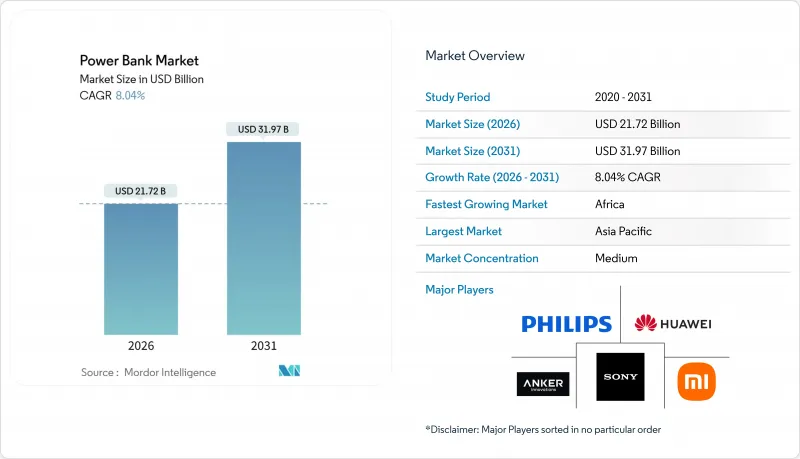
根據 Mordor Intelligence 預測,行動電池市場規模預計將在 2026 年達到 217.2 億美元,到 2031 年達到 319.7 億美元,在此期間的複合年成長率為 8.04%。
本報告按容量範圍(3000mAh以下、3001-8000mAh、8001-20000mAh及其他)、充電技術(有線和無線)、應用領域(智慧型手機和平板電腦、筆記型電腦和遊戲機、穿戴式裝置和物聯網設備、相機和無人機及其他)、分銷管道(上線和線下)以及地區進行分類線。市場預測以美元(USD)計價。
全球行動電池市場趨勢及洞察
5G智慧型手機普及率的快速成長
第五代行動通訊技術(5G)的能耗比4G高出20%到30%,波束成形和持續網路掃描等技術使得重度使用者的日常續航時間從18小時縮短至12小時。即使是配備6000mAh電池的vivo X200 Pro,在連續播放5G影片9.5小時後也耗盡了電量。這證實了即使是更大容量的電池也無法滿足重度使用者一整天的使用需求。高階機型中採用的碳矽負極電池仍僅限於售價超過800美元的設備,而中階設備外接電池的普及率也僅約60%。小米在2025年第三季出貨了2,160萬台物聯網周邊設備,這些設備都需要定期充電,進一步推高了對可攜式電源的需求。 Qi2磁吸式充電目前主要應用於iPhone,因此許多安卓用戶仍然依賴有線充電器,這支撐了行動電源市場在設備電池容量逐步提升的情況下依然保持成長。
家用電器電子商務的擴張
2025年前三個季度,中國線上零售額年增9.8%,其中數位產品成長8.3%。這主要得益於一項系統,該系統透過演算法建議,向近期購買過智慧型手機或筆記型電腦的用戶展示行動電池產品資訊。阿里巴巴旗下「可攜式電源」類別2025年商品交易總額(GMV)達2,304億美元,年增15.7%。安克(Anker)的「737」型號行動電源在10000-20000mAh容量區間佔據了31%的市場佔有率。在印度2025年假期季,Flipkart透過提供現金回饋和免利息分期付款(EMI)等優惠,將行動電池推上了最暢銷配件前五名。在亞馬遜的「Prime Day 2025」活動期間,10,000mAh 行動電源的平均降價28 美元,雖然這給利潤率帶來了壓力,但也促進了銷售成長。 D2C(直接面對消費者)模式使品牌能夠繞過高達 25% 至 35% 的分銷利潤,從而以 50 至 60 美元的價格銷售 20000mAh、65W USB-C 介面的行動電源。在此之前,只有 10000mAh 的行動電源才能達到這樣的價格區間,而如今,一般消費者也能享受這種價格。
由於假冒仿冒品產品氾濫,導致信任度下降。
三星在韓國召回了1萬個電池,因為發生了18起過熱事件。同時,售價低於10美元的無品牌行動電池的線上銷量下降了15%。印尼海關查獲了5萬塊假冒的Anker產品,這些產品標稱容量為2萬mAh,但實際容量只有一半,而且缺乏過熱保護功能。印度修訂後的IS 302標準將從2026年2月起禁止進口未經認證的產品,可能會使灰色市場的出貨量減少三分之一。 UL 2056認證的費用高達每件產品1.5萬美元,這為小規模製造商設定了准入門檻,並導致市場佔有率集中在那些能夠將合規成本分攤到大規模產品系列中的品牌手中。隨著市場監管力度的加大,消費者的信任度正在轉向可追溯和經過認證的產品。
細分市場分析
預計到2025年,8001-20000mAh容量範圍的行動電源將佔總銷售量的47.89%,其吸引力在於其「最佳平衡點」:既能為智慧型手機充滿電兩到三次,又不會顯得笨重。鋰聚合物電池採購的規模經濟使得品牌能夠在保持利潤率的同時,以25-35美元的價格提供10000mAh雙端口型號。消費者之所以青睞這個容量範圍,是因為它可以輕鬆放入背包或外套口袋,並為多日旅行提供安心保障。該細分市場是天貓、京東和亞馬遜等電商平台折扣促銷的重點,而「行動電池市場」這個關鍵字也持續頻繁出現在消費者的搜尋中。容量超過30000mAh的行動電源正以9.21%的複合年成長率成長,因為攝影師、無人機飛行員和現場工程師優先考慮接近航空公司100Wh容量限制的行動電源。 AUKEY 的 27,600mAh Spark Mega 行動電源可為 MacBook Pro 充電兩次,從而減少創作者在外工作的停機時間。同時,容量低於 3,000mAh 的產品主要用於穿戴式設備,但它們對收入的貢獻微乎其微,這表明在更廣泛的行動電池市場中,各種細分市場是如何共存的。
市場對21000-30000mAh容量產品的市場需求維持穩定。這是因為這類產品可以滿足隨身行李攜帶規定的要求,並為筆記型電腦充電三次,確保了經常出差人士的便攜性。 Zendure的「SuperTank Pro」(26800mAh)配備了數位顯示螢幕,在競爭激烈的中階市場中脫穎而出。 Anker的「737」採用GaN技術,可透過單一USB-C介面提供140W的功率輸出,顯示功率和容量都會影響消費者的購買決策。 3000mAh等級的產品在便利商店和其他零售商處仍然很受歡迎,可用於為耳機和智慧型手錶設備進行緊急充電。雖然銷售量不高,但其較高的市場滲透率維持了消費者的認知度,為後續提升銷售到更高容量的產品奠定了基礎,從而支撐了行動電池市場的成長。
2025年,有線充電器預計將佔總銷售量的82.17%,這得益於USB-C介面的近乎普及及其85%–90%的能量轉換效率。 USB-C PD 3.1現已支援240W的充電功率,使筆記型電腦、平板電腦和智慧型手機能夠透過單一電纜充電,其多功能性在企業IT設備中備受青睞。結合更低的組件成本,有線產品能夠在行動電池市場以極具競爭力的價格佔有一席之地。無線充電器預計到2025年僅佔17.83%的市場佔有率,但受Qi2認證的推動,其複合年成長率預計將達到8.47%。此認證將使iPhone 12及後續機型等機械設備的感應式充電功率翻倍至15W。 Mophie的「Powerstation Wireless 10K Slim」(售價79.95美元)瞄準了重視MagSafe便利性的早期用戶。
價格差距正在縮小,AUKEY 的「MagFusion 10K」售價 39.99 美元,比競爭對手的價格低 50%,同時保持了 Qi2 無線充電速度。 Anker 的「MagGo 10K」配備了折疊式支架和智慧顯示螢幕,顯示其新增功能足以支撐 30-40% 的價格溢價。由於感應感應耦合固有的能量損耗,重度使用者往往更傾向於有線連接,尤其是在電費高昂、無法承受低效率的地區。因此,各品牌正將無線產品定位為生活風格配件而非旗艦產品,並制定銷售策略,將其作為補充產品而非替代品,推廣到更廣泛的行動電池市場。
區域分析
預計到2025年,亞太地區將佔全球銷售額的56.12%,主要得益於深圳製造商的強勁表現。深圳製造商供應全球70%的鋰聚合物電池,且生產成本比歐美同業低30%。中國的市場主導地位確保了本地化的供應鏈和快速的產品更新週期。到2026年2月印度BIS認證的最後期限,預計不合規進口產品將被淘汰,獲得認證的國產品牌市場佔有率將擴大,平均零售價格(ASP)也將趨於穩定。在日本,Qi2無線充電技術的快速普及使得支援MagSafe功能的手機零售價在2025年達到8,000至12,000日圓(約55至82美元),這顯示消費者願意為便利性買單。在韓國,繼三星2024年的召回事件之後,審核力度加強,UL 2056認證標籤的重要性進一步提升,成為大型量販店上架的必要條件。在澳大利亞,聯合國第 38.3 號條例對飛機載重進行了限制,將隨身攜帶的電池容量限制在 100Wh,促使我們對 SKU 上市策略進行了重新評估。
北美和歐洲合計佔總銷售額的30%以上,這得益於混合辦公模式的普及以及歐盟強制推行的通用充電器政策,該政策引導消費者轉向新型USB-C充電器。 Mophie針對MacBook用戶推出的140W「Powerstation Ultra 25K」售價99.95美元,反映出高階消費市場的存在。在德國,受夏季旅遊計畫的推動,2025年第一季的銷售額年增18%。法國的FNAC和Darty將其行動電池展示空間擴大了25%,並專門為相容Qi2標準的產品安裝了端蓋。由於制裁導致俄羅斯市場萎縮,這為小米等低成本中國品牌進入該市場創造了機會。
在非洲這個成長最快的地區,年複合成長率高達9.11%,可攜式電源對於彌補電網不可靠的問題至關重要。在南非,計劃於2024年實施的停電措施導致主要都市區的攜帶式電源銷售增加了35%。肯亞農村地區的M-Pesa用戶正在購買15美元的充電包以避免停電。埃及的智慧型手機普及率預計到2025年將達到65%,而夏季平均每天停電長達4小時,開羅的行動電池普及率已超過70%。在中東,由於遊客和外籍人士在炎熱氣候下攜帶多種耗電設備,攜帶式電源的需求正以每年7-8%的速度成長。拉丁美洲的年成長率為6-7%。儘管政府已投資900億美元用於電網建設,但「最後一公里」供電的不足仍然導致人們長期依賴外接電池。這些不同的區域情況共同推動了全球行動電池市場的擴張。
其他好處
- Excel格式的市場預測(ME)表
- 3個月的分析師支持
目錄
第1章:引言
- 研究假設和市場定義
- 調查範圍
第2章:調查方法
第3章執行摘要
第4章 市場狀況
- 市場概覽
- 市場促進因素
- 5G智慧型手機普及率的快速成長
- 家用電器電子商務的擴張
- 開發中國家電力系統不穩定,但其採用率卻不斷上升
- 大容量筆記型電腦和遊戲機的迅速普及。
- 行動電池租賃亭在交通樞紐的普及
- 高階機型採用氮化鎵快速充電晶片組。
- 市場限制因素
- 由於假冒仿冒品產品氾濫,導致信任度下降。
- 智慧型手機電池續航力逐步提升
- 加強聯合國第38.3號公約關於鋰離子電池航空貨運的規定
- 早期採用固體微型電池將減少外部電池組的需求。
- 產業價值鏈分析
- 監理情勢
- 技術展望
- 波特五力分析
- 宏觀經濟因素對市場的影響
第5章 市場規模與成長預測
- 按容量範圍
- 3000mAh 或更少
- 3,001~8,000mAh
- 8,001 至 20,000 毫安培時
- 21,000-30,000毫安培時
- 30,000mAh 或以上
- 透過充電技術
- 有線
- 無線的
- 透過使用
- 智慧型手機和平板電腦
- 筆記型電腦和遊戲機
- 穿戴式裝置和物聯網設備
- 相機和無人機
- 其他
- 透過分銷管道
- 線上
- 離線
- 按地區
- 北美洲
- 美國
- 加拿大
- 墨西哥
- 歐洲
- 德國
- 英國
- 法國
- 俄羅斯
- 其他歐洲國家
- 亞太地區
- 中國
- 日本
- 印度
- 韓國
- 澳洲
- 其他亞太國家
- 中東和非洲
- 中東
- 沙烏地阿拉伯
- 阿拉伯聯合大公國
- 其他中東國家
- 非洲
- 南非
- 埃及
- 其他非洲地區
- 中東
- 南美洲
- 巴西
- 阿根廷
- 南美洲其他地區
- 北美洲
第6章 競爭情勢
- 市場集中度
- 策略趨勢
- 市佔率分析
- 公司簡介
- Anker Innovations Ltd.
- Xiaomi Corporation
- Samsung Electronics Co., Ltd.
- Shenzhen Haopai Electronics(RAVPower)
- Lenovo Group Ltd.
- Sony Group Corporation
- Koninklijke Philips NV
- ADATA Technology Co., Ltd.
- Panasonic Energy Co., Ltd.
- Huawei Technologies Co., Ltd.
- ZAGG Inc.(mophie)
- Belkin International
- UGREEN Group Ltd.
- Baseus Technology Co., Ltd.
- Syska Mobile Accessories
- Ambrane India Pvt. Ltd.
- Intex Technologies (India) Ltd.
- Aukey Technology Co., Ltd.
- Zendure USA Inc.
- EcoFlow Inc.
第7章 市場機會與未來展望
According to Mordor Intelligence, the power bank market size stood at USD 21.72 billion in 2026 and is projected to reach USD 31.97 billion by 2031, advancing at an 8.04% CAGR over the period.
This report is Segmented by Capacity Range (Up To 3, 000 MAh, 3, 001-8, 000 MAh, 8, 001 - 20, 000 MAh, and More), Charging Technology (Wired, and Wireless), Application (Smartphones and Tablets, Laptops and Gaming Consoles, Wearables and IoT Devices, Cameras and Drones, Other Applications), Distribution Channel (Online, and Offline), and Geography. The Market Forecasts are Provided in Terms of Value (USD).
Global Power Bank Market Trends and Insights
Surging Penetration of 5G-Enabled Smartphones
Fifth-generation networks consume 20% to 30% more energy than 4G because beamforming and continuous network scanning shorten daily battery life from 18 hours to 12 hours for heavy users. Vivo's X200 Pro with a 6,000 mAh cell still drained in 9.5 hours under sustained 5G video streaming, confirming that even larger batteries fail to cover an entire day for power users. Flagship silicon-carbon anodes remain limited to devices above USD 800, keeping mid-tier attachment rates for external batteries near 60%. Xiaomi shipped 21.6 million IoT peripherals in Q3-2025, each demanding routine charging and compounding portable-power needs. With Qi2 magnetic charging confined mainly to iPhones, most Android owners still rely on wired packs, reinforcing market breadth even as handset capacity inches upward.
Expanding E-Commerce for Consumer Electronics
China's online retail sales rose 9.8% year on year in the first nine months of 2025, and digital products advanced 8.3%, propelled by algorithmic recommendations that surface power bank listings to recent smartphone or laptop buyers. Alibaba's Portable Power category booked USD 230.4 billion GMV in 2025, up 15.7%, with Anker's 737 model capturing 31% of the 10,000-20,000 mAh tier. Flipkart ranked power banks among its five best-selling accessories during India's 2025 festive season by bundling cashback and no-cost EMI offers. Amazon's Prime Day 2025 discounted 10,000 mAh units to an average of USD 28, compressing margins but driving volume. Direct-to-consumer sites let brands bypass 25%-35% distributor markups, allowing 20,000 mAh, 65 W USB-C models at USD 50-60, a price once reserved for 10,000 mAh packs, broadening mass-market access.
Inflated Counterfeit and Sub-Standard Products Eroding Trust
Samsung recalled 10,000 units in South Korea after 18 overheating incidents, slashing online sales for unbranded power banks under USD 10 by 15%. Indonesian customs seized 50,000 fake Anker packs labeled 20,000 mAh that tested at half capacity and lacked thermal cutoffs. India's revised IS 302 standard will bar uncertified imports after February 2026, potentially eliminating one-third of gray-market shipments. UL 2056 certification costs up to USD 15,000 per SKU, discouraging small makers and concentrating share among brands that amortize compliance across large portfolios. As marketplaces tighten audits, consumer confidence shifts toward traceable, certified models.
Other drivers and restraints analyzed in the detailed report include:
- Higher Penetration in Developing Economies With Unreliable Power Grids
- Integration of GaN Fast-Charging Chipsets in Premium Models
- Incremental Gains in Native Smartphone Battery Life
For complete list of drivers and restraints, kindly check the Table Of Contents.
Segment Analysis
The 8,001-20,000 mAh tranche captured 47.89% of 2025 revenue, underscoring its sweet-spot appeal for two to three full smartphone charges without bulk. Economies of scale in lithium-polymer procurement let brands price 10,000 mAh dual-port units between USD 25 and USD 35 while still protecting margins. Consumers gravitate toward this tier because it slides into backpacks and jackets yet offers a safety net for multiday trips. The segment anchors discount promotions on Tmall, JD, and Amazon, keeping the phrase 'power bank market' in frequent consumer searches. Above 30,000 mAh models are scaling at a 9.21% CAGR as photographers, drone pilots, and field engineers value capacities nearing the 100 Wh airline limit. AUKEY's 27,600 mAh Spark Mega can refill a MacBook Pro twice, reducing downtime for creatives on location. Meanwhile, packs under 3,000 mAh service wearables but contribute negligible revenue, demonstrating how tail segments coexist within the broader power bank market.
Demand for 20,001-30,000 mAh products remains steady because they deliver three laptop recharges yet comply with cabin rules, preserving portability for frequent flyers. Zendure's SuperTank Pro at 26,800 mAh integrates a digital readout, which differentiates it in a crowded middle band. Anker's GaN-based 737 delivers 140 W through a single USB-C port, underscoring that wattage, not just capacity, shapes buyer decisions. The up to 3,000 mAh tier survives in convenience stores for emergency top-ups of earbuds and smartwatches. Although volumes are modest, their ubiquity maintains consumer familiarity, creating entry points that later up-sell higher-capacity products, sustaining the power bank market's trajectory.
Wired models held 82.17% of 2025 revenue thanks to near-universal USB-C adoption and 85%-90% energy-conversion efficiency. USB-C PD 3.1 now supports 240 W, letting a single cable power laptops, tablets, and phones, a versatility prized in enterprise IT kits. Low bill-of-materials costs also allow wired units to command aggressive price tiers in the power bank market. Wireless packs, though only 17.83% in 2025, are projected to grow at an 8.47% CAGR on the back of Qi2 certification, which doubles inductive charging to 15 W for iPhone 12 and newer. Mophie's Powerstation Wireless 10K Slim, priced at USD 79.95, targets early adopters who value MagSafe convenience.
Price differentials are narrowing as AUKEY's MagFusion 10K retails at USD 39.99, undercutting peers by 50% while still offering Qi2 speeds. Anker's MagGo 10K incorporates a fold-out stand and a smart display, showcasing how feature layering can justify 30%-40% premiums. Nevertheless, the inherent energy loss of inductive coupling keeps heavy users loyal to wired options, especially in regions where electricity costs discourage inefficiency. Brands therefore market wireless models as lifestyle accessories rather than primary workhorses, positioning them as complements rather than substitutes within the broader power bank market size narrative.
Complete Report Scope:
- By Capacity Range
- Up to 3,000 mAh
- 3,001 - 8,000 mAh
- 8,001 - 20,000 mAh
- 20,001 - 30,000 mAh
- Above 30,000 mAh
- By Charging Technology
- Wired
- Wireless
- By Application
- Smartphones and Tablets
- Laptops and Gaming Consoles
- Wearables and IoT Devices
- Cameras and Drones
- Other Applications
- By Distribution Channel
- Online
- Offline
- By Geography
- North America
- United States
- Canada
- Mexico
- Europe
- Germany
- United Kingdom
- France
- Russia
- Rest of Europe
- Asia-Pacific
- China
- Japan
- India
- South Korea
- Australia
- Rest of Asia-Pacific
- Middle East and Africa
- Middle East
- Saudi Arabia
- United Arab Emirates
- Rest of Middle East
- Africa
- South Africa
- Egypt
- Rest of Africa
- Middle East
- South America
- Brazil
- Argentina
- Rest of South America
- North America
Geography Analysis
Asia-Pacific commanded 56.12% of 2025 sales, anchored by Shenzhen manufacturers that supply 70% of global lithium-polymer cells at cost bases 30% lower than Western peers. China's dominance ensures localized supply chains and rapid SKU refresh cycles. India's BIS hallmark deadline of February 2026 should weed out non-compliant imports, increase the share of certified domestic brands, and stabilize retail ASPs. Japan's speedy adoption of Qi2 led MagSafe-compatible models to retail at JPY 8,000-12,000 (USD 55-82) in 2025, signaling a willingness to pay for convenience. South Korea tightened audits after Samsung's 2024 recall, elevating UL 2056 labels as a prerequisite for big-box listings. Australia enforced UN 38.3 airline limits, capping carry-on capacity at 100 Wh and reshaping SKU launch strategies.
North America and Europe jointly contributed just over 30% of revenue, buoyed by hybrid work patterns and the EU common-charger mandate that nudged consumers toward new USB-C models. Mophie's 140 W Powerstation Ultra 25K launched at USD 99.95 for MacBook users, reflecting high-spend consumer segments. Germany logged 18% year-on-year sales growth in Q1-2025 amid summer travel planning. France's FNAC and Darty expanded power-bank shelf space by 25% and dedicated end-caps to Qi2 units. Russian market contraction following sanctions opened pockets for lower-priced Chinese brands like Xiaomi.
Africa, the fastest-growing region at 9.11% CAGR, depends on portable power to bridge unreliable grids. South Africa's 2024 load shedding lifted sales 35% in major metros. Kenya's rural M-Pesa users adopt USD 15 packs to avoid transaction disruptions. Egypt's smartphone penetration reached 65% in 2025, yet daily summer outages average four hours, driving attachment rates above 70% in Cairo. Middle Eastern demand grows 7%-8% as tourists and expatriates carry multiple high-drain devices in hot climates. Latin America advances 6%-7% annually; despite USD 90 billion network investment plans, last-mile power deficiencies sustain long-run reliance on external batteries. These varied regional narratives together enlarge the global power bank market.
- Anker Innovations Ltd.
- Xiaomi Corporation
- Samsung Electronics Co., Ltd.
- Shenzhen Haopai Electronics (RAVPower)
- Lenovo Group Ltd.
- Sony Group Corporation
- Koninklijke Philips N.V.
- ADATA Technology Co., Ltd.
- Panasonic Energy Co., Ltd.
- Huawei Technologies Co., Ltd.
- ZAGG Inc. (mophie)
- Belkin International
- UGREEN Group Ltd.
- Baseus Technology Co., Ltd.
- Syska Mobile Accessories
- Ambrane India Pvt. Ltd.
- Intex Technologies (India) Ltd.
- Aukey Technology Co., Ltd.
- Zendure USA Inc.
- EcoFlow Inc.
Additional Benefits:
- The market estimate (ME) sheet in Excel format
- 3 months of analyst support
TABLE OF CONTENTS
1 INTRODUCTION
- 1.1 Study Assumptions and Market Definition
- 1.2 Scope of the Study
2 RESEARCH METHODOLOGY
3 EXECUTIVE SUMMARY
4 MARKET LANDSCAPE
- 4.1 Market Overview
- 4.2 Market Drivers
- 4.2.1 Surging Penetration of 5G-Enabled Smartphones
- 4.2.2 Expanding E-Commerce for Consumer Electronics
- 4.2.3 Higher Penetration in Developing Economies With Unreliable Power Grids
- 4.2.4 Rapid Adoption of High-Capacity Laptops and Gaming Consoles
- 4.2.5 Proliferation of Power-Bank Rental Kiosks at Transit Hubs
- 4.2.6 Integration of GaN Fast-Charging Chipsets in Premium Models
- 4.3 Market Restraints
- 4.3.1 Inflated Counterfeit and Sub-Standard Products Eroding Trust
- 4.3.2 Incremental Gains in Native Smartphone Battery Life
- 4.3.3 Stricter UN 38.3 Air-Cargo Limits for Li-Ion Shipments
- 4.3.4 Early Traction of Solid-State Micro-Batteries Reducing Need for External Packs
- 4.4 Industry Value Chain Analysis
- 4.5 Regulatory Landscape
- 4.6 Technological Outlook
- 4.7 Porter's Five Forces Analysis
- 4.7.1 Bargaining Power of Suppliers
- 4.7.2 Bargaining Power of Buyers
- 4.7.3 Threat of New Entrants
- 4.7.4 Threat of Substitutes
- 4.7.5 Intensity of Competitive Rivalry
- 4.8 Impact of Macroeconomic Factors on the Market
5 MARKET SIZE AND GROWTH FORECASTS (VALUE)
- 5.1 By Capacity Range
- 5.1.1 Up to 3,000 mAh
- 5.1.2 3,001 - 8,000 mAh
- 5.1.3 8,001 - 20,000 mAh
- 5.1.4 20,001 - 30,000 mAh
- 5.1.5 Above 30,000 mAh
- 5.2 By Charging Technology
- 5.2.1 Wired
- 5.2.2 Wireless
- 5.3 By Application
- 5.3.1 Smartphones and Tablets
- 5.3.2 Laptops and Gaming Consoles
- 5.3.3 Wearables and IoT Devices
- 5.3.4 Cameras and Drones
- 5.3.5 Other Applications
- 5.4 By Distribution Channel
- 5.4.1 Online
- 5.4.2 Offline
- 5.5 By Geography
- 5.5.1 North America
- 5.5.1.1 United States
- 5.5.1.2 Canada
- 5.5.1.3 Mexico
- 5.5.2 Europe
- 5.5.2.1 Germany
- 5.5.2.2 United Kingdom
- 5.5.2.3 France
- 5.5.2.4 Russia
- 5.5.2.5 Rest of Europe
- 5.5.3 Asia-Pacific
- 5.5.3.1 China
- 5.5.3.2 Japan
- 5.5.3.3 India
- 5.5.3.4 South Korea
- 5.5.3.5 Australia
- 5.5.3.6 Rest of Asia-Pacific
- 5.5.4 Middle East and Africa
- 5.5.4.1 Middle East
- 5.5.4.1.1 Saudi Arabia
- 5.5.4.1.2 United Arab Emirates
- 5.5.4.1.3 Rest of Middle East
- 5.5.4.2 Africa
- 5.5.4.2.1 South Africa
- 5.5.4.2.2 Egypt
- 5.5.4.2.3 Rest of Africa
- 5.5.4.1 Middle East
- 5.5.5 South America
- 5.5.5.1 Brazil
- 5.5.5.2 Argentina
- 5.5.5.3 Rest of South America
- 5.5.1 North America
6 COMPETITIVE LANDSCAPE
- 6.1 Market Concentration
- 6.2 Strategic Moves
- 6.3 Market Share Analysis
- 6.4 Company Profiles (includes Global Level Overview, Market Level Overview, Core Segments, Financials as Available, Strategic Information, Market Rank/Share, Products and Services, Recent Developments)
- 6.4.1 Anker Innovations Ltd.
- 6.4.2 Xiaomi Corporation
- 6.4.3 Samsung Electronics Co., Ltd.
- 6.4.4 Shenzhen Haopai Electronics (RAVPower)
- 6.4.5 Lenovo Group Ltd.
- 6.4.6 Sony Group Corporation
- 6.4.7 Koninklijke Philips N.V.
- 6.4.8 ADATA Technology Co., Ltd.
- 6.4.9 Panasonic Energy Co., Ltd.
- 6.4.10 Huawei Technologies Co., Ltd.
- 6.4.11 ZAGG Inc. (mophie)
- 6.4.12 Belkin International
- 6.4.13 UGREEN Group Ltd.
- 6.4.14 Baseus Technology Co., Ltd.
- 6.4.15 Syska Mobile Accessories
- 6.4.16 Ambrane India Pvt. Ltd.
- 6.4.17 Intex Technologies (India) Ltd.
- 6.4.18 Aukey Technology Co., Ltd.
- 6.4.19 Zendure USA Inc.
- 6.4.20 EcoFlow Inc.
7 MARKET OPPORTUNITIES AND FUTURE OUTLOOK
- 7.1 White-Space and Unmet-Need Assessment

 行動電池市場:2026-2032年全球市場預測(按類型、電池類型、輸出容量、連接埠數量、相容設備、分銷管道和最終用戶分類)
 行動電源:全球市場佔有率和排名、總收入和需求預測(2026-2032年)
 可攜式電源市場-全球產業規模、佔有率、趨勢、機會、預測:按產品類型、容量、最終用戶、分銷管道、地區和競爭格局分類,2021-2031年
 全球行動電池市場:機會與策略展望(至2035年)
 行動電池市場規模、佔有率、趨勢和預測:按類型、最終用途和地區分類,2026-2034 年
 行動裝置充電站市場規模、佔有率和趨勢分析報告:按類型、連接容量、充電技術、最終用戶、地區和細分市場預測(2026-2033 年)
 露營行動電池市場:按產品類型、容量、輸出埠數量、最終用戶、分銷管道和地區分類
 行動電池市場規模、佔有率和成長分析:按容量、電池類型、應用、價格範圍、充電技術、銷售管道和地區分類-2026-2033年產業預測
 行動電池市場機會、成長要素、產業趨勢分析及2026-2035年預測攜帶式充電器和行動電源市場:按產品類型、電池容量、技術、介面類型、價格範圍、應用、最終用戶和分銷管道分類-全球預測,2026-2032年