


 |
市場調查報告書
商品編碼
2114454
磨料化合物:市場佔有率分析、行業趨勢和統計數據、成長預測(2026-2031 年)Bonded Abrasives - Market Share Analysis, Industry Trends & Statistics, Growth Forecasts (2026 - 2031) |
||||||

※ 本網頁內容可能與最新版本有所差異。詳細情況請與我們聯繫。
根據 Mordor Intelligence 估計,2026 年黏結磨料的市場規模為 252.3 億美元,預計在預測期(2026-2031 年)內將以 5.12% 的複合年成長率成長,到 2031 年達到 323.9 億美元。
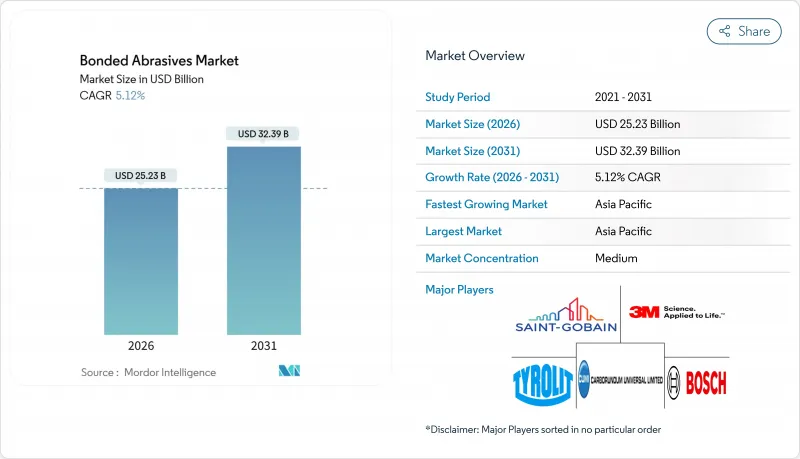
本報告按粘合劑類型(玻璃化黏合劑、樹脂黏合劑、橡膠黏合劑及其他)、材料類型(氧化鋁、碳化硼、碳化矽及其他)、終端用戶產業(汽車、航太、電氣電子及其他)和地區(亞太、北美、歐洲、南美、中東和非洲)進行細分。市場預測以美元計價。
全球磨料市場趨勢及洞察
亞洲基礎建設主導的金屬加工業繁榮
區域鋼鐵產量呈上升趨勢,主要受印度2024會計年度1.443億噸的產量(年增13.4%)以及越南和印尼產能提升的推動,後者帶動了建築工程用扁鋼產量的成長。鋼鐵產量的增加轉化為鋼坯研磨、結構梁精加工和鋼筋切割需求的增加,直接推動了黏結磨料市場的需求。儘管中國鋼廠的運轉率正在放緩,但伍德麥肯茲預測,到2031年,印度、泰國和菲律賓將消化這些產能,從而將砂輪消費轉移到南方。日本和韓國仍然是半導體晶圓和精細加工用立方氮化硼(CBN)和鑽石砂輪的主要買家,這證實了高階細分市場的存在。各國政府正在為地鐵、港口疏浚和橋樑擴建等基礎設施項目撥款,確保了鋁製輪圈的多年訂單。因此,全球和本地生產商的長期收入前景都很明朗。
樹脂砂輪可實現超過 25 公尺/秒的高速研磨線。
在汽車曲軸和航太渦輪機的加工中,陶瓷鑽石砂輪的運作速度越來越高,難以承受,因此人們更傾向於使用彈性酚醛樹脂基體結合的鑽石砂輪。經過同行評審的測試表明,樹脂結合鑽石砂輪在製造過程中能夠承受高達 125 公尺/秒的轉速,從而將加工週期縮短 30%,並最大限度地減少鎳基高溫合金的熱影響區。因此,航太原始設備製造商 (OEM) 能夠在保持表面粗糙度 Ra ≤ 0.4微米的同時,減少精加工循環次數。電動車馬達軸的圓度要求小於 5微米,而使用耐衝擊樹脂砂輪則更容易達到此公差。汽車行業的一級供應商正在使用這些砂輪,以實現每根軸 60 秒以內的加工週期,並確保生產效率。隨著周邊速度的不斷提高,需求彈性使得能夠根據 ISO 21940 爆破測試標準獲得車輪認證的供應商具有優勢。
高能耗爐具需繳納碳排放稅
陶瓷砂輪的燒製溫度超過攝氏1200度,每噸耗電3-5兆瓦時,並排放大量二氧化碳。歐盟委員會要求在2030年將二氧化碳排放量減少55%,迫使陶瓷廠維修用電窯或氫窯,每台窯爐的成本超過1000萬歐元。雖然美國產業政策為電窯提供稅額扣抵,但小規模生產商仍需800萬至1,200萬美元的初始投資。中國的「雙軌制」排放限制已經迫使河南和山東兩省的工廠在旺季減產,導致砂輪交貨期延長至八週。不斷上漲的能源附加費可能會擠壓企業的營業利潤率,減緩產能擴張,並可能拖慢以陶瓷砂輪為主導的黏結磨料市場的成長。
細分市場分析
預計到2025年,陶瓷基粘合劑將佔據黏結劑磨料市場58.06%的佔有率,並在2031年之前維持5.49%的複合年成長率。其堅固的多孔結構即使在強大的法向力作用下也能提供優異的抗燒蝕性能,從而保持曲軸、凸輪軸和渦輪葉片的形狀。此外,陶瓷基粘合劑的多種配方允許在加工過程中進行調整,即使在長期連續生產中也能確保表面品質的一致性。諸如Chalmers Grinding 4.0等研究夥伴關係透過預測修整週期,降低了單一零件的刀具成本,並將砂輪利用率提高了15個百分點。
樹脂黏接劑可在低於200°C的溫度下固化,因其彈性基體能夠吸收衝擊並抑制災難性斷裂,在高速應用中備受關注。在電動車生產線上,其耐久性在馬達軸的研磨過程中尤其重要,尤其是在超過80公尺/秒的圓週速度下。橡膠接著劑雖然市佔率僅為個位數,但仍是薄切片和無心研磨領域不可或缺的材料,其減振作用能夠提高加工精度。此外,金屬粘合劑和蟲膠粘合劑也被應用於超精密光學領域,進一步豐富了黏接磨料的市場。
區域分析
預計到2025年,亞太地區將佔全球磨料市場總銷售額的56.48%,並將以5.71%的複合年成長率成長至2031年,成長速度位居全球之首。印度是主要的消費國,其粗鋼產量預計在2024年達到1.443億噸,年增13.4%。對薄壁砂輪和碳化矽砂輪生產線的資本投資也凸顯了印度日益成長的需求。泰羅利特位於浦那的新工廠提升了該地區對立方氮化硼(CBN)和鑽石砂輪的供應,將從歐洲的運輸時間縮短至兩週。在東南亞,橋樑和鐵路走廊的公共資金投入推動了對用於結構鋼的低成本氧化鋁鋁製輪圈的需求。日本和韓國在半導體晶圓研磨領域佔據高階細分市場,主要依賴立方氮化硼(CBN)和鑽石研磨顆粒。
在北美,航太業重返美國刺激了對氮化硼的需求,但碳排放稅和高昂的電費推高了陶瓷輪的生產成本。美國能源局提供的稅額扣抵抵免鼓勵了熔爐的電氣化,但只有大型工廠才能達到所需的投資規模。關稅風險依然顯著,因為91%的熔融氧化鋁進口來自中國,因此需要從澳洲和圭亞那建立替代供應鏈。
歐洲面臨與北美類似的挑戰。歐盟的「工業碳管理戰略」要求到2030年將二氧化碳排放量減少55%,這促使聖戈班在法國測試和運營氫氣爐,而義大利的中型製造商正在考慮從液化天然氣轉向電力。德國、義大利和法國共同支撐著汽車和航太領域的研磨業務,但成本壓力正迫使一些下游加工工序轉移到東歐。
即使將南美洲和中東/非洲的市場合併計算,黏結磨料的銷量仍然很低。在巴西的汽車組裝,仍然使用鋁製輪圈來研磨曲軸;而在沙烏地阿拉伯,管道製造所需的切割片則被用於基礎設施項目。在南非的採礦作業中,樹脂黏結砂輪用於研磨鑽頭,因為砂輪的使用壽命比表面光潔度要求更為重要。
其他好處
- Excel格式的市場預測(ME)表
- 3個月的分析師支持
目錄
第1章:引言
- 研究假設和市場定義
- 調查範圍
第2章:調查方法
第3章執行摘要
第4章 市場狀況
- 市場概覽
- 市場促進因素
- 亞洲基礎建設主導的金屬加工業繁榮
- 樹脂砂輪可實現超過 25 公尺/秒的高速研磨線。
- 電動車動力傳動系統中向高精度陶瓷和立方研磨顆粒的過渡
- 人工智慧驅動的工具室自動化(配備自動磨刀功能)
- 美國和歐盟正在恢復航太領域的國內機械加工能力。
- 市場限制因素
- 高能耗爐具需繳納碳排放稅
- 二氧化鈦酚醛樹脂價格波動幅度超過18%,與去年同期相比。
- 印度和中國拋光廠加強PM2.5監管
- 價值鏈分析
- 波特五力模型
第5章 市場規模與成長預測
- 按粘合劑類型
- 玻璃化鍵
- 樹脂黏接
- 橡膠黏合
- 其他
- 依材料類型
- 氧化鋁
- 碳化硼
- 碳化矽
- 其他
- 按最終用戶行業分類
- 車
- 航太
- 醫療保健
- 電氣和電子
- 工業機械
- 其他(家具、建築/施工等)
- 按地區
- 亞太地區
- 中國
- 印度
- 日本
- 韓國
- ASEAN
- 其他亞太國家
- 北美洲
- 美國
- 加拿大
- 墨西哥
- 歐洲
- 德國
- 英國
- 義大利
- 法國
- 西班牙
- 北歐國家
- 其他歐洲國家
- 南美洲
- 巴西
- 阿根廷
- 其他南美國家
- 中東和非洲
- 沙烏地阿拉伯
- 南非
- 其他中東和非洲國家
- 亞太地區
第6章 競爭情勢
- 市場集中度
- 策略趨勢
- 市佔率和排名分析
- 公司簡介
- 3M
- Asahi Diamond Industrial(ADI)
- August Ruggeberg GmbH & Co. KG
- CUMI
- Fujimi Incorporated.
- Henan Huanghe Whirlwind CO.,Ltd.
- Hermes Schleifmittel GmbH
- Klingspor India Pvt. Ltd.
- Marrose Abrasives
- Mirka Ltd
- Osborn(DRONCO)
- Precision Abrasives Pvt. Ltd.
- Rhodius
- Robert Bosch Power Tools GmbH
- Saint-Gobain
- SAK ABRASIVES LIMITED
- Tyrolit AG
- VSM AG
- Weiler Abrasives
第7章 市場機會與未來展望
According to Mordor Intelligence, the bonded abrasives market size is estimated at USD 25.23 billion in 2026, and is expected to reach USD 32.39 billion by 2031, at a CAGR of 5.12% during the forecast period (2026-2031).
This report is Segmented by Bond Type (Vitrified Bond, Resin Bond, Rubber Bond, and Others), Material Type (Aluminum Oxide, Boron Carbide, Silicon Carbide, and Others), End-User Industry (Automotive, Aerospace, Electrical and Electronics, and Others), and Geography (Asia-Pacific, North America, Europe, South America, and Middle-East and Africa). The Market Forecasts are Provided in Terms of Value (USD).
Global Bonded Abrasives Market Trends and Insights
Infrastructure-Led Metal-Working Boom in Asia
Regional steel output is rising as India produced 144.3 million t in fiscal 2024, up 13.4% year on year, while new capacity in Vietnam and Indonesia adds flat-rolled output for construction projects. More steel means more billet grinding, structural-beam finishing, and rebar cutting, which directly lifts bonded abrasives market demand. Chinese mill utilization is softening, yet Wood Mackenzie expects India, Thailand, and the Philippines to absorb volume through 2031, shifting wheel consumption southward. Japan and South Korea remain buyers of CBN and diamond wheels for semiconductor wafer and micro-finishing work, underscoring a stable premium niche. Governments channel infrastructure budgets into metro rail, port dredging, and bridge expansion, locking in multi-year orders for aluminum-oxide wheels. The result is predictable long-cycle revenue visibility for both global and local producers.
Resinoid Wheels Supporting greater than 25 m/s Grinding Lines
Automotive crankshaft and aerospace turbine machining increasingly runs at peripheral speeds that vitrified wheels cannot safely withstand, so resin bonds with elastic phenolic matrices are preferred. Peer-reviewed trials show resin-bond diamond wheels sustain 125 m/s in production, slashing cycle time by 30% and reducing heat-affected zones on nickel superalloys. Aerospace OEMs therefore cut finishing passes while maintaining Ra <= 0.4 µm surface finishes. Electric-vehicle motor shafts require roundness within 5 µm, a tolerance easier to hit with shock-resistant resin wheels. Automotive tier-1 suppliers deploy these wheels to hit takt times below 60 s per shaft, protecting throughput. With peripheral speeds still climbing, demand elasticity favors suppliers able to certify wheels under ISO 21940 burst-test criteria.
Energy-Intensive Firing Furnaces and Carbon Taxes
Vitrified wheels fire above 1,200 °C, consuming 3-5 MWh per tonne and emitting significant CO2. The European Commission requires 55% emissions cuts by 2030, obliging ceramic plants to retrofit electric or hydrogen kilns that each cost more than EUR 10 million. U.S. industrial policy offers tax credits for electrified furnaces, yet smaller producers still face USD 8-12 million up-front capital. Chinese dual-control caps have already forced Henan and Shandong operations to curtail peak-season output, lengthening wheel lead times to eight weeks. Higher energy surcharges narrow operating margins and could delay capacity additions, moderating bonded abrasives market expansion where vitrified products dominate.
Other drivers and restraints analyzed in the detailed report include:
- Precision Ceramics and CBN for EV Powertrains
- AI-Driven Tool-Room Automation
- Ti-Oxide and Phenolic-Resin Price Volatility greater than 18% YoY
For complete list of drivers and restraints, kindly check the Table Of Contents.
Segment Analysis
Vitrified bond secured 58.06% bonded abrasives market share in 2025 and is projected to register a 5.49% CAGR to 2031. Its rigid, porous structure resists burn and preserves geometry on crankshafts, camshafts, and turbine blades even under heavy normal forces. Vitrified variants also enable in-process conditioning that keeps surface integrity consistent during long production runs. Research partnerships such as Chalmers Grinding 4.0 lower tool cost per part by predicting dressing intervals, improving wheel utilization by 15 pp.
Resin bonds, cured below 200 °C, are capturing high-speed applications where elastic matrices absorb shock and limit catastrophic bursts. Automotive EV lines value that resilience for motor shaft grinding at peripheral speeds above 80 m/s. Rubber bonds, while niche at single-digit share, remain essential for thin cutting disks and centerless grinding where vibration damping improves finish. Metal and shellac bonds fill ultra-precision optics roles, rounding out a diverse bonded abrasives market.
Complete Report Scope:
- By Bond Type
- Vitrified Bond
- Resin Bond
- Rubber bond
- Others
- By Material Type
- Aluminum Oxide
- Boron Carbide
- Silicon Carbide
- Others
- By End-user Industry
- Automotive
- Aerospace
- Medical
- Electrical and Electronics
- Industrial Machinery
- Others (Furniture, Building and Construction, Etc.)
- By Geography
- Asia-Pacific
- China
- India
- Japan
- South Korea
- ASEAN Countries
- Rest of Asia-Pacific
- North America
- United States
- Canada
- Mexico
- Europe
- Germany
- United Kingdom
- Italy
- France
- Spain
- NORDIC Countries
- Rest of Europe
- South America
- Brazil
- Argentina
- Rest of South America
- Middle-East and Africa
- Saudi Arabia
- South Africa
- Rest of Middle-East and Africa
- Asia-Pacific
Geography Analysis
Asia-Pacific commanded 56.48% bonded abrasives market revenue in 2025 and is forecast for a 5.71% CAGR to 2031, the quickest global pace. India is the swing consumer as crude steel output rose 13.4% to 144.3 million t in 2024, and capital spending on thin-wheel and silicon-carbide lines underscores local appetite. Tyrolit's new Pune plant strengthens regional access to CBN and diamond wheels, shrinking freight time from Europe to two weeks. Southeast Asia funnels public funds into bridges and rail corridors, pulling demand for cost-effective aluminum-oxide wheels on structural steel. Japan and South Korea hold premium niches in semiconductor wafer grinding, reliant on CBN and diamond grains.
In North America, aerospace reshoring stimulates CBN demand, yet carbon taxes and high electricity tariffs raise vitrified production costs. DOE tax credits encourage kiln electrification, but only large plants achieve the scale to invest. Tariff exposure remains acute because 91% of fused alumina imports originate in China, motivating alternative supply chains from Australia and Guyana.
Europe mirrors North American challenges. The EU Industrial Carbon Management strategy compels 55% CO2 reductions by 2030, so Saint-Gobain pilots hydrogen kilns in France while midsized Italian manufacturers weigh LNG-to-electric transitions. Germany, Italy, and France together sustain automotive and aerospace grinding volumes, but cost pressures shift some downstream machining to Eastern Europe.
South America and Middle East and Africa together represent low bonded abrasives market revenue. Brazil's vehicle assembly plants still grind crankshafts with vitrified aluminum-oxide wheels, while Saudi Arabian infrastructure projects buy cutting disks for pipeline fabrication. South African mining operations use resin-bond wheels for drill-bit sharpening where wheel life outweighs finish requirements.
- 3M
- Asahi Diamond Industrial (ADI)
- August Ruggeberg GmbH & Co. KG
- CUMI
- Fujimi Incorporated.
- Henan Huanghe Whirlwind CO.,Ltd.
- Hermes Schleifmittel GmbH
- Klingspor India Pvt. Ltd.
- Marrose Abrasives
- Mirka Ltd
- Osborn (DRONCO)
- Precision Abrasives Pvt. Ltd.
- Rhodius
- Robert Bosch Power Tools GmbH
- Saint-Gobain
- SAK ABRASIVES LIMITED
- Tyrolit AG
- VSM AG
- Weiler Abrasives
Additional Benefits:
- The market estimate (ME) sheet in Excel format
- 3 months of analyst support
TABLE OF CONTENTS
1 Introduction
- 1.1 Study Assumptions and Market Definition
- 1.2 Scope of the Study
2 Research Methodology
3 Executive Summary
4 Market Landscape
- 4.1 Market Overview
- 4.2 Market Drivers
- 4.2.1 Infrastructure-Led Metal-Working Boom in Asia
- 4.2.2 Resinoid Wheels Enabling greater than 25 M/S High-Speed Grinding Lines
- 4.2.3 Shift To Precision Ceramics and CBN Grains in EV Power-Trains
- 4.2.4 AI-Driven Tool-Room Automation (Self-Sharpening Set-Ups)
- 4.2.5 Re-Shoring of US/EU Aerospace Machining Capacity
- 4.3 Market Restraints
- 4.3.1 Energy-Intensive Firing Furnaces Facing Carbon Taxes
- 4.3.2 Ti-Oxide And Phenolic-Resin Price Volatility greater than 18 % YoY
- 4.3.3 Stricter PM2.5 Limits in India and China Grinding Shops
- 4.4 Value Chain Analysis
- 4.5 Porter's Five Forces
- 4.5.1 Threat of New Entrants
- 4.5.2 Bargaining Power of Suppliers
- 4.5.3 Bargaining Power of Buyers
- 4.5.4 Threat of Substitutes
- 4.5.5 Competitive Rivalry
5 Market Size and Growth Forecasts (Value)
- 5.1 By Bond Type
- 5.1.1 Vitrified Bond
- 5.1.2 Resin Bond
- 5.1.3 Rubber bond
- 5.1.4 Others
- 5.2 By Material Type
- 5.2.1 Aluminum Oxide
- 5.2.2 Boron Carbide
- 5.2.3 Silicon Carbide
- 5.2.4 Others
- 5.3 By End-user Industry
- 5.3.1 Automotive
- 5.3.2 Aerospace
- 5.3.3 Medical
- 5.3.4 Electrical and Electronics
- 5.3.5 Industrial Machinery
- 5.3.6 Others (Furniture, Building and Construction, Etc.)
- 5.4 By Geography
- 5.4.1 Asia-Pacific
- 5.4.1.1 China
- 5.4.1.2 India
- 5.4.1.3 Japan
- 5.4.1.4 South Korea
- 5.4.1.5 ASEAN Countries
- 5.4.1.6 Rest of Asia-Pacific
- 5.4.2 North America
- 5.4.2.1 United States
- 5.4.2.2 Canada
- 5.4.2.3 Mexico
- 5.4.3 Europe
- 5.4.3.1 Germany
- 5.4.3.2 United Kingdom
- 5.4.3.3 Italy
- 5.4.3.4 France
- 5.4.3.5 Spain
- 5.4.3.6 NORDIC Countries
- 5.4.3.7 Rest of Europe
- 5.4.4 South America
- 5.4.4.1 Brazil
- 5.4.4.2 Argentina
- 5.4.4.3 Rest of South America
- 5.4.5 Middle-East and Africa
- 5.4.5.1 Saudi Arabia
- 5.4.5.2 South Africa
- 5.4.5.3 Rest of Middle-East and Africa
- 5.4.1 Asia-Pacific
6 Competitive Landscape
- 6.1 Market Concentration
- 6.2 Strategic Moves
- 6.3 Market Share/Ranking Analysis
- 6.4 Company Profiles {(includes Global level Overview, Market level overview, Core Segments, Financials as available, Strategic Information, Market Rank/Share for key companies, Products and Services, and Recent Developments)}
- 6.4.1 3M
- 6.4.2 Asahi Diamond Industrial (ADI)
- 6.4.3 August Ruggeberg GmbH & Co. KG
- 6.4.4 CUMI
- 6.4.5 Fujimi Incorporated.
- 6.4.6 Henan Huanghe Whirlwind CO.,Ltd.
- 6.4.7 Hermes Schleifmittel GmbH
- 6.4.8 Klingspor India Pvt. Ltd.
- 6.4.9 Marrose Abrasives
- 6.4.10 Mirka Ltd
- 6.4.11 Osborn (DRONCO)
- 6.4.12 Precision Abrasives Pvt. Ltd.
- 6.4.13 Rhodius
- 6.4.14 Robert Bosch Power Tools GmbH
- 6.4.15 Saint-Gobain
- 6.4.16 SAK ABRASIVES LIMITED
- 6.4.17 Tyrolit AG
- 6.4.18 VSM AG
- 6.4.19 Weiler Abrasives
7 Market Opportunities and Future Outlook
- 7.1 White-space and Unmet-need Assessment

 全球金屬磨料市場規模、佔有率、趨勢和成長分析報告(2026-2034年)
 氧化鋁和氧化鋯磨料市場分析及預測(至2035年):類型、產品、技術、應用、形態、材料類型、製程、最終用戶、安裝形式
 鋼包用排水砂市場規模、佔有率及成長分析:依材料、應用、粒度、最終用戶、包裝類型及地區分類-2026-2033年產業預測
 氧化鋯和氧化鋁磨料市場:全球市場預測(2026-2032)液體砂紙市場-2026-2032年全球市場預測磨料市場:2026-2032年全球市場預測(依產品形式、材料、形狀、應用、通路和最終用途產業分類)
 黏結磨料市場規模、佔有率和成長分析:按產品類型、粘合劑類型、材料類型、最終用途產業、技術領域、分銷管道和地區分類-2026-2033年產業預測
 簇絨機械市場機會、成長要素、產業趨勢分析及2026-2035年預測
 磨料市場報告:按產品類型、應用、材料類型和地區分類(2026-2034年)全球液體砂紙市場規模、佔有率、趨勢和成長分析報告(2026-2034年)