


 |
市場調查報告書
商品編碼
2114452
智慧照明:市場佔有率分析、產業趨勢與統計、成長預測(2026-2031)Intelligent Lighting - Market Share Analysis, Industry Trends & Statistics, Growth Forecasts (2026 - 2031) |
||||||

※ 本網頁內容可能與最新版本有所差異。詳細情況請與我們聯繫。
根據 Mordor Intelligence 預測,智慧照明市場規模將從 2025 年的 50 億美元成長到 2026 年的 53.9 億美元,到 2031 年將達到 78.1 億美元,2026 年至 2031 年的複合年成長率為 7.71%。
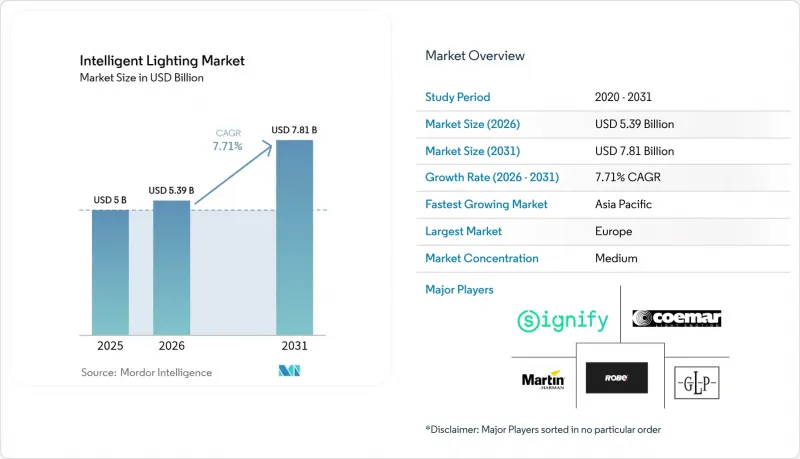
本報告按光源(LED、HID 等)、燈具類型(輪廓燈、射燈等)、控制協議(DMX-512、Art-Net/SACN 等)、應用領域(室內場館和室外場館(體育場、音樂會))、最終用戶(劇院和音樂會、電視台和廣播等)以及地區進行細分。市場預測以美元計價。
全球智慧照明市場趨勢及洞察
實況活動和節慶活動的迅速擴張
隨著全球門票銷售恢復到疫情前水平,場館營運商如今將可程式設計照明視為支撐高價位的重要收入來源。租賃公司正在擴充搖頭LED燈的庫存,因為表演者指定使用的照明設備能夠滿足從搖滾音樂會到企業晚宴等各種場合的需求,且無需重新安裝。大型製作公司正在將連網照明系統整合到演出方案中,使創新總監能夠即時調整燈光效果。智慧照明市場也因此受益,因為音樂節需要能夠在臨時微電網上運作的節能設備。分銷商正在加強其系統,以確保當日送達替換零件,從而運轉率。
降低LED成本和提高能源效率
到2025年,晶圓良率的提高以及氮化鎵元件向6吋基板的過渡,將使LED組件的平均價格下降近8%。美國能源資訊署(EIA)預測,隨著成本的下降,LED效率的提升將持續,聯邦能源效率標準將推動通用照明技術的進步,進而惠及專業應用領域。場館管理人員現在正透過將降低能源成本與較短的投資回收期(通常不到三年)聯繫起來,來證明設備升級的合理性。政府對節能維修的補貼進一步縮小了傳統照明系統和現代照明系統之間的總擁有成本差距。二極體價格的下降正在推動中端產品線的激增,從而擴大了整個智慧照明市場買家的選擇範圍。
高昂的初始投資(資本支出)正促使用戶轉向租賃模式。
在擁有2000個座位的劇院中,用連網的LED搖頭燈和主機替換老舊的照明設備通常需要花費120萬美元。資金有限的小規模業者則選擇租賃方案,以便將成本分攤到各個演出行程中。雖然租賃公司可以從運轉率中受益,但他們需要每三年更新一次設備以保持最新狀態,這增加了他們的資金需求。為了應對這種情況,照明設備OEM廠商推出了付費使用制計劃,並結合了預測性維護,但除北美和歐洲以外,這些計劃的普及速度仍然緩慢。這種趨勢導致現有設備的持續運轉率,同時暫時限制了設備的出貨量。
細分市場分析
預計到2025年,LED技術將佔據77.35%的市場。這反映了其憑藉卓越的能源效率、可程式設計控制能力和更低的成本,在智慧照明應用領域佔據穩固地位。然而,雷射系統正迅速崛起為成長最快的細分市場,預計到2031年將以16.9%的複合年成長率成長,這主要得益於大規模場館和戶外裝置中對極高亮度和精確光束控制的需求。雖然在某些高功率應用中,HID系統仍然十分重要,因為這些應用對顯色性和亮度的要求超過了LED目前的水平,但隨著LED技術的進步,其市佔率持續下降。雷射照明領域正受益於固體雷射設計的創新以及安全系統的改進,使其能夠在人員密集場所部署。
專利趨勢表明,推動雷射技術應用的各項技術正在不斷進步。例如,歐司朗的「SPL S8L91A_3 A01」是一款高性能8通道915nm SMT脈衝雷射器,採用QFN封裝,峰值光輸出功率高達1000瓦,適用於雷射雷達應用,充分展現了雷射技術實現的精準控制能力。雷射技術與智慧控制系統的融合,為既需要高亮度又需要精確空間控制的應用開闢了新的可能性。雷射二極體效率和溫度控管製造技術的進步,正在拓展基於雷射的智慧照明系統的目標市場。該領域的成長軌跡反映了產業正朝著針對特定應用場景的解決方案發展,以最佳化其在嚴苛環境下的效能。
到2025年,輪廓燈仍將保持最大的燈具市場佔有率,其多功能性備受青睞,能夠打造精準的光束形狀和圖案,這對於劇院和建築應用至關重要。聚光燈適用於需要強光、高度聚焦照明的特殊應用,而染色燈則提供寬廣均勻的照明,滿足一般區域照明需求。光束燈和混合燈是成長最快的燈具類別,它們將多種照明功能整合到單一單元中,從而降低了場館營運商的安裝複雜性和設備成本。這種混合方案體現了使用者對靈活系統的需求,這些系統能夠適應各種不同的照明需求,而無需大規模更換設備。
在照明設計創新領域,模組化和可程式設計正變得日益重要,製造商正在開發將多個光源和控制機制整合到緊湊型機殼的系統。歐司朗的「EVIYOS 2.0」正是這一趨勢的典範,它配備了25,600個可獨立控制的LED,專為汽車應用而設計。其先進的光學系統能夠實現精確的光束控制和混色,而這些功能以前需要多個照明燈具才能實現,從而提高了安裝效率並減輕了維護負擔。照明燈具類型的演變反映了行業向整合解決方案的轉變,這些解決方案旨在最大限度地提高功能性,同時最大限度地減少實體面積和功耗。
區域分析
預計到2025年,歐洲將繼續保持市場主導,市佔率將達到32.70%。這主要得益於嚴格的能源效率法規以及含汞燈具的逐步淘汰,這將催生對智慧LED照明系統的巨大需求。該地區成熟的娛樂基礎設施和支持節能技術的法律規範,正持續推動對先進照明解決方案的需求。德國憑藉其強大的汽車和娛樂產業,在歐洲引領LED照明技術的應用;而英國受益於其成熟的劇院和廣播行業,這些行業高度重視照明品質和柔軟性。歐盟針對光源的生態設計要求涵蓋了截至2020年歐洲使用的約110億盞燈具,隨著市場向LED技術轉型,這些要求正在創造持續的更換機會。
亞太地區正崛起為成長最快的地區,預計到2031年複合年成長率將達到9.7%,這反映出中國、日本和印度基礎設施的快速發展以及娛樂設施建設的不斷成長。在中國,包括閱讀燈性能要求和螢光能效標準在內的八項新的照明標準將於2024年1月起生效,這表明監管支持將促進市場擴張。在日本,照明應用預計將包括採用智慧照明系統的智慧城市應用,這將推動市場需求。該地區擁有強大的製造業能力,國內對娛樂和商業設施照明應用的需求不斷成長,這些都為該地區的發展帶來了益處。
北美是受基礎設施現代化和節能技術應用驅動的關鍵市場,但由於市場成熟度較高,其成長速度低於亞太地區。該地區在娛樂產業的領先地位以及對智慧照明技術的早期應用,為先進系統創造了穩定的需求。紐約電力局 (NYPA) 與昕諾飛 (Signify) 合作,將 50 萬盞路燈聯網,這充分展現了採用智慧照明系統的基礎設施現代化項目的規模。然而,貿易緊張局勢和關稅帶來的成本壓力正在減緩成長,因為企業正在調整供應鏈策略以減輕關稅的影響。
其他好處:
- Excel格式的市場預測(ME)表
- 3個月的分析師支持
目錄
第1章:引言
- 研究假設和市場定義
- 調查範圍
第2章:調查方法
第3章執行摘要
第4章 市場狀況
- 市場概覽
- 市場促進因素
- 疫情後實況活動及節慶活動迅速增加
- 關於降低LED成本和提高能源效率的法規。
- DMX和基於IP的控制協定的整合
- 政府逐步淘汰放電燈泡(RoHS,歐盟)
- 無人機燈光秀輔助設備的需求
- 為需要沉浸式照明的電子競技場館開發設備。
- 市場限制因素
- 由於初始資本支出(CAPEX)較高,用戶正在轉向租賃。
- 半導體和光學元件供應鏈的波動
- 由於有關藍光危害的法規限制了流明輸出。
- 新興國家程式設計技能缺口
- 產業價值鏈分析
- 監理情勢
- 技術展望
- 波特五力模型
第5章 市場規模與成長預測
- 透過光源
- LED
- HID
- 雷射
- 按燈具類型
- Profile Light
- 聚光燈
- 洗光燈
- 光束燈和混合光
- 控制協議
- DMX-512
- Art-Net/sACN
- 以乙太網路為基礎的專有標準
- 透過使用
- 室內設施
- 戶外(體育場、音樂會場地)
- 最終用戶
- 劇院和音樂廳
- 電視台和廣播公司
- 商業設施和建築空間
- 其他最終用戶
- 按地區
- 北美洲
- 美國
- 加拿大
- 墨西哥
- 南美洲
- 巴西
- 阿根廷
- 其他南美國家
- 歐洲
- 英國
- 德國
- 法國
- 義大利
- 西班牙
- 其他歐洲國家
- 亞太地區
- 中國
- 日本
- 印度
- 韓國
- 澳洲和紐西蘭
- 東南亞
- 其他亞太國家
- 中東和非洲
- 中東
- 沙烏地阿拉伯
- 阿拉伯聯合大公國
- 土耳其
- 其他中東國家
- 非洲
- 南非
- 奈及利亞
- 肯亞
- 其他非洲國家
- 中東
- 北美洲
第6章 競爭情勢
- 市場集中度
- 策略趨勢
- 市佔率分析
- 公司簡介
- Signify
- Martin Professional
- Chauvet and Sons
- Robe Lighting
- GLP German Light Products
- Coemar Lighting
- High End Systems
- Clay Paky
- PR Lighting
- ADJ Products
- ETC Electronic Theatre Controls
- Avolites
- MA Lighting
- Guangzhou Guanghong Stage Lighting
- GTD Lighting
- Elation Professional
- Showtec
- Rosco Laboratories
- Vari-Lite
- Luxibel
第7章 市場機會與未來展望
According to Mordor Intelligence, the intelligent lighting market size is expected to grow from USD 5 billion in 2025 to USD 5.39 billion in 2026 and is forecast to reach USD 7.81 billion by 2031 at 7.71% CAGR over 2026-2031.
This report is Segmented by Light Source (LED, HID, and More), Fixture Type (Profile Lights, Spot Lights, and More), Control Protocol (DMX-512, Art-Net / SACN, and More), Application (Indoor Venues and Outdoor (stadia, Concerts)), End-User (Theatres and Concerts, TV Studios and Broadcasting, and More), and Geography. The Market Forecasts are Provided in Terms of Value (USD).
Global Intelligent Lighting Market Trends and Insights
Rapid Proliferation of Live Events and Festivals
Global ticket sales rebounded to pre-pandemic levels, and venue operators now view programmable lighting as a revenue lever that supports premium pricing. Rental houses expand fleets of moving-head LEDs because promoters specify fixtures that can pivot from rock concerts to corporate galas without re-rigging. Large production companies embed networkable lighting into show packages, enabling creative directors to adjust looks in real time. The intelligent lighting market benefits when festivals demand power-efficient gear that can run on temporary microgrids. Distributors consolidate to guarantee same-day delivery of replacement parts, improving uptime during congested tour seasons.
LED Cost Declines and Energy-Efficiency Mandates
Average LED component prices declined by nearly 8% in 2025 as wafer yields improved and gallium-nitride devices transitioned to 6-inch substrates. The U.S. Energy Information Administration projects that LED efficiency improvements will continue as costs decline, with federal efficiency standards driving advancements in general service lighting that translate to professional applications. Venue managers now justify upgrades by linking utility savings to shorter payback periods, often under three years. Government subsidies for energy retrofits further narrow the total cost of ownership gap against conventional rigs. Falling diode prices unlock mid-tier product lines, broadening buyer access throughout the intelligent lighting market.
High Up-Front CAPEX Shifts Users to Rental Models
A 2,000-seat theatre often faces a USD 1.2 million bill to replace its aging rig with networkable LED moving lights and consoles. Smaller operators lack balance-sheet capacity, so they choose rental packages that spread expense over an event calendar. Rental companies enjoy higher utilization but must refresh inventory every three years to stay current, which raises their own capital needs. Fixture OEMs respond by launching pay-per-use programs bundled with predictive maintenance, yet adoption remains slow outside North America and Europe. The shift temporarily suppresses unit shipments even as it sustains utilization of installed bases.
Other drivers and restraints analyzed in the detailed report include:
- Integration of DMX and IP-Based Control Protocols
- Government Phase-Out of Discharge Lamps
- Semiconductor/Optics Supply-Chain Volatility Constrains Production
For complete list of drivers and restraints, kindly check the Table Of Contents.
Segment Analysis
LED technology commands 77.35% market share in 2025, reflecting its established position in intelligent lighting applications through superior energy efficiency, programmable control capabilities, and declining costs. However, laser-based systems emerge as the fastest-growing segment with 16.9% CAGR through 2031, driven by applications requiring extreme brightness levels and precise beam control in large venues and outdoor installations. HID systems maintain relevance in specific high-output applications where color rendering and intensity requirements exceed current LED capabilities, though their market share continues declining as LED technology advances. The laser segment benefits from innovations in solid-state laser design and improved safety systems that enable deployment in occupied spaces.
Patent developments demonstrate the technological sophistication driving laser adoption, with ams OSRAM's SPL S8L91A_3 A01, a high-performance 8-channel 915nm SMT pulsed laser in a QFN package, delivering 1000 watts peak optical power for LiDAR applications, showcasing the precision control possible with laser technology. The convergence of laser technology with intelligent control systems creates opportunities for applications requiring both high brightness and precise spatial control. Manufacturing advances in laser diode efficiency and thermal management expand the addressable market for laser-based intelligent lighting systems. The segment's growth trajectory reflects the industry's evolution toward application-specific solutions that optimize performance characteristics for demanding environments.
Profile lights maintain the largest market share among fixture types in 2025, valued for their versatility in creating precise beam shapes and patterns essential for theatrical and architectural applications. Spotlights serve specialized applications requiring intense, focused illumination, while wash lights provide broad, even coverage for general area lighting needs. Beam and hybrid lights represent the fastest-growing fixture category, combining multiple lighting functions in single units that reduce installation complexity and equipment costs for venue operators. The hybrid approach reflects user preferences for flexible systems that adapt to diverse lighting requirements without extensive equipment changes.
Technological innovations in fixture design emphasize modularity and programmability, with manufacturers developing systems that combine multiple light sources and control mechanisms in compact form factors. The EVIYOS 2.0 from ams OSRAM exemplifies this trend, offering 25,600 individually controllable LEDs in automotive applications. Advanced optical systems enable precise beam control and color mixing that previously required multiple fixtures, improving installation efficiency and reducing maintenance requirements. The fixture type evolution reflects the industry's movement toward integrated solutions that maximize functionality while minimizing physical footprint and power consumption.
Complete Report Scope:
- By Light Source
- LED
- HID
- Laser
- By Fixture Type
- Profile lights
- Spot lights
- Wash lights
- Beam and hybrid lights
- By Control Protocol
- DMX-512
- Art-Net / sACN
- Ethernet-based proprietary
- By Application
- Indoor venues
- Outdoor (stadia, concerts)
- By End-user
- Theatres and concerts
- TV studios and broadcasting
- Commercial and architectural spaces
- Other End-user
- By Geography
- North America
- United States
- Canada
- Mexico
- South America
- Brazil
- Argentina
- Rest of South America
- Europe
- United Kingdom
- Germany
- France
- Italy
- Spain
- Rest of Europe
- Asia Pacific
- China
- Japan
- India
- South Korea
- Australia and New Zealand
- Southeast Asia
- Rest of Asia Pacific
- Middle East and Africa
- Middle East
- Saudi Arabia
- United Arab Emirates
- Turkey
- Rest of Middle East
- Africa
- South Africa
- Nigeria
- Kenya
- Rest of Africa
- Middle East
- North America
Geography Analysis
Europe maintains market leadership with 32.70% share in 2025, driven by stringent energy efficiency regulations and the phase-out of mercury-containing lamps that create substantial replacement demand for intelligent LED systems. The region's mature entertainment infrastructure and regulatory framework supporting energy-efficient technologies provide stable demand for advanced lighting solutions. Germany leads European adoption through its strong automotive and entertainment industries, while the UK benefits from its established theatre and broadcasting sectors that prioritize lighting quality and flexibility. The EU's Ecodesign requirements for light sources, covering nearly 11 billion lamps in use across Europe as of 2020, create sustained replacement opportunities as the market shifts toward LED technology.
Asia-Pacific emerges as the fastest-growing region with 9.7% CAGR through 2031, reflecting rapid infrastructure development and increasing entertainment venue construction across China, Japan, and India. China's implementation of 8 new lighting standards starting January 2024, including performance requirements for reading lamps and energy efficiency standards for fluorescent lamps, demonstrates the regulatory support driving market expansion. Japan's lighting applications are expected to includes smart city applications that incorporate intelligent lighting systems and drive its demand. The region benefits from strong manufacturing capabilities and growing domestic demand for entertainment and commercial lighting applications.
North America represents a significant market segment driven by venue modernization and the adoption of energy-efficient technologies, though growth rates moderate compared to Asia-Pacific due to market maturity. The region's entertainment industry leadership and early adoption of intelligent lighting technologies create stable demand for advanced systems. Strategic partnerships like NYPA's collaboration with Signify to connect half a million streetlights demonstrate the scale of infrastructure modernization projects that incorporate intelligent lighting systems. However, trade tensions and tariff implementations create cost pressures that may moderate growth rates as companies adjust supply chain strategies to mitigate tariff impacts.
- Signify
- Martin Professional
- Chauvet and Sons
- Robe Lighting
- GLP German Light Products
- Coemar Lighting
- High End Systems
- Clay Paky
- PR Lighting
- ADJ Products
- ETC Electronic Theatre Controls
- Avolites
- MA Lighting
- Guangzhou Guanghong Stage Lighting
- GTD Lighting
- Elation Professional
- Showtec
- Rosco Laboratories
- Vari-Lite
- Luxibel
Additional Benefits:
- The market estimate (ME) sheet in Excel format
- 3 months of analyst support
TABLE OF CONTENTS
1 INTRODUCTION
- 1.1 Study Assumptions and Market Definition
- 1.2 Scope of the Study
2 RESEARCH METHODOLOGY
3 EXECUTIVE SUMMARY
4 MARKET LANDSCAPE
- 4.1 Market Overview
- 4.2 Market Drivers
- 4.2.1 Rapid proliferation of live events and festivals post-pandemic
- 4.2.2 LED cost declines and energy-efficiency mandates
- 4.2.3 Integration of DMX and IP-based control protocols
- 4.2.4 Government phase-out of discharge lamps (RoHS, EU)
- 4.2.5 Drone-light-show companion fixtures demand
- 4.2.6 Esports arena build-outs needing immersive lighting
- 4.3 Market Restraints
- 4.3.1 High up-front CAPEX shifts users to rental
- 4.3.2 Semiconductor/optics supply-chain volatility
- 4.3.3 Blue-light hazard regulation caps lumen output
- 4.3.4 Programming-skills gap in emerging economies
- 4.4 Industry Value Chain Analysis
- 4.5 Regulatory Landscape
- 4.6 Technological Outlook
- 4.7 Porter's Five Forces
- 4.7.1 Threat of New Entrants
- 4.7.2 Bargaining Power of Buyers
- 4.7.3 Bargaining Power of Suppliers
- 4.7.4 Threat of Substitutes
- 4.7.5 Intensity of Competitive Rivalry
5 MARKET SIZE AND GROWTH FORECASTS (VALUE)
- 5.1 By Light Source
- 5.1.1 LED
- 5.1.2 HID
- 5.1.3 Laser
- 5.2 By Fixture Type
- 5.2.1 Profile lights
- 5.2.2 Spot lights
- 5.2.3 Wash lights
- 5.2.4 Beam and hybrid lights
- 5.3 By Control Protocol
- 5.3.1 DMX-512
- 5.3.2 Art-Net / sACN
- 5.3.3 Ethernet-based proprietary
- 5.4 By Application
- 5.4.1 Indoor venues
- 5.4.2 Outdoor (stadia, concerts)
- 5.5 By End-user
- 5.5.1 Theatres and concerts
- 5.5.2 TV studios and broadcasting
- 5.5.3 Commercial and architectural spaces
- 5.5.4 Other End-user
- 5.6 By Geography
- 5.6.1 North America
- 5.6.1.1 United States
- 5.6.1.2 Canada
- 5.6.1.3 Mexico
- 5.6.2 South America
- 5.6.2.1 Brazil
- 5.6.2.2 Argentina
- 5.6.2.3 Rest of South America
- 5.6.3 Europe
- 5.6.3.1 United Kingdom
- 5.6.3.2 Germany
- 5.6.3.3 France
- 5.6.3.4 Italy
- 5.6.3.5 Spain
- 5.6.3.6 Rest of Europe
- 5.6.4 Asia Pacific
- 5.6.4.1 China
- 5.6.4.2 Japan
- 5.6.4.3 India
- 5.6.4.4 South Korea
- 5.6.4.5 Australia and New Zealand
- 5.6.4.6 Southeast Asia
- 5.6.4.7 Rest of Asia Pacific
- 5.6.5 Middle East and Africa
- 5.6.5.1 Middle East
- 5.6.5.1.1 Saudi Arabia
- 5.6.5.1.2 United Arab Emirates
- 5.6.5.1.3 Turkey
- 5.6.5.1.4 Rest of Middle East
- 5.6.5.2 Africa
- 5.6.5.2.1 South Africa
- 5.6.5.2.2 Nigeria
- 5.6.5.2.3 Kenya
- 5.6.5.2.4 Rest of Africa
- 5.6.5.1 Middle East
- 5.6.1 North America
6 COMPETITIVE LANDSCAPE
- 6.1 Market Concentration
- 6.2 Strategic Moves
- 6.3 Market Share Analysis
- 6.4 Company Profiles (includes Global level Overview, Market level overview, Core Segments, Financials as available, Strategic Information, Market Rank/Share for key companies, Products and Services, and Recent Developments)
- 6.4.1 Signify
- 6.4.2 Martin Professional
- 6.4.3 Chauvet and Sons
- 6.4.4 Robe Lighting
- 6.4.5 GLP German Light Products
- 6.4.6 Coemar Lighting
- 6.4.7 High End Systems
- 6.4.8 Clay Paky
- 6.4.9 PR Lighting
- 6.4.10 ADJ Products
- 6.4.11 ETC Electronic Theatre Controls
- 6.4.12 Avolites
- 6.4.13 MA Lighting
- 6.4.14 Guangzhou Guanghong Stage Lighting
- 6.4.15 GTD Lighting
- 6.4.16 Elation Professional
- 6.4.17 Showtec
- 6.4.18 Rosco Laboratories
- 6.4.19 Vari-Lite
- 6.4.20 Luxibel
7 MARKET OPPORTUNITIES AND FUTURE OUTLOOK
- 7.1 White-space and unmet-need assessment


