


 |
市場調查報告書
商品編碼
2114447
水下照明:市場佔有率分析、產業趨勢與統計、成長預測(2026-2031)Underwater Lighting - Market Share Analysis, Industry Trends & Statistics, Growth Forecasts (2026 - 2031) |
||||||

※ 本網頁內容可能與最新版本有所差異。詳細情況請與我們聯繫。
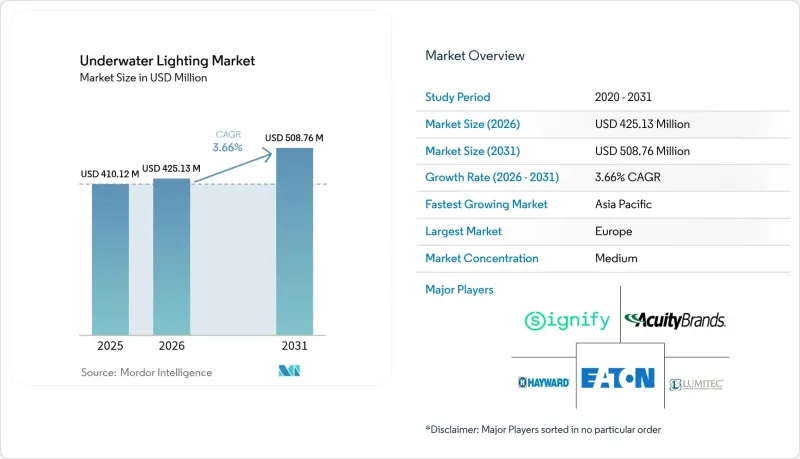
據 Mordor Intelligence 稱,水下照明市場預計到 2026 年價值 4.2513 億美元,高於 2025 年的 4.1012 億美元,預計到 2031 年將達到 5.0876 億美元。
預計 2026 年至 2031 年的複合年成長率為 3.66%。
本報告按光源(LED/鹵素燈)、安裝類型(表面安裝、嵌入式/船體貫穿式、可攜式/夾式)、應用領域(游泳池、噴泉/水景、其他)、最終用戶(住宅、商業/酒店、工業/船舶基礎設施、其他)、銷售管道(OEM/售後市場)和地區進行細分。市場預測以美元(USD)為單位。
全球水下照明市場趨勢及洞察
在游泳池和水景景觀中,美觀至關重要,因此對水下照明的需求日益成長。
2024年,美國住宅和公共游泳池的建造許可數量增加了8.9%,主要得益於LED照明的普及。與鹵素燈相比,LED燈的能耗降低了85%,使用壽命也延長至5萬小時。 Fluidra指出,包括LED照明燈具在內的永續認證產品在2023年佔其銷售額的51%,凸顯了環保意識強的消費者日益成長的需求。在中東度假村,採用DMX512控制的多區域RGB封裝技術正在被廣泛應用,該技術能夠同步噴泉和建築立面照明,使照明不再只是安全設備,而是成為重要的設計元素。雖然每個項目照明燈具數量的增加推高了平均銷售收入,但符合IEC 60598-2-18標準以及自願性的能源之星(ENERGY STAR)認證也為採購決策提供了支持。這些因素共同推動了升級換代,使得水下照明市場在泳池建設放緩的情況下仍保持成長。
政府獎勵加速照明維修中LED的普及。
美國能源效率和建築技術補助金(EECBG)計畫為公共游泳設施的LED照明改造提供資金支持,將投資回收期縮短至三年以內。歐盟指令2024/1275強制要求非住宅建築在2027年前引入自動化照明控制系統,迫使商業游泳池營運商過渡到聯網LED照明。挪威創新署(Innovation Norway)資助了哈弗蘭德(Havelandet)的一個鮭魚養殖試點項目,表明津貼支持可以降低早期採用頻譜已調整的照明設備所帶來的風險。 2024年,Mowi Feed公司使用Glamox LED維修了其工廠,在螢光因RoHS指令逐步退出市場後,電力消耗量降低了60%。因此,公共部門的資金正在加速公共和工業設施向LED照明的轉型。
船舶用LED照明燈具的初始投資成本較高。
採用鋁青銅或硼矽酸玻璃製成的優質外殼,使得嵌入式照明燈具的零售價格高達 1200 美元,而高功率船體穿透式燈具的價格則高達 2850 美元。儘管生命週期分析表明 LED 燈具因其 5 萬小時的額定壽命和 85% 的節能效果而更勝一籌,但其高昂的價格卻阻礙了小型船主和預算有限的市政當局採用。融資機構將照明視為“可選支出”,限制了資金籌措選擇,迫使客戶自行承擔全部維修費用。在新興沿海經濟體中,由於與船舶相關的可選支出預算仍然緊張,這一成本壁壘尤為突出,阻礙了水下照明市場的短期成長。
細分市場分析
到2025年,LED將佔據水下照明市場78.64%的佔有率,隨著RGB和智慧產品以5.32%的複合年成長率成長,其佔有率也將持續攀升。多晶片陣列的亮度已達到甚至超過金屬鹵化物燈,同時消除了10分鐘的重新點亮延遲。鹵素燈照明目前主要局限於老舊泳池這一小眾市場,由於變壓器和線路問題,這些泳池難以維修為LED照明。但隨著監管禁令的加速實施,預計到2030年,鹵素燈的市佔率將降至個位數。針對鮭魚光感受器最佳化的頻譜已調整的LED展現了這項技術的生物學通用性,為遠離傳統休閒市場的領域開闢了商機。同時,像Signify的「SeaCage」這樣的磷光體轉換封裝技術已實現了150 lm/W的效率,實驗室原型顯示其效率仍有進一步提升的空間。隨著連接平台的不斷發展,照明燈具和色彩場景庫的韌體更新能夠帶來售後收入,從而提升供應商的利潤率,並鞏固其在各自獨特生態系統中的客戶群。這些因素共同鞏固了LED在水下照明市場中不可撼動的地位。
嵌入式和船體貫穿式水下照明燈擴大採用智慧熱控制技術,以在水流停滯時保護二極體結,從而顯著降低故障率。雖然鹵素燈替代品仍在現有細分市場銷售,但分銷商報告稱其銷售持續下降。金屬鹵化物照明燈具仍然是需要在有限空間內獲得極高流明密度的企業的最後選擇,但即使是金屬鹵化物照明燈具也正受到LED晶片密度和散熱技術不斷進步的威脅。因此,投資人持續增加對LED專用研發的投入,而不是延長傳統燈具的使用壽命。最終,水下照明產業幾乎無一例外地將其產品藍圖圍繞LED架構展開。
即使到了2025年,表面安裝式照明仍將佔據64.12%的市場佔有率,這主要歸功於其安裝簡便,尤其受到喜歡DIY的船主青睞的螺栓固定式安裝方式。然而,嵌入式和船體貫穿式照明裝置的銷量預計將以每年6.02%的速度成長,因為造船廠會在造船過程中預先安裝這些裝置,在塗膠層之前就將線路埋入船體內部,從而避免日後鑽孔。 OceanLED的「Explore TH」系列產品適用於濕式維護,船員無需將船駛上岸即可更換燈罩。這項特性消除了傳統維護方式的弊端。嵌入式設計顯著降低了阻力,減少了與漁網和錨碇繩纏繞的風險,因此深受注重性能的船長的青睞。造船廠也十分欣賞船體貫穿式照明裝置的精緻外觀,有助於提升船舶的品牌形象。
由於改裝難度較高,表面安裝式照明燈具在售後市場仍佔據主導地位。這是因為船主只需基本的手動工具即可安裝這些燈具。同時,在新建造的遊艇上,為了避免因在船體上鑽孔而導致的保固問題,閃光燈通常內建於船體中。夾式和可攜式燈具主要面向需要短期電池供電照明的攝影師和潛水旅遊業者,但其較低的流明輸出限制了其進一步發展。隨著OEM廠商擴大在船體上安裝照明線路,水下照明市場的收入佔有率預計將從零售DIY安裝管道轉向工廠直銷管道。
區域分析
2025年,歐洲以31.88%的市佔率領先水下照明市場。這主要得益於歐盟2024/1275號指令下能源法規的推動,以及RoHS(有害物質限制指令)對螢光的逐步淘汰,從而帶動了維修需求。挪威130萬噸的鮭魚產量支撐了頻譜已調整的LED的穩定訂單,Signify的「Salmon Evolution」訂單便印證了這一點。義大利價值83.3億歐元的遊艇產業支撐著冬季維修活動,而隨著泳池能源效率標準的提高,德國和法國也大力推動泳池維修。總部位於英國的Lumishore(現為Garmin子公司)出口高價值的RGB照明燈具,凸顯了歐洲在創新領域的重要角色。
預計到2031年,亞太地區將以5.62%的複合年成長率成長,主要驅動力包括中國沿海旅遊業的投資、新加坡聖淘沙島的開發以及澳洲價值101.2億澳元的遊艇產業。在中國二線城市,對人造波浪池和漂流河的投資不斷增加,這些設施需要耐氯LED燈;而在新加坡,水下照明正被整合到建築管理系統(BMS)中,用於能源分析。在澳洲的偏遠航線上,對可靠性的需求日益成長,買家紛紛選擇IP68防護等級的硬體。在日本,由於住宅建設停滯,泳池需求有限,但LED燈正被應用於陸地上的黃尾魚和鯛魚養殖。印度的休閒遊艇市場仍然對價格敏感,但果阿邦和喀拉拉邦的豪華度假村正在採用RGB系統以在全球範圍內競爭。
2025年,北美約佔全球銷售額的27.74%。根據美國國家海事製造商協會(NMMA)報告,美國泳池建造許可證數量增加了8.9%,儘管新船銷量略有下降,但售後照明產品銷售仍然強勁。美國能源局(DOE)的代金券計畫正在加速市政泳池的維修,而佛羅裡達州的海龜保護條例規定在繁殖季節必須使用琥珀色或紅色頻譜,這推動了對可調色產品的需求。在加拿大,較短的航行季節限制了安裝時間,因此庫存預測至關重要。墨西哥坎昆的度假村正在尋求可變色潟湖照明以吸引美國遊客。這些區域性因素共同作用,使供應商能夠保持靈活性和多元化,從而增強水下照明市場的長期穩定性。
其他好處
- Excel格式的市場預測(ME)表
- 3個月的分析師支持
目錄
第1章:引言
- 研究假設和市場定義
- 調查範圍
第2章:調查方法
第3章執行摘要
第4章 市場狀況
- 市場概覽
- 市場促進因素
- 在游泳池和水景景觀中,美觀至關重要,因此對水下照明的需求日益成長。
- 政府獎勵加速照明維修中LED的普及。
- 豪華酒店、度假村和水上樂園的建設增加
- 休閒船隻和遊艇的使用量增加
- 智慧物聯網水下照明系統的興起
- 深海養殖業對頻譜已調整的水下LED的需求
- 市場限制因素
- 船舶用LED照明燈具的初始投資成本較高。
- 在腐蝕性鹽水環境中維護困難
- 由於缺乏全球統一的安全標準,認證成本增加。
- 限制敏感海洋棲地照明的光害法規
- 產業價值供應鏈分析
- 宏觀經濟因素對市場的影響
- 監理情勢
- 技術展望
- 波特五力分析
第5章 市場規模與成長預測
- 透過光源
- LED
- 鹵素
- 金屬鹵化物及其他
- 按安裝類型
- 表面貼裝型
- 船體貫穿式
- 可攜式夾式
- 透過使用
- 游泳池
- 噴泉和水景設施
- 船隻和遊艇
- 水產養殖與研究
- 最終用戶
- 住宅
- 商業和酒店
- 工業和海洋基礎設施
- 國防/政府
- 按銷售管道
- OEM
- 售後市場
- 按地區
- 北美洲
- 美國
- 加拿大
- 墨西哥
- 南美洲
- 巴西
- 阿根廷
- 智利
- 其他南美國家
- 歐洲
- 英國
- 德國
- 法國
- 義大利
- 西班牙
- 其他歐洲國家
- 亞太地區
- 中國
- 日本
- 印度
- 韓國
- 澳洲和紐西蘭
- 其他亞太國家
- 中東和非洲
- 中東
- 阿拉伯聯合大公國
- 沙烏地阿拉伯
- 土耳其
- 其他中東國家
- 非洲
- 南非
- 肯亞
- 奈及利亞
- 其他非洲地區
- 中東
- 北美洲
第6章 競爭情勢
- 市場集中度
- 策略趨勢
- 市佔率分析
- 公司簡介
- Lumitec LLC
- Signify NV
- Eaton Corporation plc
- Acuity Brands Inc.
- Hayward Industries Inc.
- OceanLED Marine Ltd.
- Lumishore Ltd.
- Aqualuma LED Lighting Pty Ltd.
- Shadow-Caster Inc.
- Perko Inc.
- TH Marine Supplies LLC
- Attwood Corporation
- Huaxia Lighting Co. Ltd.
- Global Light and Power LLC
- Dabmar Lighting Inc.
- Wibre-Elektrogerate Edmund Breuninger GmbH and Co. KG
- Spa Electrics Pty Ltd.
- Bluefin LED Ltd.
- Deep Glow Technologies Inc.
- Underwater Lights Ltd.
- Bigblue Dive Lights Inc.
第7章 市場機會與未來展望
According to Mordor Intelligence, the underwater lighting market size in 2026 is estimated at USD 425.13 million, growing from 2025 value of USD 410.12 million with 2031 projections showing USD 508.76 million, growing at 3.66% CAGR over 2026-2031.
This report is Segmented by Lighting Source (LED, and Halogen), Mounting Type (Surface-Mounted, Flush/Thru-Hull, and Portable), Application (Swimming Pools, Fountains and Water Features, and More), End User (Residential, Commercial and Hospitality, Industrial/Marine Infrastructure, and More), Sales Channel (OEM, and Aftermarket), and Geography. The Market Forecasts are Provided in Terms of Value (USD).
Global Underwater Lighting Market Trends and Insights
Rising Demand for Underwater Lights in Pools and Aesthetic Landscaping
Residential and municipal pool permits in the United States rose 8.9% in 2024, stimulating LED retrofits that cut energy use by 85% versus halogen and stretch lifespans to 50,000 hours. Fluidra noted that products carrying sustainability credentials, including LED fixtures, contributed 51% of its 2023 sales, confirming the pull from eco-conscious buyers. Middle-Eastern resorts now specify multi-zone RGB packages controlled via DMX512 to synchronize fountains with facade lighting, elevating lights from basic safety gear to key design elements. Higher fixture counts per project lift average sales values, while IEC 60598-2-18 compliance and voluntary ENERGY STAR labels support procurement decisions. Together, these factors reinforce an upgrade cycle that keeps the underwater lighting market growing even as pool construction moderates.
Government Incentives Accelerating LED Adoption in Retrofits
The US EECBG voucher program funds LED upgrades in public aquatic centers, compressing payback periods to under three years. EU Directive 2024/1275 obliges automatic lighting controls in non-residential buildings by 2027, pushing commercial pool operators toward networked LEDs. Norway's Innovation Norway financed Havlandet's pilot salmon farm, proving that grant support can de-risk early use of spectrally tuned luminaires. Mowi Feed's 2024 factory retrofit with Glamox LEDs slashed electricity consumption by 60% after RoHS restrictions removed fluorescent tubes from the market. Public-sector funding thus accelerates the baseline shift to LEDs across both civic and industrial venues.
High Initial Capital Cost of Marine-Grade LED Fixtures
Premium housings in aluminum-bronze and borosilicate glass push retail prices to USD 1,200 for flush-fit lights and USD 2,850 for high-output thru-hull units. Although life-cycle analysis favors LEDs thanks to 50,000-hour ratings and 85% energy savings, sticker shock slows adoption among small boat owners and budget-focused municipalities. Financing options are scarce because lenders view lighting as discretionary, leaving customers to fund upgrades up front. This cost hurdle weighs heaviest in emerging coastal economies where discretionary boating budgets remain tight, tempering short-term expansion of the underwater lighting market.
Other drivers and restraints analyzed in the detailed report include:
- Increasing Construction of Luxury Hotels, Resorts and Water Parks
- Increasing Construction of Luxury Hotels, Resorts and Water Parks
- Challenging Maintenance in Corrosive Saltwater Environments
For complete list of drivers and restraints, kindly check the Table Of Contents.
Segment Analysis
LEDs controlled 78.64% of the underwater lighting market size in 2025, and their share continues rising as RGB and smart variants post a 5.32% CAGR. Multi-chip arrays match or exceed metal-halide brightness while eliminating 10-minute restrike delays. Halogen lingers almost solely in legacy pool niches where transformers and wiring resist LED retrofits, yet accelerating regulatory bans should push halogen toward single-digit presence by 2030. Spectrally tuned LEDs tailored to salmon photoreceptors illustrate the technology's biological versatility, opening revenue far from traditional leisure markets. Meanwhile, phosphor-converted packages such as Signify's SeaCage hit 150 lm/W, and lab prototypes reveal scope for further efficiency gains. As connectivity platforms improve, fixture firmware updates and color-scene libraries create post-sale revenue, strengthening supplier margins and anchoring customers in proprietary ecosystems. Collectively, these factors secure LEDs as the undisputed engine of the underwater lighting market.
Flush-mounts and thru-hulls increasingly bundle intelligent thermal throttling that protects diode junctions during stagnant water events, sharply reducing failure rates. While halogen replacement bulbs still sell into existing niches, distributors report steady decline in unit volumes. Metal-halide fixtures defend a final stronghold among operators demanding extreme lumen density in tight envelopes, but continual LED advances in chip density and cooling threaten even this bastion. Consequently, investors continue to funnel capital into LED-specific R&D rather than prolonging legacy lamp life-cycles. The underwater lighting industry therefore aligns its product roadmaps almost exclusively around LED architectures.
Surface-mounted lights retained 64.12% revenue in 2025 because do-it-yourself owners favor bolt-on simplicity. Yet flush and thru-hull units will grow 6.02% annually as boatbuilders install them during lay-up, embedding wiring before gelcoat and avoiding future penetrations. OceanLED's Explore TH series supports wet-maintenance, letting crews swap lenses without hauling out, a feature that neutralizes historic service drawbacks. Flush profiles slash drag and reduce entanglement risks for fishing nets and mooring lines, appealing to performance-oriented skippers. Builders also value the through-hull's clean exterior aesthetic that supports premium vessel branding.
Retrofit complexity keeps surface-mount fixtures dominant in the aftermarket because owners can fit lights with basic hand tools. Conversely, new yachts integrate flush units to avoid warranty disputes over drilled hulls. Clip-on and portable lights address photographers and dive-tour operators who need brief, battery-powered luminance, but their low lumen output limits broader growth. As more OEMs pre-wire hulls for lights, an increasing portion of the underwater lighting market revenue will shift to factory channels and away from retail DIY installations.
Complete Report Scope:
- By Lighting Source
- LED
- Halogen
- Metal-Halide / Others
- By Mounting Type
- Surface-Mounted
- Flush / Thru-Hull
- Portable / Clip-On
- By Application
- Swimming Pools
- Fountains and Water Features
- Boats and Yachts
- Aquaculture and Research
- By End User
- Residential
- Commercial and Hospitality
- Industrial / Marine Infrastructure
- Defense and Government
- By Sales Channel
- OEM
- Aftermarket
- By Geography
- North America
- United States
- Canada
- Mexico
- South America
- Brazil
- Argentina
- Chile
- Rest of South America
- Europe
- United Kingdom
- Germany
- France
- Italy
- Spain
- Rest of Europe
- Asia-Pacific
- China
- Japan
- India
- South Korea
- Australia and New Zealand
- Rest of Asia-Pacific
- Middle East and Africa
- Middle East
- United Arab Emirates
- Saudi Arabia
- Turkey
- Rest of Middle East
- Africa
- South Africa
- Kenya
- Nigeria
- Rest of Africa
- Middle East
- North America
Geography Analysis
Europe led the underwater lighting market in 2025 with 31.88% revenue share, driven by EU Directive 2024/1275 energy mandates and the RoHS-enforced fluorescent phase-out that fueled retrofit demand. Norway's 1.3 million-ton salmon output underpins steady orders for spectrally tuned LEDs, as evidenced by Signify's Salmon Evolution win. Italy's EUR 8.33 billion yacht sector supports winter refit activity, while Germany and France tighten pool efficiency standards, spurring domestic pool upgrades. The UK's Lumishore, now under Garmin, exports high-value RGB fixtures, highlighting Europe's innovation role.
Asia-Pacific is projected to record a 5.62% CAGR through 2031, propelled by China's coastal tourism investments, Singapore's Sentosa developments, and Australia's AUD 10.12 billion boating industry. Chinese Tier-2 cities fund wave pools and lazy rivers that require chlorine-resistant LEDs, while Singapore links submerged lights to BMS dashboards for energy analytics. Australia's remote cruising routes elevate reliability requirements, pushing buyers toward IP68-rated hardware. Japan's flat residential construction limits pool growth, but land-based fish farms adopt LEDs for yellowtail and sea bream. India's leisure-boating niche remains cost-sensitive, yet luxury resorts in Goa and Kerala specify RGB systems to compete globally.
North America generated roughly 27.74% of global revenue in 2025. US pool permits climbed 8.9%, and NMMA-reported spending kept after-sales lights moving despite a slight dip in new-boat units. DOE vouchers encourage municipal pool retrofits, while Florida sea-turtle ordinances require amber or red spectra during nesting season, prompting tunable products, Canada's shorter boating season compresses installation windows, making inventory forecasting critical. Mexico's Cancun resorts demand color-changing lagoon lighting to attract U.S. tourists. Collectively, these regional nuances keep suppliers agile and diversified, reinforcing long-run stability for the underwater lighting market.
- Lumitec LLC
- Signify N.V.
- Eaton Corporation plc
- Acuity Brands Inc.
- Hayward Industries Inc.
- OceanLED Marine Ltd.
- Lumishore Ltd.
- Aqualuma LED Lighting Pty Ltd.
- Shadow-Caster Inc.
- Perko Inc.
- TH Marine Supplies LLC
- Attwood Corporation
- Huaxia Lighting Co. Ltd.
- Global Light and Power LLC
- Dabmar Lighting Inc.
- Wibre-Elektrogerate Edmund Breuninger GmbH and Co. KG
- Spa Electrics Pty Ltd.
- Bluefin LED Ltd.
- Deep Glow Technologies Inc.
- Underwater Lights Ltd.
- Bigblue Dive Lights Inc.
Additional Benefits:
- The market estimate (ME) sheet in Excel format
- 3 months of analyst support
TABLE OF CONTENTS
1 INTRODUCTION
- 1.1 Study Assumptions and Market Definition
- 1.2 Scope of the Study
2 RESEARCH METHODOLOGY
3 EXECUTIVE SUMMARY
4 MARKET LANDSCAPE
- 4.1 Market Overview
- 4.2 Market Drivers
- 4.2.1 Rising Demand for Underwater Lights in Pools and Aesthetic Water-Featured Landscaping
- 4.2.2 Government Incentives Accelerating LED Adoption in Lighting Retrofits
- 4.2.3 Increasing Construction of Luxury Hotels, Resorts and Water Parks
- 4.2.4 Growing Recreational Boating and Yachting Activities
- 4.2.5 Emergence of Smart/IoT-Enabled Underwater Lighting Systems
- 4.2.6 Deep-Sea Aquaculture's Need for Spectrally Tuned Submersible LEDs
- 4.3 Market Restraints
- 4.3.1 High Initial Capital Cost of Marine-Grade LED Fixtures
- 4.3.2 Challenging Maintenance in Corrosive Saltwater Environments
- 4.3.3 Lack of Harmonized Global Safety Standards Increasing Certification Costs
- 4.3.4 Light Pollution Regulations Limiting Illumination in Sensitive Marine Habitats
- 4.4 Industry Value / Supply-Chain Analysis
- 4.5 Impact of Macroeconomic Factors on the Market
- 4.6 Regulatory Landscape
- 4.7 Technological Outlook
- 4.8 Porter's Five Forces Analysis
- 4.8.1 Threat of New Entrants
- 4.8.2 Bargaining Power of Buyers
- 4.8.3 Bargaining Power of Suppliers
- 4.8.4 Threat of Substitutes
- 4.8.5 Intensity of Competitive Rivalry
5 MARKET SIZE AND GROWTH FORECASTS (VALUE)
- 5.1 By Lighting Source
- 5.1.1 LED
- 5.1.2 Halogen
- 5.1.3 Metal-Halide / Others
- 5.2 By Mounting Type
- 5.2.1 Surface-Mounted
- 5.2.2 Flush / Thru-Hull
- 5.2.3 Portable / Clip-On
- 5.3 By Application
- 5.3.1 Swimming Pools
- 5.3.2 Fountains and Water Features
- 5.3.3 Boats and Yachts
- 5.3.4 Aquaculture and Research
- 5.4 By End User
- 5.4.1 Residential
- 5.4.2 Commercial and Hospitality
- 5.4.3 Industrial / Marine Infrastructure
- 5.4.4 Defense and Government
- 5.5 By Sales Channel
- 5.5.1 OEM
- 5.5.2 Aftermarket
- 5.6 By Geography
- 5.6.1 North America
- 5.6.1.1 United States
- 5.6.1.2 Canada
- 5.6.1.3 Mexico
- 5.6.2 South America
- 5.6.2.1 Brazil
- 5.6.2.2 Argentina
- 5.6.2.3 Chile
- 5.6.2.4 Rest of South America
- 5.6.3 Europe
- 5.6.3.1 United Kingdom
- 5.6.3.2 Germany
- 5.6.3.3 France
- 5.6.3.4 Italy
- 5.6.3.5 Spain
- 5.6.3.6 Rest of Europe
- 5.6.4 Asia-Pacific
- 5.6.4.1 China
- 5.6.4.2 Japan
- 5.6.4.3 India
- 5.6.4.4 South Korea
- 5.6.4.5 Australia and New Zealand
- 5.6.4.6 Rest of Asia-Pacific
- 5.6.5 Middle East and Africa
- 5.6.5.1 Middle East
- 5.6.5.1.1 United Arab Emirates
- 5.6.5.1.2 Saudi Arabia
- 5.6.5.1.3 Turkey
- 5.6.5.1.4 Rest of Middle East
- 5.6.5.2 Africa
- 5.6.5.2.1 South Africa
- 5.6.5.2.2 Kenya
- 5.6.5.2.3 Nigeria
- 5.6.5.2.4 Rest of Africa
- 5.6.5.1 Middle East
- 5.6.1 North America
6 COMPETITIVE LANDSCAPE
- 6.1 Market Concentration
- 6.2 Strategic Moves
- 6.3 Market Share Analysis
- 6.4 Company Profiles (includes Global level Overview, Market level overview, Core Segments, Financials as available, Strategic Information, Market Rank/Share for key companies, Products and Services, and Recent Developments)
- 6.4.1 Lumitec LLC
- 6.4.2 Signify N.V.
- 6.4.3 Eaton Corporation plc
- 6.4.4 Acuity Brands Inc.
- 6.4.5 Hayward Industries Inc.
- 6.4.6 OceanLED Marine Ltd.
- 6.4.7 Lumishore Ltd.
- 6.4.8 Aqualuma LED Lighting Pty Ltd.
- 6.4.9 Shadow-Caster Inc.
- 6.4.10 Perko Inc.
- 6.4.11 TH Marine Supplies LLC
- 6.4.12 Attwood Corporation
- 6.4.13 Huaxia Lighting Co. Ltd.
- 6.4.14 Global Light and Power LLC
- 6.4.15 Dabmar Lighting Inc.
- 6.4.16 Wibre-Elektrogerate Edmund Breuninger GmbH and Co. KG
- 6.4.17 Spa Electrics Pty Ltd.
- 6.4.18 Bluefin LED Ltd.
- 6.4.19 Deep Glow Technologies Inc.
- 6.4.20 Underwater Lights Ltd.
- 6.4.21 Bigblue Dive Lights Inc.
7 MARKET OPPORTUNITIES AND FUTURE OUTLOOK
- 7.1 White-Space and Unmet-Need Assessment

 頻閃輔助照明市場:全球市場預測,2026-2032年遊戲室照明市場:全球市場預測,2026-2032年特種照明市場:2026-2032年全球市場預測(依產品類型、技術、應用、最終用戶及通路分類)
 全球特種照明市場
 全球特種照明市場規模、佔有率、趨勢和成長分析報告(2026-2034)
 2026年全球特種照明市場報告潛水推進器市場按車輛類型、推進類型、作業深度、繫繩和最終用途分類-2026-2032年全球預測
 全球遊戲室裝飾市場預測至2032年:按產品類型、材料、分銷管道、最終用戶和地區分類
 特種照明市場規模、佔有率及成長分析(按光源、技術、通路、應用及地區分類)-2026-2033年產業預測
 水下照明市場-全球產業規模、佔有率、趨勢、機會和預測,按光源(LED、鹵素燈、白熾燈、氙氣燈)、安裝類型、最終用戶、地區和競爭格局分類,2020-2030 年預測