


 |
市場調查報告書
商品編碼
2114443
功率放大器:市場佔有率分析、產業趨勢與統計、成長預測(2026-2031)Power Amplifier - Market Share Analysis, Industry Trends & Statistics, Growth Forecasts (2026 - 2031) |
||||||

※ 本網頁內容可能與最新版本有所差異。詳細情況請與我們聯繫。
據 Mordor Intelligence 稱,2025 年功率放大器市場價值為 282 億美元,預計到 2031 年將達到 421.3 億美元,而 2026 年為 301.5 億美元,預測期(2026-2031 年)的複合年成長率為 6.91%。
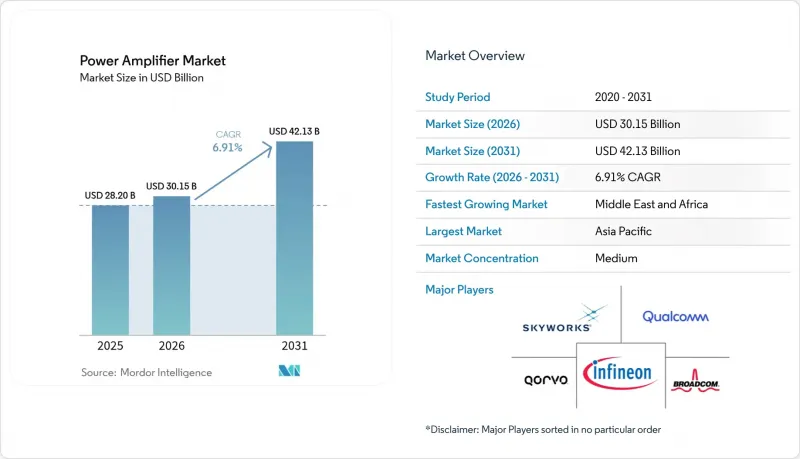
本報告按技術(矽、砷化鎵、其他)、產品(音頻功率放大器和射頻/微波功率放大器)、頻段(低於 1GHz、1-6GHz、其他)、類別(A 類、B 類、AB 類、其他)、產業(消費性電子、工業、其他)和地區(北美、南美、歐洲、亞太、中東和非洲)進行分類。
全球功率放大器市場趨勢與洞察
將GaN功率放大器整合到5G大規模MIMO中
2024年,工作頻率在1.35GHz至7.6GHz頻段的典型大型基地台無線電單元在運作環境中實現了高達38%的漏極效率,從而降低了電信運營商的營運成本。氮化鎵(GaN)晶片的小型化使得更高密度的天線面板和更簡化的散熱佈局成為可能,進而推動了用於高密度都市區網路計畫的64T/64R陣列的大規模出貨。日本和韓國的區域電信業者已利用這些效率提升來實現其碳減排藍圖,並在2025年的競標週期中加大了對GaN前端模組的採購力度。隨著每瓦成本的持續下降,預計到2028年,GaN在功率放大器市場的採用率將與GaAs在大型基地台領域的採用率相當。
Wi-Fi 6/7 路由器升級
家用和企業級網路基地台供應商加快了第二代 Wi-Fi 6 和早期 Wi-Fi 7 的發布步伐,計劃於 2024 年推出,這需要能夠在 5GHz 和 6GHz頻寬上維持多鏈路運行的中功率功率放大器 (PA)。諸如 AsiaRF 的 AP7988-002 平台等解決方案整合了高功率前端模組,將吞吐量擴展至 19Gbps,從而推高了射頻前端單元的平均售價 (ASP)。 2025 年第一季,HPE Aruba Networking 發布了三頻 Wi-Fi 7網路基地台,總容量提升了 30%,推動了對具有更嚴格的 EVM 和鄰道洩漏規範的高階晶片的需求。預計這一更新週期將使功率放大器市場保持強勁的出貨量成長勢頭,至少持續到 2027 年。
GaAs晶圓的供應限制推高了物料清單成本。
2024年下半年,出口限制導致中國提煉產量下降,鎵供應短缺,砷化鎵(GaAs)外延片價格上漲高達18%。這推高了多層射頻前端模組的物料清單(BOM)成本,擠壓了行動電話的增強型矽基氮化鎵(GaN-on-Si)製程。雖然供應商的長期多元化可以降低通膨風險,但短期供應困難已使功率放大器市場的複合年成長率(CAGR)下降了近1個百分點。
細分市場分析
在1-6GHz頻段的行動電話市場,GaAs元件保持了強勁的地位,預計2025年仍將佔40.62%的市場佔有率。然而,由於大型基地台的部署和Ku波段閘道的普及,GaN裝置的出貨量激增。預計到2031年,GaN元件的複合年成長率將達到16.92%,這將使GaN裝置在無線接入基礎設施功率放大器市場的佔有率在預測期結束時接近一半。 Qorvo公司透過將其3.5GHz Doherty級元件遷移到GaN-on-SiC工藝,在相同輸出功率下實現了15°C的結溫降低,有助於降低電信營運商的整體擁有成本(TCO)。
儘管矽鍺在相位陣列波束成形核心中仍然至關重要,但體矽CMOS在低功耗藍牙和Wi-Fi物聯網節點中繼續發揮關鍵作用。 IMEC對GaN MISHEMT偏壓穩定性的研究已經克服了先前限制30 GHz以上漏極效率的閘極滯後障礙,為GaN在毫米波行動電話模組的廣泛應用鋪平了道路。新興的GaN/鑽石基板有望提供更大的熱裕度,這將是其整合到未來6G和X波段雷達應用的關鍵因素。
射頻和微波領域,在5G廣域基地台、小型基地台和衛星通訊地面站的推動下,預計2025年將佔總銷售額的56.85%。 Filtronic公司出貨了額定功率為80W的Ku波段GaN MMIC,其功率附加效率(PAE)比傳統的GaAs產品高出40%,從而實現了更緊湊的陣列孔徑。音頻功率放大器是一個規模雖小但成長迅速的細分市場。智慧音箱和多驅動車載娛樂系統的普及推動了出貨量的成長,而GaN FET的採用消除了死區時間限制,從而提高了高功率D類基板中矽MOSFET的保真度。
用於等離子體和加熱應用的工業和科研射頻產生器也推動了對碳化矽(SiC)和氮化鎵(GaN)電晶體的需求。德州儀器擴展了其寬頻LDMOS預驅動器產品線,以滿足工業雷射和磁振造影(MRI)磁體功率級的需求,進一步鞏固了射頻產品類型在功率放大器市場中作為主要收入促進因素的地位。
區域分析
預計到2025年,亞太地區將佔全球銷售額的48.12%。這主要得益於中國行動電話組裝中心的蓬勃發展,這些中心消耗了該地區一半以上的低頻寬GaAs晶片。韓國晶圓廠正利用垂直整合擴大5G射頻前端晶片的生產,而日本材料供應商則在增加SiC晶圓的產量,以緩解GaN基板的供不應求。在印度,針對智慧型手機EMS製造商的生產獎勵正在提振國內需求,從而催生出充滿活力但仍處於發展階段的射頻測試和封裝企業叢集。短期內,隨著亞洲各國推行強調本土化合物半導體供應鏈的政策,該地區在功率放大器市場的主導地位預計將進一步鞏固。
北美地區銷售額位居第二。 Qorvo、博通和Wolfspeed等領導企業利用其在氮化鎵功率密度和散熱封裝方面的專利組合,在國防領域和5G O-RAN市場獲得了新的訂單。美國國防部雷達現代化專案採用了X波段氮化鎵晶片,其平均售價遠高於商用級產品。電信業者仍然是主要買家,他們在人口密集的城市地區將頻寬載波升級到64T/64R陣列。
歐洲市場佔有率主要由德國和法國佔據,兩國的汽車和航太製造商已將高線性度功率放大器應用於車載音訊、高級駕駛輔助系統(ADAS)和多頻段衛星通訊。歐盟與生態設計相關的待機功率法規促使製造商迅速向D類功率放大器過渡,導致現有庫存與新的製造規範之間出現暫時性不匹配。英國晶圓廠透過公私合作聯盟探索了氮化鎵鑽石外延技術,以保持與亞洲競爭對手的競爭力。
儘管規模較小,但中東和非洲的成長速度最快,複合年成長率達到11.18%,這主要得益於Ka波段遙傳技術和國家主導的低地球軌道(LEO)通訊計畫的擴張。沙烏地阿拉伯和奈及利亞的國營電信營運商已投入資金建造整合40W Ku波段功率放大器(SSPA)的閘道器,從而擴大了功率放大器市場的潛在覆蓋範圍。南美洲的部署規模也出現了適度成長,這主要得益於巴西的5G中頻段頻譜競標和政府主導的區域寬頻部署。
其他好處
- Excel格式的市場預測(ME)表
- 3個月的分析師支持
目錄
第1章:引言
- 研究假設和市場定義
- 調查範圍
第2章:調查方法
第3章執行摘要
第4章 市場狀況
- 市場概覽
- 市場促進因素
- 將GaN功率放大器整合到5G大規模MIMO中
- 由於Wi-Fi 6和7路由器的升級,對中功率公共廣播系統的需求增加。
- 在電動車資訊娛樂系統和高級駕駛輔助系統中採用D類音頻功率放大器
- LEO衛星星系引領 Ku- Ka波段SSPA
- 工業4.0時代智慧工廠對射頻加熱的需求
- 透過 O-RAN 解耦在多廠商公共廣播市場創造機遇
- 市場限制因素
- 由於GaAs晶圓供應受限,物料清單成本增加。
- 歐盟關於音頻公共廣播系統待機功率限制的生態設計法規
- 中國無廠半導體公司的進入導致低階CMOS功率放大器的價格下降。
- 用於行動電話的28GHz 超矽功率放大器的溫度控管限制
- 產業價值鏈分析
- 監理展望
- 技術展望
- 波特五力模型
- 投資分析
- 關鍵績效指標
- 宏觀經濟因素的影響
第5章 市場規模與成長預測
- 透過技術
- 矽(Si)
- 砷化鎵(GaAs)
- 氮化鎵(GaN)
- 矽鍺(SiGe)
- 互補型氧化物半導體(CMOS)
- 其他
- 依產品
- 音頻功率放大器
- 射頻/微波功率放大器
- 按頻段
- 小於1GHz
- 1~6GHz
- 6~20GHz
- 超過 20GHz
- 尺寸
- A級
- B級
- AB類
- D級
- E/F 類及其他類
- 按行業細分
- 家用電子產品
- 產業
- 電訊
- 車
- 其他行業領域
- 按地區
- 北美洲
- 美國
- 加拿大
- 南美洲
- 巴西
- 阿根廷
- 其他南美國家
- 歐洲
- 德國
- 英國
- 法國
- 義大利
- 瑞典
- 丹麥
- 其他歐洲國家
- 亞太地區
- 中國
- 日本
- 韓國
- 印度
- 其他亞太國家
- 中東和非洲
- 中東
- 沙烏地阿拉伯
- 阿拉伯聯合大公國
- 土耳其
- 其他中東國家
- 非洲
- 南非
- 其他非洲地區
- 中東
- 北美洲
第6章 競爭情勢
- 市場集中度
- 策略趨勢
- 市佔率分析
- 公司簡介
- Broadcom Inc.
- Qorvo Inc.
- Skyworks Solutions Inc.
- Qualcomm Technologies Inc.
- Infineon Technologies AG
- Texas Instruments Inc.
- Analog Devices Inc.
- NXP Semiconductors NV
- STMicroelectronics NV
- Renesas Electronics Corp.
- Wolfspeed Inc.
- MACOM Technology Solutions Inc.
- ON Semiconductor Corp.
- Microchip Technology Inc.
- Rohm Semiconductor
- Panasonic Corp.
- Murata Manufacturing Co. Ltd.
- Mini-Circuits
- CAES(Cobham Advanced Electronics)
- Sumitomo Electric Device Innovations
- Empower RF Systems
- Falcomm Inc.
- Finwave Semiconductor Inc.
第7章 市場機會與未來展望
According to Mordor Intelligence, the power amplifier market size was valued at USD 28.20 billion in 2025 and estimated to grow from USD 30.15 billion in 2026 to reach USD 42.13 billion by 2031, at a CAGR of 6.91% during the forecast period (2026-2031).
This report is Segmented by Technology (Silicon, Gallium Arsenide, and More), by Product (Audio Power Amplifiers and RF/Microwave Power Amplifiers), by Frequency Band (<1 GHz, 1 - 6 GHz, and More), by Class (Class A, Class B, Class AB, and More), by Industry Vertical (Consumer Electronics, Industrial, and More), and by Geography (North America, South America, Europe, Asia-Pacific, and Middle East and Africa).
Global Power Amplifier Market Trends and Insights
GaN PAs in 5G Massive-MIMO
Typical macro-cell radio units operating from 1.35 GHz to 7.6 GHz reported up to 38% drain efficiency in field deployments during 2024, cutting operating expenditure for carriers. The smaller footprint of GaN die enabled denser antenna panels and simplified thermal layouts, allowing 64-T/64-R arrays to ship in volume for urban densification projects. Regional operators in Japan and South Korea capitalized on the efficiency gains to comply with carbon-reduction roadmaps, reinforcing procurement of GaN front-end modules across 2025 bid cycles. As costs per watt continue to fall, GaN penetration in the power amplifier market should approach parity with GaAs in macro-cells before 2028.
Wi-Fi 6/7 Router Refresh
Home and enterprise access-point vendors accelerated second-generation Wi-Fi 6 and early Wi-Fi 7 launches in 2024, requiring mid-power linear PAs capable of sustaining multi-link operation across 5 GHz and 6 GHz. Solutions such as AsiaRF's AP7988-002 platform integrated a high-power front-end module that extended throughput to 19 Gbps, thereby lifting unit ASPs for RF front ends. In Q1 2025, HPE Aruba Networking released tri-band Wi-Fi 7 access points that improved aggregate capacity by 30%, intensifying demand for premium silicon with tighter EVM and adjacent-channel leakage specifications. This refresh cycle is set to keep the power amplifier market on a robust shipment trajectory through at least 2027.
GaAs Wafer Supply Constraints Elevating BOM Costs
Gallium availability tightened in late 2024 after export-control measures constrained Chinese refinery output, inflating GaAs epi-wafer pricing by up to 18%. Multilayer RF front-end modules, therefore, faced higher bill-of-materials outlays, pressuring handset OEM margins and encouraging an accelerated pivot toward GaN-on-silicon processes. Finwave Semiconductor signed a foundry pact with GlobalFoundries to commercialize enhancement-mode GaN-on-Si for sub-6 GHz phones, aiming to neutralize GaAs cost volatility. While long-term diversification will damp inflationary risk, short-run sourcing difficulties are trimming the headline CAGR of the power amplifier market by nearly one percentage point.
Other drivers and restraints analyzed in the detailed report include:
- EV Infotainment and ADAS Adoption of Class-D Audio PAs
- LEO Satellite Constellations Driving Ku/Ka-band SSPAs
- EU Eco-Design Idle-Power Caps on Audio PAs
For complete list of drivers and restraints, kindly check the Table Of Contents.
Segment Analysis
GaAs devices retained a 40.62% revenue position in 2025 on the strength of entrenched 1-6 GHz handset sockets, yet GaN shipments surged on macro-cell roll-outs and Ku-band gateways. GaN's 16.92% CAGR through 2031 is projected to lift its portion of the power amplifier market size for radio-access infrastructure to almost half by the end of the forecast window. Qorvo documented a 15 °C reduction in junction temperature at identical output power after migrating a 3.5 GHz Doherty stage to GaN-on-SiC, validating cost-of-ownership savings for operators.
Silicon-germanium remained integral to phased-array beamforming cores, whereas bulk CMOS stayed relevant in low-power Bluetooth and Wi-Fi IoT nodes. Research at IMEC on GaN MISHEMT bias stability removed gate-lag barriers that previously capped drain efficiency above 30 GHz, clearing a pathway for GaN proliferation in handset mmWave modules. Emerging GaN-on-diamond substrates promise further thermal headroom, a key enabler for subsequent 6G and X-band radar design-ins.
RF and microwave categories generated 56.85% of 2025 revenue, anchored by 5G macros, small cells, and satcom earth stations. Filtronic shipped Ku-band GaN MMICs rated at 80 W that outperformed preceding GaAs line-ups by 40% PAE, unlocking more compact array apertures. Audio power amplifiers contributed a smaller but fast-growing slice: proliferation of smart-speakers and multi-driver in-vehicle entertainment lifted shipments, and GaN FETs removed dead-time limitations that constrained silicon MOSFET fidelity in high-power class-D boards.
Industrial and scientific RF generators for plasma and heating also elevated SiC and GaN transistor demand. Texas Instruments expanded its wideband LDMOS pre-driver catalog to service industrial laser and MRI magnet power stages, reinforcing the RF product category's role as the revenue mainstay of the power amplifier market.
Complete Report Scope:
- By Technology
- Silicon (Si)
- Gallium Arsenide (GaAs)
- Gallium Nitride (GaN)
- Silicon Germanium (SiGe)
- Complementary MOS (CMOS)
- Other Technologies
- By Product
- Audio Power Amplifiers
- RF / Microwave Power Amplifiers
- By Frequency Band
- <1 GHz
- 1 - 6 GHz
- 6 - 20 GHz
- > 20 GHz
- By Class
- Class A
- Class B
- Class AB
- Class D
- Class E/F and Other Classes
- By Industry Vertical
- Consumer Electronics
- Industrial
- Telecommunications
- Automotive
- Other Industry Verticals
- By Geography
- North America
- United States
- Canada
- South America
- Brazil
- Argentina
- Rest of South America
- Europe
- Germany
- United Kingdom
- France
- Italy
- Sweden
- Denmark
- Rest of Europe
- Asia-Pacific
- China
- Japan
- South Korea
- India
- Rest of Asia-Pacific
- Middle East and Africa
- Middle East
- Saudi Arabia
- UAE
- Turkey
- Rest of Middle East
- Africa
- South Africa
- Rest of Africa
- Middle East
- North America
Geography Analysis
Asia-Pacific generated 48.12% of global revenue in 2025, anchored by China's handset assembly corridors, which consumed more than half of the region's low-band GaAs die. Korean fabs leveraged vertical integration to ramp 5G RF front ends, while Japanese material suppliers expanded SiC wafer output to mitigate GaN substrate gaps. India's production-linked incentives for smartphone EMS houses widened domestic demand, creating a nascent yet vibrant cluster of RF test and packaging firms. Over the near term, Asia's policy emphasis on indigenous compound-semiconductor supply chains is positioned to strengthen regional control over the power amplifier market.
North America ranked second by value. Dominant players such as Qorvo, Broadcom, and Wolfspeed exploited patent portfolios in GaN power density and thermal packaging to capture new defense and 5G O-RAN awards. The Pentagon's radar-modernization programs adopted X-band GaN tiles, pushing device ASPs significantly above commercial grades. Telecom operators remained central buyers, upgrading mid-band carriers to 64T/64R arrays in dense urban clusters.
Europe's share centered on Germany and France, where automotive and aerospace manufacturers absorbed high-linearity PAs for in-cabin audio, ADAS, and multi-band sat-comms. The EU Eco-Design idle-power regulation prompted a swift transition toward Class-D, creating a temporary mismatch between legacy inventory and new-build specs. United Kingdom fabs explored GaN-on-diamond epitaxy through public-private consortia to retain competitiveness against Asian peers.
The Middle East and Africa region, though smaller, exhibited the fastest growth at an 11.18% CAGR, fueled by Ka-band teleport expansion and sovereign LEO connectivity programs. National operators in Saudi Arabia and Nigeria earmarked capex for gateways that integrate 40 W Ku-band SSPAs, broadening the addressable slice of the power amplifier market. South America followed with moderate uptake, led by Brazil's 5G mid-band auctions and state-backed rural broadband.
- Broadcom Inc.
- Qorvo Inc.
- Skyworks Solutions Inc.
- Qualcomm Technologies Inc.
- Infineon Technologies AG
- Texas Instruments Inc.
- Analog Devices Inc.
- NXP Semiconductors N.V.
- STMicroelectronics N.V.
- Renesas Electronics Corp.
- Wolfspeed Inc.
- MACOM Technology Solutions Inc.
- ON Semiconductor Corp.
- Microchip Technology Inc.
- Rohm Semiconductor
- Panasonic Corp.
- Murata Manufacturing Co. Ltd.
- Mini-Circuits
- CAES (Cobham Advanced Electronics)
- Sumitomo Electric Device Innovations
- Empower RF Systems
- Falcomm Inc.
- Finwave Semiconductor Inc.
Additional Benefits:
- The market estimate (ME) sheet in Excel format
- 3 months of analyst support
TABLE OF CONTENTS
1 INTRODUCTION
- 1.1 Study Assumptions and Market Definition
- 1.2 Scope of the Study
2 RESEARCH METHODOLOGY
3 EXECUTIVE SUMMARY
4 MARKET LANDSCAPE
- 4.1 Market Overview
- 4.2 Market Drivers
- 4.2.1 Integration of GaN PAs in 5G Massive-MIMO
- 4.2.2 Wi-Fi 6/7 Router Refresh Boosting Mid-Power PAs
- 4.2.3 EV Infotainment and ADAS Adoption of Class-D Audio PAs
- 4.2.4 LEO Satellite Constellations Driving Ku/Ka-band SSPAs
- 4.2.5 Smart-Factory RF-Heating Demand via Industry 4.0
- 4.2.6 O-RAN Disaggregation Creating Multi-Vendor PA Opportunities
- 4.3 Market Restraints
- 4.3.1 GaAs Wafer Supply Constraints Elevating BOM Costs
- 4.3.2 EU Eco-Design Idle-Power Caps on Audio PAs
- 4.3.3 Low-End CMOS PA Price Erosion from Chinese Fabless Entrants
- 4.3.4 Thermal-Management Limits on >28 GHz Silicon PAs in Handsets
- 4.4 Industry Value Chain Analysis
- 4.5 Regulatory Outlook
- 4.6 Technological Outlook
- 4.7 Porter's Five Forces
- 4.7.1 Threat of New Entrants
- 4.7.2 Bargaining Power of Buyers
- 4.7.3 Bargaining Power of Suppliers
- 4.7.4 Threat of Substitutes
- 4.7.5 Intensity of Competitive Rivalry
- 4.8 Investment Analysis
- 4.9 Key Performance Indicators
- 4.10 Impact of Macroeconomic factors
5 MARKET SIZE AND GROWTH FORECASTS (VALUE)
- 5.1 By Technology
- 5.1.1 Silicon (Si)
- 5.1.2 Gallium Arsenide (GaAs)
- 5.1.3 Gallium Nitride (GaN)
- 5.1.4 Silicon Germanium (SiGe)
- 5.1.5 Complementary MOS (CMOS)
- 5.1.6 Other Technologies
- 5.2 By Product
- 5.2.1 Audio Power Amplifiers
- 5.2.2 RF / Microwave Power Amplifiers
- 5.3 By Frequency Band
- 5.3.1 < 1 GHz
- 5.3.2 1 - 6 GHz
- 5.3.3 6 - 20 GHz
- 5.3.4 > 20 GHz
- 5.4 By Class
- 5.4.1 Class A
- 5.4.2 Class B
- 5.4.3 Class AB
- 5.4.4 Class D
- 5.4.5 Class E/F and Other Classes
- 5.5 By Industry Vertical
- 5.5.1 Consumer Electronics
- 5.5.2 Industrial
- 5.5.3 Telecommunications
- 5.5.4 Automotive
- 5.5.5 Other Industry Verticals
- 5.6 By Geography
- 5.6.1 North America
- 5.6.1.1 United States
- 5.6.1.2 Canada
- 5.6.2 South America
- 5.6.2.1 Brazil
- 5.6.2.2 Argentina
- 5.6.2.3 Rest of South America
- 5.6.3 Europe
- 5.6.3.1 Germany
- 5.6.3.2 United Kingdom
- 5.6.3.3 France
- 5.6.3.4 Italy
- 5.6.3.5 Sweden
- 5.6.3.6 Denmark
- 5.6.3.7 Rest of Europe
- 5.6.4 Asia-Pacific
- 5.6.4.1 China
- 5.6.4.2 Japan
- 5.6.4.3 South Korea
- 5.6.4.4 India
- 5.6.4.5 Rest of Asia-Pacific
- 5.6.5 Middle East and Africa
- 5.6.5.1 Middle East
- 5.6.5.1.1 Saudi Arabia
- 5.6.5.1.2 UAE
- 5.6.5.1.3 Turkey
- 5.6.5.1.4 Rest of Middle East
- 5.6.5.2 Africa
- 5.6.5.2.1 South Africa
- 5.6.5.2.2 Rest of Africa
- 5.6.5.1 Middle East
- 5.6.1 North America
6 COMPETITIVE LANDSCAPE
- 6.1 Market Concentration
- 6.2 Strategic Moves
- 6.3 Market Share Analysis
- 6.4 Company Profiles (includes Global and Market Level Overview, Core Segments, Financials, Strategic Information, Market Rank/Share, Products and Services, Recent Developments)
- 6.4.1 Broadcom Inc.
- 6.4.2 Qorvo Inc.
- 6.4.3 Skyworks Solutions Inc.
- 6.4.4 Qualcomm Technologies Inc.
- 6.4.5 Infineon Technologies AG
- 6.4.6 Texas Instruments Inc.
- 6.4.7 Analog Devices Inc.
- 6.4.8 NXP Semiconductors N.V.
- 6.4.9 STMicroelectronics N.V.
- 6.4.10 Renesas Electronics Corp.
- 6.4.11 Wolfspeed Inc.
- 6.4.12 MACOM Technology Solutions Inc.
- 6.4.13 ON Semiconductor Corp.
- 6.4.14 Microchip Technology Inc.
- 6.4.15 Rohm Semiconductor
- 6.4.16 Panasonic Corp.
- 6.4.17 Murata Manufacturing Co. Ltd.
- 6.4.18 Mini-Circuits
- 6.4.19 CAES (Cobham Advanced Electronics)
- 6.4.20 Sumitomo Electric Device Innovations
- 6.4.21 Empower RF Systems
- 6.4.22 Falcomm Inc.
- 6.4.23 Finwave Semiconductor Inc.
7 MARKET OPPORTUNITIES AND FUTURE OUTLOOK
- 7.1 White-Space and Unmet-Need Assessment

 CMOS功率放大器市場規模、佔有率和成長分析:按頻段、應用、技術節點、終端用戶產業、輸出功率、銷售管道和地區分類-2026-2033年產業預測
 CMOS功率放大器市場:按模組、應用和地區分類
 小型基地台功率放大器市場報告:按類型、類別、應用和地區分類(2026-2034 年)
 功率放大器市場-全球產業規模、佔有率、趨勢、機會、預測:按產品、產業、地區和競爭對手分類,2021-2031年小型電池功率放大器市場 - 全球產業規模、佔有率、趨勢、機會及預測(按產品類型、應用、最終用戶、地區和競爭格局分類,2021-2031年)
 功率放大器市場-2025-2030年預測
 固態功率放大器:全球市場佔有率和排名、總收入和需求預測(2025-2031年)
 功率放大器市場規模、佔有率、趨勢分析報告:按類型、應用、地區、細分市場預測,2025-2030 年
 CMOS 功率放大器市場,按類型、頻率範圍、應用、國家和地區 - 2024-2032 年行業分析、市場規模、市場佔有率和預測