


 |
市場調查報告書
商品編碼
2114418
LTE物聯網:市場佔有率分析、產業趨勢與統計資料、成長預測(2026-2031年)LTE IoT - Market Share Analysis, Industry Trends & Statistics, Growth Forecasts (2026 - 2031) |
||||||

※ 本網頁內容可能與最新版本有所差異。詳細情況請與我們聯繫。
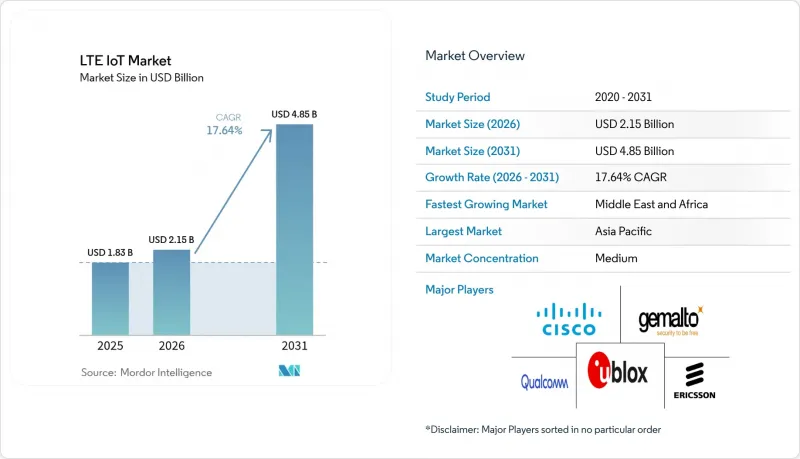
據 Mordor Intelligence 稱,LTE 物聯網市場規模預計在 2026 年達到 21.5 億美元,高於 2025 年的 18.3 億美元,預計到 2031 年將達到 48.5 億美元。
預計從 2026 年到 2031 年,其複合年成長率將達到 17.64%。
本報告按服務類型(專業服務、託管服務)、產品類型(NB-IoT、LTE-M)、終端用戶行業(IT與電信、消費電子、零售(數位商務)、醫療保健、工業及其他)和地區進行細分。以上所有細分市場的規模和預測均以美元(USD)計價。
全球LTE物聯網市場趨勢與洞察
低功耗蜂窩LPWA模組的價格低於4美元。
Nordic Semiconductor 的 nRF9151 晶片,憑藉其 64MHz 的 Arm Cortex-M33 處理器和整合的多模數據機,已證明可以降低組件成本,使其價格低於 4 美元,從而加速了此前依賴免許可 LPWAN 的農業、物流和環境感測領域的部署。中國供應商已將用於公用事業收費計量表的 NB-IoT 模組報價降至 3 美元,進一步推動了成本削減的勢頭。儘管全球許多產品目錄中的組件價格仍維持在 10 至 15 美元之間,但歐洲和亞太地區的電信營運商已開始補貼硬體,以加速 LTE 物聯網市場的普及並提高網路利用率。
強制安裝智慧電錶正在提升蜂窩網路連線速度。
超過60個司法管轄區已頒布法規,要求瓦斯、電力或公共產業安裝可遠端升級且具備通訊功能的電錶。 Telia在瑞典部署了200萬個採用NB-IoT和LTE-M技術的電錶,降低了現場差旅成本,並建構了支援5G的配電網路。 Netinium的SIM卡設定檔編配與Telit Cinterion技術的結合實現了遠端配置,解決了以往阻礙公共產業採用廣域蜂窩網路的傳統鎖定問題。這些措施正在取代專有網狀網路,並為LTE物聯網市場提供了多年的發展前景。
Sub-GHz頻段頻段的擁塞限制了容量。
目前,多種低功耗廣域網路(LPWAN)標準在有限的700-960MHz頻段內競爭。佔空比規定和功率限制抑制了小區密度,網路側的干擾管理成本也迅速增加。美國聯邦通訊委員會(FCC)於2024年開始分配新的6GHz室內頻段,但對於確保物聯網在地下和農村地區的覆蓋而言,Sub-GHz頻段頻段的傳播仍然至關重要。因此,營運商正在投資動態頻譜存取和窄頻濾波技術,這增加了成本,並減緩了LTE物聯網市場在大都會圈的發展。
細分市場分析
至2025年,專業服務將透過諮詢、設備認證和邊緣雲端整合項目,貢獻LTE物聯網市場60.25%的收入。隨著企業將生命週期營運(從SIM卡物流到安全修補程式)轉移給專業服務供應商,託管服務的採用預計將以14.92%的複合年成長率加速成長。德國電信的B2B部門將連接服務和分析能力捆綁在基於績效的合約中,將資本預算轉化為營運成本。未來,人工智慧驅動的編配平台可望減少人工工程時間,而轉型過程本身也將成為託管服務供應商的持續收入來源。
儘管標準化的接取API和eUICC配置已經縮短了試點階段,但現有設施(棕地)仍需要單獨的無線規劃和協議轉換。因此,新建設專案越來越依賴託管式服務,而專業服務對於多年期維修專案仍然至關重要。預計到2029年以後,LTE物聯網市場的託管服務將超越專業服務,這兩個細分市場預計將共同提高電信業者的客戶留存率,直到2031年。
區域分析
到2025年,隨著中國將NB-IoT覆蓋範圍擴大到每個產業10萬個連接,並將模組生產津貼3美元以下,亞太地區將佔全球整體收入的54.40%。中國移動在2024年前三個季度累計7,235億元人民幣(1,012億美元)的電信收入,凸顯了其對頻段和資本投資的持續投入。日本和韓國正致力於智慧工廠維修,而東協則利用共用的LTE骨幹網路基礎設施進行交通管理以及洪水預警系統的巡檢和運作。
中東是成長最快的次區域,預計到2031年複合年成長率將達到19.12%。卡達的魯賽爾城計畫利用NB-IoT和LTE-M感測器實現照明、廢棄物和交通控制,並將45萬居民整合到即時營運中心。沙烏地阿拉伯的「2030願景」計畫正將石油盈餘收入投資於農業物聯網,以應對糧食安全風險,並利用蜂巢式低功耗廣域網路(LPWA)技術整合溫室氣候控制和無人機灌溉系統。
在歐洲和北美,更嚴格的碳排放計算標準和3G服務的終結正推動傳統電錶和工業設備的穩定更新換代。 Telia在瑞典的電錶更換專案便是此模式的例證,該專案用授權的LTE無線電取代了專有的PLC,實施了eUICC,並簽訂了15年的合約。西班牙電信旗下的o2公司在德國的業務在2025年第一季的M2M用戶較去年同期成長了132.4%,其中大部分來自公共產業領域。在非洲和拉丁美洲,儘管仍在發展中,但由於LTE物聯網在資產追蹤和農業領域的直接部署,其應用正在迅速普及,繞過了固網。
其他好處
- Excel格式的市場預測(ME)表
- 3個月的分析師支持
目錄
第1章:引言
- 研究假設和市場定義
- 調查範圍
第2章:調查方法
第3章執行摘要
第4章 市場狀況
- 市場概覽
- 市場促進因素
- 主要因素
- 低功耗蜂窩 LPWA 標準(NB-IoT、LTE-M)模組的單價已降至 4 美元以下。
- 超過60個國家強制安裝智慧電錶
- 由於 2G 和 3G 服務的終止,設備正在向 LTE IoT 過渡。
- 未被關注的因素
- 利用 3GPP Rel-17 RedCap 將 LTE-M 功耗減半
- 透過網路切片實現QoS分層,提高物聯網設備的平均ARPU值。
- 主要因素
- 市場限制因素
- 主要因素
- Sub-GHz頻段頻段的壅塞
- 與 LoRaWAN/BLE 替代方案相比,模組價格溢價
- 未被關注的因素
- 由於間歇性NB-IoT漫遊導致的韌體分支
- 基於碳排放報告向超低功耗 LPWAN 過渡的公司
- 主要因素
- 價值供應鏈分析
- 監理情勢
- 技術展望
- 五力分析
- 供應商的議價能力
- 買方的議價能力
- 新進入者的威脅
- 替代品的威脅
- 競爭公司之間的競爭
第5章 市場規模與成長預測
- 按服務
- 專業的
- 管理
- 依產品類型
- NB-IoT(Cat-NB1)
- LTE-M(eMTC Cat-M1)
- 按最終用戶行業分類
- 資訊科技/通訊
- 家用電器
- 零售(數位商務)
- 衛生保健
- 產業
- 其他
- 按地區
- 北美洲
- 南美洲
- 歐洲
- 亞太地區
- 中東
- 非洲
第6章 競爭情勢
- 市場集中度
- 策略趨勢
- 市佔率分析
- 公司簡介
- Qualcomm Technologies
- Gemalto(Thales DIS)
- u-blox AG
- Ericsson
- Cisco(Jasper)
- Cradlepoint
- Sequans Communications
- PureSoftware
- TELUS
- MediaTek
- Verizon
- ATandT
- Vodafone
- China Mobile
- Deutsche Telekom
- Quectel
- Fibocom
- Telit Cinterion
- Semtech
- Sierra Wireless
第7章 市場機會與未來展望
According to Mordor Intelligence, LTE IoT market size in 2026 is estimated at USD 2.15 billion, growing from 2025 value of USD 1.83 billion with 2031 projections showing USD 4.85 billion, growing at 17.64% CAGR over 2026-2031.
This report is Segmented by Service (Professional, Managed), Product Type (NB-IoT, LTE-M), End-User Industry (IT and Telecommunications, Consumer Electronics, Retail (digital Ecommerce), Healthcare, Industrial, and Other Industries), and Geography. The Market Sizes and Forecasts are Provided in Terms of Value (USD) for all the Above Segments.
Global LTE IoT Market Trends and Insights
Low-power cellular LPWA modules fall below USD 4
Nordic Semiconductor's nRF9151 shows how a 64 MHz Arm Cortex-M33 and integrated multimode modem can cut bill-of-materials and approach a sub-USD 4 headline price, encouraging agriculture, logistics, and environmental-sensing deployments that once relied on unlicensed LPWAN. Chinese vendors already quote USD 3 NB-IoT modules for utility meters, reinforcing cost-down momentum . While most global catalogs still list USD 10-15 parts, operators in Europe and APAC have begun subsidizing hardware to accelerate LTE IoT market uptake and lift network utilization.
Smart-meter mandates reinforce cellular connectivity
Over 60 jurisdictions have enacted regulations that oblige gas, electricity, or water utilities to install communicating meters able to upgrade remotely. Telia's rollout of 2 million Swedish electric meters on NB-IoT and LTE-M cut truck-roll costs and established a 5G-ready distribution grid. Netinium's SIM-profile orchestration with Telit Cinterion allows remote provisioning, solving the historic lock-in that deterred utilities from wide-area cellular links. These programs create multiyear visibility for the LTE IoT market while displacing proprietary mesh networks.
Sub-GHz spectrum congestion limits capacity
Multiple LPWAN formats now compete inside finite 700-960 MHz slices. Duty-cycle rules and power caps curb cell density, and network-side interference management costs rise sharply. The FCC opened new 6 GHz indoor allocations in 2024, yet sub-GHz propagation remains critical for underground or rural IoT reach. Operators therefore invest in dynamic-spectrum access and narrowband filtering, adding cost and slowing LTE IoT market rollouts in megacities.
Other drivers and restraints analyzed in the detailed report include:
- Legacy network sunsets stimulate immediate migration
- RedCap improves LTE-M energy profile
- Carbon-footprint rules favor ultra-low-energy designs
For complete list of drivers and restraints, kindly check the Table Of Contents.
Segment Analysis
Professional services generated 60.25% of LTE IoT market revenue in 2025 through consulting, device certification, and edge-cloud integration projects. Managed-service uptake is forecast to accelerate at 14.92% CAGR as enterprises transfer lifecycle tasks, from SIM logistics to security patching, to specialist providers. Deutsche Telekom's business-to-business arm bundles connectivity with analytics in outcome-based contracts that shift capital budgets into operating fees. Over time, AI-enabled orchestration platforms will trim manual engineering hours, yet the transition itself fuels recurring revenue for managed-service vendors.
Standardized onboarding APIs and eUICC provisioning already shorten pilot phases, but brownfield industrial estates still need bespoke radio-planning and protocol translation. As a result, professional engagements remain pivotal for multiyear retrofits even while new-build projects lean more heavily on managed packages. Managed services in the LTE IoT market are projected to outgrow professional services beyond 2029, with both segments together reinforcing operator stickiness through 2031.
Complete Report Scope:
- By Service
- Professional
- Managed
- By Product Type
- NB-IoT (Cat-NB1)
- LTE-M (eMTC Cat-M1)
- By End-user Industry
- IT and Telecom
- Consumer Electronics
- Retail (Digital Commerce)
- Healthcare
- Industrial
- Other Industries
- By Geography
- North America
- South America
- Europe
- Asia-Pacific
- Middle East
- Africa
Geography Analysis
APAC contributed 54.40% of global revenue in 2025 as China scaled NB-IoT coverage to 100,000 connections per sector and subsidized module production below USD 3. China Mobile booked CNY 723.5 billion (USD 101.2 billion) telecom income in the first three quarters of 2024, underscoring sustained spectrum and capex commitments. Japan and Korea emphasize smart-factory retrofits, while ASEAN nations pilot traffic management and flood-alert systems riding shared LTE backbone infrastructure.
The Middle East is the fastest-expanding sub-region, projected at 19.12% CAGR to 2031. Qatar's Lusail City program integrates 450,000 residents into a real-time operations center using NB-IoT and LTE-M sensors for lighting, waste, and transport. Saudi Vision 2030 channels petro surplus into agricultural IoT that combats food-security risks, with cellular LPWA linking greenhouse climate controls and drone irrigation.
Europe and North America display steady renewal of legacy meters and industrial gear, aided by stricter carbon accounting and 3G shutdowns. Telia's conversion of Swedish meters shows the blueprint: swap proprietary PLC for licensed LTE radios, enable eUICC, and guarantee 15-year contracts. o2 Telefonica's German footprint reported 132.4% year-over-year M2M subscriber growth in Q1 2025, mostly utility driven . Africa and Latin America remain nascent but are leapfrogging fixed lines with direct LTE IoT adoption in asset-tracking and agriculture.
- Qualcomm Technologies
- Gemalto (Thales DIS)
- u-blox AG
- Ericsson
- Cisco (Jasper)
- Cradlepoint
- Sequans Communications
- PureSoftware
- TELUS
- MediaTek
- Verizon
- ATandT
- Vodafone
- China Mobile
- Deutsche Telekom
- Quectel
- Fibocom
- Telit Cinterion
- Semtech
- Sierra Wireless
Additional Benefits:
- The market estimate (ME) sheet in Excel format
- 3 months of analyst support
TABLE OF CONTENTS
1 INTRODUCTION
- 1.1 Study Assumptions and Market Definition
- 1.2 Scope of the Study
2 RESEARCH METHODOLOGY
3 EXECUTIVE SUMMARY
4 MARKET LANDSCAPE
- 4.1 Market Overview
- 4.2 Market Drivers
- 4.2.1 MAINSTREAM
- 4.2.1.1 Low-power cellular LPWA standards (NB-IoT, LTE-M) reach sub-USD 4 module cost
- 4.2.1.2 Smart utility-meter mandates in more than 60 countries
- 4.2.1.3 2G/3G sunsets forcing device migration to LTE IoT
- 4.2.2 UNDER-THE-RADAR
- 4.2.2.1 3GPP Rel-17 RedCap halves LTE-M power draw
- 4.2.2.2 Network-slicing-based QoS tiers lift average IoT ARPU
- 4.2.1 MAINSTREAM
- 4.3 Market Restraints
- 4.3.1 MAINSTREAM
- 4.3.1.1 Sub-GHz spectrum congestion
- 4.3.1.2 Module price premium vs LoRaWAN/BLE alternatives
- 4.3.2 UNDER-THE-RADAR
- 4.3.2.1 Patchy NB-IoT roaming causing firmware forks
- 4.3.2.2 Carbon-emission reporting pushes firms toward ultra-low-energy LPWAN
- 4.3.1 MAINSTREAM
- 4.4 Value/Supply-Chain Analysis
- 4.5 Regulatory Landscape
- 4.6 Technological Outlook
- 4.7 Porter's Five Forces Analysi
- 4.7.1 Bargaining Power of Suppliers
- 4.7.2 Bargaining Power of Buyers
- 4.7.3 Threat of New Entrants
- 4.7.4 Threat of Substitutes
- 4.7.5 Competitive Rivalry
5 MARKET SIZE AND GROWTH FORECASTS (VALUE)
- 5.1 By Service
- 5.1.1 Professional
- 5.1.2 Managed
- 5.2 By Product Type
- 5.2.1 NB-IoT (Cat-NB1)
- 5.2.2 LTE-M (eMTC Cat-M1)
- 5.3 By End-user Industry
- 5.3.1 IT and Telecom
- 5.3.2 Consumer Electronics
- 5.3.3 Retail (Digital Commerce)
- 5.3.4 Healthcare
- 5.3.5 Industrial
- 5.3.6 Other Industries
- 5.4 By Geography
- 5.4.1 North America
- 5.4.2 South America
- 5.4.3 Europe
- 5.4.4 Asia-Pacific
- 5.4.5 Middle East
- 5.4.6 Africa
6 COMPETITIVE LANDSCAPE
- 6.1 Market Concentration
- 6.2 Strategic Moves
- 6.3 Market Share Analysis
- 6.4 Company Profiles (includes Global level Overview, Market level overview, Core Segments, Financials as available, Strategic Information, Market Rank/Share, Products and Services, Recent Developments)
- 6.4.1 Qualcomm Technologies
- 6.4.2 Gemalto (Thales DIS)
- 6.4.3 u-blox AG
- 6.4.4 Ericsson
- 6.4.5 Cisco (Jasper)
- 6.4.6 Cradlepoint
- 6.4.7 Sequans Communications
- 6.4.8 PureSoftware
- 6.4.9 TELUS
- 6.4.10 MediaTek
- 6.4.11 Verizon
- 6.4.12 ATandT
- 6.4.13 Vodafone
- 6.4.14 China Mobile
- 6.4.15 Deutsche Telekom
- 6.4.16 Quectel
- 6.4.17 Fibocom
- 6.4.18 Telit Cinterion
- 6.4.19 Semtech
- 6.4.20 Sierra Wireless
7 MARKET OPPORTUNITIES AND FUTURE OUTLOOK
- 7.1 White-space and Unmet-Need Assessment

 LTE物聯網市場-2026-2032年全球市場預測
 全球LTE物聯網市場,2025-2029年
 長期演進市場-全球產業規模、佔有率、趨勢、機會與預測:依技術、應用、地區和競爭格局分類,2021-2031年