


 |
市場調查報告書
商品編碼
2114413
櫥櫃:市場佔有率分析、產業趨勢與統計數據、成長預測(2026-2031)Cabinet - Market Share Analysis, Industry Trends & Statistics, Growth Forecasts (2026 - 2031) |
||||||

※ 本網頁內容可能與最新版本有所差異。詳細情況請與我們聯繫。
根據 Mordor Intelligence 預測,櫥櫃市場規模將從 2025 年的 1,410 億美元成長到 2026 年的 1,480.9 億美元,然後在 2031 年達到 1,893.2 億美元,2026 年至 2031 年的複合年成長率為 5.04%。
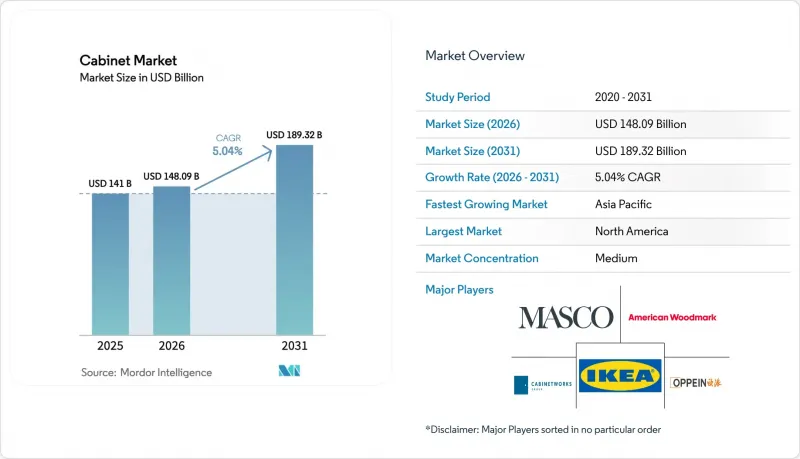
本報告按類型(RTA廚房櫥櫃、預組裝櫥櫃、半客製化櫥櫃等)、應用(廚房櫥櫃、浴室櫥櫃等)、材料(木材、金屬等)、最終用戶(住宅、商業)、配銷通路(線上、線下)和地區(北美、南美、歐洲、亞太等)進行細分。市場預測以美元計價。
全球櫥櫃市場趨勢與洞察
無框和模組化廚房佈局正逐漸成為主流。
無框櫥櫃以其全開放式設計為特色,透過取消前框,正不斷擴大市場佔有率。這種設計使得抽屜更寬、面板完全覆蓋,並增加了內部儲存空間,在相同的面積內,儲存空間幾乎可以提升兩位數。櫥櫃市場正在拓展無框產品的選擇範圍,重點關注空間最佳化和極簡美學至關重要的都市區住宅和小規模住宅。歐洲設計的影響仍然強勁,模組化規劃工具使業主和建築商能夠自由設計具有整合儲物配件的無框配置。全球零售商正在推廣廚房和浴室儲物櫃的「規劃訂購」模式,透過視覺化、數位化設計和精選產品系列簡化決策流程。大型零售商正在開設新的「規劃訂購」門市,以提高消費者對無框架和模組化配置的認知度和購買管道。
多代同堂住宅的蓬勃發展和翻新需求的不斷成長,都促進了庫存和RTA(組裝)產品線的成長。
櫥櫃市場受益於強勁的翻新需求和多用戶住宅項目,這些項目傾向於採用標準化、可複製的規格,以適應現貨和組裝(RTA)配置。櫥櫃的更換週期通常為15至20年,這在維修和翻新管道中保持了穩定的需求,並推動了產品更新換代,重點在於提升廚房和浴室的功能性、儲物空間和工作流程。 RTA產品線迎合了更嚴格的預算和更短的安裝時間,並在數位搜尋工具和配置器的普及下持續擴張,這些工具和配置器透過引導式選擇和視覺化簡化了佈局和訂購流程。展望2026年,北美地區的翻新活動依然強勁,即使住宅調整了櫥櫃、軟裝和固定裝置的預算,專業主導的項目仍保持穩定。現貨和RTA配置的普及得益於更快的交貨速度、更便捷的安裝以及在建材超市、經銷商網路和直銷網站上的廣泛供應,所有這些都有助於擴大對價格敏感的消費者的覆蓋範圍。
細分市場分析
預計到2025年,半訂製櫥櫃將佔據市場主導地位,市佔率將達到46.39%。這類櫥櫃兼具個人化和成本效益,既符合裝修預算,也符合承包商的標準。豐富的門型、飾面和儲物選擇吸引了設計專業人士和承包商的目光,兼顧了美觀與實用性。儘管面臨人事費用和前置作業時間的挑戰,訂製櫥櫃仍然作為高階專案的利基市場而存在。另一方面,現成櫥櫃則滿足了大規模承包商優先考慮速度和統一性的專案需求。隨著製造商不斷最佳化平台,提高擴充性、相容性和成本效益,模組化在半客製化和客製化櫥櫃領域正變得越來越普遍。預計半訂製櫥櫃將繼續保持主導,而組裝(RTA)櫥櫃預計將在更快的交付速度和成本優勢的推動下快速成長。
預計到2031年,RTA(即裝即用)櫥櫃將以7.26%的複合年成長率成長,這主要得益於面向注重成本的買家、小規模承包商、視覺規劃師以及家居裝飾商店網路的線上產品線。零售商正擴大採用計劃訂購模式、設計支援和提貨點,以降低成本和前置作業時間。 RTA安裝簡便,減少了對技術純熟勞工的需求,從而緩解了人手不足。領先品牌正在改進用於佈局配置、飾面選擇和針對RTA包裝客製化的購買清單的數位化工具。雖然這些進步有望擴大RTA的市場佔有率,但在翻新需求高的地區,半訂製櫥櫃仍將發揮核心作用。
預計到2025年,廚房櫥櫃將佔應用市場規模的69.39%,凸顯其在房屋翻新和住宅配置中的核心地位。與其他房間相比,廚房由於其更長的面積、更深的儲物空間以及更多的五金配件,能夠帶來更高的單次項目收益。全高儲物櫃、隱藏式儲物空間和整合式收納系統的日益普及,推動了對櫥櫃系列和配件的需求成長。整合式家電面板和相容面板的功能提升了櫥櫃的美觀度,使其在中高階價位區間佔據優勢。儘管其他房間的櫥櫃使用量不斷成長,但這些因素確保了廚房在櫥櫃市場中仍保持主導地位。
預計到2031年,浴室櫥櫃市場將以7.87%的複合年成長率成長,主要受內置電源插座、抽屜收納盒以及木紋和紋理飾面等功能的需求驅動。便利的儲物空間仍然是重中之重,推動了更深抽屜和拉出式儲物櫃的普及,以及對水槽和鏡子周圍垂直空間的充分利用。用於個人整裝儀容用品、美髮工具和隱藏式設備充電的個人化收納方案也日益受到關注。耐用性和低揮發性有機化合物(VOC)標準在浴室產品中至關重要,它們與設計趨勢共同影響產品開發。隨著翻新浪潮從主浴室擴展到次衛,供應商正在調整產品線,以滿足獨棟住宅和多用戶住宅的整修需求。
區域分析
預計到2025年,北美將佔全球櫥櫃市場規模的38.39%,其中美國憑藉活躍的翻新活動以及完善的經銷商和家居建材中心網路,將引領市場。受價格正常化、關稅擔憂和庫存管理等因素影響,消費者購買態度謹慎,導致月銷售額出現波動。成品櫥櫃、半訂製櫥櫃和訂製櫥櫃的銷售趨勢反映了宏觀經濟狀況、季節性因素以及區域項目差異。木材價格波動和加拿大軟木關稅使規劃變得複雜,而甲醛釋放標準則影響了複合木材的採購。市場持續受到維修和翻新項目、強勁的半客製化需求以及RTA(即組裝)和成品櫥櫃線上工具使用量增加的推動。
歐洲已成為櫥櫃製造和設計的重要中心,對無框和模組化設計的需求日益成長,這得益於先進的供應商和機械製造商的支持。德國在儲物領域佔據主導地位,其永續性標準、循環經濟和節能生產方式塑造了區域需求。製造商正致力於使用認證木材、低排放複合材料和水性塗料,以滿足法規和消費者期望。在歐洲設有製造地的零售商正利用規模經濟和合規優勢,投資於廚房和儲物系統的產能和自動化。隨著宏觀經濟情勢的穩定,預計房屋改造和部分新建案將保持溫和成長,並更加重視高階永續設計。
亞太地區預計到2031年將以8.38%的複合年成長率成長,主要都市化、收入成長以及西式廚房(適用於小戶型)日益普及的推動。在中國,家具業在2025年將面臨需求和成本波動的雙重挑戰,導致銷售額和利潤波動。區域供應商正將業務拓展至東南亞和中東地區,展示室也開始引進數位化規劃和模組化平台。在這個市場,除了認證木材和符合排放標準外,成本績效、緊湊的儲存空間和快速安裝也至關重要。在預測期內,零售基礎設施的投資預計將推動線上櫥櫃銷售和RTA(組裝式家具)的普及。
其他好處:
- Excel格式的市場預測(ME)表
- 3個月的分析師支持
目錄
第1章:引言
- 研究假設和市場定義
- 調查範圍
第2章:調查方法
第3章執行摘要
第4章 市場狀況
- 市場概覽
- 市場促進因素
- 無框和模組化廚房佈局正逐漸成為主流。
- 多代同堂住宅的蓬勃發展和翻新需求的增加,都促進了庫存和RTA產品線的成長。
- 廚房衛浴產品領域的電子商務成長正在加速。
- 戶外生活方式和酒店業的日益普及推動了對耐候櫥櫃的需求不斷成長。
- 透過政策主導推廣認證木材和再生材料
- 推出支援物聯網的智慧櫥櫃解決方案。
- 市場限制因素
- 木材和膠合板價格波動給生產商的利潤率帶來了壓力。
- 熟練木工短缺的情況依然存在,導致交貨時間延長。
- 關稅和反傾銷裁決正在擾亂RTA的供應鏈。
- 高昂的房屋抵押貸款貸款利率抑制了屋主在住宅裝修方面的支出。
- 產業價值鏈分析
- 波特五力分析
- 洞察最新市場趨勢與創新
- 洞察近期市場趨勢(新產品發布、策略性舉措、投資、合作、合資、業務擴張、併購等)
第5章 市場規模與成長預測
- 按類型
- 組裝(RTA)廚房櫥櫃
- 組裝/庫存櫃
- 半訂製櫥櫃
- 訂製櫥櫃
- 透過使用
- 廚房櫥櫃
- 浴室櫃
- 其他用途
- 材料
- 樹
- 金屬
- 其他原料
- 最終用戶
- 住宅
- 商業
- 透過分銷管道
- 線上
- 離線
- 按地區
- 北美洲
- 加拿大
- 美國
- 墨西哥
- 南美洲
- 巴西
- 秘魯
- 智利
- 阿根廷
- 其他南美國家
- 歐洲
- 英國
- 德國
- 法國
- 西班牙
- 義大利
- 比荷盧經濟聯盟(比利時、荷蘭、盧森堡)
- 北歐國家(丹麥、芬蘭、冰島、挪威、瑞典)
- 其他歐洲國家
- 亞太地區
- 印度
- 中國
- 日本
- 澳洲
- 韓國
- 東南亞(新加坡、馬來西亞、泰國、印尼、越南、菲律賓)
- 其他亞太國家
- 中東和非洲
- 阿拉伯聯合大公國
- 沙烏地阿拉伯
- 南非
- 奈及利亞
- 其他中東和非洲國家
- 北美洲
第6章 競爭情勢
- 市場集中度
- 策略趨勢
- 市佔率分析
- 公司簡介
- IKEA
- Masco Corporation
- American Woodmark Corporation
- Cabinetworks Group
- Oppein Home Group Inc.
- Hanssem Co., Ltd.
- MasterBrand Inc.
- Nobilia Holding GmbH
- Nobia AB
- Howdens Joinery Group PLC
- Hacker Kuchen GmbH
- Leicht Kuchen AG
- Porcelanosa Group
- Poggenpohl Mobelwerke GmbH
- GoldenHome Cabinets
- Wellborn Cabinet Inc.
- Fabuwood Cabinetry Corp.
- Crystal Cabinet Works, Inc.
- Wood-Mode LLC USA
- Schrock Cabinetry
第7章 市場機會與未來展望
According to Mordor Intelligence, the cabinet market size is expected to grow from USD 141 billion in 2025 to USD 148.09 billion in 2026 and is forecast to reach USD 189.32 billion by 2031 at a 5.04% CAGR over 2026-2031.
This report is Segmented by Type (RTA Kitchen Cabinets, Pre-Assembled, Semi-Custom Cabinets, and More), Application (Kitchen Cabinets, Bathroom Cabinets, and More), Material (Wood, Metal, and More), End User (Residential, and Commercial), Distribution Channel (Online, and Offline), and Geography (North America, South America, Europe, Asia-Pacific, and More). The Market Forecasts are Provided in Terms of Value (USD).
Global Cabinet Market Trends and Insights
Widespread shift toward frameless and modular kitchen layouts
Frameless cabinets, featuring full-access construction, are gaining market share by eliminating the face frame. This design allows wider drawers, full-overlay fronts, and increased interior yield, offering nearly double-digit gains in storage within the same footprint. The cabinet market has expanded frameless options, focusing on urban apartments and smaller homes where space optimization and minimalist aesthetics are key. European design influence remains strong, with modular planning tools enabling homeowners and installers to configure frameless setups with integrated storage accessories. Global retailers are scaling plan-and-order formats for kitchens and bath storage, streamlining decisions through visualization, digital design, and curated assortments. Large-format retailers are opening new plan-and-order points, enhancing awareness and access to frameless and modular configurations.
Multifamily construction boom and renovation uptick favoring stock and RTA lines
The cabinet market is benefiting from resilient renovation activity and multifamily construction pipelines that favor standardized, repeatable specifications suited to stock and ready-to-assemble formats. Replacement cycles for cabinets typically fall in the 15 to 20 year range, which maintains a steady cadence of demand in repair and remodel channels and supports product refreshes that emphasize function, storage, and workflow improvements in kitchens and baths. RTA lines that meet tighter budgets and faster installation windows continue to scale, helped by growing digital discovery and configurators that simplify layout and ordering through guided choices and visualization. Remodel activity in North America stayed supportive heading into 2026, with pro-led projects stabilizing even as homeowners recalibrate budgets for cabinets, surfaces, and fixtures. The mix shift toward stock and RTA configurations is reinforced by delivery speed, installation simplicity, and broad availability across home centers, dealer networks, and direct-to-consumer websites that together extend reach into price-sensitive cohorts.
Other drivers and restraints analyzed in the detailed report include:
- Quickening e-commerce growth across kitchen and bath furnishings
- Outdoor living and hospitality upgrades spurring weatherproof cabinetry
- Swings in lumber and panel costs squeezing producer margins
- Persistent skilled carpentry labor gap lengthening delivery schedules
For complete list of drivers and restraints, kindly check the Table Of Contents.
Segment Analysis
Semi-custom cabinets dominate the market with a 46.39% market share in 2025, offering a balance of personalization and cost efficiency that suits remodel budgets and builder standards. Their variety in door styles, finishes, and storage options appeals to design professionals and installers, balancing aesthetics with availability. Custom cabinets remain a niche for premium projects despite labor and lead-time challenges, while stock cabinets support large-scale builder programs focused on speed and uniformity. Modularity is gaining traction in semi-custom and custom segments as manufacturers streamline platforms to enhance scalability, interchangeability, and cost efficiency. Semi-custom cabinets are expected to retain their leadership, while ready-to-assemble (RTA) cabinets grow rapidly, driven by delivery speed and cost considerations.
RTA cabinets are forecasted to grow at a 7.26% CAGR through 2031, supported by online assortments, visual planners, and home-center footprints targeting cost-conscious buyers and small contractors. Retailers are adopting plan-and-order formats, design support, and pick-up points to reduce costs and lead times. RTA's simple installation reduces skilled labor needs, addressing labor shortages. Leading brands are enhancing digital tools for layout configuration, finish exploration, and purchase-ready lists compatible with RTA packaging. These advancements are expected to boost RTA's market share, while semi-custom cabinets remain central in remodel-heavy regions.
Kitchen cabinets accounted for 69.39% of the applications market size in 2025, highlighting their central role in remodel spending and new-home specifications. Kitchens require more linear footage, deeper storage, and greater hardware and accessory usage than other rooms, resulting in higher revenue per project. The growing adoption of full-height pantries, concealed storage, and integrated organizational systems increases the materials tied to cabinet lines and accessories. Integrated appliance panels and panel-ready features enhance cabinetry's aesthetic appeal, supporting premium pricing in mid to high tiers. These factors keep kitchens dominant in the cabinet market, even as other rooms expand their cabinet usage.
Bathroom cabinets are projected to grow at a 7.87% CAGR through 2031, driven by demand for vanities with integrated power, drawer organizers, and wood grain or textured finishes. Storage within arm's reach remains a priority, encouraging deeper drawers, pull-outs, and better vertical utilization around sinks and mirrors. Personalized storage solutions for grooming routines, haircare appliances, and concealed device charging are gaining traction. Durability and low-VOC compliance are critical in bathrooms, influencing product development alongside design trends. As renovation cycles progress through primary and secondary bathrooms, suppliers are aligning offerings to capture upgrades in single-family and multifamily homes.
Complete Report Scope:
- By Type
- Ready-to-Assemble (RTA) Kitchen Cabinets
- Pre-Assembled/Stock Cabinets
- Semi-Custom Cabinets
- Custom Cabinets
- By Application
- Kitchen Cabinets
- Bathroom Cabinets
- Other Applications
- By Material
- Wood
- Metal
- Other Raw Materials
- By End User
- Residential
- Commercial
- By Distribution Channel
- Online
- Offline
- By Geography
- North America
- Canada
- United States
- Mexico
- South America
- Brazil
- Peru
- Chile
- Argentina
- Rest of South America
- Europe
- United Kingdom
- Germany
- France
- Spain
- Italy
- BENELUX (Belgium, Netherlands, and Luxembourg)
- NORDICS (Denmark, Finland, Iceland, Norway, and Sweden)
- Rest of Europe
- Asia-Pacific
- India
- China
- Japan
- Australia
- South Korea
- South East Asia (Singapore, Malaysia, Thailand, Indonesia, Vietnam, and Philippines)
- Rest of Asia-Pacific
- Middle East And Africa
- United Arab of Emirates
- Saudi Arabia
- South Africa
- Nigeria
- Rest of Middle East And Africa
- North America
Geography Analysis
North America accounted for 38.39% of the cabinet market size in 2025, with the United States leading due to strong remodeling activity and a well-established dealer and home-center network. Monthly sales fluctuated as price normalization, tariff concerns, and inventory management prompted cautious purchasing. Sales trends across stock, semi-custom, and custom cabinets reflected macroeconomic conditions, seasonality, and regional project variations. Lumber price volatility and Canadian softwood tariffs complicated planning, while formaldehyde emission standards influenced composite wood sourcing. The market remained driven by repair and remodeling projects, steady semi-custom demand, and increased use of online tools for RTA and stock packages.
Europe serves as a key manufacturing and design hub for cabinets, with high demand for frameless and modular designs supported by advanced suppliers and machinery partners. Germany leads in storage categories, while sustainability standards, circularity, and energy-efficient production shape regional demand. Manufacturers focus on certified wood, low-emission composites, and waterborne finishes to meet regulations and consumer expectations. Retailers with European manufacturing bases invest in capacity and automation for kitchens and storage systems, leveraging scale and compliance. Stabilizing macroeconomic conditions are expected to drive moderate growth in remodeling and selective new construction, with a focus on premium and sustainable designs.
Asia-Pacific is projected to grow at an 8.38% CAGR through 2031, driven by urbanization, rising incomes, and the adoption of Western-style kitchens adapted to smaller spaces. China's furniture sector experienced revenue and profit variability in 2025 due to mixed demand and cost conditions. Regional suppliers are expanding into Southeast Asia and the Middle East, incorporating digital planning and modular platforms in showrooms. The market emphasizes value, compact storage, and quick installation, alongside compliance with certified wood and emissions standards. Investments in retail infrastructure are expected to boost online-assisted cabinet sales and RTA adoption in the forecast period.
- IKEA
- Masco Corporation
- American Woodmark Corporation
- Cabinetworks Group
- Oppein Home Group Inc.
- Hanssem Co., Ltd.
- MasterBrand Inc.
- Nobilia Holding GmbH
- Nobia AB
- Howdens Joinery Group PLC
- Hacker Kuchen GmbH
- Leicht Kuchen AG
- Porcelanosa Group
- Poggenpohl Mobelwerke GmbH
- GoldenHome Cabinets
- Wellborn Cabinet Inc.
- Fabuwood Cabinetry Corp.
- Crystal Cabinet Works, Inc.
- Wood-Mode LLC USA
- Schrock Cabinetry
Additional Benefits:
- The market estimate (ME) sheet in Excel format
- 3 months of analyst support
TABLE OF CONTENTS
1 Introduction
- 1.1 Study Assumptions & Market Definition
- 1.2 Scope of the Study
2 Research Methodology
3 Executive Summary
4 Market Landscape
- 4.1 Market Overview
- 4.2 Market Drivers
- 4.2.1 Widespread shift toward frameless and modular kitchen layouts
- 4.2.2 Multifamily construction boom and renovation uptick favoring stock and RTA lines
- 4.2.3 Quickening e-commerce growth across kitchen and bath furnishings
- 4.2.4 Outdoor living and hospitality upgrades spurring weatherproof cabinetry
- 4.2.5 Policy-driven push for certified wood and recycled inputs
- 4.2.6 Emergence of IoT-enabled smart cabinet solutions
- 4.3 Market Restraints
- 4.3.1 Swings in lumber and panel costs squeezing producer margins
- 4.3.2 Persistent skilled carpentry labor gap lengthening delivery schedules
- 4.3.3 Tariffs and anti-dumping rulings unsettling RTA supply chains
- 4.3.4 High mortgage rates curbing homeowner renovation spend
- 4.4 Industry Value Chain Analysis
- 4.5 Porter's Five Forces Analysis
- 4.5.1 Threat of New Entrants
- 4.5.2 Bargaining Power of Suppliers
- 4.5.3 Bargaining Power of Buyers
- 4.5.4 Threat of Substitutes
- 4.5.5 Competitive Rivalry
- 4.6 Insights into the Latest Trends and Innovations in the Market
- 4.7 Insights on Recent Developments (New Product Launches, Strategic Initiatives, Investments, Partnerships, JVs, Expansion, M&As, etc.) in the Market
5 Market Size & Growth Forecasts (Value)
- 5.1 By Type
- 5.1.1 Ready-to-Assemble (RTA) Kitchen Cabinets
- 5.1.2 Pre-Assembled/Stock Cabinets
- 5.1.3 Semi-Custom Cabinets
- 5.1.4 Custom Cabinets
- 5.2 By Application
- 5.2.1 Kitchen Cabinets
- 5.2.2 Bathroom Cabinets
- 5.2.3 Other Applications
- 5.3 By Material
- 5.3.1 Wood
- 5.3.2 Metal
- 5.3.3 Other Raw Materials
- 5.4 By End User
- 5.4.1 Residential
- 5.4.2 Commercial
- 5.5 By Distribution Channel
- 5.5.1 Online
- 5.5.2 Offline
- 5.6 By Geography
- 5.6.1 North America
- 5.6.1.1 Canada
- 5.6.1.2 United States
- 5.6.1.3 Mexico
- 5.6.2 South America
- 5.6.2.1 Brazil
- 5.6.2.2 Peru
- 5.6.2.3 Chile
- 5.6.2.4 Argentina
- 5.6.2.5 Rest of South America
- 5.6.3 Europe
- 5.6.3.1 United Kingdom
- 5.6.3.2 Germany
- 5.6.3.3 France
- 5.6.3.4 Spain
- 5.6.3.5 Italy
- 5.6.3.6 BENELUX (Belgium, Netherlands, and Luxembourg)
- 5.6.3.7 NORDICS (Denmark, Finland, Iceland, Norway, and Sweden)
- 5.6.3.8 Rest of Europe
- 5.6.4 Asia-Pacific
- 5.6.4.1 India
- 5.6.4.2 China
- 5.6.4.3 Japan
- 5.6.4.4 Australia
- 5.6.4.5 South Korea
- 5.6.4.6 South East Asia (Singapore, Malaysia, Thailand, Indonesia, Vietnam, and Philippines)
- 5.6.4.7 Rest of Asia-Pacific
- 5.6.5 Middle East And Africa
- 5.6.5.1 United Arab of Emirates
- 5.6.5.2 Saudi Arabia
- 5.6.5.3 South Africa
- 5.6.5.4 Nigeria
- 5.6.5.5 Rest of Middle East And Africa
- 5.6.1 North America
6 Competitive Landscape
- 6.1 Market Concentration
- 6.2 Strategic Moves
- 6.3 Market Share Analysis
- 6.4 Company Profiles (includes Global level Overview, Market level overview, Core Segments, Financials as available, Strategic Information, Market Rank/Share for key companies, Products & Services, and Recent Developments)
- 6.4.1 IKEA
- 6.4.2 Masco Corporation
- 6.4.3 American Woodmark Corporation
- 6.4.4 Cabinetworks Group
- 6.4.5 Oppein Home Group Inc.
- 6.4.6 Hanssem Co., Ltd.
- 6.4.7 MasterBrand Inc.
- 6.4.8 Nobilia Holding GmbH
- 6.4.9 Nobia AB
- 6.4.10 Howdens Joinery Group PLC
- 6.4.11 Hacker Kuchen GmbH
- 6.4.12 Leicht Kuchen AG
- 6.4.13 Porcelanosa Group
- 6.4.14 Poggenpohl Mobelwerke GmbH
- 6.4.15 GoldenHome Cabinets
- 6.4.16 Wellborn Cabinet Inc.
- 6.4.17 Fabuwood Cabinetry Corp.
- 6.4.18 Crystal Cabinet Works, Inc.
- 6.4.19 Wood-Mode LLC USA
- 6.4.20 Schrock Cabinetry
7 Market Opportunities & Future Outlook
- 7.1 Monetization Opportunities from Digitally Influenced and Content-Driven Cabinet Selection Journeys

 2026年全球浴室櫃市場報告
 2026-2030年全球櫥櫃市場2026年全球石材櫥櫃市場報告
 浴室櫃市場:2026-2032年全球市場預測(依產品類型、安裝方式、材料、門類型、最終用戶和分銷管道分類)櫥櫃市場:依材料類型、產品類型、價格範圍、最終用戶和分銷管道分類-全球預測,2026-2032年冷藏藥品櫃市場:按類型、溫度範圍、尺寸、最終用戶、應用、分銷管道分類,全球預測(2026-2032年)智慧防爆氣瓶櫃市場:依櫃體類型、防爆等級、材料、應用、最終用戶、通路分類,全球預測(2026-2032年)防爆氣瓶櫃市場:依氣體類型、類型、材料、安裝方式、應用、最終用戶、通路分類,全球預測(2026-2032年)
 全球櫥櫃市場:市場規模、佔有率和趨勢分析(按產品、材料、應用、類型和地區分類),基於細分市場的預測(2026-2033 年)
 浴室櫃市場 - 全球產業規模、佔有率、趨勢、機會、預測:按類型、材料、應用、地區和競爭格局分類,2021-2031年