


 |
市場調查報告書
商品編碼
2114365
氧化鈣:市場佔有率分析、產業趨勢與統計、成長預測(2026-2031)Calcium Oxide - Market Share Analysis, Industry Trends & Statistics, Growth Forecasts (2026 - 2031) |
||||||

※ 本網頁內容可能與最新版本有所差異。詳細情況請與我們聯繫。
據 Mordor Intelligence 稱,2025 年氧化鈣市場價值為 3.6312 億噸,預計到 2031 年將達到 4.3705 億噸,而 2026 年為 3.7427 億噸,預測期內(2026-2031 年)的複合成長率預計為 3.15%。
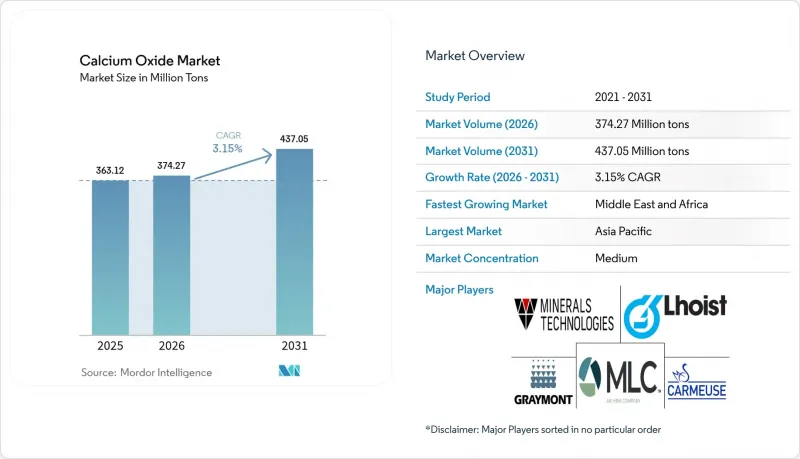
本報告按終端用戶產業(冶金、建築、化肥和化工、紙漿和造紙、耐火材料及其他終端用戶產業)和地區(亞太地區、北美、歐洲、南美以及中東和非洲)進行細分。市場預測以噸為單位。
全球氧化鈣市場趨勢及洞察
全球粗鋼產量激增
鋼鐵業仍是氧化鈣的最大單一消費產業,根據高爐技術的不同,每噸粗鋼需要使用15至50公斤生石灰。 2024年,中國粗鋼產量略高於10億噸,略有下降,但仍超過其他市場。根據經合組織(OECD)的預測,到2030年,新增煉鋼產能的40.5%仍將採用高爐-轉爐(BF-BOF)工藝,即使電弧爐(EAF)的普及率逐步提高,石灰的使用量預計仍將保持在目前的水平。印度的國家鋼鐵政策目標是到2030年實現3億噸的鋼鐵產能,其中大部分將採用高爐-轉爐工藝,從而確保對生石灰的持續需求。根據國際能源總署(IEA)的估計,煉鋼過程中的助熔劑每年排放0.3吉噸二氧化碳,凸顯了引入配備二氧化碳捕集與儲存(CCS)裝置的窯爐作為應對氣候變遷措施的重要性。即使在鋼鐵需求成長較保守的情況下,這些因素共同支撐了氧化鈣市場需求的低階。
亞太和非洲基礎設施水泥需求快速成長
在印度,預計2025會計年度,水泥產量將達到4.53億噸,這主要得益於水泥熟料與水泥比例接近0.75。東協主要經濟體正大力投資鐵路、公路和經濟適用住宅,預計2030年,區域水泥產量將以每年4-5%的速度成長。沙烏地阿拉伯的「2030願景」大型企劃需要大量的低碳混凝土。位於延布的一條日產5000噸的無熟料水泥熟料生產線表明,高純度氧化鈣可以取代波特蘭水泥熟料,同時減少高達80%的碳含量。在撒哈拉以南非洲,3,270萬公頃的酸性土壤正在降低作物產量,這推動了農業石灰計畫的發展,並與建築業的成長相輔相成。這些基礎設施和農業措施共同推動了氧化鈣市場強勁的需求成長。
能源成本高、二氧化碳排放成本高,以及對窯爐排放的管制更加嚴格。
生產一噸生石灰需要消耗3.2至4.5吉焦的熱能,在瓦斯窯中,天然氣成本可佔現金成本的60%。歐盟每噸二氧化碳近80歐元的碳價意味著,對於每噸產品排放約0.8噸二氧化碳的傳統窯爐而言,每噸生石灰的生產成本將額外增加60至70歐元。由於歐盟排放交易體系(ETS)第四階段免費配額的減少,這項負擔逐年加重。在美國,各州正在實施的新法規以及更嚴格的新污染源排放標準(NSPS)強制要求採用選擇性催化還原(SCR)和布基過濾器,這增加了資本支出(CAPEX),而產能並未相應擴大。對於小規模獨立生產商而言,為這些設備升級資金籌措變得越來越困難,從而推動了氧化鈣市場的產業結構調整。
細分市場分析
到2025年,冶金領域將佔氧化鈣市場佔有率的42.57%,這反映了氧化鈣作為高爐轉爐煉鋼助熔劑的關鍵作用。儘管全球向電弧爐(EAF)技術的轉型已將石灰用量減少至每噸鋼5-15公斤,但由於印度高爐煉鋼中心的擴張以及中國綜合煉鋼能力的持續發展,氧化鈣的絕對需求仍然強勁。用於鋼包襯裡的耐火材料級氧化鈣價格高昂,其品質認證也限制了新進入者。
受印度4.53億噸水泥產量和東協基礎建設熱潮的推動,建築業蓬勃發展。化肥和化學工業是成長最快的終端用戶產業,預計到2031年將以4.16%的複合年成長率成長。紙漿和造紙廠在其硫酸鹽法製漿製程的鹼化處理中,每噸紙漿持續使用80-120公斤熟石灰。總體而言,非金屬產業正在實現多元化發展,並在保護氧化鈣市場免受鋼鐵週期波動的影響方面發揮作用。
區域分析
亞太地區是氧化鈣市場的主要驅動力,預計到2025年將佔全球市場的49.32%,主要得益於中國大規模的鋼鐵和水泥產業以及印度加速推進的基礎建設。儘管由於中國對水泥窯實施超低排放法規,建築需求成長放緩,但對煙氣脫硫石灰(FGD石灰)的新需求正在湧現。印度政府已在其「國家基礎設施計畫」下撥款1.4兆美元,用於提高水泥產能,並確保向1000萬公頃酸性土壤供應農業用石灰。
在北美,該公司受益於《基礎設施投資與就業法案》,該法案為公路重鋪、橋樑維修和供水系統維修資金,所有這些項目都需要使用氧化鈣進行瀝青改質和水軟化。在美國鋼鐵業,由於轉向電弧爐(EAF)小型鋼廠,石灰的使用量有所下降,但由於汽車和家用電器的生產,整體需求仍然強勁。在墨西哥,卡利多拉集團擴大了在巴希奧地區的產能,推動了當地氧化鈣市場的發展,而建設業的成長又得益於近岸外包。
在歐洲,企業面臨高昂的能源成本和嚴格的碳排放目標。 2024/2620號法規將礦物碳酸鹽歸類為永久碳匯,從而促進了碳捕獲與封存(CCS)煅燒爐的使用以及用於鹼激活接合材料的高純度氧化鈣的應用。德國和法國在二氧化碳捕集水泥示範計畫方面處於領先地位,而波蘭和羅馬尼亞則主導於開發具有成本競爭力的煉鋼用水泥。在儲存和非洲,預計複合年成長率將達到3.98%,其中「沙烏地阿拉伯2030願景」下的大型企劃以及撒哈拉以南非洲的土壤石灰化計畫正在推動需求成長。南美洲的需求主要來自巴西塞拉多地區的農業和阿根廷的鋰鹵水處理,這兩項業務都依賴生石灰來調節pH值和去除雜質。
其他好處
- Excel格式的市場預測(ME)表
- 三個月的分析師支持
目錄
第1章:引言
- 研究假設和市場定義
- 調查範圍
第2章:調查方法
第3章執行摘要
第4章 市場狀況
- 市場概覽
- 市場促進因素
- 全球粗鋼產量激增
- 亞太和非洲基礎設施水泥需求快速成長
- 由於排放法規更加嚴格,CaO 在排煙脫硫(FGD) 和水處理中的使用量增加。
- 新興國家的農業土壤健康改善計劃
- 低碳水泥和碳循環技術需要高純度氧化鈣
- 市場限制因素
- 高昂的能源成本、二氧化碳成本、更嚴格的窯爐排放法規。
- 石灰石和天然氣的價格波動
- Flux 是一種新型吸附劑,正在鋼鐵業中獲得市場佔有率。
- 價值鏈分析
- 波特五力模型
第5章 市場規模與成長預測
- 按最終用戶行業分類
- 冶金
- 建造
- 化肥和化學產品
- 紙漿和造紙
- 耐火材料
- 其他終端用戶產業(橡膠、食品和飲料)
- 按地區
- 亞太地區
- 中國
- 印度
- 日本
- 韓國
- ASEAN
- 其他亞太國家
- 北美洲
- 美國
- 加拿大
- 墨西哥
- 歐洲
- 德國
- 英國
- 義大利
- 法國
- 俄羅斯
- 西班牙
- 其他歐洲國家
- 南美洲
- 巴西
- 阿根廷
- 其他南美國家
- 中東和非洲
- 沙烏地阿拉伯
- 南非
- 其他中東和非洲國家
- 亞太地區
第6章 競爭情勢
- 市場集中度
- 策略趨勢
- 市佔率和排名分析
- 公司簡介
- AKJ Minchem Private Limited
- American Elements
- Astrra Chemicals
- CAO Industries Sdn Bhd
- Carmeuse
- GRAYMONT
- GREER LIME COMPANY
- Grupo Calidra
- Imerys
- Kemipex
- Lhoist
- Linwood Mining & Minerals Corporation
- Minerals Technologies Inc.
- Mississippi Lime Company d/b/a MLC.
- Nordkalk
- Pacific Lime and Cement Limited
- Pete Lien & Sons, Inc.
- Sibelco
- Sigma Minerals Ltd
- United States Lime & Minerals
第7章 市場機會與未來展望
According to Mordor Intelligence, the calcium oxide market size was valued at 363.12 Million tons in 2025 and is estimated to grow from 374.27 Million tons in 2026 to reach 437.05 Million tons by 2031, at a CAGR of 3.15% during the forecast period (2026-2031).
This report is Segmented by End-User Industry (Metallurgical, Construction, Fertilizer and Chemicals, Pulp and Paper, Refractory, and Other End-User Industries) and Geography (Asia-Pacific, North America, Europe, South America, and Middle-East and Africa). The Market Forecasts are Provided in Terms of Volume (Tons).
Global Calcium Oxide Market Trends and Insights
Surging Global Crude-Steel Output
Steel remains the single-largest consumer of calcium oxide, using 15-50 kilograms of quicklime per ton of crude steel, depending on furnace technology. China produced just over 1.0 billion tons of crude steel in 2024, a marginal decline yet still outsizing every other market. The OECD projects that 40.5% of new steel capacity through 2030 will continue to use the BF-BOF route, preserving lime intensity even as EAF penetration inches higher. India's National Steel Policy targets 300 million tons of capacity by 2030, largely BF-BOF, effectively locking in sustained quicklime offtake. The International Energy Agency calculates that fluxes in steelmaking account for 0.3 gigatons of process CO2 annually, underscoring the climate case for CCS-equipped kilns. Collectively, these factors underpin a demand floor for the calcium oxide market even under conservative steel-growth scenarios.
Rapid Infrastructure and Cement Demand in Asia-Pacific and Africa
Cement output reached 453 million tons in India during fiscal 2025, supported by a clinker-to-cement ratio near 0.75. Major ASEAN economies are plowing public budgets into rail, highways, and affordable housing, lifting regional cement production by 4-5% each year through 2030. Saudi Arabia's Vision 2030 megaprojects require huge volumes of low-carbon concrete; a 5,000-ton-per-day clinker-free line at Yanbu showcases how high-purity CaO can substitute Portland clinker while cutting embodied carbon by up to 80%. In Sub-Saharan Africa, 32.7 million hectares of acid soils are depressing crop yields, spurring agricultural-lime programs that dovetail with construction growth. These converging infrastructure and agricultural initiatives reinforce a robust volume trajectory for the calcium oxide market.
High Energy and CO2 Costs, Tightening Kiln-Emission Limits
Producing one ton of quicklime consumes 3.2-4.5 GJ of thermal energy, and natural gas can represent 60% of cash costs for gas-fired kilns. EU carbon prices near EUR 80 per ton of CO2 translate into an additional EUR 60-70 per ton of quicklime for legacy kilns emitting roughly 0.8 tons CO2 per ton product. Free-allowance reductions under ETS Phase IV intensify this burden each year. In the United States, emerging state-level programs and stricter New Source Performance Standards compel selective catalytic reduction and fabric-filter retrofits that raise capex without expanding capacity. Small, standalone producers find it increasingly difficult to finance such upgrades, feeding a consolidation trend in the calcium oxide market.
Other drivers and restraints analyzed in the detailed report include:
- Stricter Emissions Rules Boosting CaO Use in FGD and Water Treatment
- Low-Carbon Cement and Carbon-Looping Technologies Requiring High-Purity CaO
- Limestone and Natural-Gas Price Volatility
For complete list of drivers and restraints, kindly check the Table Of Contents.
Segment Analysis
The Metallurgical segment accounted for 42.57% of calcium oxide market share in 2025, reflecting its critical function as a flux in BF-BOF steelmaking. Although the global shift toward EAF technology lowers lime intensity to 5-15 kg per ton of steel, India's BF-centric expansion and persistent integrated capacity in China sustain absolute volume demand. Refractory-grade CaO for ladle linings commands price premiums, underpinned by quality certifications that limit new entrants.
Construction is energized by India's 453-million-ton cement output and ASEAN's infrastructure boom. Fertilizer and Chemicals is the fastest-expanding end-user industry, advancing at a 4.16% CAGR through 2031. Pulp and Paper mills retain stable quicklime usage of 80-120 kg per ton of pulp in kraft causticizing loops. Collectively, non-metallurgical industries provide diversification that cushions the calcium oxide market against steel-cycle volatility.
Complete Report Scope:
- By End-user Industry
- Metallurgical
- Construction
- Fertilizer and Chemicals
- Pulp and Paper
- Refractory
- Other End-user Industries (Rubber, Food and Beverages)
- By Geography
- Asia-Pacific
- China
- India
- Japan
- South Korea
- ASEAN Countries
- Rest of Asia-Pacific
- North America
- United States
- Canada
- Mexico
- Europe
- Germany
- United Kingdom
- Italy
- France
- Russia
- Spain
- Rest of Europe
- South America
- Brazil
- Argentina
- Rest of South America
- Middle-East and Africa
- Saudi Arabia
- South Africa
- Rest of Middle-East and Africa
- Asia-Pacific
Geography Analysis
Asia-Pacific led the calcium oxide market with 49.32% of 2025 volume, anchored by China's massive steel and cement sectors and India's accelerating infrastructure pipeline. Ultra-low-emission mandates for Chinese cement kilns are generating fresh demand for FGD-grade lime even as construction growth moderates. India's government has allocated USD 1.4 trillion under its National Infrastructure Pipeline, sustaining cement capacity additions and farm-lime distribution across 10 million hectares of acid soils.
North America benefits from the Infrastructure Investment and Jobs Act, which funds highway resurfacing, bridge rehabilitation, and water-system upgrades, all of which employ CaO in asphalt modification and water-softening treatments. While the U.S. steel sector's pivot toward EAF mini-mills reduces lime intensity, overall demand remains resilient due to automotive and appliance output. Mexico's nearshoring-boosted construction growth prompted Grupo Calidra to expand Bajio capacity, reinforcing the regional calcium oxide market.
Europe operates under high energy costs and stringent carbon targets. Regulation 2024/2620 classifies mineral carbonates as permanent sinks, encouraging CCS-ready kilns and high-purity CaO for alkali-activated binders. Germany and France lead low-carbon cement trials, whereas Poland and Romania emphasize cost-competitive grades for steel. The Middle-East and Africa region, projected to grow at 3.98% CAGR, leverages Saudi Vision 2030 megaprojects and sub-Saharan soil-liming programs. South America's demand hinges on Brazil's Cerrado agriculture and Argentina's lithium brine processing, both reliant on quicklime for pH moderation and impurity removal.
- AKJ Minchem Private Limited
- American Elements
- Astrra Chemicals
- CAO Industries Sdn Bhd
- Carmeuse
- GRAYMONT
- GREER LIME COMPANY
- Grupo Calidra
- Imerys
- Kemipex
- Lhoist
- Linwood Mining & Minerals Corporation
- Minerals Technologies Inc.
- Mississippi Lime Company d/b/a MLC.
- Nordkalk
- Pacific Lime and Cement Limited
- Pete Lien & Sons, Inc.
- Sibelco
- Sigma Minerals Ltd
- United States Lime & Minerals
Additional Benefits:
- The market estimate (ME) sheet in Excel format
- 3 months of analyst support
TABLE OF CONTENTS
1 Introduction
- 1.1 Study Assumptions and Market Definition
- 1.2 Scope of the Study
2 Research Methodology
3 Executive Summary
4 Market Landscape
- 4.1 Market Overview
- 4.2 Market Drivers
- 4.2.1 Surging global crude-steel output
- 4.2.2 Rapid infrastructure and cement demand in Asia-Pacific and Africa
- 4.2.3 Stricter emissions rules boosting CaO use in Flue Gas Desulfurization (FGD) and water treatment
- 4.2.4 Agricultural soil-health programs in emerging economies
- 4.2.5 Low-carbon cement and carbon-looping technologies requiring high-purity CaO
- 4.3 Market Restraints
- 4.3.1 High energy and CO2 costs, tightening kiln-emission limits
- 4.3.2 Limestone and natural-gas price volatility
- 4.3.3 Alternative sorbents/fluxes gaining share in steel
- 4.4 Value Chain Analysis
- 4.5 Porter's Five Forces
- 4.5.1 Threat of New Entrants
- 4.5.2 Bargaining Power of Suppliers
- 4.5.3 Bargaining Power of Buyers
- 4.5.4 Threat of Substitutes
- 4.5.5 Degree of Competition
5 Market Size and Growth Forecasts (Volume)
- 5.1 By End-user Industry
- 5.1.1 Metallurgical
- 5.1.2 Construction
- 5.1.3 Fertilizer and Chemicals
- 5.1.4 Pulp and Paper
- 5.1.5 Refractory
- 5.1.6 Other End-user Industries (Rubber, Food and Beverages)
- 5.2 By Geography
- 5.2.1 Asia-Pacific
- 5.2.1.1 China
- 5.2.1.2 India
- 5.2.1.3 Japan
- 5.2.1.4 South Korea
- 5.2.1.5 ASEAN Countries
- 5.2.1.6 Rest of Asia-Pacific
- 5.2.2 North America
- 5.2.2.1 United States
- 5.2.2.2 Canada
- 5.2.2.3 Mexico
- 5.2.3 Europe
- 5.2.3.1 Germany
- 5.2.3.2 United Kingdom
- 5.2.3.3 Italy
- 5.2.3.4 France
- 5.2.3.5 Russia
- 5.2.3.6 Spain
- 5.2.3.7 Rest of Europe
- 5.2.4 South America
- 5.2.4.1 Brazil
- 5.2.4.2 Argentina
- 5.2.4.3 Rest of South America
- 5.2.5 Middle-East and Africa
- 5.2.5.1 Saudi Arabia
- 5.2.5.2 South Africa
- 5.2.5.3 Rest of Middle-East and Africa
- 5.2.1 Asia-Pacific
6 Competitive Landscape
- 6.1 Market Concentration
- 6.2 Strategic Moves
- 6.3 Market Share (%)/Ranking Analysis
- 6.4 Company Profiles (includes Global level Overview, Market level overview, Core Segments, Financials as available, Strategic Information, Products and Services, and Recent Developments)
- 6.4.1 AKJ Minchem Private Limited
- 6.4.2 American Elements
- 6.4.3 Astrra Chemicals
- 6.4.4 CAO Industries Sdn Bhd
- 6.4.5 Carmeuse
- 6.4.6 GRAYMONT
- 6.4.7 GREER LIME COMPANY
- 6.4.8 Grupo Calidra
- 6.4.9 Imerys
- 6.4.10 Kemipex
- 6.4.11 Lhoist
- 6.4.12 Linwood Mining & Minerals Corporation
- 6.4.13 Minerals Technologies Inc.
- 6.4.14 Mississippi Lime Company d/b/a MLC.
- 6.4.15 Nordkalk
- 6.4.16 Pacific Lime and Cement Limited
- 6.4.17 Pete Lien & Sons, Inc.
- 6.4.18 Sibelco
- 6.4.19 Sigma Minerals Ltd
- 6.4.20 United States Lime & Minerals
7 Market Opportunities and Future Outlook
- 7.1 White-space and Unmet-Need Assessment

 醋酸鈣市場規模、佔有率和成長分析:按等級、應用、形態、終端用戶產業、分銷通路、原料和地區分類-2026-2033年產業預測
 鈣粉市場-全球產業規模、佔有率、趨勢、機會、預測:銷售管道、最終用途、地區和競爭格局分類,2021-2031年
 泛酸鈣市場:按等級、形態、最終用戶、銷售管道和地區分類的規模、佔有率、前景和機會分析(2025-2032 年)硫酸鈣市場:依產品類型、應用、終端用戶產業及地區分類
 全球氧化鈣市場規模、佔有率、趨勢和成長分析報告(2026-2034年)
 左葉酸鈣五水合物市場:2026-2032年全球市場預測(按應用、給藥途徑、通路、最終用戶和劑型分類)醋酸鈣市場:依應用、形態、等級及通路分類-2026-2032年全球市場預測泛酸鈣市場:依等級、形態、應用、最終用戶和銷售管道分類-2026-2032年全球市場預測草酸鈣市場:2026-2032年全球市場預測(依產品類型、純度等級、原料、形態、應用、終端用戶產業及通路分類)
 鈉鹽、鉀鹽和鈣鹽市場規模、佔有率和成長分析:按鹽類型、產品等級、功能、最終用途產業和地區分類-2026-2033年產業預測