


 |
市場調查報告書
商品編碼
2114342
乙胺:市佔率分析、產業趨勢與統計、成長預測(2026-2031)Ethyleneamines - Market Share Analysis, Industry Trends & Statistics, Growth Forecasts (2026 - 2031) |
||||||

※ 本網頁內容可能與最新版本有所差異。詳細情況請與我們聯繫。
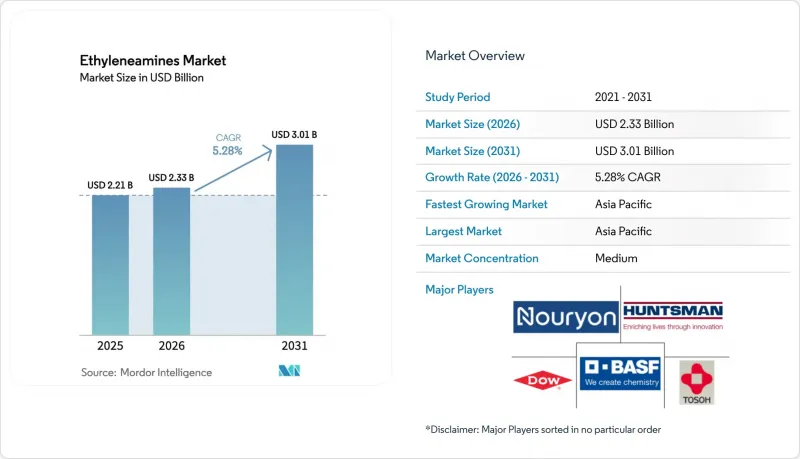
據 Mordor Intelligence 稱,2025 年乙烯胺市值為 22.1 億美元,預計到 2031 年將達到 30.1 億美元,而 2026 年為 23.3 億美元,預測期(2026-2031 年)的複合年成長率為 5.28%。
本報告按類型(乙二胺和重質乙胺)、終端用戶行業(個人護理、紙漿和造紙、黏合劑、塗料和樹脂、農業化學品、汽車、製藥、石油和天然氣、紡織、金屬及其他)以及地區(亞太地區、北美、歐洲、南美以及中東和非洲)進行細分。市場預測以美元計價。
全球乙胺市場趨勢與洞察
風力渦輪機葉片生產導致環氧樹脂需求激增。
與風力發電機製造商簽訂的多年環氧樹脂供應合約導致聚胺基固化劑的消耗量激增,進而推動了乙烯胺市場的擴張。亨斯邁提供可在室溫下固化的乙烯胺基體系,確保長度超過80公尺的葉片所需的抗疲勞強度。 2024年,中國大幅提升了風電裝置容量,每吉瓦需要大量的環氧樹脂,這進一步增加了對重質乙烯胺的需求。歐洲風力發電機葉片製造商正在向真空灌注樹脂過渡,這需要客製化的DETA和TETA混合物來控制凝膠時間。隨著轉子直徑的增加,需要更厚的層壓板才能實現更快、更徹底的固化,導致胺與樹脂的比例成長速度超過了渦輪機數量的成長速度。
亞洲和南美洲農藥消費量增加
隨著農民努力應對Glyphosate抗藥性問題,乙二胺鹽類除草劑配方在巴西和阿根廷再次受到關注。 2024年,印度批准了多種新的作物保護配方,其中許多配方都添加了乙二胺類添加劑以增強葉面吸收。作為全球最大的Glyphosate生產國,中國已將高附加價值農藥中間體列為「十四五」規劃的戰略重點領域,這將提振國內對乙二胺的需求。 2024年,南美洲大豆種植面積的大幅擴張導致除草劑用量激增,乙二胺衍生物的使用量也隨之增加。監管部門的快速核准和國內產能的提升正在推動農藥產業內乙二胺市場的短期成長。
根據毒性收緊職場接觸限值
在職業安全與健康機構將幾種乙烯胺的暴露限值降低至1 ppm後,生產商正投資升級其密閉設施。歐洲化學品管理局 (ECHA) 基於 REACH 法規的審查相關的核准費用可能會推高生產成本。亨斯邁公司已將業務重組成本(包括環境和安全措施方面的支出)累計其莫氏樹脂工廠關閉前的 2025 年預算中。儘管配方生產商正在測試聚醚胺作為部分替代品,但在固化速度和耐久性方面的權衡阻礙了其廣泛替代品。隨著監管力道的加強,產能擴張正轉向監管路徑更為清晰的地區,進而重塑全球乙烯胺市場的格局。
細分市場分析
預計到2025年,乙二胺將佔乙烯胺市場的62.94%,並將在2031年之前以5.36%的複合年成長率成長,這主要得益於其在聚醚胺生產中的雙重作用以及作為水處理螯合劑的應用。重質乙烯胺,例如DETA、TETA、TEPA和AEP,因其富含胺基官能基,可用於環氧樹脂固化、瀝青改質和油田化學領域,從而促進黏合和成膜。生物基原料正日益受到關注,BASF和贏創於2024年簽署了一項關於生質能平衡氨的協議,該協議將使產品能夠獲得ISCC PLUS認證,並享有價格溢價。
Piperazine雖然產量較小,但作為抗組織胺藥物和驅蟲藥的中間體,在製藥領域有著穩定的需求。Piperazine在環狀和鎖狀化學反應中起到橋樑作用,可促進聚脲塗層的快速固化,並為管道提供強大的防腐蝕保護。隨著葉輪尺寸的增大和低VOC法規的日益嚴格,配方規範對胺類官能基的容差要求也越來越低,這使得擁有多種重胺的供應商更具優勢。這些需求進一步鞏固了乙烯胺市場一體化生產商的優勢。在預測期內,受複合材料、油田和特殊黏合劑等領域應用的推動,乙烯胺重胺市場預計將穩定成長。
區域分析
預計到2025年,亞太地區將佔全球總量的53.32%,並將在2031年之前維持5.43%的複合年成長率。在中國,一體化綜合體的擴張正在穩步推進,恆力石化在特種材料領域主導。該領域涵蓋乙烯胺,並透過策略性地將自身的環氧乙烷生產與下游衍生物生產相結合,獲得了成本優勢。同時,印度正因其在下游化學品領域的大量資本投資而備受關注,尤其注重農業化學品和界面活性劑領域的後向整合。日本和韓國在電子和汽車製造業中扮演著至關重要的角色,但其成長率低於區域平均。在東南亞,可支配收入的成長吸引了跨國個人護理公司的關注,這推動了當地表面活性劑的生產,並導致乙烯胺進口激增。
儘管北美擁有強大的生產能力,但仍面臨激烈的競爭壓力。陶氏化學在沙烏地阿拉伯的合資企業Sadara憑藉其成本優勢的胺類產品,正逐漸從墨西哥灣沿岸地區地區奪取出口佔有率,並因此備受全球關注。在莫爾斯工廠關閉後,亨斯邁公司已將其位於巧克力灣的工廠的業務重心轉向環氧樹脂和油田相關客戶。為了實現永續性,加拿大Path2Zero乙烯聯合裝置已開始生產低碳環氧乙烷,使亞伯達成為注重環保的買家的重要供應中心。墨西哥正利用其靠近墨西哥灣沿岸地區原料產地的優勢,擴大其界面活性劑生產線,以滿足美國個人護理品牌的需求。
在歐洲,能源成本上漲和嚴格的REACH法規帶來了挑戰。因此,一些企業正在進行選擇性投資,以策略性地滿足歐洲的需求,例如BASF在安特衛普擴建烷基乙醇胺生產線,以及贏創在南京建設特種胺生產基地。在南美洲,儘管高度依賴進口,農藥消費仍是關注的焦點。中東地區在沙烏地基礎工業公司(SABIC)的乙烯胺生產設施和亨斯邁的「阿拉伯胺」合資企業的支持下,向亞洲和歐洲出口產品。他們也正在探索二氧化碳捕集項目,以展現其對永續發展的承諾。在非洲,市場仍處於發展初期,但需求主要由進口農藥和塗料驅動。
其他好處:
- Excel格式的市場預測(ME)表
- 3個月的分析師支持
目錄
第1章:引言
- 研究假設和市場定義
- 調查範圍
第2章:調查方法
第3章執行摘要
第4章 市場狀況
- 市場概覽
- 市場促進因素
- 風力渦輪機葉片生產導致環氧樹脂需求激增。
- 亞洲和南美洲農藥消費量增加
- 擴大亞太地區界面活性劑和清潔劑的生產能力。
- 過渡到使用聚胺基固化劑的低VOC塗料
- 利用乙烯胺混合物研究開發二氧化碳回收溶劑
- 市場限制因素
- 根據毒性收緊職場接觸限值
- 環氧乙烷和氨等原料價格的波動
- 新興的生物基多胺正在蠶食石油基生產路線。
- 價值鏈分析
- 波特五力模型
第5章 市場規模與成長預測
- 按類型
- 乙二胺(EDA)
- 重質乙烯胺(DETA、TETA、TEPA、AEP 等)
- 按最終用戶行業分類
- 個人護理行業
- 紙漿和造紙業
- 黏合劑、油漆、樹脂
- 農業化學工業
- 汽車產業
- 製藥業
- 石油和天然氣產業
- 紡織業
- 金屬工業
- 其他終端用戶產業
- 按地區
- 亞太地區
- 中國
- 印度
- 日本
- 韓國
- 其他亞太國家
- 北美洲
- 美國
- 加拿大
- 墨西哥
- 歐洲
- 德國
- 英國
- 義大利
- 法國
- 其他歐洲國家
- 南美洲
- 巴西
- 阿根廷
- 其他南美國家
- 中東和非洲
- 沙烏地阿拉伯
- 南非
- 其他中東和非洲國家
- 亞太地區
第6章 競爭情勢
- 市場集中度
- 策略趨勢
- 市佔率(%)/排名分析
- 公司簡介
- Alkyl Amines Chemicals Ltd.
- Arabian Amines Company
- Arkema
- BALAJI SPECIALITY CHEMICALS LIMITED
- BASF SE
- Delamine BV
- Diamines and Chemicals Ltd.
- Dow
- Eastman Chemical Company
- Evonik Industries
- Huntsman International LLC
- INEOS
- Nouryon
- Oriental Union Chemical Corporation
- SABIC
- Sadara Chemical Company
- Tosoh Corporation
第7章 市場機會與未來展望
According to Mordor Intelligence, the ethyleneamines market size was valued at USD 2.21 billion in 2025 and is estimated to grow from USD 2.33 billion in 2026 to reach USD 3.01 billion by 2031, at a CAGR of 5.28% during the forecast period (2026-2031).
This report is Segmented by Type (Ethylenediamine and Heavy Ethyleneamines), End-User Industry (Personal Care, Pulp and Paper, Adhesives/Paints/Resins, Agrochemicals, Automotive, Pharmaceutical, Oil and Gas, Textile, Metal, and Other), and Geography (Asia-Pacific, North America, Europe, South America, and Middle-East and Africa). Market Forecasts are Provided in Terms of Value (USD).
Global Ethyleneamines Market Trends and Insights
Booming Epoxy-Resin Demand from Wind-Energy Blade Production
Multi-year epoxy supply agreements are being inked by wind-turbine manufacturers, leading to a surge in the consumption of polyamine curing agents and, consequently, boosting volumes in the ethyleneamines market. Huntsman provides ethyleneamine-based systems that cure at room temperature, ensuring the necessary fatigue resistance for blades longer than 80 meters in length. In 2024, China bolstered its wind capacity significantly, with each gigawatt requiring substantial amounts of epoxy resin, thereby amplifying the demand for heavy ethyleneamines. European manufacturers of wind turbine blades are transitioning to vacuum-infusion resins, which necessitate customized DETA and TETA blends to manage gel time. With the expansion of rotor diameters, there's a need for thicker laminates to achieve a quicker through-cure, resulting in an amine-to-resin ratio that escalates at a pace outstripping the increase in turbine unit counts.
Rising Agrochemical Consumption in Asia and South America
As growers combat glyphosate resistance, Brazil and Argentina see a resurgence in herbicide formulations utilizing ethylenediamine salts. In 2024, India greenlit several new crop-protection formulations, many incorporating ethylenediamine-based adjuvants to boost foliar uptake. China, the globe's leading glyphosate producer, highlights high-value agrochemical intermediates as strategic in its 14th Five-Year Plan, bolstering local demand for ethyleneamines. With South American soybean acreage expanding significantly in 2024, herbicide application intensity surged, driving up the use of ethyleneamine derivatives. Swift regulatory approvals and bolstered domestic capacities fuel the short-term growth of the ethyleneamines market within the agrochemical sector.
Toxicity-Driven Workplace Exposure Limits Tightening
Producers are investing in containment upgrades as occupational agencies lower exposure limits for several ethyleneamines to 1 ppm. Authorization fees from European Chemicals Agency reviews under REACH could raise production costs. Before idling its Moers plant, Huntsman incurred restructuring charges in 2025, which included spending on environmental and safety measures. While formulators are testing polyetheramines as partial substitutes, trade-offs in cure speed and durability hinder widespread replacement. With tightening enforcement, capacity additions are moving toward regions with clearer regulatory pathways, reshaping the global footprint of the ethyleneamines market.
Other drivers and restraints analyzed in the detailed report include:
- Surfactant and Detergent Capacity Additions in Asia-Pacific
- Shift to Low-VOC Coatings Using Polyamine Curing Agents
- Volatile Ethylene Oxide and Ammonia Feedstock Pricing
For complete list of drivers and restraints, kindly check the Table Of Contents.
Segment Analysis
Ethylenediamine captured 62.94% of the ethyleneamines market share in 2025 and is projected to grow at a 5.36% CAGR through 2031, underpinned by its dual role in polyetheramine production and water-treatment chelation. Heavy ethyleneamines such as DETA, TETA, TEPA, and AEP supply epoxy curing, asphalt modification, and oilfield chemicals where higher amine functionality drives adhesion and film build. Bio-attributed feedstocks are gaining momentum; BASF and Evonik signed a biomass-balanced ammonia agreement in 2024, allowing ISCC PLUS certification that carries a price premium.
Piperazine, though smaller in volume, enjoys steady pharmaceutical demand as an intermediate for antihistamines and anthelmintics. Aminoethylpiperazine bridges cyclic and linear chemistries, offering fast cure in polyurea coatings and robust corrosion inhibition in pipelines. As rotor blades lengthen and low-VOC regulations tighten, formulations often specify narrow amine functionality windows, favoring suppliers with broad heavy-amine slats. These needs reinforce the dominance of integrated producers within the ethyleneamines market. Over the forecast, the ethyleneamines market size for heavy amines is expected to expand steadily, supported by composite, oilfield, and specialty-adhesive applications.
Complete Report Scope:
- By Type
- Ethylenediamine (EDA)
- Heavy Ethyleneamines (DETA, TETA, TEPA, AEP, etc.)
- By End-user Industry
- Personal Care Industry
- Pulp and Paper Industry
- Adhesives, Paints, and Resins
- Agro Chemicals Industry
- Automotive Industry
- Pharmaceutical Industry
- Oil and Gas Industry
- Textile Industry
- Metal Industry
- Other End-user Industries
- By Geography
- Asia-Pacific
- China
- India
- Japan
- South Korea
- Rest of Asia-Pacific
- North America
- United States
- Canada
- Mexico
- Europe
- Germany
- United Kingdom
- Italy
- France
- Rest of Europe
- South America
- Brazil
- Argentina
- Rest of South America
- Middle-East and Africa
- Saudi Arabia
- South Africa
- Rest of Middle-East and Africa
- Asia-Pacific
Geography Analysis
Asia-Pacific accounted for 53.32% of global volume in 2025 and is forecast to post a 5.43% CAGR to 2031. China is ramping up its integrated complexes, with Hengli Petrochemical spearheading a specialty-materials unit. This unit, which includes ethyleneamines, strategically pairs captive ethylene oxide with downstream derivatives, ensuring a cost edge. Meanwhile, India is making waves with a substantial capital investment in downstream chemicals, particularly emphasizing backward integration in agrochemicals and surfactants. While Japan and South Korea play pivotal roles in electronics and auto manufacturing, their growth lags behind the regional average. In Southeast Asia, rising disposable incomes are luring multinational personal-care firms, leading to localized surfactant production and a surge in ethyleneamine imports.
North America, despite its robust production capabilities, grapples with competitive pressures. Dow's Sadara joint venture in Saudi Arabia is making global waves by shipping cost-advantaged amines, thereby nibbling away at the Gulf Coast's export share. Following the closure of its Moers facility, Huntsman has pivoted its Chocolate Bayou plant's focus towards epoxy and oilfield clientele. In a move towards sustainability, Canada's Path2Zero ethylene complex is rolling out low-carbon ethylene oxide, positioning Alberta as a prime supply hub for environmentally-conscious buyers. Capitalizing on its proximity to Gulf-Coast feedstocks, Mexico is ramping up its surfactant lines to cater to U.S. personal-care brands.
Europe grapples with soaring energy costs and stringent REACH regulations. This has led to selective investments, such as BASF's expansion of alkyl-ethanolamines in Antwerp and Evonik's specialty-amine facility in Nanjing, strategically catering to European demand. In South America, the focus remains on agrochemical consumption, albeit with a heavy reliance on imports. The Middle East, bolstered by SABIC's ethyleneamine unit and Huntsman's Arabian Amines venture, is exporting to both Asia and Europe. They're also exploring carbon-capture projects to bolster their sustainability image. Africa, still in its infancy in this market, sees demand primarily driven by imported agrochemicals and coatings.
- Alkyl Amines Chemicals Ltd.
- Arabian Amines Company
- Arkema
- BALAJI SPECIALITY CHEMICALS LIMITED
- BASF SE
- Delamine BV
- Diamines and Chemicals Ltd.
- Dow
- Eastman Chemical Company
- Evonik Industries
- Huntsman International LLC
- INEOS
- Nouryon
- Oriental Union Chemical Corporation
- SABIC
- Sadara Chemical Company
- Tosoh Corporation
Additional Benefits:
- The market estimate (ME) sheet in Excel format
- 3 months of analyst support
TABLE OF CONTENTS
1 Introduction
- 1.1 Study Assumptions and Market Definition
- 1.2 Scope of the Study
2 Research Methodology
3 Executive Summary
4 Market Landscape
- 4.1 Market Overview
- 4.2 Market Drivers
- 4.2.1 Booming epoxy-resin demand from wind-energy blade production
- 4.2.2 Rising agrochemical consumption in Asia and South America
- 4.2.3 Surfactant and detergent capacity additions in Asia-Pacific
- 4.2.4 Shift to low-VOC coatings using polyamine curing agents
- 4.2.5 CO2-capture solvent Research and Development using ethyleneamines blends
- 4.3 Market Restraints
- 4.3.1 Toxicity-driven workplace exposure limits tightening
- 4.3.2 Volatile ethylene oxide and ammonia feedstock pricing
- 4.3.3 Emerging bio-based polyamines cannibalising petro routes
- 4.4 Value Chain Analysis
- 4.5 Porter's Five Forces
- 4.5.1 Bargaining Power of Suppliers
- 4.5.2 Bargaining Power of Buyers
- 4.5.3 Threat of New Entrants
- 4.5.4 Threat of Substitutes
- 4.5.5 Competitive Rivalry
5 Market Size and Growth Forecasts (Value)
- 5.1 By Type
- 5.1.1 Ethylenediamine (EDA)
- 5.1.2 Heavy Ethyleneamines (DETA, TETA, TEPA, AEP, etc.)
- 5.2 By End-user Industry
- 5.2.1 Personal Care Industry
- 5.2.2 Pulp and Paper Industry
- 5.2.3 Adhesives, Paints, and Resins
- 5.2.4 Agro Chemicals Industry
- 5.2.5 Automotive Industry
- 5.2.6 Pharmaceutical Industry
- 5.2.7 Oil and Gas Industry
- 5.2.8 Textile Industry
- 5.2.9 Metal Industry
- 5.2.10 Other End-user Industries
- 5.3 By Geography
- 5.3.1 Asia-Pacific
- 5.3.1.1 China
- 5.3.1.2 India
- 5.3.1.3 Japan
- 5.3.1.4 South Korea
- 5.3.1.5 Rest of Asia-Pacific
- 5.3.2 North America
- 5.3.2.1 United States
- 5.3.2.2 Canada
- 5.3.2.3 Mexico
- 5.3.3 Europe
- 5.3.3.1 Germany
- 5.3.3.2 United Kingdom
- 5.3.3.3 Italy
- 5.3.3.4 France
- 5.3.3.5 Rest of Europe
- 5.3.4 South America
- 5.3.4.1 Brazil
- 5.3.4.2 Argentina
- 5.3.4.3 Rest of South America
- 5.3.5 Middle-East and Africa
- 5.3.5.1 Saudi Arabia
- 5.3.5.2 South Africa
- 5.3.5.3 Rest of Middle-East and Africa
- 5.3.1 Asia-Pacific
6 Competitive Landscape
- 6.1 Market Concentration
- 6.2 Strategic Moves
- 6.3 Market Share(%)/ Ranking Analysis
- 6.4 Company Profiles (includes Global level Overview, Market level overview, Core Segments, Financials as available, Strategic Information, Products and Services, Recent Developments)
- 6.4.1 Alkyl Amines Chemicals Ltd.
- 6.4.2 Arabian Amines Company
- 6.4.3 Arkema
- 6.4.4 BALAJI SPECIALITY CHEMICALS LIMITED
- 6.4.5 BASF SE
- 6.4.6 Delamine BV
- 6.4.7 Diamines and Chemicals Ltd.
- 6.4.8 Dow
- 6.4.9 Eastman Chemical Company
- 6.4.10 Evonik Industries
- 6.4.11 Huntsman International LLC
- 6.4.12 INEOS
- 6.4.13 Nouryon
- 6.4.14 Oriental Union Chemical Corporation
- 6.4.15 SABIC
- 6.4.16 Sadara Chemical Company
- 6.4.17 Tosoh Corporation
7 Market Opportunities and Future Outlook
- 7.1 White-space and Unmet-need Assessment

