


 |
市場調查報告書
商品編碼
2114339
嬰兒照護包裝:市場佔有率分析、產業趨勢與統計、成長預測(2026-2031)Baby Care Packaging - Market Share Analysis, Industry Trends & Statistics, Growth Forecasts (2026 - 2031) |
||||||

※ 本網頁內容可能與最新版本有所差異。詳細情況請與我們聯繫。
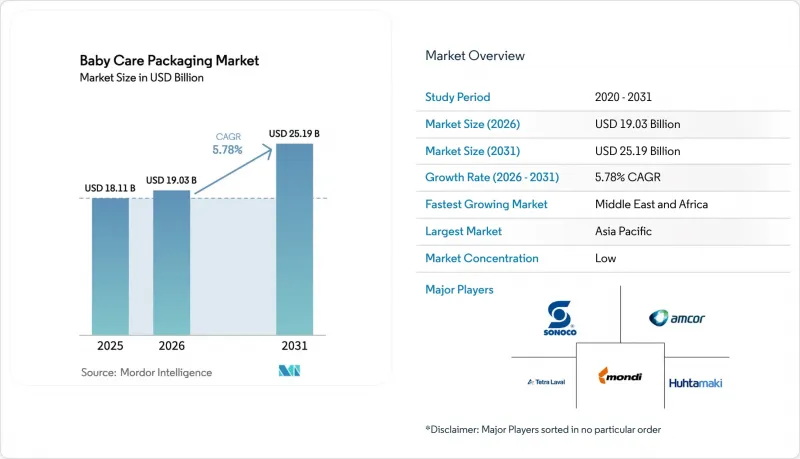
根據 Mordor Intelligence 預測,嬰兒護理包裝市場規模將從 2025 年的 181.1 億美元和 2026 年的 190.3 億美元成長到 2031 年的 251.9 億美元,2026 年至 2031 年的複合年成長率為 5.78%。
本報告根據包裝材料(塑膠、紙和紙板、其他)、包裝類型(瓶罐、小袋、罐裝、管裝、瓶蓋、封口、標籤)、應用領域(嬰幼兒食品、嬰幼兒飲品和配方奶粉、其他)、包裝形式(軟包裝、硬包裝)以及地區(北美、歐洲、其他)進行細分。市場預測以美元計價。
全球嬰兒護理包裝市場趨勢及洞察
對便於攜帶的包裝的需求日益成長。
由於父母時間有限,一次性可重複密封包裝已不再是奢侈品,而是必需品。 2024 年的一項消費者調查顯示,儘管價格高出 15% 至 30%,但注重便利性的嬰兒產品成長速度卻是標準產品的 2.7 倍。帶有防篡改封條和翻蓋的吸嘴袋比硬質罐裝產品更受歡迎,因為它們輕巧、耐摔,而且可以輕鬆放入尿布包。 Aptor 公司於 2025 年 10 月推出的「QuickFlip」配件增加了一個自密封閥,可防止產品積聚,解決了曾經阻礙吸嘴袋普及的衛生問題。乳液的無氣泵分配器也反映了這一趨勢,使父母可以單手擠出液體,同時無需在配方中添加防腐劑。總而言之,這些設計提高了便攜性、計量精度和產品質量,並透過提升父母的忠誠度來增加重複購買量。
嬰兒用品電子商務分銷的成長
在東協地區,線上通路已佔嬰兒用品零售總額的約20%,此趨勢主要得益於智慧型手機普及率高達88%(預計2026年將達90%)。包裝對於電商配送至關重要,ISTA-6跌落測試、防漏瓶蓋以及針對縮圖最佳化的圖形設計正成為新的行業標準。 Aptar的新一代桌面瓶蓋於2024年2月上市,它完全可回收利用,並在運輸過程中牢固鎖定,從而減少化妝品和嬰兒洗護用品的破損索賠。標籤上嵌入的QR碼可引導家長造訪包含透明成分資訊和教學影片的入口網站,將包裝轉變為互動式品牌工具。因此,注重數位化的千禧世代父母非常重視能夠兼顧耐用性、便利性和數據連接性的包裝製造商。
塑膠樹脂和紙板的價格波動
2026年初,聚乙烯和聚丙烯現貨價格兩位數的波動擠壓了加工商的利潤空間,迫使他們重新談判年度合約。由於歐洲紙漿供不應求和能源成本高企,紙板價格也居高不下。小規模加工商缺乏避險手段,導致產業出現退出和整合,品牌商的供應選擇也隨之減少。嬰兒護理產品的包裝成本佔產品總成本的25%之多,因此樹脂價格的劇烈波動可能會對品牌商的利潤空間造成壓力,推高商店價格,並降低價格敏感型產品的銷售量。這種不確定性使庫存計劃變得更加複雜,尤其是對於那些需要管理多個SKU以遵守不同地區安全法規的品牌而言。
細分市場分析
2025年,塑膠製品仍佔46.78%的銷售佔有率。這反映了塑膠製品在整個嬰兒護理包裝市場中,包括瓶子、瓶蓋和薄膜等產品,都具有成本績效。聚乙烯和聚丙烯是吸嘴袋的主要材料,而PET則適用於透明瓶,能夠更好地展現產品顏色。然而,隨著品牌商尋求減少化石碳排放並應對一次性塑膠課稅,生質塑膠,特別是聚乳酸(PLA)和聚羥基烷酯(PHA),預計到2031年將以7.11%的複合年成長率成長。供不應求和防潮性能差正在減緩其普及速度,但嬰兒擦拭巾重疊包裝的早期商業化生產表明,未來有望擴大規模。紙板的市場佔有率保持在20%左右,這主要得益於配方奶粉盒和尿布盒,這些包裝盒現在採用水性阻隔塗層以防止油漬。玻璃仍然是小眾產品,象徵高階有機食物泥瓶的純淨。同時,金屬管仍用於那些需要100%隔絕光線和氧氣的軟膏。由於加工商正努力調整其化石基、生物基和纖維基材的庫存,材料選擇範圍正在進一步細分,這增加了監管檢查合規性評估的工作量。
雖然將PET分解成單體的第二代酵素以及用於高密度聚苯乙烯瓶蓋的大規模機械回收流程正在減少生命週期排放,但認證成本仍然很高。各大品牌正在試行閉合迴路回收方案,以確保將廢舊產品用作原料,從而鞏固嬰兒護理包裝市場在循環經濟趨勢中的地位。如何在性能、成本和可回收性之間取得平衡,仍然是推動樹脂供應商和加工商之間合作發展的一大挑戰。
預計到2025年,袋裝和小包裝產品將佔據嬰兒護理包裝市場34.42%的佔有率,年複合成長率達6.35%,這主要得益於吸嘴蓋技術的進步,即使嬰兒自行餵食,也不容易發生溢漏。與玻璃瓶相比,袋裝和小包裝產品的輕量特性可減少高達70%的運輸排放,符合碳排放報告目標。硬質瓶罐仍佔20%左右的市場佔有率,尤其是在配方奶粉包裝領域,由於父母將堅固耐用視為安全性的標誌,這類產品需要具備高防潮性和抗氧化性。然而,由於生產者延伸責任制(EPR)成本和減重目標的實施,硬質瓶罐的成本優勢正逐漸減弱。氣霧罐和折疊式金屬管仍處於小眾市場,僅限於尿布疹噴霧劑和特定用途乳霜等對劑量精準度要求極高的應用。瓶蓋和封口曾經被認為是次要的,如今卻成為了關鍵的差異化因素。 Aptor 的「NEO」封蓋結合了防篡改封條、精確的分配功能和再生樹脂,將多部件組件整合到一個模具中。
速乾水性油墨能夠實現高清影像,並可耐受高溫蒸餾滅菌處理,這對於電商平台首頁的縮圖至關重要。同時,水溶性阻隔塗層的技術進步有望使紙袋軟質塑膠軟包裝的市場佔有率,儘管高脂肪食品的遷移測試仍然是一個尚未解決的難題。包裝形式的整合不太可能發生;相反,預計在嬰兒護理包裝市場,各品牌將根據其分銷管道和產品需求,採用硬質包裝和軟質包裝相結合的方式。
區域分析
預計到2025年,亞太地區將佔據嬰兒護理包裝市場39.89%的佔有率,這主要得益於大規模的出生人口、不斷壯大的中產階級以及現代零售業的普及。中國的「三孩政策」和印度省會城市的零售業蓬勃發展,都推動了對符合當地食品安全法規的防篡改、保存期限長的包裝的需求。在印尼、越南和菲律賓,以智慧型手機為基礎的訂閱模式正在加速軟包裝產品的普及,而日本的父母則更傾向於使用能夠減少浪費的精準計量幫浦。
北美市場憑藉其高階定位、較高的歐盟滲透率以及美國食品藥物管理局(FDA)對嬰兒安全包裝的嚴格規定,維持著20%以上的市場佔有率。這些規定有利於擁有完善合規性測試設施的加工商。雖然各品牌正快速推動單層薄膜的測試,以避免因生產者責任延伸制度(EPR)而產生的環境附加費,但多層包裝袋麵臨的回收基礎設施不足問題依然嚴峻。在歐洲,纖維包裝袋和生物塑膠包裝袋領域的領先地位支撐著20%左右的市場佔有率,但停滯不前的出生率和高額的塑膠課稅正在擠壓利潤空間,導致合資企業數量激增,旨在試點紙質吸嘴包裝袋,這可能會重新定義包裝形式的經濟格局。
預計中東和非洲將呈現全球最高的成長率,複合年成長率將達到7.24%。海灣國家的生育激勵政策、零售現代化項目以及快速的都市化,推動了消費者對注重安全性的品牌嬰兒產品的需求,尤其是在配備空調的購物中心。儘管非洲農村地區對價格仍然高度敏感,小袋市場仍然存在,但跨國公司仍在不斷推出防篡改瓶蓋以建立信任。南美洲的市佔率略低於10%,其中巴西和阿根廷主導,但該國受到貨幣波動和進口關稅的困擾,反而促進了當地加工商的發展。在聖保羅和布宜諾斯艾利斯,可重複填充的潤膚露和可堆肥濕巾已初見成效,兼顧了消費者的環保意識和價格承受能力。
其他好處
- Excel格式的市場預測(ME)表
- 3個月的分析師支持
目錄
第1章:引言
- 研究假設和市場定義
- 調查範圍
第2章:調查方法
第3章執行摘要
第4章 市場狀況
- 市場概覽
- 市場促進因素
- 對便於攜帶的包裝的需求日益成長。
- 嬰兒用品電子商務分銷的成長
- 新興經濟體出生率上升和中產階級消費擴張
- 監管機構正在推廣防篡改和安全功能。
- 帶有吸嘴蓋的奶瓶袋的普及,使嬰兒能夠自己進食。
- 將智慧墨水和QR碼應用於家長教育
- 市場限制因素
- 塑膠樹脂和紙板的價格波動
- 嚴格禁止和課稅一次性塑膠製品
- 可重複填充和可重複使用的嬰兒護理容器的興起
- 食品用生物塑膠供應鏈不穩定。
- 產業價值鏈分析
- 監理情勢
- 技術展望
- 宏觀經濟因素對市場的影響
- 波特五力分析
第5章 市場規模與成長預測
- 透過包裝材料
- 塑膠
- 紙張和紙板
- 玻璃
- 金屬
- 生質塑膠和可堆肥材料
- 按包裝類型
- 瓶子和罐子
- 包裝袋和小袋
- 能
- 管子和棍子
- 瓶蓋、封口、標籤
- 透過使用
- 嬰兒食品
- 嬰兒飲料和配方奶
- 嬰兒洗漱用品和個人保健產品
- 嬰兒保健/非處方藥
- 嬰兒服裝和配件
- 按包裝類型
- 柔軟的
- 難的
- 按地區
- 北美洲
- 美國
- 加拿大
- 墨西哥
- 歐洲
- 德國
- 英國
- 法國
- 義大利
- 西班牙
- 其他歐洲國家
- 亞太地區
- 中國
- 印度
- 日本
- 韓國
- 澳洲和紐西蘭
- 其他亞太國家
- 中東和非洲
- 中東
- 阿拉伯聯合大公國
- 沙烏地阿拉伯
- 土耳其
- 其他中東國家
- 非洲
- 南非
- 奈及利亞
- 埃及
- 其他非洲地區
- 中東
- 南美洲
- 巴西
- 阿根廷
- 南美洲其他地區
- 北美洲
第6章 競爭情勢
- 市場集中度
- 策略趨勢
- 市佔率分析
- 公司簡介
- Amcor plc
- Tetra Laval International SA
- Mondi plc
- Sonoco Products Company
- Winpak Ltd
- Huhtamaki Oyj
- UFlex Ltd
- AptarGroup Inc.
- Sealed Air Corporation
- International Paper Company
- Klockner Pentaplast
- CCL Industries Inc.
- Gerresheimer AG
- Essel Propack Ltd.
- Crown Holdings Inc.
- Ball Corporation
- Plastipak Holdings Inc.
- SIG Combibloc Group AG
- Pigeon Corporation(Packaging Division)
- Benison(泰國)有限公司
- Johnson and Johnson Internal Packaging Division
第7章 市場機會與未來展望
According to Mordor Intelligence, the baby care packaging market size is projected to expand from USD 18.11 billion in 2025 and USD 19.03 billion in 2026 to USD 25.19 billion by 2031, registering a CAGR of 5.78% between 2026 to 2031.
This report is Segmented by Packaging Material (Plastic, Paper and Paperboard, and More), Packaging Type (Bottles and Jars, Pouches and Sachets, Cans, Tubes and Sticks, Caps, and Closures and Labels), Application (Baby Food, Baby Drinks and Formula, and More), Packaging Format (Flexible, and Rigid), and Geography (North America, Europe, and More). The Market Forecasts are Provided in Terms of Value (USD).
Global Baby Care Packaging Market Trends and Insights
Rising Demand for Convenient On-The-Go Packs
Caregiver time scarcity has turned single-serve, resealable packs into necessities rather than luxuries. A 2024 consumer survey showed that convenience-oriented baby products grew 2.7 times faster than standard equivalents despite 15-30% price premiums. Spout pouches with tamper bands and flip-top closures now outperform rigid jars because they weigh less, survive drops, and slip into diaper bags. Aptar's Quick Flip fitment, launched in October 2025, added a self-sealing valve that prevents product buildup, resolving hygiene concerns that once limited pouch uptake. Airless pump dispensers for lotions echo the trend by allowing caregivers to dispense with one hand while keeping formulas preservative-free. Collectively, these designs reinforce portability, dosing precision, and product integrity, expanding repeat sales through parental loyalty.
Growth in E-Commerce Distribution for Baby Products
Online channels already account for about 20% of baby-product retail sales across ASEAN, aided by 88% smartphone penetration that will reach 90% by 2026. E-commerce shipping stresses packaging; ISTA-6 drop tests, leak-proof closures, and thumbnail-ready graphics are new baselines. Aptar's Future disc-top closure, launched in February 2024, locks during transit yet remains fully recyclable, cutting damage claims in beauty and baby toiletries. QR codes embedded on labels drive caregivers to ingredient transparency portals and how-to videos, converting packs into interactive brand tools. Digital-first millennial parents thus reward converters that merge durability, convenience, and data connectivity.
Volatility in Plastic Resin and Paperboard Prices
Double-digit swings in polyethylene and polypropylene spot prices during early 2026 squeezed converter margins and forced annual contract renegotiations. Paperboard pricing also remained elevated due to pulp scarcity and high European energy costs. Smaller converters lack hedging tools, leading to exits or consolidations that tighten supply options for brands. Baby care packs can account for up to 25% of landed product cost, so resin shocks can compress brand margins or raise shelf prices, eroding volume in price-sensitive segments. The uncertainty complicates inventory planning, especially for brands juggling multiple regional SKUs to meet varying safety regulations.
Other drivers and restraints analyzed in the detailed report include:
- Increasing Birth Rates and Middle-Class Spending in Emerging Economies
- Regulatory Push for Tamper-Evident and Safety Features
- Stringent Bans and Taxes on Single-Use Plastics
For complete list of drivers and restraints, kindly check the Table Of Contents.
Segment Analysis
Plastic retained 46.78% revenue share in 2025, reflecting its cost-to-performance edge for bottles, closures, and films across the baby care packaging market. Polyethylene and polypropylene dominate spout pouches, while PET suits transparent bottles that showcase product color. Nonetheless, bioplastics, especially polylactic acid and polyhydroxyalkanoate, are on track for 7.11% CAGR through 2031 as brands chase fossil-carbon reductions and align with single-use plastic taxes. Supply scarcity and weaker moisture barriers slow adoption, yet early commercial runs in baby wipes overwraps hint at future scaling. Paperboard stands in the mid-20s share, buoyed by formula cartons and diaper boxes that now sport water-based barrier coatings to resist grease. Glass remains niche, signaling purity in premium organic puree jars, whereas metal tubes persist in ointments that need 100% light and oxygen exclusion. Material choices are fragmenting as converters juggle inventory for fossil, bio, and fiber substrates, raising qualification workloads for regulatory testing.
Second-generation enzymes that depolymerize PET into monomers and large-scale mechanical recycling streams for high-density polyethylene closures are lowering life-cycle emissions, but certification costs remain high. Brands are piloting closed-loop take-back schemes to secure post-consumer feedstock, anchoring the baby care packaging market in circular-economy narratives. The tension between performance, cost, and recyclability continues to drive co-development between resin suppliers and converters.
Pouches and sachets commanded 34.42% of baby care packaging market share in 2025 and will ride a 6.35% CAGR as spout-cap technology makes toddler self-feeding spill-safe. Their lighter weight slashes freight emissions by up to 70% compared with glass jars, resonating with carbon-reporting targets. Rigid bottles and jars still account for a high-20s share because parents equate solidity with safety, especially in powdered formula canisters that need high moisture and oxygen barriers. Yet EPR fees and lightweighting targets erode their cost advantages. Aerosol cans and collapsible metal tubes stay niche, reserved for diaper-rash sprays and targeted creams where dosing accuracy commands a premium. Caps and closures, once an afterthought, now anchor differentiation; Aptar's NEO closure blends tamper bands, precise dosing, and post-consumer recycled resin, condensing multipiece assemblies into a single mould.
Fast-cure water-based inks enable high-definition graphics that survive retort, vital for thumbnail imagery on e-commerce storefronts. Meanwhile, soluble barrier-coating breakthroughs point toward paper-based pouches that could encroach on flexible plastic volumes, although migration testing for fatty foods remains unresolved. Format convergence is unlikely; instead, brands will deploy a mix of rigid and flexible packs, each tuned to channel and product requirements within the baby care packaging market.
Complete Report Scope:
- By Packaging Material
- Plastic
- Paper and Paperboard
- Glass
- Metal
- Bioplastics and Compostable Materials
- By Packaging Type
- Bottles and Jars
- Pouches and Sachets
- Cans
- Tubes and Sticks
- Caps, Closures and Labels
- By Application
- Baby Food
- Baby Drinks and Formula
- Baby Toiletries and Personal-Care
- Baby Healthcare / OTC
- Baby Apparel and Accessories
- By Packaging Format
- Flexible
- Rigid
- By Geography
- North America
- United States
- Canada
- Mexico
- Europe
- Germany
- United Kingdom
- France
- Italy
- Spain
- Rest of Europe
- Asia-Pacific
- China
- India
- Japan
- South Korea
- Australia and New Zealand
- Rest of Asia-Pacific
- Middle East and Africa
- Middle East
- United Arab Emirates
- Saudi Arabia
- Turkey
- Rest of Middle East
- Africa
- South Africa
- Nigeria
- Egypt
- Rest of Africa
- Middle East
- South America
- Brazil
- Argentina
- Rest of South America
- North America
Geography Analysis
Asia-Pacific, with 39.89% of the baby care packaging market share in 2025, benefits from large birth cohorts, expanding middle classes, and modern trade penetration. China's three-child incentives and India's tier-2 city retail boom both call for tamper-proof, shelf-stable packs that comply with local food-safety statutes. Smartphone-based subscription models in Indonesia, Vietnam, and the Philippines accelerate the adoption of flexible-pack products, while Japanese caregivers favor precision-dosing pumps that cut waste.
North America held a high-20s share, underpinned by premium positioning, high e-commerce penetration, and strict FDA guidance on child-resistant packaging, which favors converters with deep compliance labs. Brands rapidly test mono-material films to avoid EPR eco-fees, yet gaps in recycling infrastructure still challenge multilayer pouches. In Europe, a mid-20s share relies on leadership in fiber pouches and bio-resins, but stagnant birth rates and aggressive plastic levies squeeze margins, sparking joint ventures to pilot paper-based spout pouches that may reset format economics.
The Middle East and Africa region is forecast to post a 7.24% CAGR, the fastest globally. Gulf-natalist grants, retail modernization programs, and rapid urbanization drive demand for branded baby packs that signal safety in air-conditioned malls. Rural Africa remains price-sensitive, sustaining sachet economies, yet multinationals still introduce tamper-banded caps to build trust. South America commands a low-teens share; Brazil and Argentina lead but wrestle with currency volatility and import tariffs that buoy local converters. Refillable lotion dispensers and compostable wipes show early traction in Sao Paulo and Buenos Aires, aligning consumer eco-concerns with affordability.
- Amcor plc
- Tetra Laval International S.A.
- Mondi plc
- Sonoco Products Company
- Winpak Ltd
- Huhtamaki Oyj
- UFlex Ltd
- AptarGroup Inc.
- Sealed Air Corporation
- International Paper Company
- Klockner Pentaplast
- CCL Industries Inc.
- Gerresheimer AG
- Essel Propack Ltd.
- Crown Holdings Inc.
- Ball Corporation
- Plastipak Holdings Inc.
- SIG Combibloc Group AG
- Pigeon Corporation (Packaging Division)
- Benison (Thailand) Co., Ltd.
- Johnson and Johnson Internal Packaging Division
Additional Benefits:
- The market estimate (ME) sheet in Excel format
- 3 months of analyst support
TABLE OF CONTENTS
1 INTRODUCTION
- 1.1 Study Assumptions and Market Definition
- 1.2 Scope of the Study
2 RESEARCH METHODOLOGY
3 EXECUTIVE SUMMARY
4 MARKET LANDSCAPE
- 4.1 Market Overview
- 4.2 Market Drivers
- 4.2.1 Rising Demand for Convenient On-The-Go Packs
- 4.2.2 Growth in E-Commerce Distribution for Baby Products
- 4.2.3 Increasing Birth Rates and Middle-Class Spending in Emerging Economies
- 4.2.4 Regulatory Push for Tamper-Evident and Safety Features
- 4.2.5 Adoption of Spout-Cap Pouches Enabling Infant Self-Feeding
- 4.2.6 Integration of Smart Inks and QR Codes for Caregiver Education
- 4.3 Market Restraints
- 4.3.1 Volatility in Plastic Resin and Paperboard Prices
- 4.3.2 Stringent Bans and Taxes on Single-Use Plastics
- 4.3.3 Rise of Refillable / Reusable Baby-Care Containers
- 4.3.4 Supply-Chain Instability for Food-Grade Bio-Resins
- 4.4 Industry Value Chain Analysis
- 4.5 Regulatory Landscape
- 4.6 Technological Outlook
- 4.7 Impact of Macroeconomic Factors on the Market
- 4.8 Porter's Five Forces Analysis
- 4.8.1 Threat of New Entrants
- 4.8.2 Bargaining Power of Buyers
- 4.8.3 Bargaining Power of Suppliers
- 4.8.4 Threat of Substitutes
- 4.8.5 Intensity of Competitive Rivalry
5 MARKET SIZE AND GROWTH FORECASTS (VALUE)
- 5.1 By Packaging Material
- 5.1.1 Plastic
- 5.1.2 Paper and Paperboard
- 5.1.3 Glass
- 5.1.4 Metal
- 5.1.5 Bioplastics and Compostable Materials
- 5.2 By Packaging Type
- 5.2.1 Bottles and Jars
- 5.2.2 Pouches and Sachets
- 5.2.3 Cans
- 5.2.4 Tubes and Sticks
- 5.2.5 Caps, Closures and Labels
- 5.3 By Application
- 5.3.1 Baby Food
- 5.3.2 Baby Drinks and Formula
- 5.3.3 Baby Toiletries and Personal-Care
- 5.3.4 Baby Healthcare / OTC
- 5.3.5 Baby Apparel and Accessories
- 5.4 By Packaging Format
- 5.4.1 Flexible
- 5.4.2 Rigid
- 5.5 By Geography
- 5.5.1 North America
- 5.5.1.1 United States
- 5.5.1.2 Canada
- 5.5.1.3 Mexico
- 5.5.2 Europe
- 5.5.2.1 Germany
- 5.5.2.2 United Kingdom
- 5.5.2.3 France
- 5.5.2.4 Italy
- 5.5.2.5 Spain
- 5.5.2.6 Rest of Europe
- 5.5.3 Asia-Pacific
- 5.5.3.1 China
- 5.5.3.2 India
- 5.5.3.3 Japan
- 5.5.3.4 South Korea
- 5.5.3.5 Australia and New Zealand
- 5.5.3.6 Rest of Asia-Pacific
- 5.5.4 Middle East and Africa
- 5.5.4.1 Middle East
- 5.5.4.1.1 United Arab Emirates
- 5.5.4.1.2 Saudi Arabia
- 5.5.4.1.3 Turkey
- 5.5.4.1.4 Rest of Middle East
- 5.5.4.2 Africa
- 5.5.4.2.1 South Africa
- 5.5.4.2.2 Nigeria
- 5.5.4.2.3 Egypt
- 5.5.4.2.4 Rest of Africa
- 5.5.4.1 Middle East
- 5.5.5 South America
- 5.5.5.1 Brazil
- 5.5.5.2 Argentina
- 5.5.5.3 Rest of South America
- 5.5.1 North America
6 COMPETITIVE LANDSCAPE
- 6.1 Market Concentration
- 6.2 Strategic Moves
- 6.3 Market Share Analysis
- 6.4 Company Profiles (Includes Global Level Overview, Market Level Overview, Core Segments, Financials as Available, Strategic Information, Market Rank/Share, Products and Services, and Recent Developments)
- 6.4.1 Amcor plc
- 6.4.2 Tetra Laval International S.A.
- 6.4.3 Mondi plc
- 6.4.4 Sonoco Products Company
- 6.4.5 Winpak Ltd
- 6.4.6 Huhtamaki Oyj
- 6.4.7 UFlex Ltd
- 6.4.8 AptarGroup Inc.
- 6.4.9 Sealed Air Corporation
- 6.4.10 International Paper Company
- 6.4.11 Klockner Pentaplast
- 6.4.12 CCL Industries Inc.
- 6.4.13 Gerresheimer AG
- 6.4.14 Essel Propack Ltd.
- 6.4.15 Crown Holdings Inc.
- 6.4.16 Ball Corporation
- 6.4.17 Plastipak Holdings Inc.
- 6.4.18 SIG Combibloc Group AG
- 6.4.19 Pigeon Corporation (Packaging Division)
- 6.4.20 Benison (Thailand) Co., Ltd.
- 6.4.21 Johnson and Johnson Internal Packaging Division
7 MARKET OPPORTUNITIES AND FUTURE OUTLOOK
- 7.1 White-Space and Unmet-Need Assessment


