


 |
市場調查報告書
商品編碼
2114337
航空連接器:市場佔有率分析、行業趨勢和統計數據、成長預測(2026-2031 年)Aviation Connectors - Market Share Analysis, Industry Trends & Statistics, Growth Forecasts (2026 - 2031) |
||||||

※ 本網頁內容可能與最新版本有所差異。詳細情況請與我們聯繫。
據 Mordor Intelligence 稱,航空連接器市場預計到 2026 年價值 61.4 億美元,高於 2025 年的 58.3 億美元,預計到 2031 年將達到 79.9 億美元。
預計從 2026 年到 2031 年,其複合年成長率將達到 5.39%。
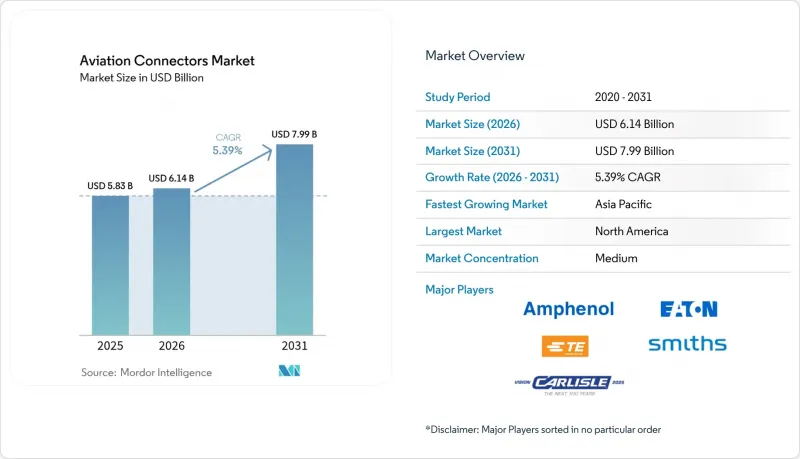
本報告按類型(PCB、射頻連接器及其他)、形狀(圓形、矩形)、應用(航空電子設備、配電系統、照明系統、客艙控制及其他)、最終用戶(OEM、售後市場)、平台(商用飛機、軍用飛機及其他)、材料(鋁合金、不銹鋼及其他)和地區進行細分。市場預測以美元計價。
全球航空航太連接器市場趨勢與洞察
民航機數量持續成長。
預計到2024年11月,全球飛機交付將達到1,180架,而空中巴士和波音的訂單總合目前已超過12,000架。這鞏固了未來幾年的生產前景,為航空連接器市場奠定了強勁的成長基礎。隨著客運量恢復到2019年以上的水平,亞太地區的航空公司約佔新訂單的40%,而單通道飛機專案的目標是保持每月60架以上的穩定生產速度。每架窄體飛機配備約1200個連接器,而寬體飛機則可配備超過2500個。因此,即使生產速度略有提高,連接器的出貨量也會隨之增加。由於租賃公司擁有超過一半的運作中飛機,且標準化介面的需求日益成長,原始設備製造商(OEM)正在推廣模組化設計,以簡化不同營運商的維護工作。老舊飛機的客艙和駕駛座維修計畫進一步擴大了需要定期更換連接器的部署範圍。
輕型飛機電氣系統需求日益成長
由於預期燃油消耗量可降低3-5%,系統可靠性可提高,全電動飛機配置正日益普及。借助電動環境控制組件、除冰系統和飛行控制作動器,機載發電量從傳統機械式飛機的約200千伏安提升至新一代設計的1兆瓦以上。這項變更導致每架飛機的連接器數量增加高達60%,迫使供應商採用複合材料和鋁鋰合金來製造外殼以減輕重量。例如,波音787飛機上的伊頓電源面板整合了超過1500個額定電壓為270伏直流和115伏特交流的高功率觸點,並配備了先進的散熱通道以適應更高的電流密度。一個歐洲研究聯盟已證明,用碳纖維增強塑膠取代鋁材可以實現兩位數的減重,這將進一步推動高性能複合材料外殼的應用。
現有飛機交付積壓
由於引擎供應、勞動力和文件方面的問題制約了生產,導致生產目標滯後。波音737 MAX的生產線在2024年的大部分時間裡每月產能上限為38架,這導致與機身製造後期階段相關的連接器交付延遲。空中巴士A320neo系列也面臨類似的生產放緩問題,動力裝置的檢查週期拖慢了組裝進度。先前基於生產速度預期建立庫存的供應商,如今由於與里程碑相關的結算延遲,面臨著營運成本增加和短期現金流緊張的困境。小規模的三級供應商尤其脆弱,因為它們缺乏專案多樣性,而且需要等待單通道飛機生產規模的擴大才能恢復。
細分市場分析
到2025年,射頻介面將佔據最大的市場佔有率,達到37.82%,因為雷達、衛星通訊和導航系統需要高達40 GHz的穩定性能。因此,預計飛機製造商將繼續優先考慮用於這些應用的堅固耐用的同軸電纜。支援AFDX和時間敏感網路(TSN)的整合模組化航空電子設備中的印刷電路基板連接器正在突破1 Gbps的頻寬限制,日益嚴格的電阻預算迫使供應商改進觸點配置。隨著串流娛樂、電子飛行包和預測性維護分析等技術在飛機上向更高頻寬發展,光纖連接器市場正以7.41%的複合年成長率成長,超過了航空連接器市場的整體成長率。僅聯合航空公司為超過1000架窄體飛機部署的星鏈計劃,預計到2027年就將產生超過40萬個新的光纖終端需求。
光ファイバーへの需要は、分散型ボックスから集中型ネットワークアーキテクチャへの移行を反映しています。コリンズエアロスペースの「Pro Line Fusion」は、光バックプレーンを利用して処理叢集を接続することで、ハーネスの重量を3分の1近く削減しつつ、フェイルセーフ要件を満たす冗長チャネルを提供しています。RFコネクタは、着陸装置ベイなどの高振動領域で依然として確固たる地位を維持している一方、ハイブリッド型電源,信号アセンブリは、新興の電動タキシングシステムにおいてシェアを拡大しつつあります。全体として、材料技術の進歩と設置作業員への研修により、光ファイバーの清浄度や曲げ半径の管理といった初期の課題は克服されつつあり、導入は今後も増加傾向を維持する見込みです。
到2025年,圓形介面的銷售額將佔總銷售額的56.10%,預計到2031年將以每年6.85%的速度成長。圓形介面具備360度電磁干擾屏蔽、螺紋連接和IP67防護等級,使其適用於流體、溫度波動和振動集中的區域,例如機翼根部、引擎吊架和起落架艙。矩形介面在基板間空間有限的高密度航空電子設備機架中表現出色。然而,矩形介面需要依靠輔助密封墊進行防潮,導致檢查週期縮短,從而增加了整體擁有成本。
符合AS85049標準的複合複合材料圓形外殼相比鋁製外殼可減輕約35%的重量,同時也能緊密地安裝在相同的面板開孔內。這項特性深受飛機營運商的青睞,因為它避免了重新設計線束的需求。同時,矩形外殼正逐漸應用於配電單元,其中刀片式觸點承載的電流超過100A/個。這兩種外殼形式在城市空中交通(UAM)示範飛機中並存。圓形外殼傳輸馬達電流,而纖薄的矩形外殼則在引擎室的狹小空間內傳輸感測器資料和電池遙測資料。這種混合架構增加了連接器的總數,有望為能夠將不同形式整合到單一模組中的供應商帶來更多收益。
區域分析
北美地區主要由波音737 MAX和787系列飛機以及洛克希德·馬丁公司的F-35組裝業務驅動,預計到2025年將佔全球收入的40.10%。主要連接器製造商正將生產集中在墨西哥,以利用當地比美國低約60%的人事費用以及美墨加協定(USMCA)帶來的近岸外包優勢。此外,該地區還受益於強勁的國防費用,這為下一代戰鬥機和飛彈系統的高可靠性介面提供了支援。
歐洲擁有強大的航太生態系統,空中巴士計劃在2024年11月前交付643噴射機,與達梭和李奧納多的軍用飛機生產形成互補。儘管歐洲航空安全局(EASA)的監管協調簡化了多國採購流程,但英國脫歐後的雙重認證進一步延長了英國工廠的前置作業時間。歐洲主要航空公司大規模機隊持續推動飛機內部光纖升級和維修的需求。
亞太地區是成長最快的地區,複合年成長率達8.52%。中國商飛的C919飛機在2024年交付了8架,並計畫在2028年實現年交付150架的目標。同時,印度新建的C295生產線於2024年9月交付了首架飛機。儘管兩國都在積極推進國內供應鏈發展,推動本地連接器認證項目,但可靠性方面仍存在差距,這為歐美供應商進入市場留下了空間。預計售後市場將蓬勃發展,尤其是在未來十年,隨著廉價航空公司機隊的擴張和MRO(維護、修理和大修)能力的提升,機上互聯維修的需求將不斷成長。
其他好處
- Excel格式的市場預測(ME)表
- 3個月的分析師支持
目錄
第1章:引言
- 研究假設和市場定義
- 調查範圍
第2章:調查方法
第3章執行摘要
第4章 市場狀況
- 市場概覽
- 市場促進因素
- 商用飛機數量的增加
- 輕型飛機電氣系統需求日益成長
- 客艙娛樂及網路連線服務的普及
- 擴大「更電動化」飛機架構的應用
- 航太設備製造商對模組化連接器介面進行標準化
- 城市空中交通平台的出現需要高密度連接器。
- 市場限制因素
- 未支付的飛機
- 原物料價格波動
- 由於飛機認證週期嚴格,導致認證延誤。
- 傳統飛機線束設計在維修項目的局限性
- 價值鏈分析
- 宏觀經濟因素對市場的影響
- 監理情勢
- 技術展望
- 波特五力分析
第5章 市場規模與成長預測
- 按類型
- PCB(印刷基板)
- 射頻連接器
- 光纖
- 其他
- 按形式
- 圓
- 長方形
- 透過使用
- 航空電子設備
- 配電
- 照明系統
- 客艙管理
- 起落架
- 客艙娛樂和網路連接
- 最終用戶
- 原始設備製造商 (OEM)
- 售後市場
- 按平台
- 商用飛機
- 軍用機
- 公務機
- 直升機
- 無人駕駛飛行器(UAV)
- 材料
- 鋁合金
- 防鏽的
- 複合材料和聚合物
- 其他
- 按地區
- 北美洲
- 美國
- 加拿大
- 墨西哥
- 南美洲
- 巴西
- 阿根廷
- 其他南美國家
- 歐洲
- 德國
- 英國
- 法國
- 西班牙
- 其他歐洲國家
- 亞太地區
- 中國
- 印度
- 日本
- 韓國
- ASEAN
- 其他亞太國家
- 中東和非洲
- 中東
- 沙烏地阿拉伯
- 阿拉伯聯合大公國
- 土耳其
- 其他中東國家
- 非洲
- 南非
- 奈及利亞
- 肯亞
- 其他非洲地區
- 中東
- 北美洲
第6章 競爭情勢
- 市場集中度
- 策略趨勢
- 市佔率分析
- 公司簡介
- Amphenol Corporation
- TE Connectivity Ltd
- Eaton Corporation plc(Souriau-Sunbank)
- Radiall SA
- ITT Inc
- Smiths Group plc(Smiths Interconnect)
- Rosenberger Hochfrequenztechnik GmbH and Co KG
- Carlisle Companies Inc(Carlisle Interconnect Technologies)
- Conesys Inc
- Glenair Inc
- Fischer Connectors SA
- Axon Cable SA
- Harwin plc
- Bel Fuse Inc
- JST Manufacturing Co Ltd
- PEI-Genesis Inc
- Hirose Electric Co Ltd
- Sabritec(Glenair)
- LEMO SA
- Phoenix Contact GmbH and Co KG
第7章 市場機會與未來展望
According to Mordor Intelligence, aviation connectors market size in 2026 is estimated at USD 6.14 billion, growing from 2025 value of USD 5.83 billion with 2031 projections showing USD 7.99 billion, growing at 5.39% CAGR over 2026-2031.
This report is Segmented by Type (PCB, RF Connectors, and More), Shape (Circular, Rectangular), Application (Avionics, Power Distribution, Lighting Systems, Cabin Management, and More), End User (OEM, Aftermarket), Platform (Commercial Aircraft, Military Aircraft, and More), Material (Aluminum Alloys, Stainless Steel, and More), and Geography. Market Forecasts are Provided in Terms of Value (USD).
Global Aviation Connectors Market Trends and Insights
Growing Commercial Aircraft Fleet Expansion
Global deliveries reached 1,180 jets through November 2024, and combined Airbus and Boeing backlogs now top 12,000 units, which locks in multi-year production visibility and secures a solid runway for the aviation connectors market. Asia-Pacific airlines absorb roughly 40% of new orders as traffic rebounds beyond 2019 levels, while single-aisle programs target sustained output rates above 60 jets per month. Each narrowbody contains about 1,200 connectors, and widebodies can exceed 2,500, so any production-rate uptick directly multiplies connector shipments. Lessors own more than half of the active fleet and increasingly specify standardized interfaces, encouraging OEMs to embed modular designs that streamline maintenance across varied operators. Cabin and cockpit retrofit programs for aging airframes further widen the installed base that needs periodic connector replacement.
Rising Demand for Lightweight Aircraft Electrical Systems
More Electric Aircraft configurations grow on the promise of 3-5% lower fuel burn and higher system reliability. Electric environmental control packs, ice-protection units, and flight-control actuators increase onboard generation from approximately 200 kVA on legacy types to over 1 MW on next-generation designs. This shift increases connector counts by up to 60% per airframe and prompts suppliers to deliver housings in composite or aluminum-lithium alloys that help keep weight in check. Eaton's power panels on the Boeing 787, for instance, integrate more than 1,500 high-power contacts rated for 270 VDC and 115 VAC, supported by advanced thermal paths that handle greater current density. Research consortia in Europe have validated double-digit weight savings when aluminum is replaced with carbon-fiber-reinforced polymers, helping the case for high-performance composite shells.
Existing Backlog of Aircraft Deliveries
Production targets have slipped as engine supply, labor, and documentation issues restrict output. Boeing's 737 MAX line stayed capped at 38 units per month for most of 2024, which defers connector shipments linked to later fuselage build stages. Airbus faced similar pacing on the A320neo family after powerplant inspection cycles slowed final assembly. Suppliers that built inventory against earlier rate assumptions now carry higher working capital, and their milestone-linked payments shift right, tightening near-term cash flow. Smaller tier-three firms are especially vulnerable because they lack program diversity and must wait for single-aisle ramps to recover.
Other drivers and restraints analyzed in the detailed report include:
- Proliferation of In-Flight Entertainment and Connectivity
- Increasing Adoption of More Electric Aircraft Architecture
- Volatility in Raw Material Prices
For complete list of drivers and restraints, kindly check the Table Of Contents.
Segment Analysis
RF interfaces account for the largest market share of 37.82% in 2025, as radar, satellite communication, and navigation systems require stable performance up to 40 GHz. Therefore, aircraft builders will continue to favor rugged coaxial lines in these applications. Printed circuit board connectors supporting AFDX and Time-Sensitive Networking within integrated modular avionics are migrating toward 1 Gbps and beyond, tightening impedance budgets that prompt suppliers to refine contact geometry. Fiber optic connectors are expanding at a 7.41% CAGR, faster than the aviation connectors market, as streaming-class entertainment, electronic flight bags, and predictive maintenance analytics move to higher bandwidth around the airframe. United's 1,000-plus narrowbody Starlink campaign alone drives a requirement for more than 400,000 new fiber terminations by 2027.
The demand for fiber optics mirrors the shift from federated boxes to centralized network architectures. Collins Aerospace's Pro Line Fusion utilizes optical backplanes to link processing clusters, reducing harness weight by nearly one-third while providing redundant paths that meet fail-safe mandates. RF connectors maintain their foothold in high-vibration areas, such as landing gear bays, whereas hybrid power-and-signal assemblies are gaining ground in emerging electric taxi systems. Overall, material advances and installer training are overcoming early pain points of fiber cleanliness and bend-radius control, so adoption will stay on a rising arc.
Circular interfaces accounted for 56.10% of the 2025 turnover and are predicted to increase by 6.85% annually through 2031. Their inherent 360-degree EMI shielding, threaded coupling, and IP67 sealing are suited for wing root zones, engine pylons, and wheel wells, where fluids, temperature swings, and vibration converge. Rectangular devices thrive in dense avionics racks where board-to-board space runs tight; still, those housings rely on secondary gasketing for moisture protection, so inspection intervals end up shorter, raising the cost of ownership.
Composite circular shells approved to AS85049 cut weight by about 35% compared with aluminum while slotting into identical panel cutouts, an attribute fleet operators prize because it avoids harness redesign. Rectangular styles win incremental use in power distribution units where blade contacts carry over 100 A per position. On Urban Air Mobility demonstrators, both shapes coexist: round cases carry motor current, and slim rectangles ferry sensor data and battery telemetry inside tight nacelles. This blended architecture should increase overall connector counts and expand revenue for suppliers that can integrate varied geometries into a single module.
Complete Report Scope:
- By Type
- PCB (Printed Circuit Board)
- RF Connectors
- Fiber Optic
- Other Types
- By Shape
- Circular
- Rectangular
- By Application
- Avionics
- Power Distribution
- Lighting Systems
- Cabin Management
- Landing Gear
- In-Flight Entertainment and Connectivity
- By End User
- Original Equipment Manufacturer (OEM)
- Aftermarket
- By Platform
- Commercial Aircraft
- Military Aircraft
- Business Jets
- Helicopters
- Unmanned Aerial Vehicles (UAVs)
- By Material
- Aluminum Alloys
- Stainless Steel
- Composite and Polymer
- Other Materials
- By Geography
- North America
- United States
- Canada
- Mexico
- South America
- Brazil
- Argentina
- Rest of South America
- Europe
- Germany
- United Kingdom
- France
- Spain
- Rest of Europe
- Asia-Pacific
- China
- India
- Japan
- South Korea
- ASEAN
- Rest of Asia-Pacific
- Middle East and Africa
- Middle East
- Saudi Arabia
- United Arab Emirates
- Turkey
- Rest of Middle East
- Africa
- South Africa
- Nigeria
- Kenya
- Rest of Africa
- Middle East
- North America
Geography Analysis
North America captured 40.10% of 2025 revenue, powered by Boeing's 737 MAX and 787 lines plus Lockheed Martin's F-35 final assembly operations. Connector majors cluster production in Mexico, taking advantage of labor costs that are approximately 60% lower than those in the domestic U.S. and leveraging near-shoring resilience under the USMCA. The region also benefits from strong defense spending that underwrites high-reliability interfaces for next-generation fighters and missile systems.
Europe maintains a rich aerospace ecosystem, with Airbus delivering 643 jets through November 2024 and complementing military output from Dassault and Leonardo. Regulatory harmonization under EASA simplifies multi-country sourcing, although post-Brexit dual certification adds extra lead time for U.K. facilities. Extensive wide-body fleets at European flag carriers generate recurring demand for retrofitting fiber optic upgrades inside cabins.
Asia-Pacific is the fastest-growing region at an 8.52% CAGR. COMAC's C919 achieved eight deliveries in 2024 and targets 150 annually by 2028, while India's new C295 line shipped its first transport aircraft in September 2024. Domestic supply-chain development policies in both nations drive aggressive local connector qualification programs, though high-reliability gaps still leave room for Western vendors. Fleet expansion across low-cost carriers and MRO capacity additions assure vibrant aftermarket growth, especially as cabin-connectivity retrofits scale throughout the decade.
- Amphenol Corporation
- TE Connectivity Ltd
- Eaton Corporation plc (Souriau-Sunbank)
- Radiall SA
- ITT Inc
- Smiths Group plc (Smiths Interconnect)
- Rosenberger Hochfrequenztechnik GmbH and Co KG
- Carlisle Companies Inc (Carlisle Interconnect Technologies)
- Conesys Inc
- Glenair Inc
- Fischer Connectors SA
- Axon Cable SA
- Harwin plc
- Bel Fuse Inc
- JST Manufacturing Co Ltd
- PEI-Genesis Inc
- Hirose Electric Co Ltd
- Sabritec (Glenair)
- LEMO SA
- Phoenix Contact GmbH and Co KG
Additional Benefits:
- The market estimate (ME) sheet in Excel format
- 3 months of analyst support
TABLE OF CONTENTS
1 INTRODUCTION
- 1.1 Study Assumptions and Market Definition
- 1.2 Scope of the Study
2 RESEARCH METHODOLOGY
3 EXECUTIVE SUMMARY
4 MARKET LANDSCAPE
- 4.1 Market Overview
- 4.2 Market Drivers
- 4.2.1 Growing Commercial Aircraft Fleet Expansion
- 4.2.2 Rising Demand for Lightweight Aircraft Electrical Systems
- 4.2.3 Proliferation of In-Flight Entertainment and Connectivity
- 4.2.4 Increasing Adoption of More Electric Aircraft Architecture
- 4.2.5 Standardization of Modular Connector Interfaces by Aerospace OEMs
- 4.2.6 Emergence of Urban Air Mobility Platforms Requiring High-Density Connectors
- 4.3 Market Restraints
- 4.3.1 Existing Backlog of Aircraft Deliveries
- 4.3.2 Volatility in Raw Material Prices
- 4.3.3 Qualification Delays Due to Rigorous Aviation Certification Cycles
- 4.3.4 Limitations of Legacy Aircraft Wiring Harness Designs in Retrofit Programs
- 4.4 Value Chain Analysis
- 4.5 Impact of Macroeconomic Factors on the Market
- 4.6 Regulatory Landscape
- 4.7 Technological Outlook
- 4.8 Porter's Five Forces Analysis
- 4.8.1 Threat of New Entrants
- 4.8.2 Bargaining Power of Buyers/Consumers
- 4.8.3 Bargaining Power of Suppliers
- 4.8.4 Threat of Substitute Products
- 4.8.5 Intensity of Competitive Rivalry
5 MARKET SIZE AND GROWTH FORECASTS (VALUE)
- 5.1 By Type
- 5.1.1 PCB (Printed Circuit Board)
- 5.1.2 RF Connectors
- 5.1.3 Fiber Optic
- 5.1.4 Other Types
- 5.2 By Shape
- 5.2.1 Circular
- 5.2.2 Rectangular
- 5.3 By Application
- 5.3.1 Avionics
- 5.3.2 Power Distribution
- 5.3.3 Lighting Systems
- 5.3.4 Cabin Management
- 5.3.5 Landing Gear
- 5.3.6 In-Flight Entertainment and Connectivity
- 5.4 By End User
- 5.4.1 Original Equipment Manufacturer (OEM)
- 5.4.2 Aftermarket
- 5.5 By Platform
- 5.5.1 Commercial Aircraft
- 5.5.2 Military Aircraft
- 5.5.3 Business Jets
- 5.5.4 Helicopters
- 5.5.5 Unmanned Aerial Vehicles (UAVs)
- 5.6 By Material
- 5.6.1 Aluminum Alloys
- 5.6.2 Stainless Steel
- 5.6.3 Composite and Polymer
- 5.6.4 Other Materials
- 5.7 By Geography
- 5.7.1 North America
- 5.7.1.1 United States
- 5.7.1.2 Canada
- 5.7.1.3 Mexico
- 5.7.2 South America
- 5.7.2.1 Brazil
- 5.7.2.2 Argentina
- 5.7.2.3 Rest of South America
- 5.7.3 Europe
- 5.7.3.1 Germany
- 5.7.3.2 United Kingdom
- 5.7.3.3 France
- 5.7.3.4 Spain
- 5.7.3.5 Rest of Europe
- 5.7.4 Asia-Pacific
- 5.7.4.1 China
- 5.7.4.2 India
- 5.7.4.3 Japan
- 5.7.4.4 South Korea
- 5.7.4.5 ASEAN
- 5.7.4.6 Rest of Asia-Pacific
- 5.7.5 Middle East and Africa
- 5.7.5.1 Middle East
- 5.7.5.1.1 Saudi Arabia
- 5.7.5.1.2 United Arab Emirates
- 5.7.5.1.3 Turkey
- 5.7.5.1.4 Rest of Middle East
- 5.7.5.2 Africa
- 5.7.5.2.1 South Africa
- 5.7.5.2.2 Nigeria
- 5.7.5.2.3 Kenya
- 5.7.5.2.4 Rest of Africa
- 5.7.5.1 Middle East
- 5.7.1 North America
6 COMPETITIVE LANDSCAPE
- 6.1 Market Concentration
- 6.2 Strategic Moves
- 6.3 Market Share Analysis
- 6.4 Company Profiles (includes Global Level Overview, Market Level Overview, Core Segments, Financials as Available, Strategic Information, Market Rank/Share for Key Companies, Products and Services, and Recent Developments)
- 6.4.1 Amphenol Corporation
- 6.4.2 TE Connectivity Ltd
- 6.4.3 Eaton Corporation plc (Souriau-Sunbank)
- 6.4.4 Radiall SA
- 6.4.5 ITT Inc
- 6.4.6 Smiths Group plc (Smiths Interconnect)
- 6.4.7 Rosenberger Hochfrequenztechnik GmbH and Co KG
- 6.4.8 Carlisle Companies Inc (Carlisle Interconnect Technologies)
- 6.4.9 Conesys Inc
- 6.4.10 Glenair Inc
- 6.4.11 Fischer Connectors SA
- 6.4.12 Axon Cable SA
- 6.4.13 Harwin plc
- 6.4.14 Bel Fuse Inc
- 6.4.15 JST Manufacturing Co Ltd
- 6.4.16 PEI-Genesis Inc
- 6.4.17 Hirose Electric Co Ltd
- 6.4.18 Sabritec (Glenair)
- 6.4.19 LEMO SA
- 6.4.20 Phoenix Contact GmbH and Co KG
7 MARKET OPPORTUNITIES AND FUTURE OUTLOOK
- 7.1 White-Space and Unmet-Need Assessment

 航空連接器市場規模、佔有率和成長分析:按類型、形狀、應用、平台、材質、最終用戶和地區分類-2026-2033年產業預測
 航空連接器市場:按類型、飛機、插頭類型、形狀、應用、最終用戶、國家和地區分類-全球產業分析、市場規模、市場佔有率及2026年至2033年預測
 航空連接器市場預測至2034年—按類型、飛機類型、形狀、平台、應用、最終用戶和地區分類的全球分析
 航空連接器市場分析及預測(至2035年):類型、產品類型、服務、技術、組件、應用、材料類型、最終用戶、功能、安裝配置
 航空連接器市場規模、佔有率、成長及全球產業分析:按類型、應用和地區分類-2026-2034年洞察與預測全球航空連接器市場規模、佔有率、趨勢和成長分析報告(2026-2034年)
 飛機連接器市場:按類型、形狀、接點類型、材質、安裝方式、應用、最終用戶分類,全球預測(2026-2032年)
 航空連接器市場-全球產業規模、佔有率、趨勢、機會、預測:按類型、應用、平台、地區和競爭格局分類,2021-2031年
 航空連接器市場機會、成長動力、產業趨勢分析及 2025 - 2034 年預測
 全球航空連接器市場規模、佔有率、趨勢分析報告:2024 年至 2031 年按飛機、應用、類型和地區分類的展望和預測