


 |
市場調查報告書
商品編碼
2114324
摩托車高階騎乘輔助系統:市佔率分析、產業趨勢與統計及成長預測(2026-2031 年)Motorcycle Advanced Rider Assistance System - Market Share Analysis, Industry Trends & Statistics, Growth Forecasts (2026 - 2031) |
||||||

※ 本網頁內容可能與最新版本有所差異。詳細情況請與我們聯繫。
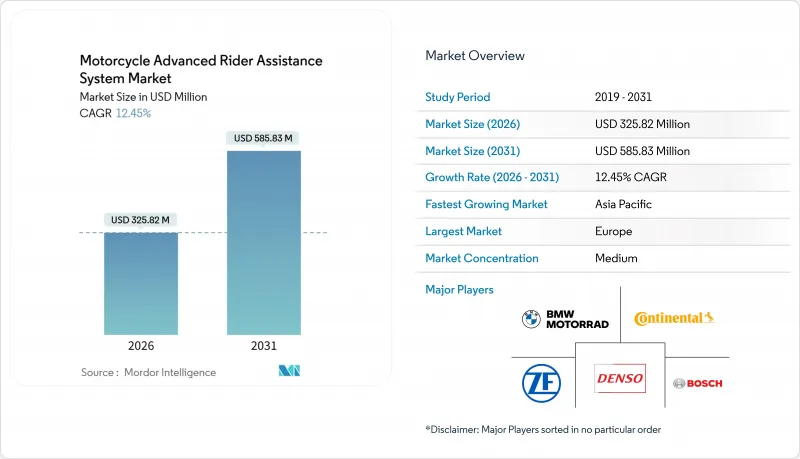
根據 Mordor Intelligence 預測,摩托車高級騎乘輔助系統 (ADAS) 的市場規模預計將在 2026 年達到 3.2582 億美元,到 2031 年達到 5.8583 億美元,在預測期內以 12.45% 的複合年成長率呈現顯著成長。
本報告按產品類型(主動式車距維持定速系統系統、摩托車穩定性控制系統、前向碰撞警報等)、感測器(雷射雷達、成像感測器等)、分銷管道(OEM 和售後市場)、組件(電控系統、感測器等)和地區進行細分。市場預測以美元計價。
全球先進摩托車騎乘輔助系統市場趨勢及洞察。
摩托車用LiDAR感測器的價格大幅下降。
與2015年相比,車用級LiDAR模組的價格已大幅下降,使得供應商能夠以與77GHz雷達相近的價格提供針對摩托車最佳化的固態LiDAR單元。博世最新一代前置雷達的探測距離達到210米,比上一代產品提升了50米,從而提高了長途騎行時的反應速度。中國統一標準「T/CECC 028-2024」定義了六個高級騎乘輔助系統(ARAS)功能等級,迫使本地OEM廠商採購可無縫整合到跨平台架構中的模組化感測器。隨著這些感測器被應用於排氣量超過500cc的高階旅行和探險摩托車,規模經濟將進一步降低成本,從而加速其在更低價格點上的普及。這一趨勢凸顯了摩托車高級騎乘輔助系統市場的結構性成本優勢,並將支撐該市場兩位數的成長。
OEM廠商共用平台,實現ARAS套件的大規模部署。
主流摩托車製造商正在多個車型中採用標準化的車架、引擎和電子系統,從而能夠在其全系車型中部署騎乘輔助硬體。一個典型的例子是將主動車距控制巡航系統、群組騎乘輔助、里程輔助和緊急煞車輔助整合到單一ECU和線束中,從而降低單位成本、開發時間和認證費用。Yamaha Motor Co, Ltd.摩托車公司的先進摩托車穩定性輔助系統(AMSAS)是內部垂直整合的典範。該系統採用六軸慣性測量單元(IMU)和雙執行器,可在低速行駛時提供平衡控制,並可無縫整合到現有的YZF-R25車架中,無需對底盤進行任何改動。基於汽車ISO 26262工具鏈的供應商-OEM合作縮短了功能安全檢驗週期,並實現了在中排量級車型中的快速擴展,而中排量級車型在亞太地區的銷量佔比很高。透過平台共用,這確保了在整個預測期內對ARAS模組的持續需求。
陡坡上感測器融合持續延遲
在高速過彎時,摩托車的傾斜角度可能超過45度,導致雷達和攝影機的視野偏離前方道路。同行評審的研究表明,側傾角、俯仰角和偏航角的快速變化會導致誤報率激增和物體分類延遲,從而導致警告閾值偏低,並削弱騎手的信心。 ISO 26262標準規定端對端延遲小於200毫秒,但許多多感測器系統在激烈的運動騎乘條件下難以達到此標準。博世的緊急煞車輔助系統可以提高碰撞避免能力,但在主動傾斜過程中啟動自動煞車會引發人們對騎士穩定性的擔憂。解決這些物理挑戰需要將慣性測量單元(IMU)資料與預測軌跡模型整合的自適應演算法,而這項研發預計將需要多個產品週期。
細分市場分析
主動式車距維持定速系統(ACC)系統在2025年佔據了摩托車高級騎行輔助系統市場34.79%的佔有率,其主導地位主要得益於旅行騎士在混合交通環境中優先考慮保持安全距離。前向碰撞警報系統預計在2026年至2031年間以15.04%的年成長率成長,成為所有產品類型中成長最快的。其成長與歐7排放標準的監控要求以及印度擬議的ABS法規相吻合,促使原始設備製造商(OEM)將前置雷達模組與預測性煞車演算法結合。由於感測器成本的降低以及運動旅行用戶對彎道安全煞車需求的增加,整合傾斜感應煞車和牽引力管理的摩托車穩定性控制系統正在廣泛應用。盲點監測技術先前僅限於乘用車,現在也應用於高階探險摩托車,利用後方雷達警告超車車輛。
諸如團體騎行輔助和里程輔助等小眾功能滿足了有組織的旅行社區的需求。雖然目前規模較小,但這款生態系統正從純粹的安全功能轉向便利性和社交騎乘功能。產品系列正沿著兩條路徑發展。碰撞緩解功能正逐漸成為法規遵循和保險福利的標配,確保其在中大排氣量摩托車上的廣泛應用。舒適性功能則成為高階車型的差異化因素,使OEM廠商能夠提供分級服務,並透過OTA更新以訂閱方式銷售功能解鎖。因此,在摩托車高級騎乘輔助系統市場建立競爭優勢的關鍵在於提供均衡的產品組合,既滿足監管機構的要求,也滿足騎乘者的需求,同時也能滿足廠商對持續收入的需求。
雷達模組憑藉其久經考驗的全天候性能和相對較低的成本,預計到2025年將佔據摩托車高級騎行輔助系統市場32.74%的佔有率。同時,LiDAR的銷售額預計將以18.42%的複合年成長率成長,這主要得益於價格低於200美元的固態雷射雷達設計,這些設計可為摩托車提供3D點雲數據,從而提高車道併線和追撞事故的預測精度。影像感測器仍面臨安裝選擇有限以及易受眩光、雨水和振動影響等挑戰,儘管基於機器學習的降噪技術正在增加演算法可用的幀數。超音波感測器適用於5公尺以內的距離,目前仍僅限於停車輔助附加元件。紅外線夜視系統對於一些長途旅行摩托車而言仍然是一項高階配置。
透過技術融合,該領域正朝著以雷達為中心的系統發展,這些系統結合了用於高解析度測繪的雷射雷達和用於視覺分類的攝影機。標準化機構正在推動感測器陣列的統一化,從而減少客製化設計,並確保來自多家供應商的穩定供應。汽車行業的持續大規模生產降低了成本,並在不影響利潤率的前提下,確保了摩托車高級騎行輔助系統市場的感測器多樣化。
區域分析
預計到2025年,歐洲將佔據摩托車高級騎行輔助系統(ARAS)市場31.72%的佔有率,並預計到2031年將維持9.78%的年成長率。歐洲嚴格的歐7排放標準強制要求車載監控和資料登錄,迫使原始設備製造商(OEM)整合多感測器電子控制單元(ECU)和先進的診斷功能。總部位於德國、義大利和奧地利的高階品牌正在為其旅行和探險車型標配主動車距控制巡航系統、盲點監測和緊急煞車輔助系統,既滿足了消費者的期望,也確保了合規性。基於歐盟《一般資料保護規範》(GDPR)的資料隱私指令促使軟體引入了本地影片儲存、同意畫面和自動匿名化等功能,雖然增加了成本,但也增強了使用者信任。保險公司透過為配備ARAS的摩托車提供兩位數的保費折扣來加速ARAS的普及,從而強化了安全性和商業性獎勵之間的良性循環。
預計到2031年,亞太地區的複合年成長率將達到13.15%,成為全球成長最快的地區。印度強制L2級摩托車配備ABS防鎖死煞車系統、中國六級智慧摩托車分類系統以及東南亞地區不斷擴大的電動化目標,共同為騎乘輔助技術的普及創造了理想條件。當地製造商正利用該地區獨特的低廉人事費用和製造成本,將感測器組件擴展到通勤和運動車型,使每個感測器單元的價格低於150美元。日本整車製造商正在將牽引力控制和傾斜感應式煞車系統整合到中等排氣量車型中,而進軍高階摩托車市場的中國汽車品牌則正在移植汽車級數位駕駛座和ADAS系統。隨著電動機車充電基礎設施的完善,48V架構提供了充足的功率餘裕,使得雷達和LiDAR能夠整合到主流平台中。
在北美,濃厚的旅遊文化,加上保險公司提供的遠端資訊處理優惠政策(可為配備自動輔助駕駛系統 (ARAS) 的騎士降低高達一半的保費),推動了 8.88% 的成長。美國監管機構已採納聯合國 DCAS 協議,以規範測試並簡化跨大西洋車型的 OEM 型式認證程序。在西亞,富裕的沿岸地區消費者偏好配備變換車道輔助和盲點警告功能的高階旅行摩托車,用於長途高速公路騎行,從而實現了 11.61% 的成長。同時,在南美、非洲和俄羅斯,高階市場的滲透率仍然有限,售後改裝套件的型式認證流程仍在完善中,導致成長速度放緩。儘管如此,可支配收入的成長和安全功能的早期普及表明,隨著資金籌措和監管政策的完善,潛在需求可能會加速成長。
其他好處:
- Excel格式的市場預測(ME)表
- 3個月的分析師支持
目錄
第1章:引言
- 研究假設和市場定義
- 調查範圍
第2章:調查方法
第3章執行摘要
第4章 市場狀況
- 市場概覽
- 市場促進因素
- 摩托車用LiDAR感測器的價格暴跌。
- OEM平台共用,實現ARAS套件的大規模部署
- 東協對高階旅行和探險摩托車的需求日益成長
- 更嚴格的歐6e/印度7階段摩托車安全標準
- 支援 V2X 的無線更新能夠增加訂閱收入。
- 配備 ARAS 系統的摩托車可享有與保險相關的遠端資訊處理折扣
- 市場限制因素
- 小傾斜角度下感測器融合延遲的持續存在
- 通勤摩托車的12V電氣系統容量不足。
- 消費者對影像資料持續收集的隱私擔憂
- 關於售後改裝套件的監管模糊之處
- 價值供應鏈分析
- 監理情勢
- 技術展望
- 波特五力模型
第5章 市場規模與成長預測
- 依產品類型
- 主動式車距維持定速系統系統
- 機車穩定控制系統
- 前碰撞警報系統
- 盲點偵測系統
- 其他產品類型
- 感測器類型
- LiDAR
- 影像
- 超音波
- 雷達
- 紅外線的
- 透過分銷管道
- 目的地設備製造商 (OEM)
- 售後市場
- 按組件
- 電控系統(ECU)
- 感應器
- 齒輪輔助
- 其他
- 按地區
- 北美洲
- 美國
- 加拿大
- 其他北美國家
- 南美洲
- 巴西
- 阿根廷
- 其他南美國家
- 歐洲
- 英國
- 德國
- 西班牙
- 義大利
- 法國
- 俄羅斯
- 其他歐洲國家
- 亞太地區
- 印度
- 中國
- 日本
- 韓國
- 其他亞太國家
- 中東和非洲
- 阿拉伯聯合大公國
- 沙烏地阿拉伯
- 土耳其
- 埃及
- 南非
- 其他中東和非洲國家
- 北美洲
第6章 競爭情勢
- 市場集中度
- 策略趨勢
- 市佔率分析
- 公司簡介
- Robert Bosch GmbH
- Continental AG
- ZF Friedrichshafen AG
- Denso Corporation
- Mitsubishi Electric Corporation
- BMW Motorrad
- Ducati Motor Holding
- Honda Motor Co.
- Yamaha Motor Co.
- Kawasaki Heavy Industries
- KTM AG
- Triumph Motorcycles
- Harley-Davidson
- Piaggio Group(Aprilia)
- Autoliv Inc.
第7章 市場機會與未來展望
According to Mordor Intelligence, the motorcycle advanced rider assistance system market size stands at USD 325.82 million in 2026 and is projected to reach USD 585.83 million by 2031, advancing at an impressive 12.45% CAGR during the forecast period.
This report is Segmented by Product Type (Adaptive Cruise Control System, Motorcycle Stability Control System, Forward Collision Warning System, and More), Sensor (LiDAR, Image, and More), Distribution Channel (OEM and Aftermarket), Component (Electronic Control Unit, Sensors, and More), and Geography. The Market Forecasts are Provided in Terms of Value (USD).
Global Motorcycle Advanced Rider Assistance System Market Trends and Insights
Rapid Decline in Motorcycle LiDAR Sensor Pricing
Automotive-grade LiDAR modules cost significantly less than they did in 2015, allowing suppliers to offer solid-state units tailored for two-wheelers at prices that rival those of 77 GHz radar. The latest generation of Bosch front-radar achieves a 210-meter detection range, extending coverage by 50 meters relative to the prior unit and improving reaction time in touring scenarios. Chinese harmonization standard T/CECC 028-2024 defines six ARAS capability levels, pushing local OEMs to source modular sensors that drop seamlessly into cross-platform architectures. As premium touring and adventure motorcycles above 500 cc adopt these sensors, economies of scale further compress costs, accelerating adoption in lower price bands. The trajectory confirms a structural cost-advantage pathway that sustains double-digit growth for the motorcycle advanced rider assistance system market.
OEM Platform-Sharing to Embed ARAS Suites at Scale
Major motorcycle makers deploy standard frames, engines, and electronic systems across multiple models, enabling rider-assist hardware to spread across entire line-ups. A flagship case integrates adaptive cruise, group-ride assist, riding-distance assist, and emergency-brake assist within the same ECU and harness, cutting unit costs, engineering time, and certification fees. Yamaha Motor's Advanced Motorcycle Stabilisation Assist System (AMSAS) illustrates in-house verticalization: a 6-axis inertial measurement unit (IMU) and dual actuators deliver low-speed balance control and seamlessly plug into existing YZF-R25 frames without chassis changes. Supplier-OEM collaborations built on automotive ISO 26262 toolchains shorten functional-safety validation, allowing rapid scale-ups across mid-displacement categories that dominate sales volumes in Asia-Pacific. Platform-sharing thereby locks in sustained demand for ARAS modules throughout the forecast period.
Persistent Sensor-Fusion Latency at Lean Angles
During steep cornering, motorcycles can exceed 45-degree lean angles, shifting the radar and camera fields of view away from the road ahead. Peer-reviewed work shows false-positive spikes and longer object-classification latency when roll, pitch, and yaw change rapidly, forcing conservative warning thresholds that diminish rider confidence. ISO 26262 demands sub-200-millisecond end-to-end latency, yet many multi-sensor stacks struggle to meet this standard under aggressive sport-riding. Bosch's emergency-brake assist improves rear-end collision avoidance but raises rider-stability concerns when automatic braking triggers during active lean. Solving these physics-driven challenges requires adaptive algorithms that blend IMU data with predictive trajectory modeling, an R&D priority expected to take several product cycles.
Other drivers and restraints analyzed in the detailed report include:
- Rising Demand for Premium Touring and Adventure Bikes in ASEAN
- Stricter Euro 7 and Bharat Stage 7 Motorcycle-Safety Mandates
- Limited 12-V Electrical Headroom on Commuter Motorcycles
For complete list of drivers and restraints, kindly check the Table Of Contents.
Segment Analysis
Adaptive cruise control systems, which held 34.79% of the motorcycle advanced rider assistance system market share in 2025, remain dominant thanks to touring riders who value automatic gap-keeping in mixed traffic. Forward-collision warning systems are projected to grow at 15.04% annually from 2026 to 2031, the quickest pace within product categories. Their ascent aligns with Euro 7 monitoring mandates and draft Indian ABS rules, pushing OEMs to embed front-radar modules coupled with predictive braking algorithms. Motorcycle stability control systems, integrating tilt-aware braking and traction management, expand as sensor costs fall and sport-touring customers demand corner-safe braking. Blind-spot detection, previously a passenger-car exclusive, is now available on high-trim adventure bikes that use rear radar to flag overtaking vehicles.
Niche features such as group-ride assist and riding-distance assist cater to organized touring communities and, though small today, illustrate the ecosystem's shift from pure safety to convenience and social riding features. The product portfolio paints a two-track evolution. Collision-mitigation capabilities become baseline for regulatory compliance and insurance incentives, ensuring broad penetration across mid- and high-displacement motorcycles. Comfort-oriented features differentiate premium models, allowing OEMs to tier trim levels and sell subscription-based feature unlocks via OTA updates. Competitive positioning, therefore, hinges on a balanced offering that satisfies regulators, riders, and recurring-revenue ambitions inside the motorcycle advanced rider assistance system market.
Radar modules held 32.74% of the motorcycle advanced rider assistance system market share in 2025 due to proven all-weather performance and a relatively low cost. Yet LiDAR revenue is forecast to rise at an 18.42% CAGR as solid-state designs fall below USD 200, providing motorcycles with 3-D point clouds that improve lane-merging and rear-collision estimation accuracy. Image sensors remain hampered by limited mounting options and exposure to glare, rain, and vibration, although machine-learning-enhanced de-noising now salvages more frames for algorithmic use. Ultrasonic sensors, useful at distances of less than 5 meters, remain confined to parking-assist add-ons. Infrared night-vision remains a luxury option for a small subset of long-distance touring bikes.
Technological convergence steers the sector toward radar-centric arrays complemented by LiDAR for high-resolution mapping and cameras for visual classification. Standard-setting bodies encourage harmonized sensor suites, reducing bespoke engineering and securing multi-vendor supply resilience. Continued automotive volume drives down costs, ensuring sensor diversification without jeopardizing profit margins inside the motorcycle advanced rider assistance system market.
Complete Report Scope:
- By Product Type
- Adaptive Cruise Control System
- Motorcycle Stability Control System
- Forward Collision Warning System
- Blind Spot Detection System
- Other Product Types
- By Sensor
- LiDAR
- Image
- Ultrasonic
- Radar
- Infrared
- By Distribution Channel
- Original Equipment Manufacturer (OEM)
- Aftermarket
- By Component
- Electronic Control Unit (ECU)
- Sensors
- Gear Assistors
- Others
- By Geography
- North America
- United States
- Canada
- Rest of North America
- South America
- Brazil
- Argentina
- Rest of South America
- Europe
- United Kingdom
- Germany
- Spain
- Italy
- France
- Russia
- Rest of Europe
- Asia-Pacific
- India
- China
- Japan
- South Korea
- Rest of Asia-Pacific
- Middle East and Africa
- United Arab Emirates
- Saudi Arabia
- Turkey
- Egypt
- South Africa
- Rest of Middle-East and Africa
- North America
Geography Analysis
Europe controlled 31.72% of the motorcycle advanced rider assistance system market share in 2025 and is projected to expand at 9.78% through 2031. The continent's strict Euro 7 mandates obligate on-board monitoring and data logging, pushing OEMs to embed multi-sensor ECUs and advanced diagnostics. Premium brands headquartered in Germany, Italy, and Austria equip touring and adventure models with adaptive cruise, blind-spot detection, and emergency-brake assist as standard, ensuring regulatory compliance while meeting consumer expectations. Data-privacy directives under Europe's GDPR prompt software features such as local video storage, consent screens, and automatic anonymization, adding cost but also boosting user trust. Insurance carriers accelerate uptake by offering double-digit policy discounts for ARAS-equipped bikes, reinforcing a virtuous cycle of safety and commercial incentives.
Asia-Pacific is forecast to grow at a 13.15% CAGR through 2031, the fastest worldwide. India's impending ABS requirement for L2 motorcycles, China's six-tier intelligence classification, and expanding electrification targets across Southeast Asia jointly create the ideal conditions for rider-assist proliferation. Local producers scale sensor packages into commuter and sport models, leveraging regionally low labor and manufacturing costs to hit sub-USD 150 sensor unit thresholds. Japanese OEMs now integrate traction control and tilt-aware braking across mid-displacement offerings, while Chinese automotive brands migrating into high-end motorcycles port over car-grade digital cockpits and ADAS stacks. As charging infrastructure for electric bikes improves, 48-V architectures unlock ample electrical headroom, enabling the integration of radar and LiDAR on mainstream platforms.
North America advances at 8.88% owing to an entrenched motorcycle touring culture and insurance telematics incentives that slash premiums by as much as half for ARAS-equipped riders. Stateside regulators adopt UN DCAS protocols to harmonize testing, simplifying OEM homologation for cross-Atlantic models. Western Asia posts an 11.61% rise amid affluent consumers in the Gulf who favor premium touring machines with lane-change and blind-spot alerts for long stretches of highway. South America, Africa, and Russia lag, with premium-segment penetration remaining limited and homologation pathways for retrofit kits still in development. Even so, improving disposable income and early pilots of safety features hint at latent demand that could accelerate should financing and regulatory clarity emerge.
- Robert Bosch GmbH
- Continental AG
- ZF Friedrichshafen AG
- Denso Corporation
- Mitsubishi Electric Corporation
- BMW Motorrad
- Ducati Motor Holding
- Honda Motor Co.
- Yamaha Motor Co.
- Kawasaki Heavy Industries
- KTM AG
- Triumph Motorcycles
- Harley-Davidson
- Piaggio Group (Aprilia)
- Autoliv Inc.
Additional Benefits:
- The market estimate (ME) sheet in Excel format
- 3 months of analyst support
TABLE OF CONTENTS
1 Introduction
- 1.1 Study Assumptions and Market Definition
- 1.2 Scope of the Study
2 Research Methodology
3 Executive Summary
4 Market Landscape
- 4.1 Market Overview
- 4.2 Market Drivers
- 4.2.1 Rapid Decline in Motorcycle LiDAR Sensor Pricing
- 4.2.2 OEM Platform-Sharing to Embed ARAS Suites at Scale
- 4.2.3 Rising Demand for Premium Touring and Adventure Bikes in ASEAN
- 4.2.4 Stricter Euro 6e / Bharat Stage 7 Motorcycle-Safety Mandates
- 4.2.5 V2X-Enabled Over-the-Air Updates Unlocking Subscription Revenue
- 4.2.6 Insurance-Linked Telematics Discounts for ARAS-Equipped Bikes
- 4.3 Market Restraints
- 4.3.1 Persistent Sensor-Fusion Latency at Lean Angles
- 4.3.2 Limited 12-V Electrical Headroom on Commuter Motorcycles
- 4.3.3 Consumer Privacy Concerns Over Continuous Vision Data Capture
- 4.3.4 Aftermarket Retro-Fit Kit Regulatory Ambiguity
- 4.4 Value / Supply-Chain Analysis
- 4.5 Regulatory Landscape
- 4.6 Technological Outlook
- 4.7 Porter's Five Forces
- 4.7.1 Threat of New Entrants
- 4.7.2 Bargaining Power of Suppliers
- 4.7.3 Bargaining Power of Buyers
- 4.7.4 Threat of Substitutes
- 4.7.5 Industry Rivalry
5 Market Size and Growth Forecasts (Value (USD))
- 5.1 By Product Type
- 5.1.1 Adaptive Cruise Control System
- 5.1.2 Motorcycle Stability Control System
- 5.1.3 Forward Collision Warning System
- 5.1.4 Blind Spot Detection System
- 5.1.5 Other Product Types
- 5.2 By Sensor
- 5.2.1 LiDAR
- 5.2.2 Image
- 5.2.3 Ultrasonic
- 5.2.4 Radar
- 5.2.5 Infrared
- 5.3 By Distribution Channel
- 5.3.1 Original Equipment Manufacturer (OEM)
- 5.3.2 Aftermarket
- 5.4 By Component
- 5.4.1 Electronic Control Unit (ECU)
- 5.4.2 Sensors
- 5.4.3 Gear Assistors
- 5.4.4 Others
- 5.5 By Geography
- 5.5.1 North America
- 5.5.1.1 United States
- 5.5.1.2 Canada
- 5.5.1.3 Rest of North America
- 5.5.2 South America
- 5.5.2.1 Brazil
- 5.5.2.2 Argentina
- 5.5.2.3 Rest of South America
- 5.5.3 Europe
- 5.5.3.1 United Kingdom
- 5.5.3.2 Germany
- 5.5.3.3 Spain
- 5.5.3.4 Italy
- 5.5.3.5 France
- 5.5.3.6 Russia
- 5.5.3.7 Rest of Europe
- 5.5.4 Asia-Pacific
- 5.5.4.1 India
- 5.5.4.2 China
- 5.5.4.3 Japan
- 5.5.4.4 South Korea
- 5.5.4.5 Rest of Asia-Pacific
- 5.5.5 Middle East and Africa
- 5.5.5.1 United Arab Emirates
- 5.5.5.2 Saudi Arabia
- 5.5.5.3 Turkey
- 5.5.5.4 Egypt
- 5.5.5.5 South Africa
- 5.5.5.6 Rest of Middle-East and Africa
- 5.5.1 North America
6 Competitive Landscape
- 6.1 Market Concentration
- 6.2 Strategic Moves
- 6.3 Market Share Analysis
- 6.4 Company Profiles (Includes Global Level Overview, Market Level Overview, Core Segments, Financials as Available, Strategic Information, Market Rank/Share for Key Companies, Products and Services, SWOT Analysis, and Recent Developments)
- 6.4.1 Robert Bosch GmbH
- 6.4.2 Continental AG
- 6.4.3 ZF Friedrichshafen AG
- 6.4.4 Denso Corporation
- 6.4.5 Mitsubishi Electric Corporation
- 6.4.6 BMW Motorrad
- 6.4.7 Ducati Motor Holding
- 6.4.8 Honda Motor Co.
- 6.4.9 Yamaha Motor Co.
- 6.4.10 Kawasaki Heavy Industries
- 6.4.11 KTM AG
- 6.4.12 Triumph Motorcycles
- 6.4.13 Harley-Davidson
- 6.4.14 Piaggio Group (Aprilia)
- 6.4.15 Autoliv Inc.
7 Market Opportunities and Future Outlook
- 7.1 White-space and Unmet-Need Assessment


