


 |
市場調查報告書
商品編碼
2114284
雷射二極體:市場佔有率分析、產業趨勢與統計、成長預測(2026-2031)Laser Diode - Market Share Analysis, Industry Trends & Statistics, Growth Forecasts (2026 - 2031) |
||||||

※ 本網頁內容可能與最新版本有所差異。詳細情況請與我們聯繫。
根據 Mordor Intelligence 預測,雷射二極體市場規模預計將在 2025 年達到 85.9 億美元,2026 年達到 93.7 億美元,到 2031 年達到 144.8 億美元,2026 年至 2031 年的複合年成長率為 9.09%。
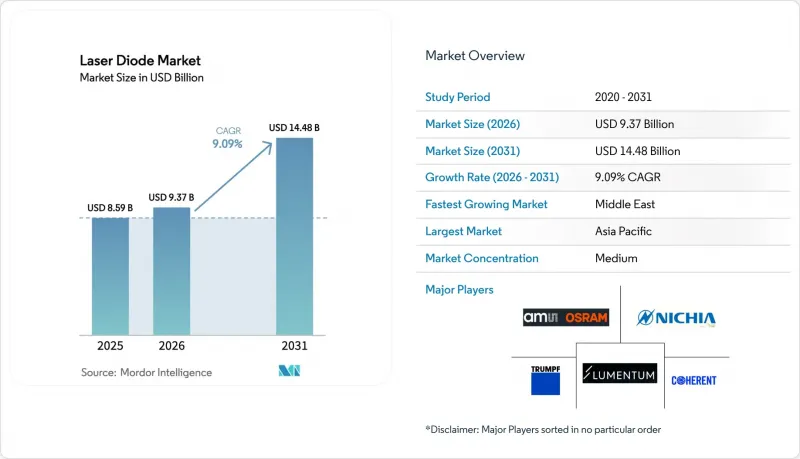
本報告按類型(邊發射型、VCSEL 等)、波長(紅外線、紅光等)、功率輸出(低功率、中功率、高功率)、工作模式(連續波、脈衝)、封裝配置(TO-CAN、C-mount 等)、最終用戶應用(通訊/資料通訊通訊、工業、其他)和地區(北美、其他)進行細分。市場預測以美元計價。
全球雷射二極體市場趨勢及洞察
智慧型手機中 3D 感測和人臉辨識技術的廣泛應用,正在推動對 VCSEL 的需求。
到2025年,全球智慧型手機製造商將出貨約12億台搭載VCSEL陣列的設備,從而實現安全的臉部認證和深度增強影像擷取。蘋果公司正引領這股潮流,擴大TrueDepth技術的應用範圍。為了滿足iPhone 17的訂單,Lumentum已將其在泰國的晶片分揀產能提高了30%。安卓OEM廠商也紛紛效仿,三星和小米都採用了ams OSRAM的940奈米陣列,即使在強光下,也能將誤拒率控制在0.5%以下。 VCSEL在回流焊接中具有抗濕性,無需使用氣密封裝的邊緣發射器,從而降低了組裝成本。符合IEC 60825-1 1級標準,供應商可微調光束發散角和占空比,使角膜峰值曝光量低於0.39毫瓦,從而保持雷射二極體市場的成長動能。
利用1550奈米DFB雷射快速部署FTTH網路
到2025年,全球光纖到府(FTTH)連線數將超過6.8億,其中中國佔淨成長的58%,這得益於各省強制推行Gigabit部署的政策。 1550奈米色散回饋雷射可最大限度地減少色散,並支援40公里無源光鏈路,分光比為1:128。2025年,MACOM推出了一款內置電吸收調製器的Gigabit磷化銦(InP)DFB雷射器,該雷射器可將模組接入面積縮小40%,並降低高密度連接器,可將模組接入尺寸縮小40%的功耗。同年,土耳其國家光纖計畫新增420萬戶家庭光纖連接,這些連接均採用住友電工的雷射器,進一步擴大了雷射二極體的潛在市場。 OpenLight 於 2025 年 9 月展示了其 1.6TerabitDR8 收發器,證實到 2027 年,這些相同的 1550 奈米通道將在 AI叢集中部署。
溫度控管的挑戰限制了功率超過 20 瓦的連續波系統的規模化發展。
當連續輸出功率超過 20 瓦時,結溫會升至 85°C 以上,溫度每升高 10°C,載子複合效率就會下降 12%,進而縮短使用壽命。微通道冷卻器會增加每個模組 45 美元的成本,並且需要消耗 15 瓦的功率來驅動泵浦光,這削弱了其相對於燈泵浦固體雷射的效率優勢。合成金剛石板的熱導率是金剛石板的五倍,nLIGHT 公司在對 100 瓦光纖耦合模組的測試中,成功地將結溫降低了 18°C,但其成本會增加每平方公分 12 美元。 2025 年,IEEE 的研究人員提案了鎵銦相變插入件,用於吸收脈衝工作期間的瞬態熱量,但這無法滿足通訊產業的絕緣要求。在封裝成本降低之前,此限制將限制雷射二極體市場輸出功率藍圖的上限。
細分市場分析
到2025年,邊發射裝置憑藉其在長距離鏈路中無與倫比的單模耦合效率,將以46.13%的市佔率引領雷射二極體市場。由於晶圓級測試速度高達每小時12,000個晶片,垂直腔面發射雷射(VCSEL)陣列預計到2031年將以每年10.98%的速度成長。這遠高於包覆面邊發送器。雖然量子級聯雷射在中紅外線感測領域仍屬於小眾應用,但法布里-珀羅二極體正被應用於對成本要求較高的短距離網路中。
就生產成本而言,VCSEL 在家用電子電器具有優勢,因為基板空間有限,而且無需氣密封裝可以將組裝製程縮短 25%。雖然邊發射雷射預計仍將在高密度分波多工( DWDM) 領域佔據主導地位,但向 VCSEL 的逐步過渡使得高通量晶圓製造成為競爭的焦點。這一趨勢凸顯了發射極創新對於維持雷射二極體市場長期成長的重要性。
預計到2025年,波長在700-1600奈米範圍內的紅外線光源將佔總銷售額的49.21%,凸顯其在通訊、工業感測和光纖雷射激發等領域的重要作用。隨著雷射磷光體投影機利用3瓦晶片實現4000流明的亮度,取代顯示器和汽車抬頭顯示器中的汞燈,波長在400-500奈米範圍內的藍光二極體預計將以11.82%的複合年成長率成長。
日亞化學株式會社的450奈米裝置實現了42%的電光轉換效率,因此能夠製造出亮度高達5000流明、重量僅1.8公斤的可攜式投影機。儘管紅光和綠光波段穩定成長,但由於矽基板上氮化鎵(GaN)的高缺陷密度,紫外光的產量成長緩慢。這些趨勢共同推動了收入來源的多元化,並為雷射二極體市場的長期穩定發展奠定了基礎。
區域分析
預計到2025年,亞太地區將佔全球銷售額的53.61%。這得歸功於日本一體化的供應鏈以及中國470億美元的半導體獎勵策略,該計劃使複合半導體晶圓產量較2023年成長了34%。在韓國,預計智慧型手機和5G回程傳輸將消耗9,200萬個二極體,這表明該地區消費和基礎設施需求均衡。
北美市場約佔銷售額的22%,主要得益於國防預算和超大規模資料中心業者營運商的採購。 2025年8月,Lumentum擴建了位於加州的無塵室,以滿足《晶片和資訊安全法案》(CHIPS Act)規定的國內採購比例要求。歐洲市場佔據18%的佔有率,其中德國汽車製造商已將雷射雷達(LiDAR)整合到180萬輛汽車中,英國國家醫療服務體系(NHS)也在420家醫院部署了基於雷射的診斷系統。
受沙烏地阿拉伯「2030願景」光纖骨幹網路和阿拉伯聯合大公國超大規模叢集佈線的推動,中東地區預計將以12.46%的複合年成長率成長。預計到2029年,阿拉伯聯合大公國的超大規模集群佈線將每月產生15Exabyte的跨境流量。南美和非洲仍是新興市場,但巴西的國家寬頻計畫和肯亞的光纖回程傳輸計畫表明,熟悉當地標準的供應商將迎來不斷擴大的新商機。這些趨勢共同推動了地理分佈廣泛的雷射二極體市場的發展。
其他好處:
- Excel格式的市場預測(ME)表
- 3個月的分析師支持
目錄
第1章:引言
- 研究假設和市場定義
- 調查範圍
第2章:調查方法
第3章執行摘要
第4章 市場狀況
- 市場概覽
- 市場促進因素
- 智慧型手機中 3D 感測和人臉辨識技術的廣泛應用,正在推動對 VCSEL 的需求。
- 利用1550奈米DFB雷射快速部署FTTH網路
- 採用905奈米脈衝雷射的汽車LiDAR項目
- 高功率二極體雷射在金屬積層製造的應用日益廣泛
- 用於利用二極體激勵模組的定向能量武器的國防預算正在迅速成長。
- 採用藍綠色光氮化鎵雷射的美容醫療器材小型化
- 市場限制因素
- 溫度控管的挑戰限制了功率超過 20 瓦的連續波系統的規模化發展。
- 供應鏈對鎵和銦的依賴導致了價格波動。
- 歐洲有關眼部暴露的安全法規限制了消費品的產量。
- 在矽基基板製造氮化鎵晶圓時良率的變化導致藍光雷射的成本增加。
- 產業價值鏈分析
- 宏觀經濟因素對市場的影響
- 技術展望
- 波特五力分析
第5章 市場規模與成長預測
- 按類型
- 邊發射雷射二極體
- VCSEL
- 量子級聯雷射
- DFB 和 DBR
- 法布里-珀羅雷射二極體
- 按波長
- 紅外線(700-1600 奈米)
- 紅色(630-700 奈米)
- 藍色(400-500 奈米)
- 綠色(500–570 奈米)
- 紫外光(波長小於400奈米)
- 按輸出功率
- 低功率(小於1瓦)
- 中功率(1-10瓦)
- 高功率(10瓦或以上)
- 透過操作模式
- 連續波(CW)
- 脈衝型
- 軟體包配置
- TO-CAN
- C型介面
- HHL和蝴蝶
- 模組/子系統
- 透過最終用戶應用程式
- 通訊和資料通訊
- 工業加工/製造
- 醫療保健
- 車
- 家用電子電器和顯示器
- 國防與安全
- 研究與學術
- 按地區
- 北美洲
- 美國
- 加拿大
- 墨西哥
- 南美洲
- 巴西
- 阿根廷
- 其他南美國家
- 歐洲
- 英國
- 德國
- 法國
- 西班牙
- 義大利
- 其他歐洲國家
- 亞太地區
- 中國
- 印度
- 日本
- 澳洲
- 韓國
- 其他亞太國家
- 中東
- 沙烏地阿拉伯
- 阿拉伯聯合大公國
- 土耳其
- 其他中東國家
- 非洲
- 南非
- 肯亞
- 其他非洲國家
- 北美洲
第6章 競爭情勢
- 市場集中度
- 策略趨勢
- 市佔率分析
- 公司簡介
- Coherent Corp.
- Lumentum Holdings Inc.
- Nichia Corporation
- TRUMPF SE+Co KG
- OSRAM Opto Semiconductors GmbH
- IPG Photonics Corp.
- Hamamatsu Photonics KK
- Sharp Corp.
- Sumitomo Electric Industries Ltd.
- Sony Corp.
- Mitsubishi Electric Corp.
- Ushio Inc.
- Jenoptik AG
- Thorlabs Inc.
- Frankfurt Laser Co.
- OSI Laser Diode Inc.
- Lasea SA
- Newport Corp.
- Rohm Semiconductor
- nLIGHT Inc.
- Excelitas Technologies Corp.
- Broadcom Inc.
第7章 市場機會與未來展望
According to Mordor Intelligence, the laser diode market size is projected to be USD 8.59 billion in 2025, USD 9.37 billion in 2026, and reach USD 14.48 billion by 2031, growing at a CAGR of 9.09% from 2026 to 2031.
This report is Segmented by Type (Edge-Emitting, VCSEL, and More), Wavelength (Infrared, Red, and More), Output Power (Low, Mid, and High), Operating Mode (Continuous-Wave, and Pulsed), Packaging Configuration (TO-CAN, C-Mount, and More), End-User Application (Telecommunications and Datacom, Industrial, and More), and Geography (North America, and More). Market Forecasts are Provided in Terms of Value (USD).
Global Laser Diode Market Trends and Insights
Proliferation of 3D Sensing and Face-ID in Smartphones Propelling VCSEL Demand
Global smartphone makers shipped roughly 1.2 billion handsets with embedded VCSEL arrays in 2025, enabling secure facial authentication and depth-enhanced imaging. Apple drove the pace by expanding TrueDepth adoption, prompting Lumentum to boost its Thailand die-sorting capacity by 30% to meet iPhone 17 orders. Android OEMs followed suit, with Samsung and Xiaomi selecting ams OSRAM 940-nanometer arrays that maintain false-reject rates below 0.5% in bright sunlight. VCSELs cut assembly cost because they withstand reflow humidity, eliminating hermetic sealing that edge-emitters require. Compliance with IEC 60825-1 Class 1 limits has led suppliers to finetune beam divergence and duty cycles, keeping peak exposure within 0.39 milliwatts at the cornea, thereby sustaining momentum in the laser diode market.
Rapid Deployment of FTTH Networks Leveraging 1550 nm DFB Lasers
Worldwide FTTH lines exceeded 680 million in 2025, with China contributing 58% of net additions under provincial gigabit mandates. Distributed-feedback lasers at 1550 nanometers minimize chromatic dispersion, enabling 40 kilometer passive optical links that support 1:128 split ratios. MACOM released a 25-gigabit indium-phosphide DFB with integrated electro-absorption modulator in 2025, shrinking module footprint by 40% and lowering power budgets in dense access nodes. Turkey's national fiber plan deployed 4.2 million new homes that same year using Sumitomo Electric lasers, further broadening the addressable laser diode market. OpenLight's 1.6-terabit DR8 transceiver, demoed in September 2025, validates that these same 1550 nanometer lanes will move inside AI clusters by 2027.
Thermal Management Challenges Limiting Continuous-Wave Scaling Above 20 W
Junction temperatures climb above 85 degrees Celsius when continuous output exceeds 20 watts, cutting carrier-recombination efficiency by 12% per 10-degree rise and shortening lifetime. Microchannel coolers add USD 45 per module and consume 15 watts for pumping, eroding the efficiency edge over lamp-pumped solid-state lasers. Synthetic diamond plates offer five-fold higher thermal conductivity, tested by nLIGHT in 100-watt fiber-coupled modules that achieved an 18 degree reduction in junction temperature but at USD 12 per square centimeter premium. IEEE researchers in 2025 proposed gallium-indium phase-change inserts that absorb transient heat during pulsed duty but remain incompatible with telecom hermeticity standards. Until packaging costs fall, this restraint will moderate the top-end of the laser diode market power roadmap.
Other drivers and restraints analyzed in the detailed report include:
- Automotive LiDAR Programs Adopting 905 nm Pulsed Lasers
- Rising Use of High-Power Diode Lasers in Metal Additive Manufacturing
- Supply-Chain Dependency on Gallium and Indium Causing Price Volatility
For complete list of drivers and restraints, kindly check the Table Of Contents.
Segment Analysis
Edge-emitting devices led the laser diode market with 46.13% share in 2025, owing to unmatched single-mode coupling efficiency for long-haul links. VCSEL arrays are forecast to grow at 10.98% through 2031, driven by wafer-level testing speeds that reach 12,000 dice per hour, far surpassing cleaved-facet edge emitters. Quantum-cascade lasers remain niche in mid-infrared sensing, while Fabry-Perot diodes serve cost-sensitive short-reach networks.
Production economics favor VCSELs in consumer electronics where board space is at a premium and hermetic sealing can be skipped, cutting assembly steps by 25%. Edge emitters will stay dominant in dense wavelength-division multiplexing, yet a gradual mix shift toward VCSELs keeps competitive focus on high-throughput wafer fabrication. This dynamic underscores how emitter innovation is central to sustaining long-run expansion of the laser diode market.
Infrared sources between 700 and 1600 nanometers generated 49.21% of 2025 revenue, underlining their role in telecom, industrial sensing, and fiber-laser pumping. Blue diodes at 400 to 500 nanometers are projected to expand at 11.82% CAGR as laser-phosphor projectors deliver 4,000 lumens from 3-watt chips, replacing mercury lamps in displays and automotive head-up systems.
Nichia's 450 nanometer devices achieved 42% wall-plug efficiency, enabling a 5,000-lumen portable projector that weighs just 1.8 kilograms. Red and green bands grow modestly, while ultraviolet yields lag due to GaN-on-silicon defect densities. Collectively these trends diversify revenue streams, supporting stable long-term prospects for the laser diode market.
Complete Report Scope:
- By Type
- Edge-Emitting Laser Diodes
- VCSEL
- Quantum Cascade Lasers
- DFB and DBR
- Fabry-Perot Laser Diodes
- By Wavelength
- Infrared (700-1600 nm)
- Red (630-700 nm)
- Blue (400-500 nm)
- Green (500-570 nm)
- Ultraviolet (Less than 400 nm)
- By Output Power
- Low Power (Less than 1 W)
- Mid Power (1-10 W)
- High Power (More than 10 W)
- By Operating Mode
- Continuous-Wave (CW)
- Pulsed
- By Packaging Configuration
- TO-CAN
- C-Mount
- HHL and Butterfly
- Module/Sub-System
- By End-User Application
- Telecommunications and Datacom
- Industrial Processing and Manufacturing
- Healthcare and Medical
- Automotive
- Consumer Electronics and Display
- Defense and Security
- Research and Academia
- By Geography
- North America
- United States
- Canada
- Mexico
- South America
- Brazil
- Argentina
- Rest of South America
- Europe
- United Kingdom
- Germany
- France
- Spain
- Italy
- Rest of Europe
- Asia-Pacific
- China
- India
- Japan
- Australia
- South Korea
- Rest of Asia-Pacific
- Middle East
- Saudi Arabia
- United Arab Emirates
- Turkey
- Rest of Middle East
- Africa
- South Africa
- Kenya
- Rest of Africa
- North America
Geography Analysis
Asia-Pacific generated 53.61% of global revenue in 2025, backed by Japan's integrated supply chains and China's USD 47 billion semiconductor stimulus that lifted compound-semiconductor wafer output by 34% from 2023. South Korea consumed 92 million diodes for smartphones and 5G backhaul, illustrating the region's balanced mix of consumer and infrastructure demand.
North America contributed roughly 22% of sales, leveraging defense appropriations and hyperscaler procurement. Lumentum expanded California cleanrooms in August 2025 to meet CHIPS Act domestic-content thresholds. Europe held an 18% share, with German automakers integrating LiDAR in 1.8 million cars and the UK National Health Service rolling out laser-based diagnostics in 420 hospitals.
The Middle East, projected at a 12.46% CAGR, is wiring Saudi Vision 2030's fiber backbone and UAE hyperscale clusters that will drive 15 exabytes per month of cross-border traffic by 2029. South America and Africa remain emerging, yet Brazil's national broadband plan and Kenya's fiber backhaul projects underscore incremental opportunities for suppliers attuned to local standards. Together, these patterns reinforce a geographically diversified laser diode market.
- Coherent Corp.
- Lumentum Holdings Inc.
- Nichia Corporation
- TRUMPF SE + Co KG
- OSRAM Opto Semiconductors GmbH
- IPG Photonics Corp.
- Hamamatsu Photonics K.K.
- Sharp Corp.
- Sumitomo Electric Industries Ltd.
- Sony Corp.
- Mitsubishi Electric Corp.
- Ushio Inc.
- Jenoptik AG
- Thorlabs Inc.
- Frankfurt Laser Co.
- OSI Laser Diode Inc.
- Lasea SA
- Newport Corp.
- Rohm Semiconductor
- nLIGHT Inc.
- Excelitas Technologies Corp.
- Broadcom Inc.
Additional Benefits:
- The market estimate (ME) sheet in Excel format
- 3 months of analyst support
TABLE OF CONTENTS
1 INTRODUCTION
- 1.1 Study Assumptions and Market Definition
- 1.2 Scope of the Study
2 RESEARCH METHODOLOGY
3 EXECUTIVE SUMMARY
4 MARKET LANDSCAPE
- 4.1 Market Overview
- 4.2 Market Drivers
- 4.2.1 Proliferation of 3D Sensing and Face-ID in Smartphones Propelling VCSEL Demand
- 4.2.2 Rapid Deployment of FTTH Networks Leveraging 1550 nm DFB Lasers
- 4.2.3 Automotive LiDAR Programs Adopting 905 nm Pulsed Lasers
- 4.2.4 Rising Use of High-Power Diode Lasers in Metal Additive Manufacturing
- 4.2.5 Defense Funding Surge for Directed-Energy Weapons Utilizing Diode-Pumped Modules
- 4.2.6 Miniaturization of Medical Aesthetic Devices Integrating Blue-Green GaN Lasers
- 4.3 Market Restraints
- 4.3.1 Thermal Management Challenges Limiting Continuous-Wave Scaling Above 20 W
- 4.3.2 Supply-Chain Dependency on Gallium and Indium Causing Price Volatility
- 4.3.3 Safety Regulations on Eye Exposure Restricting Consumer-Grade Power in Europe
- 4.3.4 Yield Variability in GaN-on-Silicon Wafer Fabrication Raising Costs for Blu-ray Lasers
- 4.4 Industry Value Chain Analysis
- 4.5 Impact of Macroeconomic Factors on the Market
- 4.6 Technological Outlook
- 4.7 Porter's Five Forces Analysis
- 4.7.1 Bargaining Power of Suppliers
- 4.7.2 Bargaining Power of Buyers
- 4.7.3 Threat of New Entrants
- 4.7.4 Threat of Substitutes
- 4.7.5 Intensity of Competitive Rivalry
5 MARKET SIZE AND GROWTH FORECASTS (VALUE)
- 5.1 By Type
- 5.1.1 Edge-Emitting Laser Diodes
- 5.1.2 VCSEL
- 5.1.3 Quantum Cascade Lasers
- 5.1.4 DFB and DBR
- 5.1.5 Fabry-Perot Laser Diodes
- 5.2 By Wavelength
- 5.2.1 Infrared (700-1600 nm)
- 5.2.2 Red (630-700 nm)
- 5.2.3 Blue (400-500 nm)
- 5.2.4 Green (500-570 nm)
- 5.2.5 Ultraviolet (Less than 400 nm)
- 5.3 By Output Power
- 5.3.1 Low Power (Less than 1 W)
- 5.3.2 Mid Power (1-10 W)
- 5.3.3 High Power (More than 10 W)
- 5.4 By Operating Mode
- 5.4.1 Continuous-Wave (CW)
- 5.4.2 Pulsed
- 5.5 By Packaging Configuration
- 5.5.1 TO-CAN
- 5.5.2 C-Mount
- 5.5.3 HHL and Butterfly
- 5.5.4 Module/Sub-System
- 5.6 By End-User Application
- 5.6.1 Telecommunications and Datacom
- 5.6.2 Industrial Processing and Manufacturing
- 5.6.3 Healthcare and Medical
- 5.6.4 Automotive
- 5.6.5 Consumer Electronics and Display
- 5.6.6 Defense and Security
- 5.6.7 Research and Academia
- 5.7 By Geography
- 5.7.1 North America
- 5.7.1.1 United States
- 5.7.1.2 Canada
- 5.7.1.3 Mexico
- 5.7.2 South America
- 5.7.2.1 Brazil
- 5.7.2.2 Argentina
- 5.7.2.3 Rest of South America
- 5.7.3 Europe
- 5.7.3.1 United Kingdom
- 5.7.3.2 Germany
- 5.7.3.3 France
- 5.7.3.4 Spain
- 5.7.3.5 Italy
- 5.7.3.6 Rest of Europe
- 5.7.4 Asia-Pacific
- 5.7.4.1 China
- 5.7.4.2 India
- 5.7.4.3 Japan
- 5.7.4.4 Australia
- 5.7.4.5 South Korea
- 5.7.4.6 Rest of Asia-Pacific
- 5.7.5 Middle East
- 5.7.5.1 Saudi Arabia
- 5.7.5.2 United Arab Emirates
- 5.7.5.3 Turkey
- 5.7.5.4 Rest of Middle East
- 5.7.6 Africa
- 5.7.6.1 South Africa
- 5.7.6.2 Kenya
- 5.7.6.3 Rest of Africa
- 5.7.1 North America
6 COMPETITIVE LANDSCAPE
- 6.1 Market Concentration
- 6.2 Strategic Moves
- 6.3 Market Share Analysis
- 6.4 Company Profiles (Includes Global-Level Overview, Market-Level Overview, Core Segments, Financials, Strategic Information, Market Rank/Share, Products and Services, Recent Developments)
- 6.4.1 Coherent Corp.
- 6.4.2 Lumentum Holdings Inc.
- 6.4.3 Nichia Corporation
- 6.4.4 TRUMPF SE + Co KG
- 6.4.5 OSRAM Opto Semiconductors GmbH
- 6.4.6 IPG Photonics Corp.
- 6.4.7 Hamamatsu Photonics K.K.
- 6.4.8 Sharp Corp.
- 6.4.9 Sumitomo Electric Industries Ltd.
- 6.4.10 Sony Corp.
- 6.4.11 Mitsubishi Electric Corp.
- 6.4.12 Ushio Inc.
- 6.4.13 Jenoptik AG
- 6.4.14 Thorlabs Inc.
- 6.4.15 Frankfurt Laser Co.
- 6.4.16 OSI Laser Diode Inc.
- 6.4.17 Lasea SA
- 6.4.18 Newport Corp.
- 6.4.19 Rohm Semiconductor
- 6.4.20 nLIGHT Inc.
- 6.4.21 Excelitas Technologies Corp.
- 6.4.22 Broadcom Inc.
7 MARKET OPPORTUNITIES AND FUTURE OUTLOOK
- 7.1 White-Space and Unmet-Need Assessment

 2026年釔鋁石榴石(YAG)雷射針灸全球市場報告
 單射極雷射二極體市場規模、佔有率和成長分析:按波長、功率、應用、最終用戶和地區分類-2026-2033年產業預測
 高功率光纖雷射晶片市場分析及預測(至2035年):類型、產品、技術、組件、應用、最終用戶、功能、安裝配置、解決方案
 雷射二極體市場:按類型、摻雜材料、技術、工作模式和應用分類-2026-2032年全球市場預測
 2026-2030年全球藍光雷射二極體市場
 光纖耦合雷射模組市場報告:趨勢、預測與競爭分析(至2035年)高功率VCSEL市場報告:趨勢、預測與競爭分析(至2035年)
 雷射二極體市場報告:按產品類型、應用和地區分類(2026-2034 年)單波長雷射市場報告:趨勢、預測及競爭分析(至2035年)緊湊型雷射市場:按雷射類型、功率範圍、應用和最終用戶分類,全球預測,2026-2032年