


 |
市場調查報告書
商品編碼
2114283
球粘土:市場佔有率分析、行業趨勢和統計數據、成長預測(2026-2031)Ball Clay - Market Share Analysis, Industry Trends & Statistics, Growth Forecasts (2026 - 2031) |
||||||

※ 本網頁內容可能與最新版本有所差異。詳細情況請與我們聯繫。
據 Mordor Intelligence 稱,2026 年球粘土市場價值估計為 4.7773 億美元,預計在預測期(2026-2031 年)內將以 4.98% 的複合年成長率成長,到 2031 年達到 6.0914 億美元。
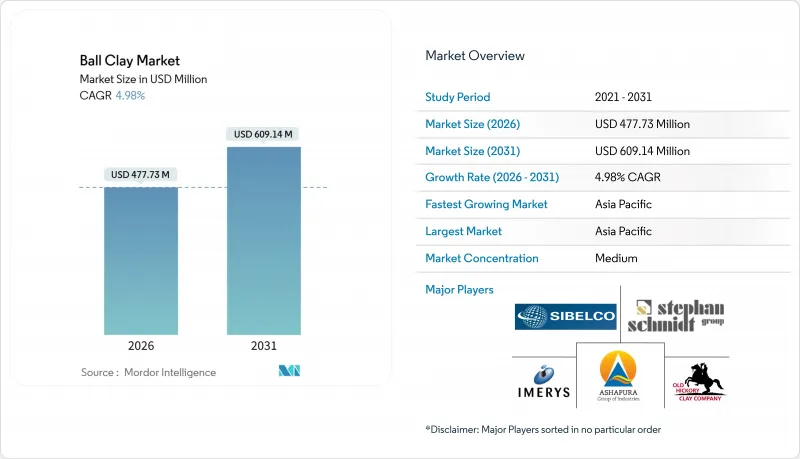
本報告按終端用戶產業(陶瓷[衛浴設備、牆地磚、餐具、磚塊及其他陶瓷製品]和非陶瓷[黏合劑和密封劑、橡膠和塑膠、化肥和殺蟲劑及其他非陶瓷製品])和地區(亞太地區、北美地區、歐洲地區、南美地區以及中東和非洲地區)進行細分。市場預測以美元計價。
全球球粘土市場趨勢與洞察
亞太地區高層住宅衛浴設備安裝量的快速成長。
隨著中國和印度的都市化加快,衛浴設備的需求正從簡單的更換轉向初始安裝。開發人員現在為多層建築配備陶瓷衛浴潔具,並利用球土的可塑性進行薄壁澆鑄。印度的瓷磚行業正經歷顯著的成長。同時,衛浴設備的產量也在上升,這主要得益於建築規範要求面積超過600平方英尺的公寓必須將潮濕區域與衛生間隔離。泰國的衛浴設備市場主要由幾家大型公司主導,這些公司從英國大量採購球土。開發商現在會在專案交付前幾個月就預訂衛浴設備,從而在施工初期就確保球土的需求。全球超過一半的陶瓷衛浴設備都使用來自英國的球土生產。這種特殊的黏土具有獨特的配比,其中高嶺石、雲母和石英的比例經過精心調整,使其能夠進行低水分注漿成型,並且燒成收縮率小於 8%。在該地區,人們偏好薄而光滑的白色表面,因此對高品質、低鐵等級的黏土需求量不斷增加。
擴大在印度和東協的陶瓷磚生產能力
2023年,印度確立了其全球最便宜瓷磚生產國的地位。這得歸功於其位於莫爾比的工廠生產活動的激增和運轉率的提高。同時,越南儘管擁有產能大規模的工廠,但2024年的產量卻低於預期。這種產量短缺為擴大球粘土訂單提供了絕佳機會,尤其是在出口開始復甦的情況下。在印度尼西亞,生產商面臨原料物流的挑戰。與本地生產的高嶺土相比,來自澳洲和馬來西亞的進口推高了到貨價格。此外,高嶺土成本的上漲促使配方設計師轉向混合配方。這些混合配方中會加入低等級的球粘土,但前提是其白度必須保持在可接受的範圍內。為了進一步滿足該地區不斷成長的需求,卡爾加里亞正在尼泊爾建造其第八家工廠。預計這將增加對球粘土的需求,並進一步推動整個南亞地區的進口需求。
替代品的可用性(高嶺土、合成粘合劑)
對於塑性較低的產品,例如建築磚和經濟型瓷磚,使用高嶺土或合成粘合劑可以降低成本。 2020年至2024年間,印度瓷磚廠降低了配方中球土的比例,並採用了價格較低廉的本地高嶺土。中國擁有豐富的高嶺土蘊藏量,因此可以採用高嶺土比例更高、球土比例更低的配方。雖然聚乙烯醇等粘合劑可以提高原料強度,但其燒成收縮率不如球土穩定,限制了其在陶瓷領域的應用。這項限制正在影響市場成長速度。
細分市場分析
到2025年,陶瓷應用將佔球土市場佔有率的93.19%,預計到2031年將與整體市場保持相似的成長速度,複合年成長率(CAGR)為4.98%。亞太地區的建築熱潮,尤其是高層建築的建設,正在推動衛浴設備市場的發展,目前,採用英國產原料的混合料正被用於生產陶瓷製品。在美國,牆磚和地磚佔據了球土消費的大部分佔有率,其中大尺寸的陶瓷瓷磚需要更高的可塑性指數。在歐洲,由於歐盟嚴格的過渡規則建議使用高品質、低鐵等級的球土,餐具市場正在經歷重組。隨著行業轉向高嶺土,磚塊和其他建築陶瓷的市場佔有率正在下降。印度磚廠正在降低其混合料中球土的比例,這就是這種轉變的明顯跡象。目前,非陶瓷應用領域的球土市場規模小規模,但具有成長潛力。黏合劑和密封劑製造商開始採用Amlok 321等表面處理產品來提高抗垂流性能。同時,橡膠和塑膠產業的混煉商則在產品中添加球土以確保尺寸穩定性。化肥和農藥載體目前僅佔市場佔有率的一小部分,但其成長受到高陽離子交換容量(CEC)黏土競爭的限制。真正的成長潛力在於3D列印工業陶瓷領域,在該領域,超塑性混合物能夠滿足標準高嶺土難以達到的嚴格顆粒規格要求。
這些趨勢也受到其他因素的進一步推動。中國和印度的衛浴設備製造商目前正透過遠期合約提前鎖定供應,導致現貨市場供應緊張。在德國和義大利,餐具製造商正在調整籌資策略,以降低烏克蘭局勢可能造成的供應中斷風險,增加了對英國認證等級材料的需求。在美國,基礎設施投資正在推動黏合劑產業的成長,尤其是各州層級的「購買美國貨」條款鼓勵使用國產原料。此外,積層製造與生物醫學研究的融合正在創造新的機遇,預計未來幾年將迎來顯著成長。
區域分析
預計到2025年,亞太地區將佔據球土市場38.06%的佔有率,以5.14%的複合年成長率成為全球成長最快的地區。印度莫爾比擁有龐大的瓷磚生產能力,每年消耗大量的球土,並不斷增加從英國和泰國的進口。在中國,長石成本的上漲促使生產商調整球土配方以確保其可塑性。同時,越南工廠的低運轉率顯示市場需求尚未充分開發。在泰國,八家主要的衛浴設備製造商正轉向英國尋求優質釉藥,這凸顯了英國的重要性。
預計到2025年,北美將佔據顯著的市場佔有率。美國既滿足國內市場需求,也滿足出口需求。田納西州以供應大尺寸規格瓷磚所需的高塑性原料而聞名。儘管受住宅開工週期的影響,需求會有波動,但諸如更大浴室和翻新需求等趨勢確保了市場的穩定成長。加拿大和墨西哥的製造商向美國礦場採購原料,並利用較低的運輸成本,以提升區域技術水準。
烏克蘭高嶺土產量下降給歐洲帶來了挑戰。為了彌補缺口,英國礦區,特別是博維和佩特羅克斯托礦區,正向歐洲大陸各地的客戶供應大量蘊藏量。德國的史蒂芬·施密特公司(Stephan Schmidt KG)透過提供經認證的低鐵餐具級高嶺土,滿足了歐盟標準。西班牙和義大利曾依賴烏克蘭高嶺土,如今已轉向從英國和德國進口,這使得它們的供應鏈更容易受到政治和監管變化的影響。
儘管南美和中東/非洲地區的總市場佔有率不大,但預計中期將實現成長。巴西是主要的瓷磚生產國,利用聖保羅州和巴拉那州的礦床進行生產,並透過從阿根廷進口來補充供不應求。沙烏地阿拉伯由於建築業的蓬勃發展,衛浴設備的進口量也增加。南非精心打造了一系列產品,從歐洲採購優質原料生產高階衛浴設備,同時使用本地產的高嶺土生產更基礎的磚塊。
其他好處:
- Excel格式的市場預測(ME)表
- 3個月的分析師支持
目錄
第1章:引言
- 研究假設和市場定義
- 調查範圍
第2章:調查方法
第3章執行摘要
第4章 市場狀況
- 市場概覽
- 市場促進因素
- 亞太地區高層住宅的衛生設施安裝量正在迅速增加。
- 擴大在印度和東協的陶瓷磚生產能力
- 北美住宅裝修市場復甦
- 歐盟對食品接觸餐具制定了更嚴格的標準
- 用於3D列印的高級陶瓷需要超塑性混合物
- 市場限制因素
- 替代品的可用性(高嶺土、合成粘合劑)
- 露天礦場環境影響評估許可證核准延誤。
- 政治敏感區域內球土的集中分佈
- 價值鏈分析
- 波特五力模型
第5章 市場規模與成長預測
- 按最終用戶行業分類
- 陶瓷製品
- 衛浴設備
- 牆磚和地磚
- 餐具
- 磚
- 其他陶瓷(建築陶瓷和耐火材料)
- 非陶瓷
- 黏合劑和密封劑
- 橡膠和塑膠
- 化肥和殺蟲劑
- 其他非陶瓷
- 陶瓷製品
- 按地區
- 亞太地區
- 中國
- 印度
- 日本
- 韓國
- 澳洲
- 其他亞太國家
- 北美洲
- 美國
- 加拿大
- 墨西哥
- 歐洲
- 德國
- 英國
- 法國
- 義大利
- 俄羅斯
- 其他歐洲國家
- 南美洲
- 巴西
- 阿根廷
- 其他南美國家
- 中東和非洲
- 沙烏地阿拉伯
- 南非
- 其他中東和非洲國家
- 亞太地區
第6章 競爭情勢
- 市場集中度
- 策略趨勢
- 市佔率和排名分析
- 公司簡介
- 20 Microns
- Amarnath Industries
- Amarnath Industries
- ASHAPURA GROUP OF INDUSTRIES
- Ashok Alco-chem Limited(AACL)
- Finore Minerals LLP
- G & W Mineral Resources
- Golcha Associated(Associated Soapstone Distribution Company Pvt. Ltd)
- Gujarat Mineral Development Corporation Ltd
- Imerys
- JLD Minerals
- KaMin LLC
- Kentucky-Tennessee Clay Co.
- Mahavir Minerals Ltd.
- Modkha Marine Sdn Bhd
- Mota Ceramic Solutions
- Old Hickory Clay Company
- Sibelco
- Stephan Schmidt KG
第7章 市場機會與未來展望
According to Mordor Intelligence, the ball clay market size is estimated at USD 477.73 million in 2026, and is expected to reach USD 609.14 million by 2031, at a CAGR of 4.98% during the forecast period (2026-2031).
This report is Segmented by End-User Industry (Ceramic [Sanitary Ware, Wall and Floor Tiles, Tableware, Bricks, and Other Ceramics] and Non-Ceramic [Adhesives and Sealants, Rubbers and Plastics, Fertilizers and Insecticides, and Other Non-Ceramics]) and Geography (Asia-Pacific, North America, Europe, South America, and Middle-East and Africa). The Market Forecasts are Provided in Terms of Value (USD).
Global Ball Clay Market Trends and Insights
Surge in Sanitary-Ware Installations Across Asia-Pacific High-Rise Housing
As urbanization accelerates in China and India, the demand for sanitary ware has transitioned from mere replacements to initial installations. Developers are now equipping multi-story towers with vitreous china fixtures, which leverage the plasticity of ball clay for their thin-wall casting. India's ceramic tile industry is witnessing significant growth. Concurrently, the output of sanitary ware is on the rise, driven by building codes that mandate separate wet areas in apartments exceeding 600 square feet. Thailand's market for sanitary fixtures is largely dominated by key players, who collectively source substantial volumes of UK ball clay. Developers are now pre-ordering fixtures months prior to project handovers, securing their ball clay demand earlier in the construction timeline. Over half of the world's vitreous china sanitary ware is produced using UK ball clay. This specific clay, with its unique kaolinite-mica-quartz balance, allows for lower-water slip casting and boasts a firing shrinkage of under 8%. The region's affinity for thin, glossy white surfaces heightens the demand for premium, low-iron grades.
Expansion of Ceramic Tile Capacity in India and ASEAN
In 2023, India claimed the title of the world's lowest-cost tile producer, buoyed by a surge in activity at Morbi-based factories, which ramped up their utilization. Meanwhile, Vietnam, with its plants boasting significant capacity, managed to produce less than its potential in 2024. This shortfall presents a significant opportunity for increased ball clay orders, especially as exports begin to pick up. In Indonesia, producers face a challenge: logistics for raw materials. Imports from Australia and Malaysia inflate landed prices compared to locally sourced kaolin. Furthermore, rising kaolin costs are prompting formulators to pivot towards blended bodies. These blends incorporate lower-grade ball clay, but only where the whiteness tolerances permit. In a move underscoring the region's growing demand, Kajaria is constructing its eighth plant in Nepal, projecting an additional need for ball clay, further bolstering import demand across South Asia.
Availability of Substitutes (Kaolin, Synthetic Binders)
Low-plasticity products, including construction bricks and economy tiles, benefit from cost savings when using kaolin and synthetic binders. Between 2020 and 2024, Indian tile plants reduced their ball clay content, opting for locally sourced kaolin that costs less. China's vast kaolin reserves allow for compositions with a higher proportion of kaolin and a lower proportion of ball clay. While binders such as polyvinyl alcohol enhance green strength, they fall short of ball clay in firing-shrinkage predictability, restricting their use in vitreous ceramics. This limitation impacts the market growth rate.
Other drivers and restraints analyzed in the detailed report include:
- Rebound in North-American Residential Remodeling
- Tightening Specifications in European Union Food-Contact Tableware
- Environmental-Impact Permitting Delays at Open-Pit Mines
For complete list of drivers and restraints, kindly check the Table Of Contents.
Segment Analysis
Ceramic applications held 93.19% of the ball clay market share in 2025 and should mirror the overall 4.98% CAGR to 2031. Asia-Pacific's construction boom, particularly in high-rises, is driving the sanitaryware market, with vitreous china output now incorporating blends sourced from the UK. Wall and floor tiles dominate U.S. consumption, and large-format porcelain tiles are now requiring higher plasticity indices. In Europe, tableware is consolidating, influenced by stringent EU migration rules that favor premium, low-iron grades. As the industry shifts towards kaolin, bricks and other construction ceramics are losing market share. This shift is evident as Indian brick manufacturers have reduced their ball clay content. While the ball clay market for non-ceramic applications is currently modest, it shows potential for growth. Formulators of adhesives and sealants are turning to surface-treated products like Amlok 321 for improved sag resistance. Meanwhile, compounders in rubber and plastics are incorporating ball clay to ensure dimensional stability. Although fertilizer and pesticide carriers occupy a small portion of the market, their growth is hampered by competition from higher-CEC clays. The real growth potential lies in 3D-printed technical ceramics, where ultra-plastic blends can meet stringent particle specifications, a feat standard kaolin struggles to achieve.
These trends are further bolstered by secondary effects. Producers of sanitaryware in China and India are now forward-contracting their supplies in advance, leading to tighter spot volumes. In Germany and Italy, tableware manufacturers are diversifying their sourcing strategies to mitigate risks from disruptions in Ukraine, consequently boosting the demand for certified UK grades. In the U.S., infrastructure spending is driving the adhesive sector's growth, especially with state-level "Buy American" clauses promoting domestically mined inputs. Furthermore, the intersection of additive manufacturing and biomedical research is unveiling a fresh opportunity, which is poised to grow significantly in the coming years.
Complete Report Scope:
- By End-User Industry
- Ceramic
- Sanitary Ware
- Wall and Floor Tiles
- Tableware
- Bricks
- Other Ceramics (Construction Ceramics and Refractories)
- Non-ceramic
- Adhesives and Sealants
- Rubbers and Plastics
- Fertilizers and Insecticides
- Other Non-ceramics
- Ceramic
- By Geography
- Asia-Pacific
- China
- India
- Japan
- South Korea
- Australia
- Rest of Asia-Pacific
- North America
- United States
- Canada
- Mexico
- Europe
- Germany
- United Kingdom
- France
- Italy
- Russia
- Rest of Europe
- South America
- Brazil
- Argentina
- Rest of South America
- Middle-East and Africa
- Saudi Arabia
- South Africa
- Rest of Middle-East and Africa
- Asia-Pacific
Geography Analysis
Asia-Pacific retained 38.06% of the ball clay market share in 2025 and is set for a 5.14% CAGR, the fastest worldwide. Morbi, India, with a significant tile capacity, consumes a substantial amount annually and is ramping up imports from the UK and Thailand. In China, producers are adjusting ball clay ratios to ensure plasticity as feldspar costs rise. Meanwhile, Vietnam's under-utilized plants hint at untapped demand. In Thailand, eight leading sanitaryware manufacturers are turning to the UK for premium glazing, underscoring the latter's significance.
By 2025, North America is poised to capture a notable market share. The U.S. caters to both its domestic market and exports. Tennessee stands out, providing high-plasticity grades crucial for large-format tiles. While housing-start cycles introduce demand fluctuations, trends like larger bathroom spaces and remodeling choices ensure steady growth. Manufacturers in Canada and Mexico are sourcing from U.S. mines, capitalizing on freight savings that bolster regional specialization.
Europe faces challenges post-Ukraine's output decline. To fill the gap, UK basins, especially Bovey and Petrockstowe, are dispatching significant reserves to clients across the continent. Germany's Stephan Schmidt KG is meeting EU standards by offering certified low-iron grades for tableware. Spain and Italy, once dependent on Ukrainian kaolin, have shifted their reliance to imports from the UK and Germany, making their supply chains more vulnerable to political and regulatory changes.
South America and the combined regions of the Middle-East and Africa hold a modest share in the market but show promise for medium-term growth. Brazil, standing as a leading tile producer, is leveraging deposits from Sao Paulo and Parana, with Argentine imports filling any supply voids. In Saudi Arabia, a construction surge is driving a rise in sanitaryware imports. South Africa is curating its offerings, sourcing premium materials from Europe for upscale sanitaryware, while using local kaolin for more basic brick production.
- 20 Microns
- Amarnath Industries
- Amarnath Industries
- ASHAPURA GROUP OF INDUSTRIES
- Ashok Alco - chem Limited (AACL)
- Finore Minerals LLP
- G & W Mineral Resources
- Golcha Associated (Associated Soapstone Distribution Company Pvt. Ltd)
- Gujarat Mineral Development Corporation Ltd
- Imerys
- JLD Minerals
- KaMin LLC
- Kentucky-Tennessee Clay Co.
- Mahavir Minerals Ltd.
- Modkha Marine Sdn Bhd
- Mota Ceramic Solutions
- Old Hickory Clay Company
- Sibelco
- Stephan Schmidt KG
Additional Benefits:
- The market estimate (ME) sheet in Excel format
- 3 months of analyst support
TABLE OF CONTENTS
1 Introduction
- 1.1 Study Assumptions and Market Definition
- 1.2 Scope of the Study
2 Research Methodology
3 Executive Summary
4 Market Landscape
- 4.1 Market Overview
- 4.2 Market Drivers
- 4.2.1 Surge in sanitary-ware installations across Asia-Pacific high-rise housing
- 4.2.2 Expansion of ceramic tile capacity in India and ASEAN
- 4.2.3 Rebound in North-American residential remodeling
- 4.2.4 Tightening specifications in European Union food-contact tableware
- 4.2.5 3-D-printed advanced ceramics requiring ultra-plastic blends
- 4.3 Market Restraints
- 4.3.1 Availability of substitutes (kaolin, synthetic binders)
- 4.3.2 Environmental-impact permitting delays at open-pit mines
- 4.3.3 Concentration of Tier-1 deposits in politically sensitive belts
- 4.4 Value Chain Analysis
- 4.5 Porter's Five Forces
- 4.5.1 Bargaining Power of Suppliers
- 4.5.2 Bargaining Power of Consumers
- 4.5.3 Threat of New Entrants
- 4.5.4 Threat of Substitutes
- 4.5.5 Degree of Competition
5 Market Size and Growth Forecasts(Value)
- 5.1 By End-User Industry
- 5.1.1 Ceramic
- 5.1.1.1 Sanitary Ware
- 5.1.1.2 Wall and Floor Tiles
- 5.1.1.3 Tableware
- 5.1.1.4 Bricks
- 5.1.1.5 Other Ceramics (Construction Ceramics and Refractories)
- 5.1.2 Non-ceramic
- 5.1.2.1 Adhesives and Sealants
- 5.1.2.2 Rubbers and Plastics
- 5.1.2.3 Fertilizers and Insecticides
- 5.1.2.4 Other Non-ceramics
- 5.1.1 Ceramic
- 5.2 By Geography
- 5.2.1 Asia-Pacific
- 5.2.1.1 China
- 5.2.1.2 India
- 5.2.1.3 Japan
- 5.2.1.4 South Korea
- 5.2.1.5 Australia
- 5.2.1.6 Rest of Asia-Pacific
- 5.2.2 North America
- 5.2.2.1 United States
- 5.2.2.2 Canada
- 5.2.2.3 Mexico
- 5.2.3 Europe
- 5.2.3.1 Germany
- 5.2.3.2 United Kingdom
- 5.2.3.3 France
- 5.2.3.4 Italy
- 5.2.3.5 Russia
- 5.2.3.6 Rest of Europe
- 5.2.4 South America
- 5.2.4.1 Brazil
- 5.2.4.2 Argentina
- 5.2.4.3 Rest of South America
- 5.2.5 Middle-East and Africa
- 5.2.5.1 Saudi Arabia
- 5.2.5.2 South Africa
- 5.2.5.3 Rest of Middle-East and Africa
- 5.2.1 Asia-Pacific
6 Competitive Landscape
- 6.1 Market Concentration
- 6.2 Strategic Moves
- 6.3 Market Share(%)/Ranking Analysis
- 6.4 Company Profiles (includes Global level Overview, Market level overview, Core Segments, Financials as available, Strategic Information, Products and Services, and Recent Developments)
- 6.4.1 20 Microns
- 6.4.2 Amarnath Industries
- 6.4.3 Amarnath Industries
- 6.4.4 ASHAPURA GROUP OF INDUSTRIES
- 6.4.5 Ashok Alco - chem Limited (AACL)
- 6.4.6 Finore Minerals LLP
- 6.4.7 G & W Mineral Resources
- 6.4.8 Golcha Associated (Associated Soapstone Distribution Company Pvt. Ltd)
- 6.4.9 Gujarat Mineral Development Corporation Ltd
- 6.4.10 Imerys
- 6.4.11 JLD Minerals
- 6.4.12 KaMin LLC
- 6.4.13 Kentucky-Tennessee Clay Co.
- 6.4.14 Mahavir Minerals Ltd.
- 6.4.15 Modkha Marine Sdn Bhd
- 6.4.16 Mota Ceramic Solutions
- 6.4.17 Old Hickory Clay Company
- 6.4.18 Sibelco
- 6.4.19 Stephan Schmidt KG
7 Market Opportunities and Future Outlook
- 7.1 White-space and Unmet-Need Assessment

 2026-2030年全球球粘土市場
 球粘土市場:依形狀、等級、化學成分及應用分類-2026-2032年全球市場預測
 球粘土市場規模、佔有率和成長分析(按類型、價格、應用和地區分類)-2026-2033年產業預測
 全球球粘土市場