


 |
市場調查報告書
商品編碼
2114282
石蠟:市場佔有率分析、產業趨勢與統計、成長預測(2026-2031)Paraffin - Market Share Analysis, Industry Trends & Statistics, Growth Forecasts (2026 - 2031) |
||||||

※ 本網頁內容可能與最新版本有所差異。詳細情況請與我們聯繫。
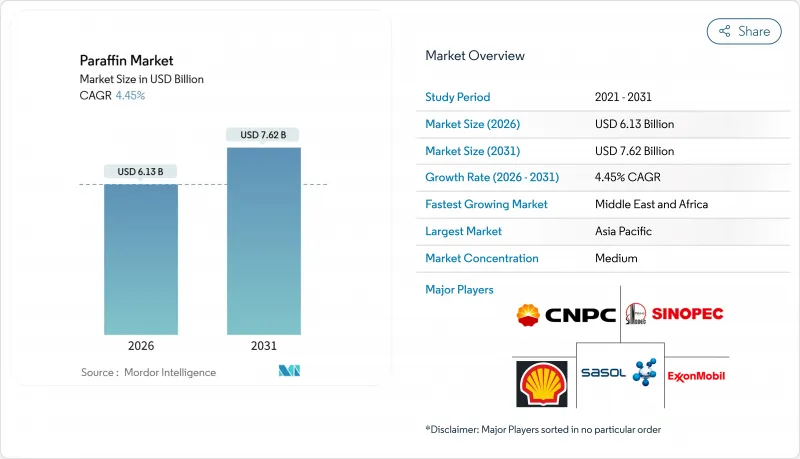
根據 Mordor Intelligence 估計,2026 年石蠟市場價值為 61.3 億美元,預計在預測期(2026-2031 年)內將以 4.45% 的複合年成長率成長,到 2031 年達到 76.2 億美元。
本報告按類型(石蠟、液體石蠟、煤油、凡士林)、應用領域(化妝品和個人護理、紙板和包裝、燃料、橡膠、潤滑劑及其他應用)和地區(亞太地區、北美地區、歐洲地區、南美地區以及中東和非洲地區)進行細分。市場預測以美元計價。
全球石蠟市場趨勢與洞察
蠟燭製造需求增加
儘管大豆蠟和蜂蠟等替代品的競爭日益激烈,石蠟在全球蠟燭產業的原料供應量中仍佔據重要佔有率。大眾市場品牌偏好石蠟,因為它香味擴散穩定、熔點一致,且價格優於植物蠟。由於原料成本佔每支蠟燭總成本的很大一部分,與綜合煉油廠簽訂剩餘蠟供應合約的製造商即使在原油價格波動的情況下也能維持利潤率。雖然永續性如今已成為高階市場的焦點,但在北美和歐洲,通用石蠟在注重性價比和季節性產品的市場中仍然佔據主導地位。歐盟持續關注低價中國蠟燭,加劇了供應的不確定性,促使區域製造商加快爭取長期蠟供應合約的步伐。
個人護理和化妝品生產規模擴大,尤其是在亞洲。
亞太地區中產階級的壯大推動了液態石蠟在保濕霜、潤唇膏和護髮產品中的消費。BASF已提升其上海潤膚劑產能以滿足此趨勢。液態石蠟,學名為“paraffinum liquidum”,符合歐盟法規1223/2009和美國FDA 21 CFR 172.880的要求,使跨國品牌能夠放心地拓展其產品配方,確保合規性。儘管「清潔美容」趨勢推動了荷荷巴油和乳木果油的使用,但由於成本績效和微生物穩定性,液態石蠟仍然是大眾市場產品中的主要成分。擁有垂直整合煉油廠的傳統供應商受益於REACH法規,該法規要求提供完整的煉油歷史記錄,限制了投機性進口。
生物基蠟替代品的快速發展
嘉吉公司的NatureWax系列產品提供源自大豆、椰子、棕櫚和菜籽的蠟,這些蠟可直接用於罐裝蠟燭和蠟燭熔塊的生產,而無需顯著改變生產過程。愛荷華州立大學的測試表明,大豆蠟混合物的燃燒時間與石蠟相當,縮小了先前存在的性能差距。加州65號提案對石油基蠟燭的警告以及歐盟的循環經濟目標,正推動採購趨勢轉向可再生資源。 2024年後,提取效率的提高將降低大豆蠟的成本,從而削弱石蠟的價格優勢。儘管由於需要平衡食品、生質柴油和蠟的需求,農業原料的生產規模仍受到限制,但通用蠟燭蠟生產商的利潤率仍面臨壓力。
細分市場分析
到2025年,石蠟將佔石蠟市場44.36%的佔有率,主要驅動力來自蠟燭製造和包裝塗料。由於生物基替代品逐漸銷售量通用蠟的市場佔有率,該細分市場的成長落後於石蠟市場的整體擴張。液態石蠟的複合年成長率為5.42%,配方生產商重視符合美國FDA 21 CFR 172.880和歐盟法規1223/2009的要求。Orix集團GTL工廠生產的超高純度FT蠟價格較高,適用於對硫含量要求接近零的醫藥和食品接觸應用。凡士林(主要由聯合利華旗下的「凡士林」主導)仍然是一個小眾但穩定的細分市場。煤油與石蠟市場仍有間接聯繫,其需求主要受航空燃料供需趨勢驅動,而非蠟提取。成長率的比較表明,市場需求集中在高純度、特定用途的等級產品上,這些產品可以賣出更高的價格,而通用石蠟的市場佔有率正在逐漸縮小。
特種產品供應量的不斷成長正在進一步改變市場結構。埃克森美孚的「Prowaxx」系列產品涵蓋從全精煉蠟到粗蠟的各種產品,正在實現公司一體化價值鏈的商業化。歐洲REACH法規只允許具備完整原料可追溯性的煉油商進入市場。全叢集(FT)生產需要數十億美元的投資,而除政府支持的項目和大型石油公司合資企業外,新增產能的擴張幾乎停滯不前。這些結構性障礙導致石蠟市場兩極化加劇,使得特種蠟生產商能夠在通用蠟銷售量保持平穩的情況下提高盈利。
區域分析
預計到2025年,亞太地區將佔全球石蠟市場收入的46.27%,主要得益於中國煉油規模的擴大和印度產能的不斷成長。 2024年上半年,中石化的原油加工量支撐了該地區的石蠟供應,但歐盟增值稅的變化限制了其維持低出口價格的能力。在印度,石蠟主要產自古吉拉突邦、帕尼帕特和巴勞尼的煉油廠。然而,由於國內增值產品產量有限,印度仍依賴進口特種產品。日本ENEOS公司向對產品品質要求較高的電子和製藥企業供應高純度石蠟。隨著中國企業為規避歐盟關稅而將生產設施遷往他處,韓國和東南亞國協正逐漸成為替代生產地,重塑了區域供應鏈格局。
中東和非洲的石蠟市場正以5.23%的複合年成長率成長。沙烏地阿拉伯下游產業的擴張、南非Sasol公司生產的燃料製油(FT)產品以及豐富的低硫原料供應,都支撐了其價格競爭力。殼牌和Sasol在卡達的Orix GTL綜合體供應符合全球醫藥標準的超高純度石蠟。儘管北美和歐洲的成長速度較慢,但由於一些特殊應用優先考慮品質和合規性,人均消費量仍然很高。埃克森美孚在新加坡和鹿特丹的加氫裂解裝置維修正在擴大II類石蠟的產能,從而增強了這兩個地區的高純度石蠟供應。以巴西石油公司(Petrobras)為首的南美洲預計將在經濟發展的推動下實現穩步成長,而除南非以外的非洲國家則專注於向歐洲出口。
區域趨勢表明,在石蠟市場,銷售成長主要集中在亞太地區和中東,而北美和歐洲則主要透過特種石蠟來追求盈利。隨著貿易政策的演變,供應鏈的複雜性預計將會增加,因此區域整合和物流能力對於價值創造至關重要。
其他好處:
- Excel格式的市場預測(ME)表
- 3個月的分析師支持
目錄
第1章:引言
- 研究假設和市場定義
- 調查範圍
第2章:調查方法
第3章執行摘要
第4章 市場狀況
- 市場概覽
- 市場促進因素
- 蠟燭製造業的需求增加
- 個人護理和化妝品生產規模擴大,尤其是在亞洲。
- 電子商務主導的軟性包裝市場成長
- 利用FT法實現超高純度石蠟的商業化
- 石蠟模型在精密金屬鑄造和積層製造上的應用。
- 市場限制因素
- 生物基蠟替代品的快速發展
- 原油衍生原料成本的波動
- 歐盟的反傾銷稅正在抑制中國的蠟燭出口。
- 價值鏈分析
- 監理情勢
- 技術展望
- 波特五力模型
第5章 市場規模與成長預測
- 按類型
- 石蠟
- 液態石蠟
- 煤油
- 凡士林
- 透過使用
- 化妝品和個人護理
- 紙板和包裝
- 燃料
- 橡皮
- 潤滑劑
- 其他用途
- 按地區
- 亞太地區
- 中國
- 印度
- 日本
- 韓國
- 東南亞國協
- 其他亞太國家
- 北美洲
- 美國
- 加拿大
- 墨西哥
- 歐洲
- 德國
- 英國
- 義大利
- 法國
- 俄羅斯
- 其他歐洲國家
- 南美洲
- 巴西
- 阿根廷
- 其他南美國家
- 中東和非洲
- 南非
- 沙烏地阿拉伯
- 其他中東和非洲國家
- 亞太地區
第6章 競爭情勢
- 市場集中度
- 策略趨勢
- 市佔率和排名分析
- 公司簡介
- Calumet Specialty Products Partners
- Cepsa
- China National Petroleum Corporation(CNPC)
- China Petroleum & Chemical Corporation(Sinopec)
- ENEOS Corporation
- Exxon Mobil Corporation
- Farabi Petrochemicals Company
- H&R Group
- HollyFrontier Refining & Marketing LLC
- Hywax GmbH
- Indian Oil Corporation Ltd
- Kemipex
- LANXESS
- NIPPON SEIRO CO., LTD
- PersianParaffin
- Petrobras
- Repsol
- Sasol Ltd
- Shell plc
- The International Group Inc.
第7章 市場機會與未來展望
According to Mordor Intelligence, the paraffin market size is estimated at USD 6.13 billion in 2026, and is expected to reach USD 7.62 billion by 2031, at a CAGR of 4.45% during the forecast period (2026-2031).
This report is Segmented by Type (Paraffin Wax, Liquid Paraffin, Kerosene, and Petroleum Jelly), Application (Cosmetics and Personal Care, Paperboard and Packaging, Fuel, Rubber, Lubricants, and Other Applications), and Geography (Asia-Pacific, North America, Europe, South America, and Middle-East and Africa). The Market Forecasts are Provided in Terms of Value (USD).
Global Paraffin Market Trends and Insights
Rising Demand from Candle Manufacturing
Paraffin retains a significant share of raw-material volume in the global candle sector despite mounting competition from soy and beeswax alternatives. Mass-market brands favor paraffin because of its scent throw consistency, lower melting point variance, and price advantage over plant waxes. Feedstock costs account for a significant portion of total candle unit economics, so producers that lock in slack-wax contracts with integrated refiners can protect margins during crude swings. Sustainability positioning now shapes premium segments, yet value-tier and seasonal lines in North America and Europe still rely on commodity paraffin. Ongoing EU scrutiny of low-priced Chinese candles adds supply uncertainty, further motivating regional manufacturers to secure long-term wax contracts.
Expansion of Personal-Care and Cosmetics Production, Especially in Asia
Asia-Pacific's expanding middle class underpins liquid paraffin consumption in moisturizers, lip balms, and hair-care products. BASF ramped emollient capacity in Shanghai to align with this trajectory. Liquid paraffin, listed as "paraffinum liquidum," satisfies EU Regulation 1223/2009 and FDA 21 CFR 172.880, giving multinational brands the compliance confidence to scale formulations. Although clean-beauty narratives spur trials of jojoba and shea butter, liquid paraffin's cost-effectiveness and microbiological stability keep it embedded in mass-market SKUs. Established suppliers with vertically integrated refineries benefit from REACH rules that demand full refining traces, limiting opportunistic imports.
Rapid Development of Bio-Based Wax Substitutes
Cargill's NatureWax line supplies soy, coconut, palm, and rapeseed waxes that slot into container candles and wax melts without major process tweaks. Iowa State University trials show soy blends can match paraffin's burn time, shrinking the historical performance gap. California Proposition 65 warnings on petroleum-derived candles and EU circular-economy goals steer procurement toward renewables. Soy-wax costs have fallen since 2024 on crushing-efficiency gains, eroding paraffin's price lead. Scaling constraints remain, as agri-feedstocks must balance food, biodiesel, and wax demand, but commodity candle-wax producers still face margin pressure.
Other drivers and restraints analyzed in the detailed report include:
- Growth of E-Commerce-Led Flexible Packaging
- Commercialisation of Ultra-Pure FT-Based Paraffin Grades
- Volatility in Crude-Oil-Derived Feedstock Costs
For complete list of drivers and restraints, kindly check the Table Of Contents.
Segment Analysis
Paraffin wax controlled 44.36% of the paraffin market share in 2025, anchored by candle manufacturing and packaging coatings. Growth for the segment lags the paraffin market size expansion because bio-based options are chipping away at commodity volumes. Liquid paraffin is advancing at a 5.42% CAGR, with formulators rewarding its compliance under FDA 21 CFR 172.880 and EU Regulation 1223/2009. Ultra-pure FT waxes from the Oryx GTL plant command premiums and align with pharmaceutical and food-contact applications that demand near-zero sulfur. Petroleum jelly, dominated by Unilever's Vaseline, remains a niche yet steady sub-segment. Kerosene stays tangential to the paraffin market, as aviation fuel dynamics drive most demand rather than wax extraction. The contrast in growth rates shows volume gravitating toward high-purity, application-specific grades that justify premiums, while commodity paraffin wax endures gradual erosion.
Widening specialty supply further shifts the landscape. ExxonMobil's Prowaxx line spans from fully refined to slack waxes, monetizing its integrated value chain. REACH registration in Europe limits market entry to refiners with full feedstock traceability. FT output requires a multibillion-dollar investment, stalling new capacity outside state-backed or supermajor ventures. These structural hurdles reinforce a bifurcated paraffin market in which specialty producers grow profitability even if commodity volumes flatten.
Complete Report Scope:
- By Type
- Paraffin Wax
- Liquid Paraffin
- Kerosene
- Petroleum Jelly
- By Application
- Cosmetics and Personal Care
- Paperboard and Packaging
- Fuel
- Rubber
- Lubricants
- Other Applications
- By Geography
- Asia-Pacific
- China
- India
- Japan
- South Korea
- ASEAN Countries
- Rest of Asia-Pacific
- North America
- United States
- Canada
- Mexico
- Europe
- Germany
- United Kingdom
- Italy
- France
- Russia
- Rest of Europe
- South America
- Brazil
- Argentina
- Rest of South America
- Middle-East and Africa
- South Africa
- Saudi Arabia
- Rest of Middle-East and Africa
- Asia-Pacific
Geography Analysis
Asia-Pacific held 46.27% of the paraffin market revenue in 2025, underpinned by China's refining scale and India's rising capacity. In the first half of 2024, Sinopec's crude throughput supported regional wax availability; however, changes in EU VAT have restricted its ability to underprice exports. India's refining system produces paraffin wax in Gujarat, Panipat, and Barauni. Yet due to limited domestic upgrading, the country still relies on specialty imports. Japan's ENEOS channels high-purity waxes to electronics and pharmaceutical manufacturers that demand consistent quality. South Korea and ASEAN nations are emerging as alternative hubs as Chinese companies reroute production to avoid potential EU duties, reshaping regional supply networks.
The Middle East and Africa paraffin market is growing at a 5.23% CAGR. Saudi Arabia's downstream expansion, South Africa's Sasol FT output, and abundant low-sulfur feedstock support competitive pricing. Shell and Sasol's Oryx GTL complex in Qatar provides ultra-pure waxes that meet global pharmaceutical specifications. North America and Europe grow more slowly but boast higher per-capita consumption due to specialty applications that value quality and compliance. ExxonMobil's Singapore and Rotterdam hydrocracker upgrades add Group II capacity, reinforcing the supply of high-purity waxes for both regions. South America, led by Brazil's Petrobras, offers incremental growth linked to economic development, while Africa, beyond South Africa, focuses on exporting to Europe.
The geographic split illustrates a paraffin market in which volume growth concentrates in Asia-Pacific and the Middle East, whereas North America and Europe pursue profitability via specialty grades. Supply-chain complexity will intensify as trade policies evolve, making regional integration and logistics capabilities critical to value capture.
- Calumet Specialty Products Partners
- Cepsa
- China National Petroleum Corporation (CNPC)
- China Petroleum & Chemical Corporation (Sinopec)
- ENEOS Corporation
- Exxon Mobil Corporation
- Farabi Petrochemicals Company
- H&R Group
- HollyFrontier Refining & Marketing LLC
- Hywax GmbH
- Indian Oil Corporation Ltd
- Kemipex
- LANXESS
- NIPPON SEIRO CO., LTD
- PersianParaffin
- Petrobras
- Repsol
- Sasol Ltd
- Shell plc
- The International Group Inc.
Additional Benefits:
- The market estimate (ME) sheet in Excel format
- 3 months of analyst support
TABLE OF CONTENTS
1 Introduction
- 1.1 Study Assumptions and Market Definition
- 1.2 Scope of the Study
2 Research Methodology
3 Executive Summary
4 Market Landscape
- 4.1 Market Overview
- 4.2 Market Drivers
- 4.2.1 Rising demand from candle manufacturing
- 4.2.2 Expansion of personal-care and cosmetics production, especially in Asia
- 4.2.3 Growth of e-commerce-led flexible packaging
- 4.2.4 Commercialisation of ultra-pure FT-based paraffin grades
- 4.2.5 Adoption of paraffin patterns in precision metal casting and additive manufacturing
- 4.3 Market Restraints
- 4.3.1 Rapid development of bio-based wax substitutes
- 4.3.2 Volatility in crude-oil-derived feedstock costs
- 4.3.3 EU anti-dumping duties curbing Chinese candle exports
- 4.4 Value Chain Analysis
- 4.5 Regulatory Landscape
- 4.6 Technological Outlook
- 4.7 Porter's Five Forces
- 4.7.1 Bargaining Power of Suppliers
- 4.7.2 Bargaining Power of Consumers
- 4.7.3 Threat of New Entrants
- 4.7.4 Threat of Substitute Products
- 4.7.5 Intensity of Competitive Rivalry
5 Market Size and Growth Forecasts (Value)
- 5.1 By Type
- 5.1.1 Paraffin Wax
- 5.1.2 Liquid Paraffin
- 5.1.3 Kerosene
- 5.1.4 Petroleum Jelly
- 5.2 By Application
- 5.2.1 Cosmetics and Personal Care
- 5.2.2 Paperboard and Packaging
- 5.2.3 Fuel
- 5.2.4 Rubber
- 5.2.5 Lubricants
- 5.2.6 Other Applications
- 5.3 By Geography
- 5.3.1 Asia-Pacific
- 5.3.1.1 China
- 5.3.1.2 India
- 5.3.1.3 Japan
- 5.3.1.4 South Korea
- 5.3.1.5 ASEAN Countries
- 5.3.1.6 Rest of Asia-Pacific
- 5.3.2 North America
- 5.3.2.1 United States
- 5.3.2.2 Canada
- 5.3.2.3 Mexico
- 5.3.3 Europe
- 5.3.3.1 Germany
- 5.3.3.2 United Kingdom
- 5.3.3.3 Italy
- 5.3.3.4 France
- 5.3.3.5 Russia
- 5.3.3.6 Rest of Europe
- 5.3.4 South America
- 5.3.4.1 Brazil
- 5.3.4.2 Argentina
- 5.3.4.3 Rest of South America
- 5.3.5 Middle-East and Africa
- 5.3.5.1 South Africa
- 5.3.5.2 Saudi Arabia
- 5.3.5.3 Rest of Middle-East and Africa
- 5.3.1 Asia-Pacific
6 Competitive Landscape
- 6.1 Market Concentration
- 6.2 Strategic Moves
- 6.3 Market Share/Ranking Analysis
- 6.4 Company Profiles (includes Global level Overview, Market level overview, Core Segments, Financials as available, Strategic Information, Market Rank/Share, Products and Services, Recent Developments)
- 6.4.1 Calumet Specialty Products Partners
- 6.4.2 Cepsa
- 6.4.3 China National Petroleum Corporation (CNPC)
- 6.4.4 China Petroleum & Chemical Corporation (Sinopec)
- 6.4.5 ENEOS Corporation
- 6.4.6 Exxon Mobil Corporation
- 6.4.7 Farabi Petrochemicals Company
- 6.4.8 H&R Group
- 6.4.9 HollyFrontier Refining & Marketing LLC
- 6.4.10 Hywax GmbH
- 6.4.11 Indian Oil Corporation Ltd
- 6.4.12 Kemipex
- 6.4.13 LANXESS
- 6.4.14 NIPPON SEIRO CO., LTD
- 6.4.15 PersianParaffin
- 6.4.16 Petrobras
- 6.4.17 Repsol
- 6.4.18 Sasol Ltd
- 6.4.19 Shell plc
- 6.4.20 The International Group Inc.
7 Market Opportunities and Future Outlook
- 7.1 White-space and Unmet-need Assessment

 全球石蠟市場規模、佔有率、趨勢和成長分析報告(2026-2034年)
 微膠囊化石蠟相變材料市場規模、佔有率和成長分析:按產品類型、外殼材料、形態、應用、溫度範圍、終端用戶產業和地區分類-2026-2033年產業預測
 C5-C8正構石蠟市場:依等級、純度、功能、包裝類型、應用、終端用戶產業和銷售管道-全球預測,2026-2032年氯化石蠟市場:依供應鍊長度、應用、終端用戶產業及通路分類-2026-2032年全球預測
 氯化石蠟市場規模、佔有率、趨勢及預測(按產品類型、應用和地區分類,2026-2034年)
 2026年全球氯化石蠟市場報告
 石蠟市場-全球產業規模、佔有率、趨勢、機會、預測:按類型、應用、地區和競爭格局分類,2021-2031年液態石蠟市場按等級、包裝類型、純度、應用和分銷管道分類-全球預測(2026-2032 年)
 氯化石蠟市場規模、佔有率及成長分析(按產品類型、應用和地區分類)-2026-2033年產業預測
 高黏度聚乙烯醇:全球市佔率及排名、總收入及需求預測(2025-2031年)