


 |
市場調查報告書
商品編碼
2114278
球閥:市佔率分析、產業趨勢與統計、成長預測(2026-2031)Ball Valve - Market Share Analysis, Industry Trends & Statistics, Growth Forecasts (2026 - 2031) |
||||||

※ 本網頁內容可能與最新版本有所差異。詳細情況請與我們聯繫。
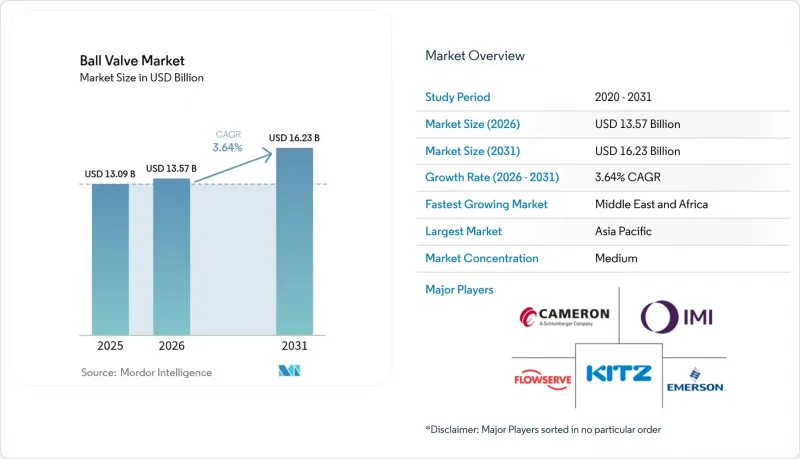
據 Mordor Intelligence 稱,2025 年球閥市值為 130.9 億美元,預計到 2031 年將達到 162.3 億美元,而 2026 年為 135.7 億美元,預測期(2026-2031 年)的複合年成長率為 3.64%。
本報告按閥門類型(浮動、耳軸式、升降桿式、頂入式、全焊接式、低溫式)、材質(碳鋼、不銹鋼、鑄鐵等)、閥門尺寸(1英寸以下、1-6英寸、6-25英寸等)、操作方式(手動、電動、氣壓、其他天然氣)、最終用戶(石油處理、石油處理、石油處理)。市場預測以美元(USD)計價。
全球球閥市場趨勢與洞察
亞太地區新興國家液化天然氣基礎設施的快速擴張
亞洲各國政府將液化天然氣(LNG)視為加強能源安全和減少對煤炭依賴的直接途徑。預計到2025年,全球LNG出口能力將成長18%,主要目標市場為亞洲進口終端,這將推動對能夠承受低至-162 度C低溫的低溫球閥的需求。這些閥門必須確保在液化、運輸和再氣化整個過程中實現無洩漏密封。因此,擁有先進冶金技術和成熟低溫測試經驗的供應商具有顯著優勢。在越南和菲律賓等依賴進口、管線網路不發達的市場,浮體式儲存再氣化裝置(FSRU)正部署使用高品質的耳軸式低溫閥門。這項需求推高了平均售價,並保護了主要供應商免受替代風險的影響,進一步鞏固了球閥市場的盈利發展。
在歐洲的氫氣和碳捕集與封存計畫中,球閥在惡劣環境下的應用正在不斷擴大。
歐盟計畫在2030年生產1000萬噸可再生氫,這就要求管道和儲氫網路能夠承受超過700巴的壓力,同時避免氫致裂紋的產生。為了滿足這些機械要求,並應對二氧化碳捕集與儲存(CCS)管線中超臨界二氧化碳帶來的腐蝕挑戰,雙相和超級雙相合金正逐漸成為主流生產材料。獲得認證、符合不斷發展的氫能標準的製造商享有先發優勢,因為工廠業主在簽訂合約前會要求提供可靠的安全證明文件。這一趨勢正在鞏固歐洲作為技術示範基地的地位,並擴大球閥市場的高階細分領域。
由於全球鍛造產能有限,前置作業時間正在延長。
由於過去十年供應商的整合,目前僅有少數幾家開式模鍛廠能夠生產大直徑鎳合金坯料。航太產業和能源產業需求的同步成長,使得產能捉襟見肘,交貨週期從傳統的12-16週延長至24-32週。專案業主現在必須要么儲備緩衝庫存,要么在進度風險超過技術優勢的情況下接受替代閥門類型。雖然一些原始設備製造商(OEM)正在尋求垂直整合,但所需的資金投入和認證時間意味著,至少在本世紀末之前,情況不太可能有所改善。
細分市場分析
預計到2025年,浮動球閥市場將佔總銷售額的26.60%,主要得益於其在煉油廠、供水和通用應用領域的高適應性。雖然低溫球閥目前仍屬於小眾市場,但由於LNG接收站和氫氣出口樞紐對可在低至-162 度C的溫度下可靠密封的需求,其市場正以6.12%的複合年成長率快速成長。終端用戶優先考慮經氦質譜測試檢驗的「零洩漏」閥座和「防爆」閥桿,這提高了市場進入門檻,並維持了較高的價格水平。
目前,在潛水艇先導計畫中經過驗證的積層製造流體通道,與全焊接閥體相比,可實現更輕的重量和更低的壓力損失。同時,軌道式和升降式閥桿設計即使在傳統浮動閥會因節流操作而損壞的情況下,也能維持閥座的使用壽命。這些技術的進步,使得產品系列更加多元化,功能範圍更加廣泛,即使在蝶閥和塞閥等替代閥正在被考慮的市場中,球閥仍然保持著重要的地位。
由於碳鋼在管道和工業設施中具有優異的強度成本比,預計到2025年,碳鋼將佔球閥市場規模的31.50%。整體,氫氣專案傾向使用抗脆性的超級雙相鋼和奧氏體鋼閥體,合金需求正以5.07%的複合年成長率成長。此外,雙相鋼可以提高耐壓等級,使管道工程師能夠減少管道壁厚,從而降低資本投資。
由於不銹鋼價格波動,原始設備製造商 (OEM) 擴大採用符合 304L 和 316L 雙重認證標準的鋼材,從而提高採購柔軟性。此外,積層製造技術的引入使得功能梯度材料的應用成為可能,其中高鎳基體增強板材層,而碳鋼主要用於外殼,從而最佳化了整體成本。
區域分析
到2025年,亞洲將佔球閥市場收入的30.60%,這主要得益於中國工業的成長和東南亞液化天然氣進口終端的建設。各國政府所推行的清潔能源政策正在支持閥門的永續供應。印度的「印度製造」計畫正在促進國內閥門生產,但仍依賴進口符合氫能先導計畫嚴苛使用條件的閥內件。日本和韓國在區域貿易中保持著技術優勢,優先發展用於特定化學製程的高性能合金。
中東是成長最快的地區,預計到2031年將維持4.94%的複合年成長率,主要得益於營運商對現有油田進行低排放閥門維修,以及建造新的液化天然氣巨型生產線。光是卡達的北田擴建計畫就需要數千台低溫閥門裝置,而沙烏地阿美公司正在其整個天然氣集輸網路中部署智慧執行器,以滿足甲烷排放強度目標。土耳其的交通網擴建計畫也帶動了大口徑管道閥門訂單的成長。
由於中游環節的更換義務,北美仍佔據相當大的市場佔有率。頁岩氣收集系統需要耐酸性氣體的高壓球閥。加拿大油砂管路需要硬面閥座來應對瀝青磨損。墨西哥正在開放能源市場,並為其出口管道進口API 6D認證的閥門。氣候變遷法規正在推動ISO 15848-1認證產品的普及,這些法規提出了有利於知名品牌的額外要求。
其他好處:
- Excel格式的市場預測(ME)表
- 3個月的分析師支持
目錄
第1章:引言
- 研究假設和市場定義
- 調查範圍
第2章:調查方法
第3章執行摘要
第4章 市場狀況
- 市場概覽
- 市場促進因素
- 亞太地區新興國家的液化天然氣基礎建設正在加速擴張。
- 在歐洲的氫能和碳捕集與封存計畫中,球閥在惡劣環境下的應用正在不斷擴大。
- 北美中游產業的強制性資產現代化正在推動設備升級的需求。
- 北歐國家供水事業的快速數字化正在推動智慧球閥的普及。
- FPSO部署的快速成長導致低溫球閥在巴西和西非地區的應用日益廣泛。
- 在中東地區推廣低排放(「零甲烷洩漏」)閥門的相關法規
- 市場限制因素
- 由於全球鍛造產能有限,前置作業時間正在延長。
- 在磨蝕性採礦應用中,金屬座閥的初始投資較高
- 在緊湊型HVAC系統中,旋塞閥和蝶閥越來越受歡迎。
- 不銹鋼價格的波動給亞洲二級加工企業的利潤率帶來了壓力。
- 價值供應鏈分析
- 監理展望
- 技術展望
- 波特五力分析
- 投資和資金籌措分析
第5章 市場規模與成長預測
- 按閥門類型
- 浮動球閥
- 耳軸式球閥
- 升降桿/軌道球閥
- 頂部進球閥
- 全焊接球閥
- 低溫球閥
- 材料
- 碳鋼
- 不銹鋼
- 鑄鐵/球墨鑄鐵
- 合金(雙相鋼、因科鎳合金、哈氏合金)
- 青銅和黃銅
- 其他材料
- 按閥門尺寸
- 小於 1 英吋(DN 25)
- 1英寸至6英寸
- 6 "-25"
- 25英寸至50英寸
- 50吋或更大
- 驅動
- 手動的
- 電的
- 氣壓
- 油壓
- 電液
- 按最終用戶行業分類
- 石油和天然氣
- 化工/石油化工
- 水和污水處理
- 發電
- 採礦和金屬
- 食品/飲料
- 製藥和生物技術
- 暖通空調和製冷
- 紙漿和造紙
- 其他行業
- 按地區
- 北美洲
- 美國
- 加拿大
- 墨西哥
- 歐洲
- 英國
- 德國
- 法國
- 義大利
- 其他歐洲國家
- 亞太地區
- 中國
- 日本
- 印度
- 韓國
- 其他亞太國家
- 中東
- 以色列
- 沙烏地阿拉伯
- 阿拉伯聯合大公國
- 土耳其
- 其他中東國家
- 非洲
- 南非
- 埃及
- 其他非洲國家
- 南美洲
- 巴西
- 阿根廷
- 其他南美國家
- 北美洲
第6章 競爭情勢
- 市場集中度
- 策略趨勢
- 市佔率分析
- 公司簡介
- Emerson Electric Co.
- Flowserve Corporation
- Schlumberger(Cameron)
- IMI plc
- Kitz Corporation
- Crane Co.
- Baker Hughes(Valves and Process Solutions)
- Honeywell International Inc.
- Alfa Laval AB
- Curtiss-Wright Corporation
- SAMSON AG
- Velan Inc.
- CIRCOR International Inc.
- AVK Holding
- Mueller Water Products Inc.
- Neway Valve Co., Ltd.
- Bonney Forge Corp.
- Metso Corporation(Valmet)
- Hitachi Ltd.
- Valvitalia SpA
- Georg Fischer Ltd.
- Danfoss A/S
- Castel SRL
- Sanhua Holding Group
第7章 市場機會與未來展望
According to Mordor Intelligence, the ball valve market size was valued at USD 13.09 billion in 2025 and estimated to grow from USD 13.57 billion in 2026 to reach USD 16.23 billion by 2031, at a CAGR of 3.64% during the forecast period (2026-2031).
This report is Segmented by Valve Type (Floating, Trunnion-Mounted, Rising-Stem, Top-Entry, Fully-Welded, Cryogenic), Material (Carbon Steel, Stainless Steel, Cast Iron, and More), Valve Size (Up To 1", 1"-6", 6"-25", and More), Actuation (Manual, Electric, Pneumatic, and More), End-User (Oil & Gas, Chemicals, Water, and More), and Geography. The Market Forecasts are Provided in Terms of Value (USD).
Global Ball Valve Market Trends and Insights
Accelerated LNG Infrastructure Expansion in Emerging Asia Pacific
Asian governments view LNG as an immediate route to strengthen energy security and cut coal reliance. An 18% rise in global LNG export capacity in 2025, mainly aimed at Asian import terminals, magnifies demand for cryogenic ball valves rated to -162 °C. These units must guarantee methane-tight sealing throughout liquefaction, transport, and regasification duty, which favors vendors with deep metallurgical expertise and validated low-temperature testing records. Import-dependent markets such as Vietnam and the Philippines, lacking pipeline grids, are rolling out floating storage and regasification units that specify premium trunnion-mounted cryogenic valves. This requirement lifts average selling prices and insulates leading suppliers from substitution risk, reinforcing profitable growth for the Ball valve market.
Rising Adoption of Severe-Service Ball Valves in Hydrogen & CCS Projects across Europe
The EU's plan to generate 10 million t of renewable hydrogen by 2030 requires pipelines and storage networks that can withstand pressures above 700 bar while avoiding hydrogen-induced cracking. Duplex and super-duplex alloys are moving into mainstream production to meet these mechanical demands and the corrosion challenges of supercritical CO2 in carbon capture and storage (CCS) lines. Manufacturers that certify materials under evolving hydrogen standards enjoy a first-mover advantage, because plant owners seek proven safety documentation before awarding contracts. This trend cements Europe's role as a technology test bed and enlarges the premium tier of the Ball valve market.
Prolonged Lead-Times due to Global Forging Capacity Constraints
A decade of supplier consolidation has left only a handful of open-die forges capable of producing large-diameter, nickel-alloy blanks. Simultaneous demand from aerospace and energy increases capacity strain, with delivery cycles stretching to 24-32 weeks versus the historical 12-16 week window. Project owners now embed buffer inventories or accept alternate valve styles if schedule risk outweighs technical benefit. Some OEMs pursue vertical integration, but capital needs and qualification timelines delay relief until late decade.
Other drivers and restraints analyzed in the detailed report include:
- North American Mid-stream Asset Modernization Mandates Driving Replacement Demand
- Rapid Digitalization of Water Utilities Spurs Smart Ball Valve Retrofit in Nordics
- High Capital Outlay for Metal-Seated Valves in Abrasive Mining Applications
For complete list of drivers and restraints, kindly check the Table Of Contents.
Segment Analysis
The Ball valve market size for floating designs logged 26.60% revenue in 2025, driven by their adaptability across refinery, water, and general-purpose services. Cryogenic ball valves, though niche, are rising at a 6.12% CAGR as LNG terminals and hydrogen export hubs demand guaranteed sealing down to -162 °C. End users emphasize zero-leakage seats and blow-out-proof stems validated by helium mass-spectrometer testing, a standard that raises entry barriers and sustains premium price realization.
Additive-manufactured flow paths, now field-proven in subsea pilots, reduce weight and pressure drop in fully welded bodies. Meanwhile, orbit and rising-stem variants preserve seat life where throttling duty would damage conventional floating valves. Together, these developments diversify product portfolios and extend the functional scope, preserving relevance of ball valves even in markets exploring butterfly or plug alternatives.
Carbon steel held 31.50% share of the Ball valve market size in 2025 thanks to its favorable strength-to-cost ratio across pipelines and industrial utilities. Hydrogen projects now favor alloy-based bodies with super-duplex or austenitic grades to resist embrittlement, raising alloy demand at a 5.07% CAGR. Duplex grades also unlock higher allowable pressure ratings, enabling pipeline engineers to downsize schedules and shave capex.
Stainless-steel price volatility pushes OEMs to qualify dual-certified grades that meet both 304L and 316L requirements, streamlining procurement flexibility. Additive manufacturing introduces functionally graded materials where high-nickel matrices reinforce seat zones, while carbon-steel dominates outer shells, optimizing total cost.
Complete Report Scope:
- By Valve Type
- Floating Ball Valves
- Trunnion-Mounted Ball Valves
- Rising-Stem / Orbit Ball Valves
- Top-Entry Ball Valves
- Fully-Welded Ball Valves
- Cryogenic Ball Valves
- By Material
- Carbon Steel
- Stainless Steel
- Cast Iron / Ductile Iron
- Alloy-Based (Duplex, Inconel, Hastelloy)
- Bronze and Brass
- Other Materials
- By Valve Size
- Up to 1" (DN 25)
- 1" - 6"
- 6 " - 25"
- 25" - 50"
- Above 50"
- By Actuation
- Manual
- Electric
- Pneumatic
- Hydraulic
- Electro-Hydraulic
- By End-User Industry
- Oil and Gas
- Chemicals and Petrochemicals
- Water and Wastewater
- Power Generation
- Mining and Metals
- Food and Beverage
- Pharmaceuticals and Biotechnology
- HVAC and Refrigeration
- Pulp and Paper
- Other Industries
- By Geography
- North America
- United States
- Canada
- Mexico
- Europe
- United Kingdom
- Germany
- France
- Italy
- Rest of Europe
- Asia-Pacific
- China
- Japan
- India
- South Korea
- Rest of Asia-Pacific
- Middle East
- Israel
- Saudi Arabia
- United Arab Emirates
- Turkey
- Rest of Middle East
- Africa
- South Africa
- Egypt
- Rest of Africa
- South America
- Brazil
- Argentina
- Rest of South America
- North America
Geography Analysis
Asia accounted for 30.60% of Ball valve market revenue in 2025, propelled by Chinese industrial growth and Southeast Asian LNG import terminals. Government policies that mandate cleaner energy mix underpin sustained valve procurement. India's "Make in India" scheme fosters domestic valve production yet still relies on imported severe-service trims for hydrogen pilots. Japan and South Korea prioritize high-performance alloys for niche chemical processes, maintaining a technology premium in regional trade.
The Middle East is the fastest-growing cluster, projecting 4.94% CAGR to 2031 as operators retrofit low-emission valves in legacy fields and build green-field LNG mega-trains. Qatar's North Field expansion alone calls for thousands of cryogenic units, while Saudi Aramco deploys smart actuators across gas gathering networks to satisfy methane-intensity goals. Turkey's transit ambitions also translate into large-bore pipeline valve orders.
North America retains sizable share owing to mid-stream replacement mandates. Shale-gas gathering systems need high-pressure ball valves resistant to acid gases. Canadian oil sands lines demand hard-faced seats to manage bitumen abrasion. Mexico, opening its energy market, imports API 6D-certified valves for export-class pipelines. Climate regulation stimulates adoption of ISO-15848-1 certified products, adding incremental requirements that favor established brands.
- Emerson Electric Co.
- Flowserve Corporation
- Schlumberger (Cameron)
- IMI plc
- Kitz Corporation
- Crane Co.
- Baker Hughes (Valves and Process Solutions)
- Honeywell International Inc.
- Alfa Laval AB
- Curtiss-Wright Corporation
- SAMSON AG
- Velan Inc.
- CIRCOR International Inc.
- AVK Holding
- Mueller Water Products Inc.
- Neway Valve Co., Ltd.
- Bonney Forge Corp.
- Metso Corporation (Valmet)
- Hitachi Ltd.
- Valvitalia S.p.A.
- Georg Fischer Ltd.
- Danfoss A/S
- Castel SRL
- Sanhua Holding Group
Additional Benefits:
- The market estimate (ME) sheet in Excel format
- 3 months of analyst support
TABLE OF CONTENTS
1 INTRODUCTION
- 1.1 Study Assumptions and Market Definition
- 1.2 Scope of the Study
2 RESEARCH METHODOLOGY
3 EXECUTIVE SUMMARY
4 MARKET LANDSCAPE
- 4.1 Market Overview
- 4.2 Market Drivers
- 4.2.1 Accelerated LNG Infrastructure Expansion in Emerging Asia Pacific
- 4.2.2 Rising Adoption of Severe-Service Ball Valves in Hydrogen and CCS Projects across Europe
- 4.2.3 North American Mid-stream Asset Modernization Mandates Driving Replacement Demand
- 4.2.4 Rapid Digitalization of Water Utilities Spurs Smart Ball Valve Retrofit in Nordics
- 4.2.5 Surge in FPSO Deployments Boosting Cryogenic Ball Valve Uptake in Brazil and West Africa
- 4.2.6 Regulatory Push for Low-Emission ("Fugitive-Methane-Free") Valves in the Middle East
- 4.3 Market Restraints
- 4.3.1 Prolonged Lead-Times due to Global Forging Capacity Constraints
- 4.3.2 High Capital Outlay for Metal-Seated Valves in Abrasive Mining Applications
- 4.3.3 Increasing Preference for Plug and Butterfly Valves in Compact HVAC Systems
- 4.3.4 Volatile Stainless-Steel Prices Eroding Margins for Tier-2 Asian Manufacturers
- 4.4 Value / Supply-Chain Analysis
- 4.5 Regulatory Outlook
- 4.6 Technological Outlook
- 4.7 Porter's Five Forces Analysis
- 4.7.1 Bargaining Power of Suppliers
- 4.7.2 Bargaining Power of Buyers
- 4.7.3 Threat of New Entrants
- 4.7.4 Threat of Substitutes
- 4.7.5 Intensity of Competitive Rivalry
- 4.8 Investment and Funding Analysis
5 MARKET SIZE AND GROWTH FORECASTS (VALUE)
- 5.1 By Valve Type
- 5.1.1 Floating Ball Valves
- 5.1.2 Trunnion-Mounted Ball Valves
- 5.1.3 Rising-Stem / Orbit Ball Valves
- 5.1.4 Top-Entry Ball Valves
- 5.1.5 Fully-Welded Ball Valves
- 5.1.6 Cryogenic Ball Valves
- 5.2 By Material
- 5.2.1 Carbon Steel
- 5.2.2 Stainless Steel
- 5.2.3 Cast Iron / Ductile Iron
- 5.2.4 Alloy-Based (Duplex, Inconel, Hastelloy)
- 5.2.5 Bronze and Brass
- 5.2.6 Other Materials
- 5.3 By Valve Size
- 5.3.1 Up to 1" (DN 25)
- 5.3.2 1" - 6"
- 5.3.3 6 " - 25"
- 5.3.4 25" - 50"
- 5.3.5 Above 50"
- 5.4 By Actuation
- 5.4.1 Manual
- 5.4.2 Electric
- 5.4.3 Pneumatic
- 5.4.4 Hydraulic
- 5.4.5 Electro-Hydraulic
- 5.5 By End-User Industry
- 5.5.1 Oil and Gas
- 5.5.2 Chemicals and Petrochemicals
- 5.5.3 Water and Wastewater
- 5.5.4 Power Generation
- 5.5.5 Mining and Metals
- 5.5.6 Food and Beverage
- 5.5.7 Pharmaceuticals and Biotechnology
- 5.5.8 HVAC and Refrigeration
- 5.5.9 Pulp and Paper
- 5.5.10 Other Industries
- 5.6 By Geography
- 5.6.1 North America
- 5.6.1.1 United States
- 5.6.1.2 Canada
- 5.6.1.3 Mexico
- 5.6.2 Europe
- 5.6.2.1 United Kingdom
- 5.6.2.2 Germany
- 5.6.2.3 France
- 5.6.2.4 Italy
- 5.6.2.5 Rest of Europe
- 5.6.3 Asia-Pacific
- 5.6.3.1 China
- 5.6.3.2 Japan
- 5.6.3.3 India
- 5.6.3.4 South Korea
- 5.6.3.5 Rest of Asia-Pacific
- 5.6.4 Middle East
- 5.6.4.1 Israel
- 5.6.4.2 Saudi Arabia
- 5.6.4.3 United Arab Emirates
- 5.6.4.4 Turkey
- 5.6.4.5 Rest of Middle East
- 5.6.5 Africa
- 5.6.5.1 South Africa
- 5.6.5.2 Egypt
- 5.6.5.3 Rest of Africa
- 5.6.6 South America
- 5.6.6.1 Brazil
- 5.6.6.2 Argentina
- 5.6.6.3 Rest of South America
- 5.6.1 North America
6 COMPETITIVE LANDSCAPE
- 6.1 Market Concentration
- 6.2 Strategic Moves
- 6.3 Market Share Analysis
- 6.4 Company Profiles (includes Global level Overview, Market level overview, Core Segments, Financials as available, Strategic Information, Market Rank/Share for key companies, Products and Services, and Recent Developments)
- 6.4.1 Emerson Electric Co.
- 6.4.2 Flowserve Corporation
- 6.4.3 Schlumberger (Cameron)
- 6.4.4 IMI plc
- 6.4.5 Kitz Corporation
- 6.4.6 Crane Co.
- 6.4.7 Baker Hughes (Valves and Process Solutions)
- 6.4.8 Honeywell International Inc.
- 6.4.9 Alfa Laval AB
- 6.4.10 Curtiss-Wright Corporation
- 6.4.11 SAMSON AG
- 6.4.12 Velan Inc.
- 6.4.13 CIRCOR International Inc.
- 6.4.14 AVK Holding
- 6.4.15 Mueller Water Products Inc.
- 6.4.16 Neway Valve Co., Ltd.
- 6.4.17 Bonney Forge Corp.
- 6.4.18 Metso Corporation (Valmet)
- 6.4.19 Hitachi Ltd.
- 6.4.20 Valvitalia S.p.A.
- 6.4.21 Georg Fischer Ltd.
- 6.4.22 Danfoss A/S
- 6.4.23 Castel SRL
- 6.4.24 Sanhua Holding Group
7 MARKET OPPORTUNITIES AND FUTURE OUTLOOK
- 7.1 White-Space and Unmet-Need Assessment

 球閥市場規模、佔有率和趨勢分析報告:按材質、閥門尺寸、應用、地區和細分市場預測(2026-2033 年)
 球閥市場-2026-2032年全球市場預測
 球閥市場規模、佔有率和成長分析:按類型、材質、最終用途、通路和地區分類-2026-2033年產業預測
 鍛鋼耳軸式球閥市場預測至2034年-按類型、應用和地區分類的全球分析
 工業球閥市場規模及預測(2021-2034),全球及區域佔有率、趨勢及成長機會分析報告:按類型、尺寸、等級及產業分類球浮球閥市場:材質、閥門類型、壓力等級、應用、終端用戶產業及通路分類-2026-2032年全球市場預測鍛造耳軸球閥市場:依操作機制、壓力等級、材料、尺寸、終端用戶產業及銷售管道,全球預測,2026-2032年
 全球球閥市場規模、佔有率、趨勢和成長分析報告(2026-2034年)
 2026年全球球閥市場報告耳軸式和浮動球閥市場:按閥門類型、材料、壓力等級、溫度範圍、應用和最終用途行業分類,全球預測,2026-2032年